Pakistan helped mediate a US-Iran agreement after more than 100 days of war, with officials saying the deal emerged after behind-the-scenes diplomacy aimed at securing a fragile ceasefire and easing tensions https://t.co/rBesGXfqSM
BREAKING: E4 nations including the UK, France, Germany and Italy said on Sunday the countries were prepared to lift sanctions on Iran in response to steps on its nuclear program after the US and Iran reached a deal to end their war.
🔴 More on https://t.co/5H0QqpggO4
BREAKING: Pakistan’s PM Shehbaz Sharif says a US-Iran deal is now in place and mediators will facilitate a series of meetings this week.
🔴 LIVE updates: https://t.co/De7wcu8AcJ
Pakistan-born billionaire Shahid Khan immigrated to the U.S. nearly 60 years ago and made his initial fortune making one-piece bumpers for cars and trucks. https://t.co/cgLCUXSK46 #Forbes250
📸: Robert Severi for Forbes
Pakistan has played a key role in mediation between the US and Iran. Beijing’s close ties to Islamabad help it influence those negotiations. https://t.co/r4c3TD20AE
Sometimes you'll hear Pakistanis say that there was a coherent geographic unit consistent w/ modern Pakistan that was created by the mountains & Indus River basin that long predates the Mughals, British India, or even Islam. This is a good historical example for that argument.
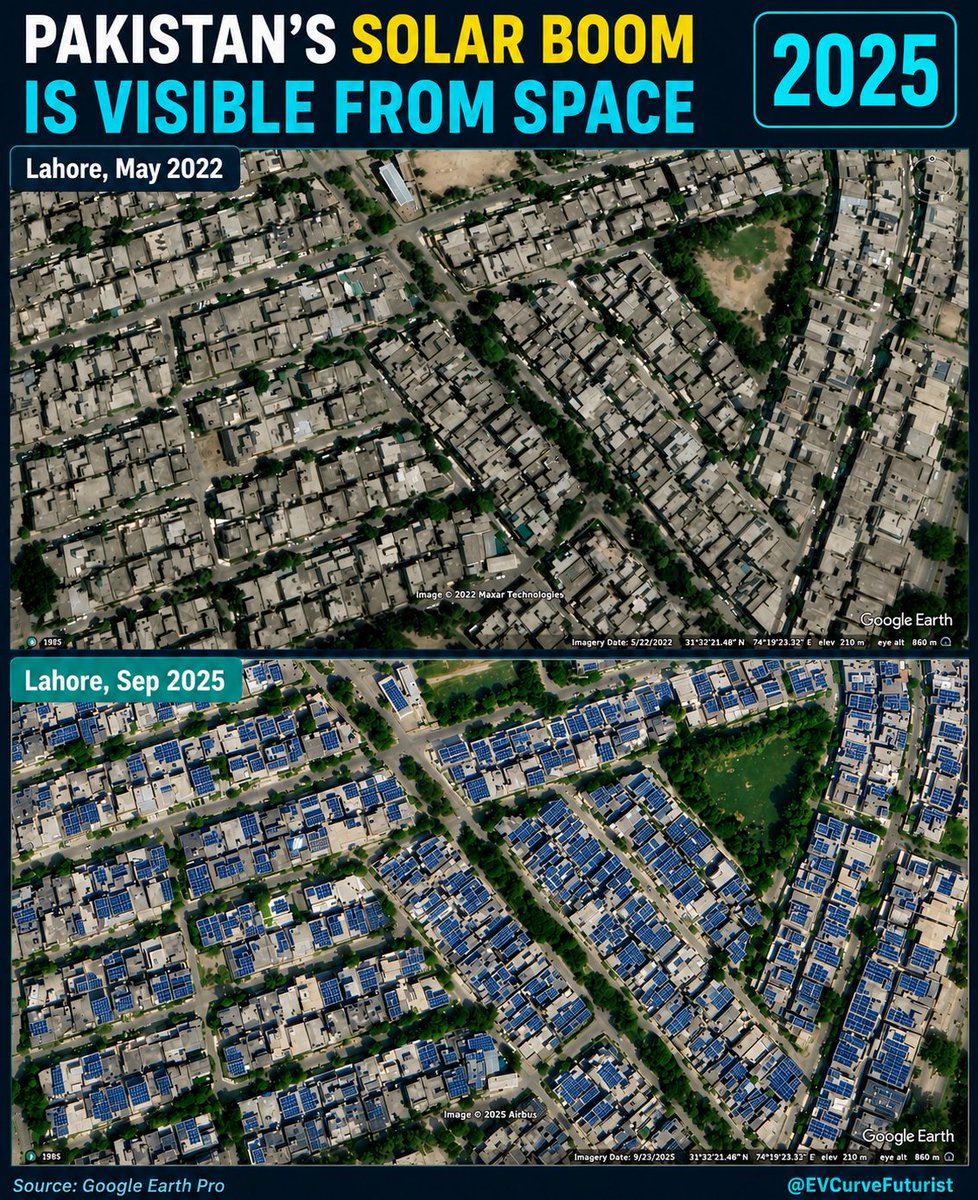
Pakistan may be accidentally building one of the world’s first decentralised #solar economies. The craziest part? Real scale barely shows in official stats. Imported 51.5 GW solar panels by late 2025—nearly = entire grid. Yet registered net-metered rooftop solar just 5.3–6.8 GW.
What makes this story so extraordinary is the speed.
In only a few years, Pakistan appears to have gone from a relatively minor solar market to potentially sourcing around a quarter of its electricity from solar once distributed generation is included.
👉 ~16.6–17 GW solar imports in 2024
👉 ~18 GW solar imports in 2025
👉 ~51.5 GW cumulative imports by late 2025
👉 Rooftop solar: ~1.3 GW → 4.1 GW in 2024
👉 ~5.3–6.8 GW registered rooftop solar in 2025
👉 24+ GW estimated behind-the-meter/off-grid
👉 Solar potentially ~25% of actual electricity use
The massive gap between imported panels and officially registered systems strongly suggests tens of gigawatts are now operating quietly on homes, farms, factories and businesses across the country.
This increasingly looks less like a normal energy transition and more like large-scale consumer-led grid defection.
And economics is driving nearly all of it.
Electricity tariffs surged. Diesel prices climbed. Blackouts remained common. Meanwhile ultra-cheap Chinese solar panels and falling battery prices made self-generation economically irresistible.
So millions effectively made the same calculation:
Generate your own power, or remain trapped inside an expensive and unstable system.
Once solar becomes cheaper than the grid itself, adoption can move faster than governments, utilities and even official statistics can keep up with.
This isn’t gradual transition by any stretch. It may ultimately become a blueprint for how energy-poor nations break free from legacy old-world energy systems dominated by fossil fuels and increasingly expensive centralised power.
It’s decentralisation at escape velocity.
This is #Bettrification.
#OPINION: Together with #Pakistan, #SaudiArabia is extinguishing the fire of fighting, helping prevent escalation, and giving advocates of peace hope, writes Prince Turki Al-Faisal https://t.co/Mnq6MgWnLT
🇵🇰 🇨🇳 ‘The Legend of Maula Jatt’ has broken into one of the most exclusive film quotas in the world — the first Pakistani film ever to do so.
In cinemas across China from May 21, 2026.
A huge moment for Pakistani cinema, and a new door opening for our stories on the world stage.
So far in April, Gwadar has handled around 11,000 standard shipping containers. For a port that handled around 8,300 containers in all of 2025 and historically has not seen more than 20 ships dock in an entire year, the current activity is unprecedented. https://t.co/sGRaRYqhre
Pakistan’s central role in Iran peace talks has given the nuclear-armed South Asian nation a new prominence, but American officials shouldn’t lose sight of a larger goal: deradicalizing Pakistani foreign policy, writes @dhume
https://t.co/j6qdIvrd5z