Bangladesh strongly condemns Israel’s plan to advance settlement construction in the E1 area of the occupied West Bank. Such actions are contrary to international law and relevant UN Security Council resolutions, and further undermine the territorial integrity of the occupied Palestinian territory and prospects for a viable two-state solution.
Bangladesh calls upon Israel to immediately halt all settlement activities in the occupied Palestinian territory and reiterates its unwavering support for the legitimate and inalienable rights of the Palestinian people, including their right to establish an independent and sovereign State of Palestine on the basis of the pre-1967 borders, with East Jerusalem as its capital.
Bangladesh urges the international community to intensify diplomatic efforts to prevent actions that undermine Palestinian statehood and to advance a just, comprehensive and lasting peace in the Middle East, based on international law and the two-state solution.
Bangladesh stands in solidarity with the people of Palestine and remains committed to supporting their legitimate aspirations for freedom, dignity, justice and statehood.
AI data centres are hungry for land, water & power.
I’m calling on every major AI company to publicly disclose the full environmental impact of its systems – as a matter of transparency
No more hidden costs.
No more shifting the burden onto those least able to bear it.
It is time to come clean.
Trevor Noah explains how monopolies, franchises, and corporate control changed the movie industry and why original films struggle today.
Watch the full conversation on Trevor Noah’s YouTube channel.
#TrevorNoah#Hollywood#Movies#Cinema
The #Bangladesh Nationalist Party did a very good job indeed of giving people the impression that it believed in reforms that would secure the structural independence of the judiciary - including measures to insulate judicial appointments from executive influence.
In all the years that these issues were discussed and demanded in Bangladesh, has a single BNP politician, ever said publicly that they did not support these reforms? Did any BNP politician ever say that they had reservations?
No, they did not.
When the interim government - among its most significant reforms - introduced legislation to give effect to these principles, did the Bangladesh Nationalist Party not give every impression that it supported it?
Yes, it did.
However, now with the party returning to power, soon after Md Asaduzzaman gets his feet under the law minister's desk, everything changes.
So it is very disappointing that the BNP government is repealing these ordinances.
This is a terrible terrible blunder by the new Bangladesh government.
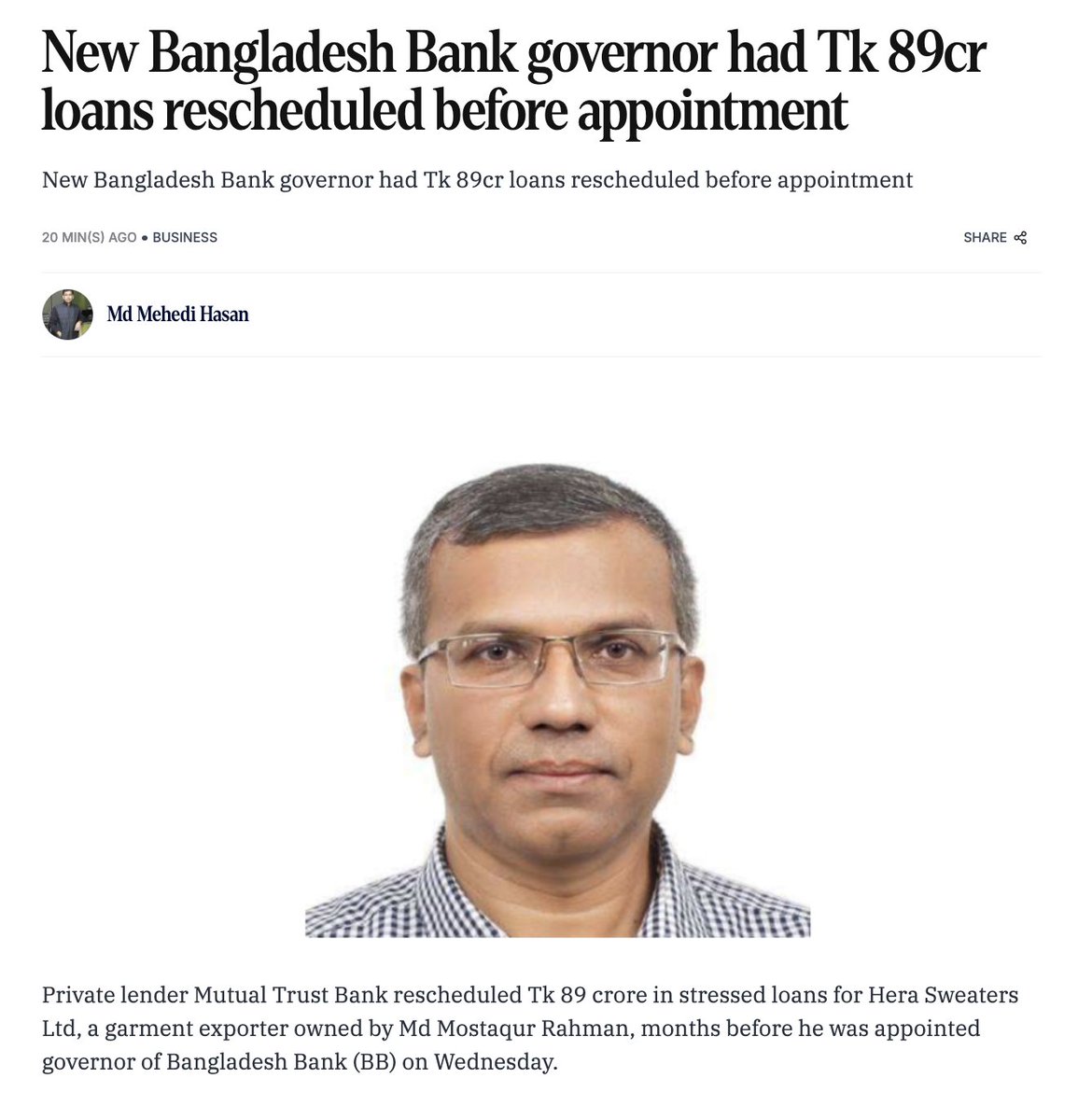
First, an industrialist as governor of the country's Central Bank.
Secondly, one with rescheduled loans.
And thirdly, someone who was a member of the governing party's election steering committee.
An end to anything like an independent Bangladesh Bank. And we are not even looking at qualifications and experience ....
(89 crore taka is just over $7 million)
https://t.co/DNmoDpnCLb
In Hatia, Noakhali, local BNP t*errorists raped a mother of three for the “crime” of voting for the Shapla Koli symbol. I strongly condemn and protest this heinous and shameful incident.
In the post-uprising Bangladesh of 2024, such a vile repetition of Awami fascist behavior is absolutely unacceptable.
So far, the role of the law enforcement agencies has been disappointing. Immediate action must be taken against these terrorists.
The BNP must take responsibility for these incidents. Effective measures must be adopted to control its leaders and activists. Otherwise, it will have to face severe consequences.
As a former international cricketer who has played in Bangladesh and in ICC events, I’m deeply disappointed by today's ICC’s inconsistency. It accepted India’s security concerns for not touring Pakistan in 2025, yet appears unwilling to apply the same understanding to Bangladesh. Consistency and fairness are the foundation of global cricket governance. Bangladesh’s players and millions of its fans deserve respect - not mixed standards. The ICC should build bridges, not burn them.
Hasnat Abdullah came live a short while ago.
He used the caption "Nineteen Eighty-Four"
I assume that through this caption, Hasnat was referring to George Orwell’s novel "1984"
In "1984" there is a warning that -
When people become afraid to speak, the state no longer needs to use force. If people can be silenced, the state system automatically becomes oppressive.
By using the caption "1984" Hasnat Abdullah may have wanted to remind us of one of Orwell’s most frightening warnings.
The message is --
Authoritarianism does not arrive suddenly.
It comes through silence, compromise, and the mindset of "let it be" Freedom does not survive on its own.
Freedom -and truth-must be protected every day.
In "1984" Orwell presents the extreme form of the elite recruitment theory. He shows how a specific group tries to keep power confined within a limited circle and attempts to keep ordinary people outside politics. Lineage or wealth is used to maintain control over political power.
This kind of politics blocks the entry of new or different ideas. It cannot tolerate new voices. Power keeps revolving within the same group, and democracy exists only in name.
"1984" is essentially a warning.
In this book, Orwell shows how a state can gradually take control over people’s freedom of speech, freedom of thought, and private life. There is a famous line in the novel-- "Big Brother is watching you"
It is this kind of state machinery and politics described by Orwell that we wanted to break free from.
In post-Hasina Bangladesh, we wanted transparent media, pro-country politics, and a system that ensures the rights of ordinary people.
Hasina took our lives, Dr. Yunus shattered our dreams, and the future may once again be entering the old darkness.
What a terrible misfortune for us.
#Bangladesh 🇧🇩: Amnesty International calls on the interim government of Bangladesh to ensure prompt, thorough, independent, and impartial investigations into the killing of youth leader Sharif Osman Hadi, and the subsequent mob violence which led to the burning of the offices Prothom Alo and Daily Star and Chhayanaut, and the harassment of New Age editor, Nurul Kabir. Furthermore, we are alarmed by the lynching of Hindu garment worker Dipu Chandra Das following allegations of blasphemy.
Amnesty International condemns the mob violence which has resulted in injuries, destruction of property, and even death. The interim government must take immediate steps to hold perpetrators of acts of violence and killings accountable in a fair trial without recourse to the death penalty.
The senior UK lawyers who have written to the #Bangladesh government about the ongoing trial proceedings against Tulip Siddiq MP for alleged corruption are absolutely right that the standards of the trial which she is facing falls well below international standards.
But the letter to the government, as quoted in the Guardian newspaper, suggests the lawyers have been misled by Siddiq.
1. No lawyer allowed
As Tulip Siddiq chose not to surrender herself to the court to face trial, she is treated in Bangladesh law as a "fugitive". And, under Bangladesh law, as a "fugitive" for this kind of case (where there is no death penalty), she has no right to choose a lawyer or even have the court appoint a lawyer to represent her.
All that happens in such a trial is that the prosecution presents the evidence and the judge makes a decision. This is common in Bangladesh.
This was the law when Siddiq's Aunt Sheikh Hasina was prime minister for 15 years. Nothing has changed.
So the claim in the letter that her lawyer, who would otherwise have represented her in court, was forced not to is a complete lie - since she is unable to have a lawyer represent her in these proceedings.
2. No house arrest
Moreover, the specific claim that her lawyer was put "under house arrest" and "forced to stand down" is total bunkum.
First, I know the lawyer whom she is referring to, and it is not true that he was "placed under house arrest". The current government or law enforcing authorities have at no time impeded this lawyer from leaving his house.
Second, in any case, as noted above, since Siddiq had no right to a lawyer in court, it does not make sense that any lawyer she instructed could have been "forced to stand down". There was nothing for any lawyer to "stand down" from, since no lawyer could have represented Siddiq at the hearing.
3. Unfair trial but ...
There is no doubt that without receiving any legal representation of any kind, the trial against Siddiq - before even considering the evidence - is pretty much a travesty of justice.
However, the way Siddiq has presented her case to the senior UK lawyers is highly inaccurate. With Tulip's past misrepresentations about her relationship with Bangladesh and the Awami League, such senior lawyers should be far more careful about believing everything that she says about herself and Bangladesh, and just repeating them. They have now allowed themselves to be part of a cycle of disinformation.
https://t.co/8AM1pmtEeT