We live, love, and die with the protagonists from our favorite novels and movies. We share in the profundity of their emotion, the idiosyncrasies of their personality, the texture of their ambition. We can identify with them so intensely that the line between our experience and their own fades away as our cognitive horizons become nearly identical.
And yet, back in the so-called “real world”, this state of mind is lost on us; as we drive to our next thing, we regard every stranger on the road as a hindrance to our own agenda. Should the person in front of us drive too slow they become guilty of a blasphemous level of incompetence.
Sipping my muddy coffee under a charcoal sky, I now watch as students disburse chaotically across campus, each of them moving to their own complex algorithm. My attention settles on a kid effortlessly coasting down the path on his longboard, snaking between swaths of brilliant jade in the form of meticulously groomed grass, and I wonder: if I was privy to the sum of information that comprises his life, if I was present for every moment, witnessed every detail, felt every storm surge then subside from within, would I still prefer myself? I mean, when you look for the reason why it is you are so self-interested, when you try to find precisely where the bias for your own point of view really lies, the only appropriate answer is *proximity*
If we could live a million different lives simultaneously, perhaps our favorite subjective experience would not be the one that constrains us now. One could theoretically fall in love with any person from the point of view of someone, somewhere.
The realization that each random passerby is living a life as deep and complex as your own is beautiful, but the fact that it must be realized means it is not the default mode of being. It reveals itself to you as you turn the page, or perhaps even in traffic, replacing your initial frustration with compassionate understanding. Still, every now and then, you catch a glimpse.
🚨JOB ALERT🚨
OPEN-RANK, tenure-track job in SOCIAL INFLUENCE.
Come be my colleague @UCLA Psychology!
Full ad 👉 https://t.co/Pb27M3pYLj
Please RT + spread!
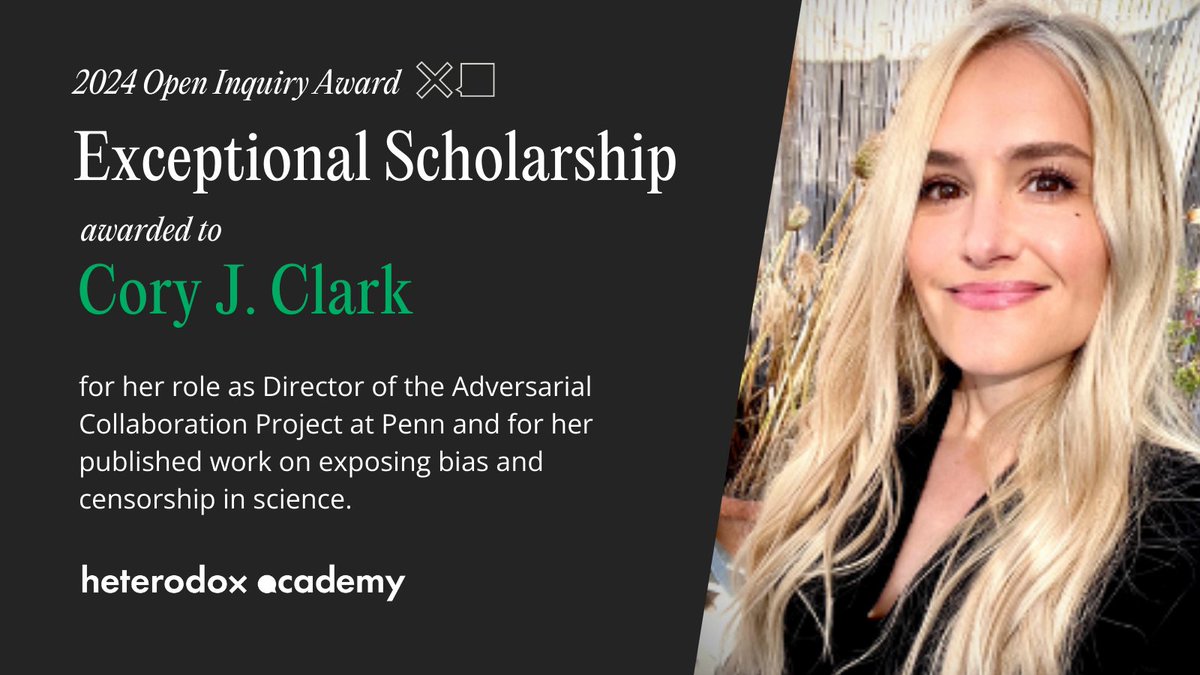
Cory J. Clark is one of our esteemed Open Inquiry Awards winners, receiving the 2024 award for Exceptional Scholarship. She is recognized for projects that expose bias and censorship in science and her leadership of the Adversarial Collaboration Project.
https://t.co/2m2UULoKCK
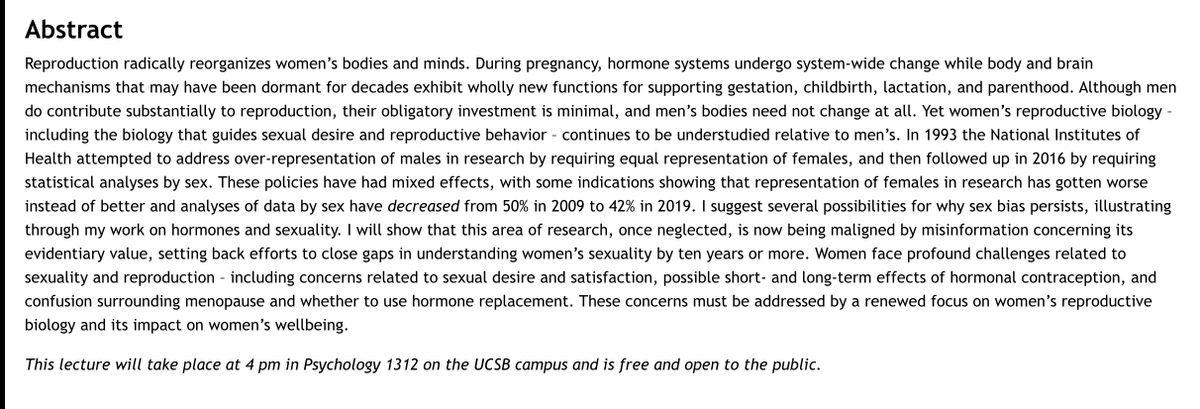
Weds! Join me at Harvard for a talk with the "Misinformation" group at the Kennedy School. Major issues in women's reproductive psychology and sexual health have been neglected or obstructed by misinformation. Eager to discuss this with a policy audience!
https://t.co/kovhS6GJEK
Excited to talk to colleagues at @sagecenterucsb
Talk title:
Hormones and Women’s Sexuality: Information Deficits, Overeager Criticism, and Misinformation – and Why Fixing It is Urgent
****This Thursday**** April 04, 2024
Location: Psychology 1312, free & public