

Top Tweets for #100DaysofWeb3

Starting to Learn Web 3 Development for the next 4 months and committing to finish it before the end of October 2026👩💻 #100DaysofWeb3

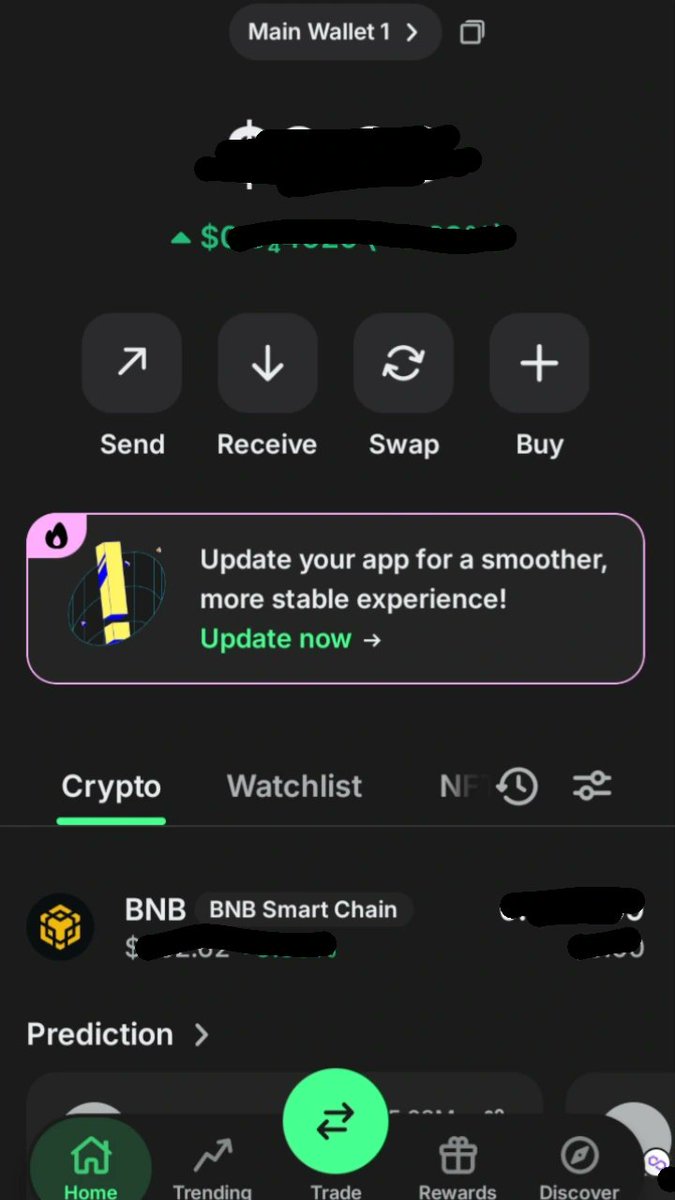
Day 3/30: Web3 wallet is live ✅
Real Trust Wallet. Real journey.
Blurred for security 🔒
Web3 Rule #1: Never show your bags 💰
Your keys, your crypto 🔑
Building in public from zero.
Day 4: Free NFT claim tomorrow 🚀
#Web3 #Crypto #BuildInPublic #100DaysOfWeb3

What is "The Genesis"?📜
Our Robinhood Testnet ecosystem hides a secret Lore of 10 elements.
Execute > DECRYPT GENESIS ARCHIVE on the portal to trigger a terminal decryption sequence💻✨
WHY KAMI (100)? TERRA (2M)?👇
https://t.co/hk2Cy9L2Bt
#Web3 #GameFi #100DaysOfWeb3 #dApps


🧵Day 12: Layer 1 vs Layer2
Ever wonder why people still use chains like Ethereum despite it being expensive and slow, well it is because there are chains built on them to make it faster, still don’t get it? I will explain
#100DaysOfWeb3 #LearningInPublic #Web3Africa


Day 11/100 [ #100DaysOfWeb3 ]
Cryptocurrency
If you’ve been following my tweets since day one, you’ve probably noticed I say the word “crypto” a lot. So the real question is: what exactly is cryptocurrency?
Cryptocurrency is simply digital money. Unlike cash, it doesn’t exist as physical coins or paper notes. It lives entirely online.
But there’s a big difference between crypto and the money in your bank. Most traditional money is controlled by governments and banks, while many cryptocurrencies operate on decentralized networks, meaning no single authority controls them.
Crypto runs on something called the blockchain. A blockchain is like a shared digital record book that tracks transactions across many computers. This system makes transactions secure, transparent, and very difficult to change once they’re recorded.
The word crypto comes from cryptography, which is a method of securing information using advanced mathematics. This technology helps protect your funds and verify transactions on the network.
What makes cryptocurrency unique is that it’s global, digital, and often decentralized. A big shift from how traditional money systems work.
For example:
📌 Bitcoin is often called digital gold because many people use it as a store of value.
📌 Ethereum allows developers to build apps and smart contracts on its network.
📌 Solana is known for fast transactions and low fees.
People use crypto in many different ways. Sending payments, trading assets, collecting NFTs, using DeFi platforms and even playing blockchain games.
Pretty interesting, right? So the next time someone asks you what cryptocurrency is, you’ll know exactly how to explain it.
Catch you in the next one..
![whxspope's tweet photo. Day 11/100 [ #100DaysOfWeb3 ]
Cryptocurrency
If you’ve been following my tweets since day one, you’ve probably noticed I say the word “crypto” a lot. So the real question is: what exactly is cryptocurrency?
Cryptocurrency is simply digital money. Unlike cash, it doesn’t exist as physical coins or paper notes. It lives entirely online.
But there’s a big difference between crypto and the money in your bank. Most traditional money is controlled by governments and banks, while many cryptocurrencies operate on decentralized networks, meaning no single authority controls them.
Crypto runs on something called the blockchain. A blockchain is like a shared digital record book that tracks transactions across many computers. This system makes transactions secure, transparent, and very difficult to change once they’re recorded.
The word crypto comes from cryptography, which is a method of securing information using advanced mathematics. This technology helps protect your funds and verify transactions on the network.
What makes cryptocurrency unique is that it’s global, digital, and often decentralized. A big shift from how traditional money systems work.
For example:
📌 Bitcoin is often called digital gold because many people use it as a store of value.
📌 Ethereum allows developers to build apps and smart contracts on its network.
📌 Solana is known for fast transactions and low fees.
People use crypto in many different ways. Sending payments, trading assets, collecting NFTs, using DeFi platforms and even playing blockchain games.
Pretty interesting, right? So the next time someone asks you what cryptocurrency is, you’ll know exactly how to explain it.
Catch you in the next one..](https://pbs.twimg.com/media/HCpNO5WXsAAn1cA.jpg)
Day 10/100 [ #100DaysOfWeb3 ]
Choosing the Right Crypto Wallet
Now that you understand what crypto wallets are and how they work, let’s talk about the popular ones you’ll actually use.
Not all wallets work the same way. Most wallets are built to work best with specific blockchains. For example, Ethereum wallets handle Ethereum-based transactions, Solana wallets are made for Solana, and so on. Choosing the right wallet helps your crypto move smoothly and safely.
@MetaMask is one of the most popular wallets for Ethereum and EVM-compatible blockchains like @base, @BNBCHAIN, @arbitrum, @Lisk, and others. You can use it as a browser extension or a mobile app. It’s great for connecting to decentralized apps like DeFi platforms, NFT marketplaces, blockchain games and the metaverse.
For @solana, most people use @phantom or @solflare. These wallets are fast, simple, and make sending SOL, buying NFTs, and using Solana apps feel easy. Phantom is also becoming a multi-chain wallet, while Solflare is a solid choice if you’re interested in staking on Solana.
If you’re using Avalanche, Core Wallet is a popular option. For @SuiNetwork, @SlushWallet is designed specifically for that ecosystem. Both allow you to store, send, and interact with tokens on their blockchains securely.
Then there’s @TrustWallet which supports many different blockchains in one app. It’s a good choice if you want a simple, all-in-one wallet without switching between multiple apps.
These are just a few of the popular wallets out there. The best wallet isn’t about hype but the one that matches the blockchain you’re using and what you want to do.
Catch you in the next one.
![whxspope's tweet photo. Day 10/100 [ #100DaysOfWeb3 ]
Choosing the Right Crypto Wallet
Now that you understand what crypto wallets are and how they work, let’s talk about the popular ones you’ll actually use.
Not all wallets work the same way. Most wallets are built to work best with specific blockchains. For example, Ethereum wallets handle Ethereum-based transactions, Solana wallets are made for Solana, and so on. Choosing the right wallet helps your crypto move smoothly and safely.
@MetaMask is one of the most popular wallets for Ethereum and EVM-compatible blockchains like @base, @BNBCHAIN, @arbitrum, @Lisk, and others. You can use it as a browser extension or a mobile app. It’s great for connecting to decentralized apps like DeFi platforms, NFT marketplaces, blockchain games and the metaverse.
For @solana, most people use @phantom or @solflare. These wallets are fast, simple, and make sending SOL, buying NFTs, and using Solana apps feel easy. Phantom is also becoming a multi-chain wallet, while Solflare is a solid choice if you’re interested in staking on Solana.
If you’re using Avalanche, Core Wallet is a popular option. For @SuiNetwork, @SlushWallet is designed specifically for that ecosystem. Both allow you to store, send, and interact with tokens on their blockchains securely.
Then there’s @TrustWallet which supports many different blockchains in one app. It’s a good choice if you want a simple, all-in-one wallet without switching between multiple apps.
These are just a few of the popular wallets out there. The best wallet isn’t about hype but the one that matches the blockchain you’re using and what you want to do.
Catch you in the next one.](https://pbs.twimg.com/media/HAJOuC7XEAAdHji.jpg)

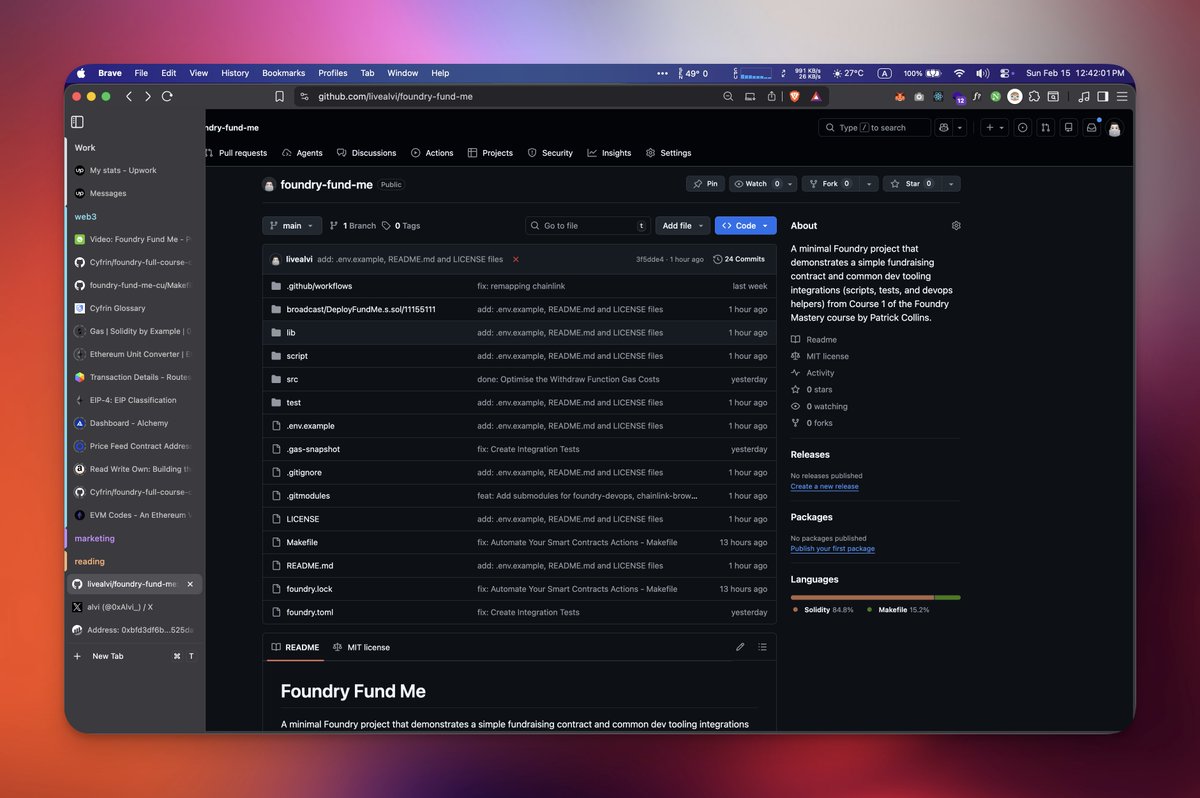
Day 5
- I’ve published a smart contract repo: Foundry Fund Me, built using @solidity_lang, @paradigm’s Foundry,
@chainlink, and @Alchemy, and special thanks to @PatrickAlphaC 🥂
- Let’s connect, #Builders 🏗️
#web3 #BuildInPublic #100DaysOfWeb3 #LearningInPublic #Web3Journey


Day 2 – Feb 12, 2026
- Watched 2 lessons from @CyfrinUpdraft
(Foundry Fundamentals)
- Read 6 pages from Atomic Habitats
#web3 #BuildInPublic #100DaysOfWeb3 #LearningInPublic #Web3Journey
Day 1 – Feb 11, 2026
- Watched 4 lessons from @CyfrinUpdraft (Foundry Fundamentals)
- Explored a few open-source projects
#web3 #BuildInPublic #100DaysOfWeb3 #LearningInPublic #Web3Journey

Day 02/100
Deep dive into the essentials.
✅ Wallet Architecture & Types
✅ Public vs. Private Keys (Security hygiene)
✅ Creating & Broadcasting Transactions
✅ Understanding Gas & Fees
Laying the foundation before writing Solidity.
#100DaysOfWeb3 #Crypto #DevCommunity

Day 9/100 [ #100DaysOfWeb3 ]
Public and Private keys
You might think that just having crypto in your wallet means you truly own it, but ownership in crypto goes a bit deeper than that. Let’s break it down.
Every crypto wallet is built around two important keys: a public key and a private key.
Think of it this way:
📌Your public key is like your home address. Anyone can know it and use it to send you something.
📌Your private key is like your house key. Only the person holding it can open the door.
These two keys are what power every crypto wallet. The wallet app you use is just the screen you see, the keys are what actually control your crypto.
Your public key helps create your wallet address, which is the long mix of letters and numbers people use to send you crypto. It’s safe to share. Some blockchains even let you use easy-to-read names like pope.base.eth instead of a long address. Think of it as a nickname that still points to your real wallet.
Your private key, however, is the most important part. It proves ownership and authorizes transactions.
‼️Never share it with anyone‼️
Anyone who has your private key has full access to your crypto.
If you lose your private key, you lose your crypto forever.
If someone else gets it, they can take everything and there’s no customer support to reverse it.
When you create a wallet, you’re also given a seed phrase. This is a human-readable backup of your private key. If you lose your phone or computer, the seed phrase is how you recover your wallet. ‼️The same rule applies: never share it with anyone‼️
In crypto, owning your keys means owning your crypto.
Catch you in the next one…
![whxspope's tweet photo. Day 9/100 [ #100DaysOfWeb3 ]
Public and Private keys
You might think that just having crypto in your wallet means you truly own it, but ownership in crypto goes a bit deeper than that. Let’s break it down.
Every crypto wallet is built around two important keys: a public key and a private key.
Think of it this way:
📌Your public key is like your home address. Anyone can know it and use it to send you something.
📌Your private key is like your house key. Only the person holding it can open the door.
These two keys are what power every crypto wallet. The wallet app you use is just the screen you see, the keys are what actually control your crypto.
Your public key helps create your wallet address, which is the long mix of letters and numbers people use to send you crypto. It’s safe to share. Some blockchains even let you use easy-to-read names like pope.base.eth instead of a long address. Think of it as a nickname that still points to your real wallet.
Your private key, however, is the most important part. It proves ownership and authorizes transactions.
‼️Never share it with anyone‼️
Anyone who has your private key has full access to your crypto.
If you lose your private key, you lose your crypto forever.
If someone else gets it, they can take everything and there’s no customer support to reverse it.
When you create a wallet, you’re also given a seed phrase. This is a human-readable backup of your private key. If you lose your phone or computer, the seed phrase is how you recover your wallet. ‼️The same rule applies: never share it with anyone‼️
In crypto, owning your keys means owning your crypto.
Catch you in the next one…](https://pbs.twimg.com/media/G_Bizd2XAAAt-j_.jpg)
Day 8/100 [ #100DaysOfWeb3 ]
Types of Crypto Wallets
Crypto wallets come in different types, and each one is designed for a specific purpose.
📌 Hot wallets / Software wallets
Hot wallets are wallets that are connected to the internet. They live on your phone or computer and are great for everyday use. Because they’re easy to access, they’re commonly used for sending, receiving, and interacting with apps in Web3. Examples include mobile and browser wallets like trust wallet, phantom, metamask. The trade-off is that being online means they require extra care with security.
📌 Cold wallets / Hardware wallets
Cold wallets are not connected to the internet. They are usually physical devices that store your crypto offline, making them much harder to hack. These are best for long-term storage or holding larger amounts of crypto that you don’t plan to use often. They are considered one of the safest ways to store crypto. Examples are Ledger and Trezor hardware wallets.
📌 Custodial wallets
Custodial wallets are wallets where someone else controls your crypto for you. Exchanges like Binance and Bybit are the most common example. They’re easy to use but you’re trusting the platform to keep your funds safe since you don’t control the private keys.
📌 Non-custodial wallets
Non-custodial wallets give you full control. You own the private keys, which means you alone control your funds. No one can freeze or access your crypto without your permission. This comes with more responsibility, especially when it comes to keeping your recovery phrase safe. If you loose your private keys you loose access to your funds. Examples are Trust wallet, Phantom, Metamask..
Hot wallets prioritize convenience, while cold wallets prioritize security. The right choice depends on how often you use your crypto and how much you’re holding.
Custodial wallet gives control of your money to exchanges, similar to how traditional banks work. Non-custodial wallets gives you complete ownership and control of your money.
![whxspope's tweet photo. Day 8/100 [ #100DaysOfWeb3 ]
Types of Crypto Wallets
Crypto wallets come in different types, and each one is designed for a specific purpose.
📌 Hot wallets / Software wallets
Hot wallets are wallets that are connected to the internet. They live on your phone or computer and are great for everyday use. Because they’re easy to access, they’re commonly used for sending, receiving, and interacting with apps in Web3. Examples include mobile and browser wallets like trust wallet, phantom, metamask. The trade-off is that being online means they require extra care with security.
📌 Cold wallets / Hardware wallets
Cold wallets are not connected to the internet. They are usually physical devices that store your crypto offline, making them much harder to hack. These are best for long-term storage or holding larger amounts of crypto that you don’t plan to use often. They are considered one of the safest ways to store crypto. Examples are Ledger and Trezor hardware wallets.
📌 Custodial wallets
Custodial wallets are wallets where someone else controls your crypto for you. Exchanges like Binance and Bybit are the most common example. They’re easy to use but you’re trusting the platform to keep your funds safe since you don’t control the private keys.
📌 Non-custodial wallets
Non-custodial wallets give you full control. You own the private keys, which means you alone control your funds. No one can freeze or access your crypto without your permission. This comes with more responsibility, especially when it comes to keeping your recovery phrase safe. If you loose your private keys you loose access to your funds. Examples are Trust wallet, Phantom, Metamask..
Hot wallets prioritize convenience, while cold wallets prioritize security. The right choice depends on how often you use your crypto and how much you’re holding.
Custodial wallet gives control of your money to exchanges, similar to how traditional banks work. Non-custodial wallets gives you complete ownership and control of your money.](https://pbs.twimg.com/media/G-nuvJZbUAAACNv.jpg)

Day 1/100 Web3 learning.
Hashing is one-way, encryption is reversible.
Symmetric vs asymmetric keys.
Public key is shareable, private key is secret.
Encodings: ASCII, Hex, Base64, Base58.
Learning step by step.
#Web3 #CryptoNews #Blockchain #100DaysOfWeb3 #buildinpublic

Day 100 of #100DaysOfWeb3
Mining Cont’d
Risks & Red Flags
Mining & earning in Web3 can be exciting… but scams are everywhere (billions lost every year!).
Biggest red flags to watch out for:
- "Guaranteed" high returns (like 5–10% daily) → Almost always a scam!
- Fake cloud mining sites → Pretty dashboards but you can’t withdraw
- Apps that ask for your seed phrase or upfront payment to "unlock" rewards
- Anonymous teams + pressure to join fast or recruit friends (Ponzi vibes)
- Promises of free mobile mining with no real work → Usually just steals data
Safe habits:
- Do your own research (DYOR) — check real reviews & community
- Never share your private keys/seed phrase
- Start with tiny amounts on trusted platforms
- If it sounds too good to be true… it probably is!
Day 99 of #100DaysOfWeb3
How to Participate, From Super Easy to Advanced
Mining levels are like video game difficulty, pick what fits your time & budget!
Beginner (Low effort, low cost):
- Staking → Just hold & lock coins in a wallet/app
- DePIN → Download an app, share WiFi or storage (some start for $0!)
- Cloud/stake-to-mine → Rent power or stake to get mining rewards (no hardware)
Intermediate:
- GPU mining → Use your gaming PC for coins like Ravencoin or Ethereum Classic
Advanced (High effort & money):
- Buy ASIC machines → Mine Bitcoin or Litecoin/Dogecoin (needs cheap electricity & space)
Quick tip: Start small! Try staking or a free DePIN app first, no risk of burning your PC 😅
What level are you at right now? Beginner or ready to level up?
Day 99 of #100DaysOfWeb3
How to Participate, From Super Easy to Advanced
Mining levels are like video game difficulty, pick what fits your time & budget!
Beginner (Low effort, low cost):
- Staking → Just hold & lock coins in a wallet/app
- DePIN → Download an app, share WiFi or storage (some start for $0!)
- Cloud/stake-to-mine → Rent power or stake to get mining rewards (no hardware)
Intermediate:
- GPU mining → Use your gaming PC for coins like Ravencoin or Ethereum Classic
Advanced (High effort & money):
- Buy ASIC machines → Mine Bitcoin or Litecoin/Dogecoin (needs cheap electricity & space)
Quick tip: Start small! Try staking or a free DePIN app first, no risk of burning your PC 😅
What level are you at right now? Beginner or ready to level up?
Day 98 of #100DaysOfWeb3
The Main Types of Mining in Web3 (2026 Edition)
Let’s keep it super simple — here are the 4 biggest ways people "mine" or earn in Web3 right now:
1. Classic PoW Mining
Using computers to solve puzzles → Earn new coins
Examples: Bitcoin (needs expensive machines), Kaspa or Ravencoin (can use normal GPUs)
2. Staking (Proof-of-Stake)
Lock up your coins to help secure the network → Earn rewards
Super easy — no machines needed! (Most popular on Ethereum & many new chains)
3. Liquidity Mining / Yield Farming
Put your crypto in DeFi pools (like lending pools) → Earn extra tokens
Like putting money in a savings account that pays you bonuses
4. DePIN Mining (The hot new trend!)
Share real-world stuff with the network → Get paid
Examples: Share your WiFi (Helium), extra storage, or even your phone’s sensors
Which one sounds most interesting to you ? Let me know in the comments.
Day 8/100 [ #100DaysOfWeb3 ]
Types of Crypto Wallets
Crypto wallets come in different types, and each one is designed for a specific purpose.
📌 Hot wallets / Software wallets
Hot wallets are wallets that are connected to the internet. They live on your phone or computer and are great for everyday use. Because they’re easy to access, they’re commonly used for sending, receiving, and interacting with apps in Web3. Examples include mobile and browser wallets like trust wallet, phantom, metamask. The trade-off is that being online means they require extra care with security.
📌 Cold wallets / Hardware wallets
Cold wallets are not connected to the internet. They are usually physical devices that store your crypto offline, making them much harder to hack. These are best for long-term storage or holding larger amounts of crypto that you don’t plan to use often. They are considered one of the safest ways to store crypto. Examples are Ledger and Trezor hardware wallets.
📌 Custodial wallets
Custodial wallets are wallets where someone else controls your crypto for you. Exchanges like Binance and Bybit are the most common example. They’re easy to use but you’re trusting the platform to keep your funds safe since you don’t control the private keys.
📌 Non-custodial wallets
Non-custodial wallets give you full control. You own the private keys, which means you alone control your funds. No one can freeze or access your crypto without your permission. This comes with more responsibility, especially when it comes to keeping your recovery phrase safe. If you loose your private keys you loose access to your funds. Examples are Trust wallet, Phantom, Metamask..
Hot wallets prioritize convenience, while cold wallets prioritize security. The right choice depends on how often you use your crypto and how much you’re holding.
Custodial wallet gives control of your money to exchanges, similar to how traditional banks work. Non-custodial wallets gives you complete ownership and control of your money.
Day 8/100 [ #100DaysOfWeb3 ]
Crypto Wallets
Today, let’s talk about wallets but not the kind you carry in your pocket. We’re talking about crypto wallets.
A crypto wallet is a tool that allows you to store, send, and receive cryptocurrency. Think of it as your personal gateway to your digital money. Unlike a physical wallet, it exists on your phone, computer or a special hardware device.
You can choose to keep your crypto on an exchange, but in that case, the exchange is holding it for you. With a crypto wallet, you are in direct control of your funds. No middlemen and no waiting for approval.
Your wallet helps you keep your crypto secure, send and receive funds, check your balance, and view your transaction history. Simply put, it’s your entry point into the crypto world.
Every wallet comes with a unique address, similar to a bank account number. When someone sends you crypto, it goes straight to that address and appears in your wallet.
So the next time someone says, “I’m sending you crypto,” you’ll know exactly where it goes.
Catch you in the next one, where we’ll talk about the different types of crypto wallets.
![whxspope's tweet photo. Day 8/100 [ #100DaysOfWeb3 ]
Crypto Wallets
Today, let’s talk about wallets but not the kind you carry in your pocket. We’re talking about crypto wallets.
A crypto wallet is a tool that allows you to store, send, and receive cryptocurrency. Think of it as your personal gateway to your digital money. Unlike a physical wallet, it exists on your phone, computer or a special hardware device.
You can choose to keep your crypto on an exchange, but in that case, the exchange is holding it for you. With a crypto wallet, you are in direct control of your funds. No middlemen and no waiting for approval.
Your wallet helps you keep your crypto secure, send and receive funds, check your balance, and view your transaction history. Simply put, it’s your entry point into the crypto world.
Every wallet comes with a unique address, similar to a bank account number. When someone sends you crypto, it goes straight to that address and appears in your wallet.
So the next time someone says, “I’m sending you crypto,” you’ll know exactly where it goes.
Catch you in the next one, where we’ll talk about the different types of crypto wallets.](https://pbs.twimg.com/media/G-dZz9zXcAAVGoF.jpg)
Day 97 of #100DaysOfWeb3
What is Mining in Web3? (The Basics + How It Changed)
Mining used to mean one main thing: using powerful computers to solve hard math puzzles and earn crypto rewards. This is called Proof-of-Work (PoW) like Bitcoin still uses today.
But in 2026, "mining" means much more, It now includes any way you help a decentralized network and get paid for it even without big computers.
Simple examples today:
- Classic mining → Bitcoin, Litecoin, Kaspa (using special machines or your PC)
- New ways → Staking coins, sharing your internet/WiFi, or providing storage
Key point: Mining evolved from "heavy electricity + machines" → "easy ways anyone can join"
Tomorrow we look at the main types.
Day 8/100 [ #100DaysOfWeb3 ]
Crypto Wallets
Today, let’s talk about wallets but not the kind you carry in your pocket. We’re talking about crypto wallets.
A crypto wallet is a tool that allows you to store, send, and receive cryptocurrency. Think of it as your personal gateway to your digital money. Unlike a physical wallet, it exists on your phone, computer or a special hardware device.
You can choose to keep your crypto on an exchange, but in that case, the exchange is holding it for you. With a crypto wallet, you are in direct control of your funds. No middlemen and no waiting for approval.
Your wallet helps you keep your crypto secure, send and receive funds, check your balance, and view your transaction history. Simply put, it’s your entry point into the crypto world.
Every wallet comes with a unique address, similar to a bank account number. When someone sends you crypto, it goes straight to that address and appears in your wallet.
So the next time someone says, “I’m sending you crypto,” you’ll know exactly where it goes.
Catch you in the next one, where we’ll talk about the different types of crypto wallets.
Day 7/100 [ #100DaysOfWeb3 ]
Modern Staking
Staking today has evolved beyond just one method. Modern staking now comes in a few different forms, each designed for different needs.
📌 Native staking
This is the most basic form of staking. You stake a blockchain’s own token like ETH, SOL, BNB, or ADA directly on the network. By locking up your tokens, you help secure the blockchain and earn rewards in return. This is staking in its simplest form.
📌 Delegated staking
In delegated staking, you don’t run the system yourself. Instead, you delegate your tokens to a validator who does the work on your behalf. Blockchains like Cosmos and Polkadot use this model. You still own your tokens, the validator helps secure the network, and you both share the rewards.
📌 Liquid staking
Liquid staking lets you stake your crypto without locking it up completely. When you stake through platforms like Lido or Rocket Pool, you receive a new token that represents your staked crypto. You can use that token to trade, lend, or use in DeFi while still earning staking rewards at the same time.
📌 Restaking
Restaking is a newer idea. It allows you to reuse your already staked crypto to help secure other networks or services. Platforms like EigenLayer make this possible. In return for taking on more responsibility and risk, you can earn additional rewards.
Modern staking gives you more options. Whether you want simplicity, passive income, flexibility, or higher returns while still helping secure Web3 networks.
Day 96 of #100DaysOfWeb3
Mining in Web3
Mining, a popular concept in Web3, used to refer to solving complex math problems but now it has evolved beyond that. Over the last few days of the #100Days challenge, I’ll be exploring what mining is, its types, participation levels as well as its risks and red flags.
Day 95 of #100DaysOfWeb3
Most popular blockchains in Nigeria and products built on them PART 1
1. Base blockchain @base
@baseapp - Web3 social media.
@useazza - WhatsApp offramping chatbot.
@aboki - Easy offramping platform
@Paycrypt_org1 - direct cryptocurrency to utilities app.
Day 94 of #100DaysOfWeb3
Whoa! Almost forgot this.
AI , Cryptocurrency, decentralization are new innovations that make up web3.
—-
Nothing much but I showed up.
Last Seen Hashtags on Sotwe
Teenagegirls()
Seen from Norway
سالب_جدة
Seen from Saudi Arabia
ProstitutaVip
Seen from Argentina
สมุทรปราการ
Seen from Thailand
دنيا_سمراني
上海
Seen from Japan
பகுத்தறிவு_பகலவன்_பெரியார்
Seen from United States
incestoreal
Seen from Ecuador
NOlimit filter:videos
Seen from Turkey
bcafc
Seen from United Kingdom
Most Popular Users

Elon Musk 
@elonmusk
240.2M followers

Barack Obama
@barackobama
119.3M followers

Donald J. Trump
@realdonaldtrump
111.6M followers

Cristiano Ronaldo
@cristiano
109M followers

Narendra Modi
@narendramodi
107M followers

Rihanna
@rihanna
97.3M followers

NASA
@nasa
92.1M followers

Justin Bieber
@justinbieber
90.6M followers

KATY PERRY
@katyperry
86.8M followers

Taylor Swift
@taylorswift13
80.6M followers

Lady Gaga
@ladygaga
72.2M followers

Kim Kardashian
@kimkardashian
69.4M followers

YouTube
@youtube
68.6M followers

Virat Kohli
@imvkohli
68.6M followers

Bill Gates
@billgates
63.4M followers

The Ellen Show
@theellenshow
62.5M followers

CNN
@cnn
61.9M followers

Neymar Jr
@neymarjr
61.1M followers

X
@x
60.9M followers

Selena Gomez
@selenagomez
59.9M followers