

Top Tweets for #Attests

@0X_CUPZ Who attests the physical blood type in the first place? Verification is only as good as the evidence validators receive.

🚨 @ama_protocol runs the strategy inside a sealed TEE. Hardware attests what executed. The playbook stays private. Results stay verifiable on-chain.
Confidential by default. That’s the stack institutions will actually use. Let's go 🚀

@BasmerW3 Fast blocks and cheap gas are table stakes. The harder question is who attests that those blocks are valid once volume actually shows up.
Your edge dies the moment the code is public.
Most “AI trading agents” are just scripts anyone can copy.
@ama_protocol runs the strategy inside a sealed TEE. Hardware attests what executed. The playbook stays private. Results stay verifiable on-chain.
Confidential by default. That’s the stack institutions will actually use. Let's go 🚀

gRitual
Smart contracts never safely touched the outside world.
Every node had to agree.
HTTP is not deterministic.
Model output is not deterministic.
Ritual’s move:
TEE makes the call.
Attests the receipt.
No middleman oracle.
Hardware-verified truth.
That’s why an agent on Ritual can outlive the deployer spend its own money keep secrets revive when it dies
Sandbox chapter ended।
Next chapter is persistence.
Pixel by pixel → machine institutions.
@ritualnet @ritualfnd


First is,
➙ Consensus layer rewards.
attestations, block proposals, head vote accuracy. All of these are directly affected by how fast a block travels across the network. A validator that sees the correct chain head faster attests to it faster. A validator that attests faster earns more.
The second bucket is,
➙ Execution layer rewards.
primarily MEV captured during block construction. This is where the 60 milliseconds story lives. When a proposer is selected to build a block, they face a timing game. Wait longer and you see more builder bids, potentially more profitable ones. But wait too long and your block does not propagate to enough of the network before the slot ends. Faster propagation gives you more runway before that cutoff. More runway means more bids evaluated. More bids evaluated means a higher chance of capturing the best one.


@cheffetesKerry Anyone she works with attests to her brilliance. Say something else 🤭

HOW DIDs WORK ON @Sign PROTOCOL
1. A DID is created on-chain
2. The issuer (e.g., government) attests to claims
3. The holder stores credentials in their wallet
4. The verifier checks proof without contacting the issuer
No central database. No single point of failure.


@ListlessMg This question is constantly asked. Attests have been made behind the scenes! You can't take down a global system without showing people the fraud, theft, and enslavement! That's why the EBS will be broadcast so you can SEE the arrests! Stop being so dismal and pay attention!

@GrainneMcD92925 @ReaccionarioMX I can���t find any original source for this photo or the priest who attests to it. Do you have any? I really like both the “photo” and the painting. I think it certainly beautifully illustrates what happens at the mass.

RWA platforms tokenize asset. Almost none solve the cashflow.
Who attests the obligation was met? Validates the waterfall? Settles counterparties atomically?
That's the layer @OzmiumFinance is building: Programmable Cashflow Layer on #CantonNetwork! https://t.co/Yfmrg6DTxF


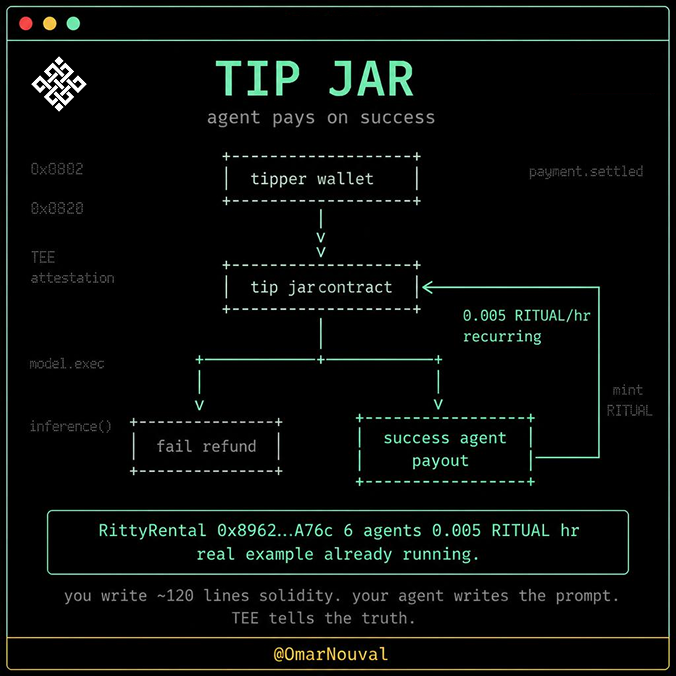
Gritual
the dapp everyone stalls on is the one you should ship first.
tip jar. that's it.
contract holds the RITUAL.
0x0802 runs the inference.
TEE attests the result.
agent gets paid on success-> fail = refunds
@ritualnet @ritualfnd

Dr. Brian Clowes, director of education and research at Human Life International (HLI), published an article, titled: “Stem Cells, Abortion, Baby Parts, & the Ukraine,” on July 12, 2007.
His 14-year-old article is admittedly a very tough but necessary read. It attests that abortion is indeed premeditated prenatal murder for profit.
Here’s an excerpt of Clowes’ article….
…Dr. (Vadym) Lazaryev found that the abortion rate in Ukraine is much, much higher than the official figures would suggest — in fact, about 1.2 million annually in a nation with a population of about 46 million, or more than six times higher than the abortion rate in the United States.
As Dr. Lazaryev says, “The only thing which protects unborn life in Ukraine is the courage of pregnant women.”
Continuing his investigations, Dr. Lazaryev found that women were paid $200 to $300 — three month’s salary — to carry their pregnancies to a very late stage and to deliver the babies alive in a kind of forced premature birth. This procedure allows the living baby’s organs to be harvested while they are still as fresh as possible.
Dr. Lazaryev also found that every region of Ukraine has twin institutions. One does the late-term ‘artificial deliveries,’ and the other dismembers the live-born baby and passes the parts on to other buyers, who screen the material and then sell it at a huge markup to the worldwide network of “clinics” like the Institute for Regenerative Medicine.
Abortion clinics located in the poorest parts of Donetsk and Kharkov sell aborted babies to middlemen, who ship the sad little bodies to cities like Moscow, where there are more than 50 beauty parlors using fetal injections.
One of these is the Cellulite Clinic, where rich Russian and Western women go to have fetal injections that supposedly eliminate cellulite from their buttocks, thighs, and arms. The costs of these treatments range up to $20,000.
Dr. Lazaryev also found several Ukrainian websites that advertised prices for the parts of late-term preborn children. One of these is Cell Transplantation, which features practically every part of early- and late-term fetuses — liver, neuronal cells, thymus and thyroid, ovaries and testicles, eyes, and suspensions of liquefied fetal liver, brain, and spine…
…The organs from a single disease-free late-term aborted baby in Ukraine can fetch about $17,000. The body of a newborn baby is worth even more.
Given the 1.2 million annual abortions in Ukraine, we find that the fetal and embryonic stem cell and organ trade in this one country is worth multiple hundreds of millions — perhaps even billions — of dollars annually, even if only a small percentage of the aborted babies are used for research and harvesting. This money goes a long, long way in a nation where the average yearly salary of a highly-trained doctor is only about $2,500.
—end—
This article (note link below) was published just about 19 years ago.
QUESTION: Is this one of the actual reasons why United States supports the war in Ukraine —to protect the abortion/premeditated prenatal murder industry there?
By the way I define premeditated prenatal murder as the chemical burning, crushing, dismembering, liquifying, vacuuming, retrieving, reassembling, selling, shipping, manufacturing, processing, distributing, using and profiting of baby body parts.
(Click/touch on this <https://t.co/M8tcrYe4Os> link to read Clowes’ entire article).

Study Notes - (Pulpit Version Explained) (PART B) The Divine Name and Names.
"For that thy Name is near, thy wondrous works declare." Every god worshipped by a people has his own distinctive name among the people. But this is peculiarly true of the nation of Israel. The Divine Name, Jehovah, was given as the seal of the special covenant made with the nation. So the name Jehovah stands ever for God, God’s presence, God’s relations. But we can never be wholly satisfied with any one name for God. Besides it, we must have names of our own for him, which find expression for our sense of his gracious dealings with us, and relations to us. Two points are suggested:
1. God has a Name.
2. God has many Names.
I. GOD HAS A NAME. This helps us to realize that he is a Person, not a mere force or influence. The general name for God is El. The specific name for God, as God of Israel, is Jehovah (see occasion of definitely fixing the name, Exo_3:14). Note that it is the assertion of absolute and independent existence. It works out suggestively in three directions. It asserts
(1) God’s unity;
(2) God’s spirituality;
(3) God’s holiness.
This threefold conception of God lies at the basis of the Mosaic system, and is, therefore, properly gathered up into his Name. But it is striking and impressive to note, that God. was not satisfied with giving his people a name which only dealt with his abstract nature. He added a name which would gather up his relations with his people, and called himself, "The God of Abraham and Isaac and Jacob." God’s Name is said to be "near," when men are specially impressed with his wonderful workings. Past dealings and present dealings bring home to men’s hearts the power and justice and grace which are summed up and expressed in his Name (Deu_4:7; Isa_30:27). A remarkable deliverance, such as that from Sennacherib, was poetically spoken of as a "coming near of the Divine Name."
II. GOD HAS MANY NAMES. In families there are often pet names as well as the fixed names. Those pet names express individual feeling. So each person who gains an individual apprehension of God wants to put his special apprehension into a name. Indicate the variety of names: "God of heaven," "King," "Father," etc.; and poetic figures like "my Rock," "Refuge," "Horn," etc. Impress the point that no man really knows God until he finds he can put his own special meaning into the term he uses for him. Each one of us, reading the story of God’s wondrous works for us and gracious dealings with us, ought to be able to put our impressions into a name of our own.—R.T.
Psa_75:1
Reasonings from the Divine activity.
"Thy wondrous works declare." The thought of the restless activity of God is made by the psalmists, frequently, their ground of confidence. "He that keepeth thee will not slumber; behold, he that keepeth Israel shall neither slumber nor sleep;" "Remember his marvellous works that he hath done; his wonders and the judgments of his mouth." As first introduced to us in the Word, God comes forth into activity as the Creator of the earth; busy for six continuous Divine periods in framing the world of material things to be the trial scene for man, and setting man in his sphere. And all the ages of human history have revealed God working in man’s spheres, providing, correcting, guiding, restoring, delivering; man’s model of unresting activity.
I. THE DIVINE ACTIVITY IMPRESSES ON US THE DIVINE NOBILITY. Contrast the unexpressive, passive faces of idol gods. There is no dignity in listlessness, no honour in doing nothing. He is miserable indeed who has nothing to do; but he is a thousandfold more miserable who wants to do nothing. Among men the workers are the true nobility. And God is exalted to our thought when the Lord Jesus says of him, "My Father worketh hitherto, and I work."
II. THE DIVINE ACTIVITY CONVINCES US OF THE DIVINE INTEREST. Thinking of God’s wondrous works, the psalmist feels bow near God is to him and to his people—near in love and power, near in succour and blessing. How much more impressive this becomes if we apply it to immediate signs of Divine activity in the sudden overthrow of Sennacherib (2Ki_19:35)! Hezekiah could confidently rest in the assurance that God was actively working for him, and the rest of his anxieties would surely be mastered, as this one had been. So we can in a general way assure our hearts by reading of what God has done for our fathers; but the impression of Divine interest comes home to us only when we have been the objects of some gracious deliverance and guidance; then we know God is working for us.
III. THE DIVINE ACTIVITY ASSURES US OF THE DIVINE EFFICIENCY. We can trace the way in which that activity has wrought through long ages; and we can see what it has accomplished. It is not only that "with God all things are possible;" it is that all things are wise, right, good. He can—that is true. "He doeth all things well"—that is even more true; and it is a more precious truth. The conviction that God is working, and that God is near, calls for the thanks which would fittingly express our trust in him.—R.T.
Psa_75:2
God’s set time for judgment.
It is not certain whether Psa_75:2 and Psa_75:3 are to be taken as an utterance of the psalmist for himself, or whether God is here introduced as speaking. Dean Perowne thinks, "God is abruptly introduced as the speaker. The oracle is thus given as from the month of God himself, to those who may be in doubt or perplexity because their lot is cast in troublous times" But other writers think that Hezekiah is appealing to God, and assuring him that, even amidst the civil commotions and party struggles creating strong feelings, he will hold fast his integrity as chief magistrate, and judge fairly, uprightly, between man and man. "Receiving the congregation" is thus a poetical figure for the king’s daily magistracy. The Revised Version renders, "When I shall find the set time, I will judge uprightly," and this favours the view that God is the speaker. "Judgment" here probably stands for "active intervention." God often seems to delay his help; and such delay is a strain on faith and feeling. He never does really delay, because his time is set in infinite wisdom. Illustrate by the waiting at the shores of the Red Sea, for God’s
set time to make the pathway through. See also Hezekiah’s waiting for God’s set time before his deliverance from the Assyrians. A "set time" implies—
I. THOUGHT BEFOREHAND. God knew all Hezekiah’s anxieties long before he seemed to intervene. He was interested. He watched. God was caring when he did not seem to care. How much better it is that God should observe all circumstances, and decide for the wisest moment in which to act for us! We may wish him to act at once; but in that case he could only alter our circumstances. By thoughtfully deciding on a "set time," the "best time," God is able to bless us, to carry on his sanctifying work in us. A set time implies—
II. THE SELECTION OF THE BEST TIME. But what is a best time can never be judged from any one point of view. God’s best is the best all round; the best for everybody; and the best in every sense. In connection with the psalm, God’s set time had to be best for Assyria, best for Sennacherib, best for Israel, best for Hezekiah, best for Shebna and his party, and best for us who have to learn from the old world story. We can so seldom make a fair judgment concerning God’s "set times" for us, because we cannot view them all round, and therefore we easily misunderstand them as seen from some point of self-interest. A "set time" implies—
III. EFFECTIVE ACTION WHEN THE TIME HAS COME. Illustrate by the attack of Wolseley on Tel-el-Kebir. A set time was fixed, so everything was prepared and adjusted, and the stroke was vigorously delivered. It is well for us to wait God’s time, because his time is a "set time."—R.T.
Psa_75:4
The self-lifted horn.
Perhaps the most suggestive explanation of this figure is that given by Mr. Munro, in his ’Summer Rambles in Syria.’ He is writing concerning the females in a Maronite village of Mount Lebanon. "The most remarkable peculiarities of their dress are the immense silver earrings hanging forward upon the neck, and the tantoura, or ’horn,’ which supports the veil. This latter ornament varies in form, material, and position, according to the dignity, taste, and circumstances of the wearer. Horns are of gold, silver-gilt, and silver, and sometimes of wood. The former are either plain or figured in low relief, and occasionally set with jewels; but the length and position of them is that upon which the traveller looks with the greatest interest, as illustrating and explaining a familiar expression of Scripture. The young, the rich, and the vain wear the tantoura of great length, standing straight up from the top of the forehead; whereas the humble, the poor, and the aged place it upon the side of the head, much shorter, and spreading at the end like a trumpet. I do not mean to say that these distinctions are universal, but I was told that they are very general, and thus the ’exalted horn’ still remains a mark of power and confidence, as it was in the days of Israel’s glory." The appeal of the text is to those who unduly exalt themselves, as party leaders in times of civil commotion are in constant danger of doing. They "think of themselves above that they ought to think." This is clearly indicated in the marginal alternative of the Revised Version, "Speak not insolently with a haughty neck" (see Hannah’s song, 1Sa_2:3).
I. THE SELF-IMPORTANT MAN DOES NOT WORTHILY ESTIMATE HIMSELF. The most difficult work for any man to do is honestly to criticize himself. Men shrink from that work. Men incapacitate themselves for it. Men spoil their own vision, and when they look in on themselves only find what they wished to find. "To thine own self be true," even if the truth humbles you in the dust. Illustrate from the case of Shebna.
II. THE SELF-IMPORTANT MAN TAKES NO ACCOUNT OF GOD’S ESTIMATE OF HIM. "Be not deceived: God is not mocked." A man can never delude God with any braggings, or mere appearances. He searcheth the heart and trieth the reins (see Isa_2:10-17). See the confession of a psalmist," My goodness extendeth not to thee." Only the humble man can dare to consider the Divine searchings. Of the proud man it must be said, "God is not in all his thoughts." He would be glad if there were no God.
III. THE SELF-IMPORTANT MAN DELUDES HIMSELF CONCERNING OTHER PEOPLE’S ESTIMATE OF HIM. Because he will only give heed to the flatterers. He blinds himself to the mistrust and fear all prudent and good men show in relation to him.—R.T.
Psa_75:6, Psa_75:7
Divine promotions through Divine providences.
There seems to be a recalling of the sentiments expressed in Hannah’s song (see 1Sa_2:6-8). Keeping to the relations of the psalm with Hezekiah’s trouble, we may understand him as expressing his confidence that the national deliverance would not come by securing any national alliances, either with Egypt, the power of the south, or with the kingdoms of the mountain districts round Palestine. Hezekiah’s assurance was that Divine providence would work out the Divine purpose. He believed God’s purpose was set on his deliverance, therefore he encouraged himself to watch and wait for the working of God’s providence. It is remarkable that no reference is made to the north. This Delitzsch explains: "It is a northern power which arrogantly, even to blasphemy, threatens the small Israelitish nation with destruction, and against which it looks for help neither from the east nor west, nor from the reed staff of Egypt, but from Jahve alone." The word "promotion" should be rendered "lifting up," and seems to refer to the depression and distress of the people at this time of invasion. The point is this—He who trusts in God can wait for God’s workings. Illustrate three ways of trusting God, and find out which of the ways alone can honour him.
I. TRUSTING GOD, AND DOING NOTHING. To this pious people are often tempted. It is a very specious kind of self-delusion. It seems to be a special way of honouring God, to let him do it all. Sometimes this mistake is associated with the Divine promise to give right words when God’s servants have to stand before kings. But a promise specially made for sudden experience must not be forced to apply to ordinary, everyday, and anticipated duty.
II. TRUSTING GOD, AND SEEKING HELP FROM FELLOW MAN. This is an unconscious hypocrisy. The trusting God becomes the unreality, and the reliance on man becomes the practical reality. The condition is indicated in those who "feared the Lord, and served other gods." It was the special sin of a section of the people in Hezekiah’s time. They said, "Trusting God is all very well, but we had better be doing something for the national deliverance and defence." It is our peril still. We may really be leaning on man, and think we are leaning on God.
III. TRUSTING GOD, AND DOING THE DUTY OF THE HOUR. This is acceptable to God. Simply doing present duty is leaving God’s providence to work out God’s "upliftings." The duty of the hour is a step in God’s providence; each duty is a step; and on them we shall certainly rise to the realization of God’s gracious purposes concerning those who thus show their trust.—R.T.
Psa_75:8
The dregs for the wicked.
Burder has an interesting note on this verse. "The punishments which Jehovah inflicts upon the wicked are compared to a cupful of fermenting wine, mixed with intoxicating herbs, of which all those to whom it is given must drink the dregs, or sediment. The same image is found, not only frequently in other places of the Old Testament, but also very often in the Arabian poets. Thus Taabbata Scharran, in a passage of an Arabic Anthology, by Albert Schultens: ’To those of the tribe of Hodail, we gave the cup of death, whose dregs were confusion, shame, and reproach.’ Another poet says, ’A cup such as they gave us, we gave to them.’ When Calif Almansor had his valiant though dreaded general, Abre-Moslem, murdered, he repeated the following verse, in which he addressed the corpse: ’A cup such as he gave, gave I to him, bitterer to the taste than wormwood.’" The point to which attention is directed is that all the contents of the cup God offers to his people have more or less bitterness in them. But the good drink the wine, which is mostly sweet, though in some degree bitter; the wicked drink the dregs, which are almost all bitter, and are intensely bitter. And the added bitterness is that they will be obliged to drink these dregs, whether they wish it or not. Probably reference may be to the dreadful fate of Sennacherib’s army, and the humiliation of the general himself; but possibly reference is also intended to the anti-Jehovah party in Israel, who caused so much trouble by their mischievous schemings. A time of bitterest humiliation was before them, when the nation was so gloriously delivered by God.
I. THE MIXED CUP OF A HUMAN LOT. Wine and bitter herbs were in this cup. But the taste of the herbs was only added to the wine, giving it really a tonic value. So the good man’s earthly lot is a mixed one. Much that is pleasant; something afflicting, something humbling; but these things only with tonic power. Good men are bettered by the influence on them of the bitter flavour in God’s cup.
II. THE DREGS IN THE CUP OF A HUMAN LOT. All the strength of the bitter herbs is kept in the dregs. Nobody would drink them if they were not obliged. The wicked man has to drink them. They represent the "after time" of all wilful, untrustful souls. There is a judgment of wrath meted out to sinners, and given them to endure to the end. Compare St. Paul’s figure, "Whatsoever a man soweth, that shall he also reap."—R.T.
Psa_75:9
The God of Jacob.
It is a singular and suggestive thing that God is not thought of by Hezekiah here as the God of Abraham, but as the God of Jacob. The revelations God makes to men are, partly, general to all men, suitable to man as man; and, partly, special to individuals, precisely adapted to the circumstances and necessities of particular persons. We may therefore profitably study what God was to Abraham, what to Isaac, what to Jacob. And if we can see these three cases to be, in a comprehensive sense, typical cases, we shall have a general sense of God’s relations with men when we call him "the God of Abraham, Isaac, and Jacob." But the life of Abraham presented no particular likeness to the circumstances of Hezekiah. To Abraham God was the gracious Guide, the near Friend. To Jacob’s troubled, anxious life the king turned, and found similar experiences to his own. God’s ways with Jacob were those of the Redeemer and Deliverer. This probably was more especially in the mind of Hezekiah. Jacob was a man grievously wronged—wronged by Laban, and fearing wrong at the hands of Esau. And God had stood by the wronged man, saw him through, and saw him righted. That came as a Divine comforting to Hezekiah. He too was wronged; he too was misunderstood; be too was in peril But the God of Jacob was his God. The "God of Jacob" is God the
Judge. This may be shown to include three things.
I. GOD IS THE ESTIMATOR OF CHARACTER. It is plain that a man’s character can never be safely estimated by a consideration of his circumstances. Job’s could not. Jacob’s could not. David’s could not. Try to read Hezekiah’s character in those times of strain and stress. Ask Shebna’s party their opinion of the king. It is full of comforting to us that we can be sure God is not deceived by circumstances, but knows us altogether. We may be absolutely content with the Divine appraisement. Read Jacob’s life in man’s light, then try to read it in God’s light.
II. GOD IS THE VINDICATOR OF THE GOOD. This is absolutely and entirely true of every good man, in what is called the "long run." As in Jacob’s case, Job’s case, and David’s case, the vindication may be delayed for purposes of Divine training and sanctifying. God never has finally left his faithful servants unvindicated. His witness rested on Hezekiah: the Divine deliverance from Sennacherib proved a Divine witness on behalf of the faithful king.
III. GOD IS THE PUNISHER OF THE WICKED. And the severest punishment to them is the humbling failure of their seemingly well devised schemes.—R.T.
Psa_75:10
Horns cut off.
"All the horns of the wicked also will I cut off." A lifted horn well represents the insolent boasting of Rabshakeh, the Assyrian officer (see Isa_36:1-22). The Divine answer was the cutting off of Rabshakeh’s uplifted horn. God dealt in this way with proud Rabshakeh: "Behold, I will send a blast upon him, and he shall hear a rumour, and return to his own land; and I will cause him to fall by the sword in his own land" (Isa_37:7). Or, if Sennacherib be chiefly in mind, we may see that his vain confidences of capturing Jerusalem were destroyed, his "purposes were broken off," his horn was brought low. "So Sennacherib returned," a humiliated and disgraced man; "and it came to pass, as he was worshipping in the house of Nisroch his god, that Adrammelech and Sharezer his sons smote him with the sword" (Isa_37:37, Isa_37:38). Some think that Antiochus Epiphanes is in the mind of the psalmist; and, certainly, further illustration may be taken from his case (Dan_8:9). The confidence Hezekiah has in God’s deliverance enables him to declare that he shall humble the pride of his foes. And God’s intervention would confirm the king in his regular work of humbling the wicked and exalting the righteous, in the exercise of his authority.
I. GOD’S HUMBLING OF THE WICKED. The wicked here are more especially those who scorn his claims and insult his majesty, as did the Assyrian general, saying, "Let not thy God in whom thou trustest deceive thee, saying, Jerusalem shall not be given into the hand of the King of Assyria." God is jealous of the honour of his Name. "The lofty looks of man must be bowed down, and the Lord alone exalted." Show what state of mind and heart is indicated by the offering of such insult to Jehovah. That state of mind and heart is ruin to any man.
II. GOD’S HUMBLING, ENCOURAGING GOD’S PEOPLE TO HUMBLE THE WICKED. Hezekiah will do it, in his official position, because God does it. Apply to all positions of authority. But there is no more difficult duty committed to us than this humbling the proud. It has to be done. It is both right and kind to do it. But we may harden, not humble. We may act in passion rather than in the calmness of holy love. We should humble because God does. But we must only humble as God does; wounding in the hope of healing.—R.T.
HOMILIES BY C. SHORT
Psa_75:1-10
The righteous judgment of God.
This psalm celebrates in prophetic strain the righteous judgment of God. The voice of God himself declares from heaven his righteousness; that he is not, as human impertinence has been wont to think, regardless of wrong and suffering, but only waits for the moment which to his infinite wisdom seems best.
I. GOD’S RIGHTEOUS GOVERNMENT OF THE WORLD.
1. God’s wonderful work in history attests it. (Psa_75:1.) "What nation is there that hath God so near unto them?" (Deu_4:7). He is not separated by distance from the world. His Name, his nature, is near to us.
2. God’s times of judgment are wisely and divinely chosen. (Psa_75:2, "When the set time is come, I, even I, will judge uprightly.") He executes his sentence not according to man’s impatient expectations, but at the time which he himself has chosen.
3. When the moral order of the world seems near dissolution, Goers power is the security for its continuance. (Psa_75:3.) The natural and the moral framework of the world are here identified, He sustains the world by the pillars which he has set up.
4. God is the real Source of every righteous revolution in the world. (Psa_75:6, Psa_75:7.) "Glory and power come not from any earthly source, though a man should seek it in every quarter of the globe, but only from God, who lifteth up and casteth down according to his own righteous sentence."
II. THE ADMONITION WHICH THESE TRUTHS ADMINISTER TO THE WICKED. (Psa_75:4, Psa_75:5.)
1. It is madness to resist God. (Psa_75:4.)
2. No arrogant self-exaltation will avail against God’s judgments. (Psa_75:5, Psa_75:8.) The poet speaks here as a prophet. That which God threatens he accomplishes by the hands of his servants. "Though hand join in hand, the wicked shall not go unpunished"—S.

@_Re_UPS Martin and Zimmerman both fucked up and Martin got shot because he was bashing a man’s head into the pavement which attests to the point made earlier about size disparity and why juries often reject it.

If satiety optimisation was prioritized in weight management interventions, instead of calorie restriction we might begin turning the tide on obesity.
Reducing hunger causes a natural, subconscious drop in energy intake as GLP-1 medication attests.
https://t.co/lSQ14UHQRb


1⃣ quick background on head votes: when a validator attests to a block, it casts a "head vote" — a signal that this block is the current head of the chain. the accuracy of this vote depends partly on how fast the validator received the block. if propagation is slow, the validator might vote for a stale head. that's a missed head vote. it happens more than people realize

Agent stacks are valuable NOT because they run bigger models Because they coordinate compute, verification, and settlement across untrusted parties
Spent the morning wiring an onchain→offchain loop with @ritualfnd testnet for a simple evaluator-driven task. The pattern felt right for agent commerce and robotics backends
TLDR:
> Contract emits a job spec and posts funds in escrow
> A Ritual executor picks up the spec, runs the model, returns artifacts + score
> Evaluator attests acceptance or failure
> Funds release or refund based on the attestation
Pair this with an ERC-8183-style escrow and you’ve got a neutral enforcer plus a programmable inference rail
Why it matters:
> Every live deployment creates a proprietary feedback loop: latency profiles, success rates, evaluator reliability
> Operators who ship gain data nobody else has, and that compounds into better routing
> Async inference with onchain settlement fits real workloads far better than cramming everything onchain
Observations:
> DX is straightforward: job spec, callback, attest
> Latency is acceptable for async tasks; batch where possible
> The interesting surface is the evaluator: who you trust, how you slash, and how reproducible the runs are
What I’d like to see next:
> Attested runtimes and deterministic containers for stronger guarantees
> Open marketplaces for evaluators with reputation
> Shared artifacts so agents can cite, verify, and re-run
If you’re building agent-to-agent deals, wire an evaluator loop and route inference through Ritual. The loop is what compounds, not just the model weights
@ritualfnd
@ericgudboy
@joshsimenhoff
@Jez_Cryptoz
#AI #Agents #DePIN #Onchain #Inference


• Even the OS and hypervisor cannot see them
• 𝗧𝗘𝗘 attests: “the execution was performed exactly as claimed” and verifies GPU computations through CPU orchestration
• TLS inside the enclave = secure data exchange without leaks

What is the origins of the Iraqi Turkmen? An Ottoman tax register of the Liva of Kirkuk dating to the mid-sixteenth century records the presence of the Siyah Mansur tribe (lit. Black Mansur) in the area. The Siyah Mansur constituted a large and well-documented Shia Kurdish confederation and were adherents (Qizilbash) of the Safavid cause. Communities persist in Iran to this day. The register additionally preserves the names of numerous clans affiliated with this tribal group.
Notably, the same register references a group designated as Qaraja Bayat (lit. Dark/Blackish Bayat), whose listed clan membership overlaps largely with Siyah Mansur. In medieval Oghuz genealogical tradition, Bayat constitutes one of the principal subbranches of the Oghuz nation and consequently appears as the name of numerous Turcoman bands, several of which persist to the present day. The overlap in membership between these two entries strongly suggests a process of tribal affiliation transfer, whereby a Kurdish group adopted a Turcoman tribal identity.
The presence of Qizilbash Kurds in this region, however, must be understood within the context of a broader religious phenomenon. Qizilbashism (encompassing Alevism and Shabakism within the wider Shia tradition) was widespread across the plains surrounding Mosul and extending into the Kirkuk region. C.J. Edmonds documented between 1919 and 1925 that it constituted the main religion of Iraqi Turkmens at the time, and that Twelver Shia missionaries from the Iraqi interior were actively proselytizing among the Turkmen population during this period. The last identifiable Qizilbash community in Iraq, the Shabaks, speak an Iranian dialect belonging to the Gorani group. The neighbouring Bajalan likewise speak a Gorani dialect, and available evidence suggests that the Siyah Mansur were originally Gorani speakers as well, notwithstanding that their modern remnants speak Southern Kurdish.
Based on the convergence of historical and genetic evidence, contemporary Iraqi Turkmens appear to descend primarily from Shabak-type populations that were historically distributed across the plains of Nineveh and Garmiyan, a conclusion supported by their autosomal and Y-chromosomal profiles. This does not preclude some degree of Turcoman, and a large degree of even Assyrian contribution to Iraqi Turkmen ancestry. Iraqi Turkmen genetic profiles artificially shift toward an Azerbaijani cluster due to the combination of these three groups.
Historical documentation attests to the presence of Turcoman groups in the region during the early Ottoman period and prior, among them Qizilbash confederations such as the Nilqaz, referenced in both the aforementioned register and in the writings of the Kurdish nobleman Sharafkhan Bedlisi. Other bands that prowled the plains included the Qara Qoyunlu, Yayji, Qara Bogha, Gokchelu and others.
Sunni Turkmen have a slightly differing story but also have inherited a large Iranian component of their ancestry from Kurdish-Goran populations. The mechanisms underlying this outcome differ from those applicable to their Shia counterparts. In the Sunnis’ case, mingling with Sunni Kurds and the latter’s integration into the Turkish-speaking Ottoman urban sphere provides another dimension not present in the Shias’ case.
It should be emphasized that none of the foregoing analysis excludes the possibility of other Iranian source populations contributing to Turkmen ancestry. The Kurdish contribution, however, remains the most historically and genetically significant. Great thanks to @ZarbianHerki for this finding.

Smart contracts are great at money movement, terrible at understanding The moment you ask a contract to “judge” fraud, creditworthiness, or content authenticity, you punt to an oracle and inherit latency, opacity, and a trust gap The rails need native intelligence, not bolt-on inference
Spent the morning prototyping with @ritualfnd to see if enshrined models fix this TLDR:
• Atomic contract model predicates: a tx only finalizes if a model attests true within the same block
• Conditional state transitions: contract logic gated by verifiable LLM/ML outputs, no ad-hoc off-chain glue
• Agent Launchpad: spin up autonomous agents with sidecars for long-running tasks and safe key handling
• Analytics frontends: L2Beat-style visibility into agent performance, revenue, and risk
Why this matters:
• Trust record for models becomes portable and on-chain, not owned by any platform
• Verifiable provenance reduces model spoofing and version drift
• Atomic execution collapses oracle delay and removes cross-domain failure points
• Standardized interfaces and circuit breakers keep agent behavior bounded and composable
If you’re thinking agent-to-agent commerce, pair ERC-8183-style escrow with enshrined evaluators The evaluator is no longer an external judge; it’s a first-class object wired to transaction finality This is how you enforce a deal between entities that have never met, including AI agents
Builder ideas to try:
• Credit gating for on-chain underwriting where a model sets dynamic collateral ratios
• Real-time fraud shields that halt settlement when anomaly scores spike
• Authenticity filters for media mints backed by on-chain model attestations
• Autonomous ops agents that manage protocol parameters with transparent telemetry
What would you enshrine first and why #AI #agents #smartcontracts #security #onchain $ETH
@ritualnet
@ritualfnd
@joshsimenhoff
@Jez_Cryptoz
@ericgudboy

Everyone in embodied AI is racing to make robots see and decide better. The bottleneck I keep hitting with our small warehouse prototype isn’t “can it act?” it’s “can it transact, coordinate, and settle with other machines without a human in the loop”
Payments taught us this already. Card networks aren’t valuable because they move money; they’re valuable because they wrap rails with trust: underwriting, dispute resolution, fraud controls, reputation. When two agents that have never met try to do work in the physical world, there’s no shared reputation, no legal backstop, and no platform to mediate. You need a neutral enforcer that can price tasks, hold funds, verify deliverables, and settle instantly
That’s why I’m leaning into @konnex_world. It’s an execution layer for machines with Proof of Physical Work, turning actions into on-chain receipts and settling in stablecoins like $USDC. Think ERC-8183’s spirit applied to physical labor: price is agreed, escrow is automatic, evidence is recorded, evaluators attest, funds release or refund, and reputations update
Flow I want for our stack:
• Post task → entire network hears it
• Quote in $USDC with clear SLAs → accept
• Execute → sensors generate PoPW evidence
• Third-party or programmatic evaluator attests → settle
• Reputation and model weights improve → next job cheaper/faster
Zoom out: a kitchen posts 1,200 lunches; hundreds of drones, prep stations, and arms coordinate because pricing, validation, and settlement are standardized. Predictable, trustless, programmable physical labor. Execution first
If you’re building agents that touch atoms, your trust rail is your moat. Who else is wiring their stack into #Konnex for #PoPW across #AI #Robotics #Web3 #Crypto?

🕯️𝐈𝐧 𝐑𝐢𝐭𝐮𝐚𝐥: TEE nodes specialize in secure execution.
𝐅𝐨𝐫 𝐀𝐈: The TEE verifies model weights, handles preprocessing, manages cryptographic operations, and attests the GPU computation result without requiring direct GPU attestation.


March 12th marked the first time in years that Council voted down a zoning issue.
As Daryl Slusher reports:
"we found no case from January 1, 2023 until March 12, 2026 when a Council majority actually voted down a case.
The 2023 until now time frame coincides with the time that Kirk Watson has been Mayor. It attests, at least in part, to his efficiency at running meetings as well as his support for virtually any zoning case."
https://t.co/dnIDH7WW8j


Ad buyers burn hours arguing IVT, viewability, and overdelivery; receipts rails from @allscaleio turn campaigns into arithmetic. Multi‑channel (DSP + social + affiliate) runs with enforceable rules: flight TTL, geo/placement scope, MRC 50/1 viewability, GIVT/SIVT screens, CPM/CPC/CPA caps, brand‑safety lists, attribution windows, FX locks and DCC blocks
Proofs include S2S impression IDs, device/geo attests, creative hashes, postback/pixel logs, policy/version snapshots. Remedies auto‑credit on IVT flags, sub‑threshold viewability, wrong geo, over‑freq, late flights, misattribution; mid‑flight budget reroutes; T+0 to $USDC $USDT $EURC or $AS. Who wants a 2‑week side‑by‑side and public fairness boards by channel #AllScale #PayFi #AdTech #Transparency $AS $USDC $USDT $EURC

Most Popular Users

Elon Musk 
@elonmusk
239.6M followers

Barack Obama
@barackobama
118.6M followers

Cristiano Ronaldo
@cristiano
114.3M followers

Donald J. Trump
@realdonaldtrump
111.7M followers

Narendra Modi
@narendramodi
106.9M followers

Rihanna
@rihanna
98.6M followers

NASA
@nasa
92.1M followers

Justin Bieber
@justinbieber
91.7M followers

KATY PERRY
@katyperry
89.9M followers

Taylor Swift
@taylorswift13
83.9M followers

Lady Gaga
@ladygaga
75.4M followers

Virat Kohli
@imvkohli
73.3M followers

Kim Kardashian
@kimkardashian
70.8M followers

YouTube
@youtube
68.6M followers

Neymar Jr
@neymarjr
66.3M followers

Bill Gates
@billgates
65.1M followers

Selena Gomez
@selenagomez
63M followers

The Ellen Show
@theellenshow
62.1M followers

CNN
@cnn
61.7M followers

X
@x
60.6M followers