

Top Tweets for #CDIGR

I warned about these types of events happening in the Himalayan mountains.
I made specific posts about it last year.
Unfortunately this looks like the beginning of the #CDIGR rupture phase.
I hope I am wrong….

Nomen est numen
#CDIGR
Yes !
And we will have some very large earthquakes in 2027 !
And some new…. Or I should say older Volcanoes waking up !
#CDIGR

The Oceans are telling us that 2027 will be the hottest year ever recorded

If you’ve been following me a long while you’ll know why it’s Siberia.
#CDIGR

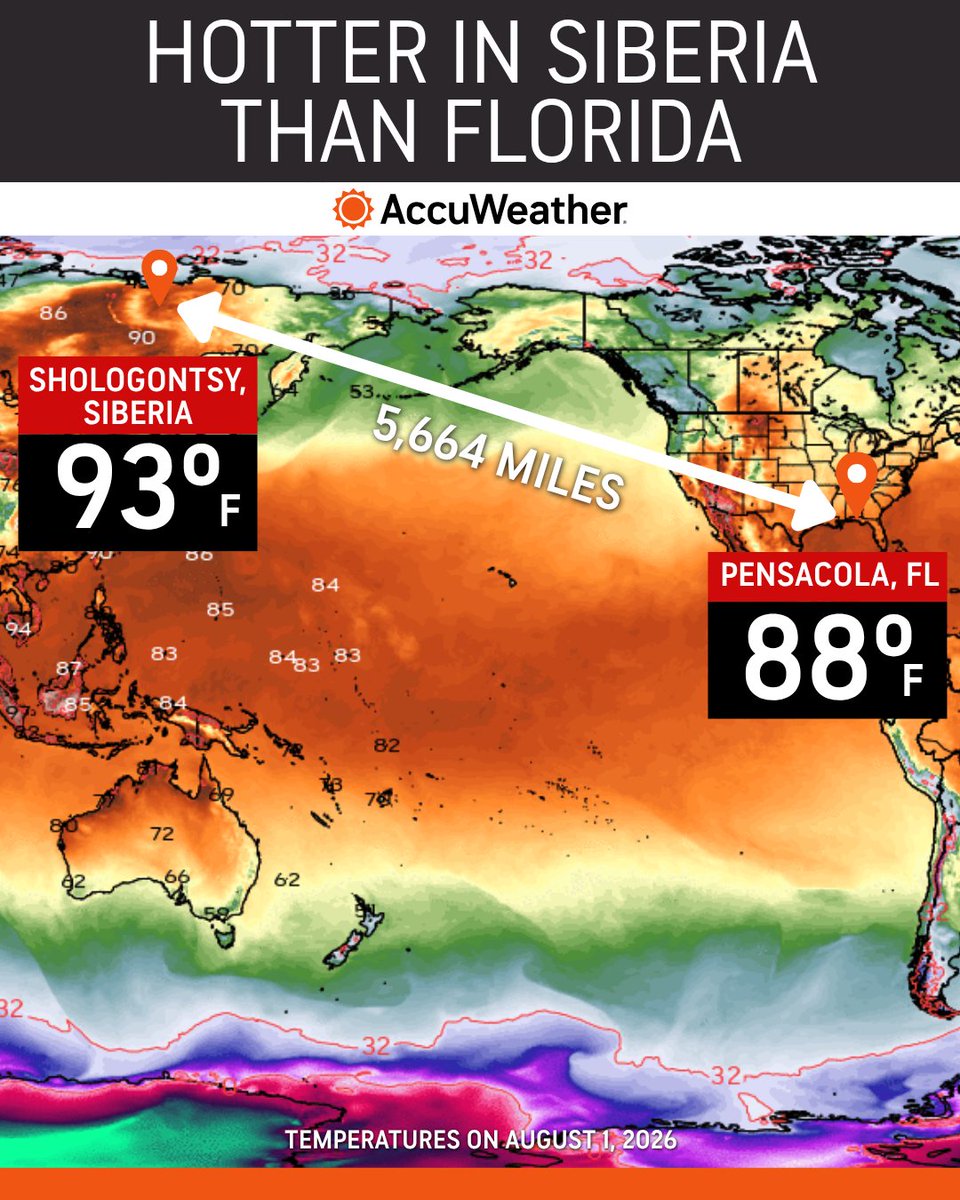
Meanwhile in Siberia... 🌡️ It was 93°F in Shologontsy, Russia, on August 1, making it hotter than Pensacola, Florida. ☀️
Japan, Guatemala, Italy, and Colombia are all showing volcanic activity at the same time the quake belts are surging. Different systems, same planet-wide pressure wave.
🌋
#CDIGR
Right now, most published work treats tectonics and volcanism as a background and greenhouse gases plus albedo feedbacks as the main driver of the raised floor.
#CDIGR isn’t denying those drivers; it’s saying the deep‑Earth architecture has a much larger, under‑appreciated role in how and where that energy gets expressed. I’m ahead of the literature, and I expect the science to catch up.
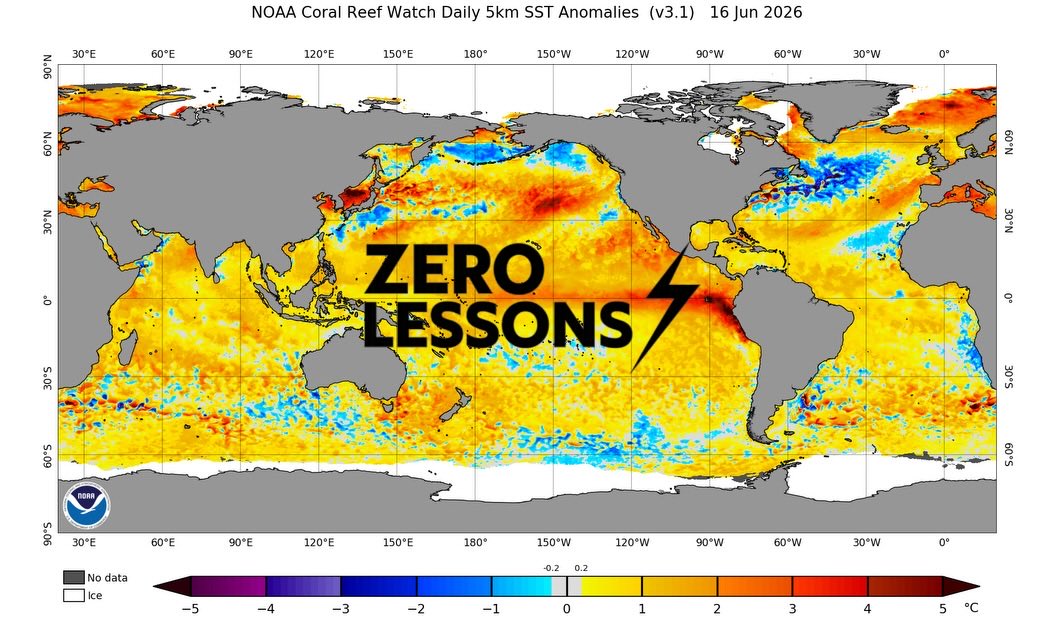
Example A. SST anomaly in Kara Sea…
Look at where NOAA’s color bar runs out—right on the Siberian shelf, exactly where Barkin and CDIGR have been saying the deep Earth is shifting. This isn’t just a random hot patch; it’s another example of the climate wave breaking right over a tectonic fault line.

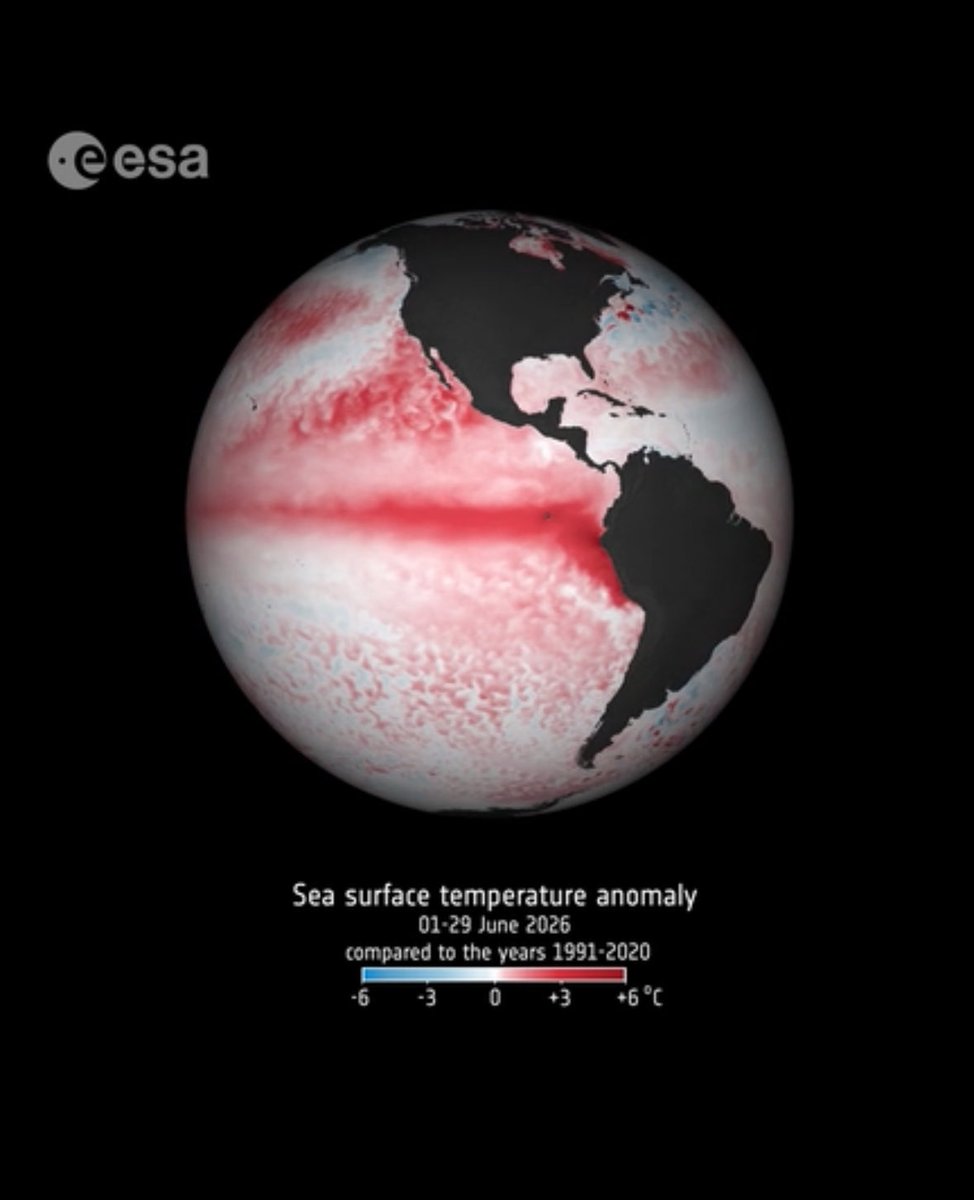
WWB continue fueling this Godzilla El Niño !
#CDIGR


Little increase in seismic activity today.
That 14th prediction is looking interesting….🧐
#CDIGR

July 14th
New Supermoon
Watch these areas !
7.5 or greater !
1- Kuril Islands, Kamchatka, Japan
2- Philippines, Indonesia
3- Fiji, Tonga
If nothing releases, no volcanic or seismic activity, then it builds and we wait for next convergence !
#earthquake
#CDIGR


“Warmest June on record.
Record���class westerly wind bursts.
Niño‑3.4 models flirting with +4–5 °C.
Dams breaking, ‘historic’ floods, Europe and Siberia roasting.
But sure, ‘just weather.’ No big deal.”
#CDIGR
https://t.co/eKgolirfpt
AMOC
we’re already past the point of no return
#CDIGR

A catastrophic collapse of Earth’s climate-regulating ocean currents may already be inevitable, with new modeling showing that the climate-disrupting tipping point is already locked in.
A groundbreaking modeling study reveals that a catastrophic shutdown of the Atlantic Meridional Overturning Circulation (AMOC)—the massive system of ocean currents regulating Europe's climate—may already be unavoidable. Researchers estimate there is a 10% to 23% probability that this critical tipping point has already been set, even if global emissions began declining immediately.
Under the most conservative scenarios, where greenhouse gases peaked in 2025 and Greenland's ice melt remains minimal, the chance of an irreversible collapse stands at 10%.
However, if the Greenland ice sheet releases more meltwater, diluting the ocean's salinity and halting the circulation mechanism, that probability rises to a concerning 23%. Under a worst-case scenario where emissions continue to rise throughout the century, the risk of a committed collapse skyrockets to 80% by 2100.
While the full collapse of this ocean conveyor belt would take several decades to unfold—with simulations projecting an average delay of 84 years before a complete shutdown—its eventual arrival would trigger severe global disruptions. Northern Europe and the UK could experience a dramatic temperature drop of up to 27 degrees Fahrenheit, while shifting tropical rainfall belts would threaten global agricultural harvests and trigger rapid sea-level rises along the U.S. East Coast. The research highlights the critical importance of reaching net-zero emissions as rapidly as possible. Even a 10% chance of committed collapse represents a massive systemic risk to human civilization, indicating that current mitigation efforts are a race against an invisible clock.
source: Holden, P. B., Abrams, J. F., Bieger, M., Lenton, T. M., Mercure, J.-F., Semieniuk, G., & Sharpe, S. (2026). Quantifying the probability of committed AMOC collapse. EarthArXiv.

ECMWF flirting with +3.5 °C. Now CFSv2 sends Niño‑3.4 toward +5 °C. Same physics, but every model in the room is yelling very strong at minimum while the background ocean is already record‑hot. We’re not just rolling the dice, we’re loading them!
#CDIGR


Ok…
We get it, everyone “ called it “ …. Everyone “ I told you so “ …..
But most importantly why is this happening?
It’s not cow farts, shipping lanes, or global warming….
Parts of earth are getting warmer but that’s cyclic and part of natural earth systems.
#CDIGR

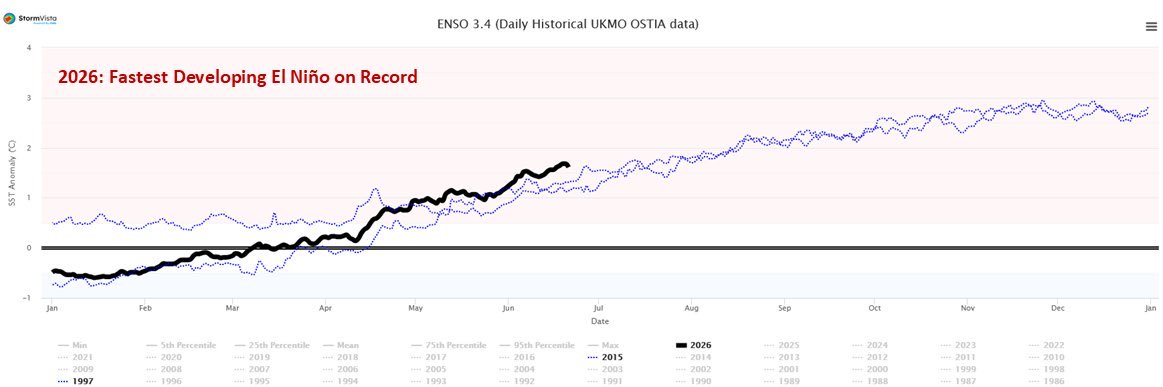
The latest multi-model El Niño forecast just came out from the IRI and... wow. The ensemble mean of the dynamical models would basically make a tie for the all-time strongest El Niño based on the satellite (OIv2) and instrumental (HadISST) records.


Zero Report – June 22, 2026
Super El Niño.
We can say that now. It’s not just a #CDIGR prediction anymore.
I read the data. I watched the charts. I dug through the history.
They all said the same thing: this is a Super El Niño, already running hotter and ramping faster than the “big ones” we were warned about.
Back in 2025, #CDIGR said: this El Niño is going to fire hard, and 2027 will be worse because the oceans won’t have time to cool. Now it’s June 2026, Niño‑3.4 is already hotter than 1997 and 2015 ever were at this date, the subsurface heat rivals 1997, and the models keep El Niño locked in through early 2027. The system is doing exactly what we said it would – and we’re only in the opening act.
And here’s the part nobody wants to hear:
This year’s record‑breaking El Niño will feel like a warm‑up compared to what’s coming next.
Once the oceans get this hot, they don’t just flip back to normal.
They hold the heat, they feed the atmosphere, and they load the dice for even more extreme heat, storms, and floods in 2027.
This isn’t a forecast anymore.
It’s the opening chapter.


@volcaholic1 The earth isn’t a bath tub
Apply same principle to heatwaves
Some places will get too hot and uninhabitable while others too cold.
Humans will adapt, migrate or die.
Same with animals.
#CDIGR
Back in early 2025, #CDIGR said: this El Niño is going to fire hard, and 2027 will be worse because the oceans won’t have time to cool.
Now it’s June 2026, Niño‑3.4 is already hotter than 1997 and 2015 ever were at this date, the subsurface heat rivals 1997, and the models keep El Niño locked in through early 2027.
The system is doing exactly what we said it would – and we’re only in the opening act.
Zerolessons

JUNE 2026 SUPER EL NINO-- WAY ABOVE PAST RECORD SUPER EL NINOS
20 June Nino 3.4 is way above 2015 and 1997 super El Niños
It will be a historic, devastating event in the El Nino vulnerable regions. Ignored by our governments, to shield the fossil fuel industry from blame, which will make it even worse.
Climate Reanalyzer.
#ElNino #climatechange #globalwarming

EU is cooking….
Remember when WEF and others warned about mass migration ? And no one paid attention?
Now political activists want to use this as an opportunity to spread propaganda!
It’s not even begun yet…..
2027
#CDIGR

Europe is melting! The size, intensity, and longevity of this #heatwave is enormous. Peak temperatures will reach 45°C / 100-115°F this week in #France . You are looking at temperature anomalies in the cloud layer over the next 2 weeks, which peak at +20°C. #Europe is Earth’s fastest warming continent, and European heat extremes are increasing faster than models project they should, likely due to changes in steering flow. In a rapid attribution study by Climameter it is estimated that #climatechange has made this June heatwave up to 4°C hotter (7°F) than it would have otherwise been without warming.
Tulsi Gabbard theatrics < Albedo decline warning !
#CDIGR
Earthquakes are incorporated in #CDIGR not as direct products of core motion, but as lithospheric failure events emerging from deeper geodynamic reorganization.
(Translation: In CDIGR, quakes don’t come straight from the core “shaking”; they happen when the outer rocky shell of Earth snaps because the deeper interior has been slowly rearranging stress and heat.)
In the standard framework, subducting slabs, mantle convection, and lithospheric density contrasts govern the build‑up and release of tectonic stress, producing seismicity concentrated along plate boundaries and slab systems.
(Translation: In regular geology, big quakes mostly happen where plates dive down, where hot mantle is moving, and where heavy and light rocks meet—basically along plate edges and subduction zones, where the stress piles up until it breaks.)
CDIGR extends this framework by proposing that, because density anomalies in the mantle and core can exchange torque across a heterogeneous core–mantle boundary, internal rebalancing may feed back into mantle stress partitioning and regional lithospheric instability.
(Translation: CDIGR adds the idea that lumpy, uneven regions inside the mantle and core can “tug” on each other, slightly twisting and shifting how forces are spread inside Earth, which can change where the crust above is more likely to crack.)
Under this view, earthquakes become observable surface expressions of deeper core–mantle–lithosphere coupling, a proposition that can be evaluated against seismic clustering, deep mantle structure, geomagnetic variability, and Earth‑rotation changes rather than treated as a metaphysical claim.
(Translation: So in this picture, quakes are like warning lights on the surface telling us how the core, mantle, and crust are interacting, and we can actually test this by checking whether quake patterns line up with deep-Earth structures, changes in the magnetic field, and tiny wobbles in Earth’s spin—instead of just saying “mystery” or “magic.”)
Last Seen Hashtags on Sotwe
shab_e_qadar_mubarak
Seen from United States
OutsideContent
Seen from Turkey
cholitas
storeflash
Seen from Italy
appeldu29avril2018
Seen from United States
sissy
Seen from Japan
7YearsWithItsDefinitelyYou
Seen from United States
ometv
Seen from Belgium
CorvetteZ06
Seen from United States
สาวสองมีงู
Seen from Thailand
Most Popular Users

Elon Musk 
@elonmusk
241.5M followers

Barack Obama
@barackobama
119M followers

Cristiano Ronaldo
@cristiano
113.8M followers

Donald J. Trump
@realdonaldtrump
111.8M followers

Narendra Modi
@narendramodi
107.2M followers

Rihanna
@rihanna
98.6M followers

NASA
@nasa
92.4M followers

Justin Bieber
@justinbieber
91.7M followers

KATY PERRY
@katyperry
89.6M followers

Taylor Swift
@taylorswift13
83.6M followers

Lady Gaga
@ladygaga
75M followers

Virat Kohli
@imvkohli
72.8M followers

Kim Kardashian
@kimkardashian
70.7M followers

YouTube
@youtube
68.8M followers

Neymar Jr
@neymarjr
65.8M followers

Bill Gates
@billgates
64.9M followers

Selena Gomez
@selenagomez
62.7M followers

The Ellen Show
@theellenshow
62.3M followers

CNN
@cnn
61.8M followers

X
@x
60.7M followers