

Top Tweets for #ChestWallBlocks

🦴🔥 𝐑𝐈𝐁 𝐅𝐑𝐀𝐂𝐓𝐔𝐑𝐄 𝐀𝐍𝐀𝐋𝐆𝐄𝐒𝐈𝐀: 𝐌𝐀𝐏 𝐁𝐄𝐅𝐎𝐑𝐄 𝐘𝐎𝐔 𝐁𝐋𝐎𝐂𝐊
#RibFractureAnalgesia #RegionalAnaesthesia #PainMedicine #AcutePain #TraumaPain #ChestWallBlocks #ESPB #SAPB #IntercostalNerves #PainGenerator #DynamicPain #OpioidSparingAnalgesia #GrayZoneInRA #GrayAreasInRA
𝐆𝐑𝐀𝐘 𝐙𝐎𝐍𝐄𝐒 𝐢𝐧 𝐑𝐀:
✅ Rib fractures are not rare injuries.
✅ They account for nearly 10% of trauma admissions & may be seen in up to 39% of blunt thoracic trauma.
✅ Real challenge is not only the fracture.
✅ It is the pain-driven respiratory compromise that follows.
✅ Before choosing a block, we must understand the anatomy.
1️⃣ 🧠 𝐑𝐈𝐁 𝐏𝐀𝐈𝐍 𝐒𝐓𝐀𝐑𝐓𝐒 𝐖𝐈𝐓𝐇 𝐈𝐍𝐍𝐄𝐑𝐕𝐀𝐓𝐈𝐎𝐍
▫️ Ribs are mainly supplied by intercostal nerves, which are anterior rami of thoracic spinal nerves.
▫️ Pain also comes from periosteum, collateral branches, lateral cutaneous branches, intercostal muscles, endothoracic fascia, and exothoracic fascia.
▫️ So rib fracture pain is not one nerve, one rib, or one simple pathway.
2️⃣ 🦴 𝐅𝐑𝐀𝐂𝐓𝐔𝐑𝐄 𝐋𝐎𝐂𝐀𝐓𝐈𝐎𝐍 𝐌𝐀𝐓𝐓𝐄𝐑𝐒
▫️ Posterior / posterolateral fractures may have stronger posterior chest wall and paraspinal contribution.
▫️ Lateral / anterolateral fractures commonly involve lateral cutaneous and intercostal territories.
▫️ Anteromedial fractures may require anterior intercostal or parasternal coverage.
▫️ Multilevel or bilateral fractures may need broader neuraxial or paravertebral strategies.
3️⃣ 🎯 𝐌𝐀𝐓𝐂𝐇 𝐓𝐇𝐄 𝐁𝐋𝐎𝐂𝐊 𝐓𝐎 𝐓𝐇𝐄 𝐓𝐄𝐑𝐑𝐈𝐓𝐎𝐑𝐘
▫️ ESPB may be a selective option for posterior or posterolateral rib fractures.
▫️ SAPB may be more anatomically congruent for lateral and anterolateral rib fractures.
▫️ Parasternal / anterior intercostal approaches may be useful for anteromedial pain.
▫️ Thoracic paravertebral or epidural analgesia may provide broader coverage when clinically appropriate.
4️⃣ ⚠️ 𝐍𝐎𝐓 𝐀𝐋𝐋 𝐁𝐋𝐎𝐂𝐊𝐒 𝐀𝐑𝐄 𝐌𝐄𝐂𝐇𝐀𝐍𝐈𝐒𝐓𝐈𝐂𝐀𝐋𝐋𝐘 𝐒𝐀𝐌𝐄
▫️ ESPB is a posterior fascial plane technique.
▫️ Dorsal ramus involvement is more consistent.
▫️ Ventral ramus, paravertebral, or epidural spread may be variable.
▫️ Central convergence of pain does not mean all peripheral blocks behave equally.
5️⃣ 🫁 𝐎𝐔𝐓𝐂𝐎𝐌𝐄𝐒 𝐒𝐇𝐎𝐔𝐋𝐃 𝐁𝐄 𝐅𝐔𝐍𝐂𝐓𝐈𝐎𝐍𝐀𝐋
▫️ Deep inspiration
▫️ Effective cough
▫️ Dynamic pain during movement
▫️ Physiotherapy participation
▫️ Incentive spirometry performance
▫️ Pneumonia prevention
▫️ Delirium and functional recovery
6️⃣ 💉 𝐒𝐘𝐒𝐓𝐄𝐌𝐈𝐂 𝐋𝐈𝐃𝐎𝐂𝐀𝐈𝐍𝐄 𝐍𝐄𝐄𝐃𝐒 𝐀 𝐒𝐀𝐅𝐄𝐓𝐘 𝐋𝐄𝐍𝐒
▫️ It is controlled systemic local anesthetic exposure.
▫️ It may modulate neuronal excitability and central sensitization.
▫️ Elderly trauma patients may have a narrower therapeutic margin.
▫️ LAST monitoring should be systematic, not casual.
✅ 𝐊𝐄𝐘 𝐓𝐀𝐊𝐄𝐀𝐖𝐀𝐘𝐒
▫️ Map the fracture.
▫️ Identify the neural territory.
▫️ Understand the block mechanism.
▫️ Choose the technique accordingly.
🚫 One-size-fits-all analgesia may miss the dominant pain generator.
🦴 Rib fracture analgesia is not just about blocking pain - it is about restoring breathing, coughing, mobilization, and recovery.

"Innermost Intercostal Muscle: One Muscle, Three Faces!"
#Anatomy #ThoracicWall #MedicalEducation
#ChestWallBlocks
#ParasternalBlocks
#MyRATips
Tip of the Day:
Deep inside your thoracic wall 🫁 lies the Innermost Intercostal Muscle, but it doesn't always stay whole — it detaches beautifully into:
🛡️ Innermost Intercostal:
Between ribs, deepest layer
🧭 Sternocostalis (Transversus Thoracis):
Anteriorly near the sternum
🧩 Subcostalis:
Posteriorly, spanning multiple ribs
Key Facts:
✅ All arise from the same muscular plane
✅ Share the same nerve supply (intercostal nerves)
✅ Share the same function (depress ribs during expiration)
✅ Differ only by location and fiber arrangement
They are not truly separate muscles — they are regional adaptations of a single deep muscle layer!
🦴✨ Nature’s engineering at its finest!

Tip of the Day
"Where It Starts, It Spreads: Chest Wall Blocks Decoded"
#RegionalAnesthesia
#ChestWallBlocks
#UltrasoundGuidedBlocks
#AnatomyMatters
#BlockSpread
#PecsBlock
#SAPBlock
#PainManagement
#AnesthesiaTips
Always know the origin and insertion of the muscle where local anesthetic (LA) is deposited during chest wall blocks.
The anatomical extent of that muscle largely determines the dermatomal coverage of the block.
For example:
Pectoralis Major extends only to the 6th rib, typically providing coverage from T2 to T6.
Serratus Anterior originates as far as the 9th rib, allowing the SAP block to cover T3 to T9.
Understanding muscle anatomy is key to predicting block spread and optimizing analgesia.
By Dr. Kartik Sonawane

" THORACIC WALL BLOCKS:
An Art of Looking Between the Lines"
#Thoracicwallblocks
#Chestwallblocks
#Parasternalblocks
#PECSblocks
#SAPblocks #PVB #ESPblock #RISSblock #ITPblock
My 10 points between 6 LINES:
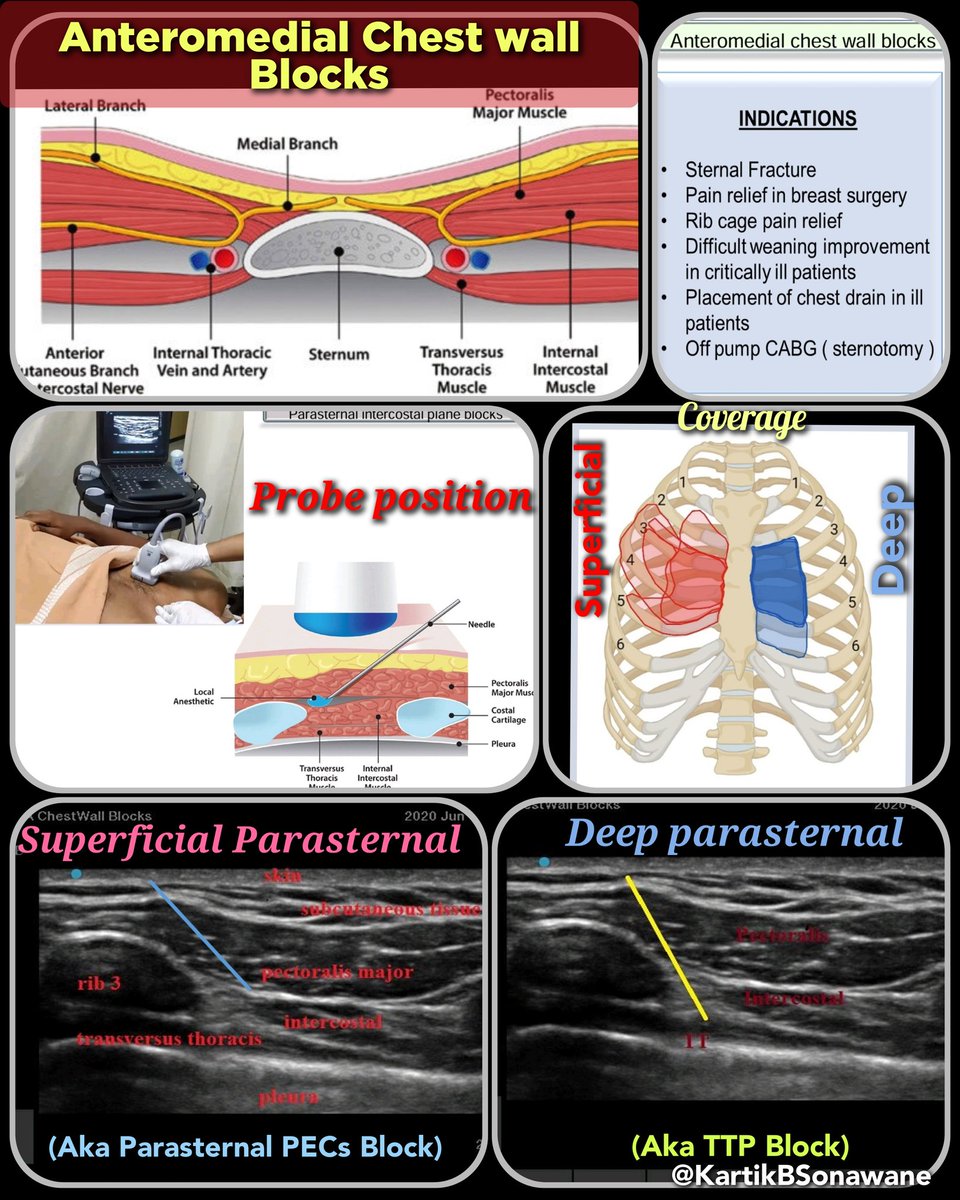
ANTERIOR CHEST WALL BLOCKS:
(A) Medial to the Midclavicular line:
PMM covers ribs & ICMs in the parasternal region. External ICM becomes the Anterior Intercostal Membrane anteriorly (Posterior Intercostal Membrane is formed by Internal ICM posteriorly).
1. Parasternal blocks: Probe placed sagitally over the parasternal region. LA deposition- Between PMM and ICM for Superficial parasternal block OR between internal ICM and transversus thoracic muscle for Deep parasternal (Transversus Thoracic Plane) block. Coverage- Anterior cutaneous nerve T2-T6. Vascular landmark- Internal mammary A. in TTP block.
(B) Between Midclavicular - Anterior axillary lines:
Muscles from superficial to deep include PMM, PMnM, and SAM above ribs & ICMs.
2. PEC ZERO (Modified Clavipectoral Fascial Plane) block:* Probe placed vertically between the clavicle (proximally) and 2nd Rib (distally). LA deposition- Above and below PMnM. Vascular landmark- Acromial branch of TAA.
3. PEC 1 (InterPectoral plane) block: Probe over 2nd Rib. LA deposition- Between PMM and PMnM. Vascular landmark- Pectoral branch of TAA. Coverage- LPN & MPN.
4. PEC 2 (Pecto-Serattus Plane) Block: Probe over 3rd Rib. LA depostion (2 injections)- Between PMM-PMnM & PMnM-SAM. Coverage- LPN & MPN, ICNs T2-T6.
(C) Between Anterior - Posterior Axillary lines:
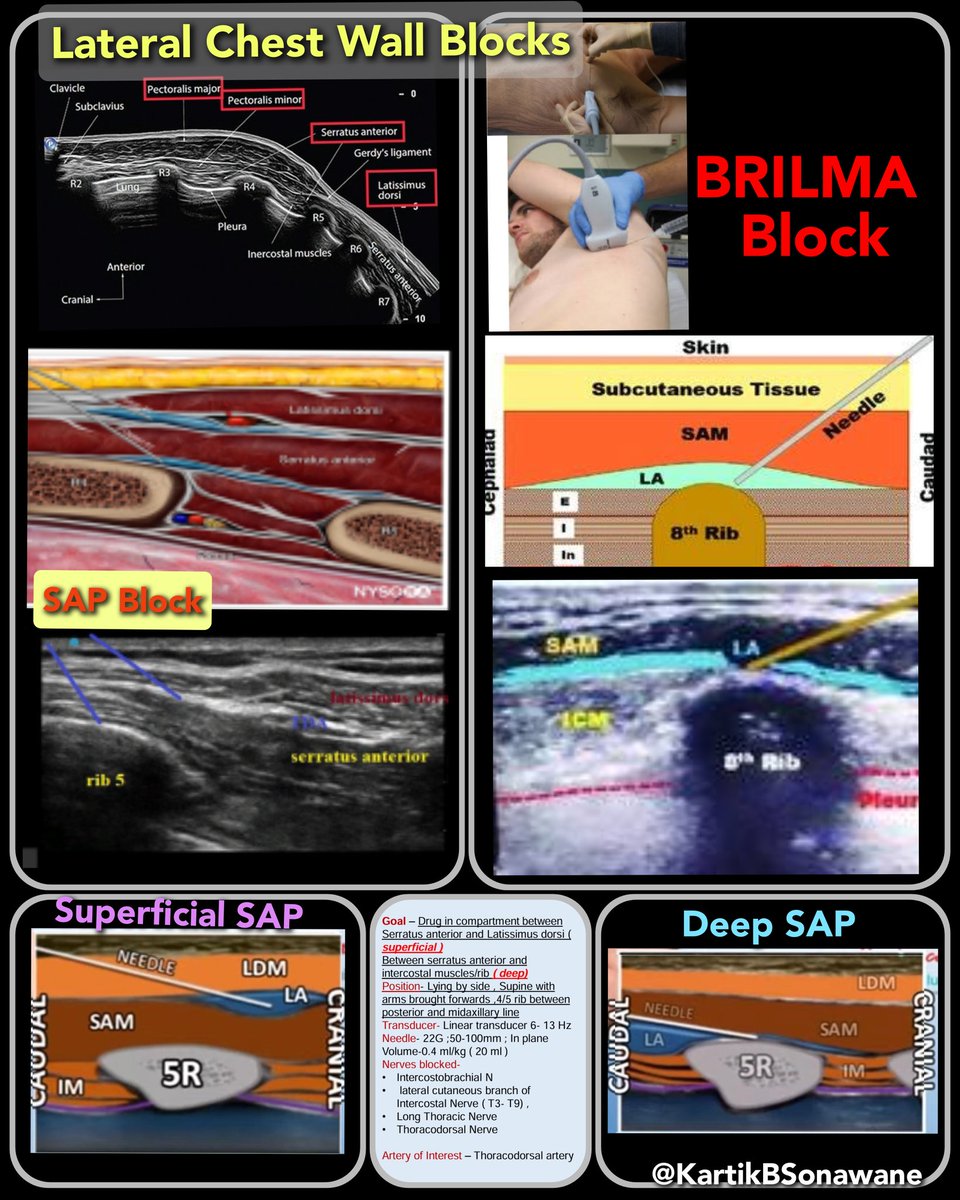
Muscles include SAM (anterior to midaxillary line). LDM & SAM (posterior to midaxillary line) above the ribs.
5. BRILMA (on 4/5th ribs) and modified BRILMA (on 7/8th ribs): Probe placed at midaxillary. LA depostion- Between SAM and Ribs. Coverage- Lateral cutaneous nerves T2-T7 (BRILMA) and T5-T12 (modified BRILMA).
6. SAP 1 (superficial SAP): Probe between Midaxillary- Posterior axillary lines. LA deposition- Between SAP muscle and LDM at 4/5 th ribs level. Coverage-Intercostobrachial N., T3-T9, LTN, and TDN.
SAP 2 (Deep SAP): LA deposition below SAM at 4/5 th ribs level. Vascular landmark- Thoracodoral A above SAM. Coverage- Intercostobrachial N. and T3-T9.
POSTERIOR CHEST WALL BLOCKS:
(D) Probe kept parasagittal 2.5 cm lateral to the midline:
7. Thoracic PVB: LA deposition above pleura by piercing superior costotransverse ligament.
8. Inter Transverse Process (ITP) Block: LA deposition anterior to C-T ligament in the retro CT space.
(E) Probe kept parasagittal 4 cm lateral to the midline:
9. Thoracic ESP Block: LA deposition below ESPM by hitting the tip of the TP.
(F) Probe between TP and Scapula:
10. RISS (Rhomboids Intercostal Sub-Serratus plane) Block: LA deposition between RHM-ICM along the Medial border and below SAM at the inferior angle of the Scapula. Coverage- T2-T11 dermatomes.


"Regional Analgesia in Rib #"
#Ribsfractures
#chestwallblocks
#thoracicwallblocks
#Ribsanalgesia
#PainManagementinfracturedRibs
My 10 points:
1. Ribs are innervated by periosteal branches arising from Collateral branches of ICNs that run along the superior border of Ribs along with collateral vessels.
2. Richly innervated structures in Ribs are periosteum, outer covering fascia (Exothoracic), & inner underlying fascia (endothoracic).
3. All these fascia are richly innervated with branches of neighbouring ICNs.
Outer ribs also receive sensory branches from LCN when it is exiting from the main ICN in midaxillary line.
4. Whenever such multiple innervations contribute in sensory information u need a FIELD block over affected Ribs.
5 . SAP block does exactly same by creating field block over the affected and nearby ribs blocking all necessary innervations.
Deep SAP directly involve intercostal nerves (Lateral branch) as it's given above ribs. Analgesia onset will be faster, But duration will be less due to vascularity. Advantage- it won't involve LTN & TDN (can be spared with Diluted LA also).
Superficial SAP will hav more duration.
6. Best to give modified SAP combining both for faster onset with (deep with 10-15cc) and prolonged duration (superficial with 20-30 cc). Also add dexa to prolong further duration.
7. IMHO,
Best is *Thoracic Epidural* . Mainly for bilateral rib #. Cannot be given in anticoagulated patients. Require sterile conditions and proper positioning of patients. Volume 2-3 ml / segment
8. Second Best is *PVB* . Mainly for unilateral Rib #. Require expertise, associated with complications like pleural rupture, vessel injury and LAST. Require proper positioning of patient. Volume 2ml/Segment.
9. Third best options are:
*ESP* block better only for posterolateral Rib #. Volume 0.3-0.5 ml/kg.
*SAP* block provide wide coverage. Covers from midclavicular line anteriorly to midscapular line posteriorly. Best for anterolateral # which are common. Can be given without USG by simply hitting ribs. Volume 0.4-0.5 ml/kg
10. Other blocks ,
*RISS* block for anterolateral and posterior rib #. Block away from fracture ribs so comfortable for patient. Volume 0.3-0.4 ml/kg
BRILMA & modified BRILMA block to obtain extensive craniocaudal coverage in multiple rib #.
*ICN block* . Now became outdated. Multiple injections required. Shortest duration analgesia (2-6hrs). Volume 2-3 ml per Nerve.
Parasternal blocks are needed for anteromedial Ribs #.


Last Seen Hashtags on Sotwe
Wimbledon
Seen from France
中野三玖
Seen from Japan
DumbGovernor
Seen from United States
ร่มเกล้านัดเย็ด
Seen from Thailand
Srimoyee Mukherjee
Seen from Oman
uhmegle
Seen from Netherlands
barfour
Seen from United States
CorazonDeCaballeroXTCM
Seen from United Kingdom
momson()+filter:native_video
Seen from Egypt
momson(*****)********+filter:native_video
Seen from Australia
Trends for you
Most Popular Users

Elon Musk 
@elonmusk
240.7M followers

Barack Obama
@barackobama
119.2M followers

Donald J. Trump
@realdonaldtrump
111.7M followers

Cristiano Ronaldo
@cristiano
110.8M followers

Narendra Modi
@narendramodi
107M followers

Rihanna
@rihanna
97.7M followers

NASA
@nasa
92.2M followers

Justin Bieber
@justinbieber
90.9M followers

KATY PERRY
@katyperry
87.8M followers

Taylor Swift
@taylorswift13
81.6M followers

Lady Gaga
@ladygaga
73.1M followers

Virat Kohli
@imvkohli
70M followers

Kim Kardashian
@kimkardashian
69.8M followers

YouTube
@youtube
68.7M followers

Bill Gates
@billgates
63.9M followers

Neymar Jr
@neymarjr
62.8M followers

The Ellen Show
@theellenshow
62.4M followers

CNN
@cnn
61.9M followers

Selena Gomez
@selenagomez
60.8M followers

X
@x
60.8M followers