

Top Tweets for #CommonGrace

Praise God for music.
#commongrace

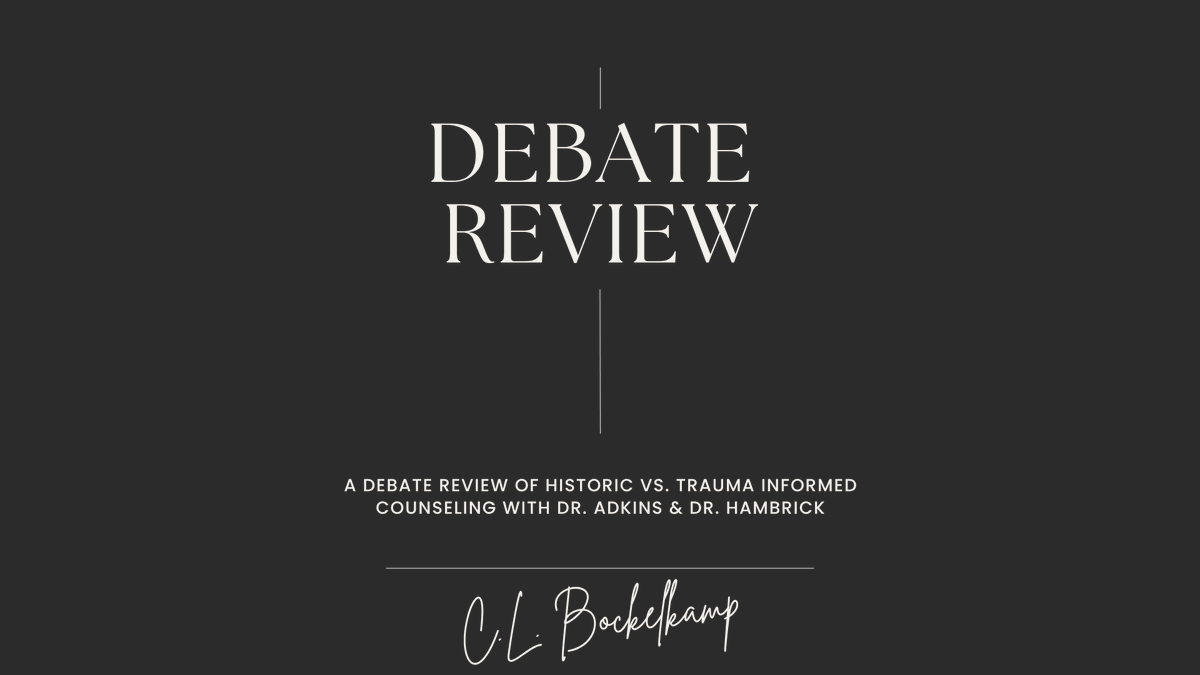
I'd encourage all people who are interested in #BiblicalCounseling and #CommonGrace to read this review of the Rice Debate.

My Review of the Rice Debate is finished. I did my best to give thoughtful but pointed critique without impugning intentions.
I do pray this is taken graciously as it was written.
#VanTil #CommonGrace #BiblicalCounseling
Van Til labels Christians “covenant keepers” and non-Christians “covenant breakers.” What use can Christians make of non-Christian resources?
“The covenant keepers will make use of the works of the covenant breakers which these have been able and compelled to perform in spite of themselves. As Solomon used the cedars of Lebanon (1 Kings 5:8-10), the products of the rain and the sunshine that had come to the covenant breakers, and as he used the skill of these very covenant breakers for the building of the temple of God, so also those who through the Spirit of God have believed in Christ may and must use all the gifts of all men everywhere in order by means of them to perform the cultural task of mankind” (Common Grace and the Gospel, 138).
“The case is similar with respect to the knowledge of unbelievers and their ability to do that which is relatively good. The fact that they are in principle opposed to God and would destroy the very foundation of knowledge and ethics, yet, in spite of this, because of God’s common grace, they can discover much truth and do much good” (Common Grace and the Gospel, 190).
“Since sinners are not consistent, and have what is from their point of view an old man within them they can engage in science and in the general interpretation of the created universe and bring to light much truth. He can discover that which is true and usable for the Christian” (A Christian Theory of Knowledge, 294).
Van Til did not limit the Christian use of non-Christian thinking to the “hard sciences” or to “earthly, inferior matters.” He saw value and even usefulness in secular philosophy.
“It should be carefully noted that our criticism of [the church’s use of Aristotle] does not imply that we hold it to be wrong for the Christian church to make formal use of the categories of thought discovered by Aristotle or any other thinker. On the contrary, we believe that in the Providence of God, Aristotle was raised up of God so that he might serve the church of God by laying at its feet the measures of his brilliant intellect” (A Survey of Christian Epistemology, In Defense of Biblical Christianity 2, 1969, 57).
Van Til, #BiblicalCounseling and #CommonGrace
It is fascinating what Van Til says in A Christian Theory of Knowledge (43-44) about how those who are dead in sin can discover truth about people and problems—the content of psychology.
“Thus the Christian apologist should, to be sure, look sympathetically into the efforts of men in general when they seek to analyze themselves and their problems. There will be no doubt elements of truth in such an analysis….”
“Just now we spoke of elements of truth that may be found in the non-Christian diagnosis of sin and evil…. Reformed theologians speak of this restraint upon mankind in general as due to common grace. The restraint of God upon fallen mankind enables it to help build the culture of the race….”
“In spite of what he does against God, he yet can and must work for God; thus he is able to make a positive contribution to human culture. Thus it comes to pass that they of whom Scripture says that their minds are darkened can yet discover much truth….”
“But in spite of being dead in sins, they can, because of God’s common grace, discover truth…. Fallen man knows truth and does morally good things in spite of the fact that in principle he is set against God.”
What can we learn from Reformed theology about common grace and how biblical counselors may engage with extra-biblical information? 70 Resources on Common Grace, Biblical Counseling, and Reformed Theology. https://t.co/eUFINF7jDH #BiblicalCounseling #CommonGrace
God’s Sovereign, Christ-Glorifying Common Grace: Over Every Square Inch! https://t.co/34m5ELtFDW God’s sovereign, Christ-glorifying common grace covers every square inch of God’s creation and glorifies the wisdom of Christ. #CommonGrace #BibleCn #BiblicalCounseling
This is another very important discussion in response to @DrKeithAEvans's address. I appreciate the careful, respectful, academic, practical approach that Dr. Brooks takes in this response. Well worth reading for #BibleCn #BiblicalCounseling #CommonGrace

I've listened to my friend @DrKeithAEvans's inaugural convocation address a couple of times over the last few days. Biblical counselors aren't handed microphones and asked to give academic lectures very often, so I was excited to see Keith's contribution.
https://t.co/nXhO5wi23U
Van Til, Kuyper, Bavinck, and Biblical Counselors: An Assessment. https://t.co/w2h5w2dMrd Can #BiblicalCounselors follow the #CommonGrace teachings of #Kuyper & #Bavinck? Or, to be a true biblical counselor, must we only follow the teachings of Van Til on common grace?
https://t.co/dhw9WYC0vY Newly updated, now 161 free resources. 161 Resources for Counseling the Whole Person: Soul Physicians of Embodied-Soul. What does the Bible teach about #BiblicalCounseling, the #Body, the #EmbodiedSoul, #Trauma, #CommonGrace, #Research, #Science, and #Neuroscience?
@BradHambrick @Pastor_Ken_CBC @PeaceWorks_CM
@praximtheology @LaineyGreer @LowerLeavell @joehussung @jonathanholmes @ElizaJaneHuie
@lucasabatier @LucyAnnMoll @AnneDryburgh
@bethmariebroom @KevinCarson @jared_poulton
@SGanschow @drgrcevich @DrAaronNew
@806_reformer @jasonkovacs @BroTylerEllison
@JamesAHatt @BibClinCounEdu @Jensnewsong
@KristinKellen @HillMargy @ProfCubas @timallchin
Important article by Ed Welch of @ccef responding to an @acbc journal article that critiqued Welch's approach. A Response to Francine Tan’s JBSC Article https://t.co/VMmMcj8rM9 #BibleCn #CommonGrace
This is an important article for current #BibleCn discussions about #CommonGrace https://t.co/IS9BvvauVV Natural Theology and Van Til: A Novel Departure from the Reformed Tradition.
John Calvin on Christian Engagement with Non-Christian Thinking #BibleCn #CommonGrace #BiblicalCounseling #Calvin #JohnCalvin
Calvin on the Believer’s Use of the Unbeliever’s Understanding
According to Calvin, the light of intelligence is to be regarded as a divine grace and its power is discussed extensively in the Institutes at II: 2.12-15. For example:
“Whenever we come upon these matters in secular writers, let that admirable light of truth shining in them teach us that the mind of man through fallen and perverted from its wholeness, is nevertheless clothed and ornamented with God’s excellent gifts…. Shall we deny that the truth shone upon the ancient jurists who established civic order and discipline with such great equity? Shall we say that the philosophers were blind in their fine observations and artful descriptions of nature? Shall we say that those men were devoid of understanding who conceived the art of disputation and taught us to speak reasonably? Shall we say that they are insane who developed medicine, devoting their labor to our benefit? What shall we say of all the mathematical sciences? Shall we consider them the ravings of madmen? No, we cannot read the writings of the ancients on these subjects without great admiration. We marvel at them because we are compelled to recognized how preeminent they are…. Those men whom Scripture (1 Cor. 2:14) calls ‘natural men’ were, indeed, sharp and penetrating in their investigation of inferior things. Let us, accordingly, learn by their example how many gifts the Lord left to human nature even after it was despoiled of its true good” (Calvin, Institutes, II: 2.15, 273-275).
This gift of peculiar grace is so significant for Calvin that when we come across it manifested in an unbeliever,
“We shall neither reject the truth itself, nor despise it wherever it appears, unless we wish to dishonor the Spirit of God. If we regard the Spirit of God as the sole foundation of truth, we shall not despise it wherever it shall appear” (Calvin, Institutes, II: 2.14).
According to Calvin, to reject truth, wherever it appears, is to dishonor God, who is the sole foundation of truth. Instead, we should “own this assistance” given to us “by the work of the ungodly:
“If the Spirit dwells only in believers, this refers to the Spirit of Sanctification. Nevertheless, he fills, moves and quickens all things by the power of the same Spirit. If the Lord has willed that we be helped in physics, dialectic, mathematics and other like disciplines by the work of the ungodly—let us own this assistance” (Calvin, Institutes, II: 2.16).
“While men dispute about individual sections of the law, they agree on the general conception of equity. The fact remains that some seed of political order has been implanted in all men” (Calvin, Institutes, II: 2.13).
“Hardly anyone is found who does not manifest talent in some art” (Calvin, Institutes, II: 2:17).
Calvin on Philosophy and Psychology
For Calvin, God’s common grace extends to matters of philosophy, theology, and even to “a slight taste of His divinity.” However, apart from saving grace, their common grace understandings could only lead them so far.
“Certainly I do not deny that one can read competent and apt statements about God here and there in the philosophers. The Lord gave them a slight taste of His divinity—sometimes impelled them to make utterances by the confession of which they would themselves be corrected. But their seeing did not direct them to the truth, much less enable them to attain it” (Calvin, Institutes, II: 2.18).
Calvin complimented pagan philosophers Plato and Aristotle on their teachings about psychology.
“Plato, in some passages, talks nobly of the faculties of the soul; and Aristotle, in discoursing of it, has surpassed all in acuteness…. They certainly thought more purely and wisely on the subject than some amongst ourselves, who boast that they are the disciples of Christ” (Calvin, Psychopannychia, in Selected Works, 3:420).
Calvin on Common Grace and the Unbelieving Mind
In his Commentary on Hebrews, while Calvin distinguishes the regenerate from the unregenerate mind, he still commends God’s work in the minds of the unbeliever:
“God indeed favors none but the elect alone with the Spirit of regeneration, and that by this they are distinguished from the reprobate; for they are renewed after his image and receive the earnest of the Spirit in hope of the future inheritance, and by the same Spirit the Gospel is sealed in their hearts. But I cannot admit that all this is any reason why He should not grant the reprobate also some taste of his grace, why He should not irradiate their minds with some sparks of his light, why he should not give them some perception of his goodness, and in some sort engrave his word on their hearts.”
In his Commentary on Genesis, Calvin noted how Cain’s descendants distinguished themselves in animal husbandry, music, and metallurgy. Jabal fathered “those who live in tents and raise livestock, while Jubal “was the father of all who play the harp and flute” and Tubal-Cain “forged all kinds of tools out of bronze and iron” (Gen 4:20-21). Calvin elaborates on this:
“Moses now relates that, with the evils which proceeded from the family of Cain, some good had been blended. For the invention of arts, and of other things which serve to the common use and convenience of life, is a gift of God by no means to be despised, and a faculty worthy of commendation.”
Calvin on the Unbelieving Mind “Clothed and Ornamented with God’s Excellent Gifts”
Calvin described the capacity for goodness in the non-Christian as a gift from God. He said that an unbelieving mind:
“Though fallen and perverted from its wholeness, is nevertheless clothed and ornamented with God’s excellent gifts” (Calvin, Institutes of the Christian Religion, 2.2.15).
Regarding human understanding, Calvin wrote:
“When we so condemn human understanding for its perpetual blindness as to leave it no perception of any object whatever, we not only go against God’s Word, but also run counter to the experience of common sense” (Calvin, Institutes of the Christian Religion, II.ii.12).
Thus, for Calvin, denying the unbeliever’s perceptual capacities goes against Scripture, experience, and common sense. While a weakened human understanding stumbles around, according to Calvin:
“Its efforts do not always become so worthless as to have no effect, especially when it turns its attention to things below” (Calvin, Institutes of the Christian Religion, II.ii.13).
He then explained himself more fully:
“To perceive more clearly how far the mind can proceed in any matter according to the degree of its ability, we must here set forth a distinction. This, then, is the distinction: that there is one kind of understanding of earthly things; another of heavenly” (Calvin, Institutes of the Christian Religion, II.ii.13).
It is important to understand what Calvin meant by “earthly things.” He includes government, household management, mechanical skills, and the liberal arts (which includes philosophy) and sciences. Among the “heavenly things” are the pure knowledge of God, the nature of true righteousness, and the mysteries of the kingdom (Calvin, Institutes of the Christian Religion, II.ii.13).
Calvin on “The Ministry of the Ungodly”
Similarly, Calvin made a startling case, in his Institutes (Beveridge ed.), 2.2.15–16, for Christians availing themselves of “the work and ministry of the ungodly”:
“Therefore, in reading profane authors, the admirable light of truth displayed in them should remind us that the human mind, however much fallen and perverted from its original integrity, is still adorned and invested with admirable gifts from its Creator. If we reflect that the Spirit of God is the only fountain of truth, we will be careful, as we would avoid offering insult to him, not to reject or condemn truth wherever it appears…. If the Lord has been pleased to assist us by the work and ministry of the ungodly in physics, dialectics, mathematics, and other similar sciences, let us avail ourselves of it.”
In his Commentary on Titus, speaking of Paul’s positive use of a non-Christian philosopher in Titus 1:12, Calvin explains:
“From this passage we may infer that those persons are superstitious, who do not venture to borrow anything from heathen authors. All truth is from God; and consequently, if wicked men have said anything that is true and just, we ought not to reject it; for it has come from God. Besides, all things are of God; and, therefore, why should it not be lawful to dedicate to his glory everything that can properly be employed for such a purpose?”
Cornelius Van Til on Christian Engagement with Non-Christian Thinking #BibleCn #CommonGrace #BiblicalCounseling @KeesVanTil
Cornelius Van Til is one of the most conservative Reformed theologians on the noetic effect of sin, total depravity, common grace, presuppositionalism, and apologetics. Yet, speaking of the “natural man” (the non-Christian, the unsaved person), Van Til explains,
“In principle he is hostile to God. But he cannot carry through his principle completely. He is restrained by God from doing so. Being restrained by God from doing so, he is enabled to make contributions to the edifice of human knowledge” (A Christian Theory of Knowledge, 22).
“The forces of creative power implanted in him are to some extent released by God’s common grace. He therefore makes positive contributions in science in spite of his principle and because both he and the universe are the exact opposite of what they, by his principles, thinks they are” (A Christian Theory of Knowledge, 22).
Is this just the hard sciences? No. It is fascinating what Van Til says in A Christian Theory of Knowledge (43-44) about how those who are dead in sin can discover truth about people and problems—the content of psychology.
“Thus the Christian apologist should, to be sure, look sympathetically into the efforts of men in general when they seek to analyze themselves and their problems. There will be no doubt elements of truth in such an analysis….”
“Just now we spoke of elements of truth that may be found in the non-Christian diagnosis of sin and evil…. Reformed theologians speak of this restraint upon mankind in general as due to common grace. The restraint of God upon fallen mankind enables it to help build the culture of the race….”
“In spite of what he does against God, he yet can and must work for God; thus he is able to make a positive contribution to human culture. Thus it comes to pass that they of whom Scripture says that their minds are darkened can yet discover much truth….”
“But in spite of being dead in sins, they can, because of God’s common grace, discover truth…. Fallen man knows truth and does morally good things in spite of the fact that in principle he is set against God.”
Van Til labels Christians “covenant keepers” and non-Christians “covenant breakers.” What use can Christians make of non-Christian resources?
“The covenant keepers will make use of the works of the covenant breakers which these have been able and compelled to perform in spite of themselves. As Solomon used the cedars of Lebanon (1 Kings 5:8-10), the products of the rain and the sunshine that had come to the covenant breakers, and as he used the skill of these very covenant breakers for the building of the temple of God, so also those who through the Spirit of God have believed in Christ may and must use all the gifts of all men everywhere in order by means of them to perform the cultural task of mankind” (Common Grace and the Gospel, 138).
“The case is similar with respect to the knowledge of unbelievers and their ability to do that which is relatively good. The fact that they are in principle opposed to God and would destroy the very foundation of knowledge and ethics, yet, in spite of this, because of God’s common grace, they can discover much truth and do much good” (Common Grace and the Gospel, 190).
“Since sinners are not consistent, and have what is from their point of view an old man within them they can engage in science and in the general interpretation of the created universe and bring to light much truth. He can discover that which is true and usable for the Christian” (A Christian Theory of Knowledge, 294).
Van Til did not limit the Christian use of non-Christian thinking to the “hard sciences” or to “earthly, inferior matters.” He saw value and even usefulness in secular philosophy.
“It should be carefully noted that our criticism of [the church’s use of Aristotle] does not imply that we hold it to be wrong for the Christian church to make formal use of the categories of thought discovered by Aristotle or any other thinker. On the contrary, we believe that in the Providence of God, Aristotle was raised up of God so that he might serve the church of God by laying at its feet the measures of his brilliant intellect” (A Survey of Christian Epistemology, In Defense of Biblical Christianity 2, 1969, 57).
“In Van Til’s lectures on the Psychology of Religion (1-3), he provides the following charge to pastors: ‘Ministers of the gospel should have a knowledge of a sound psychological approach to men. . . . We see then that as Christian ministers we can no doubt learn something from the technique of the modern school of psychology of religion. We should always be thankful for any improvement in the technique of handling men that any one offers us.’”
Newly updated with 28 additional resources. 128 Free Resources for Counseling the Whole Person: Soul Physicians of Embodied-Soul. What does the Bible teach about #BiblicalCounseling, the #Body, the #EmbodiedSoul, #Trauma, #Suffering, #CommonGrace, #Research, #Science, and #Neuroscience ? https://t.co/Zi1eXSOJAv

Considering God's common grace: the inherent human capacity for love, moments of unexpected joy, the drive to create and build... blessings available to all. So grateful for His widespread gifts! 😊🌍
#CommonGrace #GodsLove #Humanity #Blessings #Gratitude
From @wagraham and @TGC #CommonGrace
https://t.co/rZwd5SkMCp
“My perspective changed gradually as I read the apostolic fathers and theologians like John Calvin. They introduced me to a way of seeing the world as God’s good creation corrupted by sin and in desperate need of a Redeemer, but full of grace and goodness from God. Because of common grace, that world is filled with wonder and beauty; God made it that way. There’s purpose and meaning in this world that should inform our moral reasoning.”

https://t.co/QmgWlIPiCc
A Thread with Questions for Biblical Counselors Who Are Against Clinically-Informed Biblical Counseling (CIBC) #BibleCn #BiblicalCounseling #ClinicallyInformed #TraumaInformed #CommonGrace #Research #ReformedTheology
First, I do not use “clinically-informed” or “trauma-informed” for my approach to biblical counseling. Instead, I describe my biblical counseling model as: Gospel-Centered/Christ-Centered, Theologically-Saturated, Relationship-Focused, Church History-Informed, Research-Aware Soul Physician of Embodied-Souls. https://t.co/U63zXkOwvp 1/
Thinking about how God's 'common grace' shines through in unexpected ways - the laughter of children, the resilience of the human spirit, the comfort of friendship. Blessings for all, a glimpse of His love. 😊🌍
#CommonGrace #GodsLove #Blessings #Gratitude #Theology
Considering God's common grace: the ability for humans, regardless of belief, to create art, music, and technology that blesses the world. A testament to His widespread love and gifts! 😊🌍
#CommonGrace #Theology #GodsLove #Creation #GiftsFromGod
Last Seen Hashtags on Sotwe
Most Popular Users

Elon Musk 
@elonmusk
240.6M followers

Barack Obama
@barackobama
119.2M followers

Donald J. Trump
@realdonaldtrump
111.7M followers

Cristiano Ronaldo
@cristiano
110.4M followers

Narendra Modi
@narendramodi
107M followers

Rihanna
@rihanna
97.6M followers

NASA
@nasa
92.2M followers

Justin Bieber
@justinbieber
90.9M followers

KATY PERRY
@katyperry
87.6M followers

Taylor Swift
@taylorswift13
81.4M followers

Lady Gaga
@ladygaga
72.9M followers

Virat Kohli
@imvkohli
69.7M followers

Kim Kardashian
@kimkardashian
69.7M followers

YouTube
@youtube
68.7M followers

Bill Gates
@billgates
63.8M followers

Neymar Jr
@neymarjr
62.5M followers

The Ellen Show
@theellenshow
62.4M followers

CNN
@cnn
61.9M followers

X
@x
60.8M followers

Selena Gomez
@selenagomez
60.7M followers