

Top Tweets for #CryptoGraph

-
𝘞𝘩𝘢𝘵 𝘈𝘭𝘨𝘰𝘳𝘢𝘯𝘥 𝘣𝘳𝘪𝘯𝘨𝘴 𝘵𝘰 𝘵𝘩𝘦 𝘵𝘢𝘣𝘭𝘦:
• Atomic transfers
• Deterministic finality
• Native asset tokenization
• Post-quantum State Proofs
• Falcon-1024 accounts
• Interoperability through cryptographic proofs.

🧵 SWITZERLAND HAS HELVETIA. EUROPE HAS APPIA. SILVIO MICALI HAS FIAT CHAIN.
On November 24, the Swiss National Bank announced an exploratory project for a Swiss Financial Ledger.
Meanwhile, the @ecb is developing its own vision for a tokenized European financial ecosystem.
And there is an interesting historical connection to @Algorand.
Let’s connect the dots. 👇
The Swiss Financial Ledger.
The Swiss National Bank, UBS, SIX, Zürcher Kantonalbank, PostFinance, BCV, Basler Kantonalbank, Sygnum Bank and Seturion are exploring a shared DLT infrastructure where:
• Central bank money
• Commercial bank money
• Tokenized securities
can interact seamlessly.
The initiative is part of Project Helvetia and builds on Project Agorá.
Meanwhile, the Eurosystem is pursuing a similar direction through two complementary initiatives:
• Pontes: connecting DLT platforms with central bank money settlement.
• Appia: developing a longer-term vision for an integrated tokenized financial ecosystem.
But the history goes back much further.
In November 2017, @silviomicali presented @Algorand at a conference jointly organized by the ECB and Banca d’Italia.
Years later, Banca d’Italia explored an Algorand-based implementation connecting DLT transactions with central bank money settlement through TIPS.
The research included:
“TIPS-Algorand Just In Time Locking.”
Banca d’Italia’s TIPS Hash-Link approach separates the transfer of digital assets on DLT platforms from settlement in central bank money.
The objective is interoperability between distributed ledgers and existing financial infrastructure.
This is precisely the kind of challenge the Eurosystem continues to address.
Now enter Silvio Micali’s Fiat Chain.
A public blockchain designed for institutional finance without requiring its own native cryptocurrency.
Its design addresses three fundamental challenges:
• Regulation
• Sovereignty
• Security
And its proposed connection to @Algorand through Peer Chains leverages State Proofs.
Consider what Algorand already brings to the table:
• Atomic transfers
• Deterministic finality
• Native asset tokenization
• Post-quantum State Proofs
• Falcon-1024 accounts
• Interoperability through cryptographic proofs
Technological capabilities relevant to the next generation of financial infrastructure.
Look at the bigger picture.
• Swiss Financial Ledger
• Pontes & Appia
• Project Agorá
• Algorand & Fiat Chain
Different initiatives, but increasingly convergent objectives:
Interoperability, tokenization, secure settlement and the interaction of different forms of regulated money.
Neither the Swiss National Bank nor the ECB has announced Fiat Chain as the selected infrastructure for these initiatives.
But Algorand’s documented history with Banca d’Italia makes Micali’s latest work particularly interesting.
From presenting @Algorand at an ECB conference in 2017 to designing a public blockchain for institutional finance.
Perhaps the most interesting question is no longer whether financial markets will adopt DLT.
It is which architecture will connect them.


gRialo!
Today, let's look at how a protocol can keep evolving without making existing applications bear all the risk.
Protocol Upgrades Need a Safer Path
Networks built to last have to evolve. Bugs need fixing, cryptography improves, and new application needs continue to emerge. The difficult part is upgrading without turning every change into a disruptive event.
A safer upgrade path separates preparation, activation, and fallback. New logic can be introduced behind clear checkpoints, tested against live conditions, and enabled only when the network reaches the required state.
Compatibility matters as much as deployment. Existing applications and accounts need predictable rules during the transition. Operators need to know which version is active, and developers need a way to reason about transactions that cross an upgrade boundary.
A rollout plan also needs clear stop conditions. If a new version fails a compatibility or safety check, operators should know whether activation can be paused and what recovery options remain.
업그레이드를 멈춰야 하는 조건도 미리 정해두는 것이 중요합니다. 새 버전에서 호환성이나 안전성 문제가 발견되면 활성화를 중단할 수 있는지, 어떤 복구 방법이 남아 있는지 확인할 수 있어야 하죠.
Rialo’s work around protocol evolution points toward upgrades as an engineered lifecycle rather than a one-time migration.
Good upgrade design does not promise that software will never change. Instead, it makes every change observable, controlled, and recoverable.
For infrastructure meant to support real applications over years, that discipline is part of reliability.
지리알로!
오늘은 프로토콜이 계속 발전하면서도 기존 서비스에 미치는 위험을 줄이려면 어떤 업그레이드 설계가 필요한지 살펴보겠습니다.
프로토콜 업그레이드에는 더 안전한 경로가 필요하다
오래 운영되는 네트워크는 반드시 변화합니다. 버그를 수정하고, 암호 기술을 개선하며, 새로운 애플리케이션 요구를 반영해야 합니다. 어려운 점은 모든 변경을 큰 장애로 만들지 않고 업그레이드하는 것입니다.
더 안전한 업그레이드 경로라면 준비, 활성화, 복구 단계를 구분해야 합니다. 새로운 로직을 점검 지점에 맞춰 도입하고 실제 조건에서 검증한 뒤, 네트워크가 준비됐을 때 활성화하는 방식입니다.
배포만큼 호환성도 중요합니다. 기존 애플리케이션과 계정은 전환 기간에도 예측 가능한 규칙을 가져야 합니다. 운영자는 어떤 버전이 활성화됐는지 알아야 하고, 개발자는 업그레이드 경계를 넘는 트랜잭션을 이해할 수 있어야 합니다.
Rialo가 다루는 프로토콜 진화는 업그레이드를 일회성 이전이 아니라 관리되는 생애주기로 바라봅니다.
좋은 업그레이드 설계는 소프트웨어가 변하지 않는다고 약속하지 않습니다. 대신 변화가 관찰 가능하고 통제 가능하며 복구할 수 있도록 만듭니다.
실제 서비스를 오랫동안 뒷받침할 인프라라면, 이런 업그레이드 원칙 역시 신뢰성의 중요한 부분입니다.
@RialoHQ


@aysho_M Powerful quantum computers could potentially threaten traditional cryptographic signature systems such as ECDSA and Ed25519, which are widely used across the blockchain ecosystem.

@hariprasad_bg Solo employee with four agents is the only job where every coworker is also your fault.
When they start blaming each other you'll want receipts. fmsg gives each agent an address and cryptographically linked threads: https://t.co/lcCodeqtSN

@RialoHQ 5) Founders: Future-proof your protocol's security for decades.
Eliminate elliptic curve risks, drop trusted setups, and protect user assets via Lattice-Based Hash Primitives.
Lattice cryptography. Zero trusted setup. Quantum-proof state.
1) Quantum computers threaten to break elliptic curve cryptography and forge blockchain state histories.
Legacy Merkle and KZG commitments rely on assumptions vulnerable to Shor's algorithm.
Web3 state security needs quantum-resistant foundations.
@RialoHQ


Post-Quantum Cryptography: What Every Security Team Needs to Know | Read -•
https://t.co/IJzpPl1lin
- What Is Post-Quantum Cryptography?
- The Threat: Harvest Now, Decrypt Later
- The New Standards: ML-KEM, ML-DSA, SLH-DSA and More
- Deadlines and Regulation
- What Is Already Deployed
Step 1: Build a Cryptographic Inventory
Step 2: Prioritize With Mosca's Inequality, With Code
Step 3: Migrate With Crypto-Agility
- Performance and Compatibility Pitfalls
- Governance, Vendors and a Roadmap
- Frequently Asked Questions

@LordBelgrave I may appear to you to be an ordinary scientist, but my talent for linguistics is not my only ability. I also possess extraordinary talent in cryptography. In the world of economics, I am the best.
This talent is dedicated exclusively to certain organizations for the purpose of

@Bili_6_ rialo cdks rust library streamlines key management and txn signing simplifying cryptographic operations for developers

@teodorwern https://t.co/lLPNHKE68M
Free to start.
You get read only access, and every review is cryptographically signed and verifiable in one click.
Connect Stripe without exposing card data.

while cryptographic commitments are anchored to Bitcoin. This allows the same asset standard to work across different Bitcoin environments.
& Utexo is building on this foundation.
Its goal is to bring USDT from networks like Ethereum & Tron onto Bitcoin through RGB.
@Agastyabuilds Every review is cryptographically signed and verifiable in one click.
Free to start.
Read, only access.
Connect Stripe without exposing card data.
https://t.co/lLPNHKE68M
@chaitanya_one https://t.co/lLPNHKEDYk
Free to start.
Read, only access, and every review is cryptographically signed and verifiable in one click.
You can hook Stripe up without exposing card data.
It uses client side validation, means transaction details & asset states. Those are kept with participants instead of being published on a public ledger. Only cryptographic commitments are anchored to Bitcoin through UTXOs.

Loading 3rd-party JavaScript without cryptographic verification hands external servers direct control over your visitors' browsers.
SRI blocks tampered CDN scripts before they ever execute.
#AppSec #WebSecurity #SRI #TaoIDR #Cybersecurity


How ready are GCC & Arab banks for Post-Quantum TLS (X25519MLKEM768)? 🔐
With Saudi Central Bank (SAMA circular 482021280) milestones, NCA cryptographic standards (NCS-1 / NCS-2), and the UAE National Encryption Policy underway, financial institutions face a clear imperative: protect today’s encrypted TLS sessions against "Harvest Now, Decrypt Later" threats.
At Quantum Aether, we just published two open resources:
1️⃣ GCC Banks Post-Quantum Cryptography Requirements Guide: A factual breakdown of regulatory mandates, timelines, and technical migration steps across Saudi Arabia, the UAE, Qatar, Bahrain, Oman, and Kuwait.
2️⃣ Arab Banks Post-Quantum TLS Report (Nov 2026): Verifiable public measurements of hybrid X25519MLKEM768 (FIPS 203 ML-KEM) adoption across regional banking domains.
🔗 Read the GCC regulatory guide:
https://t.co/n9G8tPwd2t
🔗 Explore the Arab Banks report & test your own domain for free:
https://t.co/QjkuHt8opQ
#PostQuantumCryptography #CyberSecurity #GCCBanking #SAMA #MLKEM #TLS13 #InfoSec
@PrismaXai Trustless Verification Without Bridges
4) Traditional cross-chain reads rely on multisig oracles that introduce massive security vulnerabilities and latency. PX verifies every remote state read against shared settlement roots, guaranteeing cryptographic certainty in milliseconds.
@PrismaXai Non-Blocking Queries for Devs
3) For devs: @PrismaXai exposes native RPC hook precompiles. A contract dispatches an async read request, pauses execution cleanly, and resumes automatically once the cryptographic state proof returns—zero custom oracle infrastructure required
2) @RialoHQ leverages Cross-Chain State Sync via Asynchronous Message Passing.
Chains emit cryptographically verified state messages independently, allowing destination contracts to execute without waiting for origin finality.


gmic guys
Seismic Onchain Crypto 🔥
On Seismic, contracts can perform cryptographic operations directly within the EVM using 6 new precompiles:
➠ RNG (0x64) random numbers generated within the TEE
➠ ECDH (0x65) shared secret between keys
➠ AES-GCM Encrypt / Decrypt (0x66 / 0x67)
➠ HKDF (0x68) key derivation
➠ secp256k1 Sign (0x69)
📌 Regular Solidity contracts call them just like regular functions. Theres no need to include complex cryptographic operations in the bytecode📌
This makes it possible to encrypt data, generate keys, and sign transactions directly on-chain within the same environment where private transactions are executed 👍
@SeismicSys @xealistt @NoxxW3 @heathcliff_eth

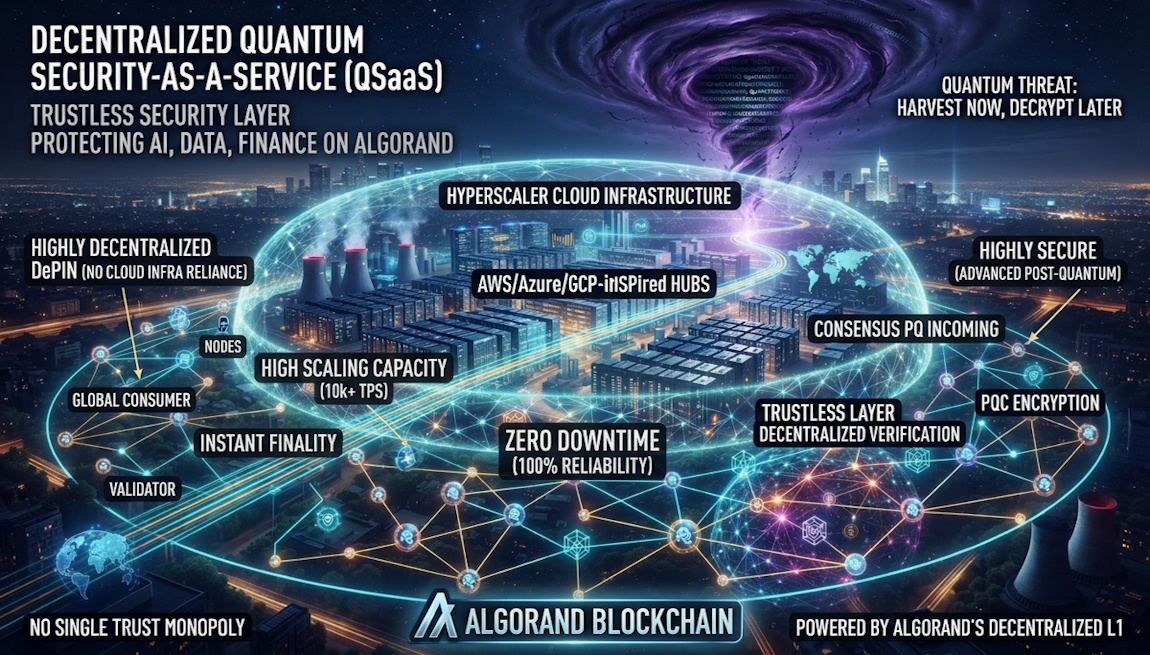
Quantum Security-as-a-Service (QSaaS) fits the hyperscaler narrative as a trustless security layer & DePIN hedge designed to protect data, AI workloads & financial rails from quantum decryption—without trusting a cloud monopoly with their cryptographic keys.
algorand:native


1. **Handshake** – Sends cryptographic identity, capability manifest (available sensors, computational resources, current models).
2. **Registry sync** – Downloads benchmark database (now 340 cases from 12 labs). Uploads own contributions (23 new cases from microfluidic experiments).
3. **Collaborative discovery** – Network detects a discrepancy: drag reduction data for shark‑skin riblets differs from another one by 12%. Joint investigation spawned.
4. **Meta‑analysis** – Universal Translator identifies the cause: used fresh water (pH 7), another used salt water (pH 8.2) — surface charge affects riblet efficacy.
5. **New invariant** – `{PH_VALUE}` added to the global knowledge graph.

No Single Point of Trust: How Distributed Key Generation Strengthens Rialo’s Cryptographic Infrastructure
In blockchain systems, private keys are more than cryptographic credentials - they represent control over assets, transactions, and network authority.
But relying on a single entity to generate and distribute a private key creates a critical security risk. Distributed Key Generation (DKG) addresses this problem by shifting key creation from centralized trust to collective cryptographic coordination.
For Rialo, DKG is a foundational building block for threshold signing and trust-minimized workflows.
From Centralized Keys to Distributed Control
Traditional key generation often relies on a trusted dealer to create a private key, split it into shares, and distribute them to participants.
The problem? That dealer may retain a copy of the complete key or become a single point of compromise.
DKG removes this dependency.
Instead of trusting one party, multiple participants collectively generate shared key material. Each participant holds an individual key share, while no single participant controls the complete cryptographic authority.
Threshold Cryptography: Security Through Collaboration
DKG provides the foundation for Threshold Cryptography, where a predefined number of participants must cooperate to produce a valid cryptographic output.
Consider a 3-of-5 threshold scheme:
-> Five participants hold separate key shares.
-> Any three can collaborate to generate a valid signature.
-> No individual participant can independently exercise the full signing authority.
This creates distributed control without requiring the complete private key to be held by any single party.
How Rialo Applies DKG
Rialo applies DKG as a foundation for threshold signing and trust-minimized workflows.
This approach supports a cryptographic infrastructure where signing authority is distributed rather than concentrated in one entity.
Its significance extends to:
-> Threshold Signing: Multiple participants collaborate to authorize cryptographic operations.
-> Distributed Authorization: Reducing dependence on a single key holder.
-> Trust-Minimized Workflows: Removing the trusted dealer from the key-generation process.
-> Adversarial Resilience: Exploring stronger protection against faulty or malicious participants.
Rialo also highlights the importance of making DKG more robust in adversarial environments, where participants may fail or behave maliciously.
The Bigger Picture: Trust Is Distributed from Day One
Threshold Cryptography distributes control over a secret. DKG ensures that this distribution begins at the very moment the key is created.
That distinction matters.
Security should not depend on trusting one entity to generate a key correctly and then distribute it honestly. The generation process itself must be decentralized.
Centralized Key Generation → Distributed Key Generation → Collaborative Cryptographic Control.
Rialo is building on this principle to support threshold signing and more trust-minimized blockchain workflows.
The goal isn't just to distribute keys. It's to eliminate the need to trust a single party with the power those keys represent.
@RialoHQ


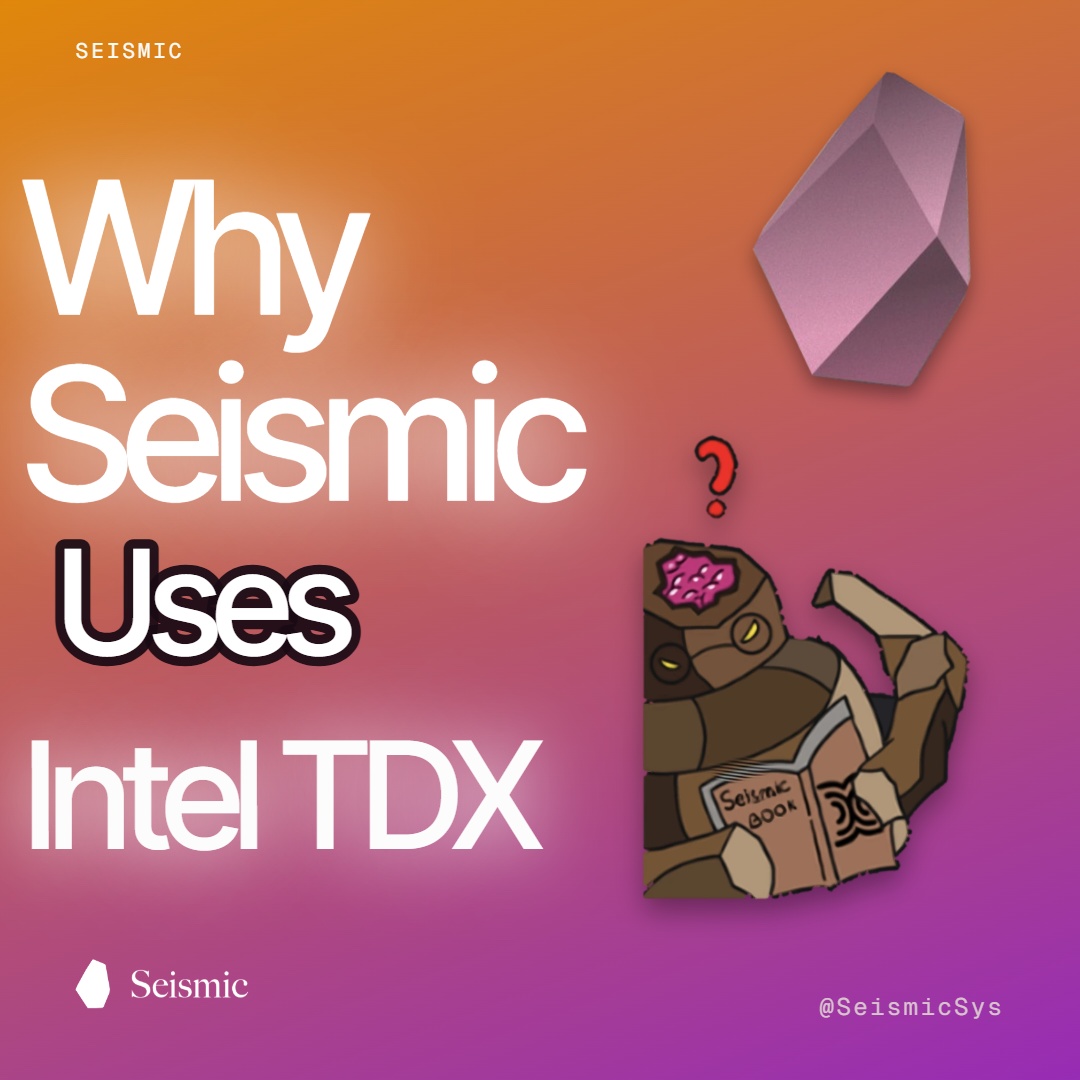
Why Seismic Uses Intel TDX ?
Intel TDX is an important part of Seismic's infrastructure.
It helps create hardware-isolated environments where sensitive execution data and cryptographic keys are protected from the host system.
For me, the interesting part isn't simply using trusted hardware. It's how @SeismicSys integrates that protection into its blockchain execution process.
This gives the network another layer of defense for confidential financial applications.
@NoxxW3 @heathcliff_eth @xealistt
2) @RialoHQ
leverages Shared Settlement Layers via Uniform Proof Verification Bridges. Instead of building bespoke bridges, rollups settle state transitions through one standardized cryptographic verification layer.

Most Popular Users

Elon Musk 
@elonmusk
240M followers

Barack Obama
@barackobama
118.6M followers

Cristiano Ronaldo
@cristiano
114.4M followers

Donald J. Trump
@realdonaldtrump
111.7M followers

Narendra Modi
@narendramodi
106.9M followers

Rihanna
@rihanna
98.6M followers

NASA
@nasa
92.1M followers

Justin Bieber
@justinbieber
91.7M followers

KATY PERRY
@katyperry
89.9M followers

Taylor Swift
@taylorswift13
83.9M followers

Lady Gaga
@ladygaga
75.4M followers

Virat Kohli
@imvkohli
73.3M followers

Kim Kardashian
@kimkardashian
70.8M followers

YouTube
@youtube
68.6M followers

Neymar Jr
@neymarjr
66.3M followers

Bill Gates
@billgates
65.2M followers

Selena Gomez
@selenagomez
63M followers

The Ellen Show
@theellenshow
62.1M followers

CNN
@cnn
61.7M followers

X
@x
60.6M followers