

Top Tweets for #DifferentThisTime

Reminder what can happen when you chase a hot IPO:
$RIVN solana:4yEjcMiy6GAgrpWpUvhUXfaP1vQmJXfqJjEyxBSZpump #differentthistime


Always appreciate a shoutout from Steve--one of the best accounts on here!
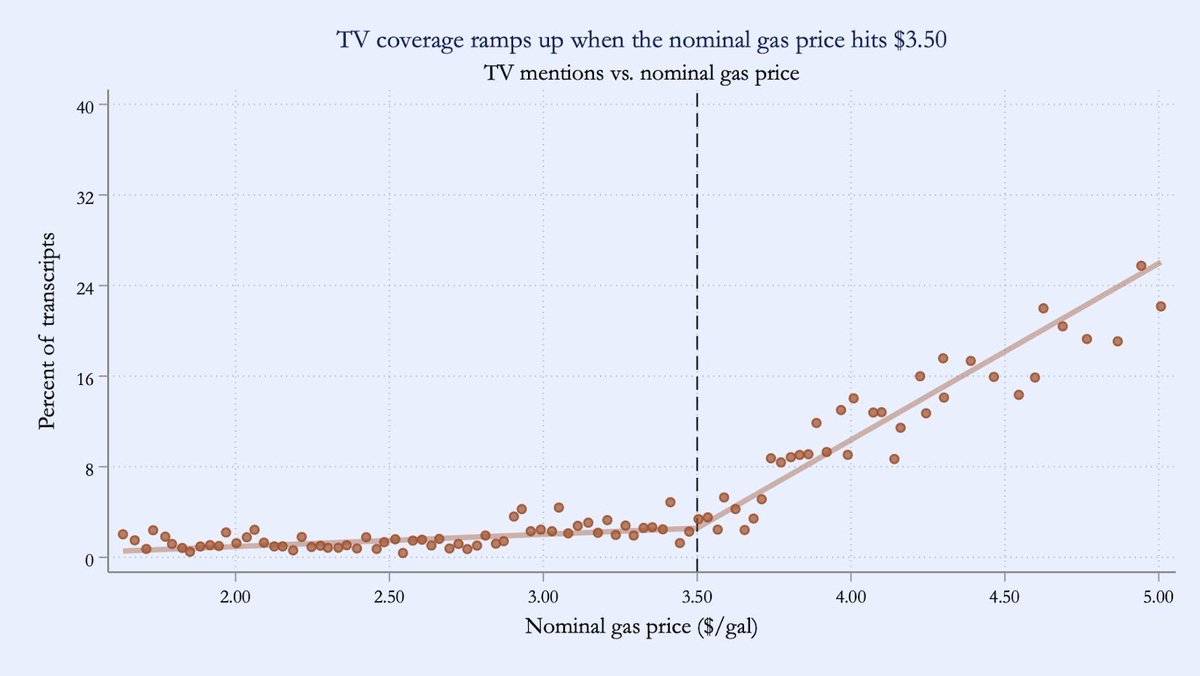
One thing that's #DifferentThisTime: the speed of the increases has led to a news cycle about gas prices well before $3.50/gal. I anticipate the # of stories will pick up speed as we surpass that.

Recall a great 2024 analysis by @weakinstrument giacomo fraccaroli and @nealemahoney on the US news media coverage and public salience of expensive gas prices around the nominal cut off of $3.5/gallon. If it holds, I think we may be about to see a lot this week.
Link below.

🇦🇷Lo que hicieron estos muchachos para (no) controlar el dólar es básicamente prender fuego toda la aldea para que la cucaracha que querían matar se les escape
#differentthistime

Will Bitcoin Treasury companies become the next Celsius or GYX?
Wanna know how an over-leveraged, rehypothecated bitcoin market craters?
Read this future history of the 2026 crash. We can’t say we weren’t warned.
#differentthistime #right? #RIGHT???

The House of Digital Cards
(A short story about Daniel F. Bernstein and his network of public companies that turned Bitcoin into a vehicle for rehypothecation, fraud, and global financial collapse.)
Bitcoin reached unprecedented heights in mid 2026.
The Los Angeles Bitcoin Conference in April had drawn over 40,000 attendees and mainstream publications ran cover stories about "Bitcoin's Financial Revolution."
Wall Street analysts loudly celebrated Bitcoin's successful integration into traditional capital markets. CNBC launched a daily "Bitcoin Business" segment. Multiple Fortune 500 companies announced exploratory committees for Bitcoin treasury allocation.
Financial publications featured glowing profiles of companies like Strategy, Nakamoto Holdings, Semler Scientific, Metaplanet, XXI, and others. These firms had pioneered what many called revolutionary treasury strategies: acquire Bitcoin, package it within complex equity structures, and watch shareholder value multiply.
Unlike the others, Michael Saylor had been brutally transparent from the start. While critics mocked him as an NGU maximalist, he never hid behind jargon or wrapped Bitcoin in convoluted instruments. Strategy’s playbook was public: buy Bitcoin, hold it long-term, and tell the world to do the same.
Saylor didn’t pitch himself as a proxy. Instead, he told everyone to self-custody, buy spot, and verify. His company wasn’t a hedge fund in disguise, it was a corporate balance sheet aligned with Bitcoin’s monetary properties, not manipulated for Wall Street arbitrage.
In contrast, Daniel F. Bernstein, CEO of Nakamoto Holdings and founder of Bitcoin Media Inc., appeared weekly on financial programs touting his "Bitcoin Exponential Growth Fund" that promised to "democratize Bitcoin exposure."
Bernstein’s proxy empire stretched across continents and asset classes, a synthetic web of low-float shells, convertible debt schemes, and Bitcoin-flavored equity wrappers designed to mimic conviction while extracting liquidity. From KDLY in the U.S. to CEP in Canada, Metaplanet in Japan, and shadow ties to TBG in Europe, every move followed the same blueprint: announce a Bitcoin treasury pivot, watch the stock pump, then monetize the mania with dilution, debt, and hype.
It wasn’t financial innovation at all. It was old-school grift dressed in orange, amplified by media platforms he controlled and legitimized by proximity to the luxry brand Bitcoin.
"Bitcoin is for everyone," Bernstein proclaimed on Bloomberg Television, grinning like a Cheshire cat, "but efficiently accessing it requires sophisticated financial architecture. That is exactly what we’ve perfected."
But warning signs about Bernstein had persisted for years. Bitcoiners on social media had consistently highlighted fundamental problems. Their messages focused on a singular truth, that these zombie corps had built a sophisticated, hyper-leveraged carry trade while claiming authentic Bitcoin conviction.
The structure might have been complex but the scam was simple.
Lisa Chen, Nakamoto's former risk officer, had tried raising alarms internally about unsustainable leverage ratios. After being dismissed in late 2025, she shared concerns with select journalists who found her claims "too technical" for their audiences. Financial regulators received multiple whistleblower complaints but classified them as "low priority" given the "innovative nature" of the business models involved.
"Look at the S-1 filings and bond covenants," wrote Richard “Dick” Greaser, credentialed journalist at The Bitcoin Bugle. "The convertible notes are tied to BTC price maintenance thresholds. The zero-coupon bonds are layered over total return swaps. The private investment structures all have hidden dilution triggers. None offer actual proof of reserves."
SEC examiners had flagged "unusual derivative structures" but approved disclosures after intensive lobbying. Congressional hearings in 2025 on "Bitcoin Innovation" featured Bernstein explaining how his company's approach would "make America the leader in digital asset monetization."
The critical questions oft-repeated across Bitcoin communities never received proper attention.
What happens when the market turns?
What’s backing the PIPE money besides hopium?
Why can’t they publish a simple proof-of-reserves?
Who controls the keys to this so-called treasury?
If they’re holding Bitcoin for the long term, why all the convertible debt?
How many times are they pledging the same coins?
Who exits first when the stock trades below NAV?
Is this a Bitcoin company or a fiat hedge fund with a Twitter strategy?
What happens when their stock crashes before they finish buying Bitcoin?
How much of this is owned by insiders and how fast can they dump?
On June 4 (what came to be known as "B Day") those questions were answered.
Nakamoto’s stock collapsed below key thresholds embedded in PIPE agreements and convertible covenants. Institutional investors rushed to protect positions, triggering automated selling protocols. The company attempted to maintain stability but found their capital reserves already locked in illiquid investments. Their emergency response involved selling Bitcoin reserves to preserve operational funds. Within 48 hours, they released 120k Bitcoin into the open market.
Sarah Miller, a 34-year-old teacher from Ohio, watched her $110,000 retirement investment in Nakamoto shrink to $12,000 in a single day. "They said it was like buying Bitcoin but safer, without any of the risk," she told reporters. "I feel so dumb but I trusted them."
Once the first major Bernstein-linked firm collapsed and sold Bitcoin into a falling market, the rest of the so-called “Bitcoin proxy” corps faced two brutal forces at once: equity implosion and liquidity evaporation. These companies weren’t siloed, they were perfectly synchronized.
Metaplanet opened to significant losses on Asian exchanges. Market sentiment turned radioactive. Their debt architecture, constructed on assumptions of continuously rising Bitcoin prices, transformed into a liquidation mechanism. Financing options disappeared. Previously attractive warrants lost all value. Impending debt obligations forced further Bitcoin liquidation. Warrant holders walked away. Their zero-coupon debt became a noose. Bond buyers were banking on equity upside to repay principal. That path vanished. Refinancing failed and then they started unwinding BTC.
The contagion spread to TBG's operations in European markets. The innovative Bitcoin-denominated bond structure that had attracted so much attention became an unsustainable liability. Their previously celebrated share price metrics now accelerated their downfall. More Bitcoin entered the market.
CEP saw the fastest collapse. Retail had been chasing it like a low-float meme coin. When liquidity disappeared, there was no one left to catch the bid. They panic sold any exposure they had. The drop spread to all Mallers-linked entities.
"It's the 2008 subprime crisis in digital form," noted economist Paul Krugman. "Leverage on leverage on leverage, with Bitcoin as the underlying collateral."
“It’s tulip mania with a Twitter handle,” sneered Peter Schiff. “They took the most volatile asset on Earth, wrapped it in junk bonds and startup stocks and called it sound money. This wasn’t a treasury strategy. It was a liquidity trap waiting for a spark. I tried to warn everyone to just buy gold.”
On-chain analysts tracked over 1M BTC moving from known proxy company wallets to exchange addresses within 72 hours. It was a liquidation wave so large it couldn’t be absorbed without systemic damage.
By Friday, approximately 2M Bitcoin had flooded exchanges with insufficient order depth. The price plummeted from an already-decimated $84,000 to $44,500. Major exchanges implemented emergency protocols. Custodial services rushed to verify reserve integrity. OTC trading ceased. Liquidity vanished across trading platforms. Bid-ask spreads widened by thousands of dollars. Market makers rapidly withdrew their support from volatile trading pairs.
CEP suspended all trading. Moon Inc. abandoned its announced Bitcoin treasury plans. SMLR quietly removed Bitcoin references from investor materials. Even Strategy shares lost nearly seventy percent of value within days. Their substantial debt obligations remained while the premium valuation needed to service them vanished. At-the-market financing options disappeared completely. Treasury coverage ratios dropped below critical thresholds. Internal margin shortfall warnings triggered throughout the organization.
The collapse rippled globally. Japan's SBI Holdings froze Bitcoin-related product development. The Central Bank of Nigeria paused its digital currency project citing "market instability." El Salvador's Bitcoin bonds traded at 24 cents on the dollar. Argentina's newly established Bitcoin reserves lost 62% of their dollar value.
Social media platforms filled with comments from Bitcoin advocates who had predicted this outcome:
"They never held Bitcoin. They exploited it." "Corporate rehypothecation wrapped in tech aesthetics." "Not Bitcoin adoption but tradfi wearing digital camouflage." "Bernstein reconstructed the paper gold system for the digital age, and investors applauded until the collapse."
The irony was palpable. "You want to own Bitcoin?" a gushing Bernstein had proclaimed on stage at the LA conference. "You'll buy it from us."
That statement now read like an admission rather than a promise.
The same financial news programs that had featured Bernstein as a "blockchain visionary" now ran segments asking "Has Bitcoin Failed?" CNBC's Jim Cramer, who months earlier had advised viewers to "get exposure through Nakamoto," now declared "Bitcoin companies were always smoke and mirrors." The Wall Street Journal, which had published "Bitcoin's Wall Street Moment" as Nakamoto hit record valuations, now ran "The Bitcoin Bubble: How We All Missed It." Attached to every segment were zoomed-in images of the ever-grinning Bernstein.
Regulatory investigations began in multiple jurisdictions. Internal documents revealed that Bernstein had constructed a complex international system that used Bitcoin advocacy as cover for aggressive financial engineering. A whistleblower leaked damaging Slack messages showing Bernstein writing:
"If KDLY trades at a 20% premium, we dump into it. That's the play." "Nobody cares about cold storage. They care about multiple expansion." "Retail doesn't understand the mechanics. That's our edge."
Financial journalists began referring to the crisis as "Bernstein's Bitcoin Bubble." Congressional committees scheduled hearings. Multiple legal firms filed investor lawsuits representing thousands of retail shareholders. Federal prosecutors confirmed "active investigations into executive conduct related to Bitcoin treasury operations."
Asked from the White House, the President didn’t have much to say. “Look, I barely know the guy. Met him once, maybe twice,” the President said. “Desperate to be near power. Has nothing to do with me. Total embarrassment. I hope justice is swift and I think it will be.”
The public's ire wasn't directed solely at Bernstein. His charismatic young protégé, Dillon LeCroix, with his trademark styled hair and expensive designer outfits, had become the face of their operation on the conference circuit. LeCroix had charmed investors on CNBC, Fox Business, and Bloomberg with confident predictions of "Bitcoin's financial renaissance through smart leverage" and his trademark “Bitcoin is corporate rocket fuel.” Now, his social media accounts were flooded with angry messages from devastated investors who had trusted his polished presentations and now wanted justice.
While many executives disappeared from public view, Michael Saylor took a different approach. In a surprise move, he conducted an emergency livestream where he opened Strategy's books completely. "Transparency is non-negotiable in this industry," he declared. Saylor revealed his company had maintained proper Bitcoin reserves through the downturn and provided Proof of Reserves for their holdings. "We never rehypothecated a single satoshi," Saylor stated firmly, looking straight into the camera. "And we never will."
"What separates speculation from investment is time horizon and leverage," Saylor explained. "We always viewed Bitcoin as a 100-year treasury reserve asset, not as financial engineering material." His approach focused on simple acquisition and secure storage, contrasting sharply with Bernstein's complex derivatives structures.
In contrast, Bernstein deactivated all social media accounts after a final post whining that he was being "scapegoated for market conditions."
The price of Bitcoin slipped further to $27,200 before finding temporary support. For days, the order book resembled a graveyard. Fear replaced conviction across markets. Every price bounce was met with immediate selling pressure. Mining companies liquidated holdings. Investment funds reduced exposure. The Bitcoin treasury companies that had positioned themselves as visionary leaders sold their holdings first and most aggressively.
As markets stabilized, a notable exception emerged. Strategy, under Saylor's leadership, began carefully accumulating again at lower prices. Their transparent approach to Bitcoin treasury management gained newfound respect. "The difference between using Bitcoin as a prop for financial engineering and holding it as a reserve asset has never been clearer," wrote The Financial Times in an analysis piece that praised Saylor's long-term vision while condemning Bernstein's schemes.
The Bitcoin price eventually stabilized around $17,700, but significant damage had occurred beyond price movements. Public perception had fundamentally shifted. The narrative surrounding Bitcoin suffered serious deterioration. The trust Bitcoin had accumulated through years of operation was compromised not by critics but by supposed advocates.
Long-term Bitcoin supporters continued their steady accumulation strategy, committed to fundamental principles. "This is why we fought so hard against wrapped Bitcoin products and Bitcoin ETFs," explained developer Adam Back. "The further you get from the actual protocol, the more risk you introduce."
A new meme began circulating across Bitcoin communities: "Rebuild. Verify. Remember."
"We told you 'not your keys, not your coins,'" wrote one prominent advocate, watching prices continue to decline. "We told you Bitcoin isn't meant to be collateral, it's the escape from collateral."
Six months later, the SEC introduced the "Cryptoasset Reserve Transparency Act," informally known as "The Saylor Rule," requiring companies holding Bitcoin to provide Proof of Reserves. The legislation cited River Financial as a model, which had pioneered regular Proof of Reserves attestations starting in 2024. The legislation marked a turning point in institutional Bitcoin adoption.
By year's end, a remarkable shift occurred. Several major financial publications ran lengthy features contrasting Bernstein's approach with Saylor's. The Wall Street Journal published "Saylor's Vindication," highlighting how Strategy's transparent Bitcoin strategy had withstood the crisis while the leveraged proxies collapsed. Saylor was invited to testify before Congress about responsible Bitcoin treasury management, where he advocated for stronger proof-of-reserves requirements.
The fundamental truth became clearer with each passing day: Bitcoin itself hadn't collapsed. What failed was fiat currency wrapped in Bitcoin aesthetics.
As the dust settled, a stark reality emerged. The only real losers were those who had blindly followed Bernstein. Meanwhile, Strategy and individual Bitcoin maximalists who had maintained self-custody of their Bitcoin in cold storage not only preserved their wealth but ended up owning even more Bitcoin. Everything sold in panic by Nakamoto Holdings and similar companies was quickly gobbled up by those who understood Bitcoin's long-term fundamental value proposition.
Daniel F. Bernstein emerged the target of a sweeping federal investigation. His assets were frozen. Former allies sang like canaries. What was left of his empire got ripped apart by clinical forensic accountants and rabid prosecutors with endless subpoenas.
The man who sold Bitcoin as a service was now lawyered up, silent, and waiting for the knock on the door.
"In the end, this was the greatest transfer of Bitcoin from weak hands to strong hands in history," noted one Bitcoin analyst. Strategy's holdings increased by nearly 40%, while on-chain metrics showed that Bitcoin maximalists had also significantly expanded their positions during the downturn.
Everyone laughed and called them crazy but when the smoke cleared and the lies were gone, the only ones holding real Bitcoin were the ones you said were too toxic.

FED'S GOOBERSBEE:
REPEATS DOESN'T WANT TO RULE OUT MARCH CUT
WON'T SPECULATE ON POTENTIAL FOR 50 BPS CUT
STRONG JOBS DATA DOESN'T NECESSARILY MEAN
OVERHEATING INVERTED YIELD CURVE NOT RELIABLE RECESSION SIGN NOW
#Transitory #DifferentThisTime

Finally. A meme that shows why people trade hogs #differentthistime


Yesterday’s spring chicken. #spring #painting #watercolour #springtimedepression #differentthistime #chronicpainter #thend #owindifwintercomes


@WallStCynic And recall Jim, I am sure you do, MSFT/CSCO revs 4x increase 2000-2015, MSFT stock flat, CSCO stock -50%.
#differentthistime


Unsustainable, this cannot go on much longer…😅

people are always so horny for a banking crisis. It's not 2008 and you are not in the big short anon.




There are a bunch of arguments you could make as to why this time is different.
But higher short-term yields take some air out of the argument for investing (vs saving)

Curve inverts again...probably nothing though.


"The second half is going to really be a story of how quickly inflation cools," says @fundstrat. "I just think the risk/reward is so much stronger."

Hey David enjoyed your interview! I hope our legislators (R&D) listen closely! They are on notice…#DifferentThisTime #MarchForOurLivesJune11 See you there, Sandra ✌️☮️

I’m on MSNBC right now
V shape is coming beras, save your capital for another day, the maximum allowable time for downtrend is overextended, it is not #DifferentThisTime…
Last Seen Hashtags on Sotwe
تانجو_برايفت
Seen from India
aydınmerkez
Seen from Turkey
cnc filter:native_video
Seen from Greece
gizliçekim
Seen from Turkey
gymgirl
Seen from Pakistan
黄播
Seen from United States
painful anal
Seen from Germany
incest() +filter:native_video
Seen from Turkey
mom son
Seen from Turkey
bwc
Seen from United States
Most Popular Users

Elon Musk 
@elonmusk
241.5M followers

Barack Obama
@barackobama
118.8M followers

Cristiano Ronaldo
@cristiano
114.5M followers

Donald J. Trump
@realdonaldtrump
111.9M followers

Narendra Modi
@narendramodi
107.1M followers

Rihanna
@rihanna
98.7M followers

NASA
@nasa
92.3M followers

Justin Bieber
@justinbieber
91.8M followers

KATY PERRY
@katyperry
90M followers

Taylor Swift
@taylorswift13
84M followers

Lady Gaga
@ladygaga
75.5M followers

Virat Kohli
@imvkohli
73.5M followers

Kim Kardashian
@kimkardashian
70.9M followers

YouTube
@youtube
68.8M followers

Neymar Jr
@neymarjr
66.5M followers

Bill Gates
@billgates
65.3M followers

Selena Gomez
@selenagomez
63.1M followers

The Ellen Show
@theellenshow
62.2M followers

CNN
@cnn
61.7M followers

X
@x
60.7M followers