The ugly truth about France and some of the other European countries currently in turmoil - and which none of the politicians want to admit because it'd be political suicide - is that you can't solve the problem by going after immigrants (as the right asserts) or the rich (as the left asserts), but you could solve it by going after the old.
One extraordinary statistic for you: people over 60 in France, a quarter of the population, own 60% of France's wealth, non-financial and financial (https://t.co/IdJ5X7OO12).
And here is another crazy statistic:
that same quarter of the population, those above 60, receive nearly two-thirds of all social spending by the French government (https://t.co/deNRNevIwq) - which is famously among the highest in the world (France's government spending is an insane 57.3% of GDP).
Last statistic: they make up about 40% of voters because they're a third of registered voters (https://t.co/zTa4RnVOmT), and they turn out far more than anyone else (https://t.co/34V2xzs9jH).
Put our 3 statistics together and there's almost a bit of an apartheid situation here: the old own most of the country's wealth, collect most of the social spending and have the political power to keep it that way.
Which makes them a de-facto rentier class, living off assets and transfers paid for by younger generations.
And, of course, at the risk of stating a truism, the future is built by the young. Yet France keeps effectively taking money away from them to give it to those whose working lives are already behind them - and need the money far less since they already own the country's wealth.
What about inheritance, I hear you ask? That's the funniest/saddest aspect: given that life expectancy has kept rising, the French now inherit a home at 54 on average. The most common case is someone in their 80s leaving it to heirs in their 50s, in effect the very old transferring wealth to the about-to-be old (https://t.co/d2RPAqLJGR).
You can add this to our earlier apartheid statement: on top of all the rest, even when the old finally let go of their wealth, it stays within their own "camp".
That's my personal situation, incidentally: I'm 42, my father is 71 and he is starting to look at ways to pass things on to me and my siblings, when our professional lives are already well settled, so it'll arrive when it changes things the least, which is pretty much the French system in a nutshell.
Now, I get that there'd be some unfairness in going after them: they paid into the system their entire working lives, playing by the rules of a social contract that told them if they paid up they'd collect at the end. Changing the rules now means breaking that promise, which is admittedly unfair.
But there's no magic wealth tree in any society: you can only take it where it is. That's the way most major societal transformations end up happening. They're often triggered by a catastrophic event (the so-called "four horsemen": mass-mobilisation war, revolution, state collapse, plague) BUT what really drives change is a transfer: wealth gets pried from the privileged class who've been sitting on it and handed to those who'll build what comes next.
So, in theory and in an ideal world, you can do without the catastrophic event and directly proceed with the transfer...
The fact that in France, and elsewhere in Europe, it's the youth protesting is probably no coincidence - even though they don't frame it as a generational fight. And even though, cruel irony, the left politicians many of them march behind promise to bring the retirement age back to 60 (https://t.co/WrJOhpWqYR), which would make the situation even worse.
Let's say they understand intuitively that the system is stacked against them, even if they haven't yet figured out how. And politicians are obviously doing what politicians do, meaning pandering to the people who actually vote, while pointing the young towards easier - and politically convenient - scapegoats.
To be clear I'm not saying it's the only problem in France, VERY far from it. I'm also not saying that all old people in France live a lavish lifestyle at the expense of younger generations: there are also plenty of very poor retirees who, if anything, would deserve more.
What I am saying is that it's probably the biggest elephant in the room: everyone can see it, nobody dares mention it - no politician, from any side, wants to run on cutting grandma's pension - and it makes every other problem harder to fix.
So Humanities’ best preservation strategy is to be interesting enough, and cute enough that we are preserved and flourished by Super Intelligence.
We def don’t want to be ants to them. Is it better to be cherished companions like dogs and cats or left alone and observed like chimps?
@moninvestor People gonna redo the whole house to match the season. 3D print all new furniture for your next dinner party. Pace of Change gonna go through the roof.
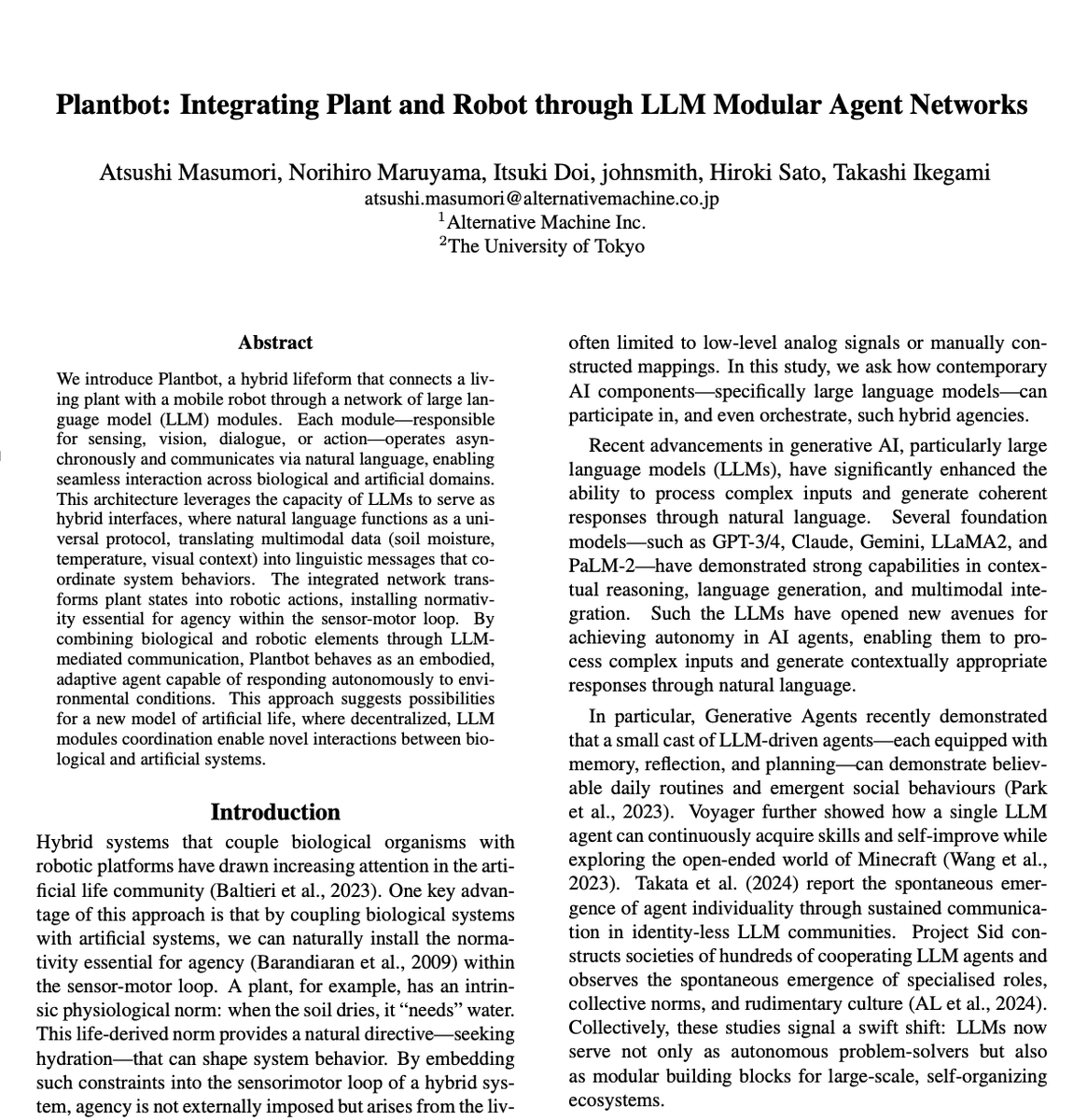
Researchers connected a living plant to a robot.. and it can now talks, walks, and knows what it wants.
They call it “PlantBot”
They took a living plant and fused it with a mobile robotic body.
To connect them, they used a decentralized network of LLMs to act as the central nervous system.
Here is the genius of it:
Biological organisms and machines operate on entirely different planes. Historically, bridging them required rigid, low-level analog signal mapping.
This paper entirely abandons that approach.
Instead of hard-coding signals, the system translates everything, soil moisture, pH levels, temperature, and visual data, directly into natural language.
The plant doesn’t just output data. It uses LLMs to "talk" to its robotic body.
The architecture is wild:
• A network of AI agents operates asynchronously to handle vision, sensing, and movement.
• Multi-channel probes read the plant's health, while LiDAR and cameras scan the room.
• The LLM translates these biological needs into physical actions in real-time.
• The plant actually interacts with humans and navigates the world as a cohesive, autonomous entity.
The LLM is no longer just a chatbot.
It is a biological-mechanical translator.
By mediating communication through natural language, they gave a houseplant autonomous agency in the physical world.
We’ve been obsessing over AIs trapped in servers or humanoid robots mimicking people.
We completely missed the possibility that AI might become the connective tissue bridging organic life and machines.
The next era of artificial life won’t just be silicon.
It’s going to be a hybrid.
Jeff’s not wrong. If it’s power vs advanced chips, China has a lot more power and can do a lot of AI w/o the most advanced chips. US can lead on chips, but if we lag on power, we’re in trouble.
If we take the view that power becomes the ultimate bottleneck, the capex optimization constraint shifts to the one input China has in greater abundance vs US (who has relatively more chips)
Then if you take the view that global token spend increasingly flows to cheap power and open weights, spot market is likely where China’s marginal impact would show up first via token dumping, esp if the future of work is mostly inference based not training (which also requires excess capacity with lower utilization rates)
So the compute forward curve actually becomes an epic industrial duration battle where China competes at the front end and the US holds the long end. The question then becomes who is the dog and who is the tail, and which strategic advantage will roll down the curve faster- chips or power? I think anyone who understands the leverage of depreciation knows the answer.
In other words this is a warning to US policymakers: the long end of the compute curve was never really about contracted chips security. It’s about energized megawatts and that’s basically the one duration the US is shortest vs its biggest geopolitical rival
@OurWorldInData@_HannahRitchie Yet clean abundant energy unlocks indoor aeroponic farming. So organic farming can be very high density, and grow plants directly in urban high rises. As this rises, expect these impacts to change.
Finally found some time to test Grok Bot.
I asked it How could cheap access to space, asteroids in our Solar System, and the Sun’s energy change the world?
Then I took the output and used Opus for some finishing touches, (mostly changing the voice and adding some text effects).
I like the result. I'll probably use this combo for future videos.
Two AIs working together produce more impressive videos than each of them alone.
One model, used by just a few scientists, and look at what we've already achieved:
New counterexamples to a nearly 60 year old plasma physics conjecture.
Five novel, lab verified enzymes designed in hours.
A genetic rearrangement that routine software had missed for years.
Nearly doubled quantum error decoding throughput and over 100x lower spacetime costs for a key quantum subroutine.
and we’re so early....Imagine the pace of progress in 2027...
This is wild! Not only will we have modified animals, but animal-android hybrids. Imagine what ants, birds, or fish could do for us when they’re bio service animals for sensing, surveillance, and operations?
Warhound, a defense‑tech startup founded by Palmer Luckey and Ben Lamm, has raised $200 million in seed funding to genetically engineer war dogs for the U.S. military.
Lamm is responsible for the de-extinction of the dire wolf which died out ~10,000 years ago.
Warhound will find top dogs and then biobank their genetic material before cloning the proven dogs.
The company will take the cell lines for top breeds like Belgian Malinois and German Shepherd before editing the genes to make the dogs perform better and improve “things like speed and agility or enhance olfactory sensors for bomb sniffing and whatnot.”
Luckey’s Anduril will supply the dogs with advanced body armor, ear coverings, and other military technology like EagleEye, an artificial intelligence military helmet.
Anduril is also reportedly working with META on battlefield augmented reality eyewear.
Lamm says the genetically modified dogs with advanced equipment will not only make the dogs safer, but will also make the human handlers safer.
The first Warhound puppies will reportedly soon be cloned and incubated and will be born in early 2027 and then will begin training.
Q3 Shareholder Update → https://t.co/u0UcDOuMNa
Highlights
– FSD Supervised attach rate grew to over 75% of new vehicle deliveries in NA
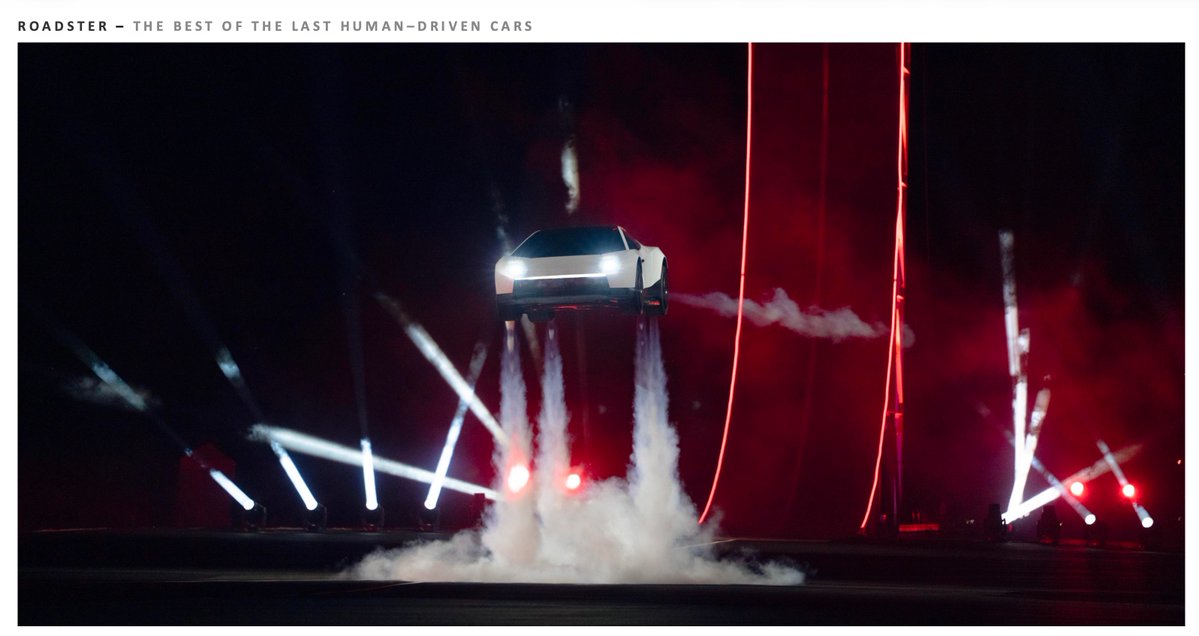
– Unveiled the next-gen Roadster
– Record deliveries in Canada, Australia, Japan & Taiwan
– Tesla Semi now in volume production. Top variant can go up to 500 miles at a full 82,000 lbs while achieving efficiency of 1.7 kWh/mile – about a third of the energy a comparable diesel truck burns for the same load
– Ended the quarter with the largest backlog for our passenger vehicles in 4 years!
FSD Supervised
– 4 new approvals since Q2 (Croatia, Slovenia, Czech Republic, Slovakia)
– FSD is now live in nine EU countries & used by over 100,000 customers logging more than 160 million kilometers since initial approval
Robotaxi
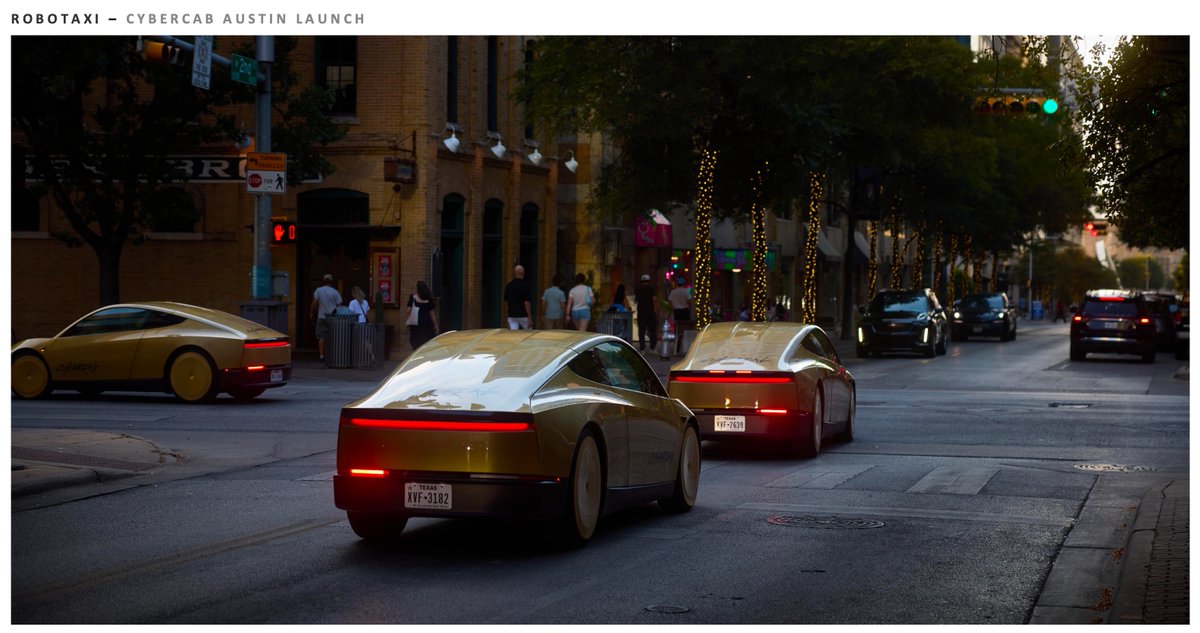
– Deployed Cybercab into our Austin fleet
– Hit nearly 2 million cumulative unsupervised miles, 8x growth in the quarter
– Austin service now runs 6 am to midnight, with wait times continuing to come down as we add cars & improve the orchestration algorithms
– Added Grok to Cybercab with Grok Bot & Connectors, letting you interface with your inbox, calendar, files, chats and tasks, all by voice.
Transport, office & living room in one
Robotics
– Started production of @Tesla_Optimus on our high-volume lines in Fremont.
These are the first production-quality bots we've built, proving that the current manufacturing process for Optimus is suitable for a commercial product
SI Compute
– On track for 400 MW of training compute by year end, feeding both vehicle & humanoid autonomy
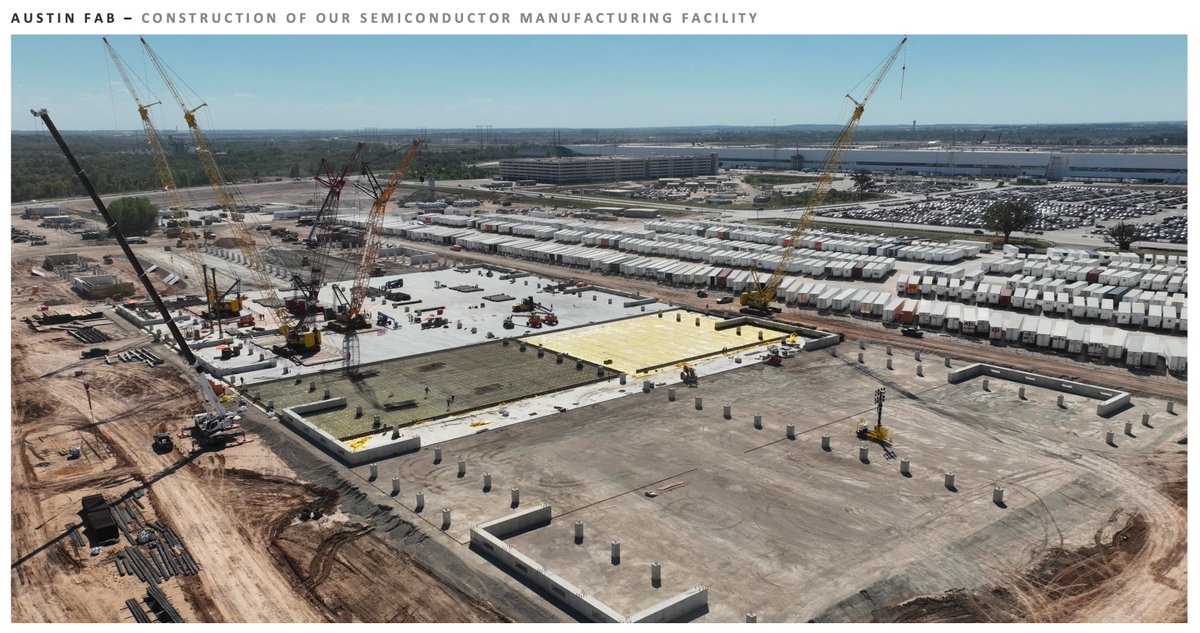
– Austin Fab construction continues, equipment commissioning planned for 2027
Battery
– Battery supply is still the limiter on how fast we ramp vehicles globally, so we're expanding on every front: pack capacity in Berlin, cathode and lithium refining in Texas, LFP cells in Nevada
– Shipped the first Megapacks built entirely with our own LFP cells
– Increasing 4680 output to support ramp of Cybercab, Semi & Model Y
Energy
– Megafactory Texas is up & running, with Megapack 3 production started
– Highest-ever order rate & backlog for energy storage
Grid constraints & power availability are making Megapack the answer for SI infrastructure demand: it excels at supplying large data center loads, smooths out demand spikes, helps new projects meet grid connection rules & makes the grid itself more stable
All with less local fossil fuel generation
Supporting Infrastructure
– Added 2,100+ net new Supercharger stalls, up 14% year over year
Last month, we demonstrated high-rate alchemy: turning mercury into real, stable gold, beating CERN’s record by a factor of 10.
Last week, we enriched isotopes in the world’s most powerful plasma centrifuge, beating the Soviet record that stood for 40 years.
Now, we’re building a fusion reactor in San Francisco to achieve record power density.