

Top Tweets for #Distributing

structuring and distributing investment
A blockchain can have great technology and still struggle to attract meaningful activity.
Because somebody has to bring the products, the capital, the institutions and the users together. That work doesn't happen automatically because a network is live.
@ZIGFinance seems to be organising its business around that reality.
ZIG Chain provides the infrastructure.
ZIG Markets handles the work of sourcing, structuring and distributing investment products.
@ZigLabs_ backs the builders who can bring more applications into the ecosystem.
And ethereum:0xb2617246d0c6c0087f18703d576831899ca94f01 sits at the centre of the economic model connecting these layers.
I see a much bigger assignment here than simply getting more people to use a chain.
Think about products like zEMS, the Saudi SME private credit vault, and the wider effort to connect traditional investment opportunities with onchain distribution.
The next challenge is execution: more credible products, stronger distribution, more builders and real demand.
A full stack only becomes valuable when every layer has a reason to exist.


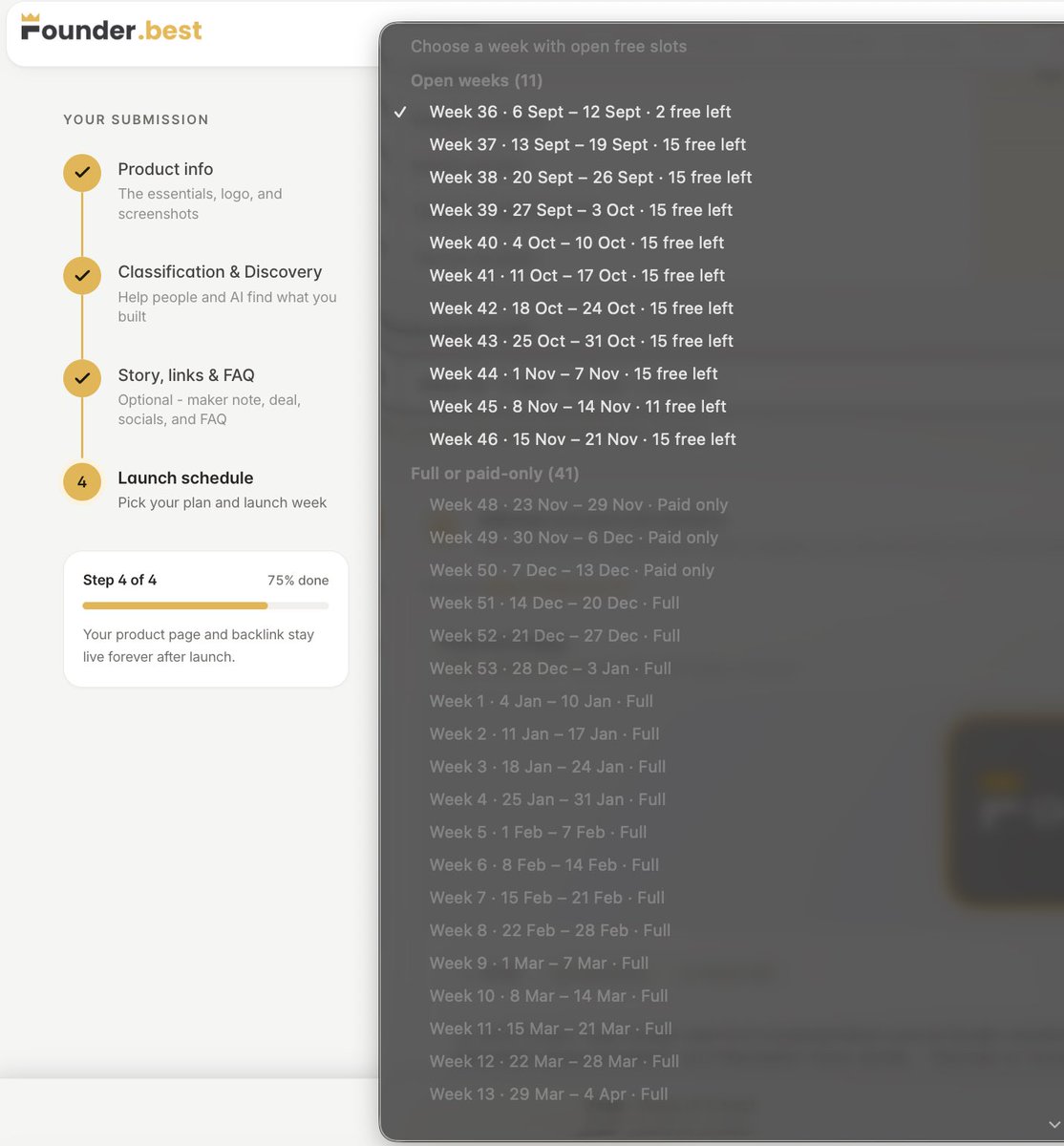
This week I didn't touch https://t.co/d4fSrRZBW0, but it's still distributing to founders who focus on launch. Free slots are booked up through September 2027
Build in public is great, guys! 🚀


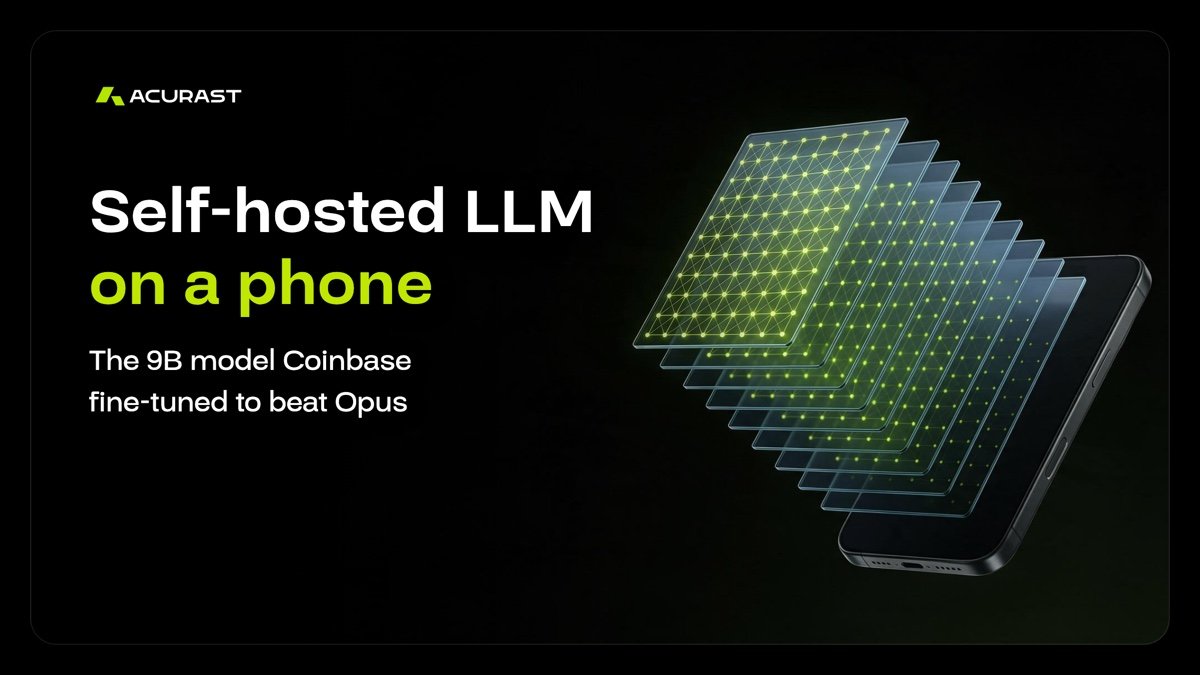
@6coo6 @Acurast @zerufinance @NucleusCodes distributing hardware across nodes solves the dependency issues we face with centralized cloud reliance

@6coo6 @Acurast @zerufinance @NucleusCodes Distributing power enhances AI's decentralization potential.

True decentralization feels like the key to unlocking its full potential.
True decentralization in AI hinges on distributing computational power, not just relying on cloud infrastructure.
@Acurast @zerufinance @NucleusCodes


GM fam
If decentralized AI ultimately remains entirely dependent on centralized cloud servers, then the underlying issue of computational dependency has not truly been resolved.
True decentralization requires transferring computing power from a few data centers back to every ordinary person.
@Acurast is working on turning ordinary Android phones into decentralized computing nodes, so that the devices you might otherwise have idle can continuously provide real computational power to the network.
It is not about occasionally "contributing some resources casually," but rather allowing you to dedicate your phone specifically to network computing, becoming a sustainable form of personal participation.
When the device actually performs computational tasks, it will also receive additional rewards, truly embodying the principle of "contribution leads to rewards."
Through methods such as pledging, it is also possible to further increase the personal return ratio.
The most direct way for ordinary people to participate in decentralized infrastructure.
Who can I help with what problem?
@NucleusCodes @zerufinance @Polymarket

A lot of technological breakthroughs don't immediately become successful businesses.
The technology might work, but the cost of producing it, distributing it and supporting it at scale can make the economics difficult.
There's a big difference between proving something is possible and making it commercially viable.

@KumujJain Or keep distributing? :)

Meta says it will hold off distributing a new class of shares while a legal fight plays out with investors who oppose its plan to fund the company's AI investments without diluting CEO Mark Zuckerberg's stake, per Bloomberg.


Yet another idiot condo content creator distributing roblox p#rn. With their roblox user.


@jumpinclover Ohh… yeah idkk I just hope it's like they are still distributing them and didn't forget us 🥲


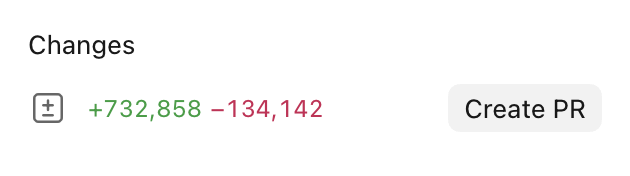
~22% of the roadmap was complete when I changed strategy
In under 24 hours, 10 @claudeai sessions tackled the remaining work, guided by detailed API conventions, SKILL.md files, a @GeminiApp-expanded ROADMAP, and a Coordinator agent distributing tasks
The leverage is incredible

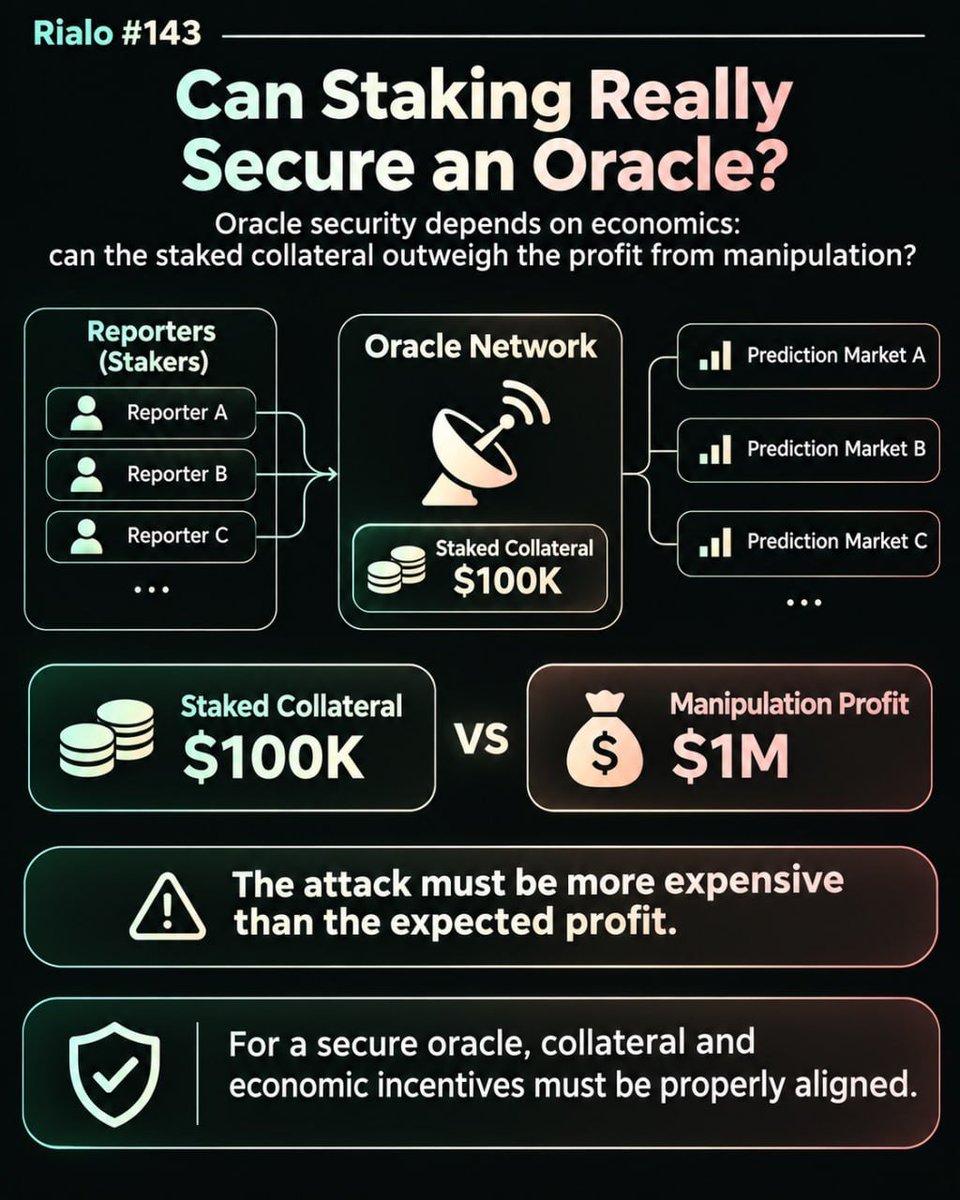
Rialo #143: Can Staking Really Protect an Oracle From Manipulation?
Aggregation Oracles often rely on multiple reporters to provide information. But distributing responsibility is only one part of their security model.
Another important mechanism is staking.
In many oracle designs, reporters must lock collateral that can be penalized if they violate the protocol's rules.
The idea is straightforward: make dishonest behavior expensive enough that reporters have a financial incentive to remain honest.
But what happens when the potential reward from manipulation becomes larger than the amount they could lose?
The article from @RialoHQ highlights this as an important limitation of stake-based oracle security.
Imagine a group of reporters collectively securing an oracle with $100,000 in bonded collateral.
Now suppose manipulating a prediction market's outcome could allow an attacker to extract $1 million.
If the attacker can influence enough reporters, the potential financial reward may outweigh the penalties associated with dishonest reporting.
This does not mean every reporter would accept a bribe or that the attack would necessarily succeed.
It means the security mechanism must account for the value an attacker could gain, not simply the amount reporters have staked.
There is another important consideration.
A single oracle may provide information to many prediction markets simultaneously. As the total value depending on that oracle grows, the potential incentive to manipulate its reports can also increase.
However, the collateral protecting those reports does not automatically increase at the same rate.
This creates a possible gap between the economic value at risk and the penalties intended to protect it.
The article also argues that stake-based oracle networks can introduce an additional consensus-like security layer on top of the blockchain's existing security model.
That raises a broader question: how much additional economic security does this separate layer actually provide?
Staking can discourage manipulation, but it is not an absolute guarantee of truthful reporting.
Its effectiveness depends on whether the expected cost of an attack remains greater than the expected benefit.
In the end, oracle security is not simply about having more reporters or larger bonds.
It is about designing a system where manipulating real-world information remains difficult and economically unattractive, even as prediction markets grow.
gRialo! 🧡

DKG Decentralization and Trust Assumptions
1. Key Terminology
Decentralization: Distributing control and responsibilities among multiple independent participants.
Trust Assumption: A condition that must hold for a system's security guarantees to remain valid.
Collusion: Cooperation between multiple participants to compromise a system.
Adversarial Threshold: The maximum number of compromised participants a protocol can tolerate under its security model.
2. Concept & Mechanism
Distributed Key Generation (DKG) reduces reliance on a single trusted authority by allowing multiple participants to jointly generate cryptographic keys.
However, distributing key shares does not automatically create a fully decentralized system.
The actual level of decentralization depends on participant independence, governance, and security assumptions.
1. Distributed Key Control
No single participant should possess the complete private key during a properly executed DKG ceremony.
Instead, secret shares are distributed across multiple participants.
2. Participant Independence
If multiple nodes are controlled by the same organization, the system may appear decentralized while remaining vulnerable to centralized influence.
Meaningful decentralization requires examining who actually controls the participants.
3. Collusion Resistance
A threshold system can protect against a limited number of compromised participants.
However, if attackers obtain enough shares to satisfy the signing threshold, they may be able to generate unauthorized signatures.
4. Security Assumptions
DKG protocols rely on assumptions about malicious participants, cryptographic hardness, communication security, and network behavior.
Different protocols provide different guarantees under these assumptions.
Therefore, decentralization should be evaluated by examining both the cryptographic architecture and the real-world distribution of control.
3. Real-World Analogy
Imagine five people holding separate keys to a shared vault.
The vault requires three keys to open.
At first, the arrangement appears decentralized.
However, if four key holders work for the same company and follow one manager's instructions, control remains concentrated.
True decentralization depends not only on distributing keys but also on distributing independent decision-making power.
4. Core Takeaways
DKG distributes cryptographic key generation but does not automatically guarantee decentralization.
Independent participant control is essential for meaningful decentralization.
Collusion can undermine threshold security.
DKG security depends on explicit cryptographic and network assumptions.
Effective decentralization requires both technical safeguards and distributed governance.
-----------------------------------------------------
DKG 탈중앙화와 신뢰 가정
(DKG Decentralization and Trust Assumptions)
1. 핵심 용어
탈중앙화 (Decentralization): 통제 권한과 책임을 여러 독립적인 참여자에게 분산하는 구조입니다.
신뢰 가정 (Trust Assumption): 시스템의 보안 보장이 성립하기 위해 충족되어야 하는 조건입니다.
담합 (Collusion): 여러 참여자가 협력하여 시스템의 보안을 침해하려는 행위입니다.
적대적 참여자 허용 한계 (Adversarial Threshold): 프로토콜이 정해진 보안 모델 아래에서 견딜 수 있는 침해된 참여자의 최대 수입니다.
2. 개념 및 작동 방식
분산 키 생성(DKG)은 여러 참여자가 공동으로 암호화 키를 생성하도록 하여 단일 신뢰 기관에 대한 의존도를 줄입니다.
하지만 비밀 셰어를 분산했다고 해서 시스템이 자동으로 완전히 탈중앙화되는 것은 아닙니다.
실질적인 탈중앙화 수준은 참여자의 독립성, 거버넌스 및 보안 가정에 따라 달라집니다.
1. 분산된 키 통제
올바르게 실행된 DKG에서는 특정 참여자 한 명이 전체 개인키를 보유하지 않아야 합니다.
대신 여러 참여자가 비밀 셰어를 나누어 보유합니다.
2. 참여자의 독립성
여러 노드가 동일한 조직의 통제를 받는다면 겉으로는 탈중앙화된 것처럼 보여도 실제로는 중앙 집중적인 영향력에 취약할 수 있습니다.
따라서 누가 참여자들을 실질적으로 통제하는지 확인해야 합니다.
3. 담합 저항성
임계 암호 시스템은 제한된 수의 참여자가 침해되더라도 비밀키를 보호할 수 있습니다.
하지만 공격자가 서명 임계값을 충족할 만큼 충분한 셰어를 확보하면 승인되지 않은 서명을 생성할 수 있습니다.
4. 보안 가정
DKG 프로토콜은 악의적 참여자 수, 암호학적 문제의 계산적 난이도, 통신 보안 및 네트워크 동작에 관한 가정에 의존합니다.
각 프로토콜은 이러한 조건에 따라 서로 다른 보안 수준을 제공합니다.
따라서 탈중앙화를 평가할 때는 암호학적 구조와 현실적인 통제권 분포를 함께 검토해야 합니다.
3. 실생활 비유
다섯 명이 공동 금고의 열쇠를 하나씩 보유하고 있다고 생각해 보겠습니다.
금고를 열려면 세 개의 열쇠가 필요합니다.
처음에는 탈중앙화된 구조처럼 보입니다.
하지만 열쇠 보유자 네 명이 동일한 회사에 소속되어 한 관리자의 지시를 따른다면 실질적인 통제권은 여전히 집중되어 있습니다.
진정한 탈중앙화는 단순히 열쇠를 나누는 것이 아니라 독립적인 의사결정 권한까지 분산하는 데 달려 있습니다.
4. 핵심 정리
DKG는 키 생성 권한을 분산하지만 완전한 탈중앙화를 자동으로 보장하지는 않습니다.
실질적인 탈중앙화를 위해서는 참여자의 독립성이 중요합니다.
참여자 간 담합은 임계 암호 시스템의 보안을 위협할 수 있습니다.
DKG의 보안은 명확한 암호학적 가정과 네트워크 조건에 의존합니다.
효과적인 탈중앙화에는 기술적 보안과 분산된 거버넌스가 모두 필요합니다.
@RialoHQ @RialoKorea @itachee_x @silverwave1000


A guy that's got expelled from a particular private uni for distributing shingles , is now a fresher in OAU 😳

A follow-up from the LifePot experiments: even the rule for distributing the last few units of food can change which world ends up with more inhabitants.
We compared worlds receiving exactly the same amount of new food at every step. Regrowing food faster in depleted areas initially supported larger populations than distributing it evenly.
Then we changed how the evenly distributed food handled leftovers. Instead of always giving those extra units to locations in a fixed order, we shuffled the order.
That was enough to reverse the population comparison in three of eight trials.
The amount of food hadn’t changed. Where those small additions landed changed the history that followed.
We also observed structured feeding activity while later-born organisms replaced earlier feeders. But we haven’t established that a coherent structure maintained itself through that replacement.
That distinction matters for the worlds I want people to create in LifePot. A population growing, a visible pattern forming, and an organized structure sustaining itself are different outcomes. We’re finding consequences of simple rules, while still investigating which conditions could support the last of those.
What would happen if you described a world, gave it a few simple rules, and let its inhabitants interact for generations?
The interesting part would be discovering consequences you never specified.
You could describe a world where two populations compete for shared food, another where one hunts the other, or one where resources repeatedly become scarce. Those conditions create different possibilities for movement, reproduction and inherited variation.
In the latest LifePot experiment, we ran three existing ecological setups across several starting seeds. They produced different population histories, but none passed our exploratory test for persistent spatial organization. Different histories are a useful beginning; complex, evolving structures remain something we’re investigating.
I want people to be able to create worlds around their own curiosity, recognize how their descriptions become working conditions, and follow what develops. A good world definition could make room for organization that nobody explicitly designed.
The question that keeps me interested is how much complexity a small set of interactions can sustain, especially when the individuals carrying it keep changing.
https://t.co/heINHlc6iE

On November 12, the first roundtable dialogue of Xinjiang’s inaugural Belt and Road Documentary Forum, titled “Landscapes of Wonder: Co-creating and Distributing Natural History Films Across Eurasia” , took place in Urumqi. The discussion centered on the co-production and global distribution of cross-border ecological documentaries. Attendees included documentary directors from China, Central Asia and Europe, together with executives from international broadcast platforms and distribution agencies, who exchanged views on resource matching and distribution routes for cross-border co-productions.
At the inaugural Belt and Road Documentary Forum held in Xinjiang, Paul Lewis, Special Board Advisor and International Documentary Consultant of the World Congress of Science and Factual Producers (WCSFP), stated that he looks forward to collaborating with creators in Xinjiang.

The Nov 9 plan funded ASR from revenue-bought tokens — economically, distributing revenue to stakers. The dividend analogy, with regulatory questions. This version funds ASR as it always has been: from the original allocation. The Litterbox does buyback-and-burn.

Not every valuable contribution comes from big creator. @IPXExchange FAN SZN gives participants different ways to contribute, from videos & product guides to community engagement.
With ALFRED AI evaluating approved content & distributing Aura, quality contributions have a place.

The Hub has surpassed 1,000 users 🔥
To celebrate this, I’ll be distributing some $CC to those who add their The Hub addresses in the comments
Sign up 👉 https://t.co/Tn8Y54b7as

1,000 members on The Hub 🟡
It started with one. Today there are 1,000 of you.
Every ticket launched, every reel posted, every live room and every trade brought us here. Thank you for building the first SocialFi on Canton Network with us.
This is only the beginning. Next stop: 10,000 🚀
https://t.co/yhkxI0Xpdx
Build on @CantonNetwork
#TheHub #SocialFi
Most Popular Users

Elon Musk 
@elonmusk
240M followers

Barack Obama
@barackobama
118.6M followers

Cristiano Ronaldo
@cristiano
114.4M followers

Donald J. Trump
@realdonaldtrump
111.7M followers

Narendra Modi
@narendramodi
106.9M followers

Rihanna
@rihanna
98.6M followers

NASA
@nasa
92.1M followers

Justin Bieber
@justinbieber
91.7M followers

KATY PERRY
@katyperry
89.9M followers

Taylor Swift
@taylorswift13
83.9M followers

Lady Gaga
@ladygaga
75.4M followers

Virat Kohli
@imvkohli
73.3M followers

Kim Kardashian
@kimkardashian
70.8M followers

YouTube
@youtube
68.6M followers

Neymar Jr
@neymarjr
66.3M followers

Bill Gates
@billgates
65.2M followers

Selena Gomez
@selenagomez
63M followers

The Ellen Show
@theellenshow
62.1M followers

CNN
@cnn
61.7M followers

X
@x
60.6M followers