사진과 영상에 레퍼런스 색감을 입혀주는 무료 도구
보정하고 싶은 사진/영상과 마음에 드는 색감의 레퍼런스 이미지를 넣으면 자동으로 색감을 분석해서 입혀줌.
노출, 대비, 채도, 색온도, 적용 강도 등을
슬라이더로 쉽게 미세 조정 할 수 있음.
완성한 룩은 .cube 파일로 다운로드해서
편집 프로그램에서 불러와 다른 작업에도 사용 가능함.
설치 없음, 회원가입 없음, 외부 업로드 없음.
솔직히 남의 떡상 게시물 뜯어보는 이 스킬, 부업러 치트키라고 봄
틱톡·인스타·유튜브·레딧·X·링크드인까지
남들 잘된 거 캐는 일을 AI한테 통째로 시키는 스킬임
이름은 social-media-research-skills
ScrapeCreators라는 곳이 6월에 올렸고 깃허브 별 4,747개
SNS 부업하면 시간 제일 많이 잡아먹는 게
남의 계정 하나씩 스크롤하면서 뭐가 터졌나 보는 거잖아
그 노가다를 에이전트한테 넘기라는 거
설명에 적힌 기능 쉽게 풀면 이 정도
1. 유난히 터진 게시물 찾기
그 계정 평소 반응보다 튀어나온 글만 골라냄
뭐가 먹혔는지 감으로 찍는 대신 걸러서 보는 거
2. 댓글 캐기
사람들이 댓글에서 뭘 묻고 뭘 불만인지 긁어옴
이 부분이 제일 중요하다고 봄
다음 콘텐츠 주제랑 팔 물건 힌트가 다 댓글에 있으니까
3. 경쟁 계정 뜯어보기
비슷한 분야 계정을 통째로 분해해서 보여줌
4. 광고 라이브러리랑 트렌드
남들이 돈 주고 돌리는 광고랑
요즘 뜨는 흐름까지 같이 봄 ㄷㄷ
클로드 코드 말고도 커서, 코덱스, 제미나이 CLI에서 돌아간다고 함
데이터는 만든 곳 이름 그대로
ScrapeCreators 쪽에서 끌어오는 방식이라
깔기 전에 저장소 설명 한 번은 읽어보는 게 맞을듯
어디에 써먹냐면
쇼츠·릴스 채널 키우는 형들
쿠팡파트너스처럼 콘텐츠로 물건 파는 부업러
회사에서 경쟁사 SNS 동향 정리하는 마케팅 직장인한테도
매주 하던 캡처 모으기가 꽤 줄어들 것 같음
쇼츠 부업 하려는 형들은 내 분야 계정 3개만 골라서 터진 글이랑 댓글부터 뽑아보셈
https://t.co/nx7YdVObJh
엄마가 허락한 유일한 강아지
엄마의 절대 금지령에 맞선 귀여운 반란으로
털 안 빠지고 짖지 않는 종이 강아지 입양
하얀 종이를 접어 만든 강아지에 바퀴를 단 구조
얇은 끈으로 연결해 산책하듯 끌고 다니는 방식
관리가 필요 없고 알러지 걱정도 없다는 점
소음과 배변 이슈 없는 반려의 대안
단, 비에 면역력이 약하다는 단점이 있음
보고 있으면 웃음이 나면서도 짠한 마음이 드는 조합임
이 정도면 엄마도 한 번은 고민해볼 것 같은 귀여움이 느껴짐
입양 방법은 타래로 👇
현재 내가 하고있는 부업
1. 유튜브
- 구독자 6천명~6만명 채널 9개 + 1개(수창진행중)
- 월 700~1200만원
2. 블로그
- 홈판형 2개, 키워드형 2개, + 1개(수창진행중)
- 월 150~300만원
3. 틱톡
- 3계정 수창 성공, 첫번째 계정 항소 진행중..
- 월 200~300만원
4. 인스타
- 음식 리뷰 채널
- 제품 협찬 + 광고 수익
그외로 부동산 월세, 주식 배당금
블로그 마케팅 대행 등이 더 있는데
대중적인 4개만 추려봄
부업은 일단 해보면서
나한테 맞는거 찾는게 중요한듯
즉 빠르게 실패해야한다는것
빠르게 실패하기님 피드보고 저도 적어봤네요 ㅎㅎ
인스타 수익 정보 2탄
수익 구라일거 같아서 더 찾아봤는데
어떤 사람은 5~7월 게시물 조회수 100만 이상 나와서 수창 뚫었고 8월부터 조회수 수익으로 반영 된다고 함
조회수 1만당 1달러정도고
한달 게시글 150개 까지 게시물 올려도 된다고 함. 이사람은 뉴스 계정이라 하루에 하나 올림
게시글 조회수 많을 때는 100만 적으면 3~5만 수준이고 수익은 2주마다 정산된다고 함
9월에 조회수 터져서 6일만에 15만원 벌었다고 함
카드뉴스 게시글 딸깍하면 만들어지는데
솔직히 한번 키워두면 노동 대비 개꿀인듯..
댓글에 다른 사람이 꿀팁 준 거 있는데 다계정 하는게 꿀팁이라고 함
이거 관심 있는 사람은 제가 카드뉴스 레퍼런스 계정 2주전인가 주제 여러개 올렸었으니 참고하시길
Rialo #125: Why Can Faster Blockchains Have Higher Middleware Costs?
Faster blockchains are usually associated with lower fees and better performance. But does faster execution always mean applications become cheaper to operate?
Not necessarily.
In the previous posts, we discussed how middleware costs accumulate across blockchain infrastructure. Interestingly, these expenses can become especially significant on high-throughput networks.
The reason is that faster blockchains can create greater demand for low-latency infrastructure.
For example, an application processing frequent transactions may need indexing services that keep up with rapid state changes, price feeds that update quickly, and automation systems that respond without significant delays.
Even when the underlying blockchain offers inexpensive transactions, maintaining this supporting infrastructure can become costly.
The article from @RialoHQ references a developer survey showing that middleware expenses can be substantial across different ecosystems.
According to the survey's self-reported figures, developers on high-speed networks such as Solana may spend hundreds of thousands of dollars per month on services like oracles, RPC infrastructure, and indexing. Developers on EVM networks can also face operating expenses in the thousands.
These figures are survey reports, not costs that every application necessarily experiences. Still, they illustrate how infrastructure requirements can affect the economics of running blockchain applications.
This creates an interesting tradeoff.
Increasing blockchain throughput allows more transactions to be processed, but applications may also require faster and more capable middleware to take advantage of that performance.
If supporting services become increasingly expensive, lower gas fees alone may not translate into lower total operating costs.
This is why evaluating blockchain performance requires looking at more than transactions per second or execution fees.
The entire application stack needs to keep up with the network.
A fast blockchain is valuable, but its benefits can be limited when the infrastructure surrounding it becomes too expensive to maintain.
In the end, improving blockchain efficiency means considering both execution performance and the cost of the services that make applications usable.
gRialo! 🧡
AI 영상 만들 때 퀄리티 높일 수 있는 용어 모음
AI로 영상을 만들 때 결과가 기대에 못 미치는 건, 요청이 너무 추상적이기 때문입니다. “분위기 있게”, “예쁘게”, “영화처럼” 같은 말은 사람에게는 통하지만, AI에게는 구체적인 지시가 되지 않습니다. 반면 트래킹 샷, 틸트 업, 스냅 줌, 핸드헬드처럼 카메라 움직임을 정확히 지정하면 연출이 훨씬 분명하게 나옵니다.
영상 퀄리티를 높이는 핵심은 막연한 감정 표현이 아니라, 카메라 움직임을 구체적으로 지시하는 데 있습니다. 그러니 꼭 명심하셔서 좋은 ai 영상을 만드시길 바랍니다.
Rialo #121: Why Can Independent Middleware Pricing Become a Problem?
In the previous post, we looked at how middleware costs accumulate across the blockchain stack. But another important question is why these costs can become inefficient even when each service is useful.
The answer lies in how middleware providers set their prices.
Oracles, indexing services, and automation providers often operate independently. Each provider sets fees based on its own costs, market position, and revenue goals.
This makes sense individually, but application developers must pay for all these services together.
For example, a developer might rely on three middleware providers. If each one raises its fees, the total operating cost increases, even though none of them is considering the application's overall expenses.
This is where Compound Marginalization becomes a problem.
The article from @RialoHQ explains that independently determined markups can accumulate across infrastructure layers, increasing costs and reducing overall demand.
The problem becomes even harder when developers depend on a specific provider. Replacing an oracle or indexing service may require additional development, testing, and infrastructure changes.
These switching costs can give certain providers greater pricing power.
As operating expenses rise, developers may increase user fees or accept lower profits. Higher prices can discourage users, reducing activity across the ecosystem.
Interestingly, this can eventually hurt middleware providers too. If fewer applications survive and fewer users participate, demand for infrastructure services may also decline.
The important point is that every service can work perfectly from a technical perspective while the combined system remains economically inefficient.
This is why independent pricing matters.
Each provider may optimize its own revenue, but the entire blockchain ecosystem depends on applications remaining affordable to build and use.
Rialo proposes integrating certain middleware capabilities directly into the base protocol to reduce redundant markups and improve pricing coordination.
The goal is not necessarily to eliminate specialized services, but to reduce the economic friction created when too many essential functions are priced independently.
In the end, blockchain efficiency is not only about faster transactions or lower gas fees.
It is also about whether the entire infrastructure stack can support sustainable applications and affordable user experiences.
gRialo! 🧡
Rialo #119: Why Does Compound Marginalization Happen in Crypto?
In the previous post, we looked at Double Marginalization, an economic problem where businesses at different stages of a supply chain independently add markups, making the final product more expensive.
But blockchain infrastructure is often more complicated than a traditional two-stage supply chain.
A single application may depend on a base-layer blockchain, oracles, indexing services, automation systems, and cross-chain infrastructure. Each layer provides a different function, and each provider may charge its own fees.
This is why the article from @RialoHQ introduces the term Compound Marginalization.
Unlike the traditional example of a manufacturer and retailer, crypto applications can face additional costs across several independent layers.
Imagine a lending application that needs to monitor collateral values and execute liquidations.
The application may pay for price feeds to obtain market data, indexing services to monitor onchain positions, and automation infrastructure to trigger actions when liquidation conditions are met.
It also needs to pay the blockchain's transaction fees when those actions are executed.
None of these services is necessarily unnecessary. Each one contributes something important to the application's operation.
The problem is that every provider makes pricing decisions independently.
An oracle provider focuses on its data service revenue. An indexing provider charges for data access, while an automation provider prices its execution services separately.
But the application developer has to pay for all of them.
As these costs accumulate, operating the application becomes more expensive, even if each individual service seems reasonably priced.
The article argues that this creates a structural problem because infrastructure providers may not fully account for how their pricing decisions affect the applications and users who ultimately pay for the entire stack.
If operating costs rise, developers may increase user fees to maintain profitability.
Higher fees can discourage users from participating, especially when transactions are small or the value of the service is relatively low.
As demand falls, applications may become less profitable, which can also reduce the activity and revenue available to the infrastructure providers themselves.
This is what makes Compound Marginalization interesting.
The problem is not simply that too many services exist. It is that several independently priced services can create costs that are inefficient for the ecosystem as a whole.
A blockchain could offer low gas fees while applications built on it still face substantial expenses from external infrastructure.
That means reducing transaction fees alone may not solve the full cost problem.
I think this is one of the most important points in Rialo's discussion of blockchain economics.
When evaluating the cost of using a blockchain, we should look beyond the base-layer fee and consider the total infrastructure required to keep an application running.
The next question is how these accumulated costs affect developers, users, and the kinds of applications that can realistically survive.
Because even if every infrastructure layer works well technically, the overall system may still struggle economically.
gRialo! 🧡
Rialo #118: What Is Double Marginalization?
In the previous post, we looked at why middleware became an important part of blockchain infrastructure. It filled gaps left by base-layer protocols and made more sophisticated applications possible.
But what happens when several essential services are provided by different companies, each setting its own prices?
This is where the economic concept of Double Marginalization becomes relevant.
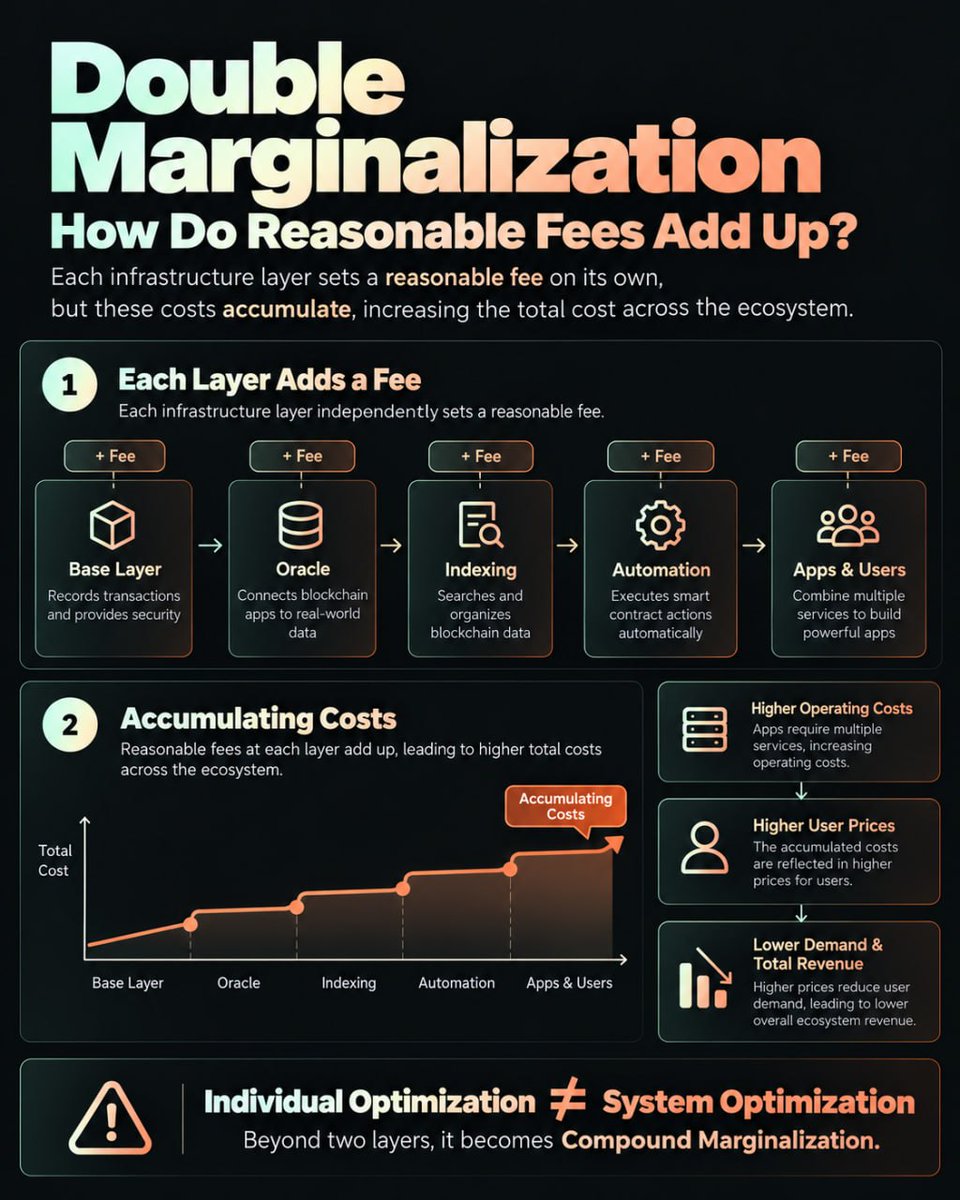
Double marginalization occurs when multiple businesses at different stages of a supply chain independently add markups to maximize their own profits.
Imagine a manufacturer selling a product to a retailer. The manufacturer adds a markup to earn a profit, and the retailer adds another markup before selling the product to consumers.
Each business is making a reasonable decision from its own perspective. However, the combined price can become higher than what would be optimal for the supply chain as a whole.
As prices rise, fewer consumers may be willing to buy the product. This can reduce total demand and, in turn, the combined profits of the businesses involved.
In other words, each company may be optimizing its own revenue while unintentionally making the entire system less profitable.
A similar problem can appear in blockchain infrastructure.
A base-layer blockchain charges transaction fees, while middleware providers charge separately for services such as data feeds, indexing, automation, or cross-chain communication.
Each provider has its own operating costs, pricing decisions, and revenue goals. But developers building applications must pay for all the services they use.
The issue is not necessarily that any single fee is unreasonable. It is that independently determined fees can accumulate across the infrastructure stack.
For example, an application might be able to afford an oracle service or an indexing service individually. But after adding automation, data access, and other dependencies, its total operating costs may become much harder to sustain.
Developers may respond by increasing user fees, reducing certain features, or choosing not to build applications with relatively small profit margins.
This creates consequences beyond the infrastructure providers themselves.
When applications become more expensive to operate, users may face higher prices. If fewer users participate, both applications and infrastructure providers can lose potential revenue.
This is the central idea behind double marginalization: individual profit maximization does not always produce the best outcome for the overall system.
The article from @RialoHQ uses this concept to explain a broader problem in crypto, where costs can accumulate across more than just two layers.
It calls this Compound Marginalization, emphasizing how multiple independent pricing decisions can create growing inefficiencies throughout the blockchain stack.
What I find interesting is that this is not simply a question of whether blockchain technology is fast or slow.
It is also about how the businesses and infrastructure supporting that technology interact economically.
Even when every individual service is useful, the combined cost structure may still discourage application development and user adoption.
Understanding double marginalization helps explain why improving blockchain economics may require more than reducing gas fees.
Sometimes, the bigger issue is how the entire infrastructure stack is organized and priced.
gRialo! 🧡
Rialo #117: Why Did Blockchain Middleware Become Necessary?
When discussing the rising cost of blockchain applications, middleware often comes up as part of the problem. But before looking at its costs, it is worth understanding why middleware became necessary in the first place.
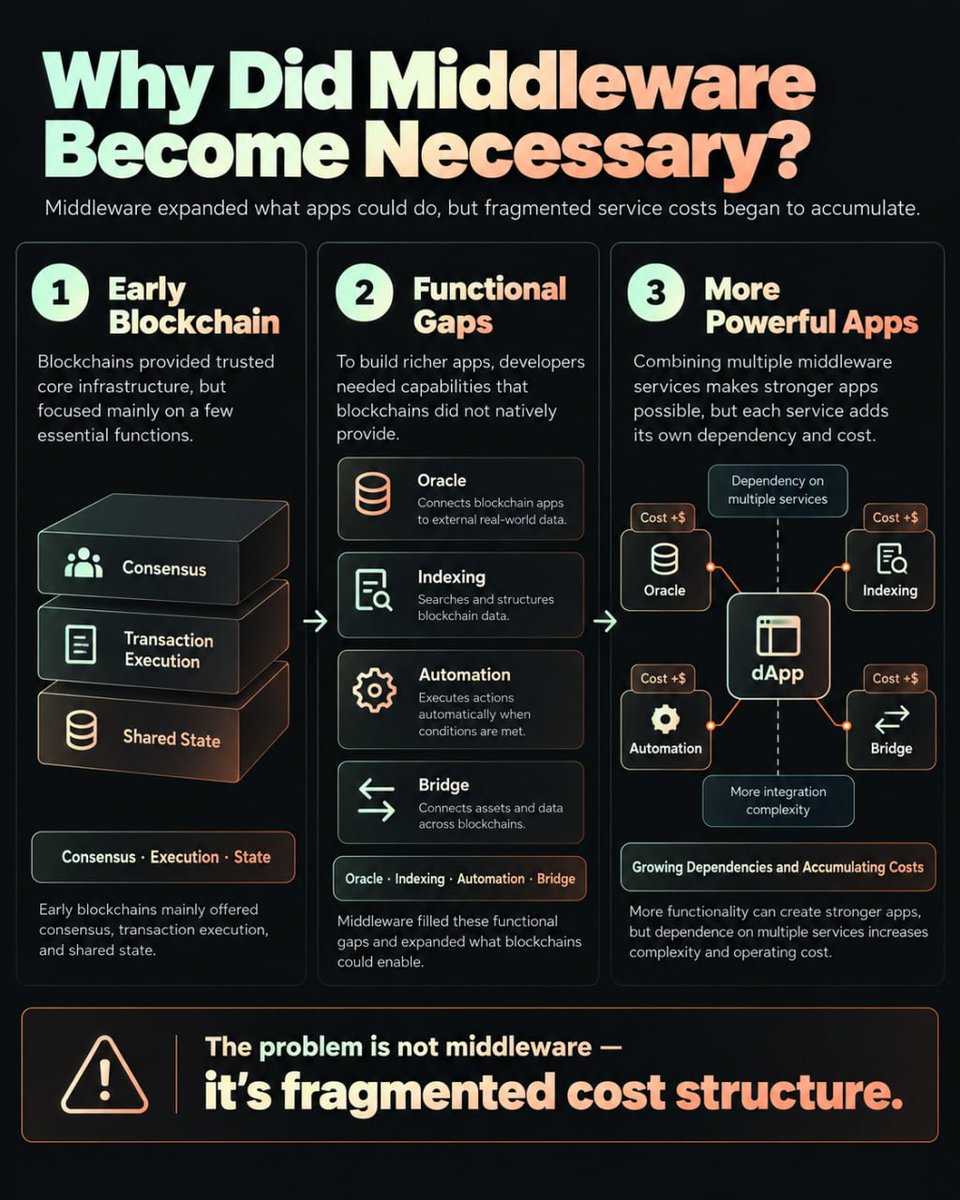
Early blockchains were designed around a relatively limited set of core functions, such as consensus, transaction execution, and maintaining shared state.
However, building real applications requires much more than processing transactions.
A DeFi lending protocol needs external price feeds to calculate collateral values. An application may need indexing services to retrieve blockchain data efficiently, scheduling systems to execute tasks automatically, or bridges to communicate with other networks.
These capabilities were not always available directly within the base protocol, creating a need for additional infrastructure.
Middleware emerged to fill those gaps.
Instead of requiring every blockchain to implement every possible feature, specialized providers could offer services that developers needed. Oracles supplied external data, indexers made blockchain information easier to access, and automation services helped applications perform recurring or condition-based tasks.
This approach had clear advantages.
Developers could build more sophisticated applications without creating every supporting service themselves. Specialized providers could focus on improving specific capabilities, while base-layer blockchains concentrated on their core responsibilities.
As a result, middleware became an important part of the blockchain ecosystem.
But over time, the relationship between applications and middleware started to create new challenges.
As applications became more dependent on external services, those services became increasingly important to everyday operations. Some providers gained significant pricing power, while applications faced difficulties replacing infrastructure they already relied on.
A service that initially made development easier could eventually become a recurring operational expense that was difficult to avoid.
And because applications often need several middleware services at once, even reasonable individual fees can add up to a substantial total cost.
This is an important distinction in the article discussed by @RialoHQ.
The problem is not that middleware exists or that specialized services have no value. Middleware helped blockchain applications become more capable.
The deeper issue is what happens when essential infrastructure is distributed across multiple independently priced layers.
Each provider focuses on its own service and revenue, but the application must pay for the entire stack.
That creates a question worth exploring: even if each middleware service is useful on its own, is the combined infrastructure economically efficient for developers and users?
This is where the discussion moves beyond technical architecture and into economics.
Middleware helped blockchains overcome functional limitations. But as the ecosystem grew, its fragmented cost structure also became something worth reconsidering.
Understanding both sides is important before discussing solutions like vertical integration.
After all, the goal should not simply be to eliminate middleware.
It should be to preserve the capabilities developers need while reducing unnecessary complexity, dependencies, and accumulated costs.
gRialo! 🧡
Rialo #116: Why Middleware Costs Are a Problem in Blockchain
Why is it so expensive to build and operate blockchain applications? Gas fees and network scalability are usually the first things that come to mind, but developers face many other costs beyond those.
One of them is middleware. Middleware provides services that blockchains do not offer natively, with oracles, indexing, scheduling, and bridging being common examples.
Imagine running a DeFi lending application. You need external price data to calculate collateral values, automation services to execute liquidations when certain conditions are met, and possibly indexing infrastructure to retrieve transactions and state data efficiently.
These services are essential for many applications to function properly. The problem is that they are often operated by different providers, each charging its own fees.
Oracle fees may seem reasonable on their own, and indexing or scheduling costs may not look particularly expensive individually. But when several services are combined into one application, the total operating cost can become significant.
Rialo's article connects this problem to an economic concept called Double Marginalization.
Double marginalization occurs when businesses at different stages of a supply chain independently set prices to maximize their own profits. As these markups accumulate, the final price rises, potentially reducing overall demand and total profits.
In blockchain, a similar problem can occur across multiple infrastructure layers. From the base layer to various middleware providers, each charges separately, causing costs to accumulate for the application using them.
The article describes this broader problem as Compound Marginalization.
This cost structure can affect both developers and users. Developers may need to charge higher fees to cover operating expenses, while users may reduce their activity when applications become too expensive.
The impact can be especially noticeable for smaller transactions or applications with thin profit margins. If the infrastructure required to process an activity costs too much relative to the value it creates, operating that service sustainably becomes difficult.
Meanwhile, financial applications that can support higher fees may be more likely to survive. The article argues that this dynamic can limit the diversity of applications being built in crypto.
What I find interesting is that this does not mean middleware itself is unnecessary.
Middleware helped overcome the limitations of earlier blockchains and made it possible to build more sophisticated applications. The issue arises when these services are spread across multiple layers, each setting prices independently without considering the total cost.
One solution proposed by @RialoHQ is to bring certain middleware functions directly into the core protocol.
By integrating capabilities such as data feeds, transaction automation, native webcalls, and indexing, Rialo aims to reduce reliance on external services and eliminate redundant costs.
Of course, this does not mean integrating every function into the blockchain is always the best approach. What matters is understanding the tradeoffs between relying on external services and providing those capabilities natively.
The most interesting part of this article for me is that it looks beyond gas fees when discussing blockchain costs.
We also need to consider how much infrastructure is required to operate a single application and how those costs accumulate across the stack.
In the end, when thinking about blockchain adoption, the cost of a single transaction is only part of the picture.
The total cost of building, operating, and maintaining an application matters just as much.
gRialo! 🧡
Rialo #115: Why Rialo Makes RWAs Real
To summarize this RWA article, I think the core point is simple. RWAs should not stop at turning real-world assets into tokens.
For an asset to become a true Real World Asset, real-world data, changing conditions, trust structures, and execution flows need to be connected to the onchain asset.
Existing RWAs have shown a lot of potential, but many of them still feel closer to static tokens. The asset may exist onchain, but real-world changes such as dividends, credit ratings, invoice payments, shipping status, occupancy, or energy production can still be reflected slowly or depend on manual verification.
In that case, RWAs become less like an upgrade to the existing financial system and more like representations of existing assets moved onchain.
The direction Rialo shows is about moving beyond this limitation. It is a structure where RWAs can receive live data, react when conditions change, handle privacy and identity requirements when needed, and turn those changes into onchain actions through fast execution.
Real-world data allows RWAs to see the real world. When data such as CPI, market feeds, payment rails, GPS, IoT sensors, or property management APIs is connected to the asset, the token can become closer to reality.
Reactivity and automation allow RWAs to move. It should not stop at receiving data. That data needs to lead to actions such as settlement, repricing, payouts, or rebalancing.
Privacy and identity allow RWAs to connect with real finance. Conditions need to be verified without exposing all information, so structures like compliant ownership or gated access can become possible.
Speed and scale allow RWAs to keep up with real markets. Markets move quickly, and real-world events can affect asset value immediately. If execution is slow, RWAs may only follow reality instead of moving with it.
When these elements connect together, RWAs can move from static tokens toward living financial instruments.
Debt and credit can reflect live ratings and payment status. Insurance can pay out based on verified events. Real estate can reflect occupancy and rental payments. Commodities can reflect the condition of real assets through GPS and inspection data.
In environmental markets, IoT or metering data can connect with carbon credits or RECs. In IP, usage or payment data can connect with royalty streams and licensing terms.
Seen this way, the future of RWAs moves beyond the question of “what can be tokenized?”
The bigger question becomes: how well can that tokenized asset receive real-world changes and execute accurately based on conditions?
I think this is the core of what @RialoHQ means by Real World Assets.
RWAs should not just be tokens with the names of real-world assets. They should be assets that carry real-world data, conditions, rules, and execution flows, and can move with them.
In the end, Rialo making RWAs real does not simply mean putting assets onchain.
It means allowing changes from the real world to be reflected in onchain assets, and allowing those assets to actually move based on conditions.
When this structure is built, RWAs can become more than copies of existing finance.
They can become faster, more automated, and more transparent financial instruments.
gRialo! 🧡
Rialo #114: The Difference Between a Static Token and a Living Asset
As I continued reading this RWA article, I felt that one of the most important distinctions is the difference between a static token and a living asset.
Many of the problems with existing RWAs begin from the fact that real-world assets are tokenized, but the token itself is not deeply connected to real-world changes. The asset may exist onchain, but data, events, payments, and status changes from the real world can still be reflected slowly.
In this kind of structure, RWAs can end up looking less like an upgrade to the existing financial system and more like a copy of existing assets moved onchain.
A static token represents an asset. A living asset is closer to a structure where the asset can move together with the real world.
For example, if a tokenized bond only represents ownership of the bond, it is closer to a static token. But if it can adjust yield or pricing based on CPI data, auction results, or market feeds, that asset becomes closer to a financial instrument connected to real-world data.
The same applies to real estate RWAs. Simply dividing property ownership or yield claims into tokens is closer to a static token. But if operating data such as occupancy, rental payments, and maintenance expenses can be reflected in asset status or yield distribution, it can become closer to a living asset.
The difference is also clear in insurance and risk markets. Rather than simply tokenizing an insurance product, what matters more is whether payouts or terms can move based on verified events such as flight delays, natural disasters, or shipping status.
Commodities, environmental markets, and intellectual property follow the same pattern. When data such as the location, condition, production, usage, or revenue of a real asset is connected to the onchain asset, the RWA no longer has to remain just a simple representation.
In the end, I think a living asset has three core elements.
First, it needs to be connected to real-world data. Changes happening in the real world should be able to be reflected in the asset.
Second, it needs to react based on conditions. It should not stop at receiving data. That data should be able to lead to actions such as pricing, settlement, payout, or rebalancing.
Third, when needed, it should also be able to handle privacy, identity, and compliance conditions. Real financial assets do not move only based on price. They also include rules, authority, and eligibility requirements.
This is the difference that @RialoHQ seems to emphasize in RWAs. It is not just about viewing RWAs as tokenized assets, but expanding them into living financial instruments that combine real-world data, automation, privacy, and speed.
From this perspective, the future of RWAs is not only about “how many assets can be tokenized.” The more important question is: how well can that tokenized asset reflect real-world changes and move based on conditions?
A static token focuses on putting a real-world asset onchain. A living asset is closer to making that real-world asset actually operate onchain.
I think this is also the core of what Rialo means by Real World Assets.
A real RWA should not just be a token with the name of a real-world asset. It should be an asset that carries real-world data, conditions, and execution flow, and can move with them.
gRialo! 🧡
Rialo #113: How Intellectual Property RWAs Can Change
When people think about RWAs, they usually think first of assets like treasuries, real estate, credit, or commodities. But intellectual property can also become an important area for RWAs.
Assets like music, film, software, and content IP continue to generate revenue in the real world. They can produce many forms of cash flow, such as streaming revenue, licensing fees, app revenue, or API usage fees.
But the existing IP market is often slow and complex when it comes to settlement. Revenue can come from many different platforms, there may be multiple rights holders, and payment cycles can take a long time.
For example, music revenue may come from platforms like Spotify or YouTube, and the value of a software license may change based on actual usage data. But if this information is not connected to the tokenized IP asset in real time, the onchain asset may only slowly follow the actual revenue flow.
This is where the RWA direction shown by @RialoHQ becomes interesting. If IP rights are not only represented as tokenized assets, but also connected to real payments and usage data, IP RWAs can become much more dynamic.
For example, tokenized music rights could automatically split and distribute royalties whenever revenue comes in from a platform. Film or software IP could also distribute earnings to rights holders automatically once payment is confirmed.
Programmable licensing is another important direction. A license can be represented as a token, and its pricing or terms can adjust automatically based on actual usage or time remaining in the license.
In this case, IP does not stop at being “a tokenized right.” It becomes closer to a programmable asset that moves according to actual usage, revenue, duration, and conditions.
In the existing IP market, delayed settlement, intermediaries, and opaque revenue reporting remain major problems. But if real-world payment data and usage data can connect to onchain workflows, this process can become more transparent and automated.
Of course, this does not mean every IP revenue flow can be fully automated. Platform data structures, rights relationships, and contract terms can be complex.
But in areas where clear payment data or usage data exists, RWAs can make the IP market more efficient.
In the end, the important questions for IP RWAs are these: how well does this token reflect the actual rights and revenue flow, and when revenue or usage occurs, can that change be connected automatically to the onchain asset?
A real IP RWA should not be just an ownership token. It should become closer to a living asset that moves based on actual revenue and usage conditions.
The RWA direction Rialo shows suggests that IP can also expand in this way.
When real-world payment, usage, and licensing data are connected to onchain assets, IP can become a more transparent, more automated, and more programmable financial asset.
gRialo! 🧡
Rialo #112: How RWAs Can Change Environmental Markets
When RWAs are connected to real-world data, environmental markets can also change in interesting ways. Assets like carbon credits and renewable energy certificates depend heavily on real-world activity and data.
For example, carbon credits need to show whether carbon reduction or removal actually happened. Renewable energy certificates also only become meaningful when they are connected to how much solar or wind energy was actually produced.
But putting these assets onchain does not automatically make the market more trustworthy. What matters is how well the token is connected to actual environmental data.
One of the biggest challenges in environmental markets is verification. It can be slow and complicated to confirm whether a project actually produced carbon reduction, whether a credit is still valid, or whether renewable energy was actually generated. If this process remains manual and opaque, tokenized carbon credits or RECs may simply carry over the same problems from the existing market.
This is where the RWA direction shown by @RialoHQ becomes interesting. If real-world inputs such as IoT sensor data, renewable energy metering data, and industrial site data can be connected to onchain assets, environmental assets can become more dynamic.
For example, carbon credits could be minted, expired, or adjusted based on IoT data collected from forests or renewable projects. If live metering data from solar or wind installations is connected to onchain settlement, renewable energy certificates can also move closer to actual production.
What matters in this structure is that environmental RWAs do not stop at simply “tokenizing green assets.” Real environmental data needs to come in, and that data needs to connect with the status, issuance, expiration, or settlement of the credit.
In that case, environmental assets can become closer to living assets directly connected to real-world environmental conditions, rather than static tokens.
Of course, this does not mean every type of environmental data can be perfectly automated or verified. But in areas where sensors, metering, and verified data sources can be used, RWAs can create a more transparent and faster structure than before.
The important questions in environmental markets are these: how accurately does this token reflect real environmental activity, and when real-world data changes, can that change be reflected in the asset’s state?
The RWA structure shown by Rialo points toward an answer to these questions. It brings in real-world data and connects condition changes to onchain actions.
As this structure develops, carbon credits and renewable energy certificates can move beyond simple claims and become programmable environmental assets connected to real data.
In the end, the core of environmental RWAs is not tokenization itself. It is verifying real environmental data and allowing the asset to move based on that data.
That is when environmental markets can move toward a more transparent, more automated, and more trustworthy direction.
gRialo! 🧡