

Top Tweets for #EnzymePrediction

EZpred: Improving Deep Learning-Based Enzyme Function Prediction Using Unlabeled Sequence Homologs
Researchers have developed EZpred, a pioneering deep learning model that significantly advances protein function prediction by utilizing unlabeled sequence homologs. This approach addresses a long-standing challenge where previous methods largely relied on homologs with known functional annotations or solely on individual protein sequences.
EZpred demonstrates notable performance gains, achieving an F1-score for EC number prediction that is 4% higher than comparable models that do not use sequence homologs and at least 10% higher than other state-of-the-art methods. For predicting the full 4-digit EC number, EZpred's F1-score is over 27% higher than existing deep learning approaches.
A key strength of EZpred is its superior ability to distinguish between enzymes and non-enzymes. It achieves a high F1-score of 0.911 for identifying enzymes, significantly outperforming current methods, which is crucial for real-world applications where the enzyme status of a protein may be unknown.
EZpred operates as a sophisticated pipeline that integrates both a deep learning component and a template-based component, which includes sequence homolog search and structure template alignment. This combined strategy yields a modest but consistent improvement in overall prediction accuracy, particularly for more challenging targets.
Ablation studies reveal several critical factors contributing to EZpred's robust performance. These include the strategic inclusion of rare EC numbers in training, enhanced feature extraction from sequence homologs, and the use of outputs from multiple layers of the ESMC protein language model. The integration of both sequence and structure search results in the template-based component also plays a vital role.
This novel tool is readily accessible as both a webserver and a downloadable source code distribution, facilitating its adoption and further research in the computational biology community.
💻Code: seq2fun.dcmb.med.umich.edu/E…
📜Paper: biorxiv.org/content/10.1101/…
#ComputationalBiology #DeepLearning #EnzymePrediction #Bioinformatics #ProteinFunction #EZpred #MachineLearning

EC-Bench: A Benchmark for Enzyme Commission Number Prediction
1.EC-Bench introduces the first comprehensive, open-source benchmark platform dedicated to enzyme function prediction using EC numbers. It provides a standardized and extensible framework to evaluate a wide range of predictive models under uniform conditions.
2.Unlike prior efforts like CARE, CAFA, or TAPE, EC-Bench includes not just datasets but also implementations of 10 representative models across homology-based, deep learning, contrastive learning, and language model (LLM) approaches.
3.EC-Bench evaluates models on three core tasks: exact EC number prediction, EC number completion (inferring missing parts), and partial/additional EC number recommendation. These tasks mirror real-world challenges in enzyme annotation.
4.In exact EC number prediction, EnzBert (an LLM) trained with learned thresholds outperformed others in generalization, particularly under low sequence similarity (30%), while BLASTp dominated at high similarity (100%).
5.A stacked ensemble model combining predictions from diverse models achieved the highest overall performance at 100% similarity, though its advantage diminished on out-of-distribution data like Price-149, revealing trade-offs in ensemble generalizability.
6.CLEAN, a contrastive learning model, stood out in EC number completion by producing the most complete annotations and showing the highest agreement with other models, indicating robustness in ambiguous annotation cases.
7.For partial EC number recommendation, EnzBert-learnt again excelled at low similarity, suggesting superior generalization for rare or novel enzyme sequences. At high similarity, CLEAN and ProteinBERT performed best.
8.Models also varied in their ability to recommend additional EC numbers for multifunctional enzymes. EnzBert and ProteinBERT showed strong performance, proposing functionally relevant secondary predictions based on reaction similarity scores.
9.EC-Bench’s data pipeline ensures high-quality benchmarking: training/test sets are curated from Swiss-Prot, with careful filtering based on sequence similarity thresholds and inclusion of only enzymes with AlphaFold-predicted 3D structures.
10.Efficiency metrics were also assessed. ECRECer and ProteinBERT are fastest at inference, while CLEAN requires extensive training time but remains efficient once trained. Memory/storage usage varies widely among models.
11.To optimize predictions, EC-Bench incorporates threshold learning and adaptive decision-making strategies for multi-label classification, accounting for varying confidence requirements across EC classes.
12.Interactive sunburst plots allow users to explore where different models succeed or fail across the EC hierarchy, offering intuitive insights into strengths and limitations at fine-grained resolution.
13.EC-Bench is designed to be modular and extensible: researchers can add new models, tasks, and metrics to benchmark their methods on standardized data with consistent evaluation criteria.
14.This platform will help guide method development in EC prediction by enabling fair comparisons, identifying task-specific strengths, and supporting the community in enzyme function annotation at scale.
💻Code: github.com/dsaeedeh/EC-Bench
📜Paper: biorxiv.org/content/10.1101/…
#ComputationalBiology #ProteinFunction #EnzymeAnnotation #DeepLearning #Benchmarking #Bioinformatics #ECnumber #LanguageModels #ContrastiveLearning #EnzymePrediction

LEVERAGING LARGE LANGUAGE MODELS FOR ENZYMATIC REACTION PREDICTION AND CHARACTERIZATION
1.This paper systematically evaluates the potential of large language models (LLMs), specifically Llama-3.1 (8B and 70B), for enzymatic reaction modeling across three key biochemical tasks: EC number prediction, forward synthesis (FS), and retrosynthesis (RS).
2.By fine-tuning LLMs using parameter-efficient LoRA adapters, the authors show that multitask learning significantly boosts performance in FS and RS, achieving up to 33.8% and 19.2% match accuracy, respectively—improvements of 7.9% and 5.3% over single-task setups.
3.The 70B model achieves 91.7% macro-average accuracy in EC class prediction (EC1), outperforming zero-shot prompting by over 60%, and approaching SOTA models trained on much larger datasets.
4.Even when trained on just 200 samples, the fine-tuned 70B model achieves 55.3% EC1 accuracy, doubling the zero-shot baseline, and outperforming an XGBoost benchmark in all tasks and data regimes.
5.To improve molecular fidelity, predictions are evaluated using canonical/non-canonical validity checks and Tanimoto similarity. Over 45% of valid outputs in multitask settings had high similarity (Tanimoto > 0.95) to ground truth, indicating useful structural approximations even when predictions are not exact.
6.Multitask fine-tuning showed synergistic benefits, particularly for FS and RS, where shared biochemical knowledge improves generalization and molecular relevance—especially in predicting chemically plausible alternatives.
7.Unlike domain-specific models, the general-purpose LLMs retain versatility across tasks and show transfer effects—models fine-tuned on one task (e.g., EC prediction) improve performance on unseen tasks (e.g., FS or RS) compared to zero-shot prompting.
8.Three LoRA configurations (light, attention, default) are benchmarked. Performance scales with the number of fine-tuned parameters, with full attention and feed-forward tuning (default) consistently delivering best results across both Llama model sizes.
9.Despite computational constraints, the use of LoRA enables scalable fine-tuning with minimal parameter updates (~0.3%), making the method accessible for labs with limited GPU resources.
10.Limitations include possible pretraining data leakage and limited EC subclass diversity in the BRENDA dataset, but the modular design allows easy extension to broader enzymatic datasets or more rigorous held-out evaluation.
11.This work demonstrates that general-purpose LLMs, when properly adapted, can tackle complex biochemical tasks involving enzyme-substrate relationships, opening new paths for AI-guided biocatalysis, reaction discovery, and functional annotation.
💻Code: github.com/Intelligent-molec…
📜Paper: arxiv.org/abs/2505.05616
#Biochemistry #EnzymePrediction #ReactionModeling #LLM #LoRA #Retrosynthesis #SMILES #Bioinformatics #MultitaskLearning #MachineLearning #ICLR2025

In silico enzyme prediction and generation by fine-tuning protein language models
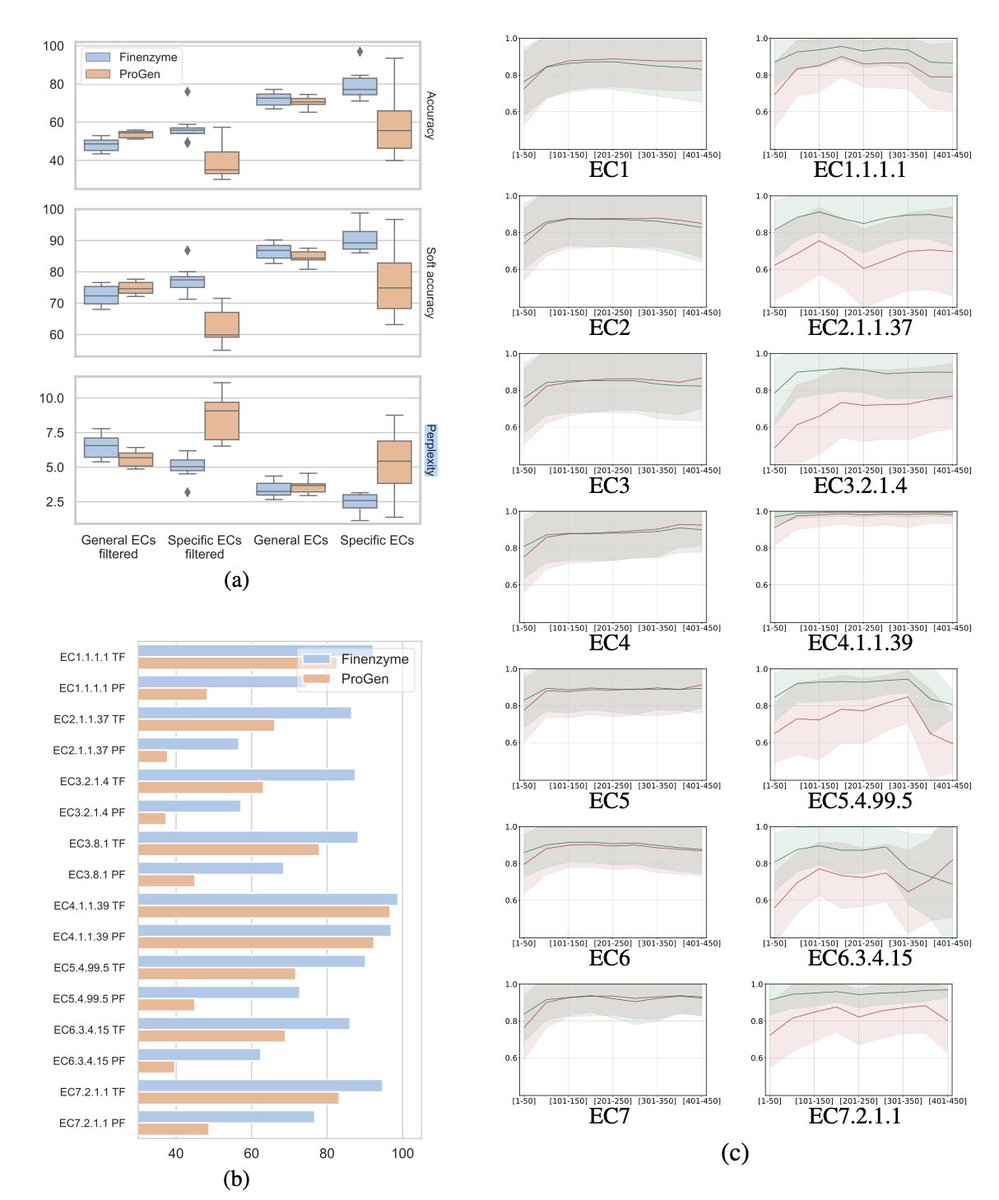
1. Finenzyme is a novel Protein Language Model (PLM) designed to predict and generate functionally characterized enzymes by integrating transfer learning, conditional learning with functional keywords, and fine-tuning techniques.
2. Unlike generalist PLMs like ProGen, Finenzyme excels at generating enzymes within specific Enzyme Commission (EC) categories, even when the generated proteins exhibit low sequence identity to natural enzymes.
3. The model leverages pre-trained ProGen as a foundation, fine-tuned using conditional tags representing specific EC classes, enabling accurate next-amino-acid predictions and targeted enzyme generation.
4. Structural comparisons using ESMFold and Foldseek revealed that Finenzyme-generated enzymes maintain high structural similarity (TM-score ~0.9) to natural counterparts, despite significant sequence divergence.
5. Functional validation with the CLEAN tool confirmed that the generated enzymes reliably preserved their EC functions, showcasing their potential utility for enzyme engineering tasks.
6. Clustering analysis of 3D structural representations showed that Finenzyme-generated enzymes closely overlap with natural enzyme clusters, further proving its ability to capture critical structural and functional features.
7. The fine-tuning approach demonstrated significant performance boosts in generating specific low-level EC class enzymes (e.g., DNA methyltransferase, cellulase) but provided limited improvements for broad, high-level EC categories.
8. Finenzyme provides a low-resource, scalable solution for enzyme generation, requiring only a single NVIDIA A100 GPU for training and yielding robust predictions validated through multiple in silico methods.
9. While the validation is currently limited to computational analysis, the strong correlation between predicted structure and function suggests that Finenzyme-generated enzymes could support experimental workflows in the future.
10. The research highlights Finenzyme as a powerful tool for targeted enzyme engineering, with potential applications spanning biotechnology and pharmaceutical industries.
📜Paper: valentini.di.unimi.it/papers…
#EnzymePrediction #ProteinDesign #DeepLearning #Bioinformatics #AI
Last Seen Hashtags on Sotwe
son sex mom
Seen from Turkey
ensestpaylasım
Seen from Turkey
سـكـــسً
Seen from Germany
anxiouspandaaaa
Seen from United States
عمه_للكلاب
Seen from United Kingdom
turkifsa
Seen from Germany
exhibitionism
Seen from Germany
转运珠
Seen from Canada
candid
Seen from Germany
Brainwash
Seen from United States
Most Popular Users

Elon Musk 
@elonmusk
240.3M followers

Barack Obama
@barackobama
118.6M followers

Cristiano Ronaldo
@cristiano
114.4M followers

Donald J. Trump
@realdonaldtrump
111.8M followers

Narendra Modi
@narendramodi
106.9M followers

Rihanna
@rihanna
98.6M followers

NASA
@nasa
92.2M followers

Justin Bieber
@justinbieber
91.7M followers

KATY PERRY
@katyperry
89.9M followers

Taylor Swift
@taylorswift13
83.9M followers

Lady Gaga
@ladygaga
75.4M followers

Virat Kohli
@imvkohli
73.3M followers

Kim Kardashian
@kimkardashian
70.8M followers

YouTube
@youtube
68.6M followers

Neymar Jr
@neymarjr
66.3M followers

Bill Gates
@billgates
65.2M followers

Selena Gomez
@selenagomez
63M followers

The Ellen Show
@theellenshow
62.1M followers

CNN
@cnn
61.7M followers

X
@x
60.6M followers