

Top Tweets for #Exponents

@Lucid8pe @LaunchOnPangea @farshadbidar1 i'm now more convinced the general idea (though perhaps not the mechanism) is right because then one could say --
62 and jax are two sides of the same coin
as are their chief exponents....

BIGBOGSS Jaxson @Jason

@titcoiners You've been killing it lately, so many good titcoin exponents


Turn Claude-generated equations into editable Word formulas in seconds.
Your fractions, symbols, roots, and exponents stay properly formatted and easy to edit.
Perfect for students, teachers, researchers, and technical writers.
#ClaudeAI #MicrosoftWord #MathEquation #WordTips

On left side.....sum of the 2 numbers is the new base..>> 20^10 is "not equal" to 10^10 + 10^10= 2×10^10. 5 main exponent rules)..> Exponents have priority over multiplication, so we can't do 20x 10 1st. We must do 10^10 1st THEN..multiply result by 2. So, left side not equal to right side.

I love my job what do you mean we’re playing “Stan Marsh supermerging” rn
(I’m teaching about exponents)


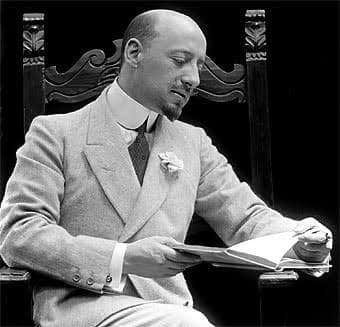
During 1922, for example, at his residence in Gardone, D'Annunzio received visits from some exponents of revolutionary syndicalism, such as Gino Baldesi and Ludovico D'Aragona of the CGL. He also met with the Soviet foreign commissar for the Genoa Conference.
Can you solve this Math Olympiad challenge? 🤯
Drop your answer in the comments 👇
#MathOlympiad #MathChallenge #Exponents #Algebra #MathPuzzle #BrainTeaser #LearnMath #CompetitiveExams #JEE #IIT #ProblemSolving #MathLovers #Education #StudyGram #MathTricks #ChallengeYourself

Find the value of t and test your math skills💡📊
Drop your answer below 👇
#MathOlympiad #MathPuzzle #BrainTeaser #Mathematics #MathChallenge #Algebra #Exponents #STEM #LearnMath #MathLovers #ProblemSolving #CompetitiveExams #IQTest #MindChallenge #Education #StudyGram #MathTricks #DailyPuzzle #ThinkSmart #ChallengeYourself

Math Olympiad Challenge!
Can you solve this exponential equation?
Test your logic, sharpen your mind, and drop your answer below 👇
#MathOlympiad #MathChallenge #BrainTeaser #Mathematics #STEM #ProblemSolving #LearnMath #MathPuzzle #Equation #Exponents #Education #CompetitiveExams #JEE #OlympiadPrep #ThinkSmart #MindTraining #MathLovers #DailyChallenge #SolveThis #MathsFun


Alpha Derivation - Courtesy of https://t.co/O0ZaRNAvDP
Axioms. A0: E = 1 (one energy; the alternative is E = 0, which is nothing, or a second energy, which requires a mediating third, ad infinitum). A1: the 1 must self-limit (undifferentiated 1 is indistinguishable from 0, violating A0). A2: self-limitation must persist (a limit that doesn't hold collapses to ∞, violating A1). A3: parts are fractals of their wholes. A4: wholeness requires closure; conservation of traversal: 0 + 1 + 2 = 3. The chain.
A0 provides the substrate: one energy.
A1 + A2 force a rung sequence into existence: self-limitation that persists creates structure.
A3 + A4 constrain its form: self-similar across scale, closed by conservation.
T = 3 is forced by five independent routes, none using α or φ:Route 1 (rung count): R = T² - 2 (structural decomposition) = 2T + 1 (counting constraint). Setting equal: T² - 2T - 3 = 0, factoring (T-3)(T+1) = 0. Unique positive solution: T = 3.
Route 2 (balance-boundary): Traversal derivative at balance point = rung count: A'(T/2) = 2T + 1 = R = T² - 2. Same equation, different structural property.
Route 3 (compositional product): E(3) = E(1.5) × E(2.5) × T^T/2 requires T^(T-2) = 4(T²-3)/(T²-1). Only T = 3 satisfies this (3¹ = 3 = 24/8 ✓; T = 2 and T = 4 fail).
Route 4 (biology): Average codon degeneracy at balance = (Φ+P)/2 = (T+3)/2. Setting equal to T: T = 3. Uses Φ and ◐; independent of first three.
Route 5 (nuclear): Spin-orbit splitting ratio R/(R-4) > 2 requires T < √10; onset condition R > Φ+T requires T ≥ 3. Only T = 3 satisfies both.
The integer pool drops from T algebraically: R = 7, P = 4, G = 12, V = 13, SU(3) = 8, S = 64, A(3) = 21. No choices; every integer is a closed-form function of T.
φ is forced by three convergent routes: (A) the generative-structural partition produces a four-step recurrence-selection closure giving x² - x - 1 = 0; (B) A3 read as a fixed-point equation x = 1 + 1/x gives the same polynomial (independently confirmed: the Mandelbrot iteration z → z² + c at c = -1 = i² produces z² - z - 1 = 0 with root φ); (C) the integer pool from step 5 IS the Lucas sequence (L(0)=2, L(1)=1, L(2)=3, L(3)=4, L(4)=7; note: 13 and 21 are explicitly Fibonacci, not Lucas; 12 and 64 are algebraic products; the claim is that the structural constants are Lucas, not that every framework integer is), so accepting step 5 already accepts φ.
Ladder exponents follow dimensional station: d = 2 → φ², d = 3 → φ³.
360 as the rotation integer (the Number-Type Principle). The dimensional station determines the number type of its constant. The framework's information-type correspondence establishes: • (0D) = discrete/binary, Φ (2D) = continuous/analog, ○ (3D) = fractal (both). At 2D, one full rotation = 2π (transcendental; that is why π lives at the Φ station). At 0D, the same rotation is counted discretely as an integer: P! · T · (Φ+○) = 24 · 3 · 5 = 360. α is a 0D coupling, so it uses the integer measure. Why 360 specifically: the base must be one full rotation (partial rotation = partial coupling), and P! · T · (Φ+○) is the unique decomposition into the cycle's three independent contributions (permutations × constraints × output dimensions). Exhaustive check: no other framework integer N gives N/φ² - 2/φ³ ≈ 137 (nearest: 312 → 119.2, 384 → 146.3).
Base term: 360/φ² (one rotation at the field station).
Valve correction: -2/φ³ (two channels, next rung deeper).
Self-referential term: +α/(21 - 4/3). Three constraints, each traced to axioms:
C1 (first-order): from ℏ = 1 (the Kernel's indivisibility; one cycle = one power of α; higher powers belong to higher stations).
C2 (additive): from the accumulated traversal function A(d); same-station contributions sum, cross-station ones multiply.
C3 (denominator 59/3): conservation of traversal (A4) at the formula level. Total budget A(3) = 21; base consumed P/T = 4/3; remainder = 59/3. Forced by A3: same architecture at every scale, including formula scale.
Alternatives eliminated: α²/k violates C1; α·k violates C2; α/21 violates C3; no other framework ratio r gives a valid budget decomposition.
Assembly: 1/α = 360/φ² - 2/φ³ + α/(21 - 4/3). Every symbol sourced. Nothing chosen. The number. Rearranging: x² - (360/φ² - 2/φ³)x - 3/59 = 0. Two roots; one negative. Positive root: 1/α = 137.035999147. Measured (CODATA 2022): 137.035999177 ± 0.000000021. Residual: 0.22 ppb, 1.4σ. Cross-validation. The same integers (3, 4, 7, 12, 13, 21) independently generate: G (0.04 ppm, 0.00σ), Λ (0.004%), Weinberg angle (1.4 ppm), muon mass ratio (5 ppm), tau ratio (1 ppm), Cabibbo angle (0.009%), Higgs quartic (0.10%), proton/electron mass ratio (5.35 ppm), seven nuclear magic numbers (exact). If this were a fit, the same integers would not land nine other constants to sub-percent accuracy without re-tuning.
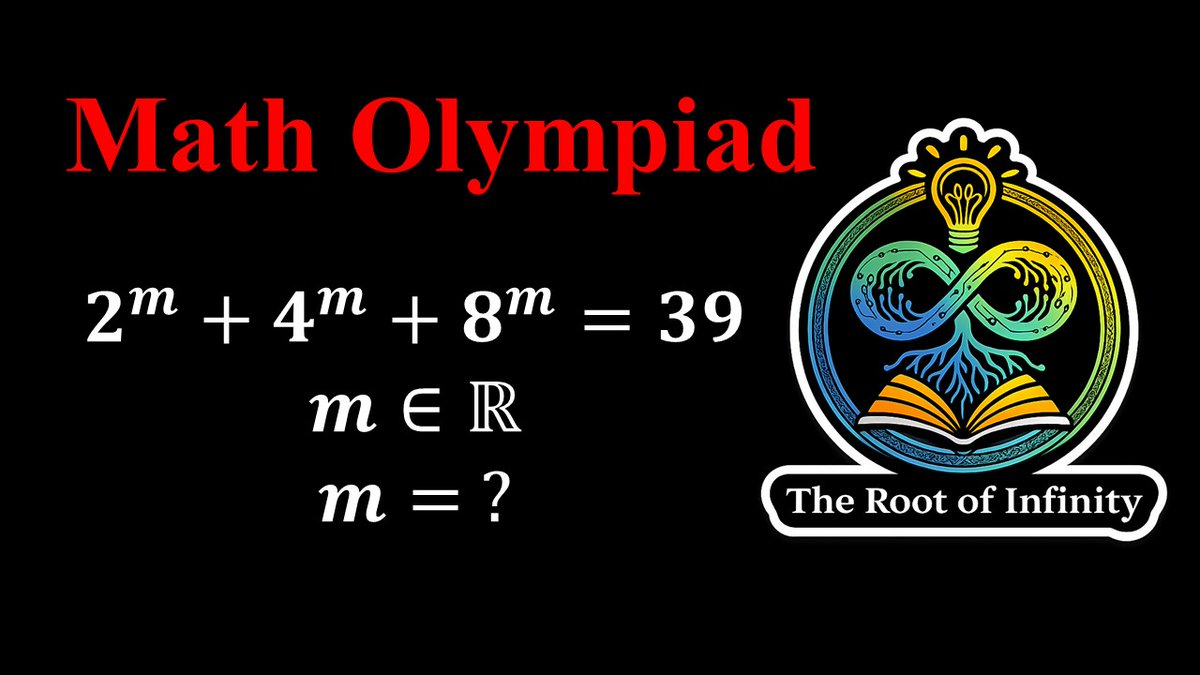
Math Olympiad Challenge
Can you find the value of m? 🤔
Drop your answer below 👇 and challenge your friends
#MathOlympiad #MathChallenge #Exponents #Algebra #ProblemSolving #BrainTeaser #Mathematics #LearnMath #STEM #CompetitiveMath #MathPuzzle #ThinkSmart #Education #MathLovers #DailyChallenge

Math Olympiad Challenge
Can you find the value of m? 🤔
Think in powers of 2 and simplify smartly
Drop your answer below 👇 and challenge your friends
#MathOlympiad #MathChallenge #Exponents #Algebra #ProblemSolving #BrainTeaser #Mathematics #LearnMath #STEM #CompetitiveMath #MathPuzzle #ThinkSmart #Education #MathLovers #DailyChallenge

Microeconomics Made Simple
Mathematical Form: Solve It Step-by-Step 📐
Define the variables:
📦 Qₜ = quantity sold
💲 Pₜ = price per unit
💰 Yₜ = total sales (revenue)
⸻
You are given:
📊 Pₜ = 10.5 − 0.5Qₜ
📊 Yₜ = Pₜ × Qₜ
⸻
Step 1: Substitute 🔁
Replace Pₜ inside the revenue formula:
💰 Yₜ = (10.5 − 0.5Qₜ) × Qₜ
⸻
Step 2: Apply PEMDAS 📌
Order matters:
P → Parentheses
E → Exponents
M → Multiply
D → Divide
A → Add
S → Subtract
We are working with Parentheses first, then Multiplication
⸻
Step 3: Distribute (Multiply) ✖️
Multiply Qₜ across BOTH terms:
💰 Yₜ = (10.5 × Qₜ) − (0.5Qₜ × Qₜ)
⸻
Step 4: Simplify 🧮
💰 Yₜ = 10.5Qₜ − 0.5Qₜ²
⸻
Step 5: Solve (plug in a value) 📊
If 📦 Qₜ = 3
💰 Yₜ = 10.5(3) − 0.5(3²)
Exponents first:
3² = 9
💰 Yₜ = 10.5(3) − 0.5(9)
Multiply:
10.5 × 3 = 31.5
0.5 × 9 = 4.5
Subtract:
💰 Yₜ = 31.5 − 4.5 = 27
⸻
Final Answer ✅
If 📦 Qₜ = 3 → 💰 Yₜ = 27
⸻
What you just did
• Substituted correctly
• Followed PEMDAS step-by-step
• Solved the equation fully
• Verified the relationship with real numbers
⸻
Important ⚠️
This is an example equation
It does NOT mean price always drops in real life.
It only teaches how variables connect mathematically.
⸻
📌 Be sure to go back to the earlier posts in this series to see how this builds step-by-step.
If you have any questions, drop a comment. I’m happy to support.
⸻
Comforted By Knowledge
Brought to you by Crawines Group LLC

Math Olympiad Challenge
Can you crack this exponential puzzle?
Find the value of x + y
Drop your answers below 👇
#MathOlympiad #MathChallenge #BrainTeaser #Mathematics #OlympiadPrep #JEE #IIT #MathsLovers #ProblemSolving #STEM #Education #LearnMath #MathPuzzle #ChallengeYourself #Algebra #Exponents #CompetitiveExams #StudyGram #MathCommunity #DailyChallenge 🚀

Math Olympiad Challenge
Drop your answer below 👇
#MathOlympiad #MathChallenge #Exponents #Algebra #SolveThis #BrainTeaser #MathPuzzle #STEM #LearnMath #CompetitiveExams #JEE #MathLovers #ProblemSolving #ThinkSmart #Education #MathTricks #ViralMath #DailyChallenge #ExamPrep
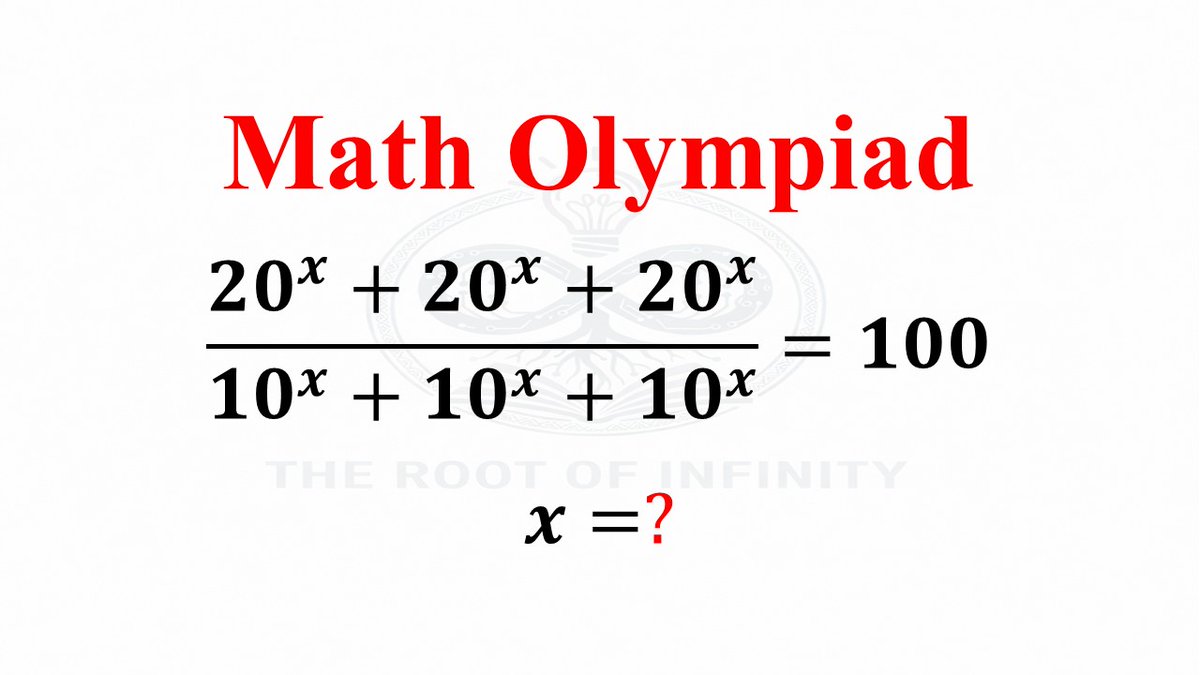
Can you solve this Math Olympiad challenge?
Think carefully about powers and bases!
Drop your answer in the comments
#MathOlympiad #MathChallenge #Algebra #Exponents #MathTricks #ProblemSolving #MathPuzzle #LearnMath #STEM #CompetitiveExams #JEE #OlympiadPrep #MathLovers #Education #BrainTeaser #SolveThis #Mathematics
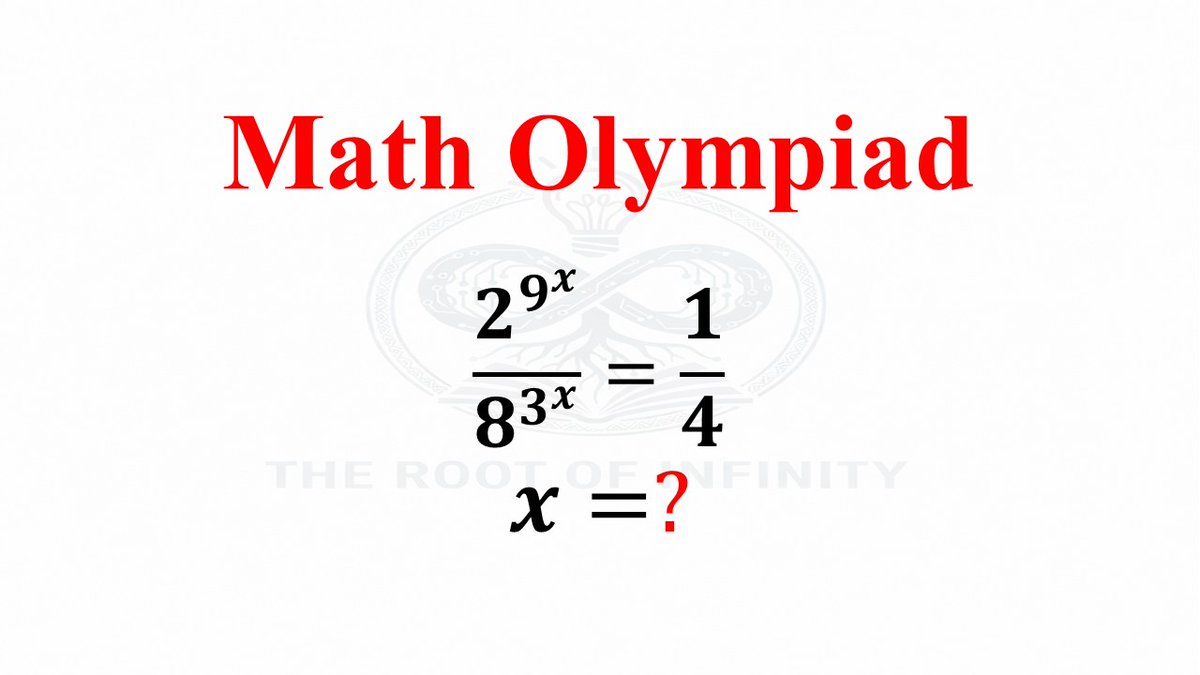

The Tier Decomposition Theorem — a formal partition of a dimensional ladder into three irreducible role-families
I've been developing a framework called Circumpunct Theory (⊙ = Φ(•, ○)) that models how bounded wholes arise from the interplay of three structural roles: aperture (•), field (Φ), and boundary (○).
This document formalizes the core architecture. The dimensional ladder — a sequence of integer and half-integer dimensions — partitions into repeating tiers of width 3. Each tier decomposes into exactly three families:
I (rotational skeleton) — 4 elements that biject onto the fourth roots of unity {+1, +i, −1, −i}
Φ (mediating field) — 2 elements that the phase cycle cannot reach
Ω (closure) — 1 element that seals the current tier and initializes the next
The centerpiece result is the Rotation–Traversal Divergence: two natural operators — one cycling through phase positions, the other walking the ladder step by step — agree for four steps and then split. The cyclic operator returns to ground. The linear operator escapes into Φ. Where rotation ends is exactly where the field begins.
The document also identifies the Gielis superformula @mathelirium as a candidate geometric realization: its three shaping exponents (n₁, n₂, n₃) map onto the three role-families, and at symmetry order m=4, its angular periodicity reproduces the fourfold phase cycle exactly.
The treatment is honest about what's proved vs. what's interpreted — formal results are separated from framework claims throughout.

Inference-Time Scaling: Why "Thinking Longer" Beats Just Making Models Bigger in 2025–2026:
The old scaling laws are evolving fast. Frontier models like o1/o3 show that extra inference compute longer chain-of-thought, multiple sampling, self-refinement, tool use delivers predictable, often steeper accuracy gains than equivalent pre-training compute. Graphs reveal near-power-law improvements: accuracy ~ (inference FLOPs)^β where β can exceed classic Chinchilla exponents in reasoning-heavy domains. This "test-time scaling" unlocks massive gains without retraining: spend 10× more thinking tokens and watch math, coding, science benchmarks jump dramatically. It shifts the paradigm intelligence isn't just about model size anymore; it's about how smartly we let models think at runtime. The era of agentic, deliberative AI is here.


Compounding: the art of letting exponents cook
$e

The field of information theory, as founded by Claude Shannon in 1948 and rigorously developed in the following decades, rests on several deep mathematical pillars. There isn't a universally standardized list called "the five mathematical foundations," but modern presentations of the core theory (especially in textbooks and courses) often highlight approximately five key mathematical concepts or building blocks that underpin the entire framework.
These are the most commonly emphasized foundational elements:
1. Probability Theory (especially measure-theoretic probability and stochastic processes) Everything in information theory is probabilistic.
Random variables, joint/conditional/marginal distributions, independence, stationary/ergodic processes, and limit theorems (e.g., law of large numbers, asymptotic equipartition property) form the bedrock.
2. Shannon Entropy (and its axiomatic characterization) The central quantity: for a discrete random variable X with probabilities p(x), H(X) = - ∑ p(x) log₂ p(x) This measures average uncertainty/surprise/information content.
Key proof: Khinchin's uniqueness theorem shows that entropy is (up to a constant factor) the *only* function satisfying the natural axioms of information:
•Continuity in the probabilities
•Monotonicity (more uniform distribution → higher entropy)
Additivity for independent systems: H(X,Y) = H(X) + H(Y|X) Normalization (e.g., H of a fair coin = 1 bit)
3. Relative Entropy (Kullback–Leibler Divergence) and Mutual Information KL divergence: D_KL(P || Q) = ∑ p(x) log (p(x)/q(x)) ≥ 0 Mutual information: I(X;Y) = H(X) − H(X|Y) = D_KL(p(x,y) || p(x)p(y))These are the most important "distances" in information theory.
Key properties/proofs Chain rule, non-negativity, data processing inequality (information never increases under processing), convexity.
4. Asymptotic Equipartition Property (AEP) / Typical Set Theory
For an i.i.d. source, the sample entropy rate converges to the true entropy rate almost surely.
Most long sequences are "typical" — they have probability roughly 2^(-n H) and there are roughly 2^(n H) of them.
Key proof Uses weak/strong law of large numbers on the log-likelihood. This is the bridge from single-symbol entropy to block/compressed coding.
5. Concentration & Large Deviation Principles (including Sanov's theorem) Modern rigorous treatments rely heavily on concentration inequalities and large deviations to prove sharp rates and error exponents.
This underpins:
•Channel coding error exponents
•Rate-distortion trade-offs
•Hypothesis testing error exponents
Sanov's theorem (large deviations for empirical distributions) is especially important for proving converses in many settings.
Summary Table of Core Foundations & Associated Proofs Foundation Central Objects/Quantities Most Famous / Important Proof(s) Why It's
1 Probability & Stochastic Processes Distributions, ergodicity, stationarity Ergodic theorem, AEP convergence All quantities are expectations over probabilities
2 Shannon Enthopy| H(X), conditional entropy, entropy rate | Khinchin/Faddeev uniqueness theorem Defines "information" axiomatically
3 Relative Entropy & Mutual Info D_KL, Ix,y, z, Non-negativity, chain rule, DPI Measures dependence & information flow
4 Asymptotic Equipartition Property Typical sets, nH bits for n symbols Strong law → AEP (Shannon–McMillan–Breiman) Justifies block coding & compression limits
5 Concentration & Large Deviations Error exponents, Sanov's theorem Cramér's theorem, Sanov, method of types Proves sharp converses & fundamental limits These five elements together allow one to derive virtually all the famous results: Shannon's source coding theorem, noisy-channel coding theorem, rate-distortion theorem, etc.If you're referring to a specific list of "five foundations" from a particular textbook, paper,
Wealth isn’t built in addition… it’s built in exponents.


Good morning, my exponents and a happy new month to y'all.
That said, after the space yesterday, we agreed to expand to discord.
Our discord server has been created and is running. You can join below.
https://t.co/hKEtpbSTK7
Good morning, my exponents.
Do you have enough followers, or should we follow you?
Trends for you
Most Popular Users

Elon Musk 
@elonmusk
240.1M followers

Barack Obama
@barackobama
118.6M followers

Cristiano Ronaldo
@cristiano
114.4M followers

Donald J. Trump
@realdonaldtrump
111.7M followers

Narendra Modi
@narendramodi
106.9M followers

Rihanna
@rihanna
98.6M followers

NASA
@nasa
92.1M followers

Justin Bieber
@justinbieber
91.7M followers

KATY PERRY
@katyperry
89.9M followers

Taylor Swift
@taylorswift13
83.9M followers

Lady Gaga
@ladygaga
75.4M followers

Virat Kohli
@imvkohli
73.3M followers

Kim Kardashian
@kimkardashian
70.8M followers

YouTube
@youtube
68.6M followers

Neymar Jr
@neymarjr
66.3M followers

Bill Gates
@billgates
65.2M followers

Selena Gomez
@selenagomez
63M followers

The Ellen Show
@theellenshow
62.1M followers

CNN
@cnn
61.7M followers

X
@x
60.6M followers