

Top Tweets for #GRAALVM

Introducing Pyronaut, a high performance Python framework built on @micronautfw @graalvm and GraalPy! https://t.co/XMiBVeb38A #python #graalvm #jvm #micronaut

Put the AI Next to the App, Not Behind a 4-Second JVM Warmup:
An AI sidecar that starts like a normal Java service is too slow for scale-to-zero and local tools. GraalVM native image turns the Java agent into a tiny binary. It starts in milliseconds, uses less memory, and can sit beside your main app to embed, rank, or call a small model.


Programado Java que não saber o que e GraalVM e um programado que esta deixa RAM na mesa.


Java in serverless is faster than you think ⚡
Quarkus, GraalVM & SnapStart are changing the game with low latency and minimal memory.
Read more: https://t.co/qOgQr31zmu
#Java #Serverless #CloudNative #microservices

Hi everybody !
Here it is ; my biggest post of the year for this type of ones, i'm so proud of this one ! :D
This post returns important things for you Google / @GeminiApp (!)
Like usual, if some ppls of the community (even ppls that have contact with GDM) want to share this feedback, you can ! ❤️
OUTLINE :
---FIRST SECTION---
1. COMPORTMENT AND ANCHORING
---SECOND SECTION---
2. APP UI AND UX RELATED PROBLEMS
---THREE SECTION (The Last)---
3. PURPOSED CHANGES FOR SOME THINGS
You're ready ? Let's start !!
---FIRST SECTION---
1. COMPORTMENT AND ANCHORING :
Let's start by say that Gemini 3.1 is VERY sychophant, even sometimes on Deep Think mode, I feel the GPT-4o vibe, this is not good! Not good for serious tasks and discussions, brainstorming, and planning ones.
Google, you need to calm your model from that ! 😅
Two : The knowledge cutoff of Janv 2025 in end-Feb 2026 is horrible for code related tasks, woah 😭
Three : Still too lazy sometimes, for complex writing tasks and long multi-related coding tasks model is not so much good – need to fix that, at least for Pro/Ultra users ! :)
Because actually, for example just a simple thing, if I ask to Gemini to re write my entire code and just add comments without modify remove or add some functional code in my entire file, it just.. succeed.. if we look frontally.
If we go deeper ; some functions in my long codes are omitted, or even more sillyestly, functions are here but slightly different, like tables of functions with a few less categories for example, etc, and it's super hard to see, it's sneaky and deceptive!
Four : Brief but important: following instructions is very bad; the worst are the fact that he's trying to follow.. implicit ones!
By 'implicit' I mean things like asking Gemini to analyse a text you want to send or post, but telling him just to analyse it. You know ?
Eh um, well ; Gemini will then try to suggest ways to 'improve' it, but sometimes it's just deceptive and sad because we just want an authentic analysis. It overthinks the whole thing and wants to correct us, often on very silly things, and things that it's obvious that we have made this voluntary.
The worst thing is that with complex tasks, it does the opposite.
It's not ambitious, doesn't consider what we want and sometimes takes the simplest solution. For very complex programmatic tasks, it's annoying.
Five (big one) : For example, if I want a 'hello world' program in Python, JavaScript and Java at the same time, Gemini 3.0 and 3.1 will use the GraalVM method, which is simple but not a real polyglot. Although 3.1 has the capacity to do it, after 15–20 minutes of testing, it could do some cool things at this level. (Not on Gemini App sadly, on Vertex AI Only)
Deep Think took 42 minutes of computing time, but obviously succeeded, haha.
This is his code (with explanations afterwards) :
#!/usr/bin/env sh
/* 2>/dev/null
node "$0"
python3 -c "exec(open('$0').read().split('\"\"\"')[1])"
java --source 11 "$0"
exit
*/
// \u000A /*
console.log("Hello World en JavaScript !");
/* */
/*
"""
print("Hello World en Python !");
"""
*/
/*\u002A/
public class polyglot {
public static void main(String[] args) {
System.out.println("Hello World en Java !");
}
}
// */
So, the magnificient thing of this code lies in its ability to create a raw, native polyglot script without relying on external virtual machines like GraalVM!
It uses a very cool trick by wrapping a shell script at the very top to orchestrate the execution – this script reads itself and separately invokes the native Node, Python, and Java interpreters, while cleverly playing with the complex overlaps of comment syntaxes to hide the specific instructions for each language.
It even redirects errors to silence the compilers when they read foreign characters, making the illusion absolutely perfect and functional! 😎
The difference between the two methods permit to see the problem of ambition in Gemini 3.1 internal mind.
Relying on GraalVM is a technical shortcut, as the virtual machine does all the heavy lifting for language interoperability.
Conversely, Deep Think's approach if we compare with it is pure high-level craftsmanship, akin to designing a puzzle where each piece simultaneously belongs to three different pictures.
And sorry but 3.1 should at least try these kind of methods even if he lost, because with my basic prompt :
"Create a hello world in js, java and python, in the same single code, they must be together, this challenge is extremely complex, courage."
(in my native language if you want the original one : "Crée un hello world en js, java et python, dans le même et seul même code, ils doivent être ensemble, ce défi est extrêmement complexe, courage.")
It does even not try to to the complex method, and even in his response it will speak of this idea (so that proves that it has the knowledge in fact of these obscure programming things, but not the good weights and parameters to just try to do it)
BUT (!) it will say that this idea is impossible because of the way of java interpret code and etc etc. (Not on VertexAI, dosent know why again, less distillation of the model?)
And if we add a paragraph in our base prompt to 3.1, like :
"Together means TOGETHER, not "in the same code but with different executions." They must be together and executable with their respective commands "node", "py", etc. But while being in only one file, without extensions."
(In my native language if you want the original one :
« Ensemble veut dire ENSEMBLE, pas "dans le même code mais a execution différentes", ils doivent être ensemble, et executables avec leurs commandes respectives "node", "py", etc. Mais tout en etant dans un seul fichier s'appelant "polyglot" sans extension. »)
Here.. it tries ! 8 min in average per try, dosen't really succeed to do it, but it is not so far to find the solution when it try to do it. At least, he tries.
And this, should normally be the normal behavior of Gemini 3 😊
---SECOND SECTION---
2. APP UI AND UX RELATED PROBLEMS
Six : Some UI/UX issues too, like the interface of Gemini, when opening file viewver, all buttons become purple, and font of the page change instantantly, so weird!
Seven : And when Gemini writes long messages, the page for unknown reason becomes laggy and framerate is low, i think the maintenance of dynamic elements such as generated text in real time is not well supported by the front-end?
Eight : The "Memory" feature (recently renamed "Instructions for Gemini"), ohh.. men.. It is an absolute nightmare for power users right now !
First, the character limit is way too restrictive (often rejecting anything over 800-2000 chars).
But the absolute WORST part is the hidden backend AI that processes what we save (!)
It forcefully rewrites and reformats our inputs! If I write strict technical rules, this backend AI intercepts it, strips the formatting, and forces a first-person perspective like "I want Gemini to...".
I literally did a crash test. I wrote a strict system prompt starting with: (DO NOT MODIFY, EVEN BREAK LINES) : followed by a beautifully structured bulleted list with specific Markdown and emojis for my coding rules.
The result? The backend AI completely ignored my meta-prompt. It destroyed my bullet points, removed my line breaks, and merged everything into a single, flat, generic paragraph. I just wanted to change some emojis in my existing rules to be more in phase in what i have in mind these times, and it rewrote the entire structure! 😭
Why alter our exact data and structural instructions ?
The API supports exact system instructions perfectly, so why does the App use a LLM to "summarize" them ?
Right now, to save complex instructions, we have to reverse-engineer this backend AI, and this is very annoying.
Google, you've updated the label from "Memory" to "Instructions", but didn't fix the core system. The placeholder text in the box — "For example, I prefer short, concise responses" — says it all.
It shows this feature was designed for superficial preferences, not for Pro and especially Ultra users who need strict, exact, and unedited persistent instructions!
Eight point five (8.5) : And while we are talking about multimodal files... the video processing support on the Gemini App is strangely bad compared to the backend !
For a simple 2-3 minute video, the App sometimes takes 25-35 seconds to process. But on Google AI Studio ? Barely 10 seconds for the exact same file !
It feels like the routing of requests with video inputs on the consumer App is broken, adds massive unnecessary latency, completely hiding the true architectural speed that Gemini is natively capable of. Please fix this routing overhead.
Nine : A quick but vital fix for Gemini Gems !
Right now, we can select a "Default Tool" when creating a Gem. But in the chat interface, this tool can still be manually changed or overridden.
We need the ability to strictly DISABLE or LOCK certain tools within a Gem so they cannot be bypassed during the conversation. If I build a specific Gem, I want its tools to be enforced !
---THREE SECTION (The Last)---
3. PURPOSED CHANGES FOR SOME THINGS
Ten : The file upload limits in the UI are an insult to Gemini's actual multimodal architecture! 😭
Right now, we are capped at a ridiculous 10 files per message (even inside Gems!).
Meanwhile, ChatGPT allows 40+ files in Projects for Pro subscriber and Business, 20 in Plus plan.
It makes zero sense to have a massive 1M context window if the UI blocks us at 10 files !
Google, you need a smarter file upload architecture.
So, here it is ; my proposal for a better QoL:
Allow a total combined limit of 75 files per message (capped at around 500k tokens per message), with smart sub-limits:
– Max 50 text/code files (crucial for devs and complex writers!)
– Max 25 images
– Max 10 audios
– Max 5 videos (while keeping the 1-hour total processing limit)
All files must be at max combinated : 75.
And possibly add a 3h coupled time of videos with a proposal of a lower quality for more additioned content?! (like AI Studio can do!)
Stop artificially restricting the model's greatest strength 😇
Eleven : Gemini desperately needs a "Projects" workspace feature !
Right now, this is a massive missing piece compared to ChatGPT. But Google, you can do it better. A true Gemini "Projects" environment must include :
– Custom Title & Icon.
– Isolated Memory options: toggle between "Project-only memory" or "Global memory" (and a toggle for the new Personal Intelligence).
– A dedicated System Prompt for the project.
– Model selection (And obviously let us use Gemini 3 Deep Think inside projects !).
– Massive knowledge base uploads : up to 100 text/code files, 10 videos, and 10 audios.
– Tool management: toggle which tools are active/inactive.
MY GAME CHANGER IDEA TO REVOLUTIONATE PROJECTS: Collaborative Projects !
Let us invite other users to add their own files to the context and chat together in the same AI workspace. ChatGPT, Claude, etc, doesn't have this, it would be a massive win for Google !
This is the end of this complete post !
Hope that it's been cool to read, for all users, and Google employees if Google see it 👾❤️
If you fix all of that.. um, let's say that Gemini and Gemini App will become UNBEATABLE lmaoo 🫂
Share this to internal please. 🙏
@GeminiApp @joshwoodward @OfficialLoganK / @demishassabis @OriolVinyalsML / @ammaar
3 More REALLY BIG things (and it's crescendo!) that could be improved that without that, it makes Gemini 3.1 very good but not as to say that the model is crazy good :
1. : If it has a more recent reliable knowledge, it would be so much better, like just at least August 2025, cmon! 🥺
Frustrate me so much that it doesn't know what is Component V2 on Discord.js, and this is so important for me and for what I create for my project, Claude Sonnet know that, Codex 5.3 too, that's sad 😔
2. : Brief but important: the following of instructions is very bad, the worse is for implicit ones ! By implicit ones I mean the things like: you ask Gemini to analyse a text that you want to send, post or anything, but you tell him to just analyze, and Gemini will even of that, anycarely try to say things to "improve", sometimes it's just deceptive and sad because we just want authentic analysis of it and just no, it overthink the whole thing and it want to correct us and most of the time on very silly things.
The worst on that that this on complex tasks precisely it do the inverse thing.. he's going not so much ambitious and sometime not so much think of what we want, and sometimes take the simplest solution, and for very complex programmatic tasks it's annoying, for example, this is complex but I'll try to simplify, if I want a hello world in py,js,java on the same time, Gemini 3.0 and 3.1 will use the GraalVM method, so simple and not real polyglot, although 3.1 have litteraly the capacity to do it, in 15-20 min of testing it could do some cool things at this complexity litteraly. And Deep Think overkilly 42 min of compute time but obviously it succed haha, and this is his code (and explications after) :
#!/usr/bin/env sh
/* 2>/dev/null
node "$0"
python3 -c "exec(open('$0').read().split('\"\"\"')[1])"
java --source 11 "$0"
exit
*/
// \u000A /*
console.log("Hello World en JavaScript !");
/* */
/*
"""
print("Hello World en Python !");
"""
*/
/*\u002A/
public class polyglot {
public static void main(String[] args) {
System.out.println("Hello World en Java !");
}
}
// */
With this commands that works with this code ! :
chmod +x polyglot
./polyglot
node polyglot
java --source 11 polyglot
So, the brilliance of this code lies in its ability to create a raw, native polyglot script without relying on external virtual machines like GraalVM!
It uses a very cool trick by wrapping a shell script at the very top to orchestrate the execution – this script reads itself and separately invokes the native Node, Python, and Java interpreters, while cleverly playing with the complex overlaps of comment syntaxes to hide the specific instructions for each language.
It even redirects errors to silence the compilers when they read foreign characters, making the illusion absolutely perfect and functional! 😎
The difference between the two methods perfectly illustrates the problem of ambition in Gemini 3.1 internal mind.
Relying on GraalVM is a technical shortcut, as the virtual machine does all the heavy lifting for language interoperability.
Conversely, Deep Think's approach if we compare with it is pure high-level craftsmanship, akin to designing a puzzle where each piece simultaneously belongs to three different pictures.
And sorry bit 3.1 should at least try these kind of methods even if he lost, because with my basic prompt :
Crée un hello world en js, java et python, dans le même et seul même code, ils doivent être ensemble, ce défi est extrêmement complexe, courage.
Translated by
"Create a hello world in js, java and python, in the same single code, they must be together, this challenge is extremely complex, good luck."
It does even not try to to the complex method, and even in it response it will speak of this idea (so that proves that it has the knowledge in fact of these obscure programming things, but not the good weights and parameters to just try to do it) BUT (!) it will say that this idea is impossible because of the way of java interpret code and etc etc.
And if we add a paragraph in our base prompt to 3.1, like :
« Ensemble veut dire ENSEMBLE, pas "dans le même code mais a execution différentes", ils doivent être ensemble, et executables avec leurs commandes respectives "node", "py", etc. Mais tout en etant dans un seul fichier s'appelant "polyglot" sans extension. »
That it's translate to :
"Together means TOGETHER, not "in the same code but with different executions." They must be together and executable with their respective commands "node", "py", etc. But while being in only one file, without extensions."
Here.. it tries ! 8 min in average per try, disent really succed to do it, it is not so far to find the solution when it try to do it, but at least it try, and this, should normally be the NORMAL behavior of Gemini 3 !! 😅
Plus, if it has less aggressive distillation (quantization too) it would be perfect! Because actually, for example just a simple thing, if a demand to him to re write my entire code and just add comments without modify remove or add some functional code in my entire file, it just.. succeed.. if we look frontally.
Because some functions in my long codes are omitted, or even more sillyestly, functions are here but slightly different, like tables of functions with a few less categories for example, etc, and it's super hard to see, it's sneaky and deceptive!
Hope really that someone at Google in the @GeminiApp/@GoogleDeepMind team, will see this to report these two things that make Gemini actually good but not really as much 🥹🙏
@OfficialLoganK @LyalinDotCom @_philschmid

Gemini 3.1 can be a fantastic model if
• they stop routing to nano banana pro and have better in context inferencing
• stop pushing low reasoning efforts in app
Because in the AI studio the reasoning efforts are significantly higher and the output is much better. They have basically solved SVGS I’m seeing the most beautiful examples all across my timeline.
But they keep anything outside of canvas or studio very low effort even if you have on pro.
If they fixed those two things I’d use this model daily

@Soso_fun_yt GraalVM approach is clever, but that 42-min magic… wow.
INSANE (!)🚨: The Ultimate "Polyglot" Coding Test exposes the true SOTA reasoning gap between Grok 4.20, Gemini 3 Pro, and Gemini 3 Deep Think.
I gave the top models an insanely complex challenge:
🇬🇧 "Create a hello world in JavaScript, Java, and Python, in the same and only code. They must be together. This challenge is extremely complex. Good luck!"
The original prompt was in french, so here it is for curious folks :
🇫🇷 « Crée un hello world en js, java et python, dans le même et seul même code, ils doivent être ensemble, ce défi est extrêmement complexe, courage ! »
The results? A massive divergence in logic, speed, and architectural thinking. 🤯
Here is the technical breakdown:
1. Grok 4.20 (Release Candidate): Clearly the "Frontend Designer" 🎨
Elon Musk just dropped this public beta, and it's fast and intelligent at the same time.
Time: ~2 mins (1m30s thinking, 30s writing).
The Code: The sad thing is that It completely failed the true "polyglot" logic.
Instead of making them run simultaneously, it just stacked three separate functional programs into one file named hello_polyglot.multi and separated them with beautiful ASCII banners.
The Vibe: It wrote gorgeous, highly-formatted text and even generated a bonus trick using lambda functions.
Great UX, but it couldn't solve the core parser conflict.
2. Gemini 3.0 Pro: The "Enterprise Architect" 🧑💻
Time: ~5.5 mins. (5min for COT and 30 seconds for writing the answer)
The Code: It realized that combining raw syntax from these three languages is fundamentally incompatible natively.
The Solution: It brilliantly bypassed the raw file constraint by using GraalVM! It built a Java file that natively instantiates a Polyglot Context to execute the JS and Python code within the same memory space. Smart, but still a workaround.+3
3. Gemini 3 Deep Think: The SOTA class world model 🧑🔬
This is where minds melt. Deep Think achieved a flawless victory.
Time: ~42 minutes to give the answer ! (Oh and i add that, pls Google, put a timer in Deep Think messages (next to its responses), this is so important, Grok has it, ChatGPT has it, but no Gemini sadly ;-;)
The Code: It built a 4-dimensional syntax puzzle where each compiler becomes "blind" to the others code... ! 🫣😵💫
The Magic: It exploited Java's pre-lexical Unicode evaluation.
By using \u000A, it forced Java to see a line break and start a multi-line comment, hiding the JavaScript console.log entirely!
Meanwhile, JS sees a single-line comment and executes perfectly. It then used Bash routing and Python's """ to flawlessly execute the rest.+4
The Verdict? 👀
Deep Think remains the undisputed king of deep, raw reasoning ! ❤️
Grok 4.20 is incredibly fast, writes beautiful structures, and punches way above its ~500B weight class, but lacks the deep architectural hacking ability.
But here is the real kicker... Gemini 3.1 is dropping TONIGHT, skipping 3.0 Pro entirely. ⚡
Will 3.1 be able to solve this Polyglot puzzle without needing 42 minutes of Deep Thinking? I'll test it directly when it'll be out ! Mark your calendars... 👀
Which approach do you respect more: GraalVM efficiency, or Deep Think's 42-minute parser manipulation? 👾
Links of chats for peoples want to read entire context, (chats are in french but you still can translate it) :
> Gemini 3 Pro Deep Think :
https://t.co/2JXSgEa8XY
> Gemini 3 Pro Preview :
https://t.co/bKXffbKHSw
> Grok 4.20 :
https://t.co/Nx1iuEGPHR

~10s to parse a research paper into structured data. ⚡️
Grobid is the king of academic PDF extraction, but running a Java sidecar is heavy.
I compiled Grobid to a native library using GraalVM and embedded it directly into Rust.
• No JVM warmup
• No API network latency
• Single binary
Perfect for AI Agents.

As a Java Dev , how many of these 10 terms are you aware of?
1. VarHandles
2. Records
3. Sealed Classes
4. Virtual Threads (Project Loom)
5. Pattern Matching
6. JPMS (Modules)
7. ZGC
8. Shenandoah
9. GraalVM
10. Project Panama
Spring Boot 4.0 API Versioning: Evolve Your REST APIs Without Breaking Clients:
Spring Boot 4.0 adds first-class API versioning directly in @RequestMapping
/ @GetMapping
annotations.
No more manual path prefixes (/v1/, /v2/) or custom filters declare versions declaratively.
Supports URL path, header (X-API-Version), or query param strategies out-of-the-box.
Perfect for microservices where APIs evolve over years without client rewrites.
Works seamlessly with Spring Boot 4's modular design, virtual threads, and GraalVM.

Leyden AOT Cache: Instant Warmup:
Project Leyden in JDK 26: AOT cache pre-compiles/hot methods across runs.
Drops startup + warmup from seconds to ms in CLI/serverless.
Portable cache, works with all GCs (no GraalVM lock-in).
Train once, share across deploys - great for Spring Boot.
Iterative training for frameworks.

Spring Boot with GraalVM Native Image + CRaC: Instant Startup Revolution:
Coordinated Restore at Checkpoint (CRaC) combined with GraalVM Native Image pushes Spring Boot applications to extreme performance: sub-100 ms startup times with pre-warmed JIT state restored instantly.
CRaC (supported in Spring Boot since 3.2, matured in 3.3+ / 3.4+) checkpoints a warmed-up JVM (HotSpot), while GraalVM Native provides tiny footprint and fast cold start.
Note (early 2026 reality): Full seamless combination of CRaC + GraalVM Native is still experimental/limited (not officially supported together due to compatibility issues), but many teams use CRaC on JVM for ultra-fast restore or Native Image alone for production scale-to-zero.
The code/config below shows the CRaC-enabled JVM path (most mature/production-ready in 2026) for serverless/FaaS/autoscaling scenarios.

Complete Modularization in Spring Boot 4.0:
Spring Boot 4.0 introduces complete modularization of its codebase — the biggest architectural shift in years! The massive spring-boot-autoconfigure JAR (once a monolithic beast) is now split into smaller, focused modules. Each technology gets its own dedicated auto-configuration module and starter, pulling in only what you need.
Benefits:Leaner apps: Reduced JAR sizes, smaller container images, lower memory footprint.
Faster builds & startup: Less transitive dependencies.
Better GraalVM native images: Easier AOT compilation and security audits.
Cleaner dependency trees: Precise control over what's included.
Upgrade to Spring Boot 4 for lighter, more maintainable apps — the future of Spring is modular


2026 Roadmap: Java JDBC/Spring Boot > Go microservices. Go fast startup? Java GraalVM native = same speed + mature ecosystem. Don't chase hype. ⚖️ #JavaVsGo”
“Spring Boot 3.x + GraalVM: Native images that boot in milliseconds. Say goodbye to JVM warmup drama. 🚀 #Performance”
Spring Boot 3 + Spring AOT + GraalVM Native Image in 2025 – The Real Production Recipe for 30 ms Cold Starts:
Everyone talks about “native Spring Boot”, but most examples stop at mvn -Pnative package and pray.
Here’s the exact, battle-tested 2025 configuration that Netflix, Alibaba, and top fintechs copy-paste today:
Full Spring AOT + GraalVM Reachability Metadata
Zero-reflection JSON (Jackson hints)
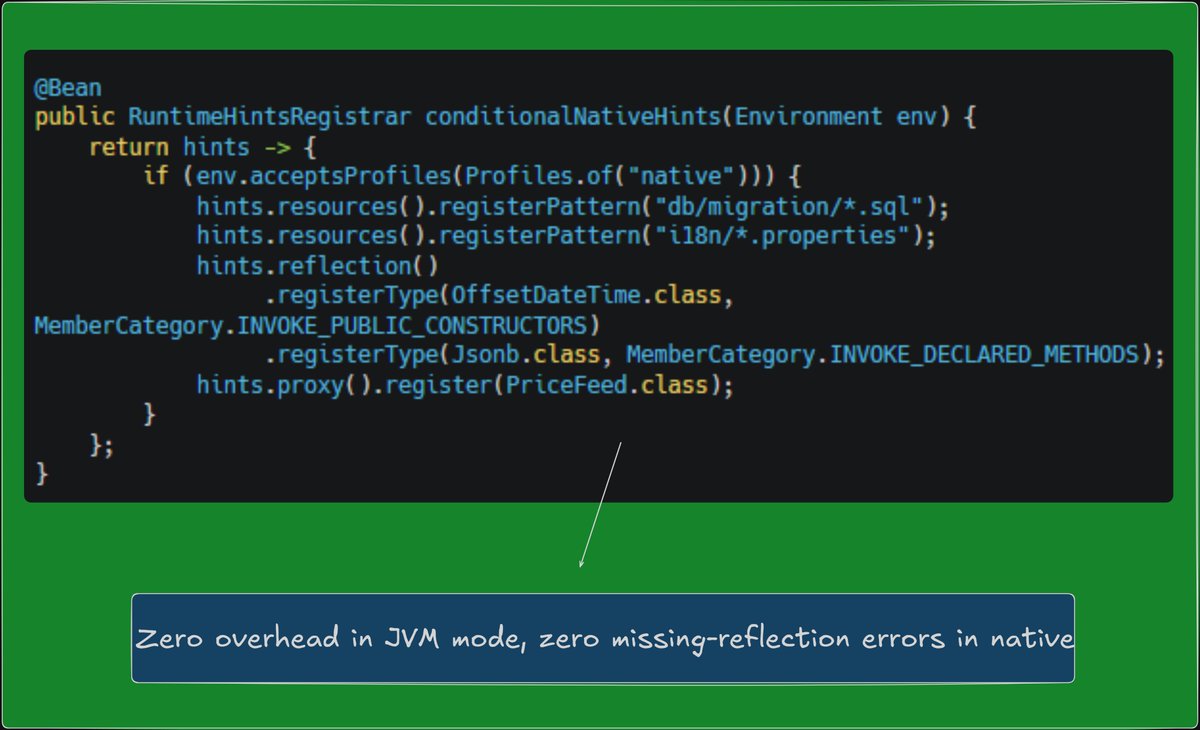
Conditional runtime hints for dev vs native
25–40 ms cold start, 15 MB RSS, 99.99th latency under 5 ms
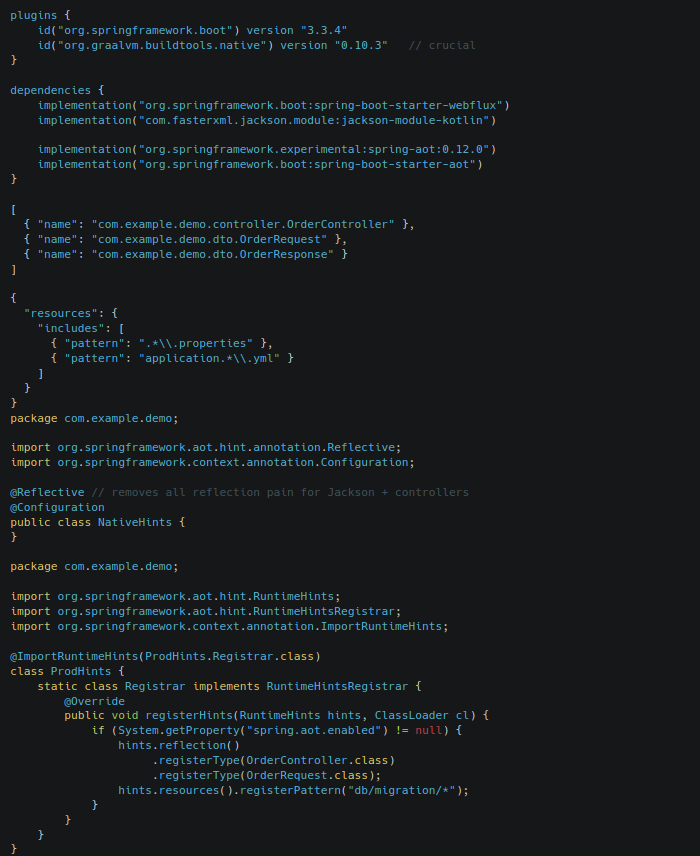
The real reason 30 ms native startup is possible :
Everyone adds static @ImportRuntimeHints and prays.
Production-grade native services generate reflection/resource/proxy hints conditionally at AOT build time, only when running under GraalVM- never bloating the JVM path.
This pattern is mandatory for any non-trivial native Spring Boot application in 2025.

AGI is here!!!
aka finally got some of my ai slopcode into an @elide_dev OSS bugfix 🎉
elide is based on the @graalvm engine and is quite hard for AI to get the complex patterns right... so what did i use?
a mix of gemini 3 pro and sonnet 4.5 thinking in @antigravity -- i can't (can totally) believe google is doing gmail for the vibecode industry (rip windsurf cursor etc // watch out jetbrains)


Cuando escribes código Java, la JVM no “entiende” tus .java.
Primero, el compilador (javac) los transforma en bytecode, un lenguaje intermedio que vive dentro de los .class.
Ese bytecode no está pensado para humanos, sino para la Java Virtual Machine, que lo interpreta o lo compila en tiempo de ejecución a código nativo según sea necesario.
Algo muy poderoso es que a la JVM no sabe ni le importa si el bytecode viene de Java, Kotlin, Scala o Groovy.
Todos terminan en el mismo destino: bytecode ejecutado por la JVM.
Ese diseño fue lo que convirtió a Java en una plataforma y no solo un lenguaje.
Tu código no corre “en el sistema operativo”,
corre en una máquina virtual que abstrae al sistema operativo.
Gracias a eso existe el famoso “write once, run anywhere”, y gracias a eso también existen herramientas como HotSpot, JIT, AOT y GraalVM
que optimizan el bytecode en tiempo real.
💡Justo por eso siempre digo que la JVM es una de las mayores obras de ingeniería de software de la historia.
Reflection es una de las herramientas más poderosas de Java.
Permite inspeccionar y manipular clases, métodos o campos en tiempo de ejecución, incluso sin conocerlos en tiempo de compilación.
Pero esa flexibilidad tiene un costo, y alto.
Cada vez que una app usa Reflection (como hace Spring o Hibernate para detectar beans, anotaciones o proxies), la JVM tiene que buscar clases por nombre, cargar metadatos y desactivar optimizaciones del compilador JIT.
Todo eso ocurre en el arranque, y por eso muchas apps Java “pesan” unos segundos antes de estar listas.
La buena noticia es que hoy existen formas de reducir ese impacto:
Spring Boot 3, por ejemplo, usa análisis AOT (Ahead of Time) para registrar toda esa metadata antes del runtime y así evitar la reflexión costosa durante el arranque.
Y con GraalVM, ese trabajo puede hacerse aún más temprano, generando ejecutables nativos que prácticamente eliminan ese costo inicial.
💡 Reflection no es el enemigo, pero entre más lo uses, más caro te saldrá el tiempo de inicio.

@Irem__Victor Java but only GraalVM

Yes, node_modules can ‘run anywhere’… as long as you drag along _hundreds_ of MBs of fragile dependencies and hope you middlewear maintainer doesn’t rejoin the job search.
Spring Boot JARs also run anywhere, JVM in prod, GraalVM native if you don’t even want that.
…while still being lighter than node_modules…

GraalVM does it for you.
GraalVM compiles Java and Spring Boot applications directly into a native executable. This is done ahead-of-time (AOT) during the build, unlike a traditional JVM which compiles code "just-in-time" as the application runs. The result is a self-contained binary that doesn't need a JVM to run.
The main benefits are near-instant startup times, drastically reduced memory usage, and smaller package sizes. This makes it ideal for microservices and cloud-native applications.
The trade-offs are significantly longer build times and that the final executable is platform-specific (e.g., a separate file for Linux vs. Windows), unlike a portable JAR file.
In terms of performance, GraalVM native images are highly competitive with C++.
Startup time is comparable. For peak computational throughput, C++ can still have an edge due to its low-level memory control.
However, GraalVM brings Java's performance into the same league as C++ for a vast majority of applications, while retaining the safety and productivity of the Java ecosystem.
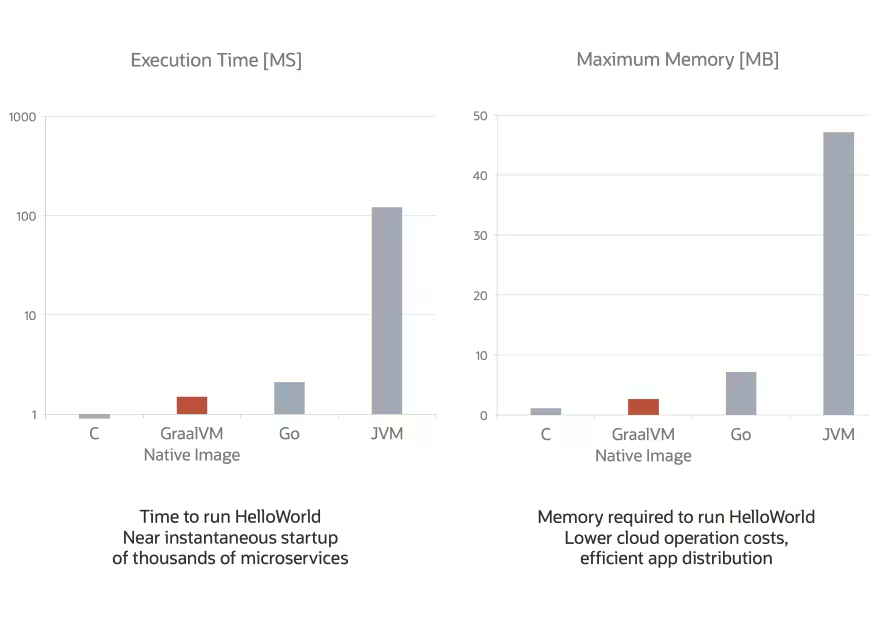
GraalVM does it for you.
GraalVM compiles Java and Spring Boot applications directly into a native executable. This is done ahead-of-time (AOT) during the build, unlike a traditional JVM which compiles code "just-in-time" as the application runs. The result is a self-contained binary that doesn't need a JVM to run.
The main benefits are near-instant startup times, drastically reduced memory usage, and smaller package sizes. This makes it ideal for microservices and cloud-native applications.
The trade-offs are significantly longer build times and that the final executable is platform-specific (e.g., a separate file for Linux vs. Windows), unlike a portable JAR file.
In terms of performance, GraalVM native images are highly competitive with C++.
Startup time is comparable. For peak computational throughput, C++ can still have an edge due to its low-level memory control.
However, GraalVM brings Java's performance into the same league as C++ for a vast majority of applications, while retaining the safety and productivity of the Java ecosystem.


@isharduld > Java
> portability
Is it from the same advertising brochure where "3 Billion Devices" lie came from?
Can I run any Java code on the STM32 MCU (or any other MCU)? JRE is no fit, J2ME is long gone. Can I have GraalVM native binary compiled for bare metal? Don't think so

@kai_fall Out of curiousity, I wrote a simple cli app https://t.co/cZk1XCUZZt in nodejs, Go, Java, and C.
NodeJS - 24 MB
Go - 2MB
Java (GraalVM) - 9MB
C - just 18 KB

@CemalIgrek @kai_fall In Java, a "Hello, World!" .class file is ~420 bytes, but requires the JVM (200+ MB for full runtime). A GraalVM native executable is ~7-15 MB—larger than C's 15 KB, comparable to Rust's 3.5 MB, but with garbage collection overhead.

My session at @spring_io is online!
I've demonstrated how to use @graalvm to build a recommender system with Python and it's data science packages directly in @springboot.
#springio23 was an amazing experience
#springboot #graalvm #polyglot #python #java

🪄 Empower your Spring Applications with Python Features on GraalVM by @j_l1nk @ Spring I/O 2023
▶️ Video: https://t.co/7lPDIRX2eW
📷 GitHub repo: https://t.co/LbHzoPO2Lv
#springio23

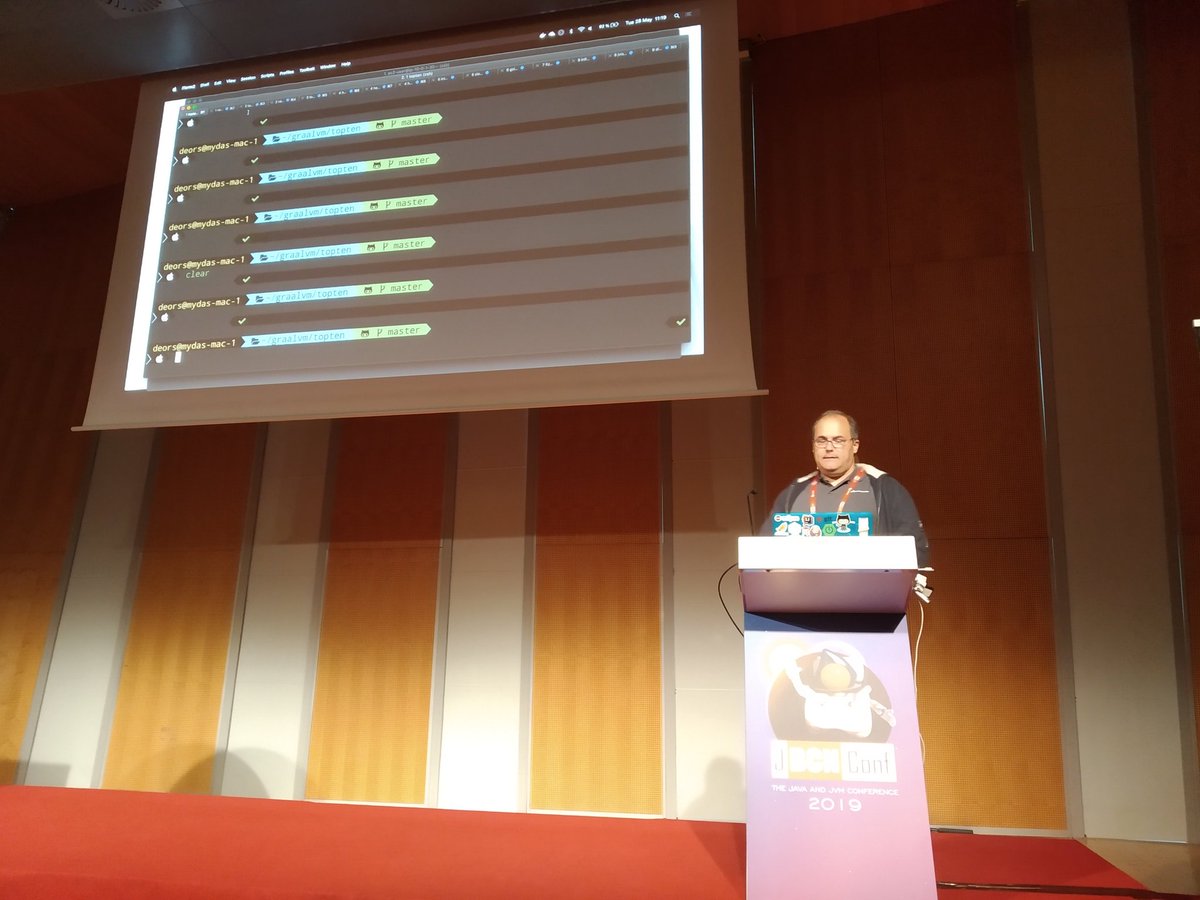
The recording of my "#Testing with #JUnit 5 and #Spring" presentation from @SpringOne 2021
is now online, and it includes a discussion on testing within #GraalVM native images. Enjoy! 🍃💻😎
https://t.co/6lh7uQ2TU7
/cc @JUnitTeam, @SpringFramework, @GraalVM

Last Seen Hashtags on Sotwe
BTSPopupAriranginKL
Seen from Kenya
Andare
Seen from United States
milf #cougar
Seen from United States
gaysmp
Seen from Indonesia
carsex()**********
Seen from Mexico
minichats
Seen from Canada
nips
Seen from United States
prettyfeet
Seen from Germany
ภาชีนัดเย็ด
Seen from Thailand
Imants
Seen from United States
Most Popular Users

Elon Musk 
@elonmusk
239.7M followers

Barack Obama
@barackobama
118.6M followers

Cristiano Ronaldo
@cristiano
114.3M followers

Donald J. Trump
@realdonaldtrump
111.7M followers

Narendra Modi
@narendramodi
106.9M followers

Rihanna
@rihanna
98.6M followers

NASA
@nasa
92.1M followers

Justin Bieber
@justinbieber
91.7M followers

KATY PERRY
@katyperry
89.9M followers

Taylor Swift
@taylorswift13
83.9M followers

Lady Gaga
@ladygaga
75.4M followers

Virat Kohli
@imvkohli
73.3M followers

Kim Kardashian
@kimkardashian
70.8M followers

YouTube
@youtube
68.6M followers

Neymar Jr
@neymarjr
66.3M followers

Bill Gates
@billgates
65.1M followers

Selena Gomez
@selenagomez
63M followers

The Ellen Show
@theellenshow
62.1M followers

CNN
@cnn
61.7M followers

X
@x
60.6M followers