

Top Tweets for #IchthyofaunaCheckList

#IchthyofaunaChecklist - Researchers presents an inventory of the ichthyofauna from the blackwater habitats of the Coastal Plain in northern Santa Catarina, southern Brazil. In total, 30 species were recorded, representing 13 families and five orders. The authors found the entire study area is highly fragmented, with restinga remnants surrounded by urban zones and industrial infrastructure. This pattern of fragmentation reduces population connectivity, impairs gene flow, and increases the risk of local extinctions.
🔓 https://t.co/zhST9Ad8o9
"The continued degradation of riparian vegetation, combined with climate change, poses an additional threat to the persistence of these communities. These findings underscore the urgent need to expand conservation actions targeting blackwater ecosystems along the southern Brazilian coastal plain."
Ichthyofauna checklists and rapid assessments are important tools for biologists, researchers, conservationists, and government bodies/NGOs. They provide critical baselines for the conservation and management of regional fish fauna. Our understanding of species composition in a territory evolves due to species movements across borders, extinctions, introductions, and new taxonomic evidence.
𝗥𝗲𝘀𝗲𝗮𝗿𝗰𝗵 𝗧𝗶𝘁𝗹𝗲
Fish assemblages and endemism in blackwater aquatic habitats of the Coastal Plain in northern Santa Catarina, southern Brazil
𝗖𝗶𝘁𝗮𝘁𝗶𝗼𝗻
Dalcin, R. H., Lima, A. O. de S., Laaf, Y. de O., Ossa-Guerra, L. E. D. la ., Dallabona, J. A., Costa, V. S. C. da ., Abilhoa, V., Pinheiro, P. C., Feltrin, C. R., & Cionek, V. de M.. (2026). Fish assemblages and endemism in blackwater aquatic habitats of theCoastal Plain in northern Santa Catarina, southern Brazil. Biota Neotropica, 26(3), e20251834. https://t.co/rZIcEBzVW0
𝗔𝗯𝘀𝘁𝗿𝗮𝗰𝘁
Blackwater streams are unique environments characterized by dark, acidic, and nutrient-poor waters, supporting highly specialized aquatic communities.
This study presents an inventory of the ichthyofauna of such systems in the northern region of Santa Catarina state, based on surveys conducted between 2020 and 2024. A total of 22 sites were sampled, including perennial rivers, intermittent streams, and temporary pools, located both within and outside protected areas. In total, 30 fish species were recorded, representing 13 families and five orders. The order Characiformes showed the highest richness and was represented mainly by small-characins of the family Acestrorhamphidae. Nine species were identified as endemic to blackwater environments of the Atlantic Forest, five of which officially listed as threatened. The guppy 𝑃𝑜𝑒𝑐𝑖𝑙𝑖𝑎 𝑟𝑒𝑡𝑖𝑐𝑢𝑙𝑎𝑡𝑎 was recorded for the first time in blackwater environments of the region, as well as 𝐵𝑟𝑎𝑐ℎ𝑦ℎ𝑦𝑝𝑜𝑝𝑜𝑚𝑢𝑠 𝑐𝑓. 𝑑𝑟𝑎𝑐𝑜, representing the first record of Hypopomidae (knifefish) in the region. DNA barcoding (using COI) provided molecular information, in addition to the morphological identification of 12 species, providing new local sequences for them. Results indicated a high similarity between the ichthyofauna of this region and that of blackwater streams in the southern coast of São Paulo. Endemic and threatened species were recorded both inside and outside legally protected areas, highlighting gaps in current conservation efforts. Furthermore, intermittent streams and temporary pools proved to be critical habitats for maintaining species with extremely restricted distributions.
The continued degradation of riparian vegetation, combined with climate change, poses an additional threat to the persistence of these communities. These findings underscore the urgent need to expand conservation actions targeting blackwater ecosystems along the southern Brazilian coastal plain.
𝗣𝗵𝗼𝘁𝗼 𝗖𝗿𝗲𝗱𝗶𝘁
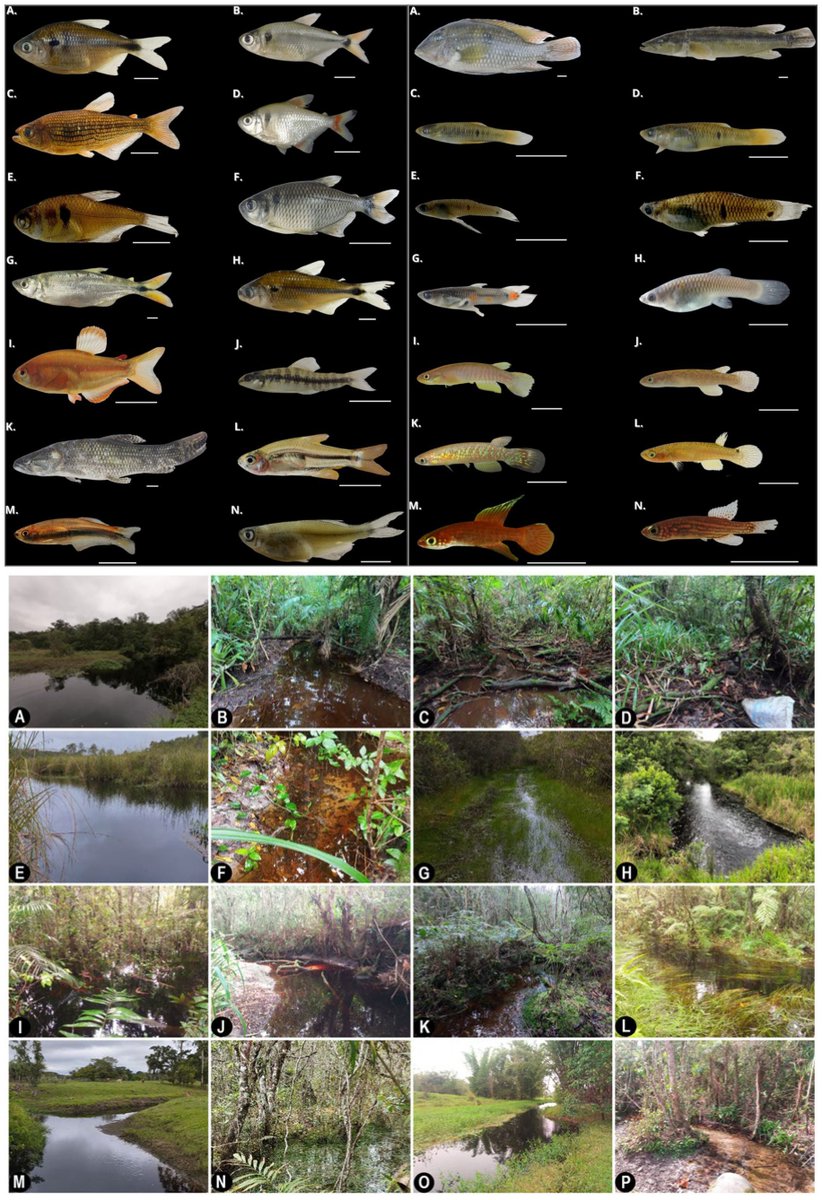
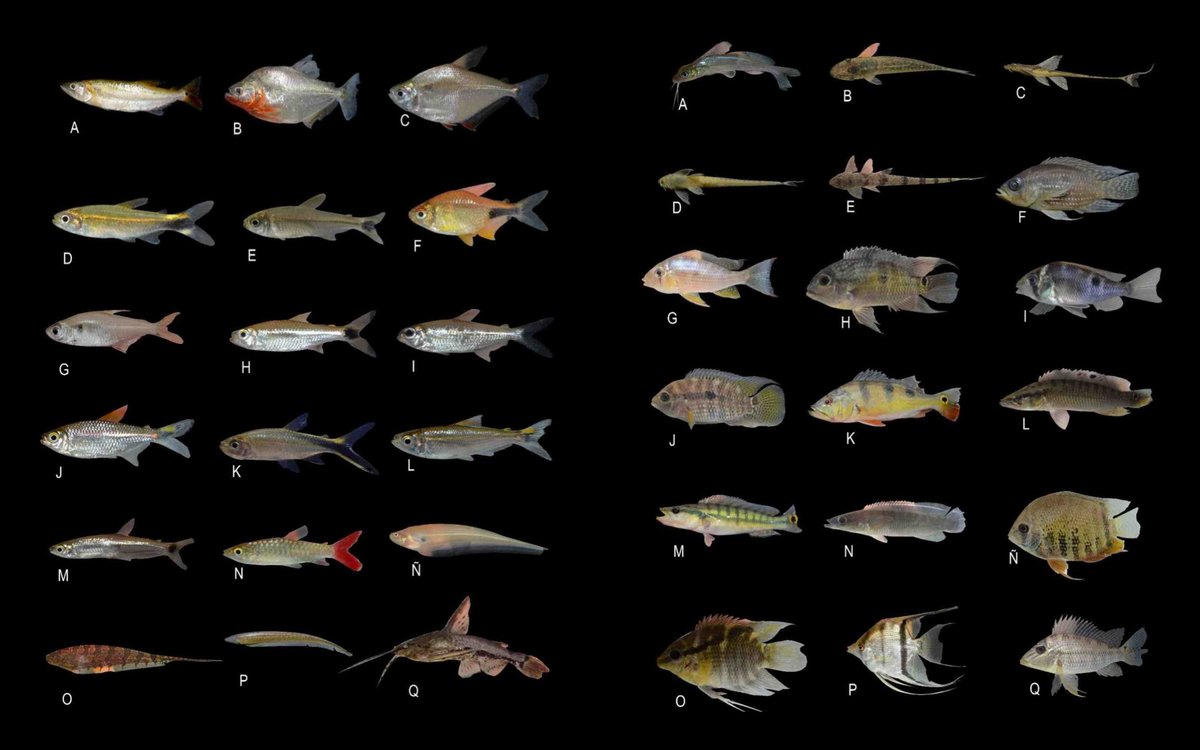
Top left - Representative species of the order Characiformes recorded in the blackwater streams of northern Santa Catarina, Brazil. (A) Astyanax lacustris. (B) Deuterodon ribeirae. (C) Hollandichthys multifasciatus. (D) Hyphessobrycon igneus. (E) Hyphessobrycon griemi. (F) Hyphessobrycon reticulatus. (G) Oligosarcus hepsetus; (H) Psalidodon laticeps. (I) Rachoviscus crassiceps. (J) Characidium lanei. (K) Hoplias malabaricus. (L) Spintherobolus ankoseion. (M) Mimagoniates lateralis. (N) Mimagoniates microlepis. The white scale bar below each photograph corresponds to 1 cm.
Top right - Representative species of the order Cichliformes and Cyprinodontiformes recorded in the blackwater streams of northern Santa Catarina, Brazil. (A) Geophagus iporangensis. (B) Saxatilia lepidota. (C) Phalloceros cf. circummontanus (male). (D) Phalloceros cf. circummontanus (female). (E) Phalloceros spiloura (male). (F) Phalloceros spiloura (female). (G) Poecilia reticulata (male). (H) Poecilia reticulata (female). (I) Atlantirivulus haraldsiolii (male). (J) Atlantirivulus haraldsiolii (female). (K) Atlantirivulus luelingi (male). (L) Atlantirivulus luelingi (female). (M) Campellolebias chrysolineatus (male); (N) Campellolebias chrysolineatus (female). The white scale bar below each photograph corresponds to 1 cm.
Bottom - Examples of sampling sites visited during fieldwork activities. (A) Saí Mirim River, Itapoá. (B) Tributary of the Saí Mirim River. (C) Temporary pool on the margins of the Saí Mirim River during the rainy season. (D) Temporary pool on the margins of the Saí Mirim River during the dry season. (E) Acaraí River, São Francisco do Sul. (F) Tributary of the Acaraí River. (G) Temporary pool on the margins of the Acaraí River. (H) Pernambuco River, Barra do Sul. (I) Tributary of the Pernambuco River. (J) Perequê River, Barra do Sul. (K) Tributary of the Perequê River. (L) Temporary pool on the margins of the Perequê River. (M) Tributary of the Itapocu River, Araquari. (N) Temporary pool on the margins of a tributary of the Itapocu River. (O) Cardoso Stream, tributary of the Itapocu River, Araquari. (P) Tributary of the Cardoso Stream.
© 2026 the Author(s). Published in the journal Biota Neotropical. An open-access article, distributed under the terms of the Creative Commons Attribution 4.0 International (CC-BY-4.0) deed. https://t.co/5IYEkz4Rwi
#Ichthyofauna #Blackwater #Ichthyology #Biodiversity #AquariumHobby #Fishkeeping #Aquarist #TropicalFish #FishTank #SantaCatarina #CoastalPlains #CoastalPlain #Brazil #Neotropical
#IchthyofaunaChecklist - Researchers in this study document the ichthyofauna composition in the Surabaya River, one of the most important rivers in East Java, Indonesia, recording 35 fish species across 31 genera and 17 families. Cyprinidae was the dominant family, comprising 10 genera and 11 species.
🔓 https://t.co/atT8ldWZ9q
"Several species endemic of Java, such as Java walking catfish 𝐶𝑙𝑎𝑟𝑖𝑎𝑠 𝑏𝑎𝑡𝑟𝑎𝑐ℎ𝑢𝑠, Asian redtail catfish 𝐻𝑒𝑚𝑖𝑏𝑎𝑔𝑟𝑢𝑠 𝑛𝑒𝑚𝑢𝑟𝑢𝑠, wrestling halfbeak 𝐷𝑒𝑟𝑚𝑜𝑔𝑒𝑛𝑦𝑠 𝑝𝑢𝑠𝑖𝑙𝑙𝑎, and spotted barb 𝐵𝑎𝑟𝑏𝑜𝑑𝑒𝑠 𝑏𝑖𝑛𝑜𝑡𝑎𝑡𝑢𝑠, were found in this study, indicating that further attention is needed to preserve their habitat."
Ichthyofauna checklists and rapid assessments are important tools for biologists, researchers, conservationists, and government bodies/NGOs. They provide critical baselines for the conservation and management of regional fish fauna. Our understanding of species composition in a territory evolves due to species movements across borders, extinctions, introductions, and new taxonomic evidence.
𝗥𝗲𝘀𝗲𝗮𝗿𝗰𝗵 𝗧𝗶𝘁𝗹𝗲
Checklist of native freshwater fish from Surabaya River, Indonesia
𝗖𝗶𝘁𝗮𝘁𝗶𝗼𝗻
Faqih AR, Triastuti RRJ, Wisudyawati D, Anitasari S, Kharisma VD, Rahayu R, Cahyono H, Suliastini J, Islamy RA, Valen FS, Tamam MB, Arisandi P, South J, Kamarudin AS, Wijaya AK, Hasan V. 2026. Checklist of native freshwater fish from Surabaya River, Indonesia. Biodiversitas 27 (3): d270327. https://t.co/XeLnoYk45p
𝗔𝗯𝘀𝘁𝗿𝗮𝗰𝘁
Surabaya River is a tributary of the Brantas River and is habitat to several freshwater fish species. The aim of this study was to provide information on the species composition of freshwater fish in the Surabaya River, one of the most important rivers in East Java, Indonesia.
All samples used in this study were caught from December 25, 2025, to January 25, 2026. Sampling was conducted at three stations on the Surabaya River: the starting point of the bifurcation at Mlirip Sluice Gate, Mojokerto Regency (Station 1); Krian Sub-District, Sidoarjo Regency (Station 2); and the end of the river at Jagir Sluice Gate, Surabaya City (Station 3). Specimens were identified using specialized papers and books.
This work recorded 35 fish species across 31 genera and 17 families. Cyprinidae was the dominant family, comprising 10 genera and 11 species. Station 1 had the highest species richness (34 species), while Station 3 had the lowest (17 species). Several species endemic of Java, such as Java walking catfish 𝐶𝑙𝑎𝑟𝑖𝑎𝑠 𝑏𝑎𝑡𝑟𝑎𝑐ℎ𝑢𝑠, Asian redtail catfish 𝐻𝑒𝑚𝑖𝑏𝑎𝑔𝑟𝑢𝑠 𝑛𝑒𝑚𝑢𝑟𝑢𝑠, wrestling halfbeak 𝐷𝑒𝑟𝑚𝑜𝑔𝑒𝑛𝑦𝑠 𝑝𝑢𝑠𝑖𝑙𝑙𝑎, and spotted barb 𝐵𝑎𝑟𝑏𝑜𝑑𝑒𝑠 𝑏𝑖𝑛𝑜𝑡𝑎𝑡𝑢𝑠, were found in this study, indicating that further attention is needed to preserve their habitat.
The new information on freshwater fish diversity across different parts of the river will be useful for updating the current database on Javanese freshwater fish species diversity and for providing an updated native species inventory for three segments during the 2025-2026 sampling. Information on the habitat use and ecological interactions of fish occurring in the Surabaya River is urgently needed to make appropriate conservation decisions and plans.
𝗣𝗵𝗼𝘁𝗼 𝗖𝗿𝗲𝗱𝗶𝘁
Freshwater fish collected from Surabaya River, East Java, Indonesia. A ) 𝑁𝑜𝑡𝑜𝑝𝑡𝑒𝑟𝑢𝑠 𝑛𝑜𝑡𝑜𝑝𝑡𝑒𝑟𝑢𝑠, B ) 𝑅𝑎𝑠𝑏𝑜𝑟𝑎 𝑎𝑟𝑔𝑦𝑟𝑜𝑡𝑎𝑒𝑛𝑖𝑎, C ) 𝑅𝑎𝑠𝑏𝑜𝑟𝑎 𝑐𝑓. 𝑙𝑎𝑡𝑒𝑟𝑖𝑠𝑡𝑟𝑖𝑎𝑡𝑎, D ) 𝐵𝑎𝑟𝑏𝑜𝑑𝑒𝑠 𝑏𝑖𝑛𝑜𝑡𝑎𝑡𝑢𝑠, E ) 𝐵𝑎𝑟𝑏𝑜𝑛𝑦𝑚𝑢𝑠 𝑏𝑎𝑙𝑙𝑒𝑟𝑜𝑖𝑑𝑒𝑠, F ) 𝐵𝑎𝑟𝑏𝑜𝑛𝑦𝑚𝑢𝑠 𝑔𝑜𝑛𝑖𝑜𝑛𝑜𝑡𝑢𝑠, G ) 𝐶𝑦𝑐𝑙𝑜𝑐ℎ𝑒𝑖𝑙𝑖𝑐ℎ𝑡ℎ𝑦𝑠 𝑎𝑝𝑜𝑔𝑜𝑛, H ) 𝐿𝑎𝑏𝑒𝑜 𝑐ℎ𝑟𝑦𝑠𝑜𝑝ℎ𝑒𝑘𝑎𝑑𝑖𝑜𝑛, I ) 𝐿𝑎𝑏𝑖𝑜𝑏𝑎𝑟𝑏𝑢𝑠 𝑙𝑒𝑝𝑡𝑜𝑐ℎ𝑒𝑖𝑙𝑢𝑠, J ) 𝑀𝑦𝑠𝑡𝑎𝑐𝑜𝑙𝑒𝑢𝑐𝑢𝑠 𝑜𝑏𝑡𝑢𝑠𝑖𝑟𝑜𝑠𝑡𝑟𝑖𝑠, K ) 𝑂𝑠𝑡𝑒𝑜𝑐ℎ𝑖𝑙𝑢𝑠 𝑣𝑖𝑡𝑡𝑎𝑡𝑢𝑠, L ) 𝑆𝑦𝑠𝑡𝑜𝑚𝑢𝑠 𝑟𝑢𝑏𝑟𝑖𝑝𝑖𝑛𝑛𝑖𝑠, M ) 𝑁𝑒𝑜𝑙𝑖𝑠𝑠𝑜𝑐ℎ𝑖𝑙𝑢𝑠 𝑠𝑜𝑟𝑜, N ) 𝐻𝑎𝑚𝑝𝑎𝑙𝑎 𝑚𝑎𝑐𝑟𝑜𝑙𝑒𝑝𝑖𝑑𝑜𝑡𝑎, O ) 𝐻𝑒𝑚𝑖𝑏𝑎𝑔𝑟𝑢𝑠 𝑛𝑒𝑚𝑢𝑟𝑢𝑠, P ) 𝑀𝑦𝑠𝑡𝑢𝑠 𝑠𝑖𝑛𝑔𝑎𝑟𝑖𝑛𝑔𝑎𝑛, Q ) 𝑀𝑦𝑠𝑡𝑢𝑠 𝑛𝑖𝑔𝑟𝑖𝑐𝑒𝑝𝑠, R ) 𝑀𝑦𝑠𝑡𝑢𝑠 𝑎𝑏𝑏𝑟𝑒𝑣𝑖𝑎𝑡𝑢𝑠, S ) 𝐺𝑙𝑜𝑠𝑠𝑜𝑔𝑜𝑏𝑖𝑢𝑠 𝑔𝑖𝑢𝑟𝑖𝑠, T ) 𝐶𝑙𝑎𝑟𝑖𝑎𝑠 𝑏𝑎𝑡𝑟𝑎𝑐ℎ𝑢𝑠, U ) 𝑃𝑎𝑛𝑔𝑎𝑠𝑖𝑢𝑠 𝑑𝑗𝑎𝑚𝑏𝑎𝑙, V ) 𝑃𝑠𝑒𝑢𝑑𝑜𝑙𝑎𝑖𝑠 𝑚𝑖𝑐𝑟𝑜𝑛𝑒𝑚𝑢𝑠, W ) 𝐿𝑎𝑖𝑑𝑒𝑠 ℎ𝑒𝑥𝑎𝑛𝑒𝑚𝑎, X ) 𝐴𝑛𝑎𝑏𝑎𝑠 𝑡𝑒𝑠𝑡𝑢𝑑𝑖𝑛𝑒𝑢𝑠, Y ) 𝑇𝑟𝑖𝑐ℎ𝑜𝑝𝑜𝑑𝑢𝑠 𝑡𝑟𝑖𝑐ℎ𝑜𝑝𝑡𝑒𝑟𝑢𝑠, Z ) 𝑇𝑟𝑖𝑐ℎ𝑜𝑝𝑠𝑖𝑠 𝑣𝑖𝑡𝑡𝑎𝑡𝑎, AA ) 𝑂𝑠𝑝ℎ𝑟𝑜𝑛𝑒𝑚𝑢𝑠 𝑔𝑜𝑟𝑎𝑚𝑦, AB ) 𝐶ℎ𝑎𝑛𝑛𝑎 𝑠𝑡𝑟𝑖𝑎𝑡𝑎, AC ) 𝑂𝑥𝑦𝑒𝑙𝑒𝑜𝑡𝑟𝑖𝑠 𝑚𝑎𝑟𝑚𝑜𝑟𝑎𝑡𝑎, AD ) 𝑀𝑎𝑠𝑡𝑎𝑐𝑒𝑚𝑏𝑒𝑙𝑢𝑠 𝑢𝑛𝑖𝑐𝑜𝑙𝑜𝑟, AE ) 𝑀𝑎𝑐𝑟𝑜𝑔𝑛𝑎𝑡ℎ𝑢𝑠 𝑎𝑐𝑢𝑙𝑒𝑎𝑡𝑢𝑠, AF ) 𝑀𝑜𝑛𝑜𝑝𝑡𝑒𝑟𝑢𝑠 𝑗𝑎𝑣𝑎𝑛𝑒𝑛𝑠𝑖𝑠, AG ) 𝑂𝑟𝑦𝑧𝑖𝑎𝑠 𝑗𝑎𝑣𝑎𝑛𝑖𝑐𝑢𝑠, AH ) 𝐴𝑝𝑙𝑜𝑐ℎ𝑒𝑖𝑙𝑢𝑠 𝑎𝑟𝑚𝑎𝑡𝑢𝑠, AI ) 𝐷𝑒𝑟𝑚𝑜𝑔𝑒𝑛𝑦𝑠 𝑝𝑢𝑠𝑖𝑙𝑙𝑎.
© 2026 the Author(s). Published in the journal Biodiversitas Journal of Biological Diversity. An open-access article, distributed under the terms of the Attribution-NonCommercial-ShareAlike 4.0 International
(CC BY-NC-SA 4.0) licence. https://t.co/jHt82aoSO6
#SurabayaRiver #Indonesia #Ichthyology #Taxonomy #Biodiversity #AquariumHobby #Fishkeeping #Aquarist #TropicalFish #FishTank #AquaticEcosystem #BrantasBasin #Conservation #Ichthyofauna #Java #Cyprinidae #SpeciesInventory

#IchthyofaunaChecklist - Here, researchers report the results of an expedition to the northern section of the Serra do Divisor National Park (PNSD) in the Rio Juruá basin, Acre State, Brazil, with the aim to increase knowledge of the ichthyofauna of a poorly known region whose protected status is currently under threat.
🔓 https://t.co/sx0OLUilU9
The PNSD is situated in the far western portion of Brazil, in the state of Acre, on the watershed divide between the upper Rio Juruá basin, in Brazil and the middle Río Ucayali basin in Peru. The Rio Juruá is one of the longest tributaries of the Amazon basin, and most of its headwaters originate in the Serra do Divisor, including the Rio Moa, the main tributary of Rio Juruá in Acre. Surveys of the ichthyofauna of the PNSD were not conducted during the preparation of the management plan, and the fish diversity of this protected area remains largely unknown.
Ichthyofauna checklists and rapid assessments are important tools for biologists, researchers, conservationists, and government bodies/NGOs. They provide critical baselines for the conservation and management of regional fish fauna. Our understanding of species composition in a territory evolves due to species movements across borders, extinctions, introductions, and new taxonomic evidence.
𝗥𝗲𝘀𝗲𝗮𝗿𝗰𝗵 𝗧𝗶𝘁𝗹𝗲
Ichthyofauna of Serra do Divisor National Park, upper Rio Moa, Rio Juruá basin, Acre State, Brazil
𝗖𝗶𝘁𝗮𝘁𝗶𝗼𝗻
Toledo-Piza, M., Giovannetti, V., Mathubara, K., Casas, A. L. da S., Mattox, G. M. T., & Jacó, T. R. F. (2026). Ichthyofauna of Serra do Divisor National Park, upper Rio Moa, Rio Juruá basin, Acre State, Brazil. Biota Neotropica, 26(2), e20251837. https://t.co/lDTkAQwL3o
𝗔𝗯𝘀𝘁𝗿𝗮𝗰𝘁
The Serra do Divisor National Park (PNSD) is situated in the far western portion of Brazil, in the state of Acre, on the watershed divide between the upper Rio Juruá basin, in Brazil and the middle Río Ucayali basin in Peru. The Rio Juruá is one of the longest tributaries of the Amazon basin, and most of its headwaters originate in the Serra do Divisor, including the Rio Moa, the main tributary of Rio Juruá in Acre. Surveys of the ichthyofauna of the PNSD were not conducted during the preparation of the management plan, and the fish diversity of this protected area remains largely unknown.
Here, we report the results of an expedition to the northern section of the PNSD, aiming to increase knowledge of the ichthyofauna of a poorly known region whose protected status is currently under threat. Seventeen localities in the upper Rio Moa drainage, in the surroundings of the region known as Pé da Serra (between 73°38’04.7” W and 73°44’52.7” W, and 07°26’52.2” S and 07°32’ 14.7” S), were sampled using hand nets and beach seines. Sampling was conducted at sites along the Rio Moa, its tributaries, and adjacent lakes.
A total of 3,504 specimens were collected, representing 103 species in 89 genera and 27 families across seven orders. The Characiformes (52 species) and Siluriformes (32 species) were the most diverse orders, followed by the Gymnotiformes (8 species), Cichliformes (8 species), Batrachoidiformes (1 species), Cyprinodontiformes (1 species), and Synbranchiformes (1 species). Species of Characiformes, Siluriformes, and Cichliformes were found in all three sampled environments. Gymnotiformes and Batrachoidiformes were not recorded from lakes, and species of Synbranchiformes and Cyprinodontiformes were found exclusively in tributaries of the Rio Moa. Six species represent new records for Brazilian drainages, 13 for the Rio Juruá drainage, and 30 for the Rio Moa.
The identification of 43 species requires additional, more detailed studies. For most species, information on the variation of diagnostic characters is provided, which, together with images of selected specimens, is intended to serve as a basis for future studies of the ichthyofauna of the PNSD.
𝗣𝗵𝗼𝘁𝗼 𝗖𝗿𝗲𝗱𝗶𝘁
Top left - Species of Characiformes: Anostomidae (a,b), Acestrorhamphidae (c–r), and Characidae (s–x) from the upper Rio Moa drainage at Serra do Divisor National Park, Acre, Brazil: a) 𝐿𝑒𝑝𝑜𝑟𝑖𝑛𝑢𝑠 𝑐𝑓. 𝑐𝑦𝑙𝑖𝑛𝑑𝑟𝑖𝑓𝑜𝑟𝑚𝑖𝑠, 100.4 mm SL; b) 𝑆𝑐ℎ𝑖𝑧𝑜𝑑𝑜𝑛 𝑓𝑎𝑠𝑐𝑖𝑎𝑡𝑢𝑠, 230.9 mm SL; c) 𝐴𝑠𝑡𝑦𝑎𝑛𝑎𝑐𝑖𝑛𝑢𝑠 𝑠𝑝., 63.9 mm SL; d) 𝐴𝑠𝑡𝑦𝑎𝑛𝑎𝑥 𝑏𝑖𝑚𝑎𝑐𝑢𝑙𝑎𝑡𝑢𝑠 species group, 63.2 mm SL; e) 𝐵𝑎𝑟𝑖𝑜 𝑜𝑙𝑖𝑔𝑜𝑙𝑒𝑝𝑖𝑠, 71 mm SL; f) 𝐵𝑎𝑟𝑖𝑜 𝑠𝑡𝑒𝑖𝑛𝑑𝑎𝑐ℎ𝑛𝑒𝑟𝑖 female, 77.3 mm SL; g) 𝐵𝑎𝑟𝑖𝑜 𝑠𝑡𝑒𝑖𝑛𝑑𝑎𝑐ℎ𝑛𝑒𝑟𝑖 male, 87.8 mm SL; h) 𝐶𝑡𝑒𝑛𝑜𝑏𝑟𝑦𝑐𝑜𝑛 𝑠𝑝𝑖𝑙𝑢𝑟𝑢𝑠, 37.2 mm SL; i) 𝐺𝑦𝑚𝑛𝑜𝑐𝑜𝑟𝑦𝑚𝑏𝑢𝑠 𝑡ℎ𝑎𝑦𝑒𝑟𝑖, 43 mm SL; j) 𝐻𝑒𝑚𝑖𝑔𝑟𝑎𝑚𝑚𝑢𝑠 𝑠𝑝., 27.4 mm SL; k) 𝐻𝑜𝑙𝑜𝑝𝑟𝑖𝑠𝑡𝑖𝑠 𝑜𝑐𝑒𝑙𝑙𝑖𝑓𝑒𝑟𝑎 species group, 26.6 mm SL; l) 𝐽𝑢𝑝𝑖𝑎𝑏𝑎 𝑎𝑠𝑦𝑚𝑚𝑒𝑡𝑟𝑖𝑐𝑎, 41.3 mm SL; m) 𝑀𝑜𝑒𝑛𝑘ℎ𝑎𝑢𝑠𝑖𝑎 𝑑𝑖𝑐ℎ𝑟𝑜𝑢𝑟𝑎, 41.4 mm SL; n) 𝑀𝑜𝑒𝑛𝑘ℎ𝑎𝑢𝑠𝑖𝑎 ℎ𝑎𝑠𝑒𝑚𝑎𝑛𝑖, 49.8 mm SL; o) 𝑀𝑜𝑒𝑛𝑘ℎ𝑎𝑢𝑠𝑖𝑎 𝑖𝑛𝑡𝑒𝑟𝑚𝑒𝑑𝑖𝑎, 29.2 mm SL; p) 𝑀𝑜𝑒𝑛𝑘ℎ𝑎𝑢𝑠𝑖𝑎 𝑐𝑓. 𝑜𝑟𝑡𝑒𝑔𝑢𝑎𝑠𝑎𝑒, 54.2 mm SL; q) 𝑀𝑜𝑒𝑛𝑘ℎ𝑎𝑢𝑠𝑖𝑎 𝑠𝑝., 40.4 mm SL; r) 𝑅𝑎𝑚𝑖𝑟𝑒𝑧𝑒𝑙𝑙𝑎 𝑛𝑒𝑤𝑏𝑜𝑙𝑑𝑖, 45 mm SL; s) 𝐴𝑝ℎ𝑦𝑜𝑐ℎ𝑎𝑟𝑎𝑥 𝑠𝑝., 35.3 mm SL; t) 𝐿𝑒𝑝𝑡𝑎𝑔𝑜𝑛𝑖𝑎𝑡𝑒𝑠 𝑠𝑡𝑒𝑖𝑛𝑑𝑎𝑐ℎ𝑛𝑒𝑟𝑖, 9.2 mm SL; u) 𝑀𝑖𝑐𝑟𝑜𝑠𝑐ℎ𝑒𝑚𝑜𝑏𝑟𝑦𝑐𝑜𝑛 𝑔𝑒𝑖𝑠𝑙𝑒𝑟𝑖, 27.4 mm SL; v) 𝑂𝑑𝑜𝑛𝑡𝑜𝑠𝑡𝑖𝑙𝑏𝑒 𝑐𝑓. 𝑓𝑢𝑔𝑖𝑡𝑖𝑣𝑎, 33.4 mm SL; w) 𝑃𝑎𝑟𝑎𝑔𝑜𝑛𝑖𝑎𝑡𝑒𝑠 𝑎𝑙𝑏𝑢𝑟𝑛𝑢𝑠, 72.5 mm SL; x) 𝑃ℎ𝑒𝑛𝑎𝑐𝑜𝑔𝑎𝑠𝑡𝑒𝑟 𝑛𝑎𝑝𝑜𝑎𝑡𝑖𝑙𝑖𝑠, 40.1 mm SL.
Top right - Species of Gymnotiformes: Apteronotidae (a–c), Gymnotidae (d), Rhamphichthyidae (e, f); Sternopygidae (g, h); and Siluriformes: Aspredinidae (i–l), Callichthyidae (m–o), Cetopsidae (p, q), Heptapteridae (r–u), Loricariidae (v–x) from the upper Rio Moa drainage at Serra do Divisor National Park, Acre, Brazil: a) 𝐴𝑝𝑡𝑒𝑟𝑜𝑛𝑜𝑡𝑢𝑠 𝑎𝑙𝑏𝑖𝑓𝑟𝑜𝑛𝑠 species group, 188.6 mm SL; b) 𝑃𝑙𝑎𝑡𝑦𝑢𝑟𝑜𝑠𝑡𝑒𝑟𝑛𝑎𝑟𝑐ℎ𝑢𝑠 𝑚𝑎𝑐𝑟𝑜𝑠𝑡𝑜𝑚𝑎 Günther, 226 mm SL; c) 𝑆𝑡𝑒𝑟𝑛𝑎𝑟𝑐ℎ𝑜𝑟ℎ𝑦𝑛𝑐ℎ𝑢𝑠 𝑠𝑝., 132.9 mm SL; d) 𝐺𝑦𝑚𝑛𝑜𝑡𝑢𝑠 𝑐𝑜𝑎𝑡𝑒𝑠𝑖 species group, 99.6 mm TL; e) 𝐺𝑦𝑚𝑛𝑜𝑟ℎ𝑎𝑚𝑝ℎ𝑖𝑐ℎℎ𝑡𝑦𝑠 𝑟𝑜𝑛𝑑𝑜𝑛𝑖, 142 mm TL; f) 𝐻𝑦𝑝𝑜𝑝𝑦𝑔𝑢𝑠 𝑙𝑒𝑝𝑡𝑢𝑟𝑢𝑠, 64.2 mm TL; g) 𝐸𝑖𝑔𝑒𝑛𝑚𝑎𝑛𝑛𝑖𝑎 𝑡𝑟𝑖𝑙𝑖𝑛𝑒𝑎𝑡𝑎 species group, 112 mm TL; h) 𝑆𝑡𝑒𝑟𝑛𝑜𝑝𝑦𝑔𝑢𝑠 𝑚𝑎𝑐𝑟𝑢𝑟𝑢𝑠, 67.8 mm TL; i, j) 𝐴𝑚𝑎𝑟𝑎𝑙𝑖𝑎 ℎ𝑦𝑝𝑠𝑖𝑢𝑟𝑎, 88.8 mm SL, dorsal and lateral views; k, l) 𝑃𝑡𝑒𝑟𝑜𝑏𝑢𝑛𝑜𝑐𝑒𝑝ℎ𝑎𝑙𝑢𝑠 𝑑𝑒𝑝𝑟𝑒𝑠𝑠𝑢𝑠, 89.2 mm SL, dorsal and lateral views; m, n, o) 𝑀𝑒𝑔𝑎𝑙𝑒𝑐ℎ𝑖𝑠 𝑡ℎ𝑜𝑟𝑎𝑐𝑎𝑡𝑎, 132.2 mm SL, lateral, ventral and dorsal views; p) 𝐷𝑒𝑛𝑡𝑖𝑐𝑒𝑡𝑜𝑝𝑠𝑖𝑠 𝑠𝑒𝑑𝑢𝑐𝑡𝑎, 27.4 mm SL; q) 𝐻𝑒𝑙𝑜𝑔𝑒𝑛𝑒𝑠 𝑚𝑎𝑟𝑚𝑜𝑟𝑎𝑡𝑢𝑠, 62.2 mm SL; r, s) 𝑃𝑎𝑟𝑖𝑜𝑙𝑖𝑢𝑠 𝑐𝑓. 𝑚𝑎𝑙𝑑𝑜𝑛𝑎𝑑𝑜𝑖, 36.5 mm SL, lateral and dorsal views; t) 𝑃𝑖𝑚𝑒𝑙𝑜𝑑𝑒𝑙𝑙𝑎 𝑠𝑝. 1, 83.4 mm SL; u) 𝑃𝑖𝑚𝑒𝑙𝑜𝑑𝑒𝑙𝑙𝑎 𝑠𝑝. 2, 66.6 mm SL; v, w, x) 𝐴𝑛𝑐𝑖𝑠𝑡𝑟𝑢𝑠 𝑠𝑝., 35.4 mm SL, lateral, dorsal and ventral views.
Bottom left - Species of Siluriformes: Loricariidae (cont.) from the upper Rio Moa drainage at Serra do Divisor National Park, Acre, Brazil: a, b, c) 𝐹𝑎𝑟𝑙𝑜𝑤𝑒𝑙𝑙𝑎 𝑠𝑚𝑖𝑡ℎ𝑖, 162 mm SL, lateral, ventral and dorsal views; d, e, f) 𝐻𝑒𝑚𝑖𝑜𝑑𝑜𝑛𝑡𝑖𝑐ℎ𝑡ℎ𝑦𝑠 𝑎𝑐𝑖𝑝𝑒𝑛𝑠𝑒𝑟𝑖𝑛𝑢𝑠, 53.1 mm SL, lateral, ventral and dorsal views; g, h, i) 𝐻𝑦𝑝𝑜𝑠𝑡𝑜𝑚𝑢𝑠 𝑐𝑜𝑐ℎ𝑙𝑖𝑜𝑑𝑜𝑛, 82.5 mm SL, lateral, ventral and dorsal views; j) 𝐿𝑎𝑚𝑜𝑛𝑡𝑖𝑐ℎ𝑡ℎ𝑦𝑠 𝑓𝑖𝑙𝑎𝑚𝑒𝑛𝑡𝑜𝑠𝑢𝑠, 193.5 mm SL; k, l, m) 𝐿𝑎𝑠𝑖𝑎𝑛𝑐𝑖𝑠𝑡𝑟𝑢𝑠 𝑠𝑐ℎ𝑜𝑚𝑏𝑢𝑟𝑔𝑘𝑖𝑖, 73.9 mm SL; lateral, ventral and dorsal views; n) 𝐿𝑖𝑚𝑎𝑡𝑢𝑙𝑖𝑐ℎ𝑡ℎ𝑦𝑠 𝑐𝑓. 𝑔𝑟𝑖𝑠𝑒𝑢𝑠, 155.3 mm SL; o, p, q) 𝐿𝑜𝑟𝑖𝑐𝑎𝑟𝑖𝑎 𝑠𝑝., 205.3 mm SL, lateral, dorsal and ventral views; r, s, t) 𝑃𝑎𝑛𝑎𝑞𝑜𝑙𝑢𝑠 𝑠𝑝., 48 mm SL; lateral, dorsal and ventral views; u, v, w) 𝑆𝑡𝑢𝑟𝑖𝑠𝑜𝑚𝑎 𝑠𝑝., 214.3 mm SL; lateral, dorsal and ventral views.
Bottom right - Study area and sampling sites in the region of the upper Rio Moa, Serra do Divisor National Park, Acre, Brazil. a ) Rio Moa, Cachoeira do Pedernal (second rapids above ICMBio base at Pé da Serra; site 4); b ) Igarapé Cabo Vitor (site 1); c ) Rio Moa, at confluence with Igarapé Cabo Vitor (site 2); d ) Rio Moa, Cachoeirinha (first rapids above ICMBio base at Pé da Serra); e ) Igarapé Ramón (site 6); f ) Rio Moa, left margin, in front of ICMBio base at Pé da Serra (sites 5 and 14); g ) Rio Moa, just downstream of Cachoeirinha (first rapids above ICMBio base at Pé da Serra; site 9); h ) Rio Moa, right margin, rocky beach, below Cachoeirinha (first rapids above ICMBio base at Pé da Serra; site 10).
© 2026 the Author(s). Published in the journal Biota Neotropica. An open access article, distributed under the terms of the Creative Commons Attribution 4.0 International (CC-BY-4.0) licence. https://t.co/5IYEkz4Rwi
#Ichthyology #Taxonomy #Biodiversity #AquariumHobby #Fishkeeping #Aquarist #TropicalFish #FishTank #Ichthyofauna #SerraDoDivisorNationalPark #rioMoa #rioJuruá #AcreState #Brazil #Acre #SerraDoDivisor #Amazonia #Neotropical #NationalPark #ConservationUnit #Amazon

#IchthyofaunaChecklist - Researchers in this study produced a database of the ichthyofauna for Parque Nacional dos Lençóis Maranhenses and adjacent areas in northeastern Brazil by integrating molecular and morphological data, enabling a revision of the ichthyofauna, including nomenclatural updates and correct identifications. Studies like this are essential for conservation strategies, providing critical baselines for the conservation and management of regional fish fauna.
Accurate species identification is a challenge in megadiverse regions, where morphology alone can lead to overestimation or underestimation of biodiversity. In this context, the incorporation of molecular approaches, such as DNA barcoding, has been useful for accurately estimating regional biodiversity, revealing cryptic diversity, and enabling non-specialists to identify species.
"results show that the diversity of some genera has been underestimated in previous studies (e.g. 𝐸𝑖𝑔𝑒𝑛𝑚𝑎𝑛𝑛𝑖𝑎 Jordan & Evermann, 1896, with three instead of one species previously recorded from PNLM and adjacent areas), while other genera had their diversities overestimated (e.g. 𝐵𝑟𝑦𝑐𝑜𝑛𝑜𝑝𝑠 Kner, 1858, with one instead of two species, although two morphotypes are recognized) (other examples can be found in Table 2), and are discussed below."
"Previous studies recorded 60 fish species in PNLM and adjacent areas, and some of these previously recorded species had their identifications revised in the present study...... Consequently, this study expands the known ichthyofaunal diversity of the PNLM and its surrounding areas to a total of 70 species."
Ichthyofauna checklists and rapid assessments are important tools for biologists, researchers, conservationists, and government bodies/NGOs. They provide critical baselines for the conservation and management of regional fish fauna. Our understanding of species composition in a territory evolves due to species movements across borders, extinctions, introductions, and new taxonomic evidence.
𝗥𝗲𝘀𝗲𝗮𝗿𝗰𝗵 𝗧𝗶𝘁𝗹𝗲
Unveiling fish diversity in the Parque Nacional dos Lençóis Maranhenses and adjacent areas through DNA barcoding, Northeastern Brazil
Open-access - https://t.co/qa9cIe2sEr
𝗖𝗶𝘁𝗮𝘁𝗶𝗼𝗻
de Oliveira Vieira, L., Kuranaka, M., Garcia-Ayala, J.R. et al. Unveiling fish diversity in the Parque Nacional dos Lençóis Maranhenses and adjacent areas through DNA barcoding, Northeastern Brazil. Biologia 81, 142 (2026). https://t.co/ejQmsMNe3q
𝗔𝗯𝘀𝘁𝗿𝗮𝗰𝘁
Accurate species identification is a challenge in megadiverse regions, where morphology alone can lead to overestimation or underestimation of biodiversity. In this context, the incorporation of molecular approaches, such as DNA barcoding, has been useful in accurately estimating regional biodiversity, revealing cryptic diversity, and enabling identification by non-specialists.
This study generated a molecular database of fishes for Parque Nacional dos Lençóis Maranhenses and adjacent areas, based on sequences of the mitochondrial cytochrome c oxidase subunit I (COI) gene. Haplotype analyses were conducted using Maximum likelihood (ML), and the delimitation of Operational Taxonomic Units (OTUs) combined the following methods: Kimura 2-parameter model (K2P), Assemble Species by Automatic Partitioning (ASAP) and Poisson Tree Processes (PTP) methods, using K2P ≥ 2% to resolve cases of incongruence between ASAP and PTP. A total of 59 species were recorded, distributed across 51 genera, 29 families, and 13 orders. In total, 258 sequences were analyzed (Two hundred and fifty-three generated in this study and five additional from GenBank), corresponding to the 59 species. K2P genetic distances revealed a clear separation between intraspecific and interspecific variation, with maximum and minimum values of 1.78% and 3.63%, respectively, resulting in a barcoding gap of 1.85% without overlap, demonstrating the high efficiency of the COI marker in species discrimination.
Five new records for the area were identified, including two non-native species. The integration of molecular and morphological data enabled a revision of the ichthyofauna, including nomenclatural updates and the correction of identifications. These findings are essential for conservation strategies.
𝗣𝗵𝗼𝘁𝗼 𝗖𝗿𝗲𝗱𝗶𝘁
See study Figures for details.
© 2026 the Author(s). Published in the journal Biologia. An open access article, distributed under the terms of the Creative Commons Attribution 4.0 International (CC-BY-4.0) licence. https://t.co/5IYEkz4Rwi
#Ichthyofauna #Brazil #Ichthyology #Taxonomy #Biodiversity #AquariumHobby #Fishkeeping #Aquarist #TropicalFish #DNABarcoding #ConservationStrategies #Conservation #FreshwaterConservation #Freshwater

#IchthyofaunaChecklist - The tributaries of the Klasafet River System in Sorong, Papua, Indonesia, support diverse freshwater fish communities but remain poorly documented despite increasing anthropogenic pressure. This study assesses the diversity, distribution, and conservation status of freshwater fishes across the tributaries of the Klasafet River System to provide a baseline for conservation planning.
🔒 https://t.co/bnSI2TS62V
🔓 (preprint) https://t.co/3LwOCjWCZQ
Ichthyofauna checklists and rapid assessments serve as important tools for biologists, researchers, conservationists, and governmental bodies/NGOs. They provide critical baselines for the conservation and management of regional fish fauna. Our understanding of species composition in a territory evolves over time due to species movements across borders, extinctions, introductions, and new taxonomic evidence.
𝗥𝗲𝘀𝗲𝗮𝗿𝗰𝗵 𝗧𝗶𝘁𝗹𝗲
Diversity and conservation status of freshwater fishes in tributaries of the Klasafet River System, Sorong, Papua, Indonesia
𝗖𝗶𝘁𝗮𝘁𝗶𝗼𝗻
Robi Binur, Ahmad Fadli, Rawati Panjaitan, Diversity and conservation status of freshwater fishes in tributaries of the Klasafet River System, Sorong, Papua, Indonesia, Journal for Nature Conservation, Volume 92, 2026, 127274, DOI: https://t.co/auG56cTQoQ
𝗔𝗯𝘀𝘁𝗿𝗮𝗰𝘁
The tributaries of the Klasafet River System (KRS) in Sorong, Papua, Indonesia, support diverse freshwater fish communities but remain poorly documented despite increasing anthropogenic pressure. This study assesses the diversity, distribution, and conservation status of freshwater fishes across KRS tributaries to provide a baseline for conservation planning.
Surveys conducted at 22 sites representing rivers, streams, creeks, and ponds recorded 22 species from eight orders and 18 families, comprising 14 native and eight non-native species. Based on their conservation status, 18 species were classified as Least Concern (LC), while 𝑍𝑒𝑛𝑎𝑟𝑐ℎ𝑜𝑝𝑡𝑒𝑟𝑢𝑠 𝑜𝑟𝑛𝑖𝑡ℎ𝑜𝑐𝑒𝑝ℎ𝑎𝑙𝑎 Collette, 1985, was categorised as Vulnerable (VU), 𝑀𝑒𝑙𝑎𝑛𝑜𝑡𝑎𝑒𝑛𝑖𝑎 𝑓𝑟𝑒𝑑𝑒𝑟𝑖𝑐𝑘𝑖 (Fowler, 1939) as Near Threatened (NT), 𝑀𝑜𝑜𝑙𝑔𝑎𝑟𝑑𝑎 𝑡𝑎𝑑𝑒 (Fabricius, 1775) as Data Deficient (DD), and 𝐺𝑙𝑜𝑠𝑠𝑜𝑔𝑜𝑏𝑖𝑢𝑠 𝑠𝑝. 3 as Not Evaluated (NE). Species richness and diversity were highest in forested streams and minimally disturbed tributaries, whereas introduced fishes dominated oil palm plantation-associated creeks and ponds. Non-native species, particularly 𝐶ℎ𝑎𝑛𝑛𝑎 𝑠𝑡𝑟𝑖𝑎𝑡𝑎 (Bloch, 1793) and 𝑃𝑢𝑛𝑡𝑖𝑢𝑠 𝑏𝑟𝑒𝑣𝑖𝑠 (Bleeker, 1849), were widespread and abundant, indicating increasing pressure on native assemblages. In contrast, endemic and habitat-specialist species were primarily restricted to clear, well-oxygenated waters with intact riparian vegetation.
These findings highlight the conservation importance of the KRS tributaries and emphasise the need for riparian protection, maintenance of hydrological connectivity, and effective management of non-native species to safeguard freshwater fish biodiversity in this region.
𝗣𝗵𝗼𝘁𝗼 𝗖𝗿𝗲𝗱𝗶𝘁
Image not from research - Sorong Rainbowfish (𝑀𝑒𝑙𝑎𝑛𝑜𝑡𝑎𝑒𝑛𝑖𝑎 𝑓𝑟𝑒𝑑𝑒𝑟𝑖𝑐𝑘𝑖). © Hakim. https://t.co/mOIARryxz6
https://t.co/YHvAd0x7ne
© 2026 the Author(s). Published in the Journal for Nature Conservation.
#Ichthyofauna #Zenarchopterus #Ichthyology #Pseudomugil #Biodiversity #AquariumHobby #Fishkeeping #Aquarist #TropicalFish #Melanotaenia #Moolgarda #Ichthyofauna #Papua #Indonesia #Conservation #Freshwater #Glossogobius #Sorong

#IchthyofaunaChecklist - Baseline fish inventory of the Trombetas River rapids, a drainage of the southeastern part of the Guiana Shield, Brazil.
🔓 https://t.co/AoGvRSjFGn
The Trombetas River basin, a clearwater tributary of the left bank of the Amazon River, originates in the southern portion of the Guiana Shield and flows into the state of Pará, Brazil. Here, researchers conducted a rapid assessment of the rich ichthyofauna from the rapids of the Trombetas River basin, revealing 53 species, 43 genera, 14 families, and seven orders. Data collected included range expansions for three fish genera, with two of them, 𝐻𝑦𝑝𝑎𝑛𝑐𝑖𝑠𝑡𝑟𝑢𝑠 and 𝑇𝑒𝑙𝑒𝑜𝑐𝑖𝑐ℎ𝑙𝑎, being represented by putative new species restricted to rapid habitats.
"The rapids remain preserved mainly due to their location within protected areas, such as the Trombetas State Forest and traditional community territories. However, the proposed Cachoeira Porteira Hydroelectric Dam poses a significant threat to these habitats and their associated fauna, as this stretch of the Trombetas River encompasses one of the last remaining natural rapid systems in the Amazon Basin." #FreeflowingRivers
Ichthyofauna checklists and rapid assessments serve as important tools for biologists, researchers, conservationists, and governmental bodies/NGOs. They provide critical baselines for the conservation and management of regional fish fauna. Our understanding of species composition in a territory evolves over time due to species movements across borders, extinctions, introductions, and new taxonomic evidence.
𝗥𝗲𝘀𝗲𝗮𝗿𝗰𝗵 𝗧𝗶𝘁𝗹𝗲
Baseline fish inventory of the Trombetas River rapids, a drainage of Southeastern of the Guiana Shield, Brazil
𝗖𝗶𝘁𝗮𝘁𝗶𝗼𝗻
Araújo, F. A. de A., Dopazo, M., Ferreira, M. F. C., Luz, Z., Silva, A. N. da, Braga, M. L. P., Malcher, J. L. de C., Damasceno, A. B. da S., Mendonça, M. B., Gimênes Júnior, H., Wosiacki, W. B., & Akama, A. (2026). Baseline fish inventory of the Trombetas River rapids, a drainage of Southeastern of the Guiana Shield, Brazil. Papéis Avulsos De Zoologia, 66, e202666022. https://t.co/bAksVany3a
𝗔𝗯𝘀𝘁𝗿𝗮𝗰𝘁
The Trombetas River basin, a clearwater tributary of the left bank of the Amazon River, originates in the southern portion of the Guiana Shield and flows into the state of Pará, Brazil. Upstream of Cachoeira Porteira, the river flows through a rocky channel with steep gradients and sandy-rocky substrates, forming numerous rapids and waterfalls. Despite the recognized biological importance of Guiana Shield rivers, comprehensive fish surveys remain scarce.
Here, we conducted a rapid assessment of the fish community inhabiting rapids, primarily using diving-based collection methods, to document species diversity and community structure in a poorly explored environment. We collected 302 specimens, representing 53 species, 43 genera, 14 families, and seven orders. Siluriformes was the most species-rich order, followed by Characiformes, Cichliformes and Gymnotiformes. At family level, Loricariidae showed the highest species richness, followed by Cichlidae, Anostomidae and Apteronotidae. We also report the first occurrence of 𝐴𝑠𝑡𝑒𝑟𝑜𝑝ℎ𝑦𝑠𝑢𝑠 𝑏𝑎𝑡𝑟𝑎𝑐ℎ𝑢𝑠 (Siluriformes, Auchenipteridae) in the Trombetas River and range extensions of the strictly rheophilic genera 𝐻𝑦𝑝𝑎𝑛𝑐𝑖𝑠𝑡𝑟𝑢𝑠 (Siluriformes, Loricariidae) and 𝑇𝑒𝑙𝑒𝑜𝑐𝑖𝑐ℎ𝑙𝑎 (Cichliformes, Cichlidae).
The rapids remain preserved mainly due to their location within protected areas, such as the Trombetas State Forest and traditional community territories. However, the proposed Cachoeira Porteira Hydroelectric Dam poses a significant threat to these habitats and their associated fauna, as this stretch of the Trombetas River encompasses one of the last remaining natural rapid systems in the Amazon Basin.
𝗣𝗵𝗼𝘁𝗼 𝗖𝗿𝗲𝗱𝗶𝘁
Examples of species from the Rio Trombetas rapids. (1) 𝐻𝑦𝑝𝑜𝑚𝑎𝑠𝑡𝑖𝑐𝑢𝑠 𝑚𝑒𝑔𝑎𝑙𝑒𝑝𝑖𝑠; (2) 𝑆𝑦𝑛𝑎𝑝𝑡𝑜𝑙𝑎𝑒𝑚𝑢𝑠 𝑙𝑎𝑡𝑜𝑓𝑎𝑠𝑐𝑖𝑎𝑡𝑢𝑠; (3) 𝑇𝑜𝑚𝑒𝑡𝑒𝑠 𝑐𝑎𝑚𝑢𝑛𝑎𝑛𝑖 (juvenile); (4) 𝐿𝑒𝑝𝑜𝑟𝑖𝑛𝑢𝑠 𝑓𝑟𝑖𝑑𝑒𝑟𝑖𝑐𝑖; (5) 𝐶𝑟𝑒𝑛𝑖𝑐𝑖𝑐ℎ𝑙𝑎 𝑠𝑝.; (6) 𝐴𝑝𝑡𝑒𝑟𝑜𝑛𝑜𝑡𝑢𝑠 𝑠𝑝.; (7) 𝑆𝑝ℎ𝑜𝑒𝑟𝑜𝑖𝑑𝑒𝑠 𝑎𝑠𝑒𝑙𝑙𝑢𝑠; (8) 𝑅ℎ𝑎𝑏𝑑𝑜𝑙𝑖𝑐ℎ𝑜𝑝𝑠 𝑠𝑝.; (9) 𝐼𝑚𝑝𝑎𝑟𝑓𝑖𝑛𝑖𝑠 𝑠𝑝.; (10) 𝑃𝑠𝑒𝑢𝑑𝑎𝑛𝑐𝑖𝑠𝑡𝑟𝑢𝑠 𝑠𝑝. 1; (11) 𝑃𝑠𝑒𝑢𝑑𝑜𝑙𝑜𝑟𝑖𝑐𝑎𝑟𝑖𝑎 𝑠𝑝.; (12) 𝑅ℎ𝑖𝑛𝑜𝑑𝑜𝑟𝑎𝑠 𝑎𝑟𝑚𝑏𝑟𝑢𝑠𝑡𝑒𝑟𝑖; (13) 𝑅ℎ𝑖𝑛𝑜𝑡𝑜𝑐𝑖𝑛𝑐𝑙𝑢𝑠 ℎ𝑎𝑙𝑏𝑜𝑡ℎ𝑖; (14) 𝑂𝑠𝑠𝑎𝑛𝑐𝑜𝑟𝑎 𝑠𝑝.; (15) 𝐴𝑛𝑐𝑖𝑠𝑡𝑟𝑢𝑠 𝑠𝑝. 1; (16) 𝐻𝑎𝑟𝑡𝑡𝑖𝑎 𝑡𝑟𝑜𝑚𝑏𝑒𝑡𝑒𝑛𝑠𝑖𝑠; (17) 𝑃𝑠𝑒𝑢𝑑𝑎𝑛𝑐𝑖𝑠𝑡𝑟𝑢𝑠 𝑠𝑝. 2; (18) 𝐵𝑎𝑟𝑦𝑎𝑛𝑐𝑖𝑠𝑡𝑟𝑢𝑠 𝑞𝑢𝑖𝑙𝑜𝑚𝑏𝑜𝑙𝑎; (19) 𝑃𝑒𝑐𝑘𝑜𝑙𝑡𝑖𝑎 𝑔𝑟. 𝑣𝑖𝑡𝑡𝑎𝑡𝑎; (20) 𝑃𝑠𝑒𝑢𝑑𝑎𝑛𝑐𝑖𝑠𝑡𝑟𝑢𝑠 𝑠𝑝. 3. All photographs by Heriberto Gimênes Jr.
Copyright © 2026 the Author(s). Published in the journal, Papéis Avulsos De Zoologia. This paper is released under a Creative Commons Attribution 4.0 International (CC-BY-4.0) licence.
#Ichthyofauna #FishInventory #Ichthyology #Trombetas #Biodiversity #AquariumHobby #Fishkeeping #Aquarist #TropicalFish #Brazil #AmazonBasin #Neotropical #NeotropicalFishes #Rapids #TrombetasStateForest #TrombetasRiver #GuianaShield #CachoeiraPorteira #Characiformes #Cichliformes #Gymnotiformes #Loricariidae #Auchenipteridae #Anostomidae #Apteronotidae #Conservation #FreshwaterConservation #Rheophilic

#IchthyofaunaChecklist - Researchers surveyed 14 river systems in St. Vincent, West Indies, which falls within the Windward & Leeward Islands freshwater ecoregion. The f/w ichthyofauna for several islands within this ecoregion is poorly described.
🔓 https://t.co/aZj2okLk2z

#IchthyofaunaChecklist - Fishes of the Conambo River Basin, an unexplored area in the Ecuadorian Amazon: first annotated checklist. Researchers document 118 species representing seven orders and 31 families, inc. taxa may represent undescribed species.
🔓 https://t.co/zubQ2qC4Xk
#IchthyofaunaChecklist - Gobioid fishes (Teleostei, Gobiiformes) of Penang Island, Malaysia: a comprehensive inventory with new records for Peninsular Malaysia.
🔒 https://t.co/seNk9ELD46

#IchthyofaunaChecklist - Ichthyofaunal diversity of the Canje River (Guyana): A distinctive lowland fauna between the Berbice and Corentyne Rivers, supported by a DNA barcode repository.
🔒 https://t.co/Gz29uVzTNF
#IchthyofaunaChecklist - The importance of scientific research in conservation units: a case study in the Itapuã State Park (RS, Brazil) / A importância da pesquisa científica em unidades de conservação: um estudo de caso no Parque Estadual de Itapuã
🔓 https://t.co/FRQMjTWZ4q

#IchthyofaunaChecklist - A checklist of the fishes of the Motagua River drainage, a transboundary watershed shared by Guatemala & Honduras. Researchers conducted an extensive review of scientific literature, followed by fieldwork documenting 51 species.
🔒 https://t.co/ajyWiDPjXZ

#IchthyofaunaChecklist - Ichthyofauna from Headwater Streams of the Araguaia and Das Mortes River Basins Mato Grosso, Central Brazil.
🔓 https://t.co/AjPivg56Do

#IchthyofaunaChecklist - “Loreto - Fish from the tributaries of Quebrada Anazo (Achuar language)”, a lovely field guide highlighting the amazing ichthyofauna biodiversity of the region, home to many recognisable aquarium species. #FieldGuide #Peru
🔗 https://t.co/R4o6wAjrAt

#IchthyofaunaChecklist - Post-2000 milestones in freshwater fish taxonomy: a comprehensive review of (136) newly described species in Türkiye.
🔓 https://t.co/gc68eqlu1i

#IchthyofaunaCheckList - Impact of Wetland Ecosystems on Freshwater Fish Assemblages in the Perlis River Basin, Peninsular Malaysia.
🔒 https://t.co/Ur9b6keAV3

#IchthyofaunaChecklist The Western Ghats, traverses Goa State, India. Researchers for two years sampled Goa’s freshwater riverine ecosystems, revealing a total of 84 species belonging to 59 genera, 26 families and 12 orders.
🔒 https://t.co/SgM0Ys9AjR

#Ichthyofaunachecklist - Diversity of Sisorid catfish of the genus 𝑃𝑠𝑒𝑢𝑑𝑜𝑙𝑎𝑔𝑢𝑣𝑖𝑎 (Teleostei: Siluriformes) in Northeastern India.
🔓 https://t.co/UAXyWRRJG2
#IchthyofaunaChecklist - Endemic fishes in the Royal Initiative Natural Science Park Project Suan Phueng, Ratchaburi Province, Thailand.
🔓 (direct PDF) - https://t.co/tPFOBJG9qA

#IchthyofaunaChecklist - Fishes at Risk: Unveiling the Hidden Diversity of a Vulnerable Lake in the Peruvian Amazon Region.
🔓 https://t.co/PPaJV7rBba
Last Seen Hashtags on Sotwe
minichat ()()()()()()******************************** filter:videos
รับงานสามโคก
Seen from Thailand
Atlfreaks
Seen from United States
REALizeYour
Seen from United States
陆港实体
Seen from United States
mauritiussex
Seen from Colombia
EnsestFoto
Seen from United States
incest amma
Seen from India
snapchat()+*+*+*+*+*+*+*+*+filter:videos
Seen from United States
BBNaijaWeek4
Seen from United States
Most Popular Users

Elon Musk 
@elonmusk
241.5M followers

Barack Obama
@barackobama
118.9M followers

Cristiano Ronaldo
@cristiano
114.5M followers

Donald J. Trump
@realdonaldtrump
111.8M followers

Narendra Modi
@narendramodi
107.1M followers

Rihanna
@rihanna
98.7M followers

NASA
@nasa
92.3M followers

Justin Bieber
@justinbieber
91.8M followers

KATY PERRY
@katyperry
90M followers

Taylor Swift
@taylorswift13
84M followers

Lady Gaga
@ladygaga
75.5M followers

Virat Kohli
@imvkohli
73.5M followers

Kim Kardashian
@kimkardashian
70.9M followers

YouTube
@youtube
68.8M followers

Neymar Jr
@neymarjr
66.5M followers

Bill Gates
@billgates
65.2M followers

Selena Gomez
@selenagomez
63.1M followers

The Ellen Show
@theellenshow
62.2M followers

CNN
@cnn
61.8M followers

X
@x
60.7M followers