

Top Tweets for #Issuers


Algorand $Algo is now bringing its PQ expertise to Ethereum and EVM chains, custody providers, wallets, issuers, and applications beyond Algorand
🔗 https://t.co/DbDplMlsiI


@blockworksres @pharos_network @ironsidecrypto @pharos_eco @Pharos_Intern @migiane23 @De_secgen @Cryptottiger @luxurynad @erzanugs @0xsalaf @chlealrj > with lower research and switching costs, issuers may face greater pressure to compete through better net returns, transparency and easier access to liquidity.

Can a company really need ₦15 billion just to issue a stablecoin in Nigeria?
The CBN’s new Virtual Assets Regulations, issued on 5 November 2026, introduce significant capital requirements:
• ₦10bn for Class 1 stablecoin issuers.
• ₦15bn for Class 2 stablecoin issuers.

Wall Street moving onchain is one thing. Giving its assets a functioning financial ecosystem is another.
That's the part of Injective Mint I find particularly interesting.
With Mint, issuers can create assets such as stocks, bonds and other RWAs through a single interface, without building custom smart contracts.
But the more important part comes after issuance.
Issuers can configure who is allowed to hold or transfer an asset, set jurisdictional restrictions, assign minting and redemption permissions, and even freeze addresses or pause transfers when necessary.
These controls are enforced at the protocol level.
And because Injective already has infrastructure for trading, lending, derivatives and collateral, tokenized assets have a potential path beyond simply existing in someone's wallet.
This is a significant difference.
Tokenization should not end when an asset gets a blockchain representation. It should create new ways for that asset to participate in financial markets.
$INJC has opened a familiar Wall Street investment route to exposure to $INJ through Nasdaq.
Injective Mint is working toward the other side of that connection: bringing traditional financial assets into onchain markets.
The real opportunity is not just putting Wall Street onchain.
It's making onchain finance useful for Wall Street.
@injective

Satya Stock Spotlight | A.K. Capital Services Ltd
A.K. CAPITAL | Merchant Banking & Debt Markets
The edge is never the stock. It is always the mind behind it
The Business - The Bridge Between Bond Issuers and Investors
Incorporated in 1993, A.K. Capital Services


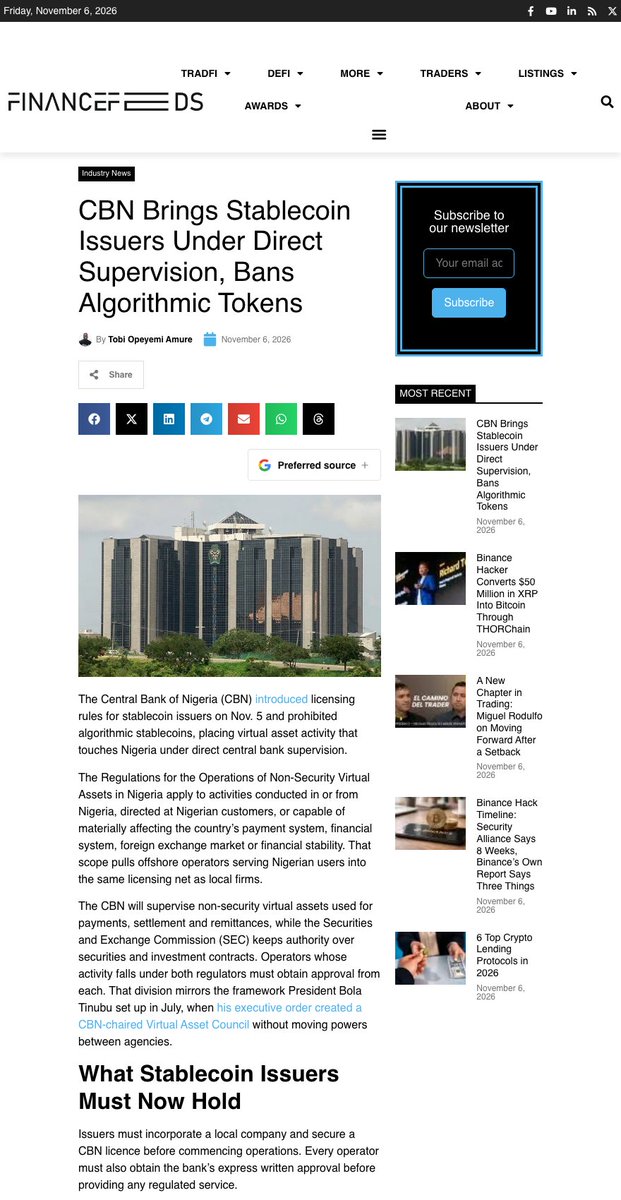
Nigeria's Central Bank has introduced sweeping regulations for stablecoins and other virtual assets, requiring foreign-currency stablecoin issuers to establish licensed local entities and bringing peer-to-peer cryptocurrency transactions under stricter foreign exchange monitoring. https://t.co/HZZbyLWaBF https://t.co/HZZbyLWaBF

Nigeria's central bank now licenses stablecoins token by token, and algorithmic pegs are banned outright. Foreign currency issuers need 15 billion naira of paid up capital, naira issuers 10 billion, plus a 2 percent reserve buffer. Existing operators have 30 days to register.

Small money fix most people never ask about: call your card company and move your due date to a few days after payday.
Most issuers let you pick it. Then the bill and the paycheck stop racing each other, and late fees get a lot rarer.
What's one 5-minute money change that actually stuck for you?
Dangote Cement has abandoned plans to pursue a secondary listing on the London Stock Exchange, citing prevailing market conditions and the company's strategic priorities in a setback for the UK market's efforts to attract major international issuers. https://t.co/3aalWPuAz8 https://t.co/3aalWPuAz8

Visa expanding its stablecoin settlement program to Monad is more than just another network integration. It’s a meaningful step toward making stablecoin infrastructure work at the scale of global payments.
The interesting part is the operational shift:
→ Participating issuers and acquirers can settle on Monad.
→ Settlement can happen 24/7, including weekends and holidays.
→ Traditional banking-hour constraints become less relevant.
→ Stablecoins move closer to becoming practical infrastructure for financial institutions.
Why does this matter?
Traditional payment systems often operate around banking schedules, creating delays when markets and businesses don’t stop moving. Stablecoin settlement introduces the possibility of continuous value transfer.
By bringing Monad into its settlement program, Visa is expanding the blockchain infrastructure available to its institutional payment ecosystem.
The bigger picture: Stablecoins aren’t just competing to become better digital money. They’re building the settlement rails for a more always-on financial system.
And integrations like this are how that transition happens.
The real metric to watch next isn’t the announcement itself. It’s adoption, settlement volume, and how many institutions actually put these rails to work.
Infrastructure first. Adoption next. Gmonad Last!

https://t.co/3gLMbNBBgq

Stablecoins are moving beyond crypto-native users.
Here's what's happened last week:
- Nigeria is defining new rules for stablecoin issuers.
→ Samsung is bringing USDC accounts to Galaxy users.
→ Yellow Card is expanding stablecoin payments into Brazil.
→ Stripe is enabling stablecoin payouts across 160+ markets.
At the same time, institutions are building tokenized securities infrastructure, tokenized funds are expanding, and DeFi is finding new uses for real-world assets.
The interesting part is how these developments connect.
Regulation, distribution, financial infrastructure, and utility are all developing together.
That's what will determine how far tokenization goes beyond the crypto ecosystem.
We broke down the developments shaping this shift in this week's RWA roundup. 👇
Another week in RWAs.
Three developments stood out:
- Nigeria’s Central Bank sets a ₦15 billion capital requirement for stablecoin issuers and bans algorithmic tokens.
- Samsung Wallet launches USDC accounts on Solana for US Galaxy users.
- Yellow Card expands stablecoin payments to Brazil through its GoMoney acquisition.
From regulation → to consumer access → to cross-border payment expansion.
These developments are happening in different markets, but they point toward the same shift: stablecoins are becoming part of mainstream financial infrastructure.
Here are five developments worth watching.
1️⃣ Stablecoin regulation is taking shape across markets
- Nigeria introduces a ₦15 billion capital requirement for stablecoin issuers and bans algorithmic tokens.
- Taiwan proposes rules requiring a bank to own more than 25% of any stablecoin issuer.
- Hong Kong's SFC counts 17 tokenized retail products and considers a tokenized gold ETF.
The conversation is shifting from whether stablecoins should exist to the rules governing who can issue them, how they are backed, and how they reach users. Nigeria's move is particularly worth watching as stablecoin adoption continues to develop across African markets.
2️⃣ Stablecoin payments are expanding beyond crypto
- Samsung Wallet launches USDC accounts on Solana for US Galaxy users.
- @yellowcard_app expands stablecoin payments to Brazil through its GoMoney acquisition.
- Stripe enables stablecoin payouts to crypto wallets in more than 160 markets.
- OnePay introduces stablecoin deposits powered by Stripe.
The opportunity is not just about giving people another way to hold digital dollars.
It's about connecting stablecoins to existing payment networks, wallets, businesses, and financial services.
3️⃣ Traditional financial institutions are building tokenized market infrastructure
- NYSE adds four transfer agents to its tokenization network.
- Broadridge's distributed ledger repo platform processes $7.6 trillion in October.
- Societe Generale accepts $10 million in tokenized US Treasuries as collateral on Canton.
- LSEG's Digital Securities Depository receives approval for the UK sandbox.
Tokenization needs the infrastructure that supports traditional financial markets: custody, settlement, transfer agents, collateral management, and compliance.
4️⃣ Tokenized stocks and funds are expanding
- Tokenized stocks reach a record $3.8 billion.
- Bullish selects @solana, @Aptos, and @ethereum for its issuer-sponsored equity tokenization service.
- Amundi tokenizes access to a flagship equity index fund on Ethereum.
- Schroders expands tokenization beyond money market funds.
- Dinari integrates proxy voting, giving dShares holders real shareholder voting rights.
But growth also comes with difficult questions.
Who has the right to tokenize a company's shares? What rights do token holders actually receive? Which venues should be allowed to trade them?
The industry is still working through these questions.
5️⃣ Tokenized assets are finding more uses in DeFi
- @RobinhoodApp, @binance, and @coinbase tokenized stocks attract $130.5 million in DeFi deposits.
- Coinbase opens USDC borrowing against PAX Gold.
- Aave V4 adds tokenized SpaceX stock as USDC collateral on Base.
- @kamino commits $20 million to expand tokenized asset offerings.
This is another important shift. Tokenized assets are becoming more than digital representations of ownership. They're starting to participate in lending, borrowing, collateral, and yield markets.
Final takeaways
i. Stablecoins are becoming more regulated and more widely distributed.
ii. Payment providers and consumer platforms are creating new access points.
iii. Traditional institutions are building infrastructure for tokenized securities.
iv. Tokenized stocks and funds are expanding into new markets.
v. DeFi is creating additional financial uses for tokenized assets.
vi. Awareness, trust, and real-world distribution remain important challenges.
The bigger picture?
We're moving from: "Stablecoins and tokenized assets are products for crypto users." To: "Blockchain-based money and assets are becoming part of the wider financial system."
The interesting question now is how quickly that infrastructure can translate into products people actually use.
We break down the biggest RWA developments every week.
Follow @d_rwastoryhouse for RWA and tokenization insights.
Stablecoins are moving beyond crypto-native users.
Here's what's happened last week:
- Nigeria is defining new rules for stablecoin issuers.
→ Samsung is bringing USDC accounts to Galaxy users.
→ Yellow Card is expanding stablecoin payments into Brazil.
→ Stripe is enabling stablecoin payouts across 160+ markets.
At the same time, institutions are building tokenized securities infrastructure, tokenized funds are expanding, and DeFi is finding new uses for real-world assets.
The interesting part is how these developments connect.
Regulation, distribution, financial infrastructure, and utility are all developing together.
That's what will determine how far tokenization goes beyond the crypto ecosystem.
We broke down the developments shaping this shift in this week's RWA roundup. 👇
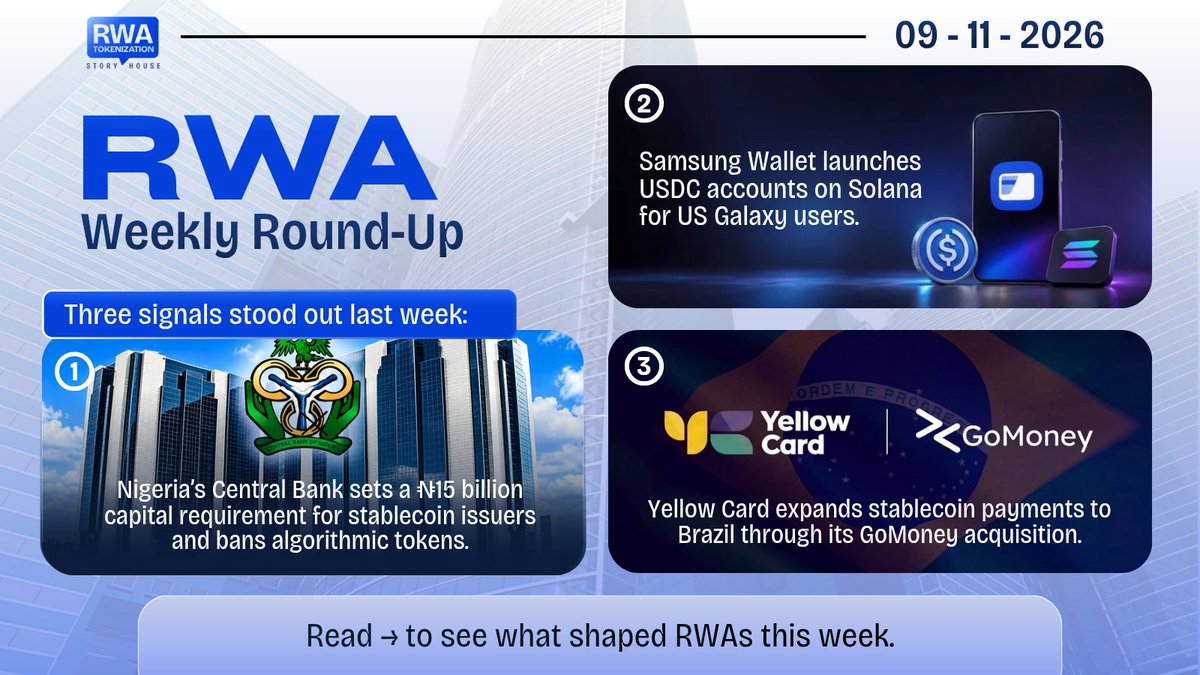
Another week in RWAs.
Three developments stood out:
- Nigeria’s Central Bank sets a ₦15 billion capital requirement for stablecoin issuers and bans algorithmic tokens.
- Samsung Wallet launches USDC accounts on Solana for US Galaxy users.
- Yellow Card expands stablecoin payments to Brazil through its GoMoney acquisition.
From regulation → to consumer access → to cross-border payment expansion.
These developments are happening in different markets, but they point toward the same shift: stablecoins are becoming part of mainstream financial infrastructure.
Here are five developments worth watching.
1️⃣ Stablecoin regulation is taking shape across markets
- Nigeria introduces a ₦15 billion capital requirement for stablecoin issuers and bans algorithmic tokens.
- Taiwan proposes rules requiring a bank to own more than 25% of any stablecoin issuer.
- Hong Kong's SFC counts 17 tokenized retail products and considers a tokenized gold ETF.
The conversation is shifting from whether stablecoins should exist to the rules governing who can issue them, how they are backed, and how they reach users. Nigeria's move is particularly worth watching as stablecoin adoption continues to develop across African markets.
2️⃣ Stablecoin payments are expanding beyond crypto
- Samsung Wallet launches USDC accounts on Solana for US Galaxy users.
- @yellowcard_app expands stablecoin payments to Brazil through its GoMoney acquisition.
- Stripe enables stablecoin payouts to crypto wallets in more than 160 markets.
- OnePay introduces stablecoin deposits powered by Stripe.
The opportunity is not just about giving people another way to hold digital dollars.
It's about connecting stablecoins to existing payment networks, wallets, businesses, and financial services.
3️⃣ Traditional financial institutions are building tokenized market infrastructure
- NYSE adds four transfer agents to its tokenization network.
- Broadridge's distributed ledger repo platform processes $7.6 trillion in October.
- Societe Generale accepts $10 million in tokenized US Treasuries as collateral on Canton.
- LSEG's Digital Securities Depository receives approval for the UK sandbox.
Tokenization needs the infrastructure that supports traditional financial markets: custody, settlement, transfer agents, collateral management, and compliance.
4️⃣ Tokenized stocks and funds are expanding
- Tokenized stocks reach a record $3.8 billion.
- Bullish selects @solana, @Aptos, and @ethereum for its issuer-sponsored equity tokenization service.
- Amundi tokenizes access to a flagship equity index fund on Ethereum.
- Schroders expands tokenization beyond money market funds.
- Dinari integrates proxy voting, giving dShares holders real shareholder voting rights.
But growth also comes with difficult questions.
Who has the right to tokenize a company's shares? What rights do token holders actually receive? Which venues should be allowed to trade them?
The industry is still working through these questions.
5️⃣ Tokenized assets are finding more uses in DeFi
- @RobinhoodApp, @binance, and @coinbase tokenized stocks attract $130.5 million in DeFi deposits.
- Coinbase opens USDC borrowing against PAX Gold.
- Aave V4 adds tokenized SpaceX stock as USDC collateral on Base.
- @kamino commits $20 million to expand tokenized asset offerings.
This is another important shift. Tokenized assets are becoming more than digital representations of ownership. They're starting to participate in lending, borrowing, collateral, and yield markets.
Final takeaways
i. Stablecoins are becoming more regulated and more widely distributed.
ii. Payment providers and consumer platforms are creating new access points.
iii. Traditional institutions are building infrastructure for tokenized securities.
iv. Tokenized stocks and funds are expanding into new markets.
v. DeFi is creating additional financial uses for tokenized assets.
vi. Awareness, trust, and real-world distribution remain important challenges.
The bigger picture?
We're moving from: "Stablecoins and tokenized assets are products for crypto users." To: "Blockchain-based money and assets are becoming part of the wider financial system."
The interesting question now is how quickly that infrastructure can translate into products people actually use.
We break down the biggest RWA developments every week.
Follow @d_rwastoryhouse for RWA and tokenization insights.


Nigeria and stablecoin battle!
The CBN has introduced a ₦15 BILLION minimum paid-up capital requirement for foreign-currency stablecoin issuers, putting USDT (Tether) and USDC (Circle) in the spotlight.
But here’s where things get interesting.
What does this mean for the numerous crypto exchanges, P2P platforms, fintech apps and digital wallets currently offering USDT and USDC services to Nigerians?
Will smaller crypto platforms be forced to restructure, seek partnerships or exit the Nigerian market?
Could this lead to fewer platforms, higher compliance costs and reduced competition?
Or is this exactly the kind of regulation Nigeria needs to attract institutional investors and build a more trusted digital asset ecosystem?
One thing is clear: Nigeria’s stablecoin industry could be heading for a major transformation.
But here’s my biggest question:
If you’re running a crypto app in Nigeria today, how are you going to navigate these new requirements?
And if you’re an everyday USDT or USDC user, should you be concerned?
🇳🇬 Nigeria is Africa’s biggest crypto market. The implications could go far beyond its borders.
What’s your take? Is this progress or overregulation?
Let’s hear your thoughts. 👇
#Bitcoin #USDT #USDC #CryptoNigeria #Stablecoins

Nigeria tightens crypto grip! 🎯 New CBN rules push stablecoin issuers for local licenses and ax algorithmic tokens. Compliance or exit?
#Crypto #Stablecoins #Nigeria $USDT #USDC #TheCoinAnalysis
🔗 https://t.co/1KzBOfYEZl

NYSE has signed six transfer agents for its planned tokenized securities venue, including Broadridge and Computershare.
One of them, tZERO, lets issuers tokenize securities on Algorand.
@Algorand


Japan INSIGHT🔥: The New York Stock Exchange is moving forward with its tokenization plans, bringing six transfer agents on board, including major industry players Broadridge and Computershare.
Among the selected firms is tZERO, which enables issuers to tokenize securities on the Algorand blockchain.
The development highlights growing institutional interest in blockchain-based securities infrastructure, potentially creating new opportunities for @Algorand as traditional finance accelerates its adoption of tokenization.


@NYSE is making progress toward its tokenized securities . . .
Among the selected firms is tZERO, which enables issuers to tokenize securities on the Algorand blockchain . . .
algorand:native

🚨TODAY: NYSE is making progress toward its tokenized securities initiative by bringing six transfer agents on board, including major players Broadridge and Computershare.
Among the selected firms is tZERO, which enables issuers to tokenize securities on the Algorand blockchain. This development highlights the growing connection between traditional financial infrastructure and blockchain technology.
@Algorand could benefit from this momentum as tokenized securities gain increasing attention from established financial institutions.



What if compliance was enforced by the blockchain itself, rather than relying on external systems to monitor transactions?
In traditional financial infrastructure, compliance checks are often handled by separate services, issuers, or application level systems.
This can create delays, fragmented enforcement, and additional infrastructure.
@RialoHQ approaches this differently by making compliance a native part of transaction execution.
Here is how it works :
▫️ Define the Policy
A financial application defines rules that determine which transactions are permitted.
For example, a stablecoin may restrict transfers involving addresses on a denylist.
▫️ Evaluate in Real Time
When a transaction is submitted, Rialo evaluates the relevant compliance conditions during execution.
It can retrieve the required information from external policy systems through native Web connectivity, while processing sensitive information within REX.
▫️ Enforce the Decision
If the transaction satisfies the policy, execution proceeds.
If it violates the required conditions, execution is aborted and no state change occurs.
▫️ Re evaluate Every Execution
This becomes especially important for recurring payments.
A payment that was compliant yesterday may no longer be compliant today.
Rialo can evaluate the policy again before every execution, automatically stopping future payments if the conditions are no longer satisfied.
Why does this matter?
Consider a recurring stablecoin payment.
Initially, the recipient is not on the denylist, so payments proceed normally.
Later, the recipient is added to the denylist.
Instead of allowing the remaining payments to continue under an outdated approval, Rialo rechecks the policy and blocks subsequent transfers.
This is the difference between checking compliance once and enforcing it continuously.
The bigger picture
Rialo combines three important capabilities :
→ Native Privacy through REX
→ Native Web Connectivity for external compliance data
→ Native Automation for recurring execution
Together, they make compliance part of the execution process rather than an external layer added around it.
The key idea :
Compliance should not simply monitor what happens onchain.
It should help determine what is allowed to happen in the first place.


MORE Digital Credit Issuers

"I want to see a lot more (Digital Credit) issuers, because I think it's very good for us, and it's very good for the industry."
Smarter Web CEO, @asjwebley, speaking recently with @TimKotzman on the Digital Credit ecosystem.
LSE: #SWC #MORE | OTCQB: $TSWCF | FRA: $3M8
Most Popular Users

Elon Musk 
@elonmusk
239.8M followers

Barack Obama
@barackobama
118.6M followers

Cristiano Ronaldo
@cristiano
114.3M followers

Donald J. Trump
@realdonaldtrump
111.7M followers

Narendra Modi
@narendramodi
106.9M followers

Rihanna
@rihanna
98.6M followers

NASA
@nasa
92.1M followers

Justin Bieber
@justinbieber
91.7M followers

KATY PERRY
@katyperry
89.9M followers

Taylor Swift
@taylorswift13
83.9M followers

Lady Gaga
@ladygaga
75.4M followers

Virat Kohli
@imvkohli
73.3M followers

Kim Kardashian
@kimkardashian
70.8M followers

YouTube
@youtube
68.6M followers

Neymar Jr
@neymarjr
66.3M followers

Bill Gates
@billgates
65.1M followers

Selena Gomez
@selenagomez
63M followers

The Ellen Show
@theellenshow
62.1M followers

CNN
@cnn
61.7M followers

X
@x
60.6M followers