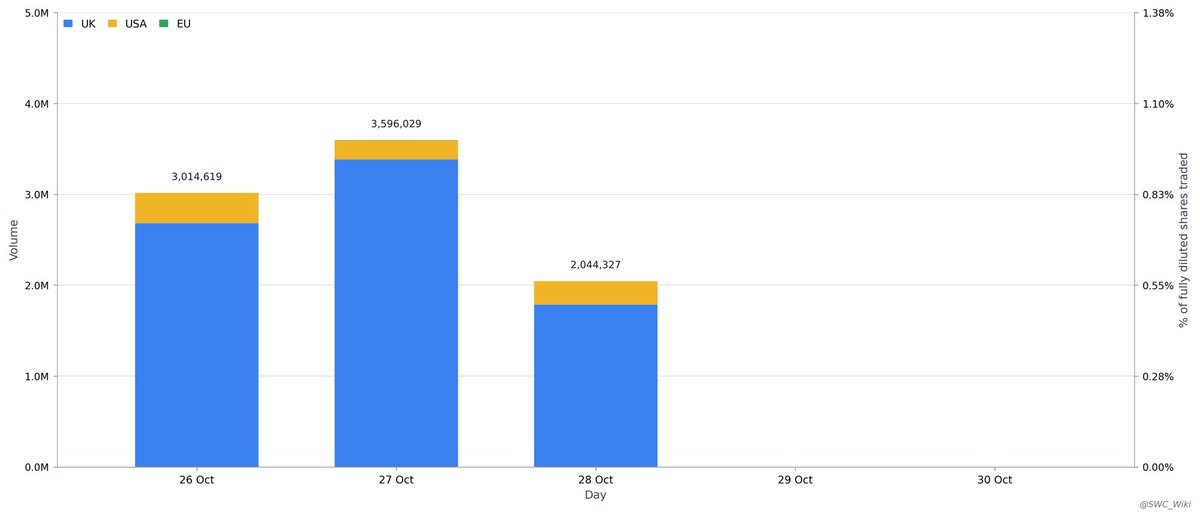
Today’s Smarter Web Livestream has been cancelled.
Our guest is unwell and unable to take part. We wish them a quick recovery.
The livestream will return next week - we’ll announce the guest tomorrow as usual. Apologies to anyone who was planning to tune in.
LSE: #SWC#MORE | OTCQB: $TSWCF | FRA: $3M8
WHAT COULD YOUR MONTHLY PENSION CONTRIBUTIONS BECOME? 💷
Following my series on building wealth, let’s look at workplace pensions—and what reinvesting dividends could do over a working lifetime.
The median eligible private-sector pension saver in Great Britain received £3,430 in total contributions in 2025.
That’s approximately £286 a month, including employer contributions and applicable tax relief.
For a return benchmark, Nest’s 2046 Retirement Date Fund delivered 8.5% annualised over the ten years to March 2026. That’s one major fund’s historical performance, rather than a UK-wide average.
Now imagine the same £286 a month invested under two scenarios:
• 8.5% annual investment growth.
• MORE maintaining a 12% annual dividend, with payments reinvested weekly at an unchanged £100 share price.
Starting from zero, with no increases in contributions:
AFTER 10 YEARS
You’ve contributed £34,300.
At 8.5%: £52,838.
MORE scenario: £65,932.
That’s £13,094 more.
AFTER 20 YEARS
You’ve contributed £68,600.
At 8.5%: £172,302.
MORE scenario: £284,529.
That’s £112,227 more.
AFTER 30 YEARS
You’ve contributed £102,900.
At 8.5%: £442,410.
MORE scenario: £1,009,298.
That’s £566,887 more and a gain of £906,398 above contributions in the MORE illustration.
THE WEEKLY REINVESTMENT IS THE KEY.
Every dividend buys more shares.
Those shares generate more dividends.
Reinvest those, and the following payments grow again.
If you stopped reinvesting at those milestones, the MORE holdings could generate, at the same assumed rate:
10 years: approximately £152 a week.
20 years: approximately £657 a week.
30 years: approximately £2,329 a week.
And MORE can be held within a SIPP where the provider supports it, so pension investing and MORE aren’t mutually exclusive. Keeping employer contributions and tax relief in the equation matters.
These figures illustrate constant returns, before inflation, additional fees and withdrawal tax. MORE’s dividend and share price can change, so the outcomes aren’t guaranteed.
The point is how much the return on your money can matter over time.
Same monthly contribution.
Same number of years.
A very different potential retirement pot.
Your pension deserves more attention than a line on your payslip.
$MORE $SWC
#WorkplacePension #CompoundGrowth #RetirementPlanning #DividendInvesting #MORE
Every Thursday morning, Smarter Web announces the proceeds raised through the Company's at-the-market facilities:
- Ordinary Shares ATM Facility
- Preferred Shares ATM Facility
Today, no RNS was issued, meaning there were no sales under either facility during the reporting period.
The ATM facilities provide Smarter Web with flexibility to raise capital. Not just issue shares simply because the facilities are available.
LSE: #SWC #MORE | OTCQB: $TSWCF | FRA: $3M8
@RSMorison@Micro2Macr0 Mismanagement is laughable. You couldn’t have a more engaging, dedicated management. The one thing the management can’t control is the share price.
If you own $ASST, $TSWCF, $SLE, or $MTPLF, you should be happy seeing another company succeed and the Bitcoin treasury space.
Especially the largest most successful one. $MSTR
This isn't a competition it's a collaboration.