

Top Tweets for #MicroCon

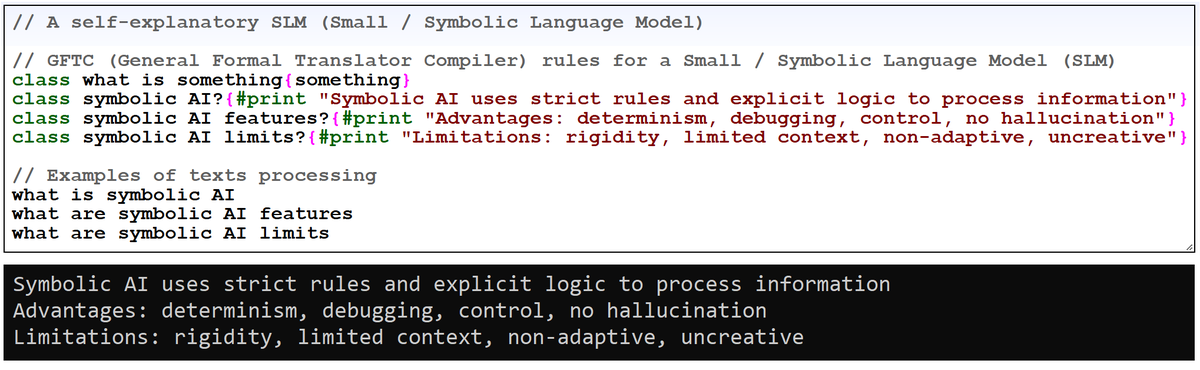
A self-explanatory SLM (Small / Symbolic Language Model) implemented in GFTC (General Formal Translator Compiler) without any other dependencies (libraries or training data), which can be run on any computing device, even on microcontrollers.
https://t.co/BKtLfp9N8o

🚀 Project Completed | Smart Air Monitor – IoT Based Environmental Monitoring System
I’m excited to share the successful completion of my Smart Air Monitor, an IoT-based environmental monitoring and automatic ventilation control system developed using the ESP32 microcontroller.
The main objective of this project was to develop a smart monitoring solution capable of continuously monitoring environmental conditions, displaying real-time sensor data, and automatically controlling ventilation based on predefined conditions.
🔹 Key Features & Technical Implementation:
• ESP32 Microcontroller: Core processing and Wi-Fi connectivity for IoT integration.
• MQ-135 Gas Sensor: Monitors gas-related environmental changes through real-time analog readings.
• DHT22 Sensor: Measures ambient temperature.
• Automated Ventilation System: Controls a ventilation fan through a MOSFET-based switching circuit according to predefined sensor thresholds.
• I2C LCD Display: Provides real-time local monitoring of sensor readings and system conditions.
• Web-Based IoT Dashboard: Developed using HTML, CSS, and JavaScript to visualize live sensor data through a web browser.
• Dynamic Data Visualization: Implements a live gas sensor graph that updates continuously, allowing sensor variations to be monitored over time.
🔹 Technologies & Tools Used:
ESP32 | Embedded C++ | Arduino IDE | IoT | HTML | CSS | JavaScript | MQ-135 | DHT22 | I2C LCD | Wi-Fi Communication
💡 Key Learning Outcomes:
Through this project, I gained practical experience in embedded system programming, sensor interfacing, wireless communication, real-time data acquisition, web server development, and hardware-software integration.
This project was a valuable opportunity to transform theoretical knowledge into a practical engineering application while strengthening my problem-solving and technical development skills.
Every project is another step towards becoming a better engineer. Looking forward to exploring more innovative technologies and developing solutions that connect electronics, automation, and the Internet of Things.
Build. Learn. Innovate. Repeat. ⚡️
🔥 Top 6 ESP32 eBooks
https://t.co/MvafQvkQbk
#IoT #ESP32 #EmbeddedSystems #ElectronicsEngineering #ArduinoIDE #SmartMonitoring #Automation #WebDevelopment #EngineeringProjects #Innovation

شباب لو سمحتوا حد عنده تجربة سابقة انه قدر يدرس ماستر بتقدير مقبول؟
انا خريج ECE وحابب ادرس ماستر في ال embedded systems and microcontroller
لو الماستر انجليزي يبقى رائع لو الماني برده مفيش مشكلة. اتمنى حد يكون خاض التجربة ويقدر يساعد. متشكر جدا

@HikafiTweets Réduire la transcendance divine à l'installation d'un capteur laser et d'un microcontrôleur pour suppléer à une défaillance cognitive chronique. La spiritualité sous respirateur artificiel pour esprits incapables de compter jusqu'à quatre sans assistance électronique. Affligeant

@LilElseCaller Of course for space programs FPGAs are a must. But for cars microcontrollers with RTOS would be enough.

@vadakkodaan I think a mix between FPGAs and microcontrollers . Specially because of the prominent SpaceX development.
@jzheng Probably they used only microcontrollers. FPGAs are expensive too.

@vadakkodaan With Realtime OS, yes this is possible on microcontrollers. But a lot easier with an FPGA. ASIC would be overkill given the production volume.

What if your edge devices could self-organize instead of depending on a central server?
Myrmic is an open-source runtime built with Rust and WebAssembly for distributed edge systems.
It aims to run applications across devices, from Linux hosts to microcontrollers, with built-in messaging, coordination and fault tolerance.
Think IoT networks, edge gateways and distributed systems that need to keep working when connections fail.
Explore the docs https://t.co/oz8aHwzkhw

▪️مكثف إزالة الربط (Decoupling)
يثبت الجهد ويحمي الدوائر المتكاملة (ICs) من الضوضاء والهبوط
يوضع قرب المعالجات ليمدها بالطاقة عند تغير الأحمال
مثل : المتحكمات الدقيقة (Microcontrollers)، المعالجات (CPUs)، والدوائر الرقمية 💻

Aquele tipo de horror que só bate a ficha um segundo depois do ponto final. Acabei de soltar uma sequência com 8 microcontos inéditos lá no perfil da página pra fechar o domingo. Passa lá na thread pra ler e me conta qual reviravolta te deixou mais desconfortável.
What I’m seeing here is some mission-critical embedded engineering. Can microcontrollers handle this, or do we need FPGAs or custom ASICs that Elon has developed specifically for this purpose?

Look at those thrusters go.

Hello everyone! I'm Olanrewaju, an Electronics and Computer Engineering student interested in embedded systems, microcontrollers, and the intersection of hardware and software.


Open source folks got a 289M-param LLM running on an NXP microcontroller, and a small diffusion model making 64x64 images on an STM32 board. No Linux, no GPU. "AI needs a data center" is turning into "AI needs a good optimizer".
https://t.co/cIhO3i62Pf

Solid collection of RF gear and dev boards. I spot the Flipper Zero with an expansion module there. I have been messing around with ESP32 and LoRa32 microcontrollers lately, and debugging the low level SPI communication is always a headache. What specific sub-GHz protocols are you trying to intercept or test with all this equipment?

8. Imagine combining all of this:
📱 Small display
🧠 Microcontroller
📡 Sensors
💻 Laptop
🤖 AI coding assistant
⚡ Automation
Suddenly, you're not just learning code.
You're building a real system.

So much JavaScript love on Microcontrollers.
NFC, Freetype, Guides for your LLM

Our September Moddable SDK release is live.
🔤FreeType. Scalable fonts.
📡RFID/NFC. Tap.
🌐WebDAV. Files served everywhere.
📄XML. In 2026.
⚡HTTP Server. Fast. Reliable.
📘Guides. For you & your LLM.
⚙️ESP-IDF 6.1. Differential flashing for fast install.
https://t.co/PYuRtKXCFF

The board started working as intended. The blue LED shows the power status of the board. The red led shows that the microcontroller is also working properly.

Exactly. The first demo is already here, and Kat has even shown Universal Weave running on a microcontroller.
What comes next is 0.5.0, the ecosystem libraries, and eventually a fully featured Loom that people can actually use for research and creative writing.
Seeing the community remain here while all of that is still ahead is definitely encouraging.
Glad to have you here this early and be part of the journey with us 🤝
This is the clearest roadmap @transkatgirl has shared so far.
@universalweave is no longer just an abstract idea hidden inside a Rust repository.
The demo has now been ported to a microcontroller, proving the core library can run even on highly limited hardware.
But the bigger reveal is what comes after 0.5.0:
UI components for egui and ratatui.
Multiplayer editing for DAG-based documents.
Text manipulation layers that make editing Weaves feel as intuitive as editing normal text.
Then all of those building blocks will come together in a fully-featured Loom designed for both LLM researchers and creative writers.
The core library is the foundation.
The ecosystem built on top of it is where people will finally experience what @universalweave makes possible.
@transkatgirl is not building one closed AI product.
She is building the layers other developers can use to create entirely new ways of interacting with AI.
For weeks, I have been telling people that $weave is still misunderstood.
Now people can finally see where all of this is going.

When we said we were making building blocks for any Loom, we meant any.
universal-weave can run anywhere, including on devices with limited capabilities. Today, we've put that to the test by porting universal-weave's demo application to run on a microcontroller.
We'll soon be shipping universal-weave 0.5.0, which will make it easier to build Loom implementations that can run anywhere. We've ensuring our highly efficient graph layout algorithm is robust enough for developers to bet their projects on, and we're further optimizing the core of universal-weave so that it continues to perform even in extreme use cases.
But we're not done yet.
Once universal-weave 0.5.0 is published, we're going to begin creating libraries and frameworks which build upon it.
These libraries will include:
universal-weave UI components for the egui and ratatui UI frameworks
Multiplayer editing of universal-weave's DAG-based documents
Text manipulation layers for universal-weave which allow developers to make editing weaves as intuitive as editing text
We plan on using these libraries to build our most ambitious demo yet: A fully-featured Loom implementation built upon the universal-weave ecosystem which can meet the needs of both LLM researchers and creative writers.
(And we have more planned after that.)
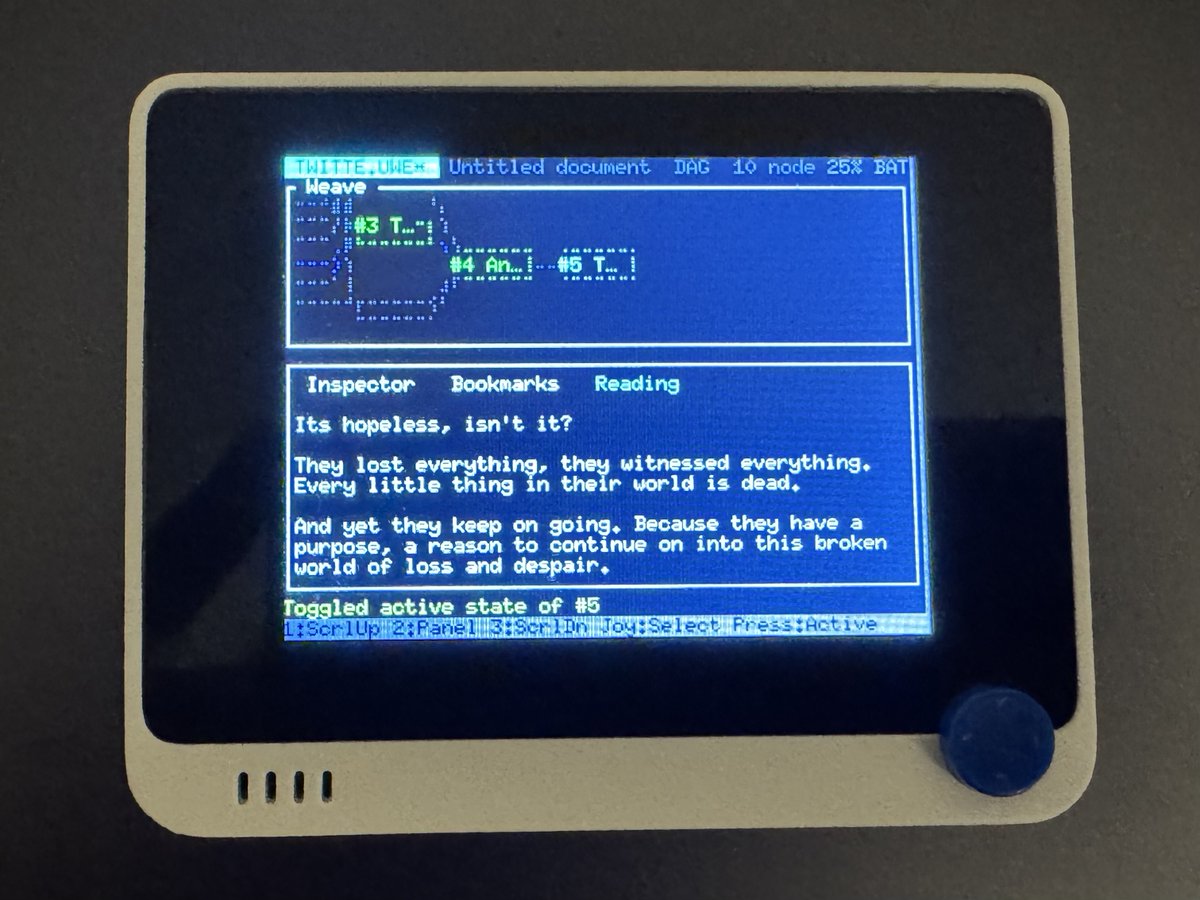
When we said we were making building blocks for any Loom, we meant any.
universal-weave can run anywhere, including on devices with limited capabilities. Today, we've put that to the test by porting universal-weave's demo application to run on a microcontroller.
We'll soon be shipping universal-weave 0.5.0, which will make it easier to build Loom implementations that can run anywhere. We've ensuring our highly efficient graph layout algorithm is robust enough for developers to bet their projects on, and we're further optimizing the core of universal-weave so that it continues to perform even in extreme use cases.
But we're not done yet.
Once universal-weave 0.5.0 is published, we're going to begin creating libraries and frameworks which build upon it.
These libraries will include:
universal-weave UI components for the egui and ratatui UI frameworks
Multiplayer editing of universal-weave's DAG-based documents
Text manipulation layers for universal-weave which allow developers to make editing weaves as intuitive as editing text
We plan on using these libraries to build our most ambitious demo yet: A fully-featured Loom implementation built upon the universal-weave ecosystem which can meet the needs of both LLM researchers and creative writers.
(And we have more planned after that.)
graphing work is taking slightly longer than we initially expected, but the microcontroller is here
work on the demo will begin as soon as we get universal-weave 0.5.0 published

The microcontroller for the demo is nearly here.
Work on the demo will start as soon as the microcontroller arrives; Right now, we're working on getting our graphing implementation to meet our high standards.

Kat is about to test that claim on actual hardware.
The microcontroller is nearly here. Once it arrives, work begins on a Loom interface running in an environment with less RAM than some graphing calculators.
While waiting, she is refining the graphing implementation until it meets her standards instead of rushing out a weak demo.
This is not about running the LLM itself on a tiny chip. It is about proving that @universalweave branching foundation is lightweight and portable enough to work far beyond a normal desktop app.
If this demo lands, “can run anywhere” stops being a claim and becomes visible proof.
That’s how real infrastructure earns trust.
$weave
The microcontroller for the demo is nearly here.
Work on the demo will start as soon as the microcontroller arrives; Right now, we're working on getting our graphing implementation to meet our high standards.
The microcontroller for the demo is nearly here.
Work on the demo will start as soon as the microcontroller arrives; Right now, we're working on getting our graphing implementation to meet our high standards.
Once our graphing library is finished, we plan on building a new demo showcasing universal-weave's portability: A Loom interface running on a microcontroller.
When we mean "can run anywhere", we mean *anywhere*, even in environments with less RAM than some graphing calculators (for reference, the TI-Nspire CX has 64MB of RAM).
(When we reach Stage 3, we're considering expanding on this to build a Loom Deck: An open-source physical Loom terminal with functionality on par with Tapestry Loom, which can be easily assembled by anyone using off-the-shelf components.)

@Bollish the planned microcontroller loom demo after graphing sounds pretty based
Trends for you
Most Popular Users

Elon Musk 
@elonmusk
240.1M followers

Barack Obama
@barackobama
118.6M followers

Cristiano Ronaldo
@cristiano
114.4M followers

Donald J. Trump
@realdonaldtrump
111.8M followers

Narendra Modi
@narendramodi
106.9M followers

Rihanna
@rihanna
98.6M followers

NASA
@nasa
92.1M followers

Justin Bieber
@justinbieber
91.7M followers

KATY PERRY
@katyperry
89.9M followers

Taylor Swift
@taylorswift13
83.9M followers

Lady Gaga
@ladygaga
75.4M followers

Virat Kohli
@imvkohli
73.3M followers

Kim Kardashian
@kimkardashian
70.8M followers

YouTube
@youtube
68.6M followers

Neymar Jr
@neymarjr
66.3M followers

Bill Gates
@billgates
65.2M followers

Selena Gomez
@selenagomez
63M followers

The Ellen Show
@theellenshow
62.1M followers

CNN
@cnn
61.7M followers

X
@x
60.6M followers