PhD in AI/ML · advisor to startups. LLM systems, RAG and agents that make it to production. Short lessons, real fixes, no hype. For founders and ML teams.
"Learn backpropagation" is a roadmap item you can tick without being able to do it.
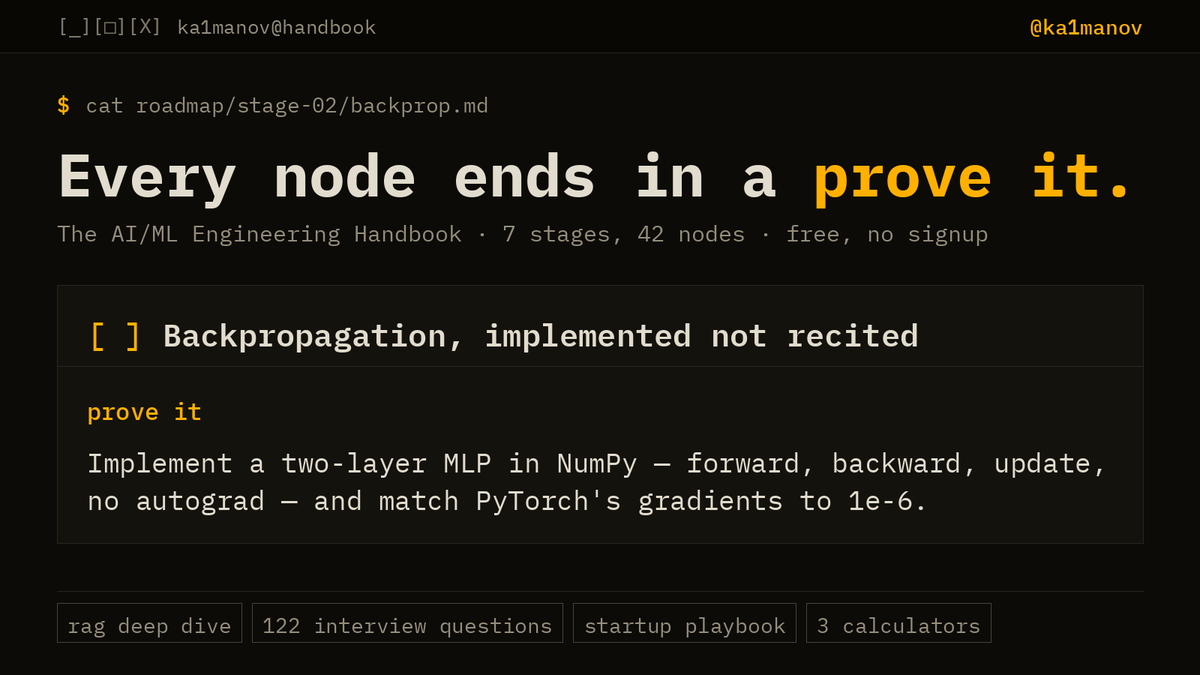
In my handbook it reads: implement backprop for a two-layer net in NumPy and match PyTorch's gradients to 1e-6. You either have that artifact or you don't.
It's a free AI/ML engineering handbook for people who ship ML systems, not notebooks. No signup, no email, no tracking.
All 42 roadmap nodes get the same three lines:
- prove it: an artifact, not an activity
- why it matters: what breaks in production without it
- an honest time estimate for someone studying around a job
Also inside:
- a RAG deep dive with a failure-mode taxonomy: symptom → cause → diagnostic → fix
- 122 interview questions and, where it matters, a weak answer next to a strong one
- a startup playbook: build, buy or fine-tune, with the cost arithmetic shown
- 3 calculators: GPU memory and KV cache, cost per successful outcome, vector index sizing
- 50 field notes and 6 long reads
Don't start at stage 00. Read the prove-it lines, and whatever you couldn't produce this afternoon is your list.
Link in the reply.
What would you make an ML engineer prove before you'd trust them with production?
Where the rebuild drifts is the useful part. That gap is usually a filter or a join someone added upstream and never wrote down.
I look for the mirror version in backtests: a strategy that comes out clean on the first run usually has a look-ahead bug in it, not a result.
Do you rebuild from raw events, or from the tables the report already sits on?
"Learn backpropagation" is a roadmap item you can tick without being able to do it.
In my handbook it reads: implement backprop for a two-layer net in NumPy and match PyTorch's gradients to 1e-6. You either have that artifact or you don't.
It's a free AI/ML engineering handbook for people who ship ML systems, not notebooks. No signup, no email, no tracking.
All 42 roadmap nodes get the same three lines:
- prove it: an artifact, not an activity
- why it matters: what breaks in production without it
- an honest time estimate for someone studying around a job
Also inside:
- a RAG deep dive with a failure-mode taxonomy: symptom → cause → diagnostic → fix
- 122 interview questions and, where it matters, a weak answer next to a strong one
- a startup playbook: build, buy or fine-tune, with the cost arithmetic shown
- 3 calculators: GPU memory and KV cache, cost per successful outcome, vector index sizing
- 50 field notes and 6 long reads
Don't start at stage 00. Read the prove-it lines, and whatever you couldn't produce this afternoon is your list.
Link in the reply.
What would you make an ML engineer prove before you'd trust them with production?
Source on GitHub, prose CC BY 4.0, code MIT. Found a mistake? Open an issue:
https://t.co/VXsMjFFeS4
Read it here, free, no signup:
https://t.co/nbk9yZ4jtb
Stacking Agentic AI on top of Generative AI makes perfect sense conceptually. But honestly, getting the memory and planning modules to work reliably for autonomous execution is where most production workflows completely break down. You can have the best LLM sitting in that Generative layer, but if it loses context while attempting basic tool use, the whole stack falls apart. Which of these layers usually eats up most of your debugging time?
@viktoroddy The real test for these 3D models is always the mesh topology and clean UV unwrapping. How well does Codex handle the export into actual production pipelines?