You've cut the same three things out of every AI draft: the exclamation marks, the "excited to share", the closing line that reads like a press release.
None of it carries over. The next chat opens with the same default voice.
A style note inside one chat dies with that chat. A Skill doesn't: it's a folder of instructions Claude loads on its own when the task matches. It reads the short description of each skill, picks what fits, and pulls in the full instructions only then.
What goes in it:
1. The description, in third person, with the trigger inside: "Writes customer emails in the user's voice. Use when drafting outreach or follow-ups." That sentence is what makes it fire.
2. Three samples you'd send as they are — a cold email, a follow-up, a reply to a complaint — each with one line on why it works.
3. A never list, copied from your own edits: no exclamation marks, no "excited to share", no opener that stacks three adjectives.
4. The shape: 80-120 words, open with what changed for them, close with one question.
Then run it on an email you already sent. When it fires you'll see "Using [skill name]" in Claude's thinking; if it stays quiet, fix the description, not the samples.
Common mistake: writing the description for yourself ("my writing style") instead of for the model — it never matches a request, so the skill sits unused.
What's the first thing you delete from every AI draft?
Follow @ka1manov — next: web search or Research, and how to tell which one a question needs.
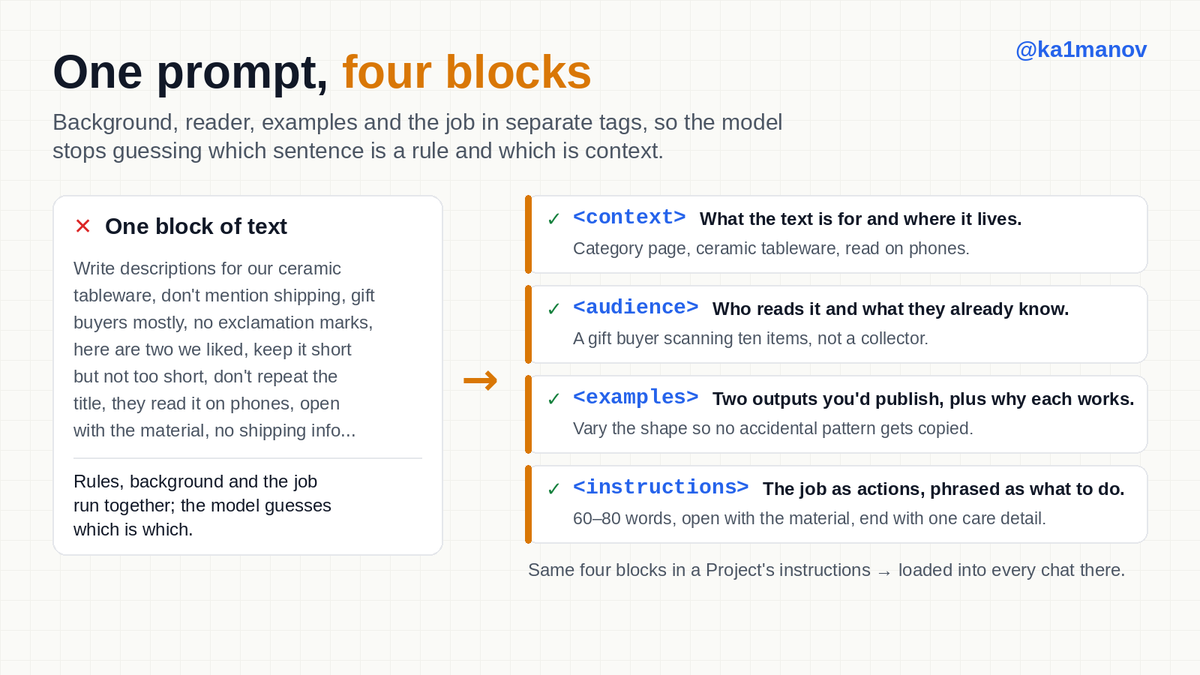
A prompt for product descriptions that started as one line is now a paragraph of rules: don't mention shipping, no exclamation marks, don't repeat the title, keep it short but not too short. The descriptions still read like every other store's.
One more "don't" won't change that. Background, rules and the job itself sit in one block of text, and the model has to guess which sentence is which.
I split every working prompt into four tagged blocks. The tags are plain XML; Claude reads them as boundaries between kinds of content, so a rule stops getting mistaken for background.
<context>
What the text is for and where it lives: category page of a store selling ceramic tableware, read mostly on phones.
</context>
<audience>
Who reads it and what they already know: a gift buyer scanning ten items, not a collector.
</audience>
<examples>
Two descriptions you'd publish as they are, each with a line on why it works. The docs suggest three to five; two beats none.
</examples>
<instructions>
The job as actions: 60–80 words, open with the material, close with one care detail. Phrase rules as what to do, so "no exclamation marks" becomes "end every sentence with a period".
</instructions>
Paste the same four blocks into a Project's instructions and every chat there starts with them loaded.
Common mistake: examples that all have the same shape. Claude copies the pattern, including the parts you didn't mean.
Follow @ka1manov — next: picking the model for the job, not the biggest one.
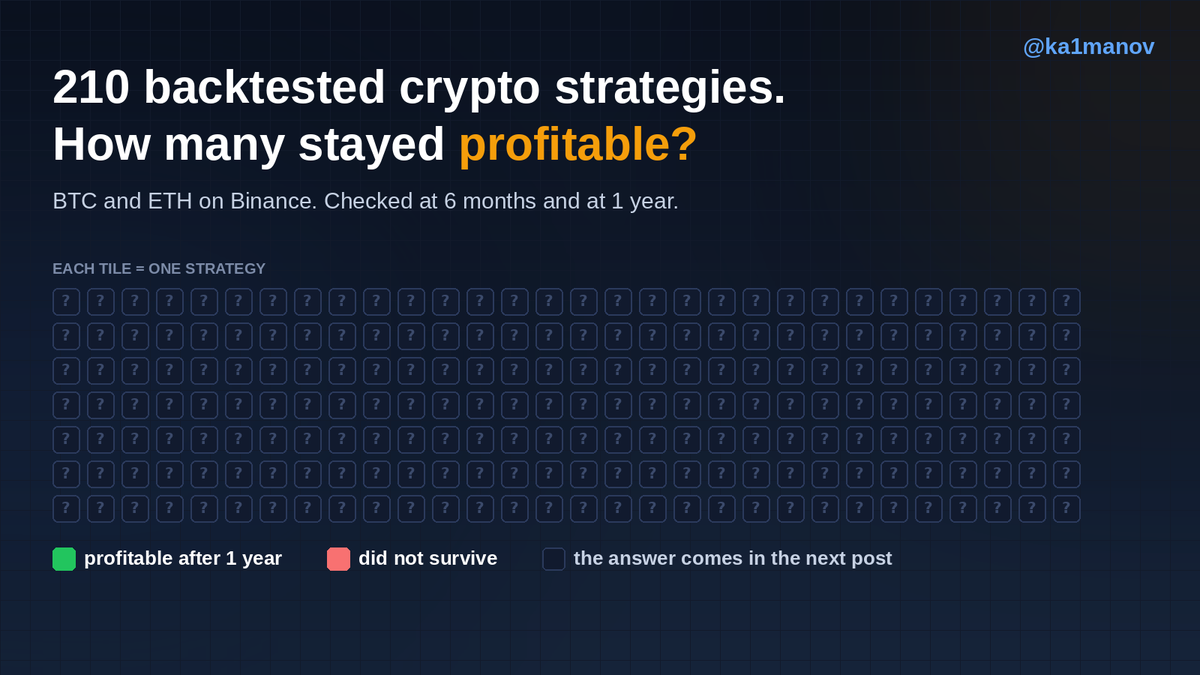
I consulted on a crypto trading system for BTC and ETH on Binance and helped build it. We wrote and backtested over 210 strategies.
Your guess: how many of them were still profitable after 6 months? After a year?
You paste the same three paragraphs into Claude every morning: who your customers are, how the product works, what tone the emails use. By the tenth chat the paste gets shorter, and the answers get vaguer with it.
That's a job for a Project, not a longer prompt. A Project holds two things: instructions (how Claude behaves in every chat there) and knowledge (files it treats as the source of truth). Every new chat inside it starts with both loaded, and the Project keeps its own memory, separate from your other chats.
One detail changes how you use it: a chat inside a Project doesn't see the other chats in that Project. Whatever you want carried forward has to live in knowledge or instructions, not in yesterday's conversation.
How I'd set one up for a sales team:
1. One Project per recurring job. Outreach to e-commerce founders is one Project; product descriptions for the store is another.
2. Instructions under a page: who Claude writes for, what a good result looks like, two things it should never do.
3. Knowledge is the 3–5 files you keep re-attaching: ICP notes, a pricing sheet, two emails that worked and why.
4. When a chat produces something you'll reuse, save it into knowledge. Otherwise the next chat starts without it.
5. On paid plans, once knowledge outgrows the context window, Claude searches it instead of reading it all. From then on clear file names and headings decide what it finds.
Common mistake: forty files and no instructions. Search finds facts; it can't guess who the reader is.
Follow @ka1manov — next: the 4-block prompt that makes Project instructions work.
My goal here: make AI understandable for people who build things. Founders, developers, anyone curious about startups and tech. I build LLM systems, RAG and agents for startups and share what works one lesson in 60 seconds, no hype. What would you like me to explain first?




![ka1manov's tweet photo. You've cut the same three things out of every AI draft: the exclamation marks, the "excited to share", the closing line that reads like a press release.
None of it carries over. The next chat opens with the same default voice.
A style note inside one chat dies with that chat. A Skill doesn't: it's a folder of instructions Claude loads on its own when the task matches. It reads the short description of each skill, picks what fits, and pulls in the full instructions only then.
What goes in it:
1. The description, in third person, with the trigger inside: "Writes customer emails in the user's voice. Use when drafting outreach or follow-ups." That sentence is what makes it fire.
2. Three samples you'd send as they are — a cold email, a follow-up, a reply to a complaint — each with one line on why it works.
3. A never list, copied from your own edits: no exclamation marks, no "excited to share", no opener that stacks three adjectives.
4. The shape: 80-120 words, open with what changed for them, close with one question.
Then run it on an email you already sent. When it fires you'll see "Using [skill name]" in Claude's thinking; if it stays quiet, fix the description, not the samples.
Common mistake: writing the description for yourself ("my writing style") instead of for the model — it never matches a request, so the skill sits unused.
What's the first thing you delete from every AI draft?
Follow @ka1manov — next: web search or Research, and how to tell which one a question needs.](https://pbs.twimg.com/media/HShotZEXIAAqbUx.jpg)