

Top Tweets for #NASAwebb

#NASAWebb and the Chandra X-ray Observatory worked together to produce this view of supernova remnant Cassiopeia A. X-rays reveal the blast wave that tore through the star, while Webb’s infrared data also shows the expanding shell of material.
Credit: NASA/CXC/SAO/ESA/CSA/STScI


🇺🇲
@NASA @Space_Station @NASAWebb
#InternationalSpaceStation
#NASAWEBB #Expedition74 #STS130
🛰
「四分之一個世紀以來,#太空站一直是我們的教室、實驗室和試驗場。#它以每小時 17,500 英里的速度在#地球上空 250 英里的軌道上運行。
🌕 https://t.co/M17ELcLLzK
https://t.co/t3zBo1vk5O
🇺🇲
@NASA @Space_Station
🛰
#SpaceStation #SpaceStation8 #InternationalSpaceStation #SpaceStationAR
🌕
「他們一起進行了數千次實驗,在醫學、材料科學和氣候研究方面取得了進展。但除了發現之外,太空站一直在為我們的下一次偉大飛躍做好準備。”
📡 https://t.co/wFrE7q5lvK.


The James Webb Space Telescope imaged the Lion Nebula in near- and mid-infrared light. The composite view highlights the gas and dust structures sculpted by the dying star, and additional details about the dust shine in mid-infrared light. #NASAWebb
https://t.co/AOiEMnGWac
It’s the circle of life and it moves us all—even stars. (Also, Pumbaa was right, stars ARE balls of gas burning billions of miles away.)
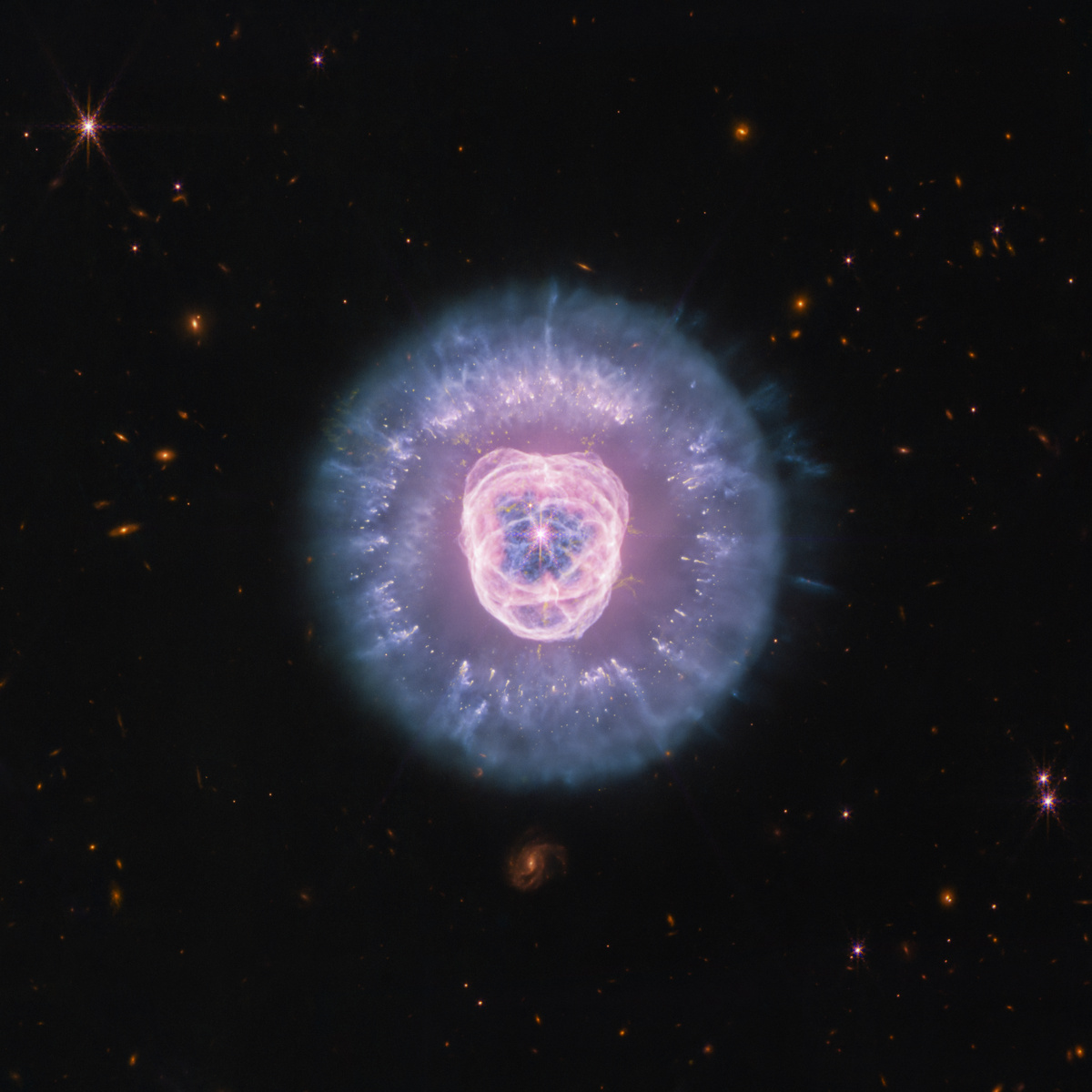
#NASAWebb has taken new images of planetary nebula NGC 2392, nicknamed the Lion Nebula, in high-resolution near- and mid-infrared. (1/7) 🧵
Not only are astronomers like Liz Taratino using #NASAWebb to see more detail than ever before, but the telescope is opening up whole new areas of astronomy to investigation.
#NASAWebb imaged the Lion Nebula in near- and mid-infrared light just in time for #WorldLionDay. The composite view highlights the gas and dust structures sculpted by the dying star, and additional details about the dust shine in mid-infrared light: https://t.co/Nt3v3pCbdO
#NASAWebb imaged the Lion Nebula in near- and mid-infrared light just in time for #WorldLionDay. The stellar core, looking like the lion’s “nose,” is responsible for sculpting the nebula’s complex gas and dust structures: https://t.co/joaPczzFUH

#NASAWebb observed irregular galaxy NGC 6822 in near-infrared light, revealing a dazzling star field. The brightest stars are pale blue, while fainter ones are yellow and orange. Credit: ESA, NASA, CSA, M. Meixner.

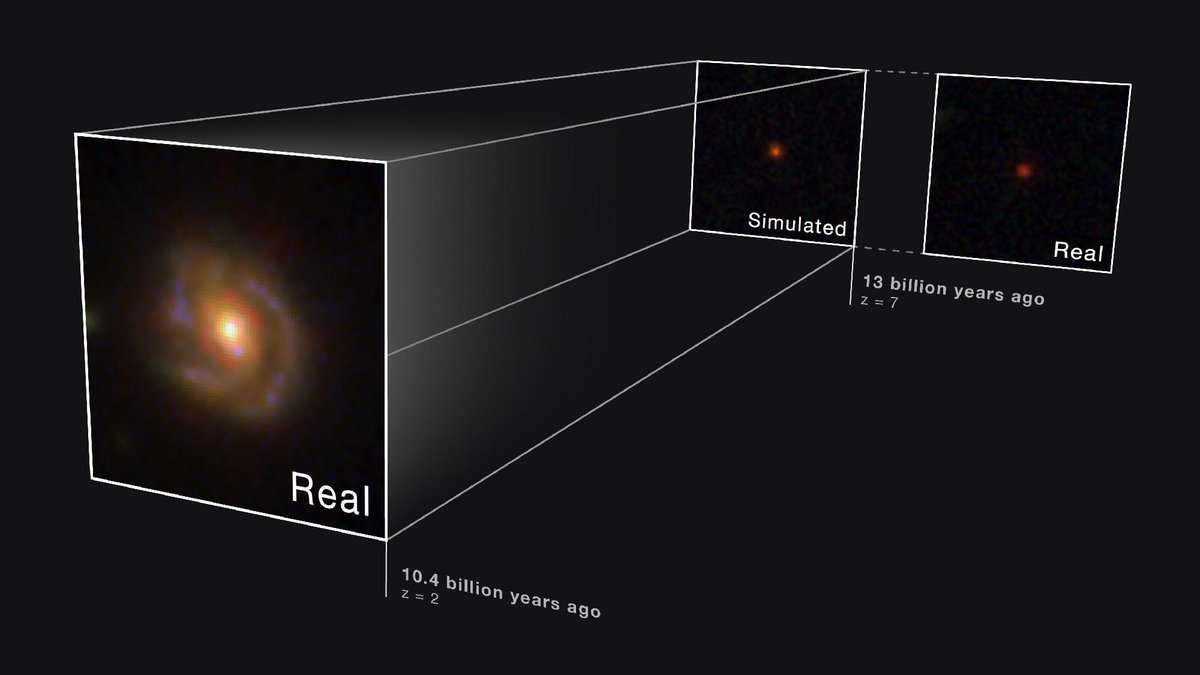
What do little red dots become as the universe ages? It’s been a question since they were discovered in the high-redshift universe by #NASAWebb in 2022. With each new observation, astronomers have gradually learned more about the nature of these mysterious red sources. (1/4) 🧵

NEWS: To learn more about distant little red dots (LRDs), scientists used #NASAWebb data of a nearby spiral galaxy with an LRD-like center and synthetically shifted it farther away. They found that the galaxy’s surrounding structure faded: https://t.co/UpsOoN1w4S
In 2022, we saw these three versions of the Pillars of Creation from #NASAWebb. Watch this explanation of how near- and mid-infrared data changes what we see: https://t.co/ukmElCsb6P
Which is your favorite Pillars image? Take the poll below! 👇

TODAY at 4 p.m.: STScI's Dr. Macarena Garcia Marin will explore #NASAWebb's record-breaking performance, scientific breakthroughs, and astonishing discoveries. We will also look ahead and ask the questions that will shape Webb's future science.
https://t.co/05hFGhHvCi
Protostar IRAS 04302+2247 will one day emerge from its “cocoon” of gas and dust. 🦋 #NASAWebb and Hubble looked at this baby star, capturing aspects like the protoplanetary disk and two wing-shaped reflection nebulas. Credit: NASA, ESA, CSA, M. Villenave et. al.


The light of a distant quasar, RX J1131, has been warped by an elliptical galaxy, creating a jeweled ring in this #NASAWebb image. This is created by gravitational lensing, which occurs as light bends around massive objects.
Credit: ESA, NASA, CSA, A. Nierenberg.

The light of a distant quasar, RX J1131, has been warped by an elliptical galaxy, creating a jeweled ring in this #NASAWebb image. This is created by gravitational lensing, which occurs as light bends around massive objects.
Credit: ESA, NASA, CSA, A. Nierenberg.

This is based on 20+ years of Hubble data and recent #NASAWebb data, used to measure the small movements of Omega Centauri’s stars over time. With this approach, a star was located orbiting an invisible object that is so hefty that it must be a black hole.
https://t.co/AfaSUIi1my
EVENT: On July 21, STScI's Dr. Macarena Garcia Marin will explore #NASAWebb's record-breaking performance, scientific breakthroughs, and astonishing discoveries. We will also look ahead and ask the questions that will shape Webb's future science.
https://t.co/05hFGhHvCi
A new planet has been found orbiting a nearby young star, Beta Pictoris. When studying the system with #NASAWebb, astronomers found the unmistakable fingerprint of a giant exoplanet where they did not expect it: https://t.co/DORxuhtH92

Most Popular Users

Elon Musk 
@elonmusk
241.5M followers

Barack Obama
@barackobama
119.1M followers

Cristiano Ronaldo
@cristiano
113.7M followers

Donald J. Trump
@realdonaldtrump
111.8M followers

Narendra Modi
@narendramodi
107.2M followers

Rihanna
@rihanna
98.6M followers

NASA
@nasa
92.4M followers

Justin Bieber
@justinbieber
91.7M followers

KATY PERRY
@katyperry
89.6M followers

Taylor Swift
@taylorswift13
83.5M followers

Lady Gaga
@ladygaga
75M followers

Virat Kohli
@imvkohli
72.7M followers

Kim Kardashian
@kimkardashian
70.7M followers

YouTube
@youtube
68.8M followers

Neymar Jr
@neymarjr
65.7M followers

Bill Gates
@billgates
64.9M followers

Selena Gomez
@selenagomez
62.7M followers

The Ellen Show
@theellenshow
62.3M followers

CNN
@cnn
61.8M followers

X
@x
60.8M followers