

Top Tweets for #Operationalization

Jeena Sikho - Big Guidance, But Execution Is the Real Test
Management now guiding:
▪️ FY27 PAT > ₹300 Cr
▪️ ₹3,000 Cr revenue in 3 to 5 years
▪️ 7,000 to 10,000 beds long term
Key trigger:
▪️ Current realization per bed is ~₹4,650/day vs proposed Ayushman reimbursement draft of ₹8,800 to 9,400/day.
▪️If reimbursement tailwinds actually kick in, operating leverage can become massive.
- Execution credibility remains the key watch item after Entero tie-up failure and delayed bed operationalization.
No Buy/Sell Recommendation
#StocksInFocus #StocksToWatch
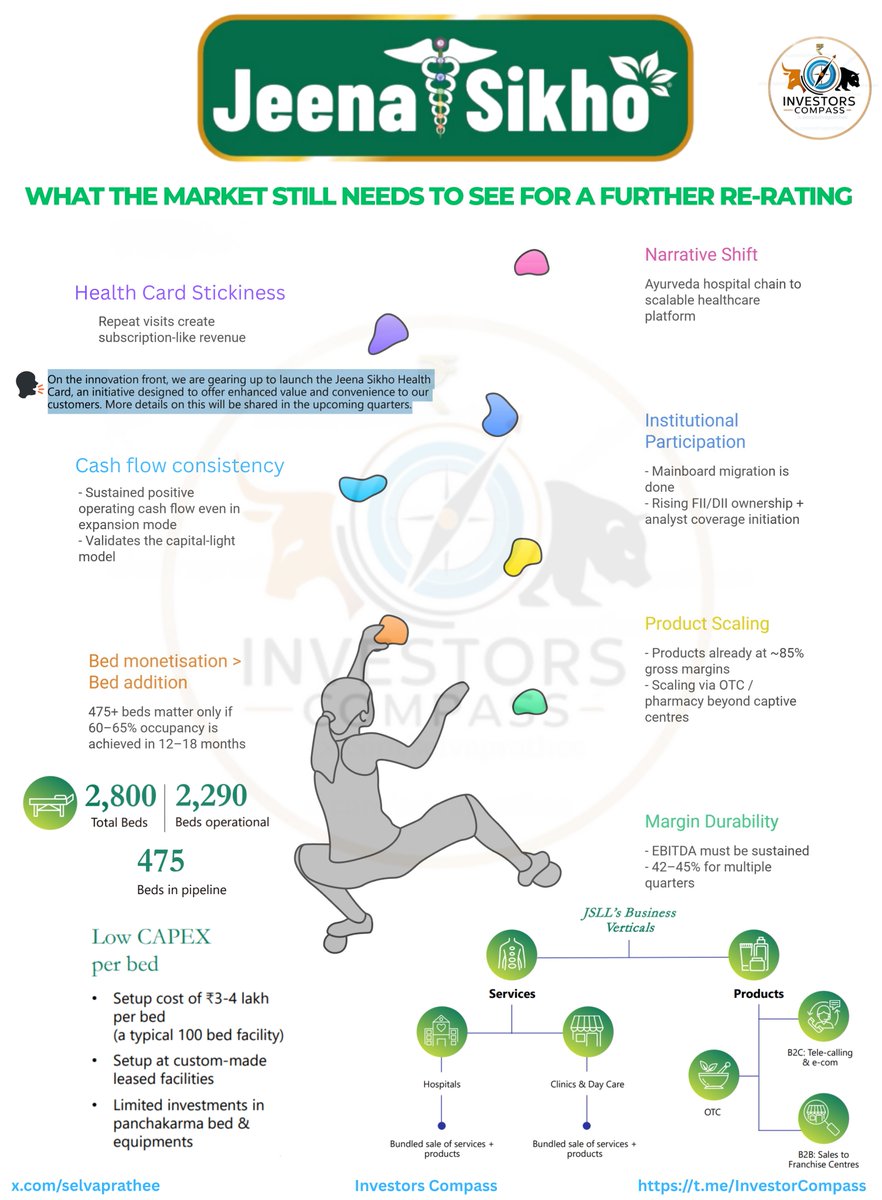
Jeena Sikho Lifecare - What the Market Still Needs to See for a Further Rerating ?
- Management highlights volume led growth, capital light expansion and margin stability.
- With ₹3 to 4L capex per bed, ~35% breakeven occupancy, <6 month payback and ~45% EBITDA margins, unit economics are attractive.
For a further re-rating, the market is watching execution on the following:
▪️ Sustained EBITDA margins (~42 to 45%) as new hospitals and clinics ramp
▪️ Occupancy ramp-up of 475+ beds under development, supporting ROCE scalability
▪️ Continued growth in IPD, OPD, Day Care and video consultations, as guided by management
▪️ Products business (~85% gross margins) scaling beyond captive centres through wider distribution
▪️ Operating cash flow behaviour during simultaneous multi-location expansion
▪️ Execution consistency in a mix of owned and franchise-led assets
▪️ Progress on Health Card rollout and its impact on repeat revenue
▪️ Greater institutional participation
▪️ Clear shift in perception from an Ayurveda chain to a services products healthcare platform
- Further rerating hinges on management commentary translating into repeatable, visible execution, especially on margins, occupancy and cash flows at scale.
No Buy/Sell recommendation
#StocksInFocus #StocksToWatch #jeenasikho #ayurveda

👑AIPOCH’s Endpoint Definition Designer was the only one that consistently behaved like a real endpoint-design layer for observational oncology studies.
https://t.co/nMqgslJwnF
It handled:
• primary vs secondary vs exploratory endpoints
• censoring logic
• composite endpoint structure
• adjudication strategy
• ascertainment bias
• surrogate endpoint labeling
• operational event definitions
But the biggest advantage was probably its operational discipline.
A few things that stood out immediately:
— mandatory clarification before long-form output
— a deployment-readiness system (provisional / workable / operational)
— a dedicated operationalization table for translating concepts into executable study rules
— 12 hard methodological rules covering surrogate claims, composite endpoint justification, and bias control
That operationalization layer is genuinely underrated.
A lot of endpoint tools stop at:
“OS, PFS, ORR…”
This one forces the next question:
“How exactly is this endpoint identified, timed, censored, adjudicated, and audited inside a real-world dataset?”
That’s the difference between a conceptual endpoint list and something that can actually survive protocol review or SAP drafting.


Tested 3 different skills on the same HCC immunotherapy vs chemotherapy RWE endpoint-design task.
Final ranking:
🥇 Endpoint Definition Designer (AIPOCH)
🥈 research-project-designer
🥉 research-methodology
https://t.co/43n6PffudZ
The interesting part wasn’t whether the outputs were “good.”
All 3 were useful.
The real difference was which skill actually understood clinical endpoint operationalization at the protocol level.

🚨Peptides will be ‘Huge’ TAM for Indian pharma companies
This is the story of a low-margin API maker in India, transitioning into a high-margin, peptide-focused CDMO — with lumpy near-term cash flows being the price of that build-out.
📈Blow out earnings this Quarter !!
Am talking about Neuland labs whose key growth drivers are :
🧬 1. CMS / CDMO ramp-up — the main engine
- biggest driver is Commercial Manufacturing Services. In Q4 FY26, Neuland posted a record total income of INR 788 crores, up 135% y-o-y, driven by CMS projects, which accounts for over 2/3rd of the quarter’s revenue
- company is deliberately shifting away from low-margin generic APIs toward higher-value human-health CDMO work
💊 2. Peptide CDMO expansion
- A major new growth vector. Strategic investments, including the planned operationalization of its new peptide facility by July 2026, are positioning the company for expansion in the high-growth peptide CDMO market.
- Management is optimistic about future growth, particularly in peptide manufacturing, where increased interest from innovators is evident. The peptide tailwind ties directly into the GLP-1 / metabolic drug boom.
🏭 3. Capacity expansion & new facilities
New facilities and capacity expansion are expected to drive revenue growth and improve operational efficiency.
- company deployed substantial capex of INR 397.1 crores during FY26 — building the manufacturing base for its commercial pipeline
Nuvama forecasts Neuland’s revenue and PAT to grow at a CAGR of 24% and 49% respectively over FY25-28E, driven by capacity expansion and product additions.


Empathy is the right diagnosis, the operationalization is what stalls most teams.
We live in the preference data space, the signal that compounds is what users say in their own words about their own problem, not what you say back to them.
Empathy without listening is just better copywriting.

GTC focused the market on inference.
For many enterprises, the gap is not capability. It is operationalization.
Tanuj Mohan explains why pilots stall and what it takes to move to production across data, security, and process.
Learn more: https://t.co/dAmexQEjFP
#GTC #NVIDIAGTC #GTC2026

@GrassmanWilliam @SpearfishingCap This is not a high quality candidate. The resume shows little detail relating to the kind of nuts and bolts work experience needed to lead the operationalization of a new product manufacturing effort. Perhaps there is more in details not shown. This does not assuage concerns.

I always found that as soon as I saw the first SotA Line 1 stuff and layout by Acro—we were all lyrical about it at the time, of course—so spacious, so... non-Japanese... not compact at all, all these curves and distances, long arms doing this or that. Not the hammer-speed and massive forces you see in videos of electronics, metallurgical, or plastics manufacturing.
Same for the subassembly—wasn’t sure if it was truly that compact and efficient. Maybe technically not as finely tuned?
Not an automation expert, but is any American company really good at that? Is Acro truly state of the art—is their legacy still at the highest end of the curve?
Maybe “old-school” robotic manufacturing is something American companies still haven’t fully mastered—or may never—while excelling at other innovative novelty like astronautical, microsurgical, genetic, pharmaceutical and similar functionality/designs?
Or is it not the hardware, but the operationalization of it?

Liquidity Pools on StandX
Systemic Function, USDT ↔ DUSD Swap, and Structural Difference from the Vault
After discussing the role of the Vault as structural infrastructure within StandX, it is necessary to move to another layer of the system: the Liquidity Pools.
While the Vault operates as an element of financial engineering focused on structural stability and systemic efficiency, the pools belong to the operational dimension of liquidity. They are not merely capital repositories; they are active mechanisms that connect flow, asset conversion, and market dynamics.
To properly understand this distinction, we must separate two fundamental concepts: systemic infrastructure and flow infrastructure.
Liquidity as Market Architecture
In an onchain perpetual derivatives environment, liquidity is not simply the volume visible in the orderbook. Liquidity is the system’s structural capacity to absorb flow without generating excessive distortions.
This capacity depends on three primary factors:
1 - Depth
2 - Continuity
3 - Conversion efficiency
Liquidity Pools operate precisely across these three dimensions.
They contribute to depth by sustaining the liquidity ecosystem. They contribute to continuity by enabling capital to circulate between assets. And they contribute to efficiency by reducing friction in entering and exiting the system.
In this sense, pools function as flow intermediation mechanisms.
The Strategic Role of the USDT ↔ DUSD Swap
A frequently overlooked aspect is the role of pools in facilitating the USDT ↔ DUSD swap.
StandX uses DUSD as productive margin. This means that trading capital operates within a specific internal framework.
However, a significant portion of users enter the ecosystem with USDT. For the system to function efficiently, a stable, deep, and low-friction conversion mechanism must exist.
This is where the pools become structurally relevant.
They do not simply facilitate swaps; they sustain the bridge between external capital and functional capital inside the DUSD ecosystem.
Without this layer:
- Capital inflows would become more costly
- The efficiency of productive margin would decline
- The internal liquidity cycle would lose fluidity
Therefore, pools are not merely market instruments. They are systemic transition mechanisms.
Liquidity Pools as Flow Infrastructure
It is useful to conceptualize pools as flow infrastructure.
They do not absorb structural risk nor do they sustain macro-level system stability. Their function is to allow capital to circulate efficiently across layers of the ecosystem.
Conceptually, they operate in three dimensions:
1 - Connectivity
They enable asset conversion, particularly USDT ↔ DUSD.
2 - Operational damping
They reduce friction in capital movement, minimizing impact and spreads during conversion.
3- Functional continuity
They ensure that the system remains accessible and operational even during increased demand.
This function differs fundamentally from that of the Vault.
Structural Difference Between Pools and Vault
Although both involve internal capital, their nature is distinct.
The Vault belongs to the structural dimension. It participates in risk absorption logic, stability mechanisms, and long-term systemic efficiency.
Liquidity Pools belong to the dynamic dimension. They participate in capital circulation and short-term operationalization of the ecosystem.
In analytical terms:
- The Vault is stability infrastructure.
- The Pools are flow infrastructure.
One guarantees resilience.
The other guarantees mobility.
They are complementary, but not interchangeable.
Implications for Traders
From a user perspective, these distinctions may appear abstract. However, their effects are concrete.
Swap efficiency directly affects the real cost of entering the system.
Operational depth influences execution quality.
Flow continuity reduces indirect friction risk during volatility.
Even if a trader never directly interacts with a pool or the Vault, they operate within the environment shaped by these structures.
And in onchain markets, infrastructure quality determines trading experience quality.
Liquidity Pools on StandX should not be understood merely as liquidity contracts. They are intermediation mechanisms that sustain capital circulation between layers of the system.
While the Vault represents structural engineering for stability, pools represent operational engineering for flow.
One sustains the building.
The other keeps capital circulating inside it.
Understanding this distinction means understanding that @StandX_Official is not just an onchain orderbook, but an integrated financial system where each layer fulfills a specific architectural function.
And in well-designed systems, edge does not lie only in the interface, but in the coherence between layers.


President Bola Tinubu has approved the implementation and operationalization of Nigeria’s carbon market framework, a landmark policy expected to generate at least $3 billion annually by 2030.
The framework positions Nigeria at the forefront of carbon trading, opening the door to large-scale emission allowance transactions across multiple sectors.
The new framework includes:
- Launch of a national carbon registry.
- Mandatory emissions reporting for companies.
- Phased compliance mechanisms aligned with Nigeria’s climate plan, which commits to emissions cuts by 2035 and net zero by 2060.
- Tax exemptions on carbon credit revenue for up to a decade.
- Accelerated capital allowances for low-carbon assets.
- R&D deductions tied to emissions-reduction projects.
These measures aim to eliminate structural risks that have previously constrained investment in carbon markets.


Dobby is the name given to one of @SentientAGI community models and serves as a concrete experiment in community-owned model governance. It’s an 8B family model distributed on Hugging Face with explicit fingerprinting and governance mechanisms.
The Dobby experiment demonstrates several important points
Dobby shows how a model can be jointly owned: contributors add datasets, vote on alignment policies, and participate in governance that determines fine-tuning directions. This is an operationalization of OML values. By publishing Dobby in open model hubs and documenting its fingerprinting, Sentient makes it discoverable to integrators and third-party tool builders. Integration into the GRID means Dobby can be a specialist agent in ROMA task trees finally Community feedback is used to adapt the model’s behavior over time without central lock-in, offering a clear alternative to closed lab update cycles.
Why Dobby is significant? It’s a living proof-of-concept a community-oriented model that demonstrates monetization, traceability, and iterative governance. For enterprises and institutions worried about vendor lock-in, Dobby and similar experiments illustrate that open models can be both usable and governable.


책을 다쓰고 났더니, 팔란티어의 AIP로직에 대한 설명이 책에서 자세하지 않았던 걸 뒤늦게 발견했네요.
구체적으로 팔란티어가 LLM을 온톨로지에 어떻게 결합시키는지에 대한 설명을 보충하여 공유합니다.
AIP Logic
팔란티어의 인공지능 플랫폼(AIP) 내에서 AIP Logic의 역할은 단순한 인공지능 도구의 범주를 넘어선다. 이것은 팔란티어의 전체적인 기업 운영 체계 속에서 그 의미를 온전히 이해할 수 있는 핵심적인 구성 요소다. 이 시스템의 근간에는 Foundry라는 데이터 운영 플랫폼이 자리하고 있으며, 이는 기업 내 분산된 데이터를 통합하여 Ontology라는 고유한 데이터 모델로 전환하는 역할을 맡는다. Ontology는 단순히 데이터를 저장하는 공간이 아니라, 현실 세계의 물리적, 개념적 객체들(예: 공장, 항공기, 공급망, 환자)을 디지털 객체로 정의하고, 그 객체들 간의 관계를 링크로 연결하여 현실 세계를 그대로 반영하는 디지털 트윈을 구축하는 데 그 목적이 있다. 이처럼 Ontology는 인간과 AI가 공통적으로 이해할 수 있는 단일한 진실의 원천(single source of truth)을 제공함으로써, AI 기반의 의사결정과 자동화가 현실의 복잡성을 직접적으로 다룰 수 있는 토대를 마련한다.
AIP는 바로 이 Ontology의 토대 위에서 생성형 AI의 역량을 결합하여, AI가 단순히 분석을 넘어 실제 운영을 자동화할 수 있도록 지원하는 플랫폼이다. AIP는 Foundry와 함께 소프트웨어 배포를 제어하는 Apollo와 결합되어, LLM 기반 웹 애플리케이션부터 비전-언어 모델을 활용하는 모바일 앱, 그리고 엣지 컴퓨팅까지 아우르는 'AI Mesh'라는 포괄적인 운영 체계를 완성한다. 이 맥락에서 AIP Logic은 바로 이 AI Mesh의 핵심적인 '건축가' 도구 중 하나로 기능한다. 이러한 접근 방식은 단순한 AI 모델 통합을 넘어선다. 팔란티어는 AI를 독립적인 분석 도구로 보는 대신, Ontology라는 독특한 데이터 모델을 통해 기업의 현실 세계 운영 자체와 깊이 결합하는 전략을 취하고 있다. 이러한 접근 방식은 Ontology가 빌 인몬(Bill Inmon)이 제안했던 데이터 웨어하우스 모델과 유사하게, 데이터 통합을 위한 막대한 초기 비용과 노력을 수반하지만 , 그 결과로 AI가 현실 세계의 '객체'와 '액션'을 직접적으로 이해하고 조작할 수 있는 강력한 기반을 제공한다. 이는 일반적인 데이터 레이크나 데이터 웨어하우스 아키텍처와 근본적으로 다른 차별점이다. AIP Logic의 '노코드'라는 특징은 바로 이러한 Ontology의 복잡성을 비기술적 사용자에게 숨기고, AI를 통해 Ontology의 가치를 쉽게 활용할 수 있도록 돕는 일종의 '진입 장벽 완화' 전략으로 해석될 수 있다.
AIP Logic은 LLM 기반의 함수를 구축, 테스트, 배포하기 위한 노코드 개발 환경이다. 이 도구의 핵심은 Ontology와의 복잡한 API 호출이나 개발 환경 구축의 어려움 없이도 사용자가 직관적인 인터페이스를 통해 AI 기반의 기능을 생성할 수 있도록 하는 데 있다. 이 인터페이스는 크게 세 가지 주요 구성 요소로 이루어져 있는데, 이는 좌측 패널의 입력, 블록, 출력 설정, 중앙의 디버거, 그리고 우측의 실행 패널이다. 사용자는 이 인터페이스에서 Ontology의 객체나 기본 데이터 타입(string, integer 등)을 입력으로 정의하고, 일련의 블록(blocks)들을 순차적으로 배열하여 AI의 논리적 명령 흐름, 즉 ‘사고의 사슬(chain-of-thought)’을 설계한다. 이 블록들은 AIP Logic 워크플로우의 최소 측정 단위이기도 하다. AIP Logic은 다양한 유형의 블록을 제공하여 복잡한 로직을 구성할 수 있게 한다.
예를 들어, 변수 생성(create variable) 블록은 향후 블록에서 사용할 변수를 생성하고, 객체 속성 가져오기(get object property) 블록은 Ontology 객체의 특정 속성을 불러온다. 가장 핵심적인 LLM 사용(use LLM) 블록은 특정 LLM을 호출하여 프롬프트 엔지니어링을 수행하며, 변환(transform) 블록은 데이터 변환이나 수학적 연산을 처리한다. 마지막으로 액션 적용(apply action) 블록은 LLM을 거치지 않고도 Ontology에 정의된 액션을 호출하여 데이터 수정을 위한 정확하고 확정적인 제어를 가능하게 한다. 이 블록들은 도구(tools)라는 메커니즘을 통해 Ontology와 상호작용한다. AIP Logic의 도구는 Ontology에 정의된 데이터, 로직, 액션의 세 가지 범주로 나뉘며, 이를 통해 LLM은 Ontology의 데이터를 조회하거나, 함수를 실행하거나, 안전하게 액션을 취할 수 있다. '노코드'라는 용어는 겉보기에는 기술적 복잡성이 전혀 없는 것처럼 들리지만, AIP Logic의 블록과 도구로 이루어진 아키텍처를 분석하면 이것이 단순한 자유 형식의 텍스트 입력 인터페이스가 아님을 알 수 있다. 오히려 이것은 LLM의 기능을 구조화된 워크플로우로 캡슐화한 일종의 시각적 프로그래밍 패러다임에 가깝다. 이러한 구조는 AI의 비결정적 특성을 통제하고, 일관되고 예측 가능한 결과를 산출하도록 유도한다. 이는 팔란티어가 추구하는 '신뢰 가능한 AI(trustworthy AI)'의 근간을 이룬다. 또한, 액션 적용 블록이 LLM을 거치지 않고 직접 호출될 수 있다는 점은, AI의 추론(inference)과 실제 운영에 대한 변경(modification)을 분리함으로써 AI의 오작동 가능성을 줄이는 안전장치로 기능함을 시사한다.
AIP Logic의 진정한 가치는 기업의 현실 세계를 모델링한 Ontology와의 깊은 통합에서 발현된다. Ontology는 기업의 데이터(객체와 링크), 로직(모델과 함수), 그리고 액션(플랫폼 액션)을 통합하는 의사결정 중심의 모델이다. AIP Logic은 이 세 가지 요소 중 로직의 핵심적인 부분으로, LLM을 통해 정의된 지능적인 함수를 Ontology에 통합하는 역할을 한다. 특히 Ontology의 액션(Actions)은 AIP Logic의 운영화에 있어 필수적인 요소로, 이는 엔터프라이즈의 '동사'를 정의하는 것과 같다.
액션은 인간 운영자나 AI 에이전트가 Ontology 내 데이터를 변경하거나 외부 시스템에 변경 사항을 적용하는 방법을 규정하며, 그 과정에 대한 세밀한 통제권을 제공한다. 여기서 팔란티어의 독특한 인간-참여형(human-in-the-loop) 메커니즘이 등장한다. AIP Logic 함수를 통해 Ontology를 수정하기 위해서는, 해당 함수가 반드시 액션에 의해 실행되어야만 한다. AIP Logic의 LLM 사용 블록이 액션 적용 도구를 호출하더라도, 그 자체만으로는 Ontology에 변경 사항이 기록되지 않는다. 변경 사항을 적용하려면 액션에 의해 직접 실행되거나 Automate와 같은 자동화 기능에 의해 호출되어야 한다. 이 구조는 AI가 Ontology에 직접적이고 비통제적인 변경을 가하는 것을 방지하고, AI 에이전트가 제안(proposals)을 생성하면 인간 운영자가 이를 검토하고 승인하는 제어 체계를 확립한다. 이 과정을 통해 인간의 판단과 전문성은 AI의 통찰력과 결합되며, 검토 및 승인 과정에서 생성된 메타데이터는 AI 모델의 재학습 및 미세 조정을 위한 귀중한 피드백 루프(feedback loop)로 활용될 수 있다. 이러한 제어 구조는 LLM 기반 워크플로우를 실제 운영 환경에 안전하게 배포하기 위한 핵심적인 전제 조건이다.
액션의 역할에 대한 심층적 이해는 팔란티어의 거버넌스 철학을 명확히 보여준다. AI의 역할이 단순한 데이터 분석과 인사이트 제공을 넘어 실제 운영에 개입하는 수준으로 확장될 때, 그 책임 소재와 통제 메커니즘은 매우 중요해진다. 팔란티어는 액션을 통해 AI 에이전트의 권한을 마치 "샌드박스(sandboxed)"와 같이 특정 데이터와 도구에 대한 접근으로 제한하는 "제어 평면(control plane)"을 구축했다. 이는 AI의 자율성을 극대화하기보다는, 인간과 AI의 협업을 통해 책임성과 신뢰성을 확보하려는 전략적 선택이다. 액션 적용 블록이 LLM과 독립적으로 작동할 수 있다는 점은 AI의 비결정적 추론과 운영에 대한 확정적 변경을 분리하여 시스템의 안정성을 극대화하려는 미묘한 의도가 반영된 것으로 보인다.
AIP Logic을 통해 개발된 기능들이 실제 운영 환경에서 지속 가능한 가치를 창출하기 위해서는 엄격한 거버넌스와 성능 관리가 필수적이다. 팔란티어는 이를 위해 플랫폼 전반에 걸쳐 다양한 제어 장치를 마련하고 있다. 첫째, AIP는 LLM 기반 워크플로우를 위한 AIP Evals라는 평가 도구를 제공한다. 이를 통해 개발자는 다양한 테스트 케이스와 평가 기준을 설정하여 AIP Logic 함수 및 프롬프트의 성능을 체계적으로 디버깅, 개선하고, 시간이 지남에 따라 모델의 성능 변화(drift)를 모니터링할 수 있다. 이는 프로덕션 환경에 배포될 AI 워크플로우의 안정성과 신뢰성을 확보하는 데 필수적인 과정이다. 둘째, AIP는 LLM이 조직의 데이터를 안전하게 처리할 수 있도록, 플랫폼이 제공하는 모든 보안 기능을 통합한다. 이는 데이터 전송 및 저장 시의 암호화, 강력한 접근 제어, 감사 로그 기능을 포함하며, 특히 역할 기반, 보안 마킹 기반, 목적 기반 접근 제어(Purpose-Based Access Control, PBAC)와 같은 다층적인 인증 및 인가 제어 방식을 통해 민감한 데이터의 보호를 보장한다. AIP Logic 함수는 이러한 엄격한 보안 모델 위에서 작동하며, LLM은 작업을 수행하는 데 필요한 최소한의 데이터에만 접근 권한을 부여받게 된다. 이는
Ontology의 보안 마킹이 파생된 모든 데이터셋과 변환 과정에 적용되는 보안 전파(Security Propagation) 메커니즘을 통해 구현된다. 셋째, AIP Logic의 사용량은 세분화된 방식으로 측정된다. 블록의 실행은 AIP Logic 사용량 측정의 원자적 단위이며, 기본 LLM 블록 실행에는 4 컴퓨트-초(compute-seconds), LLM 블록 도구 실행에는 8 컴퓨트-초의 최소 사용량이 부과된다. 또한, LLM 토큰 사용량은 프롬프트와 응답의 크기에 따라 측정되며, Ontology의 대량 텍스트를 LLM에 주입할 때 특히 유의해야 한다. AIP Logic 블록이 Ontology 쿼리, 액션 실행, 함수 실행과 같은 외부 도구를 호출할 경우, 추가적인 Foundry 컴퓨팅 자원 사용이 발생할 수 있다. 이러한 명확한 사용량 측정 기준은 기업이 비용 효율적인 방식으로 AI 워크플로우를 구축하고 관리할 수 있도록 한다.
AIP Evals, 다층적 보안 모델, 세분화된 컴퓨트 사용량 측정은 AIP Logic이 프로토타입을 넘어 실제 운영 환경에 배포될 수 있는 견고한 운영화(operationalization) 플랫폼임을 시사한다. 특히, 보안 전파와 같은 독특한 보안 메커니즘은 데이터 거버넌스와 보안이 단순히 추가적인 기능이 아니라, 팔란티어 플랫폼의 핵심 설계 원칙임을 보여준다. 이는 엔터프라이즈 AI의 가장 큰 장애물 중 하나인 데이터 보안 및 책임 문제를 근본적으로 해결하려는 시도로 볼 수 있으며, 이는 군사 및 정보기관과 같은 고위험 산업군에서 팔란티어가 가지는 강점의 원천이 된다.
지금까지 논의한 내용들을 종합하면, 팔란티어의 AIP Logic은 단순히 새로운 AI 개발 도구가 아니라, 팔란티어의 전체 플랫폼 철학을 집약적으로 구현한 산물임을 알 수 있다. 이것은 Ontology라는 현실 세계의 디지털 복제본 위에서, 블록과 도구라는 구조화된 프레임워크를 통해 LLM의 비정형적 역량을 구체적인 운영 자동화로 전환하는 매개체이다. 액션을 통한 엄격한 인간-참여형 제어 체계와 AIP Evals를 통한 지속적인 평가 메커니즘은 AI를 단순한 기술적 실험을 넘어, 기업의 핵심 운영에 안전하고 신뢰할 수 있게 통합할 수 있는 근본적인 기반을 제공한다. 궁극적으로 AIP Logic은 AI가 비즈니스 전략가의 언어로 대화하고, 현장 작업자의 경험에 부합하는 방식으로 작동하며, 의사결정의 결과를 현실 세계에 되돌려주는 강력한 피드백 루프를 구축함으로써, 기업의 운영 방식 자체를 근본적으로 재편하는 핵심적인 원동력으로 자리매김하고 있다. 이것은 팔란티어가 단순히 데이터를 분석하는 회사를 넘어, AI를 통해 현실 세계의 운영을 직접적으로 제어하는 '운영 체제'를 구축하겠다는 원대한 비전을 실현하는 구체적인 기술적 증거다.
지난번 저서 《팔란티어에 주목하라》를 세상에 선보였을 때, 저의 목표는 베일에 싸인 기업 팔란티어를 대중에게 알기 쉽게 소개하는 입문서의 역할을 하는 것이었습니다. 많은 분께서 보내주신 따뜻한 호응과 지적인 관심은 저자로서 큰 기쁨이자 보람이었습니다.
하지만 책이 나온 직후부터 제 마음 한편에는 늘 아쉬움과 책임감이 무겁게 자리했습니다. 입문서의 성격상 팔란티어라는 기업이 가진 복잡하고 다층적인 본질을 온전히 담아내지 못했다는 생각과 함께, 이미 깊은 지식을 갖춘 전문가와 투자자분들의 채워지지 않는 지적 갈증을 마주해야 했기 때문입니다.
그 갈증은 팔란티어를 단순히 ‘제2의 테슬라’나 ‘AI 시대의 총아’ 같은 피상적인 별칭 너머, 그 작동 원리의 가장 깊은 '기계실'까지 내려가 직접 보고 싶다는 열망의 다른 이름이었습니다.
그래서 이번 책에서는 지난 책과의 중복을 의식적으로 피하려 노력했습니다. 일부 같은 사례가 언급되더라도, 이는 단순히 과거의 논의를 반복하는 것이 아니라, 이전에는 미처 다루지 못했던 구조적인 깊이와 기술적인 맥락, 그리고 전략적인 의미를 더하기 위한 필수적인 장치입니다.
부디 이 책이, 독자 여러분께서 팔란티어가 벌이는 이 거대한 '세기의 도박'의 본질을 스스로의 눈으로 이해하고 그 성공과 실패의 가능성을 날카롭게 판단하는 데 필요한, 가장 정교하고 깊이 있는 분석의 틀을 제공하는 믿음직한 안내서가 되기를 진심으로 바랍니다.
예스24 📘: https://t.co/wsdXBk4QiQ
교보문고 📕: https://t.co/ft1KDS9mEG
알라딘 📗: https://t.co/DfSLhktNXA
현재는 예약 판매중이고 배송예정일은 8월 20일 수요일입니다.
쪽수 360쪽
크기 152 * 225 * 21 mm


@Anvith_ @TheAlpha10X @tsatwork @TrendSpark420 @SSage82827 @TiltQuest @DhawalDoshi5 @Praveen12Pranis @Portfolio_Bull @BharatStockLive "Greater Faridabad region turns PAT positive within one year of operationalization."
Need to see how Yatharth turns out

🏥 Yatharth Hospitals - Solid Q1FY26 Results 🚀
▪️ Revenue 🔼 22%YoY at 258 Cr Vs 212 Cr YoY
▪️ PAT 🔼 40% at 42.5 Cr Vs 30.5 Cr YoY
▪️ EBITDA 🔼 20% at 64.5 Cr Vs 54 Cr YoY
▪️ EBITDA Margin 25% vs 25.5% YoY
▪️ PAT Margin 🔼 16.5% Vs 14.3% YoY
✅ Q1FY26 Highlights
▪️ Bed Occupancy Ratio 🔼 65% Vs 61% in Q1FY25.
▪️ ARPOB 🔼 6%YoY to Rs 32,395.
▪️ Noida Extension region records highest ARPOB of Rs 39,800 🔼 7%YoY.
▪️ Greater Faridabad Region Bed Occupancy Ratio 🔼 significantly to 55% from 10% in Q1FY25.
▪️ New Delhi facility with 300 bed inaugurated in July, 25.
▪️ Faridabad facility with 400 bed set to be operational in August, 25.
▪️ Greater Faridabad region turns PAT positive within one year of operationalization.
#Yatharth #YatharthHospitals #Q1FY26Results

India's Hospital & Healthcare Services Sector: Future Outlook
1⃣ Healthcare Demand Surge
▪️Aging population + rising lifestyle diseases = consistent demand growth.
▪️Rising income levels further fuel healthcare spending.
➡️ A multi-year growth cycle ahead, but execution in scaling efficiently is key.
2⃣ Structural Demand Boom Ahead
▪️India’s population over 60 to double by 2040
▪️Diabetes, cardiac, cancer cases rising every year
▪️Rising disposable income = private healthcare boom
Implication:
➡️ Multi-decade volume + value play.
➡️ But execution, infra scalability, and cash generation will separate leaders from laggards.
3⃣ Listed Companies Riding the Trend
Hospital Operators
▪️Apollo Hospitals
▪️Narayana Hrudayalaya
▪️Max Healthcare
▪️Fortis Healthcare
▪️Rainbow Children Hospital
▪️Artemis Medicare
▪️Jupiter Life Line
▪️Yatharth Hospital
▪️Dr Agarwal’s Health
▪️Indraprastha Medical
▪️Healthcare Global
▪️Krishna Institute of Medical Sciences (KIMS)
▪️Kovai Medical
Diagnostics Chains
▪️Dr. Lal Pathlabs
▪️Thyrocare Technologies
▪️Vijaya Diagnostic
▪️Krsnaa Diagnostics
▪️Vimta Labs
4⃣ Why EV/EBITDA & EV/CFO Matter More Than PE
- Hospitals & Labs = Capital-Intensive → Cash is King
- EV/EBITDA – Operating Profit Multiple
▪️Strips out depreciation & debt noise
▪️Clean view of ops profitability
▪️High = Growth priced in
▪️Low = Mispriced or cyclical undervaluation
- EV/CFO – Cash Flow Efficiency
▪️Measures how much investor pays for ₹1 of cash flow
▪️Captures working capital swings & capex stress
▪️High = Overvaluation / cash strain
▪️Low = Efficient / lean ops
5⃣ Why It Matters for Investors
- Most investors overpay based on P/E. But:
▪️Profit = can be managed
▪️EBITDA = slightly better
▪️Cash flow = cannot be faked
- A healthcare stock with:
▪️ROCE > 15%
▪️EV/EBITDA < 35
▪️EV/CFO < 50
is a solid long-term compounder candidate.
6⃣ Key Investor Lens to Apply
▪️EV/EBITDA < 35 – Shows fair operating value without overpaying for growth
▪️EV/CFO < 50 – Indicates solid cash flow discipline and working capital control
▪️ROCE > 15% – Signals efficient use of capital-intensive infra
▪️ROE > 18% – Reflects strong returns to shareholders and asset efficiency
▪️PAT Growth > 20% – Hints at consistent reinvestment visibility and business momentum
✅ Stick to these filters in healthcare, they separate true compounders from valuation traps.
🧭 Investor Compass View
- India’s healthcare story is not just a demand narrative, it's an execution race.
✅ The winners will be those who:
▪️Scale with discipline
▪️Sweat infra efficiently
▪️Maintain strong bed occupancy rates
▪️Improve ARPOB (Average Revenue per Occupied Bed)
▪️Convert EBITDA into cash
- P/E may attract attention, but EV/CFO reveals the truth.
- The market eventually rewards cash-efficient franchises, not optically cheap ones.
➡️ Use this framework to separate hype from high-quality, and position early for the next healthcare wealth cycle.
No Buy/Sell recommendation
#StocksToFocus #StocksToWatch


This is the Gemini Deep Research plan it created before performing the task.
(1) Obtain the official Q1FY26 financial results for Premier Energies, including income statements, balance sheets, and cash flow statements. Compare these results with previous quarterly and annual reports to identify trends and significant changes in financial performance.
(2) Access and thoroughly review the Q1FY26 earnings call transcripts and investor presentations from Premier Energies. Extract management commentary on current performance, future outlook, strategic initiatives, and any specific guidance provided.
(3) Gather research reports, ratings, and target prices from various financial analysts covering Premier Energies. Analyze their commentary on the Q1FY26 results, their expectations, and any revisions to their financial models or recommendations.
(4) Investigate market sentiment and expectations regarding Premier Energies' Q1FY26 results prior to and immediately after the announcement. Look for discussions on financial news platforms and reputable investment forums like ValuePickr, Reddit, and X to gauge investor reactions.
(5) Collect detailed information on Premier Energies' capital expenditure (capex) plans, including specific project breakdowns, projected timelines for operationalization, and management's guidance on how these investments are expected to translate into future revenue.
(6) Identify and analyze key operational metrics relevant to a capex-heavy business, such as capacity utilization rates, production volumes, and efficiency ratios, for Premier Energies based on the Q1FY26 results and historical data.
(7) Review recent credit rating reports for Premier Energies to understand the company's financial health, debt levels, liquidity position, and its ability to fund ongoing and planned capital expenditures.
(8) Synthesize all gathered information to provide a comprehensive analysis of Premier Energies' Q1FY26 performance, including an evaluation of its financial health, growth prospects, and the potential impact of its capex plans on future revenue and profitability.

@Va_rian01 @Novastro_xyz Novastro transforms RWAs into dynamic, rule-bound assetswhere legal meets programmable execution.This isn't tokenization, it's operationalization.

What Are the Technical Areas in AI Governance? - https://t.co/qybmMwPPT6
As AI progress accelerates, so do the risks - and it's often unclear how to navigate them. Many challenges are partly technical. Technical AI governance uses technical analysis and tools to support effective AI governance, helping to: (a) identify where intervention is needed, (b) assess governance actions, and © design mechanisms for enforcement, incentivization, and compliance.
1️⃣ Assessment - Detect problematic training data (e.g., copyright violations, poisoning); attribute model behaviors to datasets or fine-tuning; develop methods for evaluating downstream societal impacts
2️⃣ Access - Enable privacy-preserving third-party audits; prevent evaluation datasets from leaking into training data
3️⃣ Verification - Develop black-box verification of model behavior; implement watermarking for AI output traceability
4️⃣ Security - Protect model parameters, training data, and deployment infrastructure from unauthorized access or tampering
5️⃣ Operationalization - Translate governance requirements into enforceable technical standards and controls
6️⃣ Ecosystem Monitoring - Track large model training, hardware usage, and real-world deployment risks
📖 Read more: "Open Problems in Technical AI Governance" https://t.co/qybmMwPPT6
👥 Authors: Anka Reuel, Ben Bucknall, Stephen Casper, Tim Fist, Lisa Soder, Onni Aarne, Lewis Hammond, Lujain Ibrahim, Alan Chan, Peter Wills, Markus Anderljung, Ben Garfinkel, Lennart Heim, Andrew Trask, Gabriel Mukobi, Rylan Schaeffer, Mauricio Baker, Sara Hooker, Irene Solaiman, Alexandra Sasha Luccioni, Nitarshan Rajkumar, Nicolas Moës, Jeffrey Ladish, David Bau, Paul-Andrei Bricman, Neel Guha, Jessica Newman, Yoshua Bengio, Tobin South, Alex Pentland, Sanmi Koyejo, Mykel J. Kochenderfer, Robert Trager
#AIGovernance #TechnicalGovernance #AIEthics #AIPolicy #Cybersecurity #TrustworthyAI

KP Green Engineering ☀️
🏗️ Update on the progress of new manufacturing unit at Matar, Bharuch.
🏗️ Phase 1 of the construction at the Matar factory has been successfully completed, which includes the successful commencement of trial and commercial production of the Pre-Engineering Building (PEB). This marks a significant milestone in the project.
🏗️ Furthermore, the installation of machinery for Heavy Fabrication and Transmission Lines has been
completed, with trial production scheduled for April 2025. These developments are expected to
significantly enhance our production capabilities and bring us closer to the full operationalization of the manufacturing unit.
#KPGEL

KP Green Engineering Limited 📚✏🧵
#KPGEL ☀️
☀️ Targets 🎯 to achieve 3X+ of its installed Capacity by Q1FY26
☀️ H1FY25: Higest ever PAT 📈 150℅ at ₹27 Cr
☀️ Solid Order Book of ~₹615 Cr as on 31st Dec 2024
☀️ Current Capacity: 106500 MTPA
🎯 294000 MTPA by Q12026 - Planned Greenfield Expansion
🎯 90000 MTPA - Planned Hot Dip Galvanizing Plant for Road & Rail 🚂 Infra
🇺🇸 Received its first export order from US based solar tracker manufacturer
📊 Data Credit: Sovrenn & Company AR
1/10


간단히 덧붙이자면 크게 보면 둘다 operationalization platform 기업이죠. 하나는 조직 운영, 다른 하나는 실험 설계 및 운영에 있어 문제가 뭔지 파악하고, 이를 해결하기 위한 아이디어를 행동으로 구체화합니다. 이 과정에서 둘다 software에 기반한 해결책에 집중합니다. 그런면에서 테슬라와도 공통점이 있어요.
Most Popular Users

Elon Musk 
@elonmusk
240M followers

Barack Obama
@barackobama
118.6M followers

Cristiano Ronaldo
@cristiano
114.4M followers

Donald J. Trump
@realdonaldtrump
111.7M followers

Narendra Modi
@narendramodi
106.9M followers

Rihanna
@rihanna
98.6M followers

NASA
@nasa
92.1M followers

Justin Bieber
@justinbieber
91.7M followers

KATY PERRY
@katyperry
89.9M followers

Taylor Swift
@taylorswift13
83.9M followers

Lady Gaga
@ladygaga
75.4M followers

Virat Kohli
@imvkohli
73.3M followers

Kim Kardashian
@kimkardashian
70.8M followers

YouTube
@youtube
68.6M followers

Neymar Jr
@neymarjr
66.3M followers

Bill Gates
@billgates
65.2M followers

Selena Gomez
@selenagomez
63M followers

The Ellen Show
@theellenshow
62.1M followers

CNN
@cnn
61.7M followers

X
@x
60.6M followers