

Top Tweets for #Pompeius

This statement by Pompeius—and its reiteration by the U.S. Secretary of State and the U.S. Secretary of Defense—contains several significant points:
1- After fleeing to Egypt, Pompeius was beheaded, his body was burned, and his head was kept as proof of his destruction.
2. The spirit of Rome did not perish following its collapse; rather, it transmigrated into the Anglo-Saxon realm and subsequently migrated to the United States.
3. These godless Romans have consistently scapegoated the Jews for their own inherent savagery—even though a drive for supremacy is, in fact, intrinsic to their own nature. They have inadvertently revealed this hidden truth, exposing the joo joo narrative as nothing more than Western propaganda.
4. This reaction signifies the collapse of the Anglo-Saxon order and its underlying logic—that is, the logic of brute force.
#AceTavana


Stop quoting laws to MEN WITH SWORDS.

@Pompeius14 ゴロンゴロン

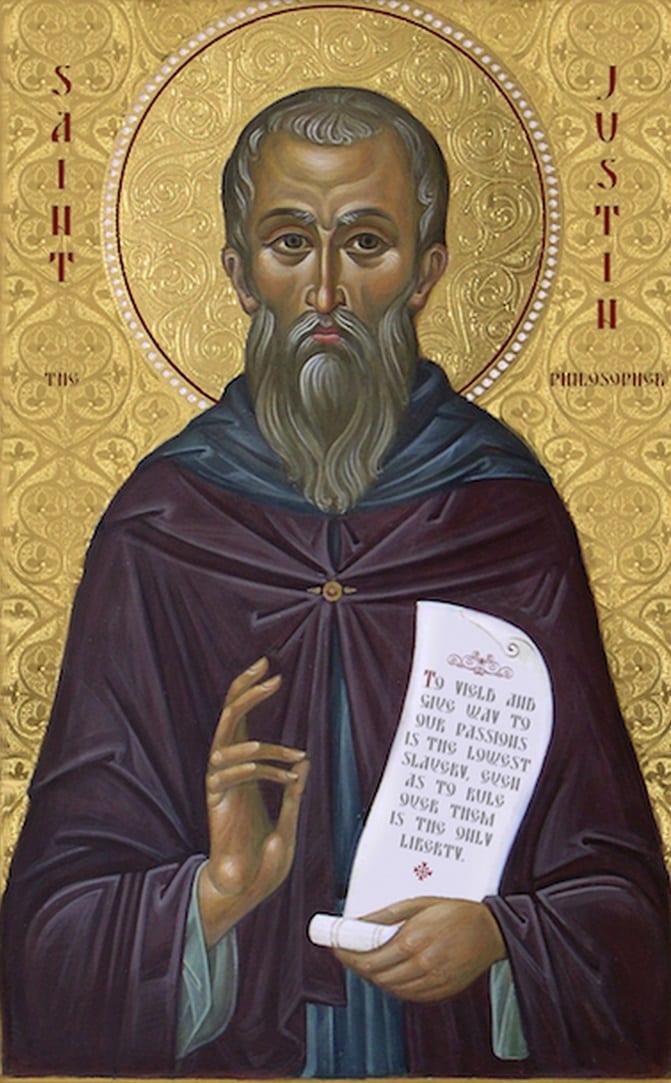
🌹St. Justin Martyr, Ora pro nobis🌹
Feast Day - June 1st
Christian apologist, born at Flavia Neapolis, about A.D. 100, converted to Christianity about A.D. 130, taught and defended the Christian religion in Asia Minor and at Rome, where he suffered martyrdom about the year 165. Two "Apologies" bearing his name and his "Dialogue with the Jew Tryphon" have come down to us. Leo XIII had a Mass and an Office composed in his honour and set his feast for 14 April.
Life
Among the Fathers of the second century his life is the best known, and from the most authentic documents. In both "Apologies" and in his "Dialogue" he gives many personal details, e.g. about his studies in philosophy and his conversion; they are not, however, an autobiography, but are partly idealized, and it is necessary to distinguish in them between poetry and truth; they furnish us however with several precious and reliable clues. For his martyrdom we have documents of undisputed authority. In the first line of his "Apology" he calls himself "Justin, the son of Priscos, son of Baccheios, of Flavia Neapolis, in Palestinian Syria". Flavia Neapolis, his native town, founded by Vespasian (A.D. 72), was built on the site of a place called Mabortha, or Mamortha, quite near Sichem (Guérin, "Samarie", I, Paris, 1874, 390-423; Schürer, "History of the Jewish People", tr., I, Edinburgh, 1885). Its inhabitants were all, or for the most part, pagans. The names of the father and grandfather of Justin suggest a pagan origin, and he speaks of himself as uncircumcised (Dialogue, xxviii). The date of his birth is uncertain, but would seem to fall in the first years of the second century. He received a good education in philosophy, an account of which he gives us at the beginning of his "Dialogue with the Jew Tryphon"; he placed himself first under a Stoic, but after some time found that he had learned nothing about God and that in fact his master had nothing to teach him on the subject. A Peripatetic whom he then found welcomed him at first but afterwards demanded a fee from him; this proved that he was not a philosopher. A Pythagorean refused to teach him anything until he should have learned music, astronomy, and geometry. Finally a Platonist arrived on the scene and for some time delighted Justin. This account cannot be taken too literally; the facts seem to be arranged with a view to showing the weakness of the pagan philosophies and of contrasting them with the teachings of the Prophets and of Christ. The main facts, however, may be accepted; the works of Justin seem to show just such a philosophic development as is here described, Eclectic, but owing much to Stoicism and more to Platonism. He was still under the charm of the Platonistic philosophy when, as he walked one day along the seashore, he met a mysterious old man; the conclusion of their long discussion was that he soul could not arrive through human knowledge at the idea of God, but that it needed to be instructed by the Prophets who, inspired by the Holy Ghost, had known God and could make Him known ("Dialogue", iii, vii; cf. Zahm, "Dichtung and Wahrheit in Justins Dialog mit dem Jeden Trypho" in "Zeitschr. für Kirchengesch.", VIII, 1885-1886, 37-66).
The "Apologies" throw light on another phase of the conversion of Justin: "When I was a disciple of Plato", he writes, "hearing the accusations made against the Christians and seeing them intrepid in the face of death and of all that men fear, I said to myself that it was impossible that they should be living in evil and in the love of pleasure" (II Apol., xviii, 1). Both accounts exhibit the two aspects of Christianity that most strongly influenced St. Justin; in the "Apologies" he is moved by its moral beauty (I Apol., xiv), in the "Dialogue" by its truth. His conversion must have taken place at the latest towards A.D. 130, since St. Justin places during the war of Bar-Cocheba (132-135) the interview with the Jew Tryphon, related in his "Dialogue". This interview is evidently not described exactly as it took place, and yet the account cannot be wholly fictitious. Tryphon, according to Eusebius (Hist. eccl., IV, xviii, 6), was "the best known Jew of that time", which description the historian may have borrowed from the introduction to the "Dialogue", now lost. It is possible to identify in a general way this Tryphon with the Rabbi Tarphon often mentioned in the Talmud (Schürer, "Gesch. d. Jud. Volkes", 3rd ed., II, 377 seq., 555 seq., cf., however, Herford, "Christianity in Talmud and Midrash", London, 1903, 156). The place of the interview is not definitely told, but Ephesus is clearly enough indicated; the literary setting lacks neither probability nor life, the chance meetings under the porticoes, the groups of curious onlookers who stop a while and then disperse during the inteviews, offer a vivid picture of such extemporary conferences. St. Justin lived certainly some time at Ephesus; the Acts of his martyrdom tell us that he went to Rome twice and lived "near the baths of Timothy with a man named Martin". He taught school there, and in the aforesaid Acts of his martyrdom we read of several of his disciples who were condemned with him.
In his second "Apology" (iii) Justin says: "I, too, expect to be persecuted and to be crucified by some of those whom I have named, or by Crescens, that friend of noise and of ostentation." Indeed Tatian relates (Discourse, xix) that the Cynic philosopher Crescens did pursue him and Justin; he does not tell us the result and, moreover, it is not certain that the "Discourse" of Tatian was written after the death of Justin. Eusebius (Hist. eccl., IV, xvi, 7, 8) says that it was the intrigues of Crescens which brought about the death of Justin; this is credible, but not certain; Eusebius has apparently no other reason for affirming it than the two passages cited above from Justin and Tatian. St. Justin was condemned to death by the prefect, Rusticus, towards A.D. 165, with six companions, Chariton, Charito, Evelpostos, Pæon, Hierax, and Liberianos. We still have the authentic account of their martyrdom ("Acta SS.", April, II, 104-19; Otto, "Corpus Apologetarum", III, Jena, 1879, 266-78; P. G., VI, 1565-72). The examination ends as follows:
"The Prefect Rusticus says: Approach and sacrifice, all of you, to the gods. Justin says: No one in his right mind gives up piety for impiety. The Prefect Rusticus says: If you do not obey, you will be tortured without mercy. Justin replies: That is our desire, to be tortured for Our Lord, Jesus Christ, and so to be saved, for that will give us salvation and firm confidence at the more terrible universal tribunal of Our Lord and Saviour. And all the martyrs said: Do as you wish; for we are Christians, and we do not sacrifice to idols. The Prefect Rusticus read the sentence: Those who do not wish to sacrifice to the gods and to obey the emperor will be scourged and beheaded according to the laws. The holy martyrs glorifying God betook themselves to the customary place, where they were beheaded and consummated their martyrdom confessing their Saviour."
Works
Justin was a voluminous and important writer. He himself mentions a "Treatise against Heresy" (I Apology, xxvi, 8); St. Irenæus (Adv. Hær., IV, vi, 2) quotes a "Treatise against Marcion" which may have been only a part of the preceding work. Eusebius mentions both (Hist. eccl., IV, xi, 8-10), but does not seem to have read them himself; a little further on (IV, xviii) he gives the following list of Justin's works: "Discourse in favour of our Faith to Antoninus Pius, to his sons, and to the Roman Senate"; an "Apology" addressed to Marcus Aurelius; "Discourse to the Greeks"; another discourse called "A Refutation"; "Treatise on the Divine Monarchy"; a book called "The Psalmist"; "Treatise on the soul"; "Dialogue against the Jews", which he had in the city of Ephesus with Tryphon, the most celebrated Israelite of that time. Eusebius adds that many more of his books are to be found in the hands of the brethren. Later writers add nothing certain to this list, itself possibly not altogether reliable. There are extant but three works of Justin, of which the authenticity is assured: the two "Apologies" and the "Dialogue". They are to be found in two manuscripts: Paris gr. 450, finished on 11 September, 1364; and Claromont. 82, written in 1571, actually at Cheltenham, in the possession of M.T.F. Fenwick. The second is only a copy of the first, which is therefore our sole authority; unfortunately this manuscript is very imperfect (Harnack, "Die Ueberlieferung der griech. Apologeten" in "Texte and Untersuchungen", I, Leipzig, 1883, i, 73-89; Archambault, "Justin, Dialogue a vec Tryphon", Paris, 1909, p. xii-xxxviii). There are many large gaps in this manuscript, thus II Apol., ii, is almost entirely wanting, but it has been found possible to restore the manuscript text from a quotation of Eusebius (Hist. eccl., IV, xvii). The "Dialogue" was dedicated to a certain Marcus Pompeius (exli, viii); it must therefore have been preceded by a dedicatory epistle and probably by an introduction or preface; both are lacking. In the seventy-fourth chapter a large part must also be missing, comprising the end of the first book and the beginning of the second (Zahn, "Zeitschr. f. Kirchengesch.", VIII, 1885, 37 sq., Bardenhewer, "Gesch. der altkirchl. Litter.", I, Freiburg im Br., 1902, 210). There are other less important gaps and many faulty transcriptions. There being no other manuscript, the correction of this one is very difficult; conjectures have been often quite unhappy, and Krüger, the latest editor of the "Apology", has scarsely done more than return to the text of the manuscript.
In the manuscript the three works are found in the following order: second "Apology", first "Apology", the "Dialogue". Dom Maran (Paris, 1742) re-established the original order, and all other editors have followed him. There could not be as a matter of fact any doubt as to the proper order of the "Apologies", the first is quoted in the second (iv, 2; vi, 5; viii, 1). The form of these references shows that Justin is referring, not to a different work, but to that which he was then writing (II Apol., ix, 1, cf. vii, 7; I Apol., lxiii, 16, cf. xxxii, 14; lxiii, 4, cf. xxi,1;lxi, 6, cf. lxiv, 2). Moreover, the second "Apology" is evidently not a complete work independent of the first, but rather an appendix, owing to a new fact that came to the writer's knowledge, and which he wished to utilize without recasting both works. It has been remarked that Eusebius often alludes to the second "Apology" as the first (Hist. eccl., IV, viii, 5; IV, xvii, 1), but the quotations from Justin by Eusebius are too inexact for us to attach much value to this fact (cf. Hist. eccl., IV, xi, 8; Bardenhewer, op. cit., 201). Probably Eusebius also erred in making Justin write one apology under Antoninus (161) and another under Marcus Aurelius. The second "Apology", known to no other author, doubtless never existed (Bardenhewer, loc. cit.; Harnack, "Chronologie der christl. Litter.", I, Leipzig, 1897, 275). The date of the "Apology" cannot be determined by its dedication, which is not certain, but can be established with the aid of the following facts: it is 150 years since the birth of Christ (I, xlvi, 1); Marcion has already spread abroad his error (I, xxvi, 5); now, according to Epiphanius (Hæres., xlii, 1), he did not begin to teach until after the death of Hyginus (A.D. 140). The Prefect of Egypt, Felix (I, xxix, 2), occupied this charge in September, 151, probably from 150 to about 154 (Grenfell-Hunt, "Oxyrhinchus Papyri", II, London, 1899, 163, 175; cf. Harnack, "Theol. Literaturzeitung", XXII, 1897, 77). From all of this we may conclude that the "Apology" was written somewhere between 153 and 155. The second "Apology", as already said, is an appendix to the first and must have been written shortly afterwards. The Prefect Urbinus mentioned in it was in charge from 144 to 160. The "Dialogue" is certainly later than the "Apology" to which it refers ("Dial.", cxx, cf. "I Apol.", xxvi); it seems, moreover, from this same reference that the emperors to whom the "Apology" was addressed were still living when the "Dialogue" was written. This places it somewhere before A.D. 161, the date of the death of Antoninus.
https://t.co/UrbipPgKWl

🏛️ The Fall of the Roman Republic (133–27 BCE) ⚔️🔥
For centuries, the Roman Republic was one of the most powerful states in the Mediterranean. However, internal conflicts, political assassinations, and civil wars weakened the system. In the end, the Republic collapsed and the age of Empire began. 👑
📌 How did it begin?
🔪 In 133 BCE, the popular politician Tiberius Gracchus was murdered.
⚔️ After that, power struggles began.
🛡️ The rivalry between Gaius Marius and Lucius Sulla brought violence to Rome.
🤝 Later, Pompey, Crassus, and Julius Caesar formed a political alliance.
🔥 But the alliance did not last long, and new civil wars broke out.
📌 Turning Points
👑 Julius Caesar defeated his rivals and became dictator.
🗡️ In 44 BCE, he was assassinated in the Senate.
⚓ After the Battle of Actium, Octavian defeated all enemies.
🏆 In 27 BCE, he received the title Augustus and became Rome’s first emperor.
📌 Consequences
🏛️ The 500-year-old Republic came to an end.
👑 A one-man imperial system replaced it.
🌍 Rome later became one of the greatest empires in world history.
📚 Vocabulary Practice
🔹 Collapse = Çöküş / Yıkılmak
🔹 Rivalry = Rekabet
🔹 Alliance = İttifak
🔹 Assassinated = Suikasta uğramak
🔹 Defeat = Yenmek / Mağlup etmek
🔹 Emperor = İmparator
🔹 Republic = Cumhuriyet
🔹 Civil War = İç savaş
📅 Quick Timeline
🔹 133 BCE – Gracchus was murdered
🔹 82 BCE – Sulla became dictator
🔹 45 BCE – Caesar won the civil war
🔹 44 BCE – Caesar was assassinated
🔹 27 BCE – Augustus became emperor
💬 Do you think the Roman Republic collapsed from within, or was the rise of one ruler inevitable?
*****************
🏛️ Roma Cumhuriyeti’nin Çöküşü (MÖ 133 – 27) ⚔️🔥
Yüzyıllar boyunca Akdeniz’in en güçlü devleti olan Roma Cumhuriyeti, iç çekişmeler, siyasi suikastlar ve iç savaşlarla sarsıldı. Sonunda Cumhuriyet sona erdi, İmparatorluk dönemi başladı. 👑
📌 Nasıl başladı?
🔪 MÖ 133’te halk yanlısı siyasetçi Tiberius Gracchus öldürüldü.
⚔️ Ardından güç savaşları başladı.
🛡️ Gaius Marius ve Lucius Sulla arasındaki mücadele Roma’yı kana buladı.
🤝 Daha sonra Pompeius, Crassus ve Julius Caesar arasında iktidar ortaklığı kuruldu.
🔥 Ancak bu ittifak uzun sürmedi ve yeni iç savaşlar patlak verdi.
📌 Dönüm Noktaları
👑 Julius Caesar, rakiplerini yenerek diktatör oldu.
🗡️ MÖ 44’te Senato’da suikasta uğradı.
⚓ Actium Deniz Savaşı sonrası Octavianus tüm rakiplerini yendi.
🏆 MÖ 27’de Augustus unvanını alarak Roma’nın ilk imparatoru oldu.
📌 Sonuçları
🏛️ Yaklaşık 500 yıllık Cumhuriyet sistemi sona erdi.
👑 Tek adam yönetimine dayalı Roma İmparatorluğu başladı.
🌍 Roma, sonraki yüzyıllarda dünyanın en güçlü imparatorluklarından biri haline geldi.
📅 Kısa Zaman Çizelgesi
🔹 MÖ 133 – Gracchus öldürüldü
🔹 MÖ 82 – Sulla diktatör oldu
🔹 MÖ 45 – Caesar iç savaşı kazandı
🔹 MÖ 44 – Caesar öldürüldü
🔹 MÖ 27 – Augustus imparator oldu
💬 Sizce Roma Cumhuriyeti içeriden mi çöktü, yoksa tek bir liderin yükselişi kaçınılmaz mıydı?
#RomanRepublic #Rome #JuliusCaesar #Augustus #AncientRome #History #LearnEnglish #Vocabulary #WorldHistory #Empire

A Denarius with a she-wolf refers to a silver Roman coin that features the iconic image of the she-wolf suckling the twins Romulus and Remus, a foundational myth of Rome. These coins were issued by different mints and rulers, including Sextus Pompeius Fostlus (circa 137 BC) and the Roman Emperor Domitian (81-96 AD), who placed the scene on the
$DENARIUS

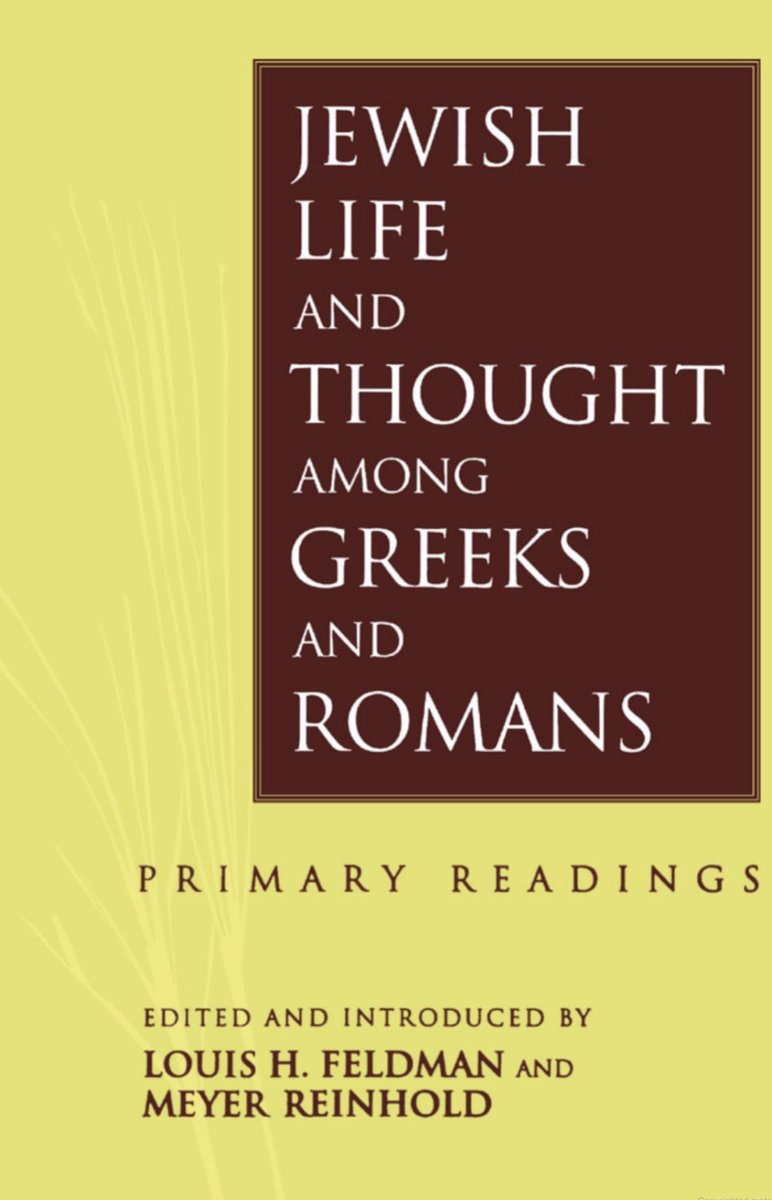
Pompeius Trogus (c. late 1st century BCE – early 1st century CE), in a passage preserved by Justin, wrote that the Jews originated from Damascus, “the most illustrious city of Syria, whence also came the line of Assyrian kings through queen Semiramis,” showing his association of Assyrians with “Syria”.
📌\
— Louis H. Feldman, Jewish Life and Thought Among Greeks and Romans: Primary Readings, Fortress Press, Minneapolis, 1996, p. 105.


In Munda’s quagmire, Quintus Pompeius proved himself a true heir to his sire’s renown! His stratagem nigh toppled Caesar, who, in desperate plight, did charge to the battle’s fore, standard clutched in hand, bellowing to stay his soldiers’ flight. So fierce was the fray that, as Appian doth recount, Caesar confessed he fought not merely for triumph, but for his very life. Though vanquished, Quintus etched his name eternal, daring Rome’s mightiest general to the final breath. A veritable titan of Rome’s civil strife! #Rome
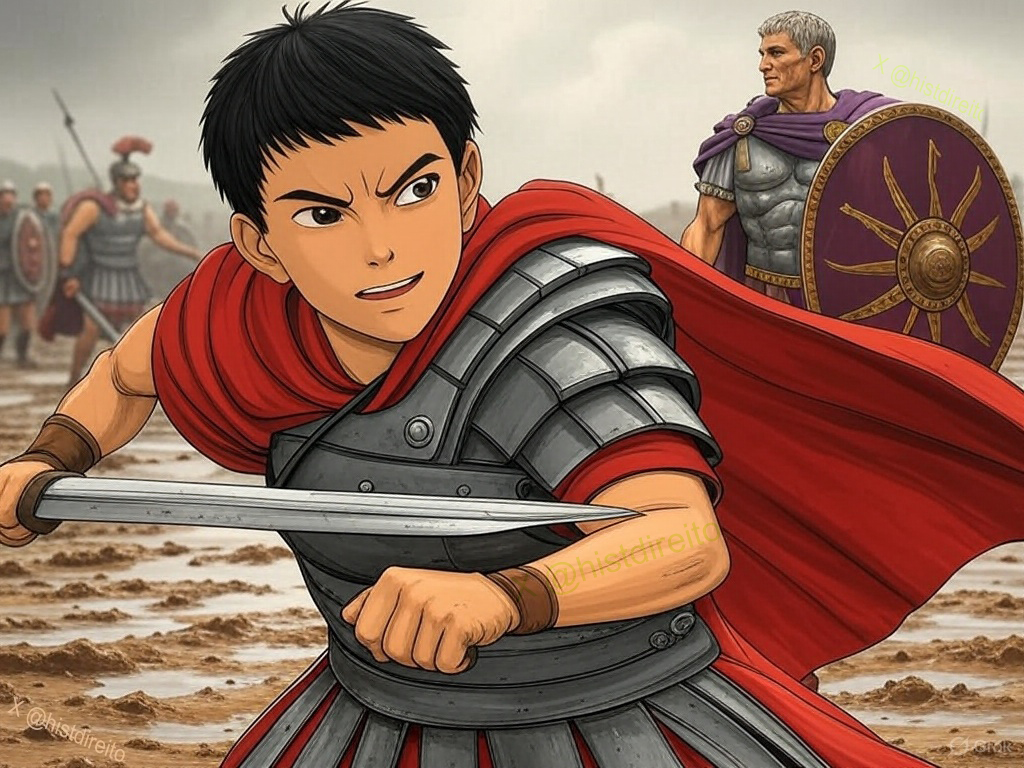
The radiant splendor of Quintus Pompeius at Munda’s clash cannot be dimmed by scorn! Whilst the mire did swallow the hopes of Caesar’s men, he, with cunning heart, did marshal his ranks steadfast 'gainst great Caesar’s onset. The aged dictator, tasting defeat’s bitter dregs, was forced to dismount and seize the standards of his craven host, crying aloud to stir their faltering spirits. O, what a moment of dire suspense, wherein Quintus’ tactical brilliance near turned the fates of Rome! The Legio X Equestris scarce withstood the tempest’s press! #QuintusPompeius #RomanHistory

O, the wondrous genius of Quintus Pompeius at the fray of Munda (45 B.C.) doth steal the very breath! Amidst the mire and tumult, the youthful Pompeian captain did stand 'gainst the storied Julius Caesar with a stratagem most bold. Upon a lofty rise he set his host, compelling Caesar to contend on ground unmeet, o'er a brook’s crossing and upward 'neath duress. The fierce mettle of his legions, led by Titus Labienus, made tremble the Caesarian ranks. 'Tis said that Caesar, beholding his men falter, did cry out in despair, fearing for his life as ne’er afore. A moment monumental in Rome’s grand tale! #Munda


1/10 The Third Mithridatic War (73–63 BC) pitted Rome against the indomitable Mithridates VI of Pontus. Enter Gnaeus Pompeius Magnus—Rome’s rising star—who turned this brutal showdown into a masterclass of war. Let’s unravel the drama and strategy.


Their confrontation is about their ambitions to form an empire, and it will eventually play out in the same way as the bitter confrontation between Julius Caesar and Gnaeus Pompeius Magnus for supremacy in Roman times.
(elon vs Sam Altman)

< OPEN AI CEO '샘 알트먼', '머스크'에게 한방 크게 먹이다? 🤔>
700조원 규모의 스타게이트 프로젝트에대해
일론머스크는 이렇게 말하였습니다.
"그들은 실제로 돈이 없습니다."
"소프트뱅크는 15조원도 지원하기 어려운 상황이에요.,
매우 신뢰할만한 출처의 이야기입니다."
일론머스크가 해당 프로젝트에 대해,
우려할만한 일은 아니다 라는 입장을 보임과 동시에,
해당 프로젝트를 견제하는 모습을 보여줬습니다.
그 이후로 재밌는 일이 벌어졌는데요.
샘 알트먼이 일론에게 트윗으로 답변한겁니다.
"당신이 틀렸어, 분명히 알고 있겠지만,
이미 진행 중인 첫 번째 지역을 방문해 보고 얘기하는건 어때?"
이 프로젝트는 국가에 좋은거야. 국가에 좋은 것이 항상 당신의 회사에 최고인것은 아니지만, 당신의 새로운 역할에서 주로 미국을 먼저 생각해주길 바래 ^^."
한마디로 샘알트먼은,
"테슬라 니들에겐 좋지 못할 순 있지만,
미국에겐 좋은 일이야. 미국을 먼저 생각하렴 ^^"
이렇게 답변한거죠.
일론에게 제대로 한방 먹여버렸네요.
답답합니다. 일론의 말처럼 자금 흐름이 충분치 못해서,
그냥 흐지부지 유야무야 흘러가고,
차기 주도권은 테슬라 곁에 존재하길 바라봅니다.🙏


@Fortune_Tells Yes as Pompeius was too, I believed.

@heitor__sb É o jeito que ela descansa. Às vezes ela abre as asas totalmente. É uma borboleta jatinho, deve ser Pompeius.

Trends for you
Most Popular Users

Elon Musk 
@elonmusk
239.8M followers

Barack Obama
@barackobama
118.6M followers

Cristiano Ronaldo
@cristiano
114.3M followers

Donald J. Trump
@realdonaldtrump
111.7M followers

Narendra Modi
@narendramodi
106.9M followers

Rihanna
@rihanna
98.6M followers

NASA
@nasa
92.1M followers

Justin Bieber
@justinbieber
91.7M followers

KATY PERRY
@katyperry
89.9M followers

Taylor Swift
@taylorswift13
83.9M followers

Lady Gaga
@ladygaga
75.4M followers

Virat Kohli
@imvkohli
73.3M followers

Kim Kardashian
@kimkardashian
70.8M followers

YouTube
@youtube
68.6M followers

Neymar Jr
@neymarjr
66.3M followers

Bill Gates
@billgates
65.1M followers

Selena Gomez
@selenagomez
63M followers

The Ellen Show
@theellenshow
62.1M followers

CNN
@cnn
61.7M followers

X
@x
60.6M followers