

Top Tweets for #ProteinRepresentation

Topotein: Topological Deep Learning for Protein Representation Learning
1. Topotein introduces a novel framework for protein representation learning, leveraging topological deep learning to capture the hierarchical organization of proteins from residues to secondary structures and beyond. This approach addresses a critical gap in current methods that often fail to fully represent the multi-scale structural patterns inherent in proteins.
2. The framework features the Protein Combinatorial Complex (PCC), a hierarchical data structure that represents proteins at multiple levels while preserving geometric information. This is complemented by the Topology-Complete Perceptron Network (TCPNet), which employs SE(3)-equivariant message passing across these hierarchical structures for more effective learning.
3. TCPNet consistently outperforms state-of-the-art geometric graph neural networks in extensive experiments across four protein analysis tasks. It demonstrates particular strength in tasks like fold classification, which require understanding secondary structure arrangements, highlighting the importance of hierarchical topological features.
4. The study provides comprehensive experimental validation, showing that TCPNet maintains robust performance even in structure-only scenarios, where other models often degrade significantly. This robustness is attributed to its ability to capture structural context through multi-rank message passing.
5. The authors also compare their approach against adapted versions of existing methods, demonstrating that effective topological deep learning requires careful architectural design. This work not only advances protein representation learning but also establishes a new paradigm for modeling hierarchical biological structures.
📜Paper: arxiv.org/abs/2509.03885v1
💻Code: github.com/ZW471/TopoteinWor…
#TopologicalDeepLearning #ProteinRepresentation #MachineLearning #Bioinformatics #ComputationalBiology

Zero-Shot Learning with Subsequence Reordering Pretraining for Compound-Protein Interaction
1. This paper introduces a novel approach for predicting compound-protein interactions (CPI) in zero-shot scenarios, where traditional methods often fail due to the lack of labeled data. The proposed method, PSRP-CPI, uses subsequence reordering to capture dependencies between protein subsequences, significantly enhancing the model's ability to generalize to unseen compounds and proteins.
2. The core innovation lies in the pretraining phase, where protein sequences are segmented into variable-length subsequences and shuffled. The model learns to reconstruct the original sequence order, thereby capturing the complex interdependencies between non-adjacent subsequences, which are crucial for predicting binding sites.
3. The authors employ a length-variable protein augmentation strategy to improve performance on small datasets. This method dynamically segments proteins into different lengths, generating diverse training samples and enhancing the model's robustness and zero-shot learning ability.
4. PSRP-CPI outperforms existing pretraining methods, especially in data-scarce scenarios. Experiments on four benchmark datasets show significant improvements in AUROC and AUPRC metrics, particularly in the challenging Unseen-Both scenario, where both compounds and proteins are not observed during training.
5. The method's effectiveness is further validated through comparisons with other pretraining models like ESM-2 and ProtBert. PSRP-CPI demonstrates superior performance on large-scale CPI datasets, despite using much smaller training datasets. This highlights its potential for practical applications in drug discovery.
6. The paper also includes comprehensive ablation studies and parameter analyses, providing insights into the optimal number of subsequences and network layers. These findings offer valuable guidance for future research in protein representation learning.
📜Paper: arxiv.org/abs/2507.20925
#ZeroShotLearning #CompoundProteinInteraction #ProteinRepresentation #SelfSupervisedLearning #DrugDiscovery

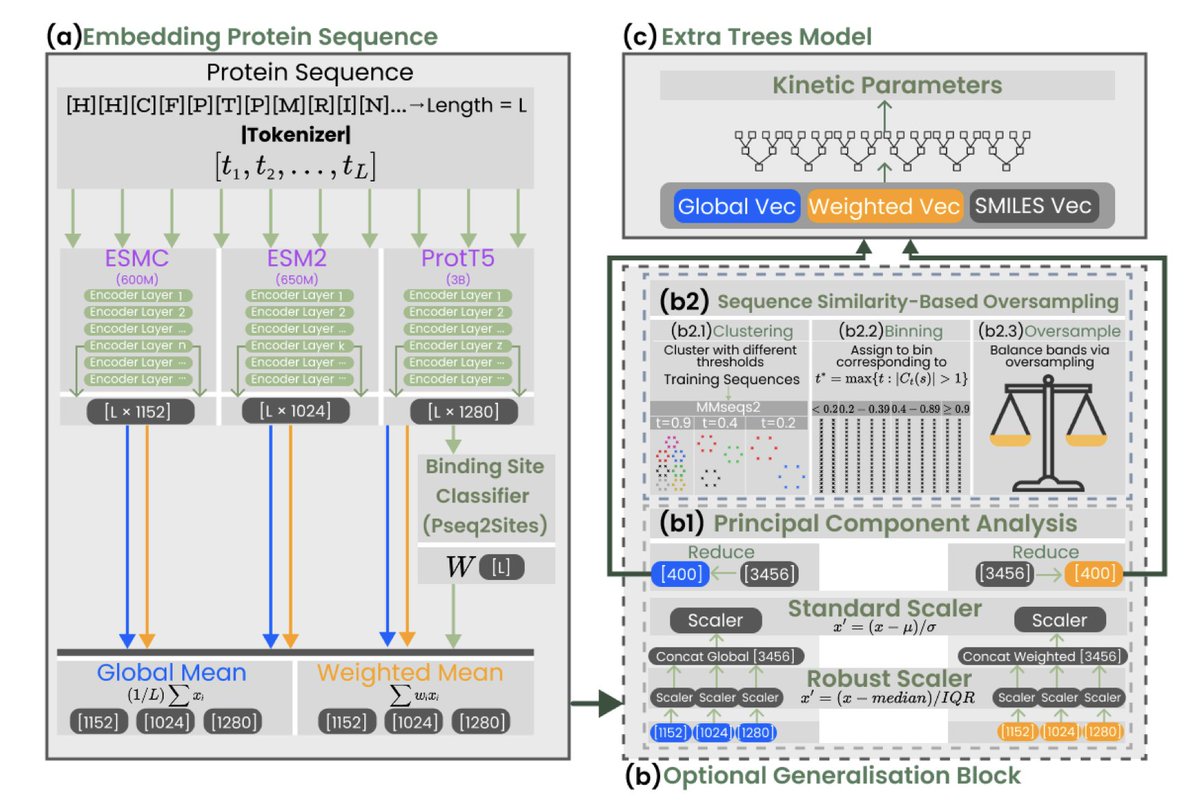
KinForm: Kinetics-Informed Feature Optimised Representation Models for Enzyme kcat and KM Prediction
1. KinForm is a novel machine learning framework designed to improve the prediction of enzyme kinetic parameters kcat and KM. It optimises protein feature representations by combining residue-level embeddings from multiple protein language models and applying advanced techniques like weighted pooling, PCA, and oversampling.
2. The framework addresses key limitations of previous methods. It uses binding-site probability pooling to focus on catalytically relevant residues, selects task-specific intermediate layers from multiple models instead of relying on the last layer, and reduces dimensionality to prevent overfitting.
3. KinForm outperforms baseline models on benchmark datasets, especially in low sequence similarity bins. This highlights its ability to generalise better to unseen sequences. The use of sequence-exclusive cross-validation (SE-CV) provides a more realistic evaluation of model performance compared to traditional random splitting.
4. The study demonstrates that incorporating predicted binding-site information and selecting optimal intermediate layers from pre-trained models significantly enhance predictive accuracy. PCA-based dimensionality reduction and similarity-based oversampling further improve generalisation to low-similarity proteins.
5. KinForm achieves strong performance without requiring complex training pipelines or specialised hardware. It uses an ensemble-based regression method (Extra Trees) and can be trained efficiently on CPUs. This makes it accessible and practical for widespread use in enzyme kinetics prediction tasks.
6. The authors highlight the importance of evaluation protocols in assessing model generalisation. SE-CV is shown to be a more rigorous and realistic method for benchmarking kinetic prediction models, as it prevents sequence overlap between training and test sets.
7. Future work includes exploring synthetic data generation to expand coverage in low-similarity subsets and incorporating richer reaction context, such as temperature and pH, into the models. These improvements could further enhance the predictive capabilities of KinForm.
💻Code: github.com/Digital-Metabolic…
📜Paper: arxiv.org/abs/2507.14639v1
#KinForm #EnzymeKinetics #MachineLearning #ProteinRepresentation #Bioinformatics #ComputationalBiology
GLProtein: Global-and-Local Structure Aware Protein Representation Learning
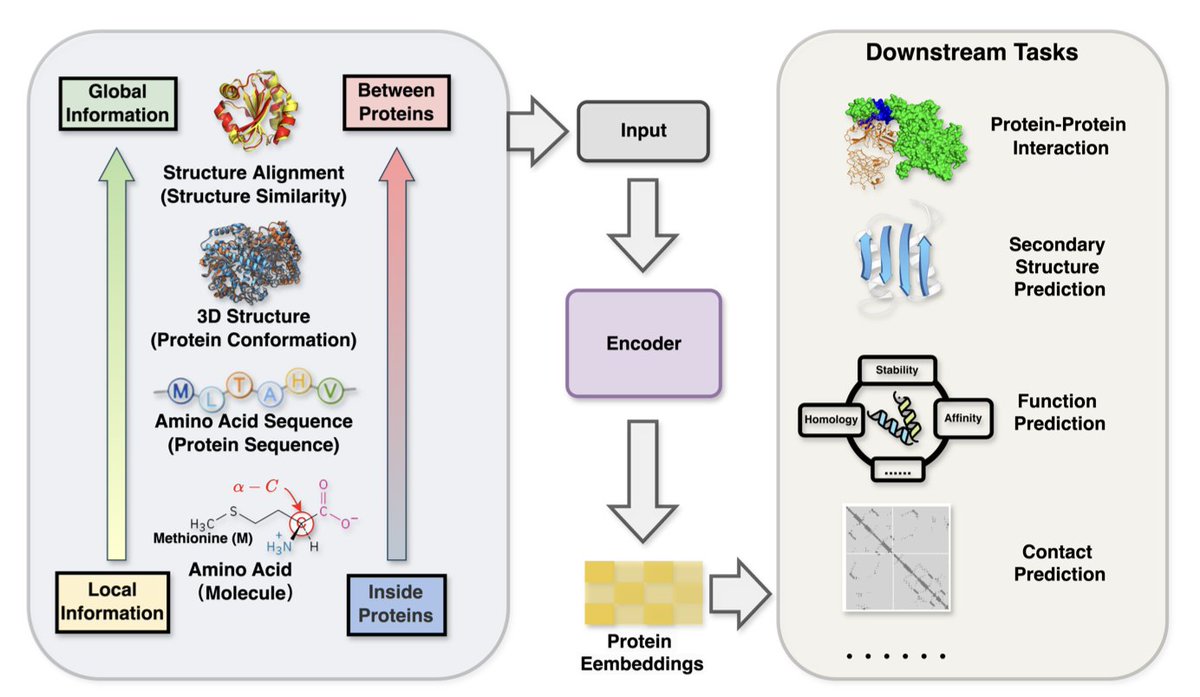
1.GLProtein introduces a novel protein pre-training framework that integrates both global structural similarity and local amino acid molecular details, which enhances protein representation learning beyond sequence-based methods.
2.The framework uniquely combines masked protein language modeling with triplet contrastive learning on protein structural similarity, 3D distance encoding, and substructure-based molecular encoding for a comprehensive structural understanding.
3.Global structure learning leverages TM-score-based triplet sampling to bring structurally similar proteins closer in embedding space while pushing dissimilar ones apart, effectively capturing protein fold similarities.
4.Local structure modeling incorporates protein 3D spatial distance encodings and amino acid substructure embeddings to better represent fine-grained chemical and structural information at the residue level.
5.Extensive experiments show GLProtein outperforms state-of-the-art models on several downstream tasks including amino acid contact prediction, secondary structure prediction, protein-protein interaction (PPI) prediction, and homology detection.
6.On contact prediction, GLProtein achieves superior accuracy in short-, medium-, and long-range contact prediction, demonstrating improved long-range spatial relationship understanding compared to baselines like SaProt and ESM-2.
7.For protein-protein interaction tasks, GLProtein consistently outperforms diverse baselines across multiple datasets and evaluation metrics, showcasing its capability to predict complex biological interactions.
8.The model is efficient, trained over 300k steps on four NVIDIA A6000 GPUs within 3 days, with comparable inference time to other top models, despite incorporating richer structural information.
9.Ablation studies confirm the critical contributions of global triplet contrastive learning, 3D distance encoding, and substructure molecular encoding to the model’s overall performance improvements.
10.Visualization of learned protein embeddings shows that GLProtein distinctly separates alpha and beta protein classes better than ESM-2, KeAP, and ProtBert, indicating more meaningful structural feature learning.
11.Future directions include extending GLProtein to incorporate multi-modal data and improve interpretability, aiming to broaden its application to diverse biological problems.
💻Code: github.com/YunqingLiu/GLProt…
📜Paper: arxiv.org/abs/2506.06294v1
#ProteinRepresentationLearning #ProteinStructure #Bioinformatics #DeepLearning #ComputationalBiology #ProteinLanguageModels #GLProtein
A Benchmarking Platform for Assessing Protein Language Models on Function-related Prediction Tasks
1. The study introduces the Protein Representation Benchmark (PROBE), a comprehensive framework for evaluating protein language models (PLMs) on four key function-related prediction tasks: semantic similarity inference, ontology-based protein function prediction, drug target family classification, and protein-protein binding affinity estimation.
2. PROBE is designed to assess how well protein representations, from classical methods to state-of-the-art PLMs, capture and predict functional characteristics of proteins, offering a comparative platform for both existing and newly developed models.
3. The framework includes a user-friendly interface and can process protein embeddings from diverse sources, making it accessible to a wide range of researchers working on protein function prediction, drug discovery, and protein interaction studies.
4. The study highlights the performance of various PLMs, including ESM2, ESM3, ProstT5, and SaProt, showing how multimodal models that incorporate both sequence and structural data outperform traditional methods in several tasks, particularly in semantic similarity and function prediction.
5. In the ontology-based protein function prediction task, the multimodal models (ESM3, ProstT5) performed particularly well, achieving high accuracy in predicting Gene Ontology (GO) terms across molecular function, biological process, and cellular component categories.
6. For drug target classification, ProtT5-XL led the benchmark in predicting the correct family of drug target proteins, highlighting the model's ability to capture evolutionary and functional patterns critical for therapeutic targeting.
7. In protein-protein binding affinity prediction, ProtALBERT showed superior performance, outclassing traditional models and indicating that transformer-based models with attention mechanisms are particularly effective for capturing amino acid interactions.
8. The benchmarking results provide critical insights into the trade-offs between different protein representation methods and how they can be optimized for various functional prediction tasks, offering a valuable tool for PLM developers.
9. PROBE is not only a tool for evaluating current models but also serves as a resource for guiding future developments in protein function prediction, facilitating the integration of multimodal data into PLM training.
10. This work emphasizes the importance of rigorous, task-specific benchmarking in advancing protein representation models and enhancing the prediction of functional protein characteristics, which is vital for drug discovery and protein engineering.
💻Code: github.com/kansil/PROBE
📜Paper: biorxiv.org/content/10.1101/…
#proteinfunction #bioinformatics #proteinlanguage #deeplearning #PLMs #drugdiscovery #proteinrepresentation #AI4Science #machinelearning #multimodalmodels

Bidirectional Hierarchical Protein Multi-Modal Representation Learning
1/ This study introduces a novel framework called Bi-Hierarchical Fusion, combining protein sequence representations from large language models (pLMs) with 3D structural data from graph neural networks (GNNs). The goal is to enhance protein representation learning for tasks like binding affinity prediction, protein-protein interactions, and enzyme classification.
2/ The Bi-Hierarchical Fusion framework addresses limitations in prior fusion techniques by incorporating bidirectional and hierarchical interactions between pLMs and GNNs. This allows for richer, more integrated protein representations, capturing both sequence-based and structural insights.
3/ The model uses two fusion methods: local Bi-Hierarchical Fusion with gating and global Bi-Hierarchical Fusion with multi-head attention. The local fusion focuses on integrating information at the amino acid level, while the global fusion extends this integration across the entire protein structure using multi-head attention.
4/ Extensive evaluations across various protein-related tasks—such as enzyme classification, protein-ligand binding affinity, and protein-protein binding site prediction—demonstrate that the Bi-Hierarchical Fusion approach consistently outperforms existing methods, including serial fusion and other state-of-the-art models.
5/ A standout feature of the Bi-Hierarchical Fusion method is its ability to dynamically adjust the integration of sequence and structural features, resulting in more accurate and reliable predictions. This is achieved through gating mechanisms and multi-head attention, which improve both local and global information exchange.
6/ The framework shows significant improvements in tasks requiring both structural and sequential knowledge, such as model quality assessment (MQA) and B-cell epitope prediction. It outperforms baseline models like ProNet and serial fusion, setting a new standard in protein representation learning.
7/ The paper also discusses the versatility of Bi-Hierarchical Fusion for future protein-related tasks, suggesting that the approach can be extended to a variety of other tasks in structural biology, drug discovery, and disease mechanism exploration.
💻Code: github.com/DeepBioLab/Bi-Hie…
📜Paper: arxiv.org/abs/2504.04770v1
#ProteinRepresentation #DeepLearning #Bioinformatics #ComputationalBiology #GraphNeuralNetworks #ProteinSequence #StructuralBiology #DrugDiscovery #ProteinInteractions #AIinBiology #MachineLearning

Advances in Protein Representation Learning: Methods, Applications, and Future Directions
1. This paper provides a comprehensive review of Protein Representation Learning (PRL), categorizing methodologies into five key areas: feature-based, sequence-based, structure-based, multimodal, and complex-based approaches. The review aims to provide researchers with a structured framework for understanding how these methods align with specific data types and research needs.
2. The paper introduces popular databases for protein sequences, structures, and functions, such as UniProt, PDB, AlphaFold DB, and ESMAtlas. These resources are essential for developing and evaluating PRL models.
3. The authors discuss key applications of PRL, including protein property prediction, structure prediction, protein design and optimization, and drug discovery. Benchmarks such as CASP and CAMEO are highlighted for evaluating protein structure prediction, while datasets like PDBbind and DUD-E are mentioned for drug discovery.
4. The review highlights recent advancements in PRL, including the integration of geometric deep learning techniques, multimodal representations combining sequence, structure, and function, and the use of pre-trained Protein Language Models (PLMs).
5. Challenges and future directions in PRL are discussed, including the need for improved generalization, model scalability, explainability, and extending PRL to other biological sequences such as DNA and RNA.
6. The authors emphasize the importance of developing scalable models, improving zero-shot and few-shot learning techniques for handling novel proteins and mutations, and enhancing model interpretability through Explainable AI techniques.
📜Paper: arxiv.org/abs/2503.16659
#ProteinRepresentationLearning #PRL #DeepLearning #MachineLearning #ProteinStructure #Bioinformatics #DrugDiscovery #ProteinDesign #AI

An Energy-Adaptive Elastic Equivariant Transformer Framework for Protein Structure Representation
1. This paper introduces E3former, a hybrid architecture combining an Energy-aware radius graph and an Elastic selective State Space Model (SSM) to improve protein structure representation. The model is designed to handle noise and data biases in both experimental and AlphaFold-predicted protein structures.
2. E3former constructs proximity graphs using energy function-based receptive fields, allowing it to adaptively adjust the receptive field of protein graphs based on molecular interactions. This mechanism enhances robustness to noisy protein structure data.
3. The architecture integrates an Equivariant Elastic-SSM block, which extracts and compresses high-order tensors sensitive to rotations, ensuring high signal-to-noise ratios in representation learning.
4. The model achieves state-of-the-art performance in structure-intensive tasks, such as inverse folding and binding site prediction, outperforming previous methods by 11.2% on inverse folding tasks and showing remarkable robustness on AlphaFold-predicted datasets.
5. E3former demonstrates strong generalization ability, particularly when handling noisy structural data. It effectively integrates geometric features with the flexibility of equivariant neural networks, making it highly suitable for tasks involving structural predictions and protein function annotation.
6. Benchmarking results indicate superior performance in both experimental and AlphaFold-predicted datasets, highlighting the potential of E3former for real-world applications in protein design, function annotation, and drug discovery.
7. Future work will focus on extending E3former to other structure-intensive tasks and enhancing its robustness to even higher levels of noise and data deviation.
📜Paper: arxiv.org/abs/2503.16996
#E3former #ProteinStructure #Transformer #EquivariantLearning #DeepLearning #Bioinformatics #ProteinRepresentation #MachineLearning #AlphaFold

Exploring the Alignment Landscape: LLMs and Geometric Deep Models in Protein Representation
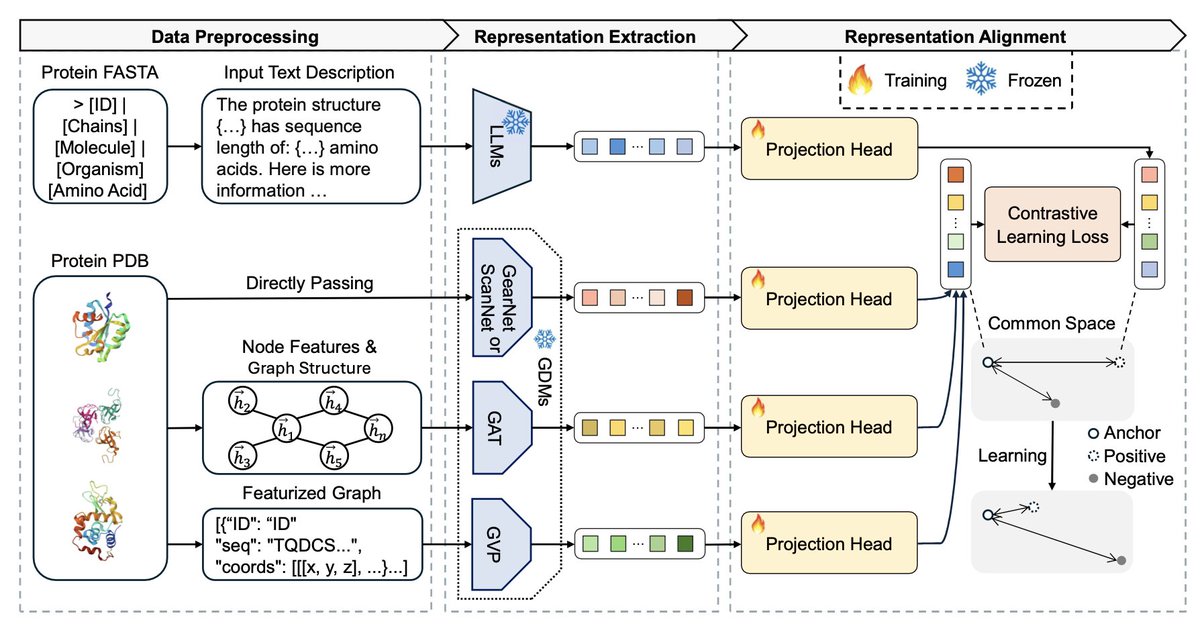
1. This study evaluates the alignment of representations between large language models (LLMs) and protein-specific geometric deep models (GDMs) in protein science, aiming to bridge text and structural data.
2. Key finding: GDMs that incorporate both graph and 3D structure data align significantly better with LLMs, especially as the embedding dimensions of LLMs increase, which enhances cross-modal understanding.
3. Alignment improves for models such as ScanNet and GearNet, which integrate detailed geometric features, unlike GDMs like GAT, which struggle with alignment.
4. Larger LLMs (like LLaMa3.1-70B) demonstrate better performance in aligning with GDMs due to their richer embedding capabilities.
5. Challenges: Protein rarity affects alignment accuracy, with rare proteins performing worse, while popular, frequently studied proteins align more effectively across modalities.
6. Strategies for improvement include increasing GDM embedding dimensions, using two-layer projection heads, and fine-tuning LLMs on protein-specific datasets to enhance alignment.
💻Code: github.com/Tizzzzy/LLM-GDM-a…
📜Paper: arxiv.org/abs/2411.05316
#ProteinRepresentation #MultimodalLearning #ComputationalBiology #LLM #GDM
Last Seen Hashtags on Sotwe
bnwo #goon
Seen from Australia
Metro
คุณป้าที่รัก
Seen from Thailand
cumtribute gf
Seen from Germany
omegle virgin
Seen from Turkey
passenger
Seen from South Africa
nudes
Seen from United Kingdom
PlayStation5
Seen from United States
Teenage()************
Seen from United Kingdom
tana french
Seen from France
Most Popular Users

Elon Musk 
@elonmusk
240.2M followers

Barack Obama
@barackobama
118.6M followers

Cristiano Ronaldo
@cristiano
114.4M followers

Donald J. Trump
@realdonaldtrump
111.8M followers

Narendra Modi
@narendramodi
106.9M followers

Rihanna
@rihanna
98.6M followers

NASA
@nasa
92.2M followers

Justin Bieber
@justinbieber
91.7M followers

KATY PERRY
@katyperry
89.9M followers

Taylor Swift
@taylorswift13
83.9M followers

Lady Gaga
@ladygaga
75.4M followers

Virat Kohli
@imvkohli
73.3M followers

Kim Kardashian
@kimkardashian
70.8M followers

YouTube
@youtube
68.6M followers

Neymar Jr
@neymarjr
66.3M followers

Bill Gates
@billgates
65.2M followers

Selena Gomez
@selenagomez
63M followers

The Ellen Show
@theellenshow
62.1M followers

CNN
@cnn
61.7M followers

X
@x
60.6M followers