

Top Tweets for #MultimodalLearning

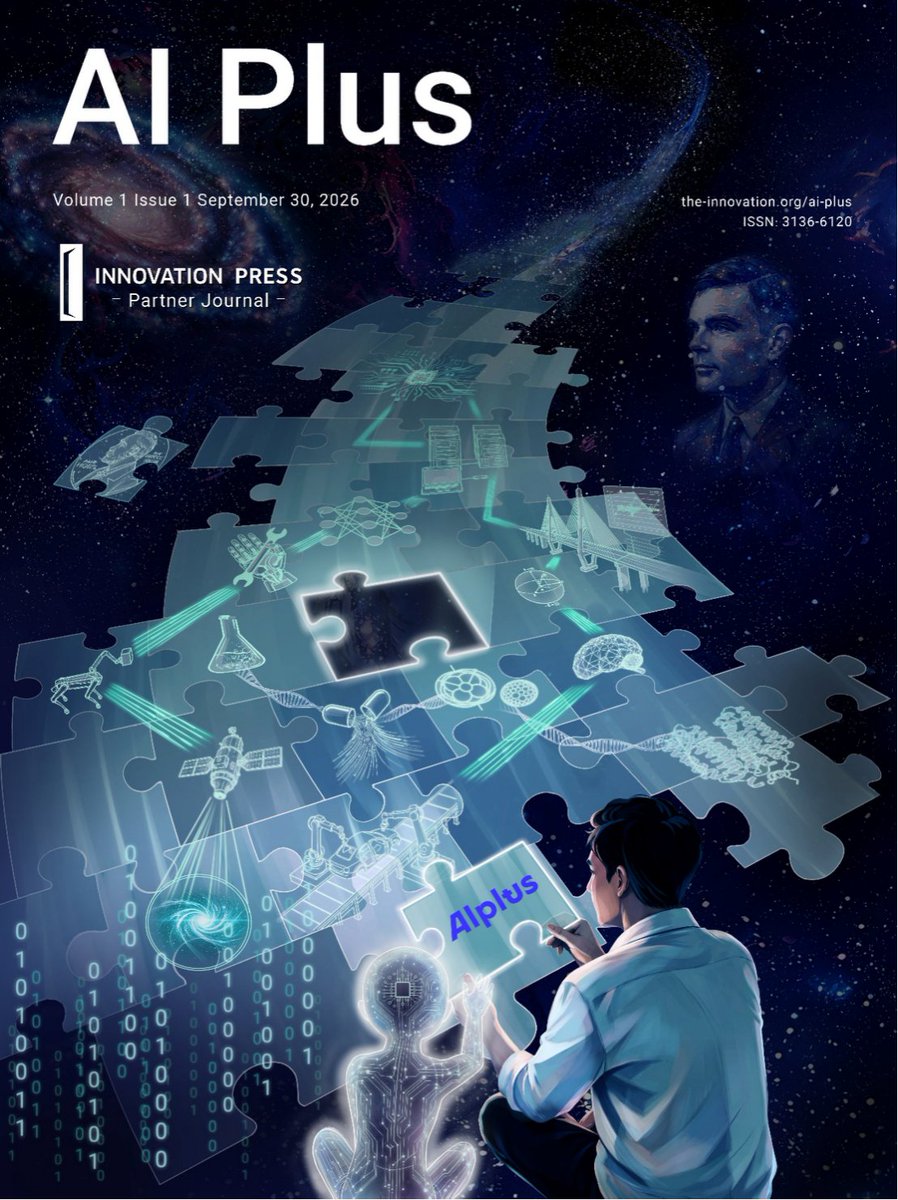
Check out the latest issue of AI Plus! Volume 1, Issue 1 is now available online!
the-innovation.org/ai-plus/a…
#ArtificialIntelligence #FoundationModels #symbolicregression #LargeLanguageModels #computingsystems #largereasoningmodels #MultimodalLearning #EmbodiedAI #AIAgents

Multimodal learning decodes the global binding landscape of chromatin-associated proteins
1. A new study introduces Chromnitron, a multimodal foundation model that accurately predicts the binding landscapes of chromatin-associated proteins (CAPs) across hundreds of proteins in unseen cell types. This is a significant step forward in understanding gene regulation and cell fate transitions.
2. Chromnitron integrates DNA sequence motifs, chromatin accessibility levels, and protein functional domains to predict CAP binding. The model was pre-trained on 1,105 CAP ChIP-seq datasets across five cell types and fine-tuned for each CAP, enabling it to generalize to new cell types and CAPs.
3. The study demonstrates Chromnitron’s ability to discover novel regulators of T cell exhaustion, identifying ZNF865 and ZNF766 as key players. This was validated through CRISPR knockout experiments, showing reduced exhaustion markers and restored effector function in T cells.
4. Chromnitron can predict dynamic CAP binding landscapes during development, revealing the orchestration of protein and regulatory element activities in neurogenesis. This provides unprecedented insights into the global dynamics of gene regulation during cell fate transitions.
5. The model’s multimodal design allows it to learn intricate relationships between CAP binding and local chromatin accessibility, outperforming existing tools like motif accessibility, maxATAC, and Enformer in predicting CAP binding profiles.
6. In silico perturbation experiments with Chromnitron reveal principles governing CAP binding, including the identification of impact motifs and the effect of chromatin accessibility changes. This highlights the model’s potential for discovering hidden regulatory interactions.
7. The study underscores the power of Chromnitron in accelerating discoveries in regulatory genomics, particularly in human primary cells. It sets the stage for future therapeutic opportunities by enabling high-throughput in silico screening and hypothesis generation.
📜Paper: biorxiv.org/content/10.1101/…
#Chromnitron #MultimodalLearning #GeneRegulation #CellFate #ComputationalBiology

Masked Omics Modeling for Multimodal Representation Learning Across Histopathology and Molecular Profiles
1. The new framework MORPHEUS integrates histopathology images and multi-omics data (transcriptomics, methylomics, genomics) into a shared latent space using a masked modeling objective. This is the first time such diverse biological data are unified in a single model for cancer analysis.
2. MORPHEUS uses a transformer-based architecture to handle the complexity of multimodal data. It tokenizes histopathology images using learnable prototypes and organizes omics data by biological pathways or genomic context. This innovative approach allows the model to capture both spatial and molecular features effectively.
3. The model is pre-trained on a large pan-cancer cohort and demonstrates superior performance in few-shot subtyping, survival prediction, and omics reconstruction tasks compared to state-of-the-art methods. This highlights its potential for developing robust multimodal foundation models in oncology.
4. MORPHEUS enables any-to-any omics generation, allowing the inference of missing omics profiles from available data. This capability is crucial for clinical settings where certain omics data may be unavailable, thus supporting more comprehensive patient profiling.
5. The framework is flexible and can be adapted to various input configurations, including histopathology alone or in combination with any subset of omics modalities. This adaptability makes it suitable for a wide range of downstream applications in cancer research and diagnostics.
6. MORPHEUS outperforms existing methods in reconstructing omics profiles from histopathology images alone or in combination with other omics data. The model shows strong complementarity between RNA and DNAm data, enhancing the accuracy of reconstructions when used together.
📜Paper: arxiv.org/abs/2508.00969v1
#ComputationalPathology #MultimodalLearning #CancerResearch #AIinMedicine

Multimodal deep learning for allergenic proteins prediction
1. A new study by Yu et al. introduces Multimodal-AlgPro, a novel deep learning framework that integrates multiple data types, including physicochemical properties, amino acid sequences, and evolutionary information, to predict allergens with unprecedented accuracy.
2. The study leverages a multimodal deep learning approach, combining convolutional neural networks (CNNs) for sequence data and multilayer perceptrons (MLPs) for molecular features, demonstrating superior performance over existing methods through extensive benchmarking.
3. A key innovation is the exhaustive search strategy for model combinations, which explores 2047 potential multimodal configurations to identify the most effective architecture, significantly enhancing the robustness and accuracy of allergen prediction.
4. The research highlights the importance of evolutionary information in allergen prediction, showing that evolutionary-based descriptors contribute more significantly to model performance than composition- or physicochemical-based descriptors.
5. Multimodal-AlgPro not only achieves state-of-the-art performance but also offers interpretability through SHAP and UMAP analyses, uncovering critical sequence motifs and evolutionary patterns that facilitate epitope discovery.
6. The study validates the model on independent datasets, including imbalanced real-world data, demonstrating its robustness and generalizability. This work has significant implications for public health and industrial applications by improving allergen identification and prevention strategies.
📜Paper: bmcbiol.biomedcentral.com/ar…
#AllergenPrediction #DeepLearning #MultimodalLearning #Bioinformatics

Adaptive Multimodal Protein Plug-and-Play with Diffusion-Based Priors
1. This research introduces Adam-PnP, a novel framework that integrates diffusion models with multiple experimental data sources to reconstruct protein structures with sub-Angstrom accuracy. The adaptive noise estimation and dynamic modality weighting mechanisms significantly enhance the robustness and accuracy of protein structure determination.
2. Adam-PnP addresses a critical challenge in computational biology: integrating noisy experimental data from various sources without requiring precise knowledge of noise levels or manual tuning of hyperparameters. This adaptive approach allows the model to learn noise levels on-the-fly and dynamically balance the influence of each data source based on its reliability.
3. The framework leverages diffusion models as powerful priors for protein structure generation. By incorporating an adaptive noise estimation scheme and dynamic modality weighting into the diffusion process, Adam-PnP reduces the need for manual hyperparameter tuning and improves reconstruction accuracy across diverse scenarios.
4. Experiments demonstrate that combining high-resolution data sources, such as partial atomic coordinates and distance restraints, significantly enhances reconstruction accuracy. The results show that Adam-PnP achieves state-of-the-art performance, with a backbone RMSD of 0.65 ± 0.18 ˚A for the combination of partial coordinates and distance restraints.
5. The study also highlights the robustness of Adam-PnP under data-limited conditions. The adaptive noise estimation mechanism allows the model to intelligently weigh information from different sources, correctly identifying and down-weighting low-quality data to improve final model accuracy.
6. This work represents a significant step towards a unified approach for protein structure determination that can flexibly incorporate diverse experimental evidence to solve complex biological inverse problems, particularly for systems where experimental evidence is scarce or of mixed quality.
💻Code: github.com/amartya21/Adam-Pn…
📜Paper: arxiv.org/abs/2507.21260v1
#ProteinStructure #DiffusionModels #ComputationalBiology #MultimodalLearning #InverseProblems


Thinking about that @JoinSapien TGE
Sapien isn’t just AI—it’s a symphony of multi-modal learning, custom agents & human-level context.
What if your data didn’t just train models, but shaped intelligence itself?
#Sapien #MultiModalLearning #CustomAgents #DataFoundry

A million-scale dataset and generalizable foundation model for nanomaterial-protein interactions
1. A novel study introduces NanoPro-3M, the largest dataset of nanomaterial-protein interactions, comprising over 3.2 million samples and 37,000 unique proteins. This dataset is pivotal for advancing AI-driven predictions in nanobiotechnology.
2. The study presents NanoProFormer, a novel foundation model that leverages multimodal representation learning to predict nanomaterial-protein affinities. It demonstrates superior generalization capabilities, even with missing data or unseen nanomaterials and proteins.
3. The research highlights the critical role of integrating protein sequences and structured experimental metadata. This multimodal approach significantly outperforms single-modality models, offering deeper insights into the determinants of protein corona formation.
4. NanoProFormer shows strong performance in zero-shot inference, achieving high accuracy on unseen proteins and nanomaterial categories. This capability is crucial for high-throughput screening and efficient nanomaterial design in diverse applications.
5. The study also explores task-specific fine-tuning across four domains, including antibody binding, cell receptor interactions, disease biomarkers, and in-depth proteomics. Fine-tuning with minimal data significantly improves model performance, showcasing its adaptability.
6. The authors advocate for reallocating experimental resources from static assays to investigating dynamic interaction processes. This shift could enhance the in vivo translation of nanomaterials and advance temporally-aware modeling.
7. The work lays a robust foundation for scalable in vitro applications, such as disease diagnostics and biosensor development. It reduces reliance on costly experiments and accelerates the translation of nanomaterials into real-world applications.
💻Code: github.com/YuHengjie/NanoPro…
📜Paper: arxiv.org/abs/2507.14245v1
#NanoPro3M #NanoProFormer #NanomaterialProteinInteractions #AIinBiology #MultimodalLearning #ZeroShotInference #FineTuning #Biosensors #DiseaseDiagnostics

Multimodal fusion with relational learning for molecular property prediction @CommsChem
1. A new framework, MMFRL (Multimodal Fusion with Relational Learning), has been introduced to significantly enhance molecular property prediction. This approach tackles the challenge of effectively leveraging diverse data sources, or modalities, for molecular analysis.
2. A key innovation of MMFRL is its ability to utilize auxiliary molecular data during pre-training to enrich embeddings, even when these additional modalities are absent during the final inference step. This ensures that valuable information can still contribute to prediction performance.
3. The researchers systematically explored different stages of multimodal fusion—early, intermediate, and late—providing a comprehensive understanding of their respective benefits and trade-offs. This detailed analysis helps in optimizing how various data types are integrated.
4. Empirical results show that MMFRL achieves superior accuracy and robustness compared to current state-of-the-art methods across various molecular property prediction tasks on MoleculeNet benchmarks. The intermediate fusion strategy, in particular, demonstrated strong performance across many tasks.
5. Beyond predictive performance, MMFRL also improves the explainability of learned molecular representations. This offers valuable insights into the underlying chemical properties and aids in practical applications like drug molecule design through post-hoc analysis.
6. Conceptually, MMFRL introduces a modified relational learning metric that provides a more continuous and comprehensive perspective on relationships between molecular instances, moving beyond rigid pairwise similarities. This allows for a deeper understanding of complex molecular interactions.
💻Code: github.com/zhengyjo/MMFRL
📜Paper: nature.com/articles/s42004-0…
#ComputationalBiology #DrugDiscovery #MachineLearning #MolecularPropertyPrediction #MultimodalLearning

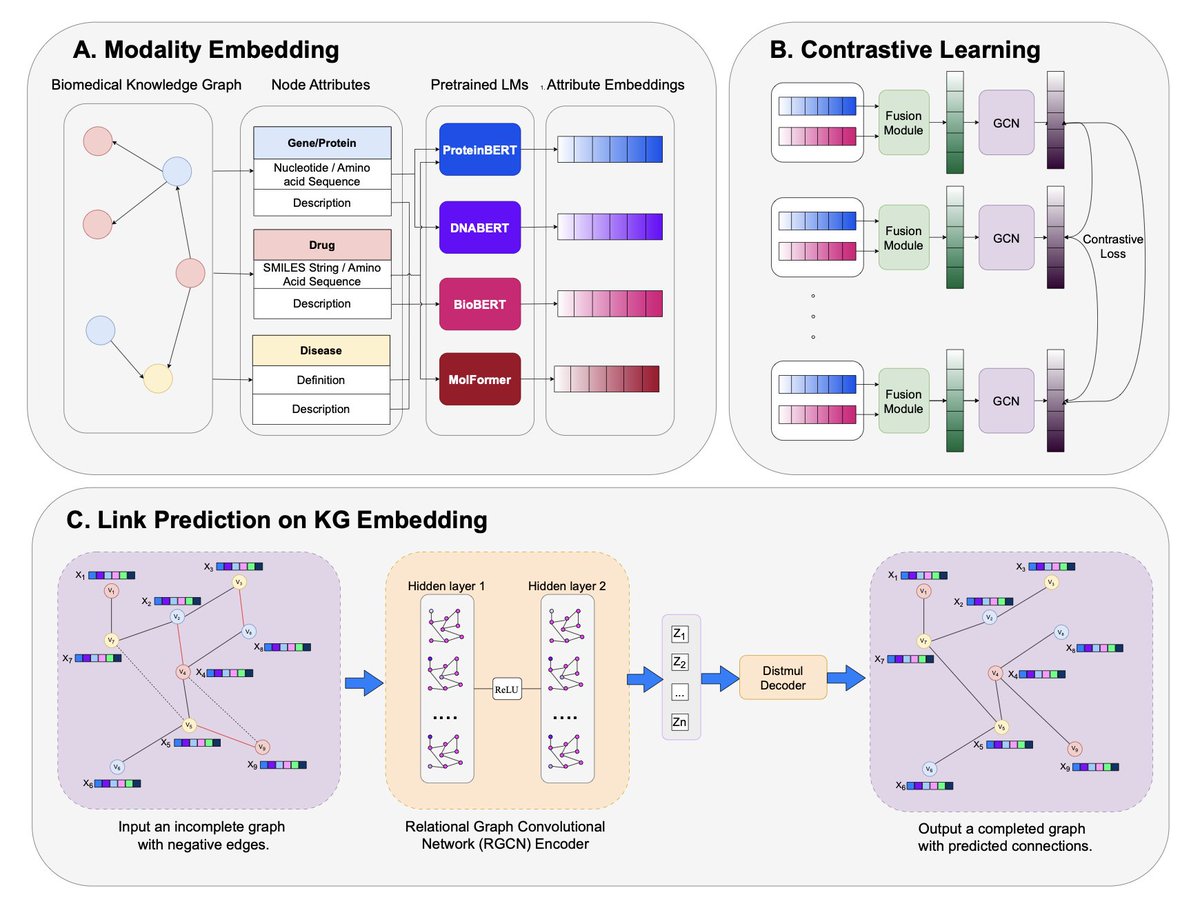
Multimodal Contrastive Representation Learning in Augmented Biomedical Knowledge Graphs
1.This work introduces a new framework for enhancing node embeddings in biomedical knowledge graphs (BKGs), combining pre-trained language models (LMs) with graph contrastive learning (GCL) for both semantic and structural representation.
2.The authors developed PrimeKG++, a significantly enriched BKG that integrates biological sequences (e.g., SMILES, amino acids, nucleotides) and detailed textual descriptions across all entity types including drugs, diseases, and genes/proteins.
3.Unlike most prior methods relying on single-modality inputs, this approach fuses multiple modalities per node through a carefully designed fusion module using techniques like Attention Fusion and ReDAF, leading to richer and more informative node representations.
4.The key technical innovation is a modular pipeline: (1) encode entity attributes using domain-specific LMs, (2) fuse the modality-specific embeddings into unified representations, (3) enhance intra-node relationships using GCL, and (4) apply knowledge graph embedding for inter-node learning and link prediction.
5.Experiments show strong and consistent link prediction performance on both PrimeKG++ and an independently augmented DrugBank drug-target interaction (DTI) dataset, especially in challenging settings with high negative sampling ratios.
6.GRACE + ReDAF consistently achieved the best performance, with AP as high as 0.996 and F1 scores up to 0.983, outperforming baselines including random initialization and direct LM-based embeddings, especially under sparse or unseen data conditions.
7.Latent space visualizations confirm that integrating LM embeddings with GCL leads to better clustering of biologically related entities, demonstrating that the learned representations are more semantically and relationally meaningful.
8.The framework generalizes well to unseen entities and novel datasets, supporting downstream applications such as drug-target and drug-disease link prediction, and potentially accelerating drug repurposing and therapeutic discovery.
9.Importantly, the authors clarify that the focus is not to beat SOTA metrics, but to demonstrate that pretrained multimodal embeddings can substantially enhance robustness, interpretability, and generalizability in biomedical KGs.
10.All data, models, and code are publicly released, offering a strong resource for the community and enabling researchers to build on this work for diverse biomedical tasks involving complex multimodal relationships.
💻Code: github.com/HySonLab/BioMedKG
📜Paper: arxiv.org/abs/2501.01644v2
#BiomedicalAI #KnowledgeGraphs #ContrastiveLearning #MultimodalLearning #DrugDiscovery #GraphNeuralNetworks #RepresentationLearning
TRIDENT: Tri-Modal Molecular Representation Learning with Taxonomic Annotations and Local Correspondence
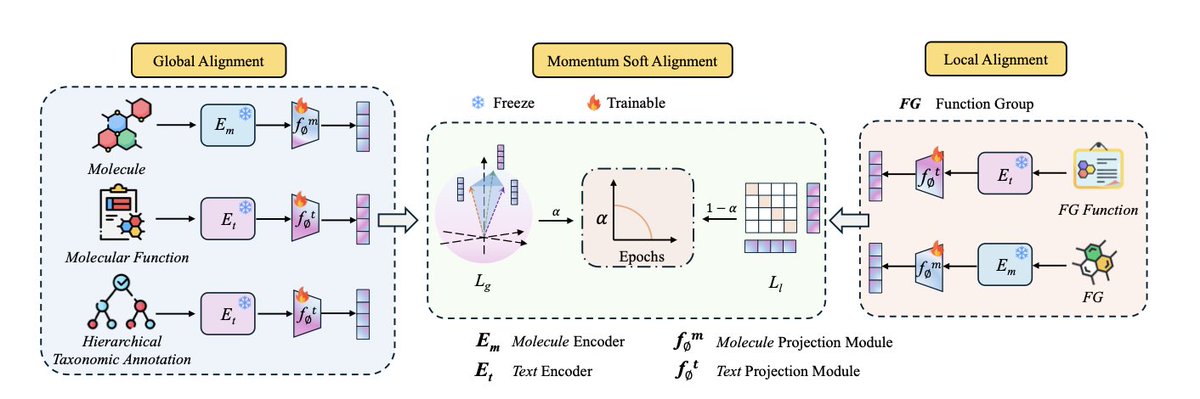
1.TRIDENT introduces a tri-modal molecular learning framework that jointly models chemical SMILES, natural language descriptions, and hierarchical taxonomic annotations (HTA) to build richer and more interpretable molecular embeddings.
2.Unlike most previous models that only use molecular graphs or simple text, TRIDENT integrates 32 taxonomic classification systems to encode nuanced, multi-level functional knowledge for each molecule, significantly improving semantic understanding.
3.TRIDENT replaces standard contrastive learning with a geometry-aware volume-based alignment loss. This enables soft, global alignment across three modalities, capturing higher-order interactions rather than just pairwise similarities.
4.Beyond global alignment, TRIDENT incorporates a novel local contrastive objective that aligns molecular substructures (like functional groups) with specific sub-spans in text. This fine-grained matching captures substructure-function relationships critical for many tasks.
5.To effectively integrate global and local alignment, TRIDENT introduces a dynamic momentum-based mechanism that adjusts their balance during training, ensuring stable convergence and optimal performance across modalities.
6.The authors curate a new dataset of 47,269 <SMILES, Text, HTA> triplets from PubChem, enriched using GPT-4o to synthesize high-quality taxonomic descriptions, providing a unique resource for structured semantic molecular learning.
7.TRIDENT achieves state-of-the-art performance on 11 downstream property prediction benchmarks, including MoleculeNet and TDC datasets. It consistently outperforms strong baselines like Atomas, MolFM, and MoleculeSTM.
8.Ablation studies show that each component—HTA, local alignment, and volume-based loss—substantially contributes to model accuracy. Removing any one leads to significant drops in ROC-AUC across tasks such as Tox21, ToxCast, and BBBP.
9.Even on data-scarce tasks like DILI and Skin Reaction, TRIDENT maintains high performance, showing strong generalization ability. This robustness is particularly important for real-world applications in drug discovery and toxicity prediction.
10.The model architecture is modular: encoders are frozen during training, and only projection layers are optimized. This design allows TRIDENT to remain lightweight while integrating strong prior knowledge from pretrained language models.
11.TRIDENT’s tri-modal, globally and locally aligned representation space opens the door to more interpretable and biologically grounded machine learning in chemistry, potentially enabling better molecular retrieval, classification, and generation.
12.This work highlights the importance of structured semantic reasoning in molecular modeling—pointing to a future where deep learning systems can understand molecules not just as flat structures, but as entities embedded in biological, ecological, and pharmacological contexts.
📜Paper: arxiv.org/abs/2506.21028v1
#AI4Science #DrugDiscovery #MultimodalLearning #MolecularRepresentation #MachineLearning #Bioinformatics #ContrastiveLearning
MolTextNet: A Two-Million Molecule-Text Dataset for Multimodal Molecular Learning
1.MolTextNet introduces a dataset of 2.5 million molecule-text pairs, designed to support large-scale multimodal learning between molecular graphs and natural language. Each entry provides detailed descriptions of structure, properties, and synthesis.
2.Unlike prior datasets like PubChem-300K and ChEBI-20 which are limited in size and informativeness, MolTextNet descriptions are on average over 10× longer, enabling richer representation learning and generalization across tasks.
3.The dataset is generated from ChEMBL35 using a synthetic text pipeline powered by GPT-4o-mini, converting molecular annotations—computed properties, structural features, bioactivities, and synthesis complexity—into coherent, academic-style descriptions.
4.MolTextNet achieves high coverage across structural diversity, physicochemical properties, and synthetic accessibility, with descriptions that explicitly link molecular structure to bioactivity and synthetic feasibility.
5.The dataset design includes rigorous quality control: invalid SMILES or short/inconsistent texts are filtered, and long molecules with extensive annotations are handled via chunked LLM processing to maintain full content fidelity.
6.A key innovation is prompting the LLMs to perform structure-property-synthesis reasoning, e.g., linking functional groups like hydroxyls and thioethers to solubility and glycosidase inhibition. These reasoning paths are baked into the dataset.
7.For evaluation, the authors pretrain CLIP-style GNN-BERT models on MolTextNet. Fine-tuning on 10 downstream property prediction tasks shows consistent improvements over models trained on existing datasets—1-2% AUC gains and up to 6% higher R² scores.
8.Zero-shot structure retrieval tests (e.g., "The molecule has three aromatic rings") show that models pretrained on MolTextNet consistently retrieve correct molecular graphs, while baselines fail. This highlights strong cross-modal alignment.
9.The dataset is accompanied by experiments that include topic modeling and keyword analysis, showing MolTextNet spans broader chemical language and functional diversity than prior benchmarks.
10.MolTextNet is designed as a foundational resource for multimodal molecular learning, enabling tasks like molecule captioning, property prediction, synthesis planning, and instruction-following molecule generation.
💻Code: huggingface.co/datasets/liug…
📜Paper: arxiv.org/abs/2506.00009v1
#MolecularAI #Chemoinformatics #MultimodalLearning #DrugDiscovery #LLM #GraphNeuralNetworks

Prot2Text-V2: Protein Function Prediction with Multimodal Contrastive Alignment
1.Prot2Text-V2 introduces a powerful framework that generates free-form natural language descriptions of protein function directly from amino acid sequences, moving beyond structured labels like GO terms.
2.Its architecture combines the ESM-3B protein encoder with LLaMA-3.1-8B-Instruct as the language decoder, connected via a lightweight two-layer nonlinear modality projector that avoids complex cross-attention.
3.The core innovation is H-SCALE (Hybrid Sequence-level Contrastive Alignment Learning), which aligns mean- and std-pooled protein embeddings with intermediate text representations using InfoNCE contrastive loss.
4.This contrastive alignment ensures protein and text representations reside in the same semantic space, enabling the decoder to generate biologically meaningful text from protein input.
5.After alignment, the model is instruction-tuned using LoRA to teach it how to generate accurate captions conditioned on protein features and optional metadata.
6.Prot2Text-V2 is trained on 250K curated SwissProt entries and evaluated under low-homology conditions, where it outperforms both traditional homology-based tools (e.g., BLAST) and LLM-based baselines.
7.The model shows especially strong performance on proteins with low sequence similarity to training data, confirming its superior generalization in the weak-homology regime.
8.In experiments, Prot2Text-V2 achieves state-of-the-art results across lexical (BLEU, ROUGE) and semantic (BioBERT, RoBERTa, GPT-4 judge) metrics, demonstrating both precision and contextual accuracy.
9.Compared to previous models like Prot2Text and ProtT3, Prot2Text-V2 is simpler to train and deploy, while achieving better alignment and generation quality, particularly under constrained homology conditions.
10.Extensive ablations confirm the value of H-SCALE contrastive pretraining, outperforming variants without it and other encoder-decoder configurations.
11.The authors emphasize that unlike general-purpose LLMs, Prot2Text-V2 is tailored to protein biology and trained on well-curated datasets, ensuring domain-relevant predictions.
12.For future work, the team plans to validate predictions experimentally and expand the framework to incorporate structural modalities and deeper reasoning capabilities.
💻Code: github.com/ColinFX/Prot2Text…
📜Paper: arxiv.org/abs/2505.11194v1
#ProteinFunction #MultimodalLearning #ContrastiveLearning #BioNLP #ComputationalBiology #LLM #Prot2TextV2

Beyond the Leaderboard: Leveraging Predictive Modeling for Protein-Ligand Insights and Discovery
1.This work introduces ProtLigand, the first general-purpose protein language model that integrates ligand chemistry directly into protein representations, capturing functional and structural nuances often missed by sequence- or structure-only models.
2.Unlike traditional docking approaches with separate encoders, ProtLigand incorporates ligand features via cross-attention during pretraining, using only sequence, AlphaFold2 structure, and SMILES without requiring complex 3D docking.
3.ProtLigand outperforms all tested baselines across six biological tasks—including thermostability, protein–protein interaction (PPI), metal ion binding, and enzyme classification—showing consistent and statistically significant gains.
4.The model achieves the highest PPI prediction accuracy (90%) and strongest correlation with experimental thermostability data (ρ = 0.731), highlighting the utility of ligand-aware representations in functional inference.
5.Importantly, ProtLigand demonstrates superior calibration, delivering more reliable confidence estimates in both classification and regression tasks, which is critical for downstream experimental decision-making.
6.A novel ligand generator module allows ProtLigand to operate without known ligands at inference time, producing plausible SMILES strings from protein embeddings and enabling de novo ligand suggestion for orphan proteins.
7.Case studies show ProtLigand correctly identifies or rejects interactions that prior models miss, including ligand-dependent interactions in heme oxygenase, MAP kinases, and autophagy enzymes, revealing its biochemical sensitivity.
8.In scenarios like Perilipin-2, where thermostability correlates with lipid-binding, ProtLigand's predictions generate experimentally testable hypotheses—e.g., ligand-induced stabilization of amphipathic regions.
9.Beyond boosting predictive performance, the model surfaces biologically interpretable signals—such as ligand-coordinated interactions or metabolically coupled proteins—supporting its role as a hypothesis generator for discovery.
10.ProtLigand’s ligand decoder reconstructs full SMILES representations from learned ligand embeddings, enabling exploration of chemical space for novel drug candidates without prior annotations.
11.This model is a step toward truly multimodal protein understanding, unifying sequence, structure, and chemical context, and enabling predictive modeling to transition from leaderboard metrics to biological insight and hypothesis formation.
💻Code: github.com/kalifadan/ProtLig…
📜Paper: biorxiv.org/content/10.1101/…
#ProteinLanguageModels #LigandBinding #MultimodalLearning #ComputationalBiology #AI4Science #DrugDiscovery #Bioinformatics #MolecularRepresentation #ProteinInteraction #Thermostability

A Survey of Molecular Representation Learning: From Single Modalities to Foundation Models
1.This survey provides a comprehensive overview of molecular representation learning (MRL), tracing its evolution from unimodal string, graph, and image-based encoders to the rise of multimodal and foundation models in chemistry.
2.A central contribution is the categorization of multimodal integration strategies into three types: alignment (contrastive learning), translation (modality-to-modality generation), and fusion (combining features across modalities at various levels).
3.The review emphasizes the limitations of single-modality approaches—such as loss of complementary information, poor generalization, and modality-specific constraints—that motivate the shift toward multimodal frameworks.
4.Multimodal models are shown to leverage complementary data sources like graphs, SMILES, 3D conformers, spectra, and text, enabling more robust and general-purpose chemical representations for diverse downstream tasks.
5.The paper outlines a unified MRL pipeline covering preprocessing, encoding strategies per modality, self-supervised training objectives, and downstream applications like property prediction and molecule generation.
6.It highlights recent encoder architectures: BERT-style transformers for SMILES, GNNs and SE(3) transformers for graphs and 3D structures, and vision transformers for molecular images and videos.
7.Contrastive learning emerges as a leading technique for multimodal alignment, enabling cross-modal representation without needing all modalities at inference time—useful when data is incomplete or noisy.
8.The authors define four criteria for “chemical foundation models”: large-scale diverse data, self-supervised training, high model capacity, and multimodal integration, aiming for robustness under distribution shifts.
9.Recent models like ChemBERTa-2, MolGPS, VideoMol, ChemDFM-X, and MolFM are reviewed as promising steps toward universal chemical foundation models, capable of generalizing across tasks and modalities.
10.The paper concludes with a call to develop large-scale, multimodal, and transferable chemical models that mirror the unification seen in NLP and vision, suggesting this will accelerate scientific discovery across domains.
📜Paper: doi.org/10.26434/chemrxiv-20…
#MolecularRepresentation #Cheminformatics #MultimodalLearning #FoundationModels #ComputationalChemistry #GraphNeuralNetworks #SMILES #SelfSupervisedLearning #DrugDiscovery #AI4Science

Multi-Modal Molecular Representation Learning via Structure Awareness
1.This work presents MMSA, a novel self-supervised framework for molecular representation learning that fuses 2D/3D graphs and molecular images, enhanced by structure-aware hypergraph modeling and memory mechanisms to capture invariant molecular features.
2.Unlike existing fusion-based methods that overlook inter-modal interactions and higher-order structure, MMSA introduces hypergraphs and memory banks to preserve both complex dependencies and stable molecular semantics across modalities.
3.The multi-modal representation learning module uses autoencoders to embed information from 2D graphs, 3D conformations, and 2D images into a shared latent space, ensuring alignment through contrastive and cross-reconstruction loss.
4.MMSA then models higher-order structural relationships via a hypergraph neural network, treating molecules as nodes and constructing hyperedges through k-nearest neighbor similarity in embedding space.
5.A memory bank stores invariant structural prototypes as anchors; embeddings are aligned to these anchors to enhance generalization, mitigate overfitting, and preserve critical molecular features across data splits and tasks.
6.The entire system is trained with a total loss combining contrastive, reconstruction, memory, and property-prediction objectives—jointly optimizing both the fusion of modalities and structure-aware learning.
7.On eight classification benchmarks from MoleculeNet, MMSA achieves state-of-the-art performance, with ROC-AUC gains of 1.8–10% over prior methods including Mole-BERT, GraphMVP, and MoleculeSDE.
8.In regression tasks, MMSA reduces RMSE across ESOL, Lipo, Malaria, and CEP datasets, highlighting its strength in encoding fine-grained molecular properties critical to drug design and material discovery.
9.MMSA also shows excellent cross-dataset generalization in molecular retrieval tasks, retrieving chemically similar molecules with high fingerprint alignment, even across datasets with distinct distributions.
10.An ablation study confirms that both the structure-awareness module and multi-modal loss terms (contrastive, reconstruction) contribute significantly to MMSA’s performance, especially when using all three modalities together.
11.MMSA is highly adaptable, improving the performance of various GNN backbones (GIN, GCN, GAT, GraphSAGE, Graphformer) and can be used as a plugin module to enhance existing graph-based pipelines.
12.Overall, MMSA establishes a new paradigm for multi-modal molecular representation learning by integrating complementary views and high-order relational priors, with wide applications in QSAR modeling, molecule retrieval, and pretraining.
💻Code: github.com/RUCAIBox/MMSA
📜Paper: arxiv.org/abs/2505.05877
#MolecularRepresentation #GraphNeuralNetworks #SelfSupervisedLearning #Hypergraph #DrugDiscovery #MultimodalLearning #MMSA #Bioinformatics #Cheminformatics #MoleculeNet

Interpretable Multimodal Learning for Tumor Protein-Metal Binding: Progress, Challenges, and Perspectives
1/ This paper explores the promise of interpretable multimodal machine learning in predicting tumor protein–metal binding, a key mechanism underlying metal-based anticancer therapies. By integrating diverse biological data, it aims to accelerate drug discovery while ensuring interpretability and biological relevance.
2/ The authors identify four key data modalities essential for modeling tumor protein–metal binding: sequence, structure, protein pocket, and biological text. Each offers distinct yet complementary insights into protein behavior, binding affinity, and biological function.
3/ They propose a structured workflow for acquiring, preprocessing, and extracting features from these modalities, enabling the training of ML models that can predict metal binding sites, classify metal types, and identify tumor metalloproteins.
4/ A major challenge highlighted is the scarcity of tumor-specific protein–metal binding datasets. To address this, the authors recommend integrating cancer datasets (e.g., TCGA) with general protein-metal binding resources (e.g., PDB, MetalPDB) to construct high-quality, tumor-relevant datasets.
5/ The study reviews existing ML models, including MCCNN, MetalPrognosis, and MetalTrans, noting that current models often lack interpretability and struggle with multimodal integration. It advocates for adapting general protein-metal models to tumor-specific settings.
6/ Interpretability is a key focus. The paper surveys both inherently interpretable models (e.g., decision trees, GAMs) and post-hoc explanation methods (e.g., SHAP, LIME, Integrated Gradients), urging their adoption to ensure model transparency and trustworthiness in biomedical applications.
7/ Future directions include integrating protein–protein interaction (PPI) networks to provide structural context for metal-binding predictions and modeling post-binding structural changes in tumor proteins to inform the design of metal-based therapeutics.
8/ This comprehensive work offers both a review and a roadmap for advancing the application of ML in cancer biology. By coupling multimodal learning with interpretability and biological grounding, it charts a path toward more effective and explainable computational tools in drug development.
📜Paper: arxiv.org/abs/2504.03847
#MachineLearning #CancerResearch #MultimodalLearning #ProteinMetalBinding #Bioinformatics #ComputationalBiology #DrugDiscovery #ExplainableAI #InterpretableML #StructuralBiology #MetalBasedDrugs

SCMPPI: Supervised Contrastive Multimodal Framework for Predicting Protein-Protein Interactions
1. SCMPPI introduces a novel supervised contrastive learning framework that fuses protein sequence and interaction network features to accurately predict protein-protein interactions (PPIs), achieving state-of-the-art performance across species.
2. The model integrates amino acid composition (AAC), dipeptide composition (DPC), and CKSAAP-ESMC embeddings with Node2Vec-based protein graph embeddings, capturing local, long-range, and network-contextual protein features.
3. A core innovation is the improved supervised contrastive loss function (Lp-Sup), which incorporates negative sample filtering based on cosine similarity, reducing false negatives and improving generalization.
4. SCMPPI achieved 98.01% accuracy and 99.62% AUC on the Yeast dataset, outperforming leading baselines like DF-PPI, TAGPPI, and KSGPPI across all major metrics including F1, sensitivity, and Matthews correlation coefficient.
5. In cross-species evaluation, SCMPPI demonstrated robust transferability, maintaining AUC > 90% on unseen Human and H. pylori datasets, surpassing other models in generalization.
6. Applied to PPI networks in CD9, Wnt signaling, and cancer-specific modules, SCMPPI accurately identified key interactors such as TP53, CDK1, AXIN1, and WNT9A—highlighting its utility for disease target discovery.
7. Ablation studies confirmed that combining sequence, graph, and contrastive learning modules yields optimal performance, with notable performance drops when any module is removed.
8. The model leverages UMAP visualization to show enhanced clustering of positive PPI pairs post-training, supporting the effectiveness of its latent co-embedding space.
9. Extensive benchmarking on eight datasets—Yeast, Human, H. pylori, PIPR-cut, and multi-species—demonstrated SCMPPI's consistent superiority in accuracy, AUC, and AUPRC across all settings.
10. SCMPPI sets a new direction in PPI prediction by bridging multimodal representation learning and contrastive supervision, offering a versatile and interpretable framework for biological network modeling.
📜Paper: arxiv.org/abs/2504.02698
#ProteinInteraction #ContrastiveLearning #MultimodalLearning #Bioinformatics #ComputationalBiology #SystemsBiology #GraphNeuralNetworks #ProteinEmbedding #DeepLearning #PPI #PrecisionMedicine

Multimodal machine learning with large language embedding model for polymer property prediction
1. PolyLLMem introduces a multimodal framework that combines Llama 3-based textual embeddings from polymer SMILES with Uni-Mol-based structural embeddings to predict 22 diverse polymer properties, delivering high accuracy with minimal data.
2. Despite being trained on a relatively small dataset (29,639 data points), PolyLLMem performs comparably or better than advanced transformer and graph-based models like PolymerBERT, TransPolymer, and PolyGNN, which typically require millions of polymer samples for pretraining.
3. A key innovation is the use of Low-Rank Adaptation (LoRA) layers, which fine-tune both textual and structural embeddings during prediction, enhancing chemical relevance without retraining large models from scratch.
4. The architecture employs a gated fusion mechanism that dynamically balances text and structure embeddings, followed by a refinement block and a regression head, enabling robust single-task prediction across a wide range of polymer properties.
5. PolyLLMem achieves superior R² scores in predicting glass transition temperature (Tg), bandgaps (Egc and Egb), density, and atomization energy, and remains competitive in challenging tasks like conductivity and mechanical properties.
6. Visualization with UMAP shows that Llama 3 embeddings capture chemically meaningful clusters from polymer SMILES, and cosine similarity heatmaps reveal that token-level embeddings distinguish structural motifs like aromatic rings and fluorinated groups.
7. Integrated Gradients attribution confirms that the model focuses on chemically relevant substructures during prediction—for example, identifying trifluoromethyl groups as key contributors to high Tg.
8. Comparative analysis shows that the combined LLM + Uni-Mol model outperforms models using either modality alone, and even classical ML pipelines using Morgan fingerprints or RDKit descriptors.
9. The model’s simplicity, lack of pretraining requirement, and adaptability make it a strong candidate for rapid, data-efficient polymer property screening, particularly in settings with limited experimental data.
10. While the model underperforms slightly on mechanical and gas permeability predictions, likely due to dataset limitations and single-task formulation, it offers a scalable and interpretable solution for polymer informatics.
💻Code: github.com/zhangtr10/PolyLLM…
📜Paper: arxiv.org/abs/2503.22962
#PolymerInformatics #LLMs #MultimodalLearning #MaterialsScience #DeepLearning #ChemInformatics #PolymerDesign #MachineLearning #Llama3 #UniMol #PolyLLMem

A Multimodal Model for Protein Function Prediction (MMPFP) @SciReports
1. MMPFP is a novel multimodal model for protein function prediction that integrates both protein sequence and structure information using Graph Convolutional Networks (GCN), Convolutional Neural Networks (CNN), and Transformer models. This approach addresses the limitations of single-modality models that often overlook structural properties critical for accurate predictions.
2. The model processes inputs through three main modules: the protein sequence encoding module, the multilayer GCN protein representation module, and the protein CNN module. By combining these modules, MMPFP constructs a comprehensive framework for learning complex protein functions.
3. MMPFP achieves state-of-the-art performance in predicting Molecular Function (MF), Biological Process (BP), and Cellular Component (CC) with AUPR scores of 0.721, 0.401, and 0.495, respectively. Fmax scores of 0.769, 0.632, and 0.695, and Smin scores of 0.320, 0.480, and 0.448 demonstrate significant improvements over baseline models.
4. Ablation studies confirm that the Transformer module within the GCN branch is essential for capturing complex relationships within protein graphs, providing a substantial performance boost over LSTM-based methods.
5. The combination of CNN, GCN, and Transformer modules allows the model to effectively integrate spatial structural features and sequence information, enhancing the overall prediction accuracy and robustness.
6. Comparative analysis against various baseline models, including TAWFN, DeepGO, DeepFRI, and others, shows that MMPFP consistently outperforms these methods by 3-5% in Fmax, AUPR, and Smin metrics.
7. The model’s multimodal architecture allows for a more comprehensive understanding of protein function, making it a promising tool for tasks like protein structure prediction, multitask learning, and integrating additional modalities such as protein-protein interaction networks.
8. Future work aims to expand MMPFP’s capabilities by incorporating new learnable features and advanced deep learning models to further improve prediction accuracy and broaden its applicability.
📜Paper: nature.com/articles/s41598-0…
#ProteinFunctionPrediction #MultimodalLearning #GCN #CNN #Transformer #DeepLearning #Bioinformatics #ProteinStructure

ProtCLIP: Function-Informed Protein Multi-Modal Learning
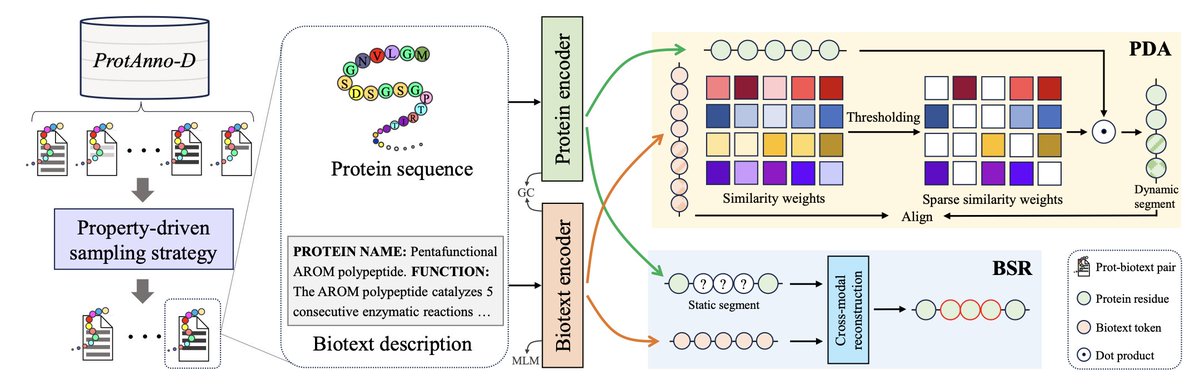
1. ProtCLIP is a novel multi-modality foundation model designed to align protein sequences with biological descriptions. It establishes a function-informed pre-training paradigm, achieving state-of-the-art performance across 22 diverse protein benchmarks.
2. The core innovation lies in the introduction of ProtAnno, a large-scale protein-text paired dataset with over 251.5 million entries. A property-driven sampling strategy balances data quality and quantity, addressing challenges from noisy annotations.
3. ProtCLIP emphasizes function-specific learning by modeling protein static and dynamic functional segments. Two segment-wise pre-training objectives—Biotext-guided Static Segment Reconstruction (BSR) and Property-grouped Dynamic Segment Alignment (PDA)—ensure fine-grained protein understanding.
4. The model showcases significant improvements, such as a 75% performance boost in cross-modal transformation benchmarks and 59.9% in GO-CC protein function prediction. It consistently surpasses prior methods in functionality classification, mutation effect prediction, and semantic similarity inference.
5. The framework combines pre-trained ESM-2 for protein encoding and PubMedBERT for text encoding, optimizing their integration through multi-modal objectives like contrastive loss and segment reconstruction.
6. ProtCLIP's results validate its potential as a universal protein representation model, capable of enhancing tasks like protein-protein interaction prediction and drug discovery through its robust, fine-grained embeddings.
7. This research not only addresses key gaps in protein-biotext pre-training but also sets a new benchmark for leveraging multi-modal learning in computational biology.
📜Paper: arxiv.org/abs/2412.20014
#ProteinDesign #AI #Bioinformatics #MultiModalLearning #ProtCLIP
Multi-Peptide: Multimodality Leveraged Language-Graph Learning of Peptide Properties
1. Multi-Peptide introduces a multimodal framework combining a transformer-based model, PeptideBERT, with a graph neural network (GNN) to predict peptide properties with enhanced accuracy, leveraging both sequence and structural features.
2. A key innovation of the model is its use of contrastive learning, aligning embeddings from PeptideBERT and the GNN into a shared latent space, inspired by CLIP. This alignment improves prediction accuracy by integrating complementary data modalities.
3. Multi-Peptide achieves state-of-the-art performance in hemolysis prediction with an accuracy of 88.057%, surpassing previous models like PeptideBERT and HAPPENN, demonstrating its robustness in sequence-based and structural integration.
4. The framework uses AlphaFold-generated structural data to inform the GNN, allowing the model to capture spatial and local sequence relationships that sequence-only models often miss.
5. The study highlights challenges in integrating multimodal data, such as balancing feature alignment and addressing noise in structural data, particularly in nonfouling property prediction tasks where the model showed reduced accuracy.
6. By fine-tuning PeptideBERT weights with multimodal contrastive learning, the framework enables zero-shot classification for unseen peptide sequences, advancing its application in therapeutic peptide design and biomaterial research.
7. Multi-Peptide provides open access to its datasets, trained weights, and framework, fostering reproducibility and encouraging further exploration in multimodal learning for bioinformatics.
💻Code: github.com/srivathsanb14/Mul…
📜Paper: pubs.acs.org/doi/10.1021/acs…
#PeptideDesign #MultimodalLearning #Bioinformatics

MMSite: A Multi-modal Framework for the Identification of Active Sites in Proteins
1. MMSite introduces a novel “First Align, Then Fuse” multi-modal strategy combining protein sequences and multi-attribute textual descriptions to identify active sites in proteins at the residue level.
2. The framework leverages a new dataset, ProTAD, containing over 570,000 protein-text pairs with 17 attribute fields. This rich semantic dataset enhances residue-level functional annotations.
3. MMSite employs a Multi-Attribute Cross-Attention (MACross) module to process textual descriptions and align them with sequence data, significantly boosting prediction accuracy.
4. Unlike traditional methods that rely solely on sequence or structure data, MMSite incorporates biomedical language models (BLMs) and protein language models (PLMs) for comprehensive multi-modal learning.
5. Benchmarks reveal that MMSite outperforms 21 state-of-the-art models, achieving superior metrics like Fmax, AUPRC, and MCC across multiple clustering thresholds.
6. The two-stage training strategy (“First Align, Then Fuse”) ensures robust alignment and fusion of modalities, yielding accurate predictions even for novel proteins without high-quality textual descriptions.
7. MMSite sets a new standard in protein research by enabling scalable, high-precision active site identification crucial for enzyme engineering, drug discovery, and understanding protein mechanisms.
💻Code: github.com/Gift-OYS/MMSite
📜Paper: openreview.net/pdf?id=XHdwlb…
#Proteomics #AI #Bioinformatics #MultiModalLearning #ActiveSites #ProteinEngineering

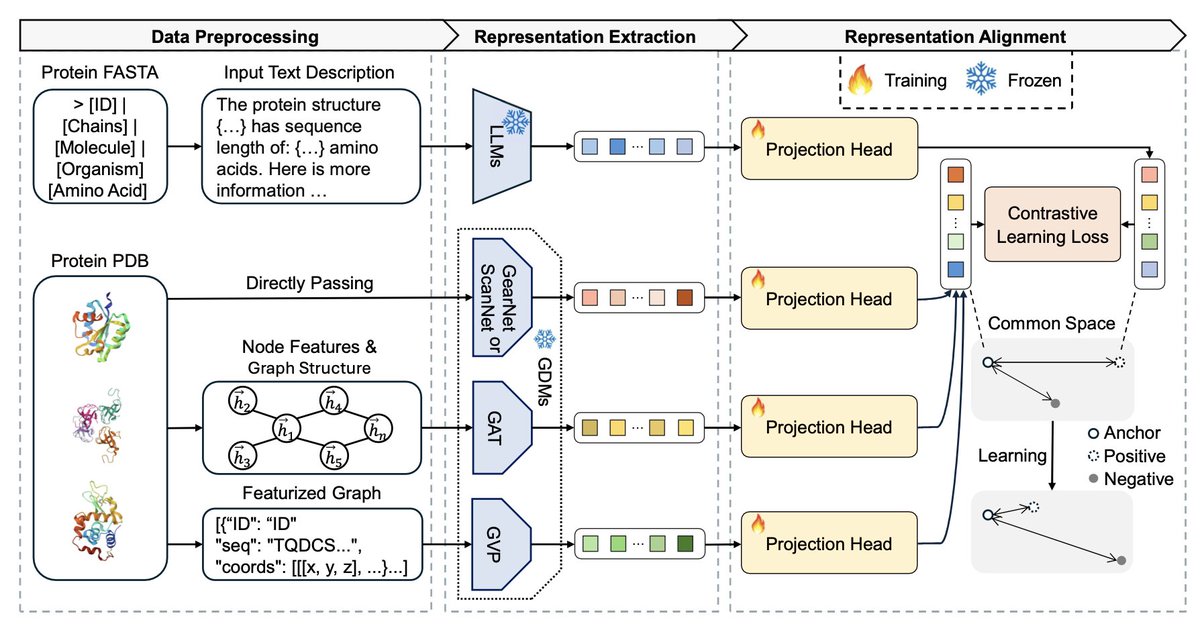
Exploring the Alignment Landscape: LLMs and Geometric Deep Models in Protein Representation
1. This study evaluates the alignment of representations between large language models (LLMs) and protein-specific geometric deep models (GDMs) in protein science, aiming to bridge text and structural data.
2. Key finding: GDMs that incorporate both graph and 3D structure data align significantly better with LLMs, especially as the embedding dimensions of LLMs increase, which enhances cross-modal understanding.
3. Alignment improves for models such as ScanNet and GearNet, which integrate detailed geometric features, unlike GDMs like GAT, which struggle with alignment.
4. Larger LLMs (like LLaMa3.1-70B) demonstrate better performance in aligning with GDMs due to their richer embedding capabilities.
5. Challenges: Protein rarity affects alignment accuracy, with rare proteins performing worse, while popular, frequently studied proteins align more effectively across modalities.
6. Strategies for improvement include increasing GDM embedding dimensions, using two-layer projection heads, and fine-tuning LLMs on protein-specific datasets to enhance alignment.
💻Code: github.com/Tizzzzy/LLM-GDM-a…
📜Paper: arxiv.org/abs/2411.05316
#ProteinRepresentation #MultimodalLearning #ComputationalBiology #LLM #GDM
Last Seen Hashtags on Sotwe
Unexpectedd
Seen from Italy
نيج_عراقي
تانجو_برايفت
Seen from Singapore
sakso türbanlı
Seen from Germany
cnc
Seen from Japan
chudai
Seen from Canada
ebony hoes
Seen from Germany
k9girl()or dogkot()***********************************************filter:videos
Seen from Turkey
public
Seen from United States
zahlsklave
Seen from Germany
Most Popular Users

Elon Musk 
@elonmusk
240.2M followers

Barack Obama
@barackobama
118.6M followers

Cristiano Ronaldo
@cristiano
114.4M followers

Donald J. Trump
@realdonaldtrump
111.8M followers

Narendra Modi
@narendramodi
106.9M followers

Rihanna
@rihanna
98.6M followers

NASA
@nasa
92.2M followers

Justin Bieber
@justinbieber
91.7M followers

KATY PERRY
@katyperry
89.9M followers

Taylor Swift
@taylorswift13
83.9M followers

Lady Gaga
@ladygaga
75.4M followers

Virat Kohli
@imvkohli
73.3M followers

Kim Kardashian
@kimkardashian
70.8M followers

YouTube
@youtube
68.6M followers

Neymar Jr
@neymarjr
66.3M followers

Bill Gates
@billgates
65.2M followers

Selena Gomez
@selenagomez
63M followers

The Ellen Show
@theellenshow
62.1M followers

CNN
@cnn
61.7M followers

X
@x
60.6M followers