

Top Tweets for #Raymondltd

In this market too, there are certain stocks which has potential to make ATM high. These are
1. Diamond Power infrastructure ltd
2. Sterlite technologies Ltd
3. Novartis ltd
4. Paislo Digital
5. Nupur Recycler
6. Tbz ltd
7. Raymond ltd
#swingtrade #breakouttrade #tbz

Equity intraday trade alert!!
#RaymondLtd
CMP : 1102 -1103
DM FOR FULL TRADE SETUP!!
DISCLAIMER: FOR EDUCATIONAL PURPOSE ONLY!!
#intraday #Marketupdate #StockMarketIndia


#RAYMOND
#RaymondLtd
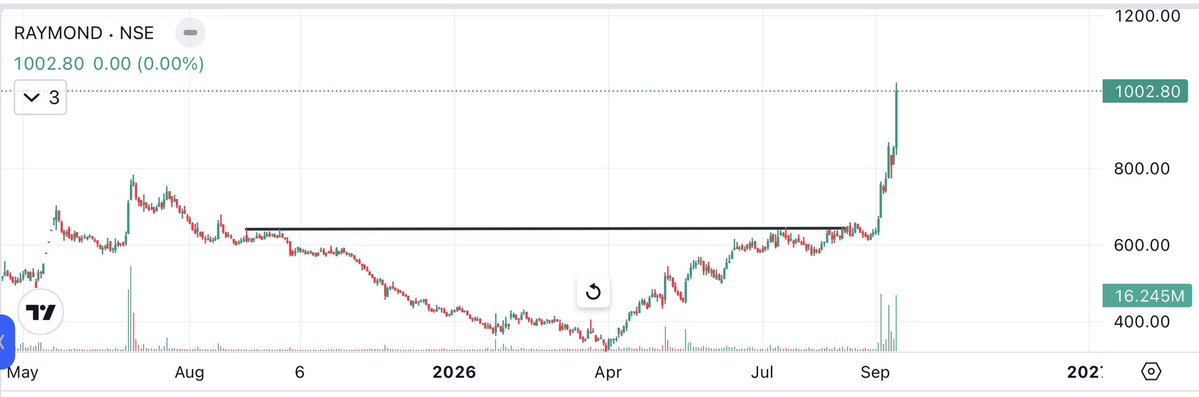
Again Blockbuster
More than 17% Up today
From 642 —->—>1024
60% Return in just 20 Trading Session ..
#StockMarketIndia
#Investment
#Learning


Raymond ltd - A Hidden Story https://t.co/vScAZl3O3Y

HEARD ON THE STREET ❗️
#RAYMONDLTD
Street is watching whether today’s fundraise could be in the ₹200–300 Cr range, broadly aligning with the company’s ongoing ₹1,000 Cr five-year capex programme.
With ₹129 Cr net cash and a ₹5,960+ Cr aerospace order book, the raise would likely be about accelerating capacity rather than plugging a balance-sheet gap.
#RaymondLtd - up 50% up from my initial tracking qty.
Now, time to take some rest... before move into unchartered territory.
Enjoy the Show....🎞️📽️
#RaymondLtd -
Going by the promoter's actions, it looks like a serious Aeronautical boom bet. especially because they are more into engine related components (which demand high quality in manufacturing ) rather than structural related components.
+
They are looking seriously into Defense sector as well.
My initial Tracking Qty. buy avg is Rs.521.
later on i averaged on upside.
44% up from initial buying.
&
22% up from my current buy avg.
Let's see, how far it goes......😊
Raymond ltd - A Hidden Story https://t.co/vScAZl3O3Y

#RaymondLtd
Good business to read about and their business segments , precision tooling and aerospace and their product portfolio
Business Deep Dive #1:
#RaymondLtd #RAYMOND #AerospaceDefence #Q1FY27
Raymond Limited hasn't made a suit in over a year. It's now a precision-engineering supplier to the world's top aircraft-engine makers, and Q1 FY27 just confirmed the order book is growing, not just being re-measured.
Full breakdown in the video — segments, margins, concall Q&A and where the FY27/FY28 numbers come from.

#RaymondLtd
Raymond Ltd
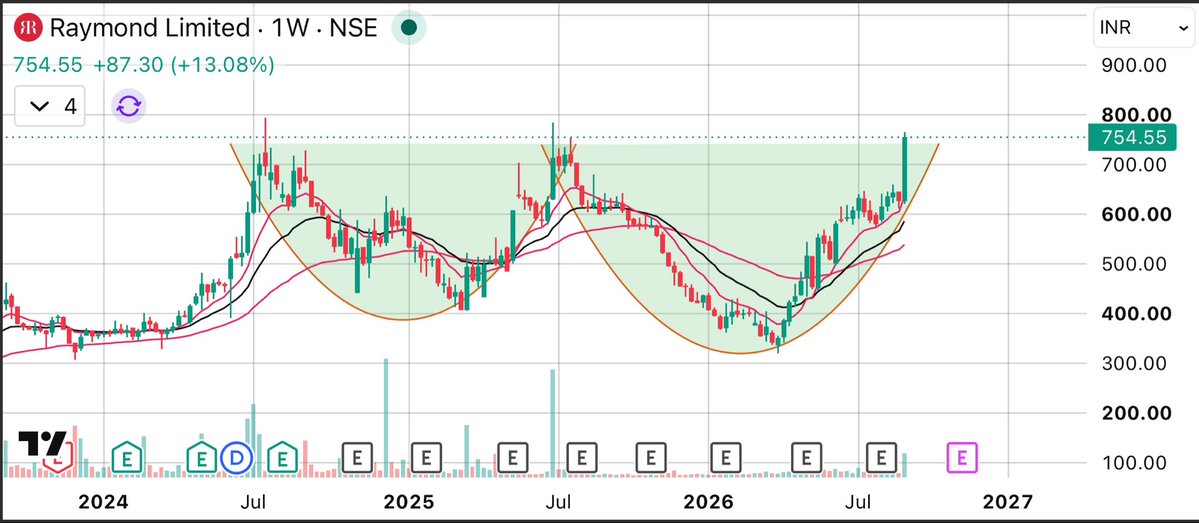
CMP 754
Two Rounding Bottoms and this breakout is about to happen for good upside
Target 820/900/1100
#Reading_between_lines
#multibaggerstock #breakout #NIFTY #BankNifty #Sensex #multibagger
#RaymondLtd - i haven't discussed much about this company. going forward, i will share my observations...
#RaymondLtd.
well that's a good news....🙂

Business Deep Dive #1:
#RaymondLtd #RAYMOND #AerospaceDefence #Q1FY27
Raymond Limited hasn't made a suit in over a year. It's now a precision-engineering supplier to the world's top aircraft-engine makers, and Q1 FY27 just confirmed the order book is growing, not just being re-measured.
Full breakdown in the video — segments, margins, concall Q&A and where the FY27/FY28 numbers come from.
#RaymondLtd #RAYMOND #AerospaceDefence #Q1FY27
1. Quick: what does Raymond make?
If you said suits, you're two years out of date — and you're actually thinking of a different company now.
Over FY24–FY26, the 100-year-old Raymond Group quietly split itself into three separately listed companies. The textiles and apparel business — Park Avenue, ColorPlus, the suits — became Raymond Lifestyle Limited. The Thane land bank and real estate business became Raymond Realty. What's left, still trading under the name "Raymond Limited," is neither of those things. It's a precision-engineering company that makes components for the top three aircraft-engine manufacturers in the world, and most of the market still hasn't updated its mental model of what this stock actually is.
2. Three things to know before we get into it:
Raymond Limited today is two businesses: auto components (starter gears, steel files — #1 in India in both) and aerospace & defence components for the world's biggest jet-engine makers.
Q1 FY27 aerospace revenue grew 40% year-on-year, and on the earnings call management put an explicit number on where margins are headed — something they hadn't done before.
An analyst directly challenged a confusing order-book number live on the call. Management's answer, worked through in real time, turned out to be good news, not a red flag.
What's actually inside "Raymond Limited" now
Strip away the old textile-brand association and there are two businesses here. The larger one, Precision Technology & Auto Components, makes starter gears, ring gears, flex-plates and steel files — unglamorous, high-volume precision parts, where Raymond is the #1 domestic maker in a couple of categories, spread across 15 manufacturing facilities.
The smaller, faster-growing, and more interesting one is Aerospace & Defence. This division is a preferred supplier to the top three global aircraft-engine manufacturers, holding a combined 88% market share of that customer set — meaning if you're one of the handful of companies making jet engines anywhere in the world, there's a good chance Raymond makes some of the parts inside it. Over 1,300 precision aero-engine parts have been developed, with 350 engineered specifically for the latest-generation LEAP engine variants used on modern narrow-body aircraft. This isn't a side project bolted onto a legacy textile company — it's a 22-year-old manufacturing capability (management's own words on the earnings call) that the corporate restructuring simply made visible as its own listed entity for the first time.
3. The quarter that actually moved the numbers:
Q1 FY27 revenue grew 13.1% year-on-year, EBITDA grew 14.3%, and profit jumped 50% — but the more interesting number is inside that total. Aerospace & Defence revenue alone grew 40.4% year-on-year, well ahead of the roughly 25% annual growth management had committed to. Auto components margin came in at 13.8%, already above the "12-13%" range management had described as a near-term target just one quarter earlier — which tells you something about how conservatively that guidance was being framed in the first place.
The CFO was explicit on the call about why this happened: "what has happened into margin this time is we got operating leverage... we also had product mix related gains... operating leverage, will it continue? The answer is yes." That's a specific, falsifiable claim — not "the quarter was strong," but a named mechanism the company is on record saying should persist.
4. The moment on the call worth paying attention to
Here's a piece of the story most companies wouldn't want written about: an analyst directly challenged Raymond's own order-book disclosure. The company had previously cited a ₹2,350 Cr order book on a 5-year basis; the new presentation showed ₹5,960+ Cr on a 10-year basis — a jump that, on the surface, looks like the company just changed the ruler to make the number bigger. The analyst pushed back on the call and asked management to translate the new figure back onto the old 5-year basis for a fair comparison.
Management did the math live and landed on ₹2,765 Cr — confirmed as "safe to assume." That's a genuine 17% quarter-on-quarter increase in the order book on a true like-for-like basis, not a disclosure trick. It's a small moment, but it's the kind of thing worth noticing: a company that gets challenged on a number and can immediately reconcile it accurately is a company that actually understands its own numbers, which isn't something you can say about every earnings call.
Separately, the order book still doesn't include anything from the new Andhra Pradesh facility currently under construction — that's pure future upside not yet in the base, though it won't contribute revenue until FY28 at the earliest, after construction and customer-approval processes.
5. The hire that confirms the next chapter
For weeks before this earnings call, there had been a press report that Raymond had hired a former BEL (Bharat Electronics) CXO to lead a defence push — but the company's own investor deck didn't mention it, which is exactly the kind of gap that makes you wonder if a story is real or overstated. An analyst asked about it directly on the call. Management's Head of Investor Relations confirmed it on record: "Mr. Bhanu Prakash Srivastava has joined us, and you've seen the exchange release. We plan to work on the defense segment as well... we'll be coming to you guys, hopefully by the next quarter or two, about the future as to how we are trying to go about this."
That's a real hire, management-confirmed, with a specific timeline for the strategy reveal. It's not yet a business — it's a stated intention with a named executive behind it, and the actual strategy is still being finalised. Worth watching for what gets announced in the next one or two quarters, not for what's already been delivered.
6. What could break the story?
The aerospace margin picture isn't a clean win yet. Segment EBITDA margin actually fell year-on-year in Q1 FY27, from 23.7% to 21.2%, on R&D and capacity-scaling costs management calls temporary. On the same call, the CFO put a specific number on where this should eventually land — "somewhere around 25%" at a mature, stabilised level — which is genuinely useful because it gives everyone a concrete target to hold the company to. But no timeline was attached to reaching it, and one quarter of margin compression isn't proof either way.
Input costs are a fresh, live pressure too: management flagged rising logistics costs, cutting-tool input costs (carbide, high-speed steel), and a minimum-wage increase on this call specifically — being offset through efficiency gains and customer pass-through negotiations, but explicitly acknowledged as something that could mean "a quarter where there could be some pressure" before it eases.
There's also a dilution question sitting in the background. In July, the promoter entity subscribed to convertible warrants that, on full conversion within 18 months, would raise promoter and promoter-group holding from 48.87% to 53.52% — SEBI formula-priced, not a discretionary discount, but still dilutive to existing minority shareholders when it converts. And the two operating subsidiaries are only 66%-owned by Raymond and its promoters jointly, with the founding Maini family holding the rest — a structural minority-interest question that showed zero drag this quarter but isn't guaranteed to stay that way.
7. The earnings arc, as far as the numbers currently go
Refer to the attached image:
This is where the table stops for now — a genuine data-availability difference from other names covered here, not an oversight. The underlying model builds FY28E EBITDA and EPS explicitly, but doesn't build a matching FY28E revenue line the way it does for FY27E, so there isn't a clean, defensible anchor yet to extend this out to FY29E the way we have for other companies. Rather than layer a new assumption on top of an assumption to force a number out, it's left open here — worth revisiting once a FY28 result or updated guidance gives something concrete to build on.
*FY28E PAT and EPS use the current ~6.7 Cr share count; if the promoter warrants fully convert within their 18-month window, FY28E EPS would dilute by roughly 10%.
8. Where this leaves things:
The most interesting thing about Raymond Limited right now isn't any single number — it's that the market's mental model of the company (textiles, suits, a legacy conglomerate) and the actual business underneath the same ticker (jet-engine components, a defence push with a named executive behind it, an order book that just grew 17% in a quarter) are two completely different stories, and most people are still pricing the old one. That gap closes eventually — either the market catches up, or the operating numbers stop justifying the newer story. Q2 FY27 results, expected around October/November, are the next real test of both the aerospace margin recovery and whatever comes out of the promised defence-strategy update.
Curious whether you'd already re-rated your own mental model of what "Raymond" means, or whether this is the first time the aerospace/defence business has actually registered. Reply and let me know — genuinely curious how much of the market is still behind on this one.
Disclaimer: Invested and biased. This is independent research shared for educational purposes. I'm not a SEBI-registered investment/research analyst, and nothing here is investment advice or a recommendation to buy, sell, or hold any security. Views are personal. Do your own research before making any investment decision.

#RaymondLtd #RaymondRealty #RAYMOND #RAYMONDREL #Q1FY27
Same demerger family. Same quarter. Not so similar report cards.
Raymond Ltd (engineering — auto components + aerospace/defence): Q1 FY27 revenue +13%, EBITDA +14%. Aerospace & Defence revenue +40.4% YoY. Net cash nearly doubled to ₹129 Cr while still funding a ₹1,000 Cr capex plan. Management held a concall, got asked the two hardest questions on the order book and the CEO-Defence hire, and answered both straight. Call graded clean.
Raymond Realty (the real estate arm): pre-sales +129% YoY, a new ₹8,500 Cr Parel JDA just pushed total project pipeline to ~₹52,000 Cr GDV. But EBITDA margin printed 13%, on the expected lines per management, with the FY27 guided band of 17-19%, and net debt rose another ₹168 Cr in the quarter as finance costs more than tripled YoY. No Q1 FY27 concall has been held yet — so there's no management explanation on record for either number.
The arm with the flashier headline (GDV, pre-sales growth) is the one currently carrying the open question. The quieter industrial arm is the one that showed up and explained itself.
Disclaimer: Not investment advice. Independent research, not SEBI-registered. DYOR.

#Aeques #AzadEngineering #DynamaticTechnologies
#Techeraengineering #unimechaerospace #apsisaerocom #belrise #obscperfection #raymondltd
The Precision Pioneers: How Nine Engineering Giants Are Rewiring Global Supply Chains
The global manufacturing landscape is undergoing a quiet but seismic shift. As nations race to de-risk their supply chains and India rapidly modernizes its military blueprint, a select group of precision engineering firms has moved from the sidelines to the center stage. These are not traditional factories; they are high-tech sanctuaries where tolerances are measured in microns.
From legacy textile empires completely transforming their DNA to native aerospace powerhouses, here is the business story of nine precision engineering champions—and how they are carving up the lucrative pies of sovereign defense, global exports, commercial aviation, and the electric vehicle revolution.
1. The Pure-Play Aerospace Titans
Aequs
Sovereign Indian Defense: Moderate | Acts as an emerging sub-contractor supplying complex structures; domestic defense makes up under 15% of its total footprint as it prioritizes commercial aerospace scales.
Export Defense: High | Pivoted aggressively into global military aviation ecosystems, leveraging cross-border defense offset policies to supply structural parts to international forces.
Commercial Aerospace: Dominant | Serves as the primary engine. Over 65% of its total corporate revenue flows directly from producing engine casings and landing gear structures for major global passenger aircraft.
Auto / EV: Moderate | Powered by its precision automotive casting vertical; currently pivoting assembly lines to capture aluminum housing frames for global EV powertrains.
Other Sectors: Moderate | Balanced by its consumer durable goods division inside its dedicated manufacturing zones, cushioning cyclical aerospace downturns.
Azad Engineering
Sovereign Indian Defense: High | Dedicated manufacturing loops supply life-critical parts for domestic missile, fighter aircraft, and space systems.
Export Defense: High | Backed by strict certifications to supply rotating airfoils and highly engineered components to global military defense primes.
Commercial Aerospace: Dominant | Represents their crown jewel. Over 70% of core revenues stem from exporting high-end turbine blades and airfoils to commercial propulsion giants.
Auto / EV: None | Strictly avoids commercial automotive components to preserve its manufacturing focus on high-margin, high-tolerance machinery.
Other Sectors: High | Sustained by a major corporate vertical supplying heavy critical parts for global nuclear, steam, and gas-powered energy turbines.
Dynamatic Technologies
Sovereign Indian Defense: Dominant | Serves as a vital industrial pillar; domestic programs like the Sukhoi Su-30MKI, LCA Tejas, and strategic domestic drones contribute over 35% of its overall defense revenue.
Export Defense: High | Acts as a sole-source global supplier for critical military lift platforms, notably building major structural pylon assemblies for the Boeing CH-47 Chinook.
Commercial Aerospace: Dominant | Drives the financial baseline. They produce 100% of the complex flap track stations for the global Airbus A320 family.
Auto / EV: Moderate | Grounded in high-end automotive engineering; currently modifying its industrial hydraulic pump units to match thermal management demands in EVs.
Other Sectors: High | Reinforced by its foundational industrial hydraulics division, which builds high-pressure fluid power systems for global agricultural and construction markets.
2. The Agile Aerospace Outliers
Techera Engineering
Sovereign Indian Defense: High | Rapidly expanding via domestic defense PSU partnerships; supplies critical ground support assemblies and automated manufacturing fixtures.
Export Defense: Moderate | Primarily acts as a Tier-2 contributor to international defense supply chains while actively scaling export marketing capabilities.
Commercial Aerospace: High | Contributes over 40% of operations through specialized aerospace tooling, structural assembly fixtures, and high-tolerance aircraft parts.
Auto / EV: Low | Retains minor exposure via historical legacy prototyping orders for regional automotive firms.
Other Sectors: High | Serves as a key growth catalyst. The company is actively executing a massive structural pivot toward private rocketry, acting as a critical launcher hardware partner to new-age space startups like Skyroot Aerospace.
Unimech Aerospace
Sovereign Indian Defense: Moderate | Operates as a selective supplier for specialized ground systems and components for sovereign military transport fleets.
Export Defense: High | Positioned strongly via global precision component supply agreements, including major long-term contracts with international defense groups like Austria's FACC.
Commercial Aerospace: Dominant | The absolute foundation of the business. Over 80% of its operations focus entirely on high-tolerance aero-engine toolings, structural components, and custom maintenance equipment.
Auto / EV: None | Zero manufacturing footprints are allocated to consumer automotive platforms.
Other Sectors: High | Diversified through an industrial engineering arm that supplies high-accuracy components for global power plants and heavy heavy-machinery assemblies.
Apsis Aerocom
Sovereign Indian Defense: Moderate | Operates as a specialized component supplier for domestic defense setups; currently securing small-batch purchase orders for high-accuracy assemblies.
Export Defense: Moderate | Historically domestic-centric with ~98% of business in India, the company is executing an estimated pivot toward the USA, Spain, and Israel to secure higher-margin export contracts.
Commercial Aerospace: High | Contributes a major share of operational revenues via multi-axis CNC machining of complex structural elements and aircraft cockpit fixtures.
Auto / EV: None | No technical alignment or assembly lines allocated to standard automotive components.
Other Sectors: High | Strategically de-risked by a highly profitable vertical that manufactures intricate, zero-tolerance structural hardware for global advanced medical imaging equipment.
3. The Chameleons: From Textiles and Auto to Precision Powerhouses
Raymond Ltd
Sovereign Indian Defense: Growing | Developing structural modules for defense electronics and precision ammunition components under the sovereign localization push.
Export Defense: High | Inherited premium international defense supply paths through the strategic acquisition of Maini Precision Products.
Commercial Aerospace: High | Maini's robust integration brings deep commercial relationships, directly supplying complex precision structural parts to global aviation tier-1 vendors.
Auto / EV: Dominant | Accounts for over 50% of its unified engineering segment revenues by mass-producing essential ring gears, flexplates, and machined drivetrain components for international EV platforms.
Other Sectors: High | Supported by a steady, legacy engineering baseline manufacturing industrial hand tools and specialized steel files for global trade.
Belrise Industries
Sovereign Indian Defense: High | Leverages large-scale stamping capacities to supply reinforced structural parts and modular sub-assemblies for domestic military logistics vehicles.
Export Defense: High | Scaled overnight by acquiring the UK's Chester Hall Precision Engineering, granting them certified access to western military aviation contracts.
Commercial Aerospace: High | Driven heavily by Chester Hall’s deep integration, supplying elite components directly into global commercial aviation and satellite assembly lines.
Auto / EV: Dominant | Remains the primary revenue machine, contributing over 60% of total group turnover by mass-producing lightweight chassis, structural frames, and battery enclosures for the booming EV market.
Other Sectors: Moderate | Sustained by standard industrial stamping, tool design, and structural heavy-engineering services for heavy machinery.
OBSC Perfection
Sovereign Indian Defense: Growing | Experiencing explosive scaling; defense revenues crossed ₹12 crore in FY26 (up from ₹5.5 crore in FY25), backed by a massive ₹130 crore long-term defense order book.
Export Defense: Moderate | Rapidly expanding its global reach; export operations hit over ₹42 crore in FY26 by delivering high-precision turned components to international sub-contractors.
Commercial Aerospace: Emerging | Actively running sample trials and leveraging its high-end Swiss-turning machinery to qualify for Tier-2 aerospace structural components.
Auto / EV: Dominant | Serves as the primary core business, generating roughly 75% of operations by supplying ultra-precise turned parts, torsion bars, and piston rods for advanced automotive suspensions and EV powertrains.
Other Sectors: High | Broadened by manufacturing high-durability precision components for international marine vessels, heavy agriculture machinery, and infrastructure hardware.
Conclusion: Who Wins Which Sector Boom?
As we look toward the next decade, India’s engineering sector is sitting at the intersection of multiple structural super-cycles. Here is how each of these nine companies is positioned to extract the maximum value from specific industry booms:
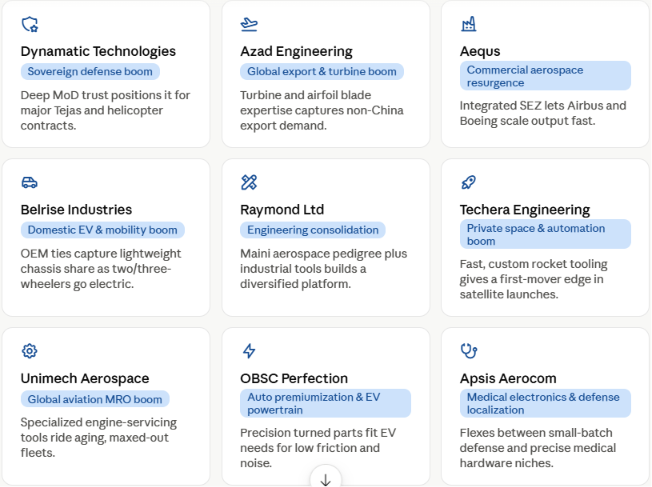
Dynamatic Technologies will benefit most from the Sovereign Indian Defense Boom. As India aggressively pushes for domestic manufacturing of fighter jets (Tejas) and defense helicopters, Dynamatic's decades of deep institutional trust with the Ministry of Defense make it the natural anchor recipient for massive state contracts.
Azad Engineering will ride the highest wave in the Global Export Defense & Turbine Boom. With Western defense OEMs actively seeking non-China manufacturing alternatives for high-complexity parts, Azad’s unmatched mastery over life-critical turbine and airfoil blades positions them perfectly to capture billions in export offset credits.
Aequs is slated to be the ultimate winner of the Commercial Aerospace Resurgence. As Airbus and Boeing face unprecedented backlogs for single-aisle aircraft, Aequs’s unique, fully integrated SEZ infrastructure allows global OEMs to scale up production rapidly without facing supply chain fragmentation.
Belrise Industries will reap the largest rewards from the Domestic EV and Shared Mobility Boom. Their massive industrial footprint and deep relationships with Indian auto OEMs mean that as two-wheelers and three-wheelers convert completely to electric drivetrains, Belrise will capture the lion's share of structural and lightweight chassis manufacturing.
Raymond Ltd will benefit the most from the Cross-Sector Engineering Consolidation. By executing a clean corporate split and combining Maini’s aerospace pedigree with their own massive industrial tool footprint, Raymond will see its highest growth as a highly diversified, premium engineering platform that global investors can easily back.
Techera Engineering will capture the peak of the Private Space and Automation Boom. As India's private space startups scale up commercial satellite launches, Techera’s agility in designing rapid, custom rocket tooling and specialized aerospace structures gives them a first-mover advantage.
Unimech Aerospace is perfectly calibrated for the Global Aviation MRO (Maintenance, Repair, & Overhaul) Boom. With global airline fleets aging and operating at maximum capacity, the demand for Unimech's highly specialized engine-servicing tools will skyrocket independently of new aircraft sales.
OBSC Perfection will win big on the Automotive Premiumization and EV Powertrain Transition. Their focus on ultra-high-precision turned parts aligns perfectly with the EV industry's absolute requirement for friction-reduced, noise-isolated mechanical components.
Apsis Aerocom will benefit most from the High-End Medical Electronics and Defense Localization Boom. Their ability to flexibly pivot between small-batch defense machining and high-margin, ultra-precise medical hardware ensures they will capture highly profitable niches that larger giants find too small to chase.
As these nine companies prove, the future belongs to the masters of precision.
#RaymondLtd
"The Complete Man" used to mean a well-dressed gentleman in a fine wool suit.
Today it means a low-pressure turbine component machined to 0.002mm tolerance for a Safran aircraft engine.
But here's the thing the market is still pricing in: aerospace is just 19% of Raymond's revenue today — yet it already earns 22.3% EBITDA margins, nearly double the auto and tools business sitting beside it.
When that 19% becomes 35-40% — which is exactly what the ₹2,350Cr order book and ₹930Cr capex programme are designed to deliver — the margin math doesn't move in a straight line. It jumps.
So the question isn't whether Raymond has pivoted. Everyone knows that. The question is whether the market has priced what happens when the turbines do the heavy lifting.
Business story
The transformation is one of the most dramatic in Indian corporate history.
Between 2024-25, Gautam Singhania executed a three-way demerger: Raymond Lifestyle (textiles) listed September 2024. Raymond Realty listed July 2025. What remains is the engineering parent — stripped of a century of textile identity — now a pure-play B2B precision engineering powerhouse.
The trigger: acquisition of Maini Precision Products (MPP). This wasn't a diversification bet. It was a deliberate capability purchase — instantly adding pre-qualified aerospace manufacturing lines, Pratt & Whitney and Safran supply relationships, and 1,300+ pre-cleared aerospace component part numbers. No 3-5 year qualification cycle. Already approved. Already in the supply chain.
The new Raymond operates through two verticals: ① JK Maini Global Aerospace (JKMGAL) — Tier-1 direct supplier to Pratt & Whitney and Safran. LPT components, flight-critical engine parts. 22.3% EBITDA. ② JK Maini Precision Technology (JKMPTL) — EV/hybrid drivetrain gears, Ring Plus Aqua, and world's #1 steel file manufacturer (JK Files). 13.4% EBITDA.
50%+ of revenue already comes from exports. The "China Plus One" sourcing wave is arriving at exactly the right time.
Moat:
The moat is built on three structural pillars:
① 1,300+ pre-qualified component part numbers. Each one took 3-5 years and ₹1-5 Crore to certify under AS9100/NADCAP. A competitor can't buy these. They must earn them — certification by certification, audit by audit. This library is a decade of compounded regulatory work that acts as a permanent entry barrier.
② Cost-in-product pricing power. Raymond's aerospace components represent just 5-8% of the final engine cost. But if they fail, the engine fails. Pratt & Whitney doesn't squeeze Raymond on price. They pay for flawless precision. That's an unusual pricing dynamic — small cost, zero negotiating pressure.
③ Commodity pass-through insulation. Multi-year LTAs have embedded steel price pass-through clauses. Raw material shocks are structurally deflected to Tier-1 aggregators. Gross margins are protected regardless of metal cycles.
Auto segment moat is Moderate — EV transition creates mix-shift risk from ICE parts.
Valuation & the mix-shift math:
Consolidated continuing operations:
FY25 A: Rev ₹1,947Cr | EBITDA 17.2% (₹335Cr) | PAT ₹52Cr | EPS ₹7.18
FY26 A: Rev ₹2,212Cr | EBITDA 15.1% (₹335Cr) | PAT ₹54Cr* | EPS ₹5.07
FY27 E: Rev ₹2,600Cr | EBITDA 18.0% (₹468Cr) | PAT ₹171Cr | EPS ₹25.69
FY28 E: Rev ₹3,150Cr | EBITDA 20.0% (₹630Cr) | PAT ₹295Cr | EPS ₹44.28
*FY26 PAT distorted by ₹201Cr non-cash goodwill reversal from demerger.
Is there big operational leverage? Yes — TWO engines running simultaneously.
① Mix-shift: every 1% of revenue shifting from auto (13.4% EBITDA) to aerospace (22.3%) adds ~90bps of blended margin. A 16-point shift = EBITDA 15% → 20%.
② Sub-linear headcount: employee costs fall 18.88% → 17.0% of sales as automated CNC lines scale volume without proportional hiring. Incremental revenue yields 35%+ EBITDA flow-through.
Growth triggers:
✅ ₹2,350Cr multi-year LTA order book; ₹400Cr+ converts FY27
✅ Aerospace 26% YoY — fastest segment, highest margin
✅ FCF turns positive FY28 — ₹465Cr CFO vs ₹310Cr FY27
✅ ROIC 8.8% → 18.7% — spread over WACC widens dramatically
Red flags:
⚠ FY26 ROIC at WACC (8.84% vs ~9%) — not yet creating economic value
⚠ Current capacity ceiling ₹2,500Cr — FY27 ₹2,600Cr target requires new Andhra Pradesh lines online on schedule
⚠ Debtor days 86 → 70 days projected — collection cycle improvement must materialize
⚠ FCF was -₹72Cr in FY26; positive FY28 thesis rests on capex peaking and capacity utilising
Management quality & governance
Improving. Not yet top-tier.
Gautam Singhania promised a three-way demerger. Delivered on schedule, with KPMG/EY verified swap ratios. Promised aerospace growth mid-twenties. Delivered 26% YoY (₹392Cr in FY26). Promised net-debt-free engineering entity. Entered FY27 with ₹68Cr cash surplus and zero net debt. Said it. Did it. Three times in a row.
Crucially — didn't install a family member to run aerospace. Gautam Maini (20+ years of Safran and Pratt & Whitney relationships) runs JKMGAL. Professional technocrat over family appointment. That's above-average capital discipline.
~49% promoter holding. Zero or minimal pledging.
Why not top-tier:
⚠ Personal controversies around Singhania created governance noise institutions dislike
⚠ ₹167Cr non-cash goodwill reversal in FY26 — clean managements avoid messy accounting shocks
⚠ Decades of engineering cash flows diverted to textiles/real estate — requires multi-year clean track record before full trust is warranted
⚠ Key-man dependency: Gautam Maini's personal OEM relationships are the aerospace division's lifeline — succession planning not institutionalised
Order pipeline — does it justify the rerating?
₹2,350Cr of multi-year order pipeline. Here's what it actually means in detail.
These are Long-Term Agreements under multi-year B2B delivery frameworks with Pratt & Whitney and Safran — global engine OEMs who have co-developed tooling and component geometries with Raymond. Switching suppliers mid-LTA means 12-24 months of re-qualification while the global aviation supply chain — already strained by Boeing/Airbus backlogs — sits partially frozen.
Not just revenue visibility. Contractual stickiness baked into the OEM's own design documentation.
The pipeline numbers :
→ ₹400Cr+ of the ₹2,350Cr backlog converts in FY27 alone
→ Current installed capacity ceiling: ₹2,500Cr (74% utilised at FY26 revenue levels)
→ Planned new capacity ceiling: ₹3,200Cr full utilisation / ₹730Cr incremental revenue at expected utilisation by FY28
→ Active RFQs for high-tolerance engine subsystems with strong conversion probability due to existing source clearances
The pipeline justifies the rerating if three things hold:
① 26% aerospace growth is structural — Safran LEAP and Pratt platforms are multi-decade programmes
② Andhra Pradesh new lines hit commercial output on schedule — FY27 is the test quarter
③ Active RFQs convert, expanding beyond the existing Pratt/Safran base
Watch FY27 Q3/Q4 — first quarter where new capacity should appear in the aerospace revenue line.
Closing thesis
The pivot — buying MPP, qualifying 1,300 parts, landing Pratt & Whitney LTAs — is known. The street has rewarded the story.
What isn't fully priced is the non-linearity. Aerospace at 19% of revenue barely moves the blended EBITDA needle. Aerospace at 35-40% — which ₹930Cr capex and ₹2,350Cr order book are designed to deliver — takes blended EBITDA from 15% to 20%. PAT goes from ₹54Cr (FY26, distorted) to ₹295Cr (FY28). EPS goes from ₹5.07 to ₹44.28.
Triggers to watch:
✅ FY27 revenue crossing ₹2,600Cr — new capacity running proof point
✅ Aerospace share crossing 25% of revenue — mix-shift becomes visible in blended margins
✅ EBITDA crossing 18% in FY27 — confirms the operational leverage thesis
✅ Debtor days compressing toward 76 days — working capital normalisation signal
✅ New aerospace LTA or RFQ conversion announced — expands beyond Pratt/Safran
Thesis cracks if:
⚠ Aerospace growth decelerates below 20% — mix-shift math fails and margin rerating stalls
⚠ Andhra Pradesh lines delayed beyond FY27 — capacity ceiling stays at ₹2,500Cr, FY27 target becomes unreachable
⚠ Gautam Maini exits — OEM relationships concentrated in one person
⚠ Another non-cash restructuring charge — governance noise restarts
[treat FY27/FY28 as model estimates]
[Not investment advice, DYOR]
![ramesh_vd's tweet photo. #RaymondLtd
"The Complete Man" used to mean a well-dressed gentleman in a fine wool suit.
Today it means a low-pressure turbine component machined to 0.002mm tolerance for a Safran aircraft engine.
But here's the thing the market is still pricing in: aerospace is just 19% of Raymond's revenue today — yet it already earns 22.3% EBITDA margins, nearly double the auto and tools business sitting beside it.
When that 19% becomes 35-40% — which is exactly what the ₹2,350Cr order book and ₹930Cr capex programme are designed to deliver — the margin math doesn't move in a straight line. It jumps.
So the question isn't whether Raymond has pivoted. Everyone knows that. The question is whether the market has priced what happens when the turbines do the heavy lifting.
Business story
The transformation is one of the most dramatic in Indian corporate history.
Between 2024-25, Gautam Singhania executed a three-way demerger: Raymond Lifestyle (textiles) listed September 2024. Raymond Realty listed July 2025. What remains is the engineering parent — stripped of a century of textile identity — now a pure-play B2B precision engineering powerhouse.
The trigger: acquisition of Maini Precision Products (MPP). This wasn't a diversification bet. It was a deliberate capability purchase — instantly adding pre-qualified aerospace manufacturing lines, Pratt & Whitney and Safran supply relationships, and 1,300+ pre-cleared aerospace component part numbers. No 3-5 year qualification cycle. Already approved. Already in the supply chain.
The new Raymond operates through two verticals: ① JK Maini Global Aerospace (JKMGAL) — Tier-1 direct supplier to Pratt & Whitney and Safran. LPT components, flight-critical engine parts. 22.3% EBITDA. ② JK Maini Precision Technology (JKMPTL) — EV/hybrid drivetrain gears, Ring Plus Aqua, and world's #1 steel file manufacturer (JK Files). 13.4% EBITDA.
50%+ of revenue already comes from exports. The "China Plus One" sourcing wave is arriving at exactly the right time.
Moat:
The moat is built on three structural pillars:
① 1,300+ pre-qualified component part numbers. Each one took 3-5 years and ₹1-5 Crore to certify under AS9100/NADCAP. A competitor can't buy these. They must earn them — certification by certification, audit by audit. This library is a decade of compounded regulatory work that acts as a permanent entry barrier.
② Cost-in-product pricing power. Raymond's aerospace components represent just 5-8% of the final engine cost. But if they fail, the engine fails. Pratt & Whitney doesn't squeeze Raymond on price. They pay for flawless precision. That's an unusual pricing dynamic — small cost, zero negotiating pressure.
③ Commodity pass-through insulation. Multi-year LTAs have embedded steel price pass-through clauses. Raw material shocks are structurally deflected to Tier-1 aggregators. Gross margins are protected regardless of metal cycles.
Auto segment moat is Moderate — EV transition creates mix-shift risk from ICE parts.
Valuation & the mix-shift math:
Consolidated continuing operations:
FY25 A: Rev ₹1,947Cr | EBITDA 17.2% (₹335Cr) | PAT ₹52Cr | EPS ₹7.18
FY26 A: Rev ₹2,212Cr | EBITDA 15.1% (₹335Cr) | PAT ₹54Cr* | EPS ₹5.07
FY27 E: Rev ₹2,600Cr | EBITDA 18.0% (₹468Cr) | PAT ₹171Cr | EPS ₹25.69
FY28 E: Rev ₹3,150Cr | EBITDA 20.0% (₹630Cr) | PAT ₹295Cr | EPS ₹44.28
*FY26 PAT distorted by ₹201Cr non-cash goodwill reversal from demerger.
Is there big operational leverage? Yes — TWO engines running simultaneously.
① Mix-shift: every 1% of revenue shifting from auto (13.4% EBITDA) to aerospace (22.3%) adds ~90bps of blended margin. A 16-point shift = EBITDA 15% → 20%.
② Sub-linear headcount: employee costs fall 18.88% → 17.0% of sales as automated CNC lines scale volume without proportional hiring. Incremental revenue yields 35%+ EBITDA flow-through.
Growth triggers:
✅ ₹2,350Cr multi-year LTA order book; ₹400Cr+ converts FY27
✅ Aerospace 26% YoY — fastest segment, highest margin
✅ FCF turns positive FY28 — ₹465Cr CFO vs ₹310Cr FY27
✅ ROIC 8.8% → 18.7% — spread over WACC widens dramatically
Red flags:
⚠ FY26 ROIC at WACC (8.84% vs ~9%) — not yet creating economic value
⚠ Current capacity ceiling ₹2,500Cr — FY27 ₹2,600Cr target requires new Andhra Pradesh lines online on schedule
⚠ Debtor days 86 → 70 days projected — collection cycle improvement must materialize
⚠ FCF was -₹72Cr in FY26; positive FY28 thesis rests on capex peaking and capacity utilising
Management quality & governance
Improving. Not yet top-tier.
Gautam Singhania promised a three-way demerger. Delivered on schedule, with KPMG/EY verified swap ratios. Promised aerospace growth mid-twenties. Delivered 26% YoY (₹392Cr in FY26). Promised net-debt-free engineering entity. Entered FY27 with ₹68Cr cash surplus and zero net debt. Said it. Did it. Three times in a row.
Crucially — didn't install a family member to run aerospace. Gautam Maini (20+ years of Safran and Pratt & Whitney relationships) runs JKMGAL. Professional technocrat over family appointment. That's above-average capital discipline.
~49% promoter holding. Zero or minimal pledging.
Why not top-tier:
⚠ Personal controversies around Singhania created governance noise institutions dislike
⚠ ₹167Cr non-cash goodwill reversal in FY26 — clean managements avoid messy accounting shocks
⚠ Decades of engineering cash flows diverted to textiles/real estate — requires multi-year clean track record before full trust is warranted
⚠ Key-man dependency: Gautam Maini's personal OEM relationships are the aerospace division's lifeline — succession planning not institutionalised
Order pipeline — does it justify the rerating?
₹2,350Cr of multi-year order pipeline. Here's what it actually means in detail.
These are Long-Term Agreements under multi-year B2B delivery frameworks with Pratt & Whitney and Safran — global engine OEMs who have co-developed tooling and component geometries with Raymond. Switching suppliers mid-LTA means 12-24 months of re-qualification while the global aviation supply chain — already strained by Boeing/Airbus backlogs — sits partially frozen.
Not just revenue visibility. Contractual stickiness baked into the OEM's own design documentation.
The pipeline numbers :
→ ₹400Cr+ of the ₹2,350Cr backlog converts in FY27 alone
→ Current installed capacity ceiling: ₹2,500Cr (74% utilised at FY26 revenue levels)
→ Planned new capacity ceiling: ₹3,200Cr full utilisation / ₹730Cr incremental revenue at expected utilisation by FY28
→ Active RFQs for high-tolerance engine subsystems with strong conversion probability due to existing source clearances
The pipeline justifies the rerating if three things hold:
① 26% aerospace growth is structural — Safran LEAP and Pratt platforms are multi-decade programmes
② Andhra Pradesh new lines hit commercial output on schedule — FY27 is the test quarter
③ Active RFQs convert, expanding beyond the existing Pratt/Safran base
Watch FY27 Q3/Q4 — first quarter where new capacity should appear in the aerospace revenue line.
Closing thesis
The pivot — buying MPP, qualifying 1,300 parts, landing Pratt & Whitney LTAs — is known. The street has rewarded the story.
What isn't fully priced is the non-linearity. Aerospace at 19% of revenue barely moves the blended EBITDA needle. Aerospace at 35-40% — which ₹930Cr capex and ₹2,350Cr order book are designed to deliver — takes blended EBITDA from 15% to 20%. PAT goes from ₹54Cr (FY26, distorted) to ₹295Cr (FY28). EPS goes from ₹5.07 to ₹44.28.
Triggers to watch:
✅ FY27 revenue crossing ₹2,600Cr — new capacity running proof point
✅ Aerospace share crossing 25% of revenue — mix-shift becomes visible in blended margins
✅ EBITDA crossing 18% in FY27 — confirms the operational leverage thesis
✅ Debtor days compressing toward 76 days — working capital normalisation signal
✅ New aerospace LTA or RFQ conversion announced — expands beyond Pratt/Safran
Thesis cracks if:
⚠ Aerospace growth decelerates below 20% — mix-shift math fails and margin rerating stalls
⚠ Andhra Pradesh lines delayed beyond FY27 — capacity ceiling stays at ₹2,500Cr, FY27 target becomes unreachable
⚠ Gautam Maini exits — OEM relationships concentrated in one person
⚠ Another non-cash restructuring charge — governance noise restarts
[treat FY27/FY28 as model estimates]
[Not investment advice, DYOR]](https://pbs.twimg.com/media/HMNL6GUbIAA1ESz.png)

Positive vibes from Trump-Modi: "No difficulty in a deal." India-US negotiations unlock potential. Raymond Ltd rallies 4% on apparel export optimism—fashion forward for stock picks? #IndiaUSDeal #RaymondLtd #BullMarket

Gautam Singhania Bets Big On Real Estate: Raymond Fabrics to foundations
Watch: https://t.co/9d1QI0ClSQ | #GautamSinghania #RaymondRealty #RaymondLtd #RealEstateIndia #AffordableLuxury

Research paper on #CapitalGoods https://t.co/VyTmiGPtUl
#AJAXEngineering #KDDLLtd #RaymondLtd #ShivalikBimetal #TechnocraftIndustries #PrajIndustries #TDPowerSystems #SkipperLtd #TransrailLighting — Capital Goods sector entering margin expansion with capex done,tailwinds strong.

रेमंड लिमिटेडच्या शेअर धारकांना आजची सकाळ धक्का देणारी ठरली. कारण, रेमंड लिमिटेडचा शेअर सुमारे ६६ टक्क्यांनी घसरला.
#RaymondLtd #raymondshare #sharemarket
https://t.co/YZ3u55KVi5
Last Seen Hashtags on Sotwe
snapchat()()()()********* (*filter:native_video)
Seen from United States
DeepInsertion
Seen from Malaysia
smno(*)**
Seen from Italy
ometv
Seen from France
eskişehirtrAvesti
Seen from Poland
ニコ生
Seen from Japan
elazığgay
Seen from Turkey
minichat()********************************************* *filter:native_video()
Seen from Denmark
brosis
Seen from New Zealand
ometv()**************filter:videos
Seen from Netherlands
Most Popular Users

Elon Musk 
@elonmusk
241.7M followers

Barack Obama
@barackobama
119M followers

Cristiano Ronaldo
@cristiano
114.3M followers

Donald J. Trump
@realdonaldtrump
111.9M followers

Narendra Modi
@narendramodi
107.2M followers

Rihanna
@rihanna
98.7M followers

NASA
@nasa
92.4M followers

Justin Bieber
@justinbieber
91.8M followers

KATY PERRY
@katyperry
90M followers

Taylor Swift
@taylorswift13
83.9M followers

Lady Gaga
@ladygaga
75.4M followers

Virat Kohli
@imvkohli
73.3M followers

Kim Kardashian
@kimkardashian
70.9M followers

YouTube
@youtube
68.8M followers

Neymar Jr
@neymarjr
66.3M followers

Bill Gates
@billgates
65.1M followers

Selena Gomez
@selenagomez
63M followers

The Ellen Show
@theellenshow
62.3M followers

CNN
@cnn
61.8M followers

X
@x
60.7M followers