

Top Tweets for #SHaredFacts


Fun Fact:
When Trump assumed the presidency on January 20, 2025, former president Biden left him a 2.9% inflation.

Furthermore, consider #GeneralSemantics from #AlfredKorzybski book #ScienceAndSanity
#WordsAreUnitsOfBrainFunction
#SharedFacts for #CollectiveLearning and #HumanReasoning

@SketchesbyBoze Reading is freedom. It opens worlds that might otherwise remain closed. Imho opinion, I believe that the lack of basic knowledge ( easily acquired through books) is the source of much of the problems in today's world. They don't have to erase history. No one sees the point.

🌍 The World in Numbers
1. 🌐 Countries - 195
2. 🗣️ Languages - 7,170
3. 👥 World Population - 8.3 Billion+
4. 📱 Internet Users - 6.12 Billion
5. 🏙️ Cities with 50,000+ Residents - 12,000+
6. 🌆 Megacities - 33
7. 🌍 Continents - 7
8. 🌊 Oceans - 5
9. 🌋 Active Volcanoes - 1,350
10. 🌕 Moons in the Solar System - 891
11. 🪐 Saturn's Moons - 274
12. ✨ Confirmed Exoplanets - 6,298
13. 🌳 Tree Species - 73,000+
14. 🌲 Tree Species in GlobalTreeSearch - 60,082
15. 🌺 Vascular Plant Species - 391,000
16. 🍄 Fungi Species - 144,000
17. 🐘 Vertebrate Species - 70,000
18. 🐜 Invertebrate Species - 1.3 Million
19. 🐦 Bird Species - 11,000
20. 🦣 Mammal Species - 6,759
21. 🦎 Reptile Species - 10,000+
22. 🐸 Amphibian Species - 8,011
23. 🐟 Fish Species - 36,500+
24. 🧭 Species Assessed by the IUCN Red List - 172,600+
25. ⚠️ Threatened Species - 48,600+
26. 🌲 Forest-Related Green Jobs - 86 Million+
27. 👨👩👧👦 People Dependent on Forests - 880 Million
28. 📴 People Without Internet Access - 2.17 Billion
Source: UN, World Bank, ITU, IUCN, NASA, ESA, GlobalTreeSearch, FAO


Maybe the rich could pay their fair share?


82 years ago, 14,000 Canadians landed on Juno Beach, many of whom would never come home.
On the anniversary of D-Day, we pause to honour those who served and sacrificed. We remember that our rights, our freedoms, and our way of life were fought for and were won by those who answered the call.


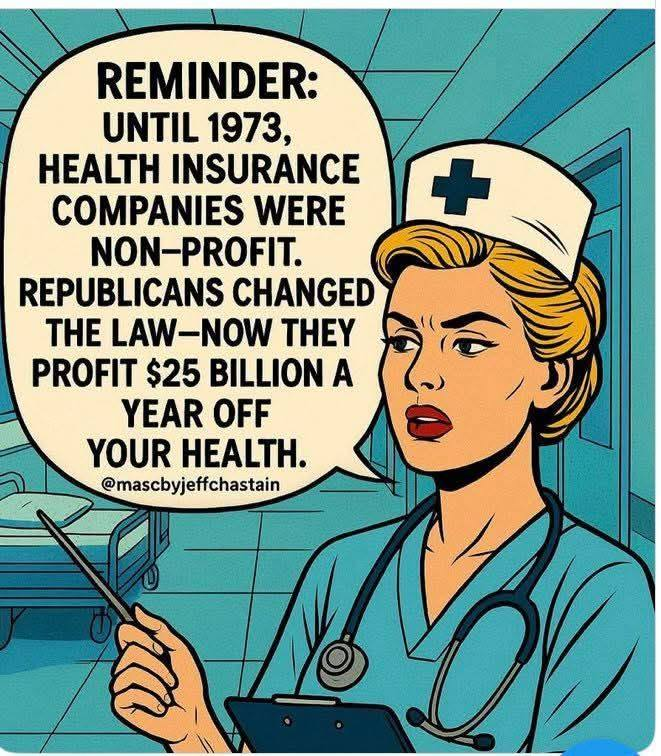
It's so funny whenever people are like "it's because of the LEFT that we're overrun by homeless people on the street!" knowing that the real reason is that Ronald Reagan slashed all the funding for low income housing and mental hospitals

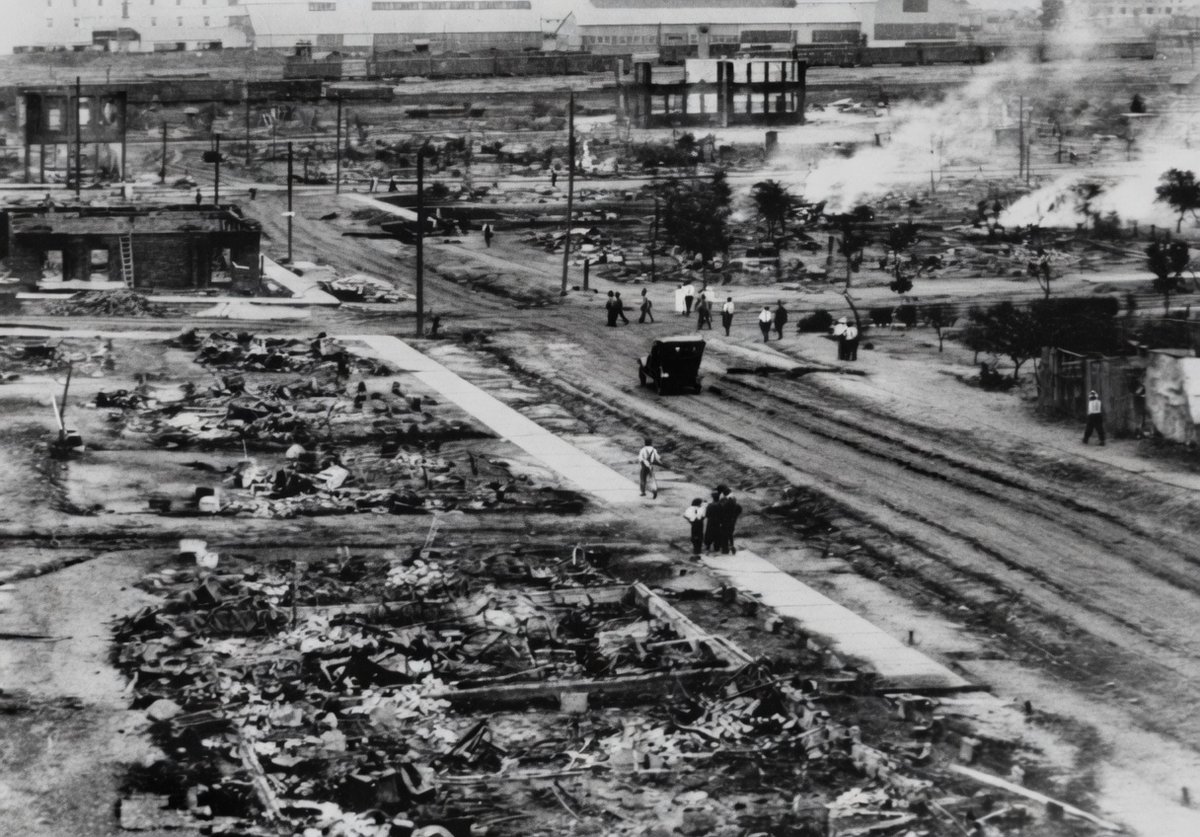
105 years ago today — May 31, 1921 — horror came to Tulsa.
A thriving, self-made Black community known as "Black Wall Street" was brutally attacked by white mobs in one of the most devastating acts of racial violence in American history.
They burned it to the ground. Hundreds of Black-owned homes and businesses — symbols of pride, prosperity, and hard-won success — were looted and reduced to rubble. At least 36 Black residents were murdered, over 800 were injured, and thousands more were left homeless, their dreams and life's work destroyed in a single night of terror.
A community that had risen against all odds was violently crushed. We remember Greenwood. We remember the lives stolen. We remember the pain that still echoes.


❌ Myth: Guaranteed income creates a disincentive to work
✅ Reality: Guaranteed income actually helps people find suitable and sustainable work that leads to more stable employment:


She was the only woman in the Senate when the most feared man in America destroyed careers with a single accusation. Male colleagues begged her to stay silent. She looked him in the eye and said, "You will not like it."
June 1, 1950. Washington, D.C.
The United States Senate was paralyzed by fear.
For four months, Senator Joseph McCarthy had terrorized the capital. He claimed to have lists of communists working in the State Department—numbers that shifted constantly (205, then 57, then 81), evidence that never materialized, but destruction that was absolutely real.
Teachers lost their jobs. Writers were blacklisted. Civil servants saw their careers destroyed. Loyalty oaths were demanded. Mere accusation was enough to ruin a life. Guilt required no proof.
And the Senate—the most powerful deliberative body in the world, filled with men who had fought in wars and built political machines—sat silent.
Every senator hoped someone else would stand up to McCarthy. Every senator was too afraid to be that someone.
Except one.
Margaret Chase Smith was a freshman Republican senator from Maine. She was 52 years old and the only woman in the chamber—not just the only woman that session, but the only woman. Period.
She had no seniority. No powerful committee assignments. No political machine protecting her. She had inherited her husband's House seat when he died in 1940, then won election to the Senate in 1948—an achievement that was grudgingly acknowledged but never taken seriously by her male colleagues.
She was dismissed as a novelty. A token. Someone who would stay quiet and vote the party line.
They didn't know Margaret Chase Smith.
At first, she had given McCarthy the benefit of the doubt. He was a fellow Republican making serious allegations. Surely he had evidence. Surely this was legitimate oversight, not witch-hunting.
She asked him privately to show her his proof.
He showed her nothing. He had nothing.
Margaret realized then that McCarthy wasn't investigating communism—he was weaponizing fear. And she watched, day after day, as her colleagues did absolutely nothing.
She later described it as "mental paralysis and muteness"—grown men rendered speechless by terror of being McCarthy's next target.
Margaret decided she would rather lose her Senate seat than lose her integrity.
She worked secretly with her aide, William Lewis, drafting what she called a "Declaration of Conscience." The speech was calm, measured, and devastating. It didn't name McCarthy, but it didn't need to. It exposed exactly what he was doing—and what the Senate's silence was enabling.
She wrote: "I speak as a Republican. I speak as a woman. I speak as a United States Senator. I speak as an American. The American people are sick and tired of being afraid to speak their minds lest they be politically smeared."
She approached six moderate Republican colleagues—men she thought might have the courage to co-sign. They read it. They agreed with every word. They were terrified to attach their names.
Four eventually signed. Two others pledged support but begged her not to include them publicly.
Many more told her privately: "Margaret, you're right, but I can't afford to make McCarthy an enemy."
The morning of June 1, 1950, Margaret walked through the marble hallway of the Capitol building, speech folded in her hand. She passed Joseph McCarthy.
He noticed the papers. He noticed how serious she looked.
"Margaret," he said, half-amused, "you look very serious. Are you going to make a speech?"
Margaret Chase Smith looked the most feared man in America directly in the eye.
"Yes," she said. "And you will not like it."
Then she walked onto the Senate floor.
At 3:00 p.m., she began speaking.
"I would like to speak briefly and simply about a serious national condition. It is a national feeling of fear and frustration that could result in national suicide and the end of everything we Americans hold dear."
For fifteen minutes, she spoke without raising her voice. She defended freedom of speech, the right to dissent, the right to hold unpopular beliefs without being destroyed. She called out the smear tactics, the guilt by association, the "Four Horsemen of Calumny"—Fear, Ignorance, Bigotry, and Smear.
She never said McCarthy's name. Everyone knew exactly who she meant.
McCarthy sat through the first few minutes, his face reddening. Then he stood up and walked out of the chamber.
When Margaret finished, the Senate chamber was silent.
Then the letters started arriving. Thousands of them. From ordinary Americans who were terrified to speak publicly but grateful that someone finally had.
President Harry Truman called it one of the finest moments of political courage he had ever witnessed.
But McCarthy's revenge was immediate and brutal.
He stripped Margaret of her committee assignment on the Senate Permanent Subcommittee on Investigations—the committee he chaired. He publicly mocked her. He encouraged a primary challenger to run against her in 1954, funneling money and support to try to unseat her.
She won anyway. By a landslide.
And McCarthy's power began to crack.
The "Declaration of Conscience" didn't end McCarthyism immediately. It took four more years. But it was the first crack in the dam. It gave others permission to speak. It showed that McCarthy could be challenged and the challenger could survive.
In 1954, during the Army-McCarthy hearings, Army counsel Joseph Welch delivered the famous line: "Have you no sense of decency, sir? At long last, have you left no sense of decency?"
That moment is remembered as McCarthy's downfall. But Margaret Chase Smith had said it first—four years earlier, when it was far more dangerous.
On December 2, 1954, the Senate formally censured Joseph McCarthy. His reign of terror was over.
Margaret Chase Smith served in the Senate until 1973—24 years total, becoming one of the most senior Republicans in the chamber. In 1964, she became the first woman ever formally nominated for president by a major party, receiving 25% of the vote in the Illinois Republican primary.
When reporters asked what she wanted to be remembered for, she didn't mention her legislative achievements or her presidential run or her years of service.
She said simply: standing up on June 1, 1950, when no one else would.
Margaret Chase Smith died in 1995 at age 97. In her obituaries, the "Declaration of Conscience" was the first thing mentioned.
Because in a city full of powerful men too terrified to speak, one woman looked a bully in the eye and said what everyone else was thinking.
She didn't have seniority. She didn't have protection. She didn't have a political machine.
She had something rarer: the refusal to let fear have the final word.
McCarthy destroyed careers with accusations. He controlled the Senate through terror. Male colleagues who had fought in wars were too afraid to challenge him.
Margaret Chase Smith was the only woman in the room. And she was the only one brave enough to stand up.
Fifteen minutes. One speech. No raised voice.
Just truth.



No immigrant stole your job. You were laid off by a capitalist who wanted cheap labor and took advantage of that immigrant to increase his profits, and nothing makes him happier than watching you blame the worker instead of him.

There are moments when memorizing something now makes deeper learning possible later.
Memorizing multiplication tables, for example, frees your mind to focus on more complex math.
For those studying English, learning irregular verbs early (eat–ate, run–ran, go–went) prevents months of confusion and opens the door to more advanced language skills.
And in history, knowing key facts, dates, and figures provides the foundation needed to analyze events with depth and context as the subject becomes more complex.
When taught well, memorization becomes the foundation that allows students to grow into critical, deep thinkers.

I believe a significant portion of mental health issues in the US are directly or indirectly caused or exacerbated by years of mismatch between your child’s wellbeing and the standard schooling environment.

Before vaccines, 1 in 5 kids never made it to their first birthday


It's hard to grasp the scale if you've never stood under the canopy.
🌳 The Amazon absorbs 2 billion tons of CO2 per year.
🌳The Congo Basin is the world's 2nd largest lung, storing 30 billion tons of carbon.
We are surgically removing our planet's life support.


This is where “uppercase” and “lowercase” came from. In the early days of printing, capital letters were kept in the upper compartments of the type case, while the smaller letters were placed below for easier access.


Study shows COVID vaccines decreased heart attacks and strokes.
A sweeping analysis of nearly 46 million adult health records has delivered a clear verdict: COVID-19 vaccination sharply lowers the risk of heart attacks and strokes, directly refuting persistent claims to the contrary.
Published in Nature Communications, the study followed people across England from December 2020 through January 2022. It documented a 10% drop in serious arterial blood clots (including heart attacks and strokes) after the first dose alone. Protection strengthened further with subsequent doses: a 20% reduction among those fully vaccinated with Pfizer/BioNTech and a striking 27% reduction for AstraZeneca recipients.
The researchers were upfront about rare side effects—myocarditis and certain clotting disorders—that can occur shortly after vaccination, but stressed these remain exceptionally uncommon.
By comparison, catching COVID-19 itself dramatically raised the odds of major cardiovascular events.
Lead co-author Dr. Samantha Ip described the results as some of the strongest evidence yet that the vaccines do more than prevent severe infection: they also confer lasting protection against two of the world’s leading killers.
[Ip, S., North, TL., Torabi, F. et al. Cohort study of cardiovascular safety of different COVID-19 vaccination doses among 46 million adults in England. Nat Commun 15, 6085 (2024). doi. org /10.1038/s41467-024-49634-x]
![Rainmaker1973's tweet photo. Study shows COVID vaccines decreased heart attacks and strokes.
A sweeping analysis of nearly 46 million adult health records has delivered a clear verdict: COVID-19 vaccination sharply lowers the risk of heart attacks and strokes, directly refuting persistent claims to the contrary.
Published in Nature Communications, the study followed people across England from December 2020 through January 2022. It documented a 10% drop in serious arterial blood clots (including heart attacks and strokes) after the first dose alone. Protection strengthened further with subsequent doses: a 20% reduction among those fully vaccinated with Pfizer/BioNTech and a striking 27% reduction for AstraZeneca recipients.
The researchers were upfront about rare side effects—myocarditis and certain clotting disorders—that can occur shortly after vaccination, but stressed these remain exceptionally uncommon.
By comparison, catching COVID-19 itself dramatically raised the odds of major cardiovascular events.
Lead co-author Dr. Samantha Ip described the results as some of the strongest evidence yet that the vaccines do more than prevent severe infection: they also confer lasting protection against two of the world’s leading killers.
[Ip, S., North, TL., Torabi, F. et al. Cohort study of cardiovascular safety of different COVID-19 vaccination doses among 46 million adults in England. Nat Commun 15, 6085 (2024). doi. org /10.1038/s41467-024-49634-x]](https://pbs.twimg.com/media/HEwL6J4bkAEHAiN.png)
Last Seen Hashtags on Sotwe
Most Popular Users

Elon Musk 
@elonmusk
240.5M followers

Barack Obama
@barackobama
119.3M followers

Donald J. Trump
@realdonaldtrump
111.7M followers

Cristiano Ronaldo
@cristiano
110.3M followers

Narendra Modi
@narendramodi
107M followers

Rihanna
@rihanna
97.6M followers

NASA
@nasa
92.1M followers

Justin Bieber
@justinbieber
90.8M followers

KATY PERRY
@katyperry
87.5M followers

Taylor Swift
@taylorswift13
81.3M followers

Lady Gaga
@ladygaga
72.9M followers

Kim Kardashian
@kimkardashian
69.7M followers

Virat Kohli
@imvkohli
69.6M followers

YouTube
@youtube
68.7M followers

Bill Gates
@billgates
63.8M followers

The Ellen Show
@theellenshow
62.5M followers

Neymar Jr
@neymarjr
62.3M followers

CNN
@cnn
61.9M followers

X
@x
60.8M followers

Selena Gomez
@selenagomez
60.6M followers