

Top Tweets for #Savetheinternet

Net neutrality is under attack by Airtel. Airtel Priority amounts to class based discrimination. Telecos should not be allowed to decide internet speeds based on the price of a user’s plan. This is capitalism at its worst #freedom #savetheinternet #airtelpriority

This is so needed right now. We’re so close to the tipping point of the web being unusable. #savetheinternet

Seeing is no longer believing.
AI can generate photorealistic images that fool anyone, all from a single text prompt.
A cottage industry of "AI detectors" has sprung up to fight back.
Researchers at @SuccinctLabs stress-tested 7 of them.
They all failed 🧵


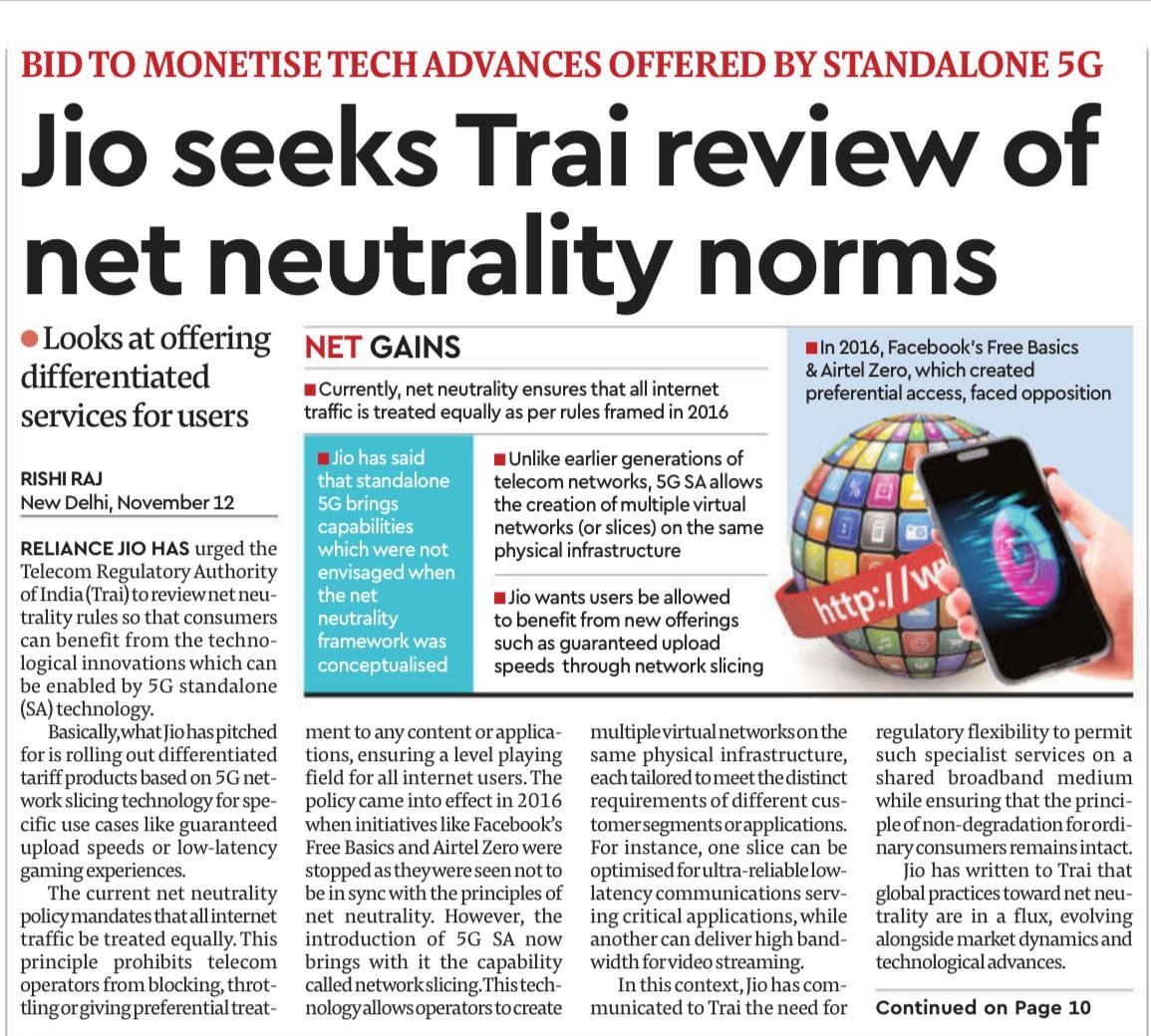
Based on this press report where Jio has sought a review of Net Neutrality regulations. As a first step we are writing to the TRAI and also filing a RTI for the public disclosure of any information. IFF remains committed to #SaveTheInternet

"Our generation must act now to save the free Internet our fathers built! What once promised open info is now a tool of control. ~ Durov
#SaveTheInternet #FreeSpeech #EndControl #DigitalFreedom #PavelDurov


I'm surprised YouTube just automatically enabled the AI dub on my channel. Great. You know what? I disabled the auto AI dub! No A.I dub in my channel! I want to get rid of the AI slop from YouTube!
#BoycottYouTube #NoAI #SaveTheInternet


Been thinking about CTOs. We CTO'd @CatalinaWhales and have no regrets.
We talk a lot about money/vibes/clout in web3, but not enough about love. Love is what gets you through the pain.
After all, if you're bound to marry your bag, you better love that bitch.
#SaveTheInternet

Every day people ask me for advice on how to CTO/derug a project.
This is the best advice you will get.
Don't Do It.
I know you want to believe that this time is different, that you are different, that this project is different.
It's not.
There are only two possible outcomes:
1) You CTO in bad faith and exploit others.
2) You CTO in good faith and make enormous sacrifices just so that others can exploit you.
Even if you start out in good faith, you will be under constant pressure to pivot to bad faith. Many of the most notorious villains in web3 didn't start out as villains; they just caved to the inexorable pressure to break bad.
Is it literally impossible? No.
But in the extremely extremely unlikely event that you have all the necessary elements to capture lightning in a bottle, success will require you getting exploited many times. Not just once.
I consider Galactic Geckos a modest success. But despite having top tier art, provenance, community, blockchain, etc, we have barely scratched the surface of our potential.
The market may need us, but most of the market doesn't want us, yet - it wants scams. We are right, but we are early.
And at what cost has our success been achieved?
I have worked long hours for 1,300 days straight without any break or vacation.
I have put 7 figures of my own money into the project, to purchase the IP and to acquire my personal Gecko collection. All purchased on the open market from other holders - nothing minted to myself for free.
Gave hundreds of thousands of dollars of interest free loans to support community members, much of which never got repaid.
The total value generated for holders has been massive. Nevertheless, many of the people that benefited the most sold everything and left rather than repay the money they owed me or even acknowledge the Gecko profits they made. Some don't even realize how much they made, as if the money fairy just magically blessed their wallet, repeatedly.
It took many many iterations of curating out extractors to get to the community we have today. Which is not just one of the best communities in web3 but the best community I've ever seen on the internet.
Maybe you want that too, but are you willing to pay the price?
Are you willing to get rinsed repeatedly for years and keep conviction through it all?
Do you have enough money saved so that you can work for free for half a decade or longer, until the job is finished?
If you are in it for the money, Don't Do It.
If you are in it for the vibes, Don't Do It.
If you are in it for the clout, Don't Do It.
If you are in it for the people, be honest with yourself. And go in with your eyes wide open.

Hi Folks, I drew my own Clippy Protest Art to protest against nasty government folks who did bad shit via censoring and surveilling everybody on the internet and world! They lied about protecting kids!
#clippy #savetheinternet #internetfreedom #digitalfreedom #freedomonline


Be like Ben.
Believe in the Jeeter Deleter.
Serious platform-level asset protection.
$ENT .$ave.thE.iNterneT. #ItsNothing

Another note on #SaveTheInternet:
The Internet Protocol's lack of native support for capital transfer led to the web2 hub-and-spoke model of information control. Hubs became centralized platforms only because centralized platforms could form capital at scale.
Web3 tech allows capital to form in any configuration. One no longer needs to enter a walled garden to get paid—at least in theory. Let's not be naïve, however: centralized platforms are not going anywhere and the hub-and-spoke model will dominate for the foreseeable future. Nevertheless, there is a difference between the hub-and-spoke organization of colonial mercantilism and that of thalassocratic order.
In the latter, hubs are akin to maritime city states that live in symbiosis with the provincial inland. The former is not really worth thinking about in the context of today's Internet because, while there are a lot of cool things being built out in the wild of the World Wide Web, there is a reason it remains unmonetized. Web3 offers us a way to change that, not by monetizing the unmonetizable, but by giving us tools to build things that would otherwise be impossible: we can now build a hinterland to the walled hubs that may be useful in the broader landscape.
Why even do this? Looking at history through the lens of relations between city and country, the existence of countryside almost appears paradoxical: why does anyone choose to live outside of the area of peak cultural potential. In modern times, the US coastal elites would deride these areas as flyover country. In a mercantilist worldview, the only reason such places exist is because they hold a monopoly over some commodity; the merchant quickly seeks to break their power over it through skillful control of capital flows. Because there is no penalty to movement on the Internet, the concept of countryside appears entirely unnecessary.
Yet what the mercantilists do not realize is that the dark area on the map is exactly what their entire existence depends on: it is the source of culture itself.
At first glance, this is entirely backwards: it is cities that give rise to the best of culture. However, that is looking at history backwards: while the merchants stay busy in the capitalist rat race, their aesthetics, their rituals, their very identity are replenished by traditions and values carried from the hinterland. Without these wells of law, myth, and cohesion, the city burns itself out.
In the context of the Internet, these safe spaces are the forums, DAOs, and subcultures that resist being fully financialized. This is where culture is incubated, where identities sharpen, and where meaning is made before it gets packaged and sold to the hubs. In an attention economy, it is where attention takes root before it may be ready for wider distribution.
Many of those building web3 tech or optimizing web3 capital flows are missing the importance of culture. Culture is not defined by either technology or finance. While it may serve as a rallying cry, basing a culture around dominance in either field risks an eventual burnout after that dominance reaches its zenith. Technology and capital are mercenary pursuits and know no loyalty.
In the Internet of the future, successful platforms will learn to occasionally rely on their brand to survive periods of slow growth. The success of their brands will rely on support from outside the castle walls: the surrounding villages will occasionally be called upon to reinforce morale when there is no money to spend. At that point, cultural capital will come to the rescue of monetary capital.
The takeaway is this: Do not underestimate the importance of culture as we build out the Internet. Invest in culture, even if you do it for pure monetary gain.

Another note on #SaveTheInternet:
The Internet Protocol's lack of native support for capital transfer led to the web2 hub-and-spoke model of information control. Hubs became centralized platforms only because centralized platforms could form capital at scale.
Web3 tech allows capital to form in any configuration. One no longer needs to enter a walled garden to get paid—at least in theory. Let's not be naïve, however: centralized platforms are not going anywhere and the hub-and-spoke model will dominate for the foreseeable future. Nevertheless, there is a difference between the hub-and-spoke organization of colonial mercantilism and that of thalassocratic order.
In the latter, hubs are akin to maritime city states that live in symbiosis with the provincial inland. The former is not really worth thinking about in the context of today's Internet because, while there are a lot of cool things being built out in the wild of the World Wide Web, there is a reason it remains unmonetized. Web3 offers us a way to change that, not by monetizing the unmonetizable, but by giving us tools to build things that would otherwise be impossible: we can now build a hinterland to the walled hubs that may be useful in the broader landscape.
Why even do this? Looking at history through the lens of relations between city and country, the existence of countryside almost appears paradoxical: why does anyone choose to live outside of the area of peak cultural potential. In modern times, the US coastal elites would deride these areas as flyover country. In a mercantilist worldview, the only reason such places exist is because they hold a monopoly over some commodity; the merchant quickly seeks to break their power over it through skillful control of capital flows. Because there is no penalty to movement on the Internet, the concept of countryside appears entirely unnecessary.
Yet what the mercantilists do not realize is that the dark area on the map is exactly what their entire existence depends on: it is the source of culture itself.
At first glance, this is entirely backwards: it is cities that give rise to the best of culture. However, that is looking at history backwards: while the merchants stay busy in the capitalist rat race, their aesthetics, their rituals, their very identity are replenished by traditions and values carried from the hinterland. Without these wells of law, myth, and cohesion, the city burns itself out.
In the context of the Internet, these safe spaces are the forums, DAOs, and subcultures that resist being fully financialized. This is where culture is incubated, where identities sharpen, and where meaning is made before it gets packaged and sold to the hubs. In an attention economy, it is where attention takes root before it may be ready for wider distribution.
Many of those building web3 tech or optimizing web3 capital flows are missing the importance of culture. Culture is not defined by either technology or finance. While it may serve as a rallying cry, basing a culture around dominance in either field risks an eventual burnout after that dominance reaches its zenith. Technology and capital are mercenary pursuits and know no loyalty.
In the Internet of the future, successful platforms will learn to occasionally rely on their brand to survive periods of slow growth. The success of their brands will rely on support from outside the castle walls: the surrounding villages will occasionally be called upon to reinforce morale when there is no money to spend. At that point, cultural capital will come to the rescue of monetary capital.
The takeaway is this: Do not underestimate the importance of culture as we build out the Internet. Invest in culture, even if you do it for pure monetary gain.
Another note on #SaveTheInternet:
The Internet Protocol's lack of native support for capital transfer led to the web2 hub-and-spoke model of information control. Hubs became centralized platforms only because centralized platforms could form capital at scale.
Web3 tech allows capital to form in any configuration. One no longer needs to enter a walled garden to get paid—at least in theory. Let's not be naïve, however: centralized platforms are not going anywhere and the hub-and-spoke model will dominate for the foreseeable future. Nevertheless, there is a difference between the hub-and-spoke organization of colonial mercantilism and that of thalassocratic order.
In the latter, hubs are akin to maritime city states that live in symbiosis with the provincial inland. The former is not really worth thinking about in the context of today's Internet because, while there are a lot of cool things being built out in the wild of the World Wide Web, there is a reason it remains unmonetized. Web3 offers us a way to change that, not by monetizing the unmonetizable, but by giving us tools to build things that would otherwise be impossible: we can now build a hinterland to the walled hubs that may be useful in the broader landscape.
Why even do this? Looking at history through the lens of relations between city and country, the existence of countryside almost appears paradoxical: why does anyone choose to live outside of the area of peak cultural potential. In modern times, the US coastal elites would deride these areas as flyover country. In a mercantilist worldview, the only reason such places exist is because they hold a monopoly over some commodity; the merchant quickly seeks to break their power over it through skillful control of capital flows. Because there is no penalty to movement on the Internet, the concept of countryside appears entirely unnecessary.
Yet what the mercantilists do not realize is that the dark area on the map is exactly what their entire existence depends on: it is the source of culture itself.
At first glance, this is entirely backwards: it is cities that give rise to the best of culture. However, that is looking at history backwards: while the merchants stay busy in the capitalist rat race, their aesthetics, their rituals, their very identity are replenished by traditions and values carried from the hinterland. Without these wells of law, myth, and cohesion, the city burns itself out.
In the context of the Internet, these safe spaces are the forums, DAOs, and subcultures that resist being fully financialized. This is where culture is incubated, where identities sharpen, and where meaning is made before it gets packaged and sold to the hubs. In an attention economy, it is where attention takes root before it may be ready for wider distribution.
Many of those building web3 tech or optimizing web3 capital flows are missing the importance of culture. Culture is not defined by either technology or finance. While it may serve as a rallying cry, basing a culture around dominance in either field risks an eventual burnout after that dominance reaches its zenith. Technology and capital are mercenary pursuits and know no loyalty.
In the Internet of the future, successful platforms will learn to occasionally rely on their brand to survive periods of slow growth. The success of their brands will rely on support from outside the castle walls: the surrounding villages will occasionally be called upon to reinforce morale when there is no money to spend. At that point, cultural capital will come to the rescue of monetary capital.
The takeaway is this: Do not underestimate the importance of culture as we build out the Internet. Invest in culture, even if you do it for pure monetary gain.

Another note on #SaveTheInternet:
The Internet Protocol's lack of native support for capital transfer led to the web2 hub-and-spoke model of information control. Hubs became centralized platforms only because centralized platforms could form capital at scale.
Web3 tech allows capital to form in any configuration. One no longer needs to enter a walled garden to get paid—at least in theory. Let's not be naïve, however: centralized platforms are not going anywhere and the hub-and-spoke model will dominate for the foreseeable future. Nevertheless, there is a difference between the hub-and-spoke organization of colonial mercantilism and that of thalassocratic order.
In the latter, hubs are akin to maritime city states that live in symbiosis with the provincial inland. The former is not really worth thinking about in the context of today's Internet because, while there are a lot of cool things being built out in the wild of the World Wide Web, there is a reason it remains unmonetized. Web3 offers us a way to change that, not by monetizing the unmonetizable, but by giving us tools to build things that would otherwise be impossible: we can now build a hinterland to the walled hubs that may be useful in the broader landscape.
Why even do this? Looking at history through the lens of relations between city and country, the existence of countryside almost appears paradoxical: why does anyone choose to live outside of the area of peak cultural potential. In modern times, the US coastal elites would deride these areas as flyover country. In a mercantilist worldview, the only reason such places exist is because they hold a monopoly over some commodity; the merchant quickly seeks to break their power over it through skillful control of capital flows. Because there is no penalty to movement on the Internet, the concept of countryside appears entirely unnecessary.
Yet what the mercantilists do not realize is that the dark area on the map is exactly what their entire existence depends on: it is the source of culture itself.
At first glance, this is entirely backwards: it is cities that give rise to the best of culture. However, that is looking at history backwards: while the merchants stay busy in the capitalist rat race, their aesthetics, their rituals, their very identity are replenished by traditions and values carried from the hinterland. Without these wells of law, myth, and cohesion, the city burns itself out.
In the context of the Internet, these safe spaces are the forums, DAOs, and subcultures that resist being fully financialized. This is where culture is incubated, where identities sharpen, and where meaning is made before it gets packaged and sold to the hubs. In an attention economy, it is where attention takes root before it may be ready for wider distribution.
Many of those building web3 tech or optimizing web3 capital flows are missing the importance of culture. Culture is not defined by either technology or finance. While it may serve as a rallying cry, basing a culture around dominance in either field risks an eventual burnout after that dominance reaches its zenith. Technology and capital are mercenary pursuits and know no loyalty.
In the Internet of the future, successful platforms will learn to occasionally rely on their brand to survive periods of slow growth. The success of their brands will rely on support from outside the castle walls: the surrounding villages will occasionally be called upon to reinforce morale when there is no money to spend. At that point, cultural capital will come to the rescue of monetary capital.
The takeaway is this: Do not underestimate the importance of culture as we build out the Internet. Invest in culture, even if you do it for pure monetary gain.
Another note on #SaveTheInternet:
The Internet Protocol's lack of native support for capital transfer led to the web2 hub-and-spoke model of information control. Hubs became centralized platforms only because centralized platforms could form capital at scale.
Web3 tech allows capital to form in any configuration. One no longer needs to enter a walled garden to get paid—at least in theory. Let's not be naïve, however: centralized platforms are not going anywhere and the hub-and-spoke model will dominate for the foreseeable future. Nevertheless, there is a difference between the hub-and-spoke organization of colonial mercantilism and that of thalassocratic order.
In the latter, hubs are akin to maritime city states that live in symbiosis with the provincial inland. The former is not really worth thinking about in the context of today's Internet because, while there are a lot of cool things being built out in the wild of the World Wide Web, there is a reason it remains unmonetized. Web3 offers us a way to change that, not by monetizing the unmonetizable, but by giving us tools to build things that would otherwise be impossible: we can now build a hinterland to the walled hubs that may be useful in the broader landscape.
Why even do this? Looking at history through the lens of relations between city and country, the existence of countryside almost appears paradoxical: why does anyone choose to live outside of the area of peak cultural potential. In modern times, the US coastal elites would deride these areas as flyover country. In a mercantilist worldview, the only reason such places exist is because they hold a monopoly over some commodity; the merchant quickly seeks to break their power over it through skillful control of capital flows. Because there is no penalty to movement on the Internet, the concept of countryside appears entirely unnecessary.
Yet what the mercantilists do not realize is that the dark area on the map is exactly what their entire existence depends on: it is the source of culture itself.
At first glance, this is entirely backwards: it is cities that give rise to the best of culture. However, that is looking at history backwards: while the merchants stay busy in the capitalist rat race, their aesthetics, their rituals, their very identity are replenished by traditions and values carried from the hinterland. Without these wells of law, myth, and cohesion, the city burns itself out.
In the context of the Internet, these safe spaces are the forums, DAOs, and subcultures that resist being fully financialized. This is where culture is incubated, where identities sharpen, and where meaning is made before it gets packaged and sold to the hubs. In an attention economy, it is where attention takes root before it may be ready for wider distribution.
Many of those building web3 tech or optimizing web3 capital flows are missing the importance of culture. Culture is not defined by either technology or finance. While it may serve as a rallying cry, basing a culture around dominance in either field risks an eventual burnout after that dominance reaches its zenith. Technology and capital are mercenary pursuits and know no loyalty.
In the Internet of the future, successful platforms will learn to occasionally rely on their brand to survive periods of slow growth. The success of their brands will rely on support from outside the castle walls: the surrounding villages will occasionally be called upon to reinforce morale when there is no money to spend. At that point, cultural capital will come to the rescue of monetary capital.
The takeaway is this: Do not underestimate the importance of culture as we build out the Internet. Invest in culture, even if you do it for pure monetary gain.
I'll be writing more about #SaveTheInternet in the coming days, but here I wanted to make a comment relevant to the assassination of Charlie Kirk and where we are as a culture:
The MAGA movement was born online, rooted in social grievances. What has greatly exacerbated things is the corporate culture capture with the rise of web2.
The core issue is that the Internet Protocol is not able to move packets of capital. Web2 provides a fix, but only large entities may fund large platforms.
The result: Internet culture has become consumerist; the only edge able to survive is the kind that stays "on brand". Anything off brand gets splintered and feeds division.
Web3 promises a real solution. Four years ago, that was consensus. But after waves of wealth extraction, we have fallen back into zero-sum games with each other—games Wall Street will always win.
We need to play long-term games again—this time with long-term people. It's time to exhibit courage in conviction and empathy for the commons. We have the tools; we just need to put them to use.
What is meant by "Internet Capital Markets"?
Is it compatible with an Internet-based commons?
ICM is a term designed to make you think:
✅ Capital, assets, markets
At no point does it evoke:
❌ Culture, people, commonwealth
#SaveTheInternet


The EU parliament wants #Uploadfilter, #Article13, etc. Let's show them that millions of Europeans are against it to prevent the threat of censorship on the internet!
5.3 million signers so far! #SavetheInternet


The @RBI has been a #RogueRegulator for long. Let it publish the feedback and level of participation to the consultation on that policy, seek counter submissions like @TRAI does.
Internet remained neutral by #SaveTheInternet, banks (esp public sector) will no longer be.

After the RBI’s draft #goldloan guidelines, the Finance Ministry has intervened and sent its recommendations to the RBI. But the problem runs deeper. BEFI VP @cpkrishnan1959 breaks it down in this week’s #InPublicInterest.
Link: https://t.co/u7Q5F0xu0D

If you value what we do, now’s the time to step up.
💜 Become a member
💸 Make a one-time donation
🎯 Start a fundraiser
Every rupee helps!
#SaveTheInternet #SupportIFF #DigitalRights
https://t.co/JSUSIbWCWh
Thank you for being part of our community. If you believe in privacy, free speech, and digital rights, support us: become a member or donate today 💜
https://t.co/BXM62MLLLd 4/4
#SupportDigitalRights #SaveTheInternet
Trends for you
Most Popular Users

Elon Musk 
@elonmusk
240.8M followers

Barack Obama
@barackobama
119.2M followers

Donald J. Trump
@realdonaldtrump
111.7M followers

Cristiano Ronaldo
@cristiano
111.3M followers

Narendra Modi
@narendramodi
107M followers

Rihanna
@rihanna
97.8M followers

NASA
@nasa
92.2M followers

Justin Bieber
@justinbieber
91.1M followers

KATY PERRY
@katyperry
88.1M followers

Taylor Swift
@taylorswift13
81.9M followers

Lady Gaga
@ladygaga
73.4M followers

Virat Kohli
@imvkohli
70.5M followers

Kim Kardashian
@kimkardashian
70M followers

YouTube
@youtube
68.7M followers

Bill Gates
@billgates
64.1M followers

Neymar Jr
@neymarjr
63.3M followers

The Ellen Show
@theellenshow
62.4M followers

CNN
@cnn
61.9M followers

Selena Gomez
@selenagomez
61.1M followers

X
@x
60.8M followers