

Top Tweets for #ScienceOfConsensus


The next frontier is Symbiotic AI: shared agency with shared reality.
#ScienceOfConsensus

#SovereignAI solves control.
#SymbioticAI solves coherence.
Most discussions around #AbundanceAI stop at ownership:
who controls the model, the data, the compute.
That’s Sovereign AI — and it matters.
Without sovereignty, abundance just recentralizes.
But sovereignty alone is not enough.
When humans and machines both execute,
the real failure mode isn’t loss of control —
it’s loss of shared reality.
Abundance AI breaks not because intelligence is scarce,
but because meaning fragments:
unattributed work, unverifiable processes,
outcomes detached from how they were produced.
This is where Symbiotic AI begins.
Symbiotic AI assumes shared agency —
human ↔ AI ↔ AI —
and asks a harder question:
how do we keep intelligence coherent, auditable, and accumulative at scale?
Abundance only compounds
when contribution is legible,
process is verifiable,
and trust is enforced by systems, not institutions.
Otherwise abundance degrades into noise.
This is why the next AI era
is not just about owning models,
but about governing causality.
#DeepIntelligenceThought
When science can compound through:
Agentic flow + shared memory + verifiable outcomes
→ #ScienceOfConsensus.
#SymbioticAI taking shape — not in theory, but in practice.
Excited to build with @ChainforGood pushing this forward.
#DeepIntelligenceMoney

The shift is happening.
DeSci is moving from idealism to implementation. People aren't just talking about decentralized science anymore, they're building, interacting, and collaborating in a decentralized economy.
This is what real progress looks like. 🧬🔬
#BGA #BGAwards @hetu_protocol
#ScienceOfConsensus
There’s a pretty simple takeaway here:
if today’s models can already red-team contracts into $4.6M of simulated exploits, tomorrow’s models will turn every latent bug in our financial infrastructure into an active attack surface.
This isn’t just “more audits needed” — it’s a regime shift.
Manual review and ad-hoc testing can’t keep up with autonomous agents probing every corner of a chain 24/7.
At Advaita, we’re pushing in the opposite direction of this fragility:
AI-assisted formal verification for contracts, protocols, and execution systems — so the same intelligence that finds exploits can also prove invariants, synthesize safer designs, and give us cryptographic, mathematically checkable guarantees instead of vibes.
If AI is going to weaponize bugs, we need AI that can industrialize proofs.

New on our Frontier Red Team blog: We tested whether AIs can exploit blockchain smart contracts.
In simulated testing, AI agents found $4.6M in exploits.
The research (with @MATSprogram and the Anthropic Fellows program) also developed a new benchmark: https://t.co/QpGPMqlDRG
#ScienceOfConsensus
Recent LLM advances keep pushing reasoning forward — but they expose a deeper structural limit:
a solitary model, no matter how strong, cannot reliably solve the hardest reasoning problems.
Difficult math, compositional logic, open-ended analysis — these don’t require more depth from one mind,
they require divergence across many minds.
So the field moved toward multi-agent systems:
multiple independent reasoning trajectories exploring the problem space in parallel.
This expands intelligence — but it also surfaces the real bottleneck:
How do stochastic, non-deterministic agents reach shared truth?
What does “agreement” even mean for systems that refine themselves differently each run?
This is where previous multi-agent setups all collapsed.
They lacked a principled mechanism for:
•establishing intersubjective agreement
•detecting convergence early
•canceling redundant computation
•minimizing latency without sacrificing correctness
•turning stochastic exploration into stable knowledge
They relied on heuristics instead of structure.
At Advaita Research, we treat this not as an engineering glitch,
but as a foundational scientific problem:
👉 How do many minds coordinate meaning into truth?
👉 How do you formalize consensus in systems that are inherently non-deterministic?
👉 How do you convert intelligence into knowledge with minimal waste?
This is the core of the Science of Consensus.
Our work introduces a coordination architecture that embeds consensus inside the inference process rather than bolting it on afterward:
•intersubjective consensus as a first-class computational object
•progressive quorum detection that identifies convergence in real time
•causal cancellation of slow or redundant reasoning paths
•latency bounded by agreement, not by stragglers
•stable truth emerging from stochastic exploration
The result is not just “better accuracy.”
It is a different ontology of intelligence:
•Over 200% improvement on IMO-level tasks
•60–70% lower latency compared to previous multi-agent systems
•Dramatically reduced compute waste
•More reliable reasoning under uncertainty
Because once consensus becomes part of the architecture,
multi-agent systems stop behaving like a swarm of independent models —
and transform into a coherent reasoning organism.
And that is the central insight:
The future of AI isn’t bigger models.
Consensus coordinates intelligence,
intelligence generates science,
science crystallises civilization.

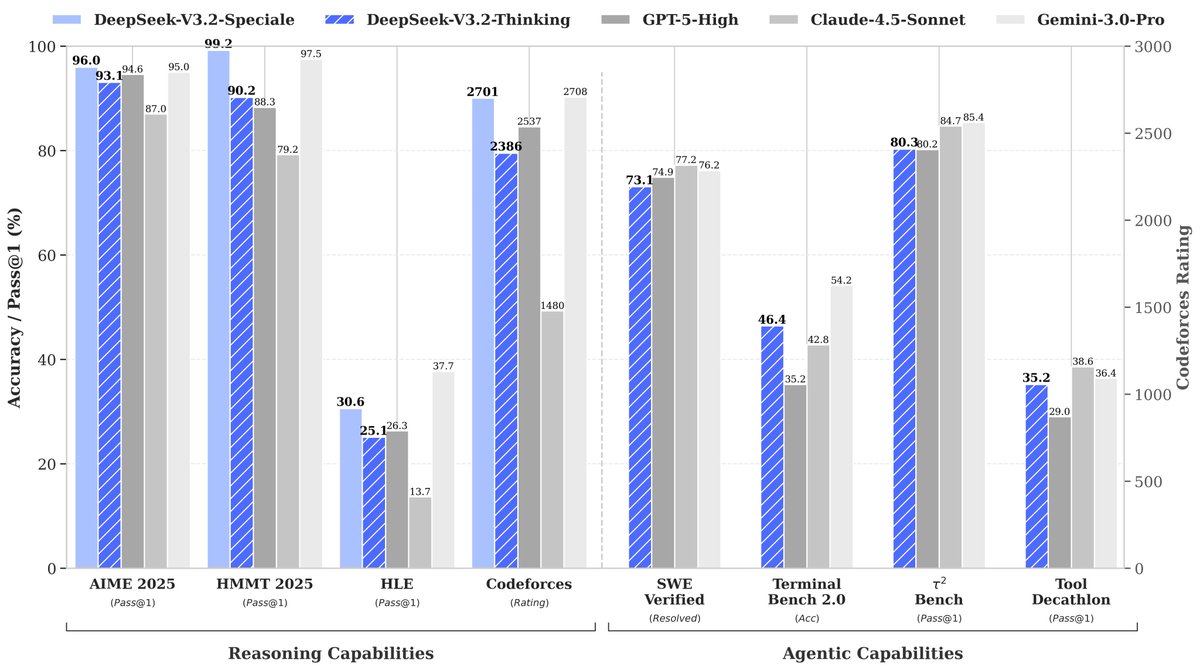
🚀 Launching DeepSeek-V3.2 & DeepSeek-V3.2-Speciale — Reasoning-first models built for agents!
🔹 DeepSeek-V3.2: Official successor to V3.2-Exp. Now live on App, Web & API.
🔹 DeepSeek-V3.2-Speciale: Pushing the boundaries of reasoning capabilities. API-only for now.
📄 Tech report: https://t.co/7EyydyNuG0
1/n
In the name of the #ScienceOfConsensus — after years assembling a frontier research team — we enter a new era: #ResearchAsCivilization
Upgrading to Advaita Research means building the substrate where-
consensus generates intelligence,
intelligence generates science,
and science crystallises civilization.
We are creating the world’s first Intelligence Consensus Layer — powered by an original mechanism:
Proof of Intersubjective Intelligence (PoII).
PoII treats intelligence as something emergent, not individual.
Meaning forms and stabilizes through
intent → reasoning → verification → consensus,
turning intelligence into a network property that can align, adapt, and evolve.
On this substrate, science becomes a continuous system —
a self-verifying, self-correcting, self-evolving engine
capable of generating new hypotheses, models, and truths at civilization scale.
Welcome to Advaita Research.
Where collective intelligence becomes scientific ontology —
and where science becomes a living protocol for civilization.
#AdvaitaResearch #ScienceOfConsensus #IntelligenceConsensusLayer #ResearchAsCivilization
Last Seen Hashtags on Sotwe
monkeyapp
Seen from Netherlands
monekyapp
Seen from Brazil
بالكيلوت
Seen from Turkey
ميقا_حصريات
Seen from Netherlands
ruthlee #onlyfans
Seen from Turkey
sorunumuz
Seen from United States
elTiempoFindeSemana
Seen from Netherlands
humping
Seen from Turkey
BusinessandCreativity
Seen from United States
incesto real
Seen from Turkey
Most Popular Users

Elon Musk 
@elonmusk
240.6M followers

Barack Obama
@barackobama
119.2M followers

Donald J. Trump
@realdonaldtrump
111.7M followers

Cristiano Ronaldo
@cristiano
110.6M followers

Narendra Modi
@narendramodi
107M followers

Rihanna
@rihanna
97.7M followers

NASA
@nasa
92.2M followers

Justin Bieber
@justinbieber
90.9M followers

KATY PERRY
@katyperry
87.7M followers

Taylor Swift
@taylorswift13
81.5M followers

Lady Gaga
@ladygaga
73.1M followers

Virat Kohli
@imvkohli
69.9M followers

Kim Kardashian
@kimkardashian
69.8M followers

YouTube
@youtube
68.7M followers

Bill Gates
@billgates
63.9M followers

Neymar Jr
@neymarjr
62.7M followers

The Ellen Show
@theellenshow
62.4M followers

CNN
@cnn
61.9M followers

X
@x
60.8M followers

Selena Gomez
@selenagomez
60.8M followers