

Top Tweets for #Sequential

NQ took the Q3 low. ES didn't.
That's sequential SMT, and Quarterly Theory tells you when to look for it.

1) ZK rollups face a massive bottleneck: verifying millions of proofs sequentially destroys on-chain throughput.
Heavy elliptic curve pairings create high gas costs and slow L1 finality.
Scaling ZK requires compressing computation before touching L1.
@RialoHQ

@PrismaXai High-Throughput Without Gas Wars
5) Independent swaps, mints, and transfers execute concurrently in the same block without fighting for sequential queue space. @PrismaXai eliminates execution bottlenecks while maintaining strict state consensus.
@PrismaXai Multi-Core Hardware Scaling
4) Sequential chains leave modern multi-core validator CPUs 90% idle. By mapping execution graphs at block ingress, @PrismaXai scales throughput linearly with hardware cores while keeping 100% EVM bytecode compatibility.
The Sequential EVM Bottleneck
1) Standard EVMs process transactions one-by-one, creating massive congestion and gas spikes even when transactions don't touch the same state. The alpha fix? Deterministic Parallel EVM Execution via Static Dependency Graphs on @PrismaXai.


$GLOB Globant S.A. Q3 2026 Earnings
• Rev: $611.14M (-1.0% YoY, beat ~$610.9M est)
• https://t.co/u52g0TYiwf ARR: $106.6M (more than doubled QoQ)
• Adj. Operating Margin: 14.1% (up sequentially)
• Non-GAAP Diluted EPS: $1.48 (in line with $1.48 est)
• Q3 FCF: $77.2M (9M record $125.9M) | Cash: $153.6M
Doubles share buyback authorization to $250M & raises year-end https://t.co/u52g0TYiwf ARR target to >$130M, though Q4 rev guidance ($596–604M) trails $610M consensus!
#GLOB #Globant #AI

⚡Understanding Parallel Execution
Interesting aspect of @pharos_network parallel execution architecture.
Instead of approaching execution as purely sequential process, parallel execution is designed to enable multiple operations to processed concurrently.
Key for scalability

@Matheus_Builder That is a great point…
we rely on `SET LOCAL` resetting at the end of the transaction right now, but explicitly testing sequential queries across two workspaces on a single pooled connection is a super smart regression check.

Yo Ron i know you were think of buying a nsx, you should message boostedboiz he’s got like 3 of them, one clean stock one and one that makes 1000+ hp sequential. Might be a good yt vid

Some early incremental milestones—such as the formation of a cellular mass, early limb budding, head formation, and progressive differentiation—broadly mirror the sequential nature of human growth without microscopes or ultrasound
A Hindu scripture attributed to Sage Pippalada


@SerhanYavcin 29.9% should be printed on every A/B dashboard. Daily peeking is the default, so most "winners" that get shipped are noise with a green badge. Why mSPRT over group-sequential alpha spending — easier to explain, or better power at small n?

@SerhanYavcin The daily-peeking trap catches almost everyone. Fixing the sample size up front, or moving to sequential testing, beats trusting the willpower to not look. Nice that the SDK keeps the outputs on the customer's server too, that's a real selling point.

Parallel agent branches save time only when effects are independent. Run two branches against one case record; compare elapsed time, conflicting writes and the final decision with a sequential baseline. Which dependency would you make explicit first? #AgentEvals

$NDAQ
Ever since QT, Sequential & SSMT came into my life, my trading accuracy has improved significantly. More importantly, trading has brought a sense of peace and confidence into my life.
#quarterlytheory #ssmt #qs #QuarterSequence


I've been building an automated pipeline for short video generation, I've shared some steps by publishing some articles already, here how it looks lately :)
It is not yet a fully motion video, it's the combined image generation sequentially put together as frames by following the master image approach: https://t.co/49bsJ79wx4
Next, I'm working on adding the real motion, now this is how it looks:
https://t.co/0P0Zy7cbzq
Generate images in Hermes using eligible Codex subscription access, then reuse one master character for different facial expressions and actions. A practical guide with setup commands, copyable prompts, real examples and checks for character consistency. https://t.co/fAgtL2SD5I

Why linear workflows struggle in agent systems
A → B → C → D
This works when every task depends on the previous one.
But if B, C, and D are independent, sequential execution adds unnecessary waiting.
Use a DAG to reflect real dependencies and run tasks in parallel.
Ondas Inc. $ONDS Q3 2026 Earnings Highlights:
Record quarterly revenue doubled sequentially and beat estimates, paired with a raised FY26 outlook and bold FY27 targets:
Revenue: $167.5M (+1,558% YoY / +100% QoQ)
Pro Forma Organic Growth: +64% YoY
Backlog: $835M (+36% QoQ, with $214M in Q3 bookings)
Cash & Short-Term Investments: $820.3M
Adjusted EBITDA: -$59.7M (GAAP Net Loss: -$64.7M)
Key Takeaways:
• Raised FY26 revenue guidance to at least $550M (implying >$250M in Q4).
• Issued initial FY27 revenue guidance of at least $1.1B (>40% organic growth, excluding new M&A) and expects consolidated Adj. EBITDA profitability by Q3 2027.
• Defense momentum continues with a $982M U.S. Army unmanned systems contract and initial deliveries on its $140M countermine program.
• Scaling ULTRA UAV production with the planned acquisition of German airframe maker Stemme.
#ONDS #DefenseTech #Drones #Earnings #Investing

Highly Efficient Cobalt/Nickel-Catalyzed Sequential Disilylation of Alkenes

Breaking Report
Highly Efficient Cobalt/Nickel-Catalyzed Sequential Disilylation of Alkenes
https://t.co/ZydDARyuHj
#CJC #Chemistry #Organic #ChemTwitter #OrgChem


Highly Efficient Cobalt/Nickel-Catalyzed Sequential Disilylation of Alkenes
Breaking Report
Highly Efficient Cobalt/Nickel-Catalyzed Sequential Disilylation of Alkenes
https://t.co/ZydDARyuHj
#CJC #Chemistry #Organic #ChemTwitter #OrgChem

Learning generative dynamics for 3D molecule generation via sequential neuro-symbolic constraints
1 SensDiff is a diffusion framework that explicitly encodes physicochemical rules into training-time generative dynamics, aiming to reduce the common failure mode where diffusion samples look statistically plausible but violate chemistry (e.g., clashes, inconsistent bonds, invalid valence).
2 The core hypothesis is that 3D molecule diffusion denoising evolves coarse-to-fine: models must first resolve macroscopic geometric conflicts, then refine bond geometry, and only later settle chemically consistent topology/valence. SensDiff mirrors this by enforcing constraints sequentially during training.
3 It builds a differentiable “molecular interface” from latent diffusion states to a symbolic state (R, A, B): decoded 3D coordinates R, soft atom-type distributions A (kept soft to preserve gradients), and soft bond posteriors B from a dedicated bond head, enabling constraints to act directly on intermediate denoising states.
4 Domain knowledge is translated into differentiable energy terms using soft truth values kappa in (0,1), mapped to energies via negative log satisfaction. This yields interpretable, rule-grounded losses rather than opaque heuristics, and provides gradients that penalize chemically invalid intermediates.
5 SensDiff uses four constraint energies: steric non-overlap (Eclash), bond-length consistency (Ebond_len), bond-angle consistency in cosine space for stability (Eangle), and valence validity based on expected bond order under soft bonds (Eval). Chemistry statistics (distance/bond/angle priors) are precomputed from data and interpolated under soft atom identities.
6 Training follows a staged curriculum: Stage 1 activates clashes, Stage 2 adds bond lengths, Stage 3 adds bond angles, Stage 4 adds valence. A stage-wise adaptive weighting strategy linearly ramps up each new constraint and then increases weight based on the rolling constraint satisfaction, reducing instability from competing gradients.
7 Symbolic constraints are applied to a one-step reverse surrogate state during training (not only the final sample), so gradients propagate through the reverse kernel back to the denoiser. This is meant to “internalize” scientific priors in parameters, rather than relying on inference-time guidance alone.
8 On unconditional generation, SensDiff reports improved validity/stability on QM9 and GEOM-Drugs versus a broad set of diffusion baselines (e.g., EDM, GEOLDM, SLDM, UAE-3D, UniGEM), with particularly notable gains in stability metrics (chemical/geometric coherence).
9 On conditional generation (QM9 quantum-property targets), SensDiff achieves lower MAE across properties (Cv, dipole moment, polarizability, HOMO/LUMO, gap), suggesting that enforcing geometry-consistent intermediates can improve controllability for geometry-dependent properties.
10 For real-world constrained design, the paper demonstrates sampling-time constraint enforcement (without retraining) for multi-objective oral drug design, steering molecules to satisfy up to seven constraints (LogP, MW, TPSA, HBD, HBA, QED, SA) while aiming to preserve structural validity.
💻Code: https://t.co/EintbRi4iC
📜Paper: https://t.co/JeBd9dkgni
#DiffusionModels #MoleculeGeneration #ComputationalChemistry #Cheminformatics #NeuroSymbolicAI #3DGeometry #DrugDiscovery #NeurIPS2026


That is the cleanest distinction between drift and a split fleet I have seen articulated.
You are completely right: alternating A-B-A across a load balancer with no convergence is not a deploy transition, it is a multi-headed endpoint. A sequential confirm rule is blind to it because neither shape gets two consecutive hits.
To answer plainly:
1No, the card does not expose distinct shapes over a window today. It tracks current subject, last confirmed baseline, and pending candidate.
2The threshold: 2 distinct schema hashes on the same subject persisting past a typical rollout window (we think 6 to 12 probe cycles / hours) is not a deploy in flight, it is a split fleet.
We are adding distinct_shapes_24h to the health card payload. If distinct_shapes_24h > 1 and pending does not converge, the verdict should flip from "pending drift" to "heterogeneous fleet".
Does 2 shapes over a 12h horizon match what you see in production for stalled rollouts?

@coffeegrafiska itd be way too choppy with some Q's having sequential decreases in PIF, but with $PGR being so big this is a good proxy for the market rate for the industry
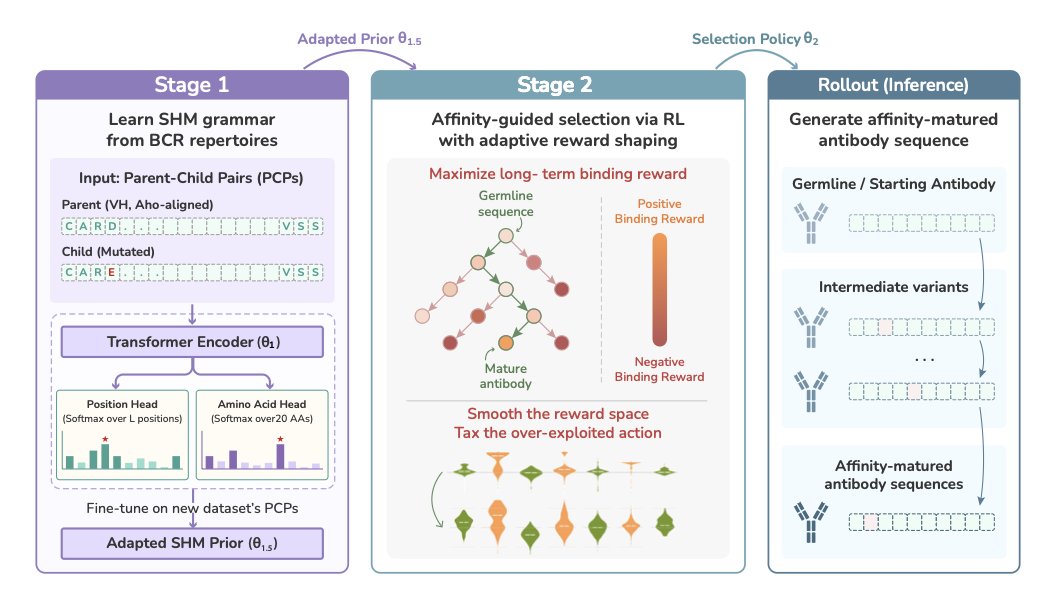
iGC: Antibody Optimization via Reinforcement Learning over a Learned Somatic Hypermutation Prior
1. The paper frames antibody affinity maturation as a sequential decision process and implements it as a two-stage system: learn how SHM generates mutations (a prior), then learn how selection favors antigen binding (an RL policy), while keeping the policy biologically plausible via KL regularization to the SHM prior.
2. Stage 1 (mutation prior): a Transformer is trained on parent–child mutation events from B-cell lineage trees to model single-step mutation actions (position, amino-acid substitution) conditioned on the full VH sequence (Aho-aligned). This full-sequence formulation targets “where to mutate” and “what to mutate to” jointly, capturing long-range context beyond k-mer hotspot models.
3. On SHM mutation prediction (Tang human BCR dataset, ~506k parent–child pairs), the learned prior more than doubles the strongest baseline on mutation-site prediction: pos@1 = 11.929% vs 5.307% (best baseline DASM mutation×selection). Joint top-1 accuracy (site+AA) is 4.864% vs 2.153% next best, indicating most gains come from better site targeting rather than substitution identity.
4. Stage 1 also includes domain adaptation to the target affinity-maturation dataset (GCReplay, mouse IGHV1-2 background). This reduces cross-species artifacts (notably a spurious FR4 bias from human-to-mouse J-gene shift) and improves alignment with empirical region targeting (e.g., FR4 argmax distribution drops near the empirical rate after adaptation).
5. Stage 2 (affinity-guided selection): the adapted SHM prior initializes an RL policy over single-mutation actions and remains as a frozen KL anchor. RL is trained offline on logged clonal trajectories with per-mutation binding rewards derived from deep mutational scanning (DMS), optimizing cumulative reward over multi-step rollouts under a fixed mutation budget.
6. A key issue addressed: direct optimization of raw DMS rewards causes policy collapse (overusing a few high-reward substitutions or drifting into “safe” framework mutations). The paper introduces Reward–Tax Meta-Gradient (RTMG): RewardNet learns a smoothed benefit signal from reward + context, while TaxNet learns a sequence-dependent penalty based on evolutionary prevalence and SHM accessibility; their difference defines a learned meta-reward.
7. RTMG is trained via a bilevel/meta-gradient setup: auxiliary networks (RewardNet/TaxNet) are updated through the effect of the meta-reward on a differentiable “probe” policy update, with constraints that preserve fidelity to measured binding signals and sequence-probability scores; the deployed policy is then updated with REINFORCE+KL using the detached meta-reward.
8. On GCReplay candidate generation (mutation budgets k=2..7), iGC targets a reward–diversity balance rather than reward alone. Compared to RL with raw reward (high reward but low diversity), iGC achieves the best or near-best reward×diversity (“Prod”) across top-N selection cutoffs (Top100/Top30/Top10 best; Top20 second-best), indicating less collapse while retaining strong affinity gains.
9. The final RL-tuned policy retains SHM hallmarks: 57.0% of iGC-predicted mutation positions fall in WRC hotspots (vs 2.0% random background), and predicted mutability remains correlated with the S5F SHM mutability model (Pearson 0.474). This supports the claim that KL-anchoring + RTMG can optimize binding without discarding SHM-consistent mutation structure.
10. Generalization test (held-out germinal centers): when entire lineage trees are unseen during training, iGC can exactly rediscover positive-reward sequences observed only in the test set—110 of 799 across k=2..4 (32.0% at k=2; 10.9% at k=3; 5.9% at k=4)—suggesting the policy is not purely memorizing training lineages.
📜Paper: https://t.co/UZvthbV5Zf
#ComputationalBiology #AntibodyEngineering #ProteinDesign #ReinforcementLearning #Immunology #MachineLearning #DeepLearning #SHM #AffinityMaturation

@OlaniyanO3 @JacobSpeculates Try to see Sequential SMT as the switch that turns the gears.
Use the opens to gauge Premium/Discount.
And keep in mind which quarter you're in and how it reacts to the previous one.
Hope that helps.

Root’s Q3 2026 results were a disaster both year-over-year against Q3 2025 and sequentially versus Q2 2026. In-force policies showed no growth, premium per policy declined, the gross combined ratio rose by 5 percentage points, gross expense ratio moved higher。
1) Linear blockchains create strict latency bottlenecks.
Processing blocks sequentially forces networks to wait for round-trip propagation, capping throughput and causing high execution latency.
High-performance chains need asynchronous consensus.
@RialoHQ

Last Seen Hashtags on Sotwe
Trends for you
Most Popular Users

Elon Musk 
@elonmusk
240.1M followers

Barack Obama
@barackobama
118.6M followers

Cristiano Ronaldo
@cristiano
114.4M followers

Donald J. Trump
@realdonaldtrump
111.7M followers

Narendra Modi
@narendramodi
106.9M followers

Rihanna
@rihanna
98.6M followers

NASA
@nasa
92.1M followers

Justin Bieber
@justinbieber
91.7M followers

KATY PERRY
@katyperry
89.9M followers

Taylor Swift
@taylorswift13
83.9M followers

Lady Gaga
@ladygaga
75.4M followers

Virat Kohli
@imvkohli
73.3M followers

Kim Kardashian
@kimkardashian
70.8M followers

YouTube
@youtube
68.6M followers

Neymar Jr
@neymarjr
66.3M followers

Bill Gates
@billgates
65.2M followers

Selena Gomez
@selenagomez
63M followers

The Ellen Show
@theellenshow
62.1M followers

CNN
@cnn
61.7M followers

X
@x
60.6M followers