

Top Tweets for #SmartWork

Working Harder Isn't Always Working Smarter.
Use AI workflow automation to reduce manual tasks and boost productivity.
🔗 https://t.co/KFB0TBlHkN
#SmartWork #AI #Productivity

Smartworking is boring... DM me

Smartworking is boring... DM me


Smartworking is boring... DM me

Smartworking is boring... DM me


"AI tools save time and simplify work. Start small, stay consistent. Growth follows."#DigitalMarketing #Freelancing #AItips #Productivity #SmartWork


@Rockzsipun1 hamne hardwork krke nikala hai unhone smartwork, thodi kismat bhi achi hai unki

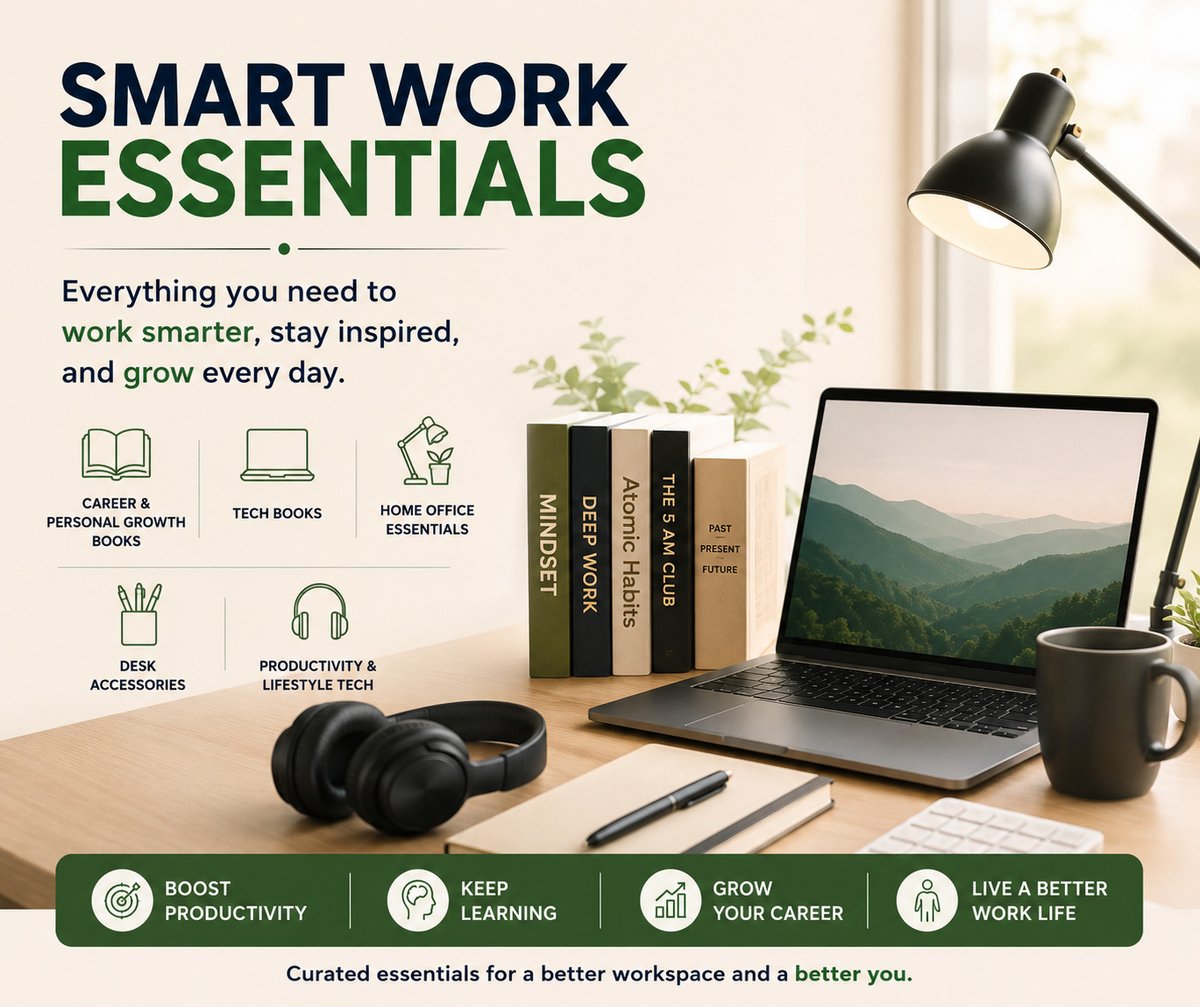
Workspace = Success. Smart Work Essentials: home office gear, desk accessories, tech & growth books. Work comfy. Learn daily. Grow steady.
Link - https://t.co/BorFKou5YV
#SmartWork #Productivity #TechBooks #PersonalDevelopment

Professional Automotive Workshop Equipment: Precision, Safety & Modern Service Solutions.
Explore the complete automotive workshop equipment.
👉 Link & details available in the first comment. 👇
#AutomotiveEquipment #GarageEquipment #VehicleMaintenance #SmartWorkshop #Automotive


@flowbonds Life no be by hardwork na by smartwork

India's GCC-led office transformation is turning flex workspace operators into high-margin, operating-leverage compounders
Workspace players (WeWork India, Smartworks, IndiQube, Awfis) delivered strong FY26 execution with double-digit revenue growth, margin expansion, rising occupancies and increasing enterprise demand.
What is Driving the Sector?
1. GCC Boom is Creating Structural Demand
Global Capability Centres (GCCs) continue to expand aggressively in India.
=> Large multinational companies prefer flexible leases.
=> Flex operators provide speed, scalability and lower upfront costs.
=> Enterprise clients now contribute a dominant share of revenues.
👉This is becoming a structural demand driver rather than a cyclical trend
2. Premiumization is Improving Economics
Clients are increasingly shifting toward:
=> Grade-A office assets
=> Managed office solutions
=> Premium workspaces
This allows operators to:
=> Charge higher rents
=> Improve occupancy
=> Increase ancillary service revenues
=> Expand EBITDA margins
3. Mature Centres = Operating Leverage
Margin expansion is now coming less from pricing and more from centre maturity.
Once occupancy crosses 80–85%:
=> Fixed costs are largely absorbed
=> Incremental seats generate disproportionately higher profits
=> EBITDA margins expand rapidly
👉This is the key reason analysts expect margins to keep improving in FY27
Company-wise Insights
WeWork India
=> Occupancy reached record 86.9%
=> Enterprise clients contribute ~77% of revenue
=> More than half of new demand is from existing customers expanding
=> Locked in ₹1,885 crore of FY27 revenue visibility
Insights:
Highest occupancy among peers and strong revenue visibility. Growth may moderate because of its already large base, but profitability remains robust.
Smartworks
=> FY27 revenue growth guidance: 28–30%
=> Enterprise clients contribute ~90% of rental income
=> Locked-in rental income of ₹5,200 crore
=> Equivalent to ~83% of projected revenue
Insights:
Among the strongest visibility stories in the sector due to large enterprise-focused contracts.
IndiQube
=> Occupancy stable at 88%
=> Value-added services contribution increased from 12% to 15%
Insights:
Moving beyond pure workspace rental toward services, which should improve margins and customer stickiness.
Awfis
=> EBITDA margin expanded from 33.3% to 36.8%
=> Benefiting from operating leverage and premiumization
Insights:
Execution remains strong, but analysts are cautious on near-term growth acceleration due to premium capex investments
Strong Demand Drivers
✅GCC expansion in India
✅Corporate shift toward asset-light office strategy
✅Hybrid working model stabilization
✅Startup ecosystem recovery
✅Premium Grade-A office demand
✅Rising managed office adoption
With GCC expansion accelerating and centre maturity improving, India's flex workspace sector is entering a sustained earnings compounding phase
🟥Disclaimer: This post is for informational and educational purposes only.
@vishan_29 @Anvith_ @Dynamicinvstr @TrendSpark420 @InvestmentVeda @Saurabh_TyagiX


Good Night Everyone ❣️
CONTENT: Sustainable Business Systems
Sustainable business systems are structured processes that allow a business to operate efficiently over time without exhausting resources or creating chaos. They focus on automation, consistency, and scalability, ensuring that growth is stable rather than stressful. With the right systems in place, businesses can reduce waste, improve productivity, and build long-term success.
A strong sustainable system supports decision-making, streamlines daily operations, and helps teams stay aligned with clear workflows. It also makes it easier to adapt to change while maintaining performance and quality. Ultimately, it turns a business from being dependent on constant effort into a well-organized, self-supporting structure.
Hashtags
#SustainableBusiness #BusinessSystems #ScalableGrowth #SmartWork #BusinessAutomation #OperationalEfficiency #BusinessSuccess #SystemThinking #DigitalBusiness #EntrepreneurMindset

Good morning Fans 🤗
Let's start today with an interesting topic this morning 👇
Digital productivity behavior in 2026📌
It is no longer about doing more work every hour — it’s about working smarter, staying focused, and using technology effectively.
People are now prioritizing structured workflows, automation, deep work, and better time management instead of constant multitasking and burnout.
Businesses, creators, and professionals are using AI tools, digital systems, and collaborative platforms to improve efficiency and reduce repetitive tasks.
Productivity today is driven by smart habits, consistency, adaptability, and the ability to stay organized in a fast-moving digital world.
Another major shift is the focus on balance and mental wellbeing. Many people now understand that sustainable productivity creates better long-term results than overworking. In 2026, success is not just about being busy — it’s about creating meaningful results through focus, discipline, and smarter systems.
#DigitalProductivity #FutureOfWork #ProductivityTips #AIWorkflow #BusinessGrowth #RemoteWork #SmartWork #TimeManagement #DigitalHabits #WorkSmarter #EntrepreneurMindset #Automation #GrowthMindset #CreativeWorkflow #2026Trends


AI 5-Minute Audit: Automate Your Daily Routine & Get More Done Without Extra Effort 👇
https://t.co/1W4pEaXjRp�
#AIAudit #Automation #ProductivityHacks #ArtificialIntelligence #AIWorkflow #FutureOfWork #DigitalEfficiency #AITools #SmartWork #TechTrends

Coworking in India shifts from startup trend to enterprise backbone.
Q4FY26 leasing activity confirms that coworking has moved from overflow demand to a core enterprise strategy.
Key Data Points
=> ~2 million sq ft leased by flex operators in a single quarter
=>Smartworks: ~900k sq ft (leader in enterprise-focused model)
=>WeWork India: ~575k sq ft across major metros
=>Flex spaces now account for 20%+ of total office absorption
=> Industry penetration expected to reach 12–15% of total office stock
Structural Shift
👉 Demand is now driven by:
=> GCCs (Global Capability Centres)
=> Large enterprises
=> Companies optimizing capex → opex shift
This fundamentally improves:
=> Visibility of demand
=> Deal sizes
=> Contract tenures
Enterprises prefer flex now due to cost efficiency, scalability and risk management.
As per Cushman & Wakefield data, net absorption
declined by 24% YOY which indicates:
=> Base effect (strong previous period)
=> Slight slowdown in fresh leasing momentum
=> Supply-side constraints
👉Not demand destruction — more of a timing + supply issue
Business Model Evolution
Earlier business model was Freelancers / startups → short-term demand and now it is Enterprises → long-term managed office contracts
India’s office market is transitioning from “lease & lock” to “flex & scale.”
Flex workspace is evolving into a core infrastructure layer for enterprise growth, not just an alternative.
Follow @DhawalDoshi5 for more updates.
@vishan_29 @Anvith_ @TrendSpark420 @Dynamicinvstr


@smartworkflo Very true. The energy one person brings into a room can influence everything around them. It really is one of the simplest ways to create a positive impact.
@smartworkflo Thank you. I want this work to genuinely help people.

الطب والمراقبة عن بعد للمرضى: كيف توسع العيادات الذكية نطاق الرعاية الصحية لتتجاوز الجدران المادية
للمزيد 👇👇👇
الرابط في أول تعليق
#faressolution #smartwork #clinic #project

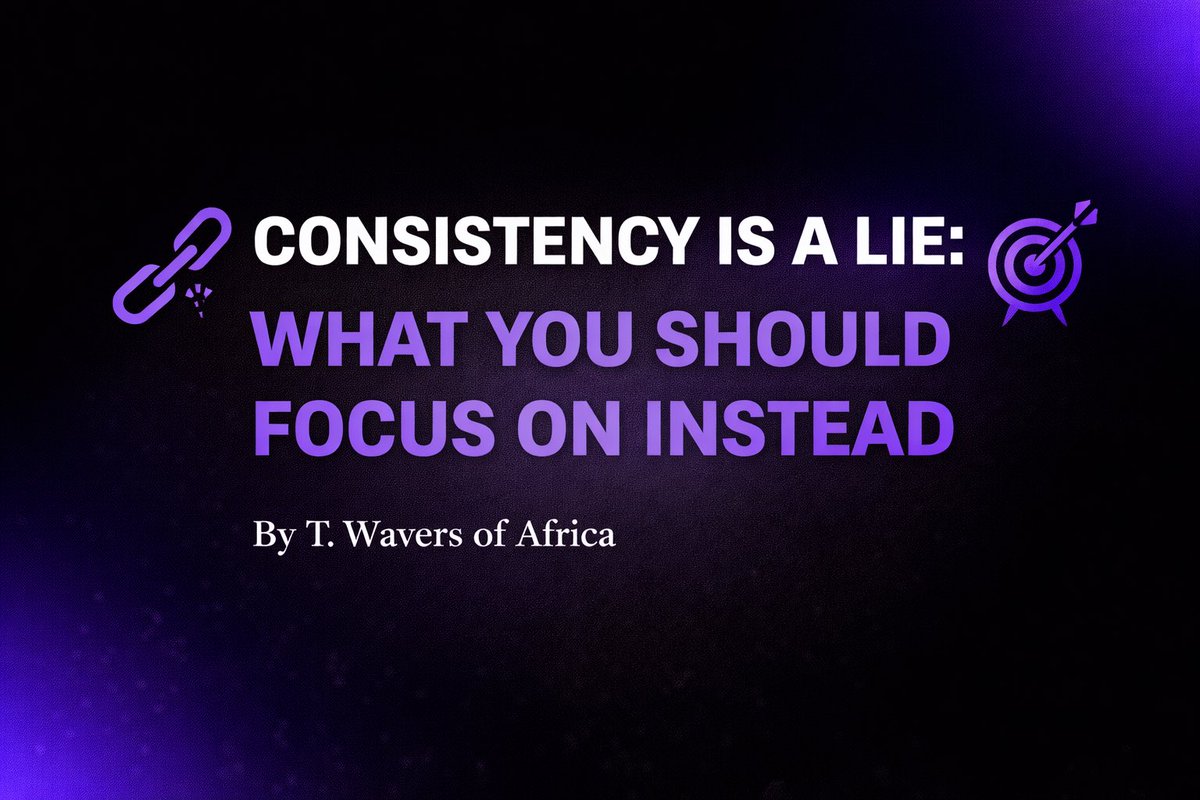
CONSISTENCY IS A LIE: WHAT YOU SHOULD FOCUS ON INSTEAD
Consistency is often praised as the key to success, but in reality, many entrepreneurs in Nigeria and across Africa struggle because they misunderstand what consistency truly means. It is not about doing something every single day perfectly. It is about building a system that allows you to show up even when life is unstable.
In this environment, things do not always go as planned. Power supply can fail, internet can be unreliable, and unexpected expenses can disrupt your schedule. If your idea of consistency depends on perfect conditions, you will keep starting and stopping.
What actually works is structure. Instead of forcing daily action without direction, focus on creating repeatable processes. For example, decide that every week you will reach out to a set number of potential customers, track your responses, and follow up. That is more powerful than random daily effort.
Another practical approach is batching your work. Create content in bulk when you have stable electricity and internet. Schedule posts ahead of time. This allows you to stay visible even on days when conditions are not favorable.
Energy management is also important. Many people burn out because they try to do too much at once. Real growth comes from doing the right things repeatedly, not doing everything at the same time. Focus on high impact actions like sales, delivery, and customer relationships.
Tracking progress matters. Write down what works and what does not. Over time, you refine your approach and reduce wasted effort. This is how small businesses grow into structured operations.
In Nigeria, adaptability is more valuable than rigid consistency. The entrepreneurs who succeed are those who adjust quickly while still moving forward. They may not show up every day, but they never stop moving.
So the goal is not perfect consistency. The goal is controlled progress. Build systems that work for your reality, not ideal conditions.
That is what creates real growth.
#Entrepreneurship #NigeriaBusiness #AfricaBusiness #GrowthMindset #SmartWork #Wavers #JesúsDeNazareth #Algérie
Structural Shift in Flex Workspaces - Betting on B2B Platforms
Operators like WeWork India (Rivet), Table Space (Desyn), and Smartworks (SmartVantage) are moving beyond leasing into full-stack B2B Platforms.
Global capability centres (GCCs), MNCs, and financial firms want integrated solutions—workspace, design, compliance, talent support, and operations—all under one umbrella.
Value-based pricing model means instead of per-seat or per-square-foot, platforms charge based on total value delivered. B2B aggregators can break even in 2 years, compared to 3–4 years for traditional leasing.
The move towards B2B platform is both demand-led and strategic as operators seek to engage early in the client lifecycle from site selection and design to operational management with an intention to increase revenue visibility and deepen client relationships.
India’s flex office market is expanding, with up to one-third of offices expected to turn flexible in 4–5 years.
India office real estate is evolving into Managed workspace + platform model.
Follow @DhawalDoshi5 for more such updates.
@vishan_29 @Dynamicinvstr @EquityInsightss

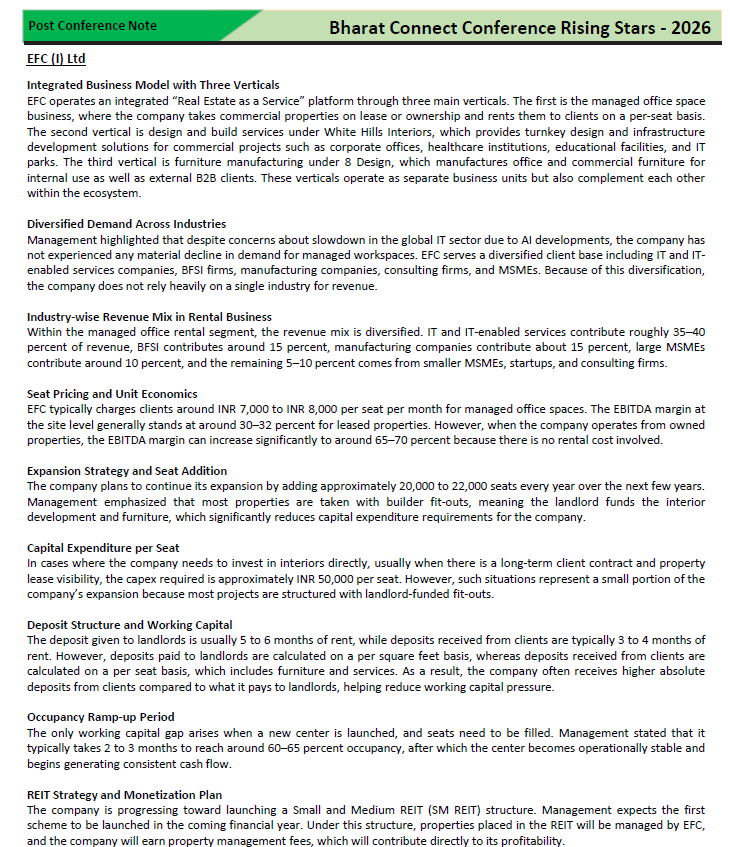
EFC (I) Ltd - Key Insights (Bharat Connect 2026)
Integrated Platform = Strong Competitive Moat
EFC is not just a co-working/managed office player—it’s a 3-in-1 ecosystem:
=> Managed workspace leasing
=> Design & build (White Hills Interiors)
=> Furniture manufacturing (B-Design)
Demand Is Diversified (Not IT-dependent)
=> IT/ITES: ~35–40% (not dominant anymore)
=> BFSI, Manufacturing: ~15% each
=> MSMEs/startups/consulting: balance mix
Unit Economics Are Solid (Hidden Upside in Owned Assets)
=> Pricing: Rs. 7,000–8,000/seat/month
=> EBITDA margins: Leased Model: 30-32% and Owned properties: 65-70%
Aggressive Expansion with Asset-light Bias
=> Planned addition: 20k–22k seats annually
=> Majority via builder-fit-out model (landlord-funded capex)
=> Only ~₹50k/seat when self-investing (minor share of projects)
=> Most expansion funded by landlords
Working Capital Is Surprisingly Favorable
=> Client deposits: 3–4 months
=> Landlord deposits: 5–6 months (but structured differently)
=> Breakeven trajectory: 60–65% occupancy in 2–3 months
REIT Optionality = Major Re-rating Trigger
=> Planning SM REIT launch next financial year.
=> This is important as it unlocks capital from assets, generates asset light management fee-income.
Earnings Quality Looks Strong
=> Rs. 60 CR PAT is not one-off
=> Driven by seat expansion and design & furniture growth
Key Risk: Leasing P&L Volatility (Short-term)
=> New centers: Costs upfront, revenue later → quarterly volatility
=> Management acknowledged that business has been tested during COVID times
=> Mitigating the risks by long-term contracts (~48 months avg)
Cash Flow Conversion – Current Weakness (Improving)
=> CFO ≈ 50% of PAT
=> Drag due to working capital-heavy D&B + furniture segments
EFC is evolving from a co-working operator → integrated workspace platform + potential REIT asset manager.
Disclaimer: This post is for informational and educational purposes only.
@vishan_29 @Dynamicinvstr @investing_t20 @Akash17971 @tsatwork @TrendSpark420
THE 4-HOUR WORKWEEK: LESSONS THAT HELP ENTREPRENEURS SCALE AND BUILD GREAT COMPANIES
The 4 Hour Workweek by Timothy Ferriss challenges a major belief in business: that working more leads to more success. Instead, it teaches that real growth comes from leverage, focus, and systems, not endless effort. Entrepreneurs who understand this don’t just build businesses they build freedom, control, and scalable structures that multiply results without constant pressure or burnout.
One key lesson is elimination. Many entrepreneurs stay busy but not productive. Ferriss applies the 80/20 principle: a small number of actions produce most results. Great entrepreneurs focus on high impact work like sales, strategy, and product improvement. Average companies waste time on low-value tasks, unnecessary meetings, and distractions that slow growth and reduce long-term efficiency and clarity.
Another powerful principle is automation. Businesses should not depend fully on the founder’s time. Systems, tools, and processes should handle repetitive tasks. When operations run smoothly without constant supervision, scaling becomes easier. This is a major difference between average and great companies. Average businesses require constant attention, while great ones are structured for efficiency, consistency, and predictable outcomes.
Outsourcing is also essential. Many entrepreneurs struggle to delegate because they want control. However, growth requires letting go of minor tasks. By assigning work to others, founders can focus on decisions that move the business forward. Delegation creates space for innovation, strategic thinking, and expansion into new opportunities.
Ferriss also introduces lifestyle design. The goal of entrepreneurship is not just money, but control over time. Great entrepreneurs build businesses that support their desired lifestyle, avoiding burnout and maintaining long-term consistency and performance.
Another lesson is testing ideas quickly. Instead of investing heavily upfront, entrepreneurs should validate ideas with small experiments. This reduces risk, increases learning speed, and improves decision-making accuracy.
The difference is clear: average companies rely on effort, while great companies rely on systems.
Content like this spreads because it challenges common thinking and invites engagement. Algorithms reward posts that generate replies, shares, and saves, pushing them to wider audiences globally.
If this resonated, share your biggest takeaway below.
#Entrepreneurship #4HourWorkweek #Wavers #BusinessGrowth #SmartWork #ScaleSmart

THE 4-HOUR WORKWEEK: LESSONS THAT HELP ENTREPRENEURS SCALE AND BUILD GREAT COMPANIES
The 4 Hour Workweek by Timothy Ferriss challenges a major belief in business: that working more leads to more success. Instead, it teaches that real growth comes from leverage, focus, and systems, not endless effort. Entrepreneurs who understand this don’t just build businesses they build freedom, control, and scalable structures that multiply results without constant pressure or burnout.
One key lesson is elimination. Many entrepreneurs stay busy but not productive. Ferriss applies the 80/20 principle: a small number of actions produce most results. Great entrepreneurs focus on high impact work like sales, strategy, and product improvement. Average companies waste time on low-value tasks, unnecessary meetings, and distractions that slow growth and reduce long-term efficiency and clarity.
Another powerful principle is automation. Businesses should not depend fully on the founder’s time. Systems, tools, and processes should handle repetitive tasks. When operations run smoothly without constant supervision, scaling becomes easier. This is a major difference between average and great companies. Average businesses require constant attention, while great ones are structured for efficiency, consistency, and predictable outcomes.
Outsourcing is also essential. Many entrepreneurs struggle to delegate because they want control. However, growth requires letting go of minor tasks. By assigning work to others, founders can focus on decisions that move the business forward. Delegation creates space for innovation, strategic thinking, and expansion into new opportunities.
Ferriss also introduces lifestyle design. The goal of entrepreneurship is not just money, but control over time. Great entrepreneurs build businesses that support their desired lifestyle, avoiding burnout and maintaining long-term consistency and performance.
Another lesson is testing ideas quickly. Instead of investing heavily upfront, entrepreneurs should validate ideas with small experiments. This reduces risk, increases learning speed, and improves decision making accuracy.
The difference is clear: average companies rely on effort, while great companies rely on systems.
Content like this spreads because it challenges common thinking and invites engagement. Algorithms reward posts that generate replies, shares, and saves, pushing them to wider audiences globally.
If this resonated, share your biggest takeaway below.
#Entrepreneurship #4HourWorkweek #BusinessGrowth #SmartWork #ScaleSmart


Mind-Bending Math Challenge
Can you solve this tricky problem before time runs out?
Test your logic, sharpen your brain, and challenge your friends
👇 Drop your answer in the comments
✔️ Correct solution coming soon…
#MathChallenge #BrainTeaser #ProblemSolving #Mathematics #MathLovers #LearnMath #STEM #Education #LogicalThinking #CriticalThinking #MathPuzzle #ChallengeYourself #MathProblems #CompetitiveExams #JEE #GATE #Olympiad #EngineeringLife #StudyGram #DailyChallenge #ThinkSmart #SmartWork #MathTricks #PuzzleTime #MindBlown 🤯


996 is criticised so much.
I honestly feel, if you are a founder and clocking in those hours. That's a massively good sign.
It shows your conviction and desire that you really just want to build and do nothing else.
It really proves that you are honestly passionate about working on what you are right now.
Obviously there's a thin line between dumbwork and smartwork. But if you know what the line is and can make the most out of your 996.
There is nothing better than being in that level of "flow-state".


hardwork + smartwork is the key of success
Trends for you
Most Popular Users

Elon Musk 
@elonmusk
240M followers

Barack Obama
@barackobama
118.6M followers

Cristiano Ronaldo
@cristiano
114.4M followers

Donald J. Trump
@realdonaldtrump
111.7M followers

Narendra Modi
@narendramodi
106.9M followers

Rihanna
@rihanna
98.6M followers

NASA
@nasa
92.1M followers

Justin Bieber
@justinbieber
91.7M followers

KATY PERRY
@katyperry
89.9M followers

Taylor Swift
@taylorswift13
83.9M followers

Lady Gaga
@ladygaga
75.4M followers

Virat Kohli
@imvkohli
73.3M followers

Kim Kardashian
@kimkardashian
70.8M followers

YouTube
@youtube
68.6M followers

Neymar Jr
@neymarjr
66.3M followers

Bill Gates
@billgates
65.2M followers

Selena Gomez
@selenagomez
63M followers

The Ellen Show
@theellenshow
62.1M followers

CNN
@cnn
61.7M followers

X
@x
60.6M followers