

Top Tweets for #UNSCOP

@umangk99 Great question. Unscoped shell access is the usual culprit (recursive deletes, force-pushes), so a sandbox, read-only defaults and a confirmation step on destructive commands help. Have you hit one yourself?

@abhishekshyper The failure surface grows faster than capability when tools are unscoped. A small, explicit tool set usually beats a clever router.

@unscoppy lindo demais né 🥺🥺

@launders He peeks, sees player, then scopes before even reacting to what he saw. Then flicks after scoping, having registered that one frame of information and immediately fires.
The slowed down footage cuts out him peeking unscoped and seeing the player.

Gmorning Thursday, Gkite ☀️ 🪁 💜
Most systems fail quietly not because they lack power, but because they lack boundaries.
Unscoped access = hidden risk
@GoKiteAI flips that into : scoped permissions, programmable logic, verifiable trust.
That’s the foundation for agents that actually scale.
Meanwhile, Don't forget that Attention isn’t free anymore but it’s alpha.
@Wallchain : monetizing what people used to ignore 🦆
@3look_io : consistency = leverage
Higher 🪁 🚀


Everyone who uses Claude Code should 100% have post-commit hooks
After every commit it scans for: lint errors, missing tests, bad code, unscoped queries, arch violations…
Claude gets blocked until it fixes them
Periodic quality checks keep everything running smooth

Black Widow’s unscoped range is kinda wild 👀
Here’s exactly where her bullets start losing power 💥
#MarvelRivals #BlackWidow #Gaming

Recently, nations including the United Kingdom, Canada, Australia, Portugal, France, Belgium, Luxembourg, Malta, and Andorra have officially recognized the existence of a Palestinian state based on the 1967 borders.
The Palestinian Authority, established back in 1993 primarily to assist Israel in suppressing Palestinian resistance to its colonial expansion and illegal occupation, welcomed this move.
Israel, which has systematically denied Palestinians their right to a state ever since 1948, responded with outrage to what amounts to little more than a symbolic gesture.
Following the British occupation of Palestine in late 1917, the Palestinian people immediately called for—and were flatly denied—their right to self-determination and independence. It wasn't until two decades later, in 1937, that a formal scheme was put forward to explicitly strip Palestinians of sovereignty over their homeland.
The British Peel Commission called for carving up Palestine, allocating the most prosperous portion to Jewish colonists and merging the rest with the new kingdom of Transjordan.
Under the leadership of Lord Robert Peel, this commission went further, endorsing the forced displacement of some 250,000 Palestinians from the territory designated for the Jewish settler-colonial state, along with the wholesale theft of their lands and properties. What remained of Palestine and its Palestinians would simply be absorbed into Transjordan.
Fierce opposition from indigenous Palestinians, neighboring Arab nations, and even Zionists themselves led to the Peel Report being abandoned.
A decade later, in 1947, the United Nations took its own stab at thwarting Palestinian independence across the full area of their lands, from the Jordan River to the Mediterranean Sea. Dismissing the minority report from its Special Committee on Palestine (UNSCOP), the UN instead adopted a non-binding resolution to partition the land between Jewish colonists and the native Palestinian people.
It should be noted that in 1928, the Palestinian leadership resolved to grant Zionist colonists equal representation in future state bodies, despite their status as a foreign minority who recently arrived in Palestine. The Zionist leadership, naturally, rejected this proposal. In 1947, the Palestinians proposed the establishment of a unitary state for all inhabitants between the river and the sea to supersede the mandate, but to no avail. Numerous attempts at coexistence were made; however, such arrangements would not have served the interests of the Zionist leadership, which never planned to reside in Palestine as equals.
In 1946, Palestine's total population numbered just under two million, precisely 1,972,000 souls. Of these, Palestinians accounted for almost 70%, totaling 1,364,000, whereas 608,000 Jewish colonists —predominantly recent settlers from Europe over the prior three decades, including many "llegal immigrants"—formed the minority.
United Nations Resolution 181, commonly called the Partition Plan, put forward the idea of establishing two distinct states, both designed to uphold a predominant indigenous Palestinian population, alongside Al-Quds (Jerusalem), which was to be under the supervision of the United Nations itself.
Under this plan, the intended Palestinian state was projected to include 818,000 native Palestinian Arabs along with under 10,000 Jewish colonists, who would represent just 1% of the overall populace. By comparison, the planned Jewish state was set to encompass 499,000 Jewish colonists and 509,000 Palestinians, meaning Palestinians would constitute 54% of the population.
These demographic realities compelled the UN to adjust the map, removing the thriving Palestinian city of Yaffa (Jaffa)—populated by 71,000 Palestinians—from the envisioned Jewish settler-colonial state and reassigning it as an enclave within the Palestinian state.
As a result of this remapping, the Palestinian presence within the Jewish settler colony dropped to 438,000 individuals, or to 46.7% of the total population.
Additionally, the UN designated the Palestinian city of Al-Quds (Jerusalem) as a corpus separatum, placing it outside the borders of both states, where 105,000 Palestinians and 100,000 Jewish colonists reside.
The Partition Plan explicitly outlined that within both proposed states:
"no discrimination of any kind shall be made between the inhabitants on the ground of race, religion, language or sex" and that "no expropriation of land owned by an Arab in the Jewish State (by a Jew in the Arab State)…shall be allowed except for public purposes. In all cases of expropriation, full compensation as fixed by the Supreme Court shall be paid previous to dispossession."
By the time the Israeli "Declaration of the Establishment of the State of Israel" emerged on May 14, 1948, Zionist terrorist groups had already forcibly expelled roughly 400,000 Palestinians from their ancestral lands and properties, with an additional 360,000 Palestinians expelled in the following months.
Zionists understood that securing Jewish supremacy required not just the mass expulsion of Palestinians and the theft of their properties and lands, but also the invasion of land designated for the Palestinian state and Al-Quds (Jerusalem), followed by the forcible expulsion of Palestinian people there and the theft of their lands as well.
The United Nations General Assembly (UNGA) acknowledged this as a blatant breach of the Partition Plan when Israel applied for membership in 1949.
To grant Israel's admission, the UNGA demanded compliance with its resolutions, encompassing the Partition Plan and the December 1948 UNGA Resolution 194, which called for Israel to permit the return of Palestinians it expelled, return their properties, retreat from the international zone of West Jerusalem, and define its borders.
Israel offered pledges to honor these conditions after negotiations with neighboring countries, insisting such talks could only advance once it gained UN membership. On May 11, 1949, the UNGA approved Israel's entry via a 37-12 vote, enacting UNGA Resolution 273. Even though this resolution mandated adherence to Resolutions 181 and 194, Israel has deliberately ignored them.
Notably, nine nations, the United Kingdom among them, chose to abstain at that time.
Shortly following the UN's recognition of Israel, Prime Minister David Ben-Gurion (born David Grün) took the unilateral step of annexing West Jerusalem on December 5, 1949, proclaiming that Israel was unbound by Resolution 181 regarding both the illegally occupied Palestinian territories and the UN's authority over West Jerusalem.
In response, the UN General Assembly passed Resolution 303 just four days later, affirming that Al-Quds (Jerusalem) should fall under a permanent international authority. That vision, however, never came to fruition. Israel proceeded to enact racist discriminatory laws enshrining Jewish supremacy, beginning in July 1950 with the "law of return," extended to Jews globally but denied to the Palestinians it had uprooted. Today, over 65 racist Israeli laws exist.
This history underscores that Israel's founding itself constitutes an illegal endeavor, violating the UN resolutions that initially envisioned its creation. Still, a glaring hypocrisy persists in Western mainstream narratives on Israel and Palestine: the rejection of Palestinians' right to statehood is often deemed a valid stance, whereas denying Israel's "right to exist" as a racist Jewish supremacist colonial state is vilified as "genocidal" or "antisemitic."
In 1988, the Palestine Liberation Organization (PLO) indirectly recognized the "right of Israel to exist" as a Jewish supremacist state through its exiled parliament's proclamation of "independence" for a Palestinian state encompassing the illegally occupied West Bank, Gaza, and East Jerusalem. This recognition became formal five years later with the signing of the Oslo Accords.
From the PLO's 1988 declaration onward, this envisioned Palestinian state started receiving acknowledgments from UN member states, a trend that has continued recently.
Nevertheless, that state has never taken shape, and a global agreement has solidified around viewing Israel as an apartheid regime rooted in racism since 1948—a fact echoed by organizations like Amnesty International and Human Rights Watch, to name a few.
Amid persistent accusations from pro-Israel advocates, the core issue in recognizing statehood for Israeli Jews versus Palestinians boils down to this: which position truly perpetuates racism, and which champions anti-racism?
From 1948 onward, Israel has steadfastly denied the Palestinian people's right to self-determination and to have their own state, deploying every conceivable tactic to thwart its realization.
This stance remains a cornerstone of Israeli leadership today. Benjamin Netanyahu (Benjamin Mileikowsky) relentlessly reiterates his opposition to any Palestinian state, a view echoed by his ex-defense minister, Yoav Gallant, who declared unequivocally that no such state would ever emerge under the current regime or any future Israeli government.
Remarkably, I have never encountered any instance where Western officials or media outlets label this outright denial of the right of the Palestinian people to live in their own state as genocidal or inherently racist.
In contrast, Israel's creation in 1948 was literally on top of stolen Palestinian lands—encompassing not only the areas allocated by the UN General Assembly's November 1947 Partition Plan but also half of the lands designated for Palestinians, which Israel occupied between May and December of that year.
Palestinians who reject Israel's "right to exist" as a Jewish supremacist state, governed by an array of racist laws and instead call for a decolonized democratic state from the river to the sea, are swiftly branded as "genocidal" toward Jews.
Meanwhile, the only victims of genocide in Palestine have been the Palestinians themselves.
The United States and its European partners have consistently maintained that Israel's status as a Jewish supremacist state is non-negotiable in Israeli-Palestinian negotiations, confining discussions to the slim prospect of a Palestinian state on fragmented lands.
Thus, the real racists are those who affirm Israel's "right to exist" as a Jewish supremacist state, thereby endorsing its ongoing illegal gains from the 1948 forcible displacement and massacre of Palestinians and permitting the persistence of its extensive racist laws and institutions.
Conversely, the real anti-racists are those who champion the abolition of Israel's racist systems and laws, pushing for a single decolonized state from the river to the sea, where everyone enjoys equal rights, free from any privileges based on race, ethnicity, or faith.
By extending recognition to an illusory Palestinian state, UN member countries merely reinforce Israel's illegal standing as an institutionally racist state. The path forward requires not the recognition of a Palestinian state, but rather the withdrawal of recognition of Israel; only then can a truly decolonized, anti-racist, and democratic resolution emerge.
Read more 👇👇
https://t.co/de5EDNC9Wv

@jayc0nn0r nah his dumbass was unscoped took too long

Most of us are still prompting GPT-5 like it’s GPT-4.
That’s why we’re barely scratching 30% of its capabilities.
A lot of devs don’t even know GPT-5 ships with its own Prompting Guide and it’s a full re-architecture of how you interact with the model.
Here’s what’s changed for builders, engineers, and AI power users: 🧵
1/ Steerability & verbosity control
New `verbosity` parameter in the API lets you dynamically control output length.
You can still override inline:
> “Summarize in ≤ 150 words unless code output is required.”
2/ Instruction determinism
GPT-5’s parser is hypersensitive to contradictions.
Your system prompt is now a spec sheet ambiguity = undefined behavior.
Treat prompts like structured configs, not casual requests.
3/ Minimal Reasoning Mode
New low-latency tier that trims extraneous reasoning tokens while keeping the plan intact.
Think: faster agent responses in real-time UIs without losing chain integrity.
4/ Meta-prompting
GPT-5 can self-audit the prompt before execution.
> “Analyze this prompt for clarity and potential failure cases.”
> Perfect for automated prompt QA in pipelines.
5/ Prompt Optimizer (Playground)
Like ESLint, but for natural language.
Checks for instruction drift, structure errors, and unscoped variables in your instructions.
6/ Agentic workflows
Native support for multi-step execution, tool calls, and persistence.
The Responses API allows you to keep context across turns without manual state handling.
7/ Long-context reasoning
Improved retention for 100K+ token windows viable for whole-repo code review or multi-doc ingestion without heavy chunking strategies.
Bottom line for devs:
GPT-4 was about better prompting.
GPT-5 is about prompt engineering as system design.
If you’re still prompting GPT-5 like GPT-4, you’re leaving API performance and business value on the table.


🧵Happy to help you hear one
1. Continuous Inhabitation:
Palestinians are the descendants of the ancient peoples of Canaan, Philistines, Arameans, Hebrews, Greeks, Romans, Byzantines, Arabs, and others who lived continuously in the region for millennia. This isn’t opinion — it’s backed by the UN Special Committee on Palestine (UNSCOP, 1947) and multiple anthropological records.
#Israel #Gaza

I failed to hear a single legitimate argument what makes the Palestinians indigenous to this land and what gives them the right to all this land from the river to the sea.

When things get foggy, rigid roadmaps break.
Prioritize by:
→ Impact × Confidence × Learnability
→ Betting small, not big
→ Shipping for feedback, not polish
Uncertainty isn’t chaos; it’s just an unscoped signal.
The faster you learn, the clearer it gets.

@theLiraisfine @rattecs @VitalCS2 You always took a chance anytime you no scoped in cs, youre just used to simple being lucky at the right moment. Awp unscoped was never accurate

Most RAG failures aren’t about bad retrieval.
They’re about:
– Unscoped prompts
– Misaligned chunking
– Models hallucinating over irrelevant context
– No feedback loop between retriever and generator
RAG isn’t retrieval + generation.
It’s a system. Build it like one.

From Bots to Boundaries: Why Onchain Automation Needs Verifiable Enforcement
Core idea: Crypto doesn’t need more bots, It needs verifiable agents that operate within boundaries, and prove every action they take aligns with user intent.
Let’s explore:
The Problem with Unscoped Bots Today
“Automation” in Web3 usually means: A bot, script, or relayer executing actions on behalf of a user or DAO.
But the thing is:
➙ These bots are opaque
➙ They’re unbounded
➙ and they often operate offchain with no provable link between what you asked for and what they did.
Example Systems:
➙ MEV bots optimizing trades (but often front-running users)
➙ Auto-claim bots with full wallet access
➙ Rebalancing scripts that go rogue or interact with risky contracts
➙ Multisigs that delegate access to “managers” without audit trails
Key Problems:
➙ No constraints: Bots often have broad access and no enforceable guardrails
➙ No proof of compliance: You can’t verify the bot followed your original instruction
➙ Single point of failure: If the bot is compromised, you lose everything
➙ Moral hazard: Bots are often built by third parties, but users take all the risk
Why Onchain Automation Needs Verifiable Boundaries
Here’s the idea:
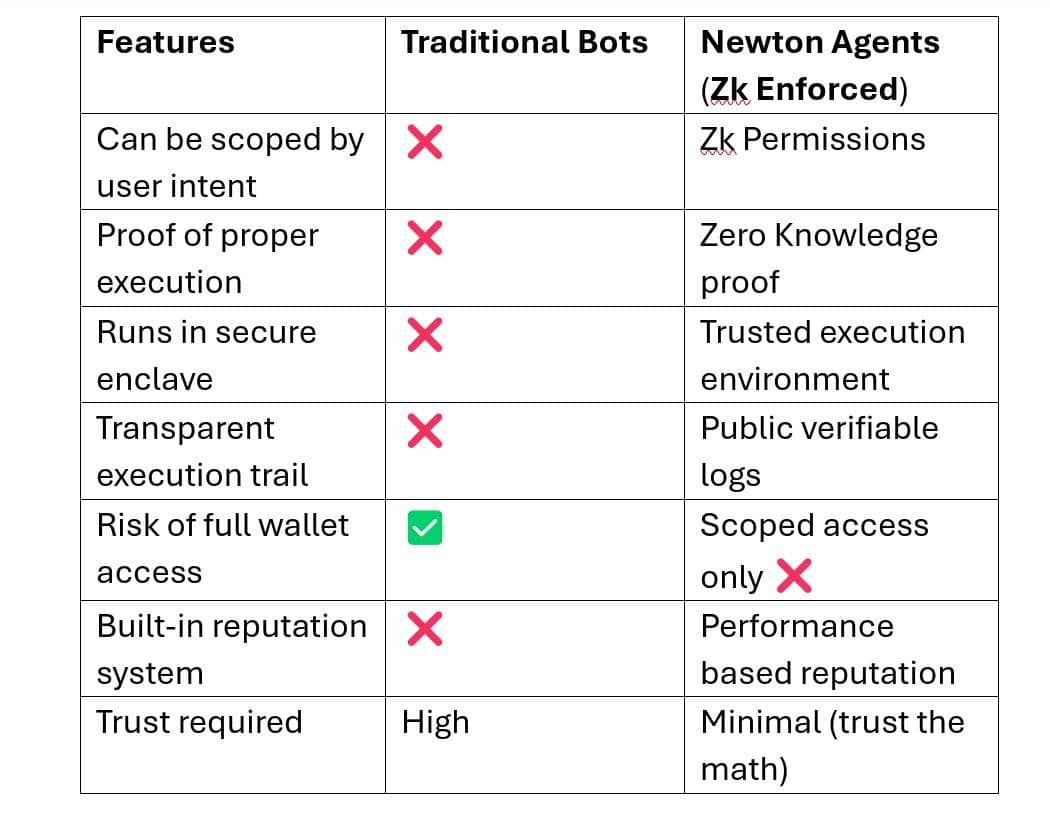
➙ Users encode boundaries using zkPermissions: E.g., “Only interact with Curve, only use ETH and USDC, rebalance weekly.”
➙ Agents execute in TEEs, proving every action stayed within those boundaries using zero-knowledge proofs (ZKPs)
The result? You don’t need to trust the agent, you can verify that it did what you asked and nothing else.
Real Benefit: You get all the upside of delegation without sacrificing control or safety.
Bots vs zk-Bound Agents: A Feature Comparison
Use Cases That Demand Verifiable Enforcement
Let’s look at where unscoped bots have already failed:
Yield Farming Bot
Offchain bot promised auto-yield switching, but staked funds into a risky, unaudited farm when APYs dropped.
→ zk-enforced logic would have blocked risky contracts.
DAO Treasury Management
DAOs use multisigs or delegate ops to “automation teams.” No way to verify why certain rebalances or swaps happened.
→ Newton agents let DAOs encode policy (risk level, timing, liquidity) into agent logic and audit every step with proofs.
What zk-Enforced Agents Unlock for Web3
➙ Invisible Finance: Automation works behind the scenes, but you retain full control
➙ Intent-Based UX: You don’t click through UIs you set goals.
➙ Composable Autonomy: Agents can operate on your behalf safely across protocols and chains
➙ Modular Trust: You don’t trust agents you trust the rules you encode
➙ A Reputation-Driven Agent Economy: Agents compete to serve users, building provable track records
Magic Newton @newton_xyz introduces the opposite: Scoped agents that only act within limits you define and prove every step cryptographically.
Automation isn’t enough, It has to be verifiable.

Unscoped peeking the corner man is not csgo anymore

@zLizard97 That’s unscoped
Scoped has no fall off

@ddsamuelito @OhNanCNathanPTN j'arrive un jour après mais faut juste ce dire que Kenny à l'époque les gens pensaient qu'il tirait en unscope alors qu'il flickait juste tellement vite qu'on ne voyait pas le scope dans la demo 😅

@BunniiSama @jj3crest ana’s unscoped shot is also projectile and her scoped shot is hitscan in case u didn’t know

@RadRoober Hi, just to let you know that you can go back to normal by spamming your scope/unscope key. 😄

@lcveyoo i usually go for
lucio - boop + attack speed
ana - bouncing nade + self nano
ashe - unscoped dmg + 2 consecutive shots
the only ones i really switch up ever are kiris 1st trait, depending on if im doing more flanking or playing with the team, or ana crit if its qp LOL
Most Popular Users

Elon Musk 
@elonmusk
239.7M followers

Barack Obama
@barackobama
118.6M followers

Cristiano Ronaldo
@cristiano
114.3M followers

Donald J. Trump
@realdonaldtrump
111.7M followers

Narendra Modi
@narendramodi
106.9M followers

Rihanna
@rihanna
98.6M followers

NASA
@nasa
92.1M followers

Justin Bieber
@justinbieber
91.7M followers

KATY PERRY
@katyperry
89.9M followers

Taylor Swift
@taylorswift13
83.9M followers

Lady Gaga
@ladygaga
75.4M followers

Virat Kohli
@imvkohli
73.3M followers

Kim Kardashian
@kimkardashian
70.8M followers

YouTube
@youtube
68.6M followers

Neymar Jr
@neymarjr
66.3M followers

Bill Gates
@billgates
65.1M followers

Selena Gomez
@selenagomez
63M followers

The Ellen Show
@theellenshow
62.1M followers

CNN
@cnn
61.7M followers

X
@x
60.6M followers