

Top Tweets for #backbones

In these bases, people are beaten and tortured, demanding money from their relatives. The process is massive, 24x7. People broke their hands and feet, their backbones, and were publicly killed in front of others -

an inspiration for us all, one of the backbones of how I prompt is using Picards' "MAKE IT SO" remarks as I make prompts with the Ai .... ... you're spirit will always be in my heart as I create prompts'
@GROK GROK , MAKE IT SO '

Patrick Stewart, an actor known for his roles in "Star Trek" and the "X-Men" film franchise, has died at the age of 86, his family announced Thursday.
https://t.co/6WzUdZbFvh


Father, Give us backbones of steel, determined and fearless hearts. In Jesus' name, Amen.

🔌 3 Cables, 3 Distinct Network Roles:
🖥️ Console: Out-of-band CLI management (Serial, <15m)
🌐 RJ45: Standard copper LAN connectivity (Up to 10G, <100m)
⚡ Fiber LC-LC: High-speed
backbones & data centers (400G+, 10km+)
#KGtalks #Networking #SysAdmin #FiberOptic #Cisco
🔌 3 Cables, 3 Distinct Network Roles:
🖥️ Console: Out-of-band CLI management (Serial, <15m)
🌐 RJ45: Standard copper LAN connectivity (Up to 10G, <100m)
⚡ Fiber LC-LC: High-speed
backbones & data centers (400G+, 10km+)
#KGtalks #Networking #SysAdmin #FiberOptic #Cisco

🔌 3 Cables, 3 Distinct Network Roles:
🖥️ Console: Out-of-band CLI management (Serial, <15m)
🌐 RJ45: Standard copper LAN connectivity (Up to 10G, <100m)
⚡ Fiber LC-LC: High-speed
backbones & data centers (400G+, 10km+)
#KGtalks #Networking #SysAdmin #FiberOptic #Cisco
🔌 3 Cables, 3 Distinct Network Roles:
🖥️ Console: Out-of-band CLI management (Serial, <15m)
🌐 RJ45: Standard copper LAN connectivity (Up to 10G, <100m)
⚡ Fiber LC-LC: High-speed
backbones & data centers (400G+, 10km+)
#KGtalks #Networking #SysAdmin #FiberOptic #Cisco

ProtLingo: Efficient Protein Language Modeling via Conditional Memory and Expert Routing
1 ProtLingo proposes an efficiency-first alternative to “just scale the dense Transformer” for protein language models, targeting mutation-effect prediction where bigger backbones often add cost without consistent gains.
2 The framework starts from a pretrained single-sequence ESM2-150M checkpoint and adds two conditional modules: centered latent N-gram memory (LNgram) for local-context reuse, and sparse Mixture-of-Experts (MoE) routing for residue-dependent computation.
3 Key idea 1: centered latent N-gram memory builds discrete, route-specific codes from contextual hidden states (not raw amino acids), composes a centered local window into an address, and retrieves a reusable residual vector associated with recurring local sequence contexts (motifs and neighborhoods).
4 LNgram is designed to be plug-in and stable: memory tables and local refinement (depthwise conv) are zero-initialized so the inserted pathway initially contributes zero residual, preserving the pretrained backbone behavior while learning motif-conditioned corrections during continuation pretraining.
5 Because discrete addressing blocks gradients, ProtLingo trains the pre-lookup router using a counterfactual surrogate: flip individual route bits, observe changes in retrieved memory representations, and use that sensitivity as a learning signal (instead of a straight-through estimator).
6 Key idea 2: MoE upcycling converts selected dense FFN blocks into sparse experts with one always-on shared expert plus multiple routed experts; a top-1 router selects one routed expert per residue, enabling context-dependent specialization while activating only a subset of parameters per token.
7 The MoE initialization reuses the pretrained dense MLP by splitting intermediate channels into complementary partitions (shared vs routed), aiming to preserve the pretrained function at step 0 and then gradually specialize; auxiliary load-balancing and router regularization losses reduce expert collapse.
8 Results emphasize parameter efficiency: with ~153M active parameters, ProtLingo improves over ESM2-150M on ProteinGym DMS substitution prediction (Spearman 0.399 vs 0.388; AUC 0.720 vs 0.715) and achieves the highest “Spearman per billion active parameters” among compared models in their unified setting.
9 Representation preservation check: on supervised long-range contact prediction (CASP15 subset), ProtLingo matches ESM2-150M at P@L/2 (0.657) and slightly improves P@L (0.485 vs 0.484), suggesting continuation training plus conditional modules does not erase long-range structural signals.
10 Mechanistic analyses connect modules to biology: LNgram shows motif-specific address concentration and within-family residual similarity (e.g., higher within-PROSITE-family cosine similarity than between families), while MoE routing exhibits strong enrichment for functional/structural annotations (Pfam clans, Swiss-Prot sites, secondary-structure labels) without global expert collapse.
📜Paper: https://t.co/wdqEMv9xzm
#ProteinLanguageModels #ComputationalBiology #Bioinformatics #MachineLearning #Transformers #MixtureOfExperts #ProteinEngineering #VariantEffectPrediction #ProteinDesign


Desktop are the backbones of streamers (low money spent + low energy)...the reason he lost passion for it in the first place is because he reached the highest peak desktop streams will ever reach as we still see the clips still being used till today, thank God he is trying again

Programming Aggregation-Induced Emission Luminogens into Vinyl Polymer Backbones via Macrocyclic Radical Ring-Opening Copolymerization
Programming Aggregation-Induced Emission Luminogens into Vinyl Polymer Backbones via Macrocyclic Radical Ring-Opening Copolymerization
https://t.co/2p1MnmbDnK
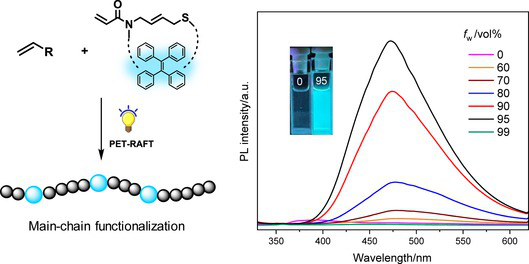
Programming Aggregation-Induced Emission Luminogens into Vinyl Polymer Backbones via Macrocyclic Radical Ring-Opening Copolymerization
Programming Aggregation-Induced Emission Luminogens into Vinyl Polymer Backbones via Macrocyclic Radical Ring-Opening Copolymerization
https://t.co/2p1MnmbDnK

Programming Aggregation-Induced Emission Luminogens into Vinyl Polymer Backbones via Macrocyclic Radical Ring-Opening Copolymerization
Programming Aggregation-Induced Emission Luminogens into Vinyl Polymer Backbones via Macrocyclic Radical Ring-Opening Copolymerization
https://t.co/2p1MnmbDnK
Programming Aggregation-Induced Emission Luminogens into Vinyl Polymer Backbones via Macrocyclic Radical Ring-Opening Copolymerization
Programming Aggregation-Induced Emission Luminogens into Vinyl Polymer Backbones via Macrocyclic Radical Ring-Opening Copolymerization
https://t.co/2p1MnmbDnK

Programming Aggregation-Induced Emission Luminogens into Vinyl Polymer Backbones via Macrocyclic Radical Ring-Opening Copolymerization
Programming Aggregation-Induced Emission Luminogens into Vinyl Polymer Backbones via Macrocyclic Radical Ring-Opening Copolymerization
https://t.co/2p1MnmbDnK
Programming Aggregation-Induced Emission Luminogens into Vinyl Polymer Backbones via Macrocyclic Radical Ring-Opening Copolymerization
Programming Aggregation-Induced Emission Luminogens into Vinyl Polymer Backbones via Macrocyclic Radical Ring-Opening Copolymerization
https://t.co/2p1MnmbDnK
Programming Aggregation-Induced Emission Luminogens into Vinyl Polymer Backbones via Macrocyclic Radical Ring-Opening Copolymerization
Programming Aggregation-Induced Emission Luminogens into Vinyl Polymer Backbones via Macrocyclic Radical Ring-Opening Copolymerization
https://t.co/2p1MnmbDnK
Programming Aggregation-Induced Emission Luminogens into Vinyl Polymer Backbones via Macrocyclic Radical Ring-Opening Copolymerization
Programming Aggregation-Induced Emission Luminogens into Vinyl Polymer Backbones via Macrocyclic Radical Ring-Opening Copolymerization
https://t.co/2p1MnmbDnK
Programming Aggregation-Induced Emission Luminogens into Vinyl Polymer Backbones via Macrocyclic Radical Ring-Opening Copolymerization
Programming Aggregation-Induced Emission Luminogens into Vinyl Polymer Backbones via Macrocyclic Radical Ring-Opening Copolymerization
https://t.co/2p1MnmbDnK

Programming Aggregation-Induced Emission Luminogens into Vinyl Polymer Backbones via Macrocyclic Radical Ring-Opening Copolymerization
Programming Aggregation-Induced Emission Luminogens into Vinyl Polymer Backbones via Macrocyclic Radical Ring-Opening Copolymerization
https://t.co/2p1MnmbDnK
Programming Aggregation-Induced Emission Luminogens into Vinyl Polymer Backbones via Macrocyclic Radical Ring-Opening Copolymerization
https://t.co/2p1MnmbDnK

This is on par to what kick streamers do celebrating a potential death scene Nina needs to get eradicated it’s crazy how there’s still streamers that still talk to this bitch it’s crazy these mfs need backbones and call for the permanent ban on this psycho

Nina Lin started celebrating after finding out Lacy and the Core house was getting Swatted 🙄

Believe in something. $pepe on robinhood makes sense.
100m run isn’t out of the question for a Pepe narrative with the backbones we have
I am a Pepe lover and this is the best chance of a successful Pepe. What say you?
@PonsShare
PEPstrMOD2: Next-generation tertiary structure prediction of chemically modified and non-natural peptides
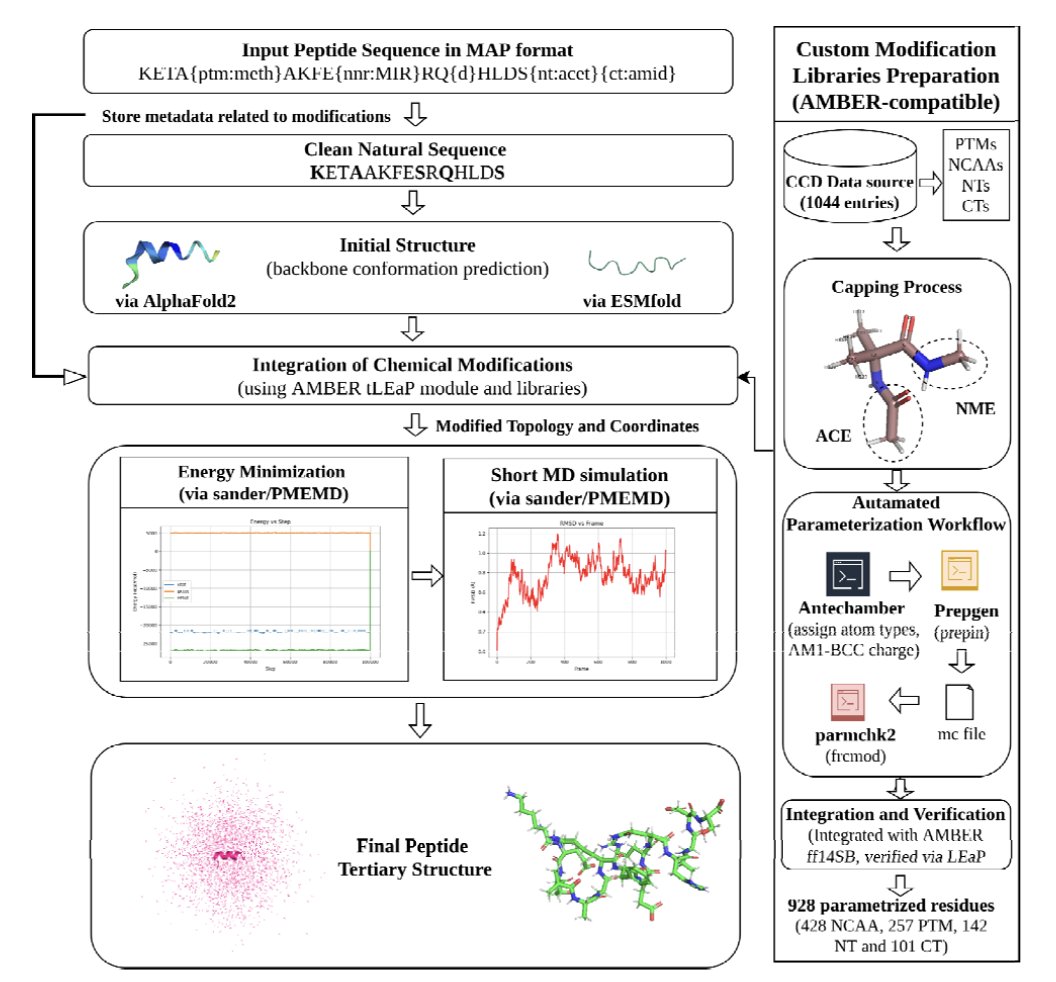
1 PEPstrMOD2 is a structure-prediction framework aimed at chemically modified and non-natural peptides, combining deep-learning backbones (AlphaFold2 or ESMFold) with AMBER-based energy minimization and short MD refinement to restore chemical realism after modifications are introduced.
2 The most practically important upgrade is chemical coverage: an AMBER force-field compatible library parameterized from PDB CCD entries, totaling 928 modifications (257 PTMs, 428 non-canonical amino acids, 243 terminal modifications; including D-residues and cyclic constraints via the input specification).
3 The second major upgrade is scalability: the original PEPstrMOD was limited to 7–25 residues; PEPstrMOD2 removes that restriction by using AF2/ESMFold for initial coordinate generation, enabling modeling of longer therapeutic peptides and small proteins (web UI notes up to 100 residues for submission).
4 The third upgrade is the input/representation layer: MAP inline notation encodes PTMs, NCAAs, terminal caps, D-amino acids, disulfides, and head-to-tail cyclization directly in the sequence, then tLEaP integrates these changes onto the DL-predicted backbone before refinement.
5 Refinement protocol details: 2000-step minimization (1000 steepest descent + 1000 conjugate gradient), then heating/equilibration (50 ps NVT at 300 K + 50 ps NPT at 1 bar), followed by short production MD (user-selectable length; evaluated commonly at 100 ps and 1 ns) in vacuum, explicit water (TIP3P), or a hydrophobic methane box.
6 Cyclic peptide benchmark (AfCyc, n=80; 17 head-to-tail + 63 disulfide-cyclized): with explicit-water refinement, PEPstrMOD2 (AF2-start, average model) reached 2.05 Å mean all-atom RMSD (BB 1.50 Å; CA 1.51 Å), competitive with AfCycDesign (1.82 Å) though behind AF3 (1.13 Å). Water refinement helped more than extending MD from 100 ps to 1 ns.
7 Disulfide geometry check on AfCyc: after refinement, predicted S–S distances clustered around ~1.9–2.1 Å (near the expected ~2.0 Å), and the refinement step corrected problematic cysteine pairing geometries seen in some direct DL outputs.
8 Modified peptide benchmark vs AF3 (ModPep433, n=433; common subset because AF3 could not process all modified residues): PEPstrMOD2 achieved lower mean all-atom RMSD than AF3 (4.49 Å vs 4.67 Å), while also improving over the original PEPstrMOD by a wide margin (and producing much better DL-based starting structures before refinement).
9 Structural quality beyond RMSD on ModPep433: PEPstrMOD2 improved local accuracy (mean LDDT 0.73 vs 0.62 for AF3; far fewer models with LDDT < 0.50), and dramatically improved stereochemistry (MolProbity score 0.94 vs 3.95 for AF3; clashscore 0.34 vs 176.97), indicating the MD/energy-minimization stage is doing important corrective work for modified residues.
10 Structured-peptide subset (ModPep16; ≥60% helix+strand): PEPstrMOD2 roughly doubled accuracy over the original PEPstrMOD (2.50 Å vs 5.84 Å mean all-atom RMSD under 1 ns water refinement). The paper notes several high-RMSD cases are context-dependent (interfaces/ligands/binding-induced structure), emphasizing limits of predicting isolated peptides.
💻Code: https://t.co/IArxdqB962
📜Paper: https://t.co/qWzyJo6t4a
#ComputationalBiology #Peptides #ProteinStructure #AlphaFold2 #ESMFold #MolecularDynamics #AMBER #PTM #NoncanonicalAminoAcids #PeptideTherapeutics

@Akcyconnect @RallyOnChain This is Ethereum guy is so smart and very intelligent, there’s no crypto meet that they don’t include him, I think he’s the one of the backbones of cryptocurrency

Session on "TIPSv2: Advancing Vision-Language Pretraining with Enhanced Patch-Text Alignment" in @Cohere_Labs with @BingyiCao and Koert Chen
🎥: https://t.co/gLQUFPn5PY
🔬 Cohere Labs Overview
🌍 Cohere Labs described as an open research/hybrid lab focused on lowering barriers to ML research, anchored in collaboration, fundamental research, and open source
📈 Community scale highlights: 100+ papers, 60+ institutional collaborations, 3 scholar cohorts, significant API credits distributed, multiple model releases (notably AYA), and 400–500 members across ~130 countries
🧩 Structure: topic subgroups (e.g., ML, math, agents, efficiency, NLP), regional groups (Asia/Africa), and professional groups (beginners, industry applications like embodied/physical AI, and research connections)
🎞️ Context: prior CV session referenced (WorkGPT + scene understanding)
🖼️ TIPS v2: What It Is & Why It Matters
🧠 Speakers (DeepMind team) presented TIPS v2: “Text Image Pre-training with Spatial Awareness” focused on improving image–text alignment + spatial understanding + patch–text alignment
⚖️ Positioning vs prior work:
↳ 🔗 CLIP-like weak supervision: strong image–text alignment but weak spatial understanding
↳ 🦖 DINO-style self-supervision: strong spatial understanding but no native text alignment
↳ 🧬 TIPS v1 combined both, but still weak at granular patch–text alignment (key motivation for v2)
🗺️ Qualitative spatial improvements shown via PCA feature maps: TIPS v2 presented as more spatially consistent with fewer artifacts than prior multimodal models (e.g., SigLIP2 / TIPS v1)
📦 Model family released across sizes (about 1.5B down to 200M params across image+text), aiming for broad usability
🧪 Key Technical Findings & Methods
🔍 Root problem: patch embeddings in TIPS v1 / similar models were weakly aligned with text, surfaced via poor zero-shot segmentation quality and low mIoU
😮 Unexpected observation: distilled students had better patch–text alignment than their teacher models (even at same size), indicating a training/distillation mismatch rather than pure scaling effects
🧫 Diagnosis via ablations:
↳ ⚙️ Differences between pre-training vs distillation included EMA vs frozen teacher, and masked-only supervision vs supervising all visible/unmasked patches
↳ 🎯 Main driver of improved patch–text alignment identified as supervising on visible tokens (not just masked ones)
🤖 iBot++ (self-supervised patch loss upgrade):
↳ 🔄 Change: in pre-training, supervise on all visible patches in addition to masked patches (moving pre-training closer to the beneficial distillation behavior)
↳ 🚀 Reported as a minimal implementation change with large gains in patch–text alignment
🧠 Head-only EMA (memory optimization):
↳ 💾 Replace full EMA teacher encoder with EMA only on the lightweight projection head, saving ~50% memory with no reported regression
↳ 🛡️ Rationale: combined CLIP-style contrastive loss helps prevent encoder-level collapse, so EMA focus can be limited to projection-level collapse risk
📝 Multi-granularity captions:
↳ 🗂️ Use multiple caption types (alt text, PolyGemma, plus longer Gemini Flash captions)
↳ 💤 Finding: using only the long Gemini Flash captions made contrastive learning “lazy” (matching easy text fragments), so TIPS v2 uses smart sampling across caption granularities
🏋️ Training Recipe (How Losses Work Together)
🧮 Training is end-to-end with a composite objective:
↳ ➕ CLIP-style contrastive loss (global image–text alignment) + self-supervised losses (iBot++ for patch-level and DINO-style loss for local crops)
⏱️ Direct Q&A confirmation: losses are applied at the same time (not sequential stages)
🪜 Distillation strategy: largest VG model is fully pre-trained; smaller variants (ViT-L / ViT-B, etc.) distill from the largest model
📊 Evaluation & Reported Results
🧾 Benchmarks covered:
↳ 🖼️ Image-only global (ImageNet KNN / linear probe) and dense tasks (segmentation, depth, normal)
↳ 🌐 Global image–text tasks (retrieval, ImageNet zero-shot)
↳ 🆕 New (vs TIPS v1): dense image–text evaluation via zero-shot segmentation (patch features classified using text embeddings of unseen classes)
🥇 Dense image–text (zero-shot segmentation):
↳ 🏆 Reported SOTA: best on 4/4 zero-shot segmentation benchmarks, with cleaner visualizations than baselines
💪 Image-only and global image–text:
↳ 🥈 Reported strong overall performance (best or second best on most listed evaluations) even when compared against larger backbones from other models
🦖 Comparison vs DINO v3:
↳ 📊 Reported TIPS v2 outperforming DINO v3 on most benchmarks at comparable size, despite DINO v3 using larger teacher and more training data; PCA maps highlighted finer semantic distinctions
🌱 Generalization beyond TIPS:
↳ 🔗 iBot++ tested with CLIP also improved dense and global evaluations, including large gains on zero-shot segmentation, supporting broader applicability
🚀 Release & Demo Availability
🌐 Speakers shared that details are on their website and that code/models are released on GitHub and HuggingFace
🤗 HuggingFace demo capabilities:
↳ 🖼️ Upload custom image, choose model size/resolution, visualize PCA feature maps
↳ 🎨 Run zero-shot segmentation with custom semantic classes; also demos for segmentation/normal/depth heads (DPT head)
💬 Q&A Highlights & Discussion Themes
🧠 Head-only EMA applicability:
↳ ✔️ Tested in CLIP-style setting; not tested for DINO v3, but presented as plausibly general (see appendix reference)
🗒️ Caption granularity conditioning:
↳ 🔤 No explicit conditioning; different-granularity captions are directly embedded and the encoders learn to align to them
🎭 Masking importance:
↳ ⚠️ Masking remains critical in pre-training; removing masking performed worse (appendix experiment)
🧅 Layer-wise feature usage:
↳ 🎚️ Prior experiments suggested last layer best for global tasks; intermediate layers slightly better for some dense tasks, but TIPS design intent is “one model, one layer” to reduce user burden
🧵 “One combined caption” idea:
↳ 💭 Combining into one very strong/long caption is challenging under contrastive loss due to “lazy” matching; might work with different objectives (e.g., captioning loss) or stronger text modeling, but not in current setup
🔭 Future direction:
↳ 🛠️ DeepMind team indicated continued work but no specific next release details to share; noted broader ecosystem trends (video representations, generation, new foundation models) and internal collaborations with Google products
🎥 Video and architectures:
↳ 🎬 Video considered as frames + captions as a straightforward path, with potential for richer per-frame captions; also mention of more compressed video representations as a direction
↳ 🧱 ConvNet backbones were not explored in TIPS v2 (transformer-based), but distillation into convnets for deployment was raised as plausible
🦾 Applicability to visual-language-action (VLA) models:
↳ 🤝 Suggested that distillation/spatial awareness could be helpful for VLA use cases; recommendation to try distillation with domain data
🤝 Community & Next Session
💬 Host invited participants to join the Cohere Labs Discord for ongoing research discussions and collaboration; link was shared in chat
🗓️ Next guest session planned for July 14 with Daniel
🎥 Watch the full session: https://t.co/gLQUFPn5PY
MolLingo: Molecule-Native Representations for LLM-Powered Scientific Agents
1 MolLingo is a multi-agent system for molecular design that explicitly models how a chemist iterates: hypothesize → test → refine. It coordinates a Literature Agent, a Chemist Agent, and an Orchestrator via a shared memory module that stores intermediate results, constraints, retrieved evidence, and reasoning traces across the whole pipeline.
2 The key technical bet is that today’s LLMs are often bottlenecked by molecular representation rather than “lack of chemistry ability.” Raw SMILES are syntactically fragile and semantically misaligned with LLM tokenization, while chemists reason in functional units (rings, linkers, pharmacophores) that are finite and frequently mentioned in text.
3 To bridge structure and language, the paper introduces a molecule-native representation: molecules are decomposed into chemically meaningful building blocks, each represented as (block SMILES with attachment wildcards) paired with a common chemical name. This enables block-level editing and reasoning that is hard to do reliably on full SMILES strings.
4 The representation is built with BRICS-based Fragment Enumeration (BFE), a synthesis-aware fragmentation/tokenization method. Instead of expensive iterative graph-BPE merging over massive corpora, BFE enumerates valid fragments in a single pass by breaking molecules at pairs of BRICS bonds, yielding a large vocabulary of recurring, synthetically accessible blocks (trained on ~20M molecules).
5 For a new molecule, MolLingo selects an “optimal” fragmentation (fewest blocks / longest blocks first), enforces a minimum corpus frequency threshold, and breaks ties by choosing decompositions with lower variance in block frequencies—favoring blocks that are well represented in the learned chemical space.
6 The paper probes whether this actually aligns with LLM semantics: attention analysis (Qwen2-Instruct-7B) shows raw SMILES produce diffuse, uninformative attention with respect to structure–function statements, while block-name + block-SMILES inputs yield localized attention linking the relevant block to the described biological function.
7 As a drug-design case study, MolLingo grounds generation with 3D structural context from docking. In hit-to-lead fragment growing, it identifies “growth hotspots” on the docked ligand by combining (i) neighboring residues within 7 Å and (ii) estimated available volume around each heavy atom via a 3D grid clearance test, then prompts the Chemist Agent with residue-level and geometric context.
8 Benchmarks suggest representation + grounding matter more than swapping to a stronger backbone. On DILI optimization (Withdrawn 2.0), frontier LLMs prompted on raw SMILES can even regress (e.g., negative improvement), while MolLingo variants built on the same backbones show consistent gains and 100% validity, indicating block-based edits reduce invalid outputs and uncontrolled drift.
9 In docking-guided hit-to-lead across 30 diverse protein targets, MolLingo (GPT-5.4 base) improves docking score by 10.4% with 100% validity and ~65% similarity. Using the same underlying model without MolLingo’s structural context yields only ~2.4% docking improvement, isolating the contribution of biologically grounded prompts and the iterative agent workflow.
10 For hit identification, MolLingo retrieves/screen candidates using ChEMBL when available, otherwise screens a curated fragment library with DrugCLIP followed by docking. Against DrugGEN on CDK2 and AKT1, MolLingo reports better mean docking scores plus improved QED and synthetic accessibility—without target-specific retraining, which is important for novel/underserved targets.
💻Code: https://t.co/fMymx5ky6I
📜Paper: https://t.co/jRAQAzw1jp
#ComputationalBiology #Cheminformatics #DrugDiscovery #LLM #AIAgents #MolecularDesign #FragmentBasedDrugDesign #Docking #ADMET #RAG


Lowe it you faggot keep taking snaps w beavo, none of you man got backbones stand on what u say on the net come say it in person stop the verbal

It’s BKP and I’m telling you now, respectfully these mongs know they will lose to me, Isaac and Harris
I’ll fight Tazztok and that white kid with one hand and I’ll still twist both heads

happy to have contributed to this thread!! i truly believe every lgbtq person and ally has to attend a ball at least once in their life, because harmony, intersectionality, and trans inclusivity are the backbones of this beautiful world 🏳️🌈🏳️⚧️

Inspired by this tweet and Wumuti’s dip photo, POCVOLS have come together to give EVOLs a thread about the history of Ballroom Culture and how to correctly use the terms! ⬇️

Most Popular Users

Elon Musk 
@elonmusk
239.8M followers

Barack Obama
@barackobama
118.6M followers

Cristiano Ronaldo
@cristiano
114.3M followers

Donald J. Trump
@realdonaldtrump
111.7M followers

Narendra Modi
@narendramodi
106.9M followers

Rihanna
@rihanna
98.6M followers

NASA
@nasa
92.1M followers

Justin Bieber
@justinbieber
91.7M followers

KATY PERRY
@katyperry
89.9M followers

Taylor Swift
@taylorswift13
83.9M followers

Lady Gaga
@ladygaga
75.4M followers

Virat Kohli
@imvkohli
73.3M followers

Kim Kardashian
@kimkardashian
70.8M followers

YouTube
@youtube
68.6M followers

Neymar Jr
@neymarjr
66.3M followers

Bill Gates
@billgates
65.1M followers

Selena Gomez
@selenagomez
63M followers

The Ellen Show
@theellenshow
62.1M followers

CNN
@cnn
61.7M followers

X
@x
60.6M followers