

Top Tweets for #backendEngineering

How does PostgreSQL let readers and writers access the same row without constantly blocking each other?
The answer is MVCC (Multi-Version Concurrency Control).
I explained how it works under the hood.
https://t.co/ALgBOH0b0U
#PostgreSQL #Database #BackendEngineering
How does PostgreSQL let readers and writers access the same row without constantly blocking each other?
The answer is MVCC (Multi-Version Concurrency Control).
I explained how it works under the hood
https://t.co/ALgBOH0b0U
#PostgreSQL #Database #BackendEngineering
How does PostgreSQL let readers and writers access the same row without constantly blocking each other?
The answer is MVCC (Multi-Version Concurrency Control).
I explained how it works under the hood
https://t.co/ALgBOH0b0U
#PostgreSQL #Database #BackendEngineering
How does PostgreSQL let readers and writers access the same row without constantly blocking each other?
The answer is MVCC (Multi-Version Concurrency Control).
I explained how it works under the hood
https://t.co/ALgBOH0b0U
#PostgreSQL #Database #BackendEngineering

6 videos are now live in my database fundamentals playlist!
Core concepts every backend engineer should understand, regardless of the database they use.
More videos coming this week. Feedback is welcome!
Link: https://t.co/ByVa1JIrtD
#BackendEngineering #Databases

Transactions and ACID are two buzz words you would hear a lot, they are related but not the same thing.
I wrote a short breakdown on the difference between the two and why it matters in real systems.
Read it here: https://t.co/vmUl8eFPNC
#Databases #BackendEngineering

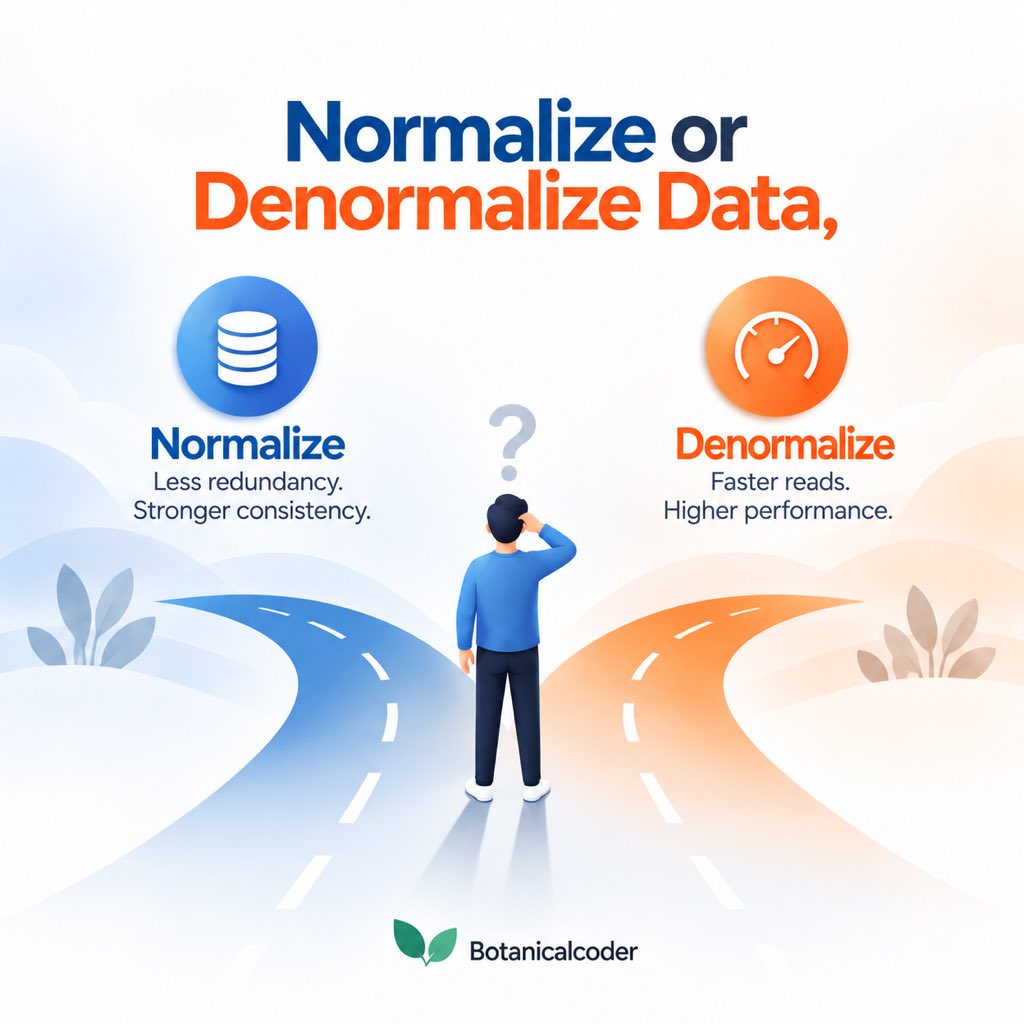
Database performance often depends on design choices and how they evolve.
When should you normalize or denormalize data? I wrote a short guide to help:
https://t.co/p7NGqyaRZv
#Database #SQL #BackendEngineering

AI Backend Engineering isn’t just about calling an LLM API.
It’s about building reliable systems around AI:
APIs → RAG → Vector DBs → Tool Calling → Agents → Observability.
#AI #BackendEngineering #Java #SpringAI


Webhook pipeline hardened. Verify HMAC before DB write. Record evidence, never drop. Queue async, return 200. Fail-closed on missing secret. 14 tests, production-ready. #Fintech #BackendEngineering

AI agents are basically distributed systems with a reasoning layer.
They have:
→ State
→ Tools
→ Failures
→ Retries
→ Timeouts
→ Dependencies
→ Observability
If you're building agents, distributed-systems thinking matters.
#AIEngineering #BackendEngineering #AgenticAI
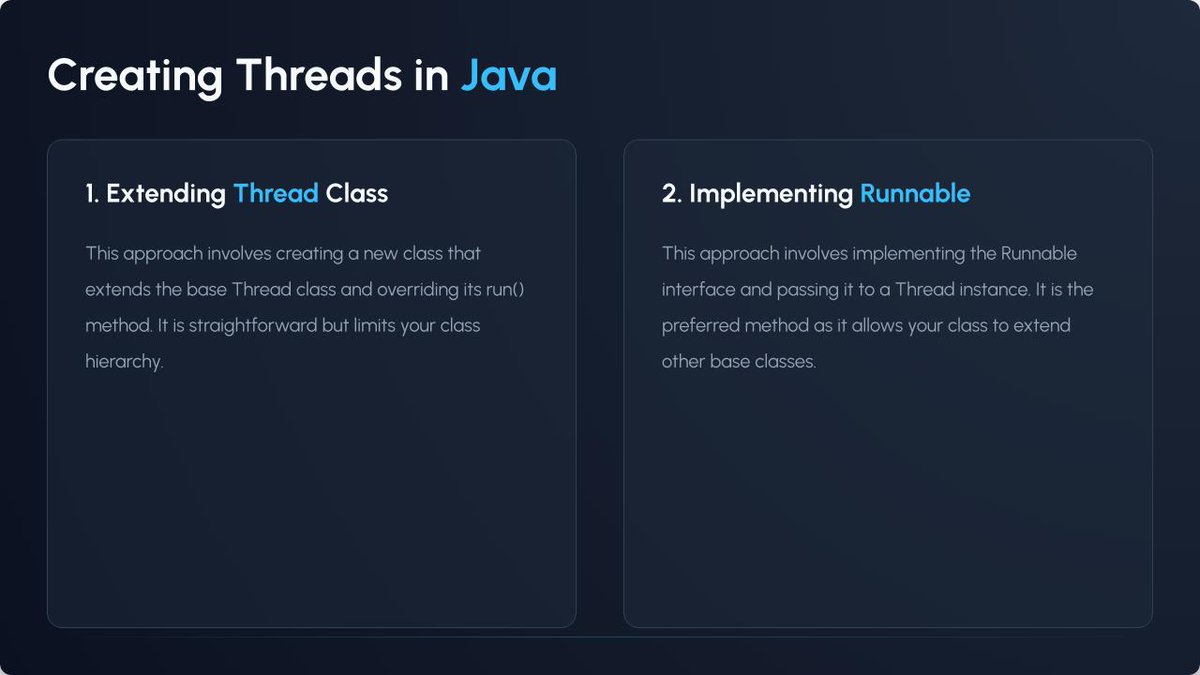
When creating threads in Java, prefer implementing Runnable.
It offers better flexibility, promotes cleaner design, and avoids the limitations of extending the Thread class.
#Java #BackendEngineering #Multithreading #Programming

Event driven vs Request driven architecture:
Request driven: A asks B directly, waits for answer
Event driven: A publishes event, B reacts when ready
Request driven = tight coupling, simpler debugging
Event driven = loose coupling, harder to trace
Neither is better.
Wrong choice for your use case is worse than either 🔥
#SystemDesign #Architecture #BackendEngineering

Deadlock explained with a real example:
Thread 1 holds Lock A, waiting for Lock B
Thread 2 holds Lock B, waiting for Lock A
Both waiting forever.
System frozen.
Nobody wins.
Prevention: always acquire locks in the same order across all threads 💀
#SoftwareEngineering #Concurrency #BackendEngineering

Synchronous vs Asynchronous:
Sync: you call a function and wait until it returns
Async: you call a function, move on, get notified when done
Sync = simpler to reason about
Async = better performance under load
Most systems need both.
Most developers pick one and use it everywhere 💀
#SoftwareEngineering #BackendEngineering #Architecture

Memoization vs Caching:
Both store results to avoid recomputation.
Memoization: function-level, in-memory, same process
Caching: system-level, external store (Redis/CDN), shared across processes
Memoization = optimization inside your code
Caching = optimization across your infrastructure
Know which layer your problem lives in 🔥
#SoftwareEngineering #Performance #BackendEngineering


Spring Boot hides complexity so well that most engineers never see it.
Until production traffic arrives.
Then suddenly:
• @Transactional doesn't behave the way you expected.
• HikariCP is exhausted.
• Thread pools are saturated.
• Database connections are leaking.
• Retries become retry storms.
• Latency doubles overnight.
• Actuator says everything is healthy while users are staring at 500 errors.
None of these failures are rare.
They're normal.
That's what surprised me most after years of running Spring Boot services in production.
The official documentation teaches you how to build the service.
Production teaches you how the service fails.
And those are very different skills.
Most Spring Boot engineers spend years learning these lessons through incidents:
The deployment that looked safe.
The query that looked harmless.
The timeout that looked reasonable.
The annotation that "should have worked."
Then production proves otherwise.
That's why I built Spring Boot Production System OS.
Not another Spring Boot course.
Not another CRUD tutorial.
A production-focused library built around the failures, bottlenecks, operational patterns, and debugging workflows that appear after the application is already live.
Inside:
• Spring Boot production failure patterns
• @Transactional pitfalls
• HikariCP tuning
• Microservices architecture
• Production debugging workflows
• Redis failure patterns
• SQL performance analysis
• JVM production failures
• Senior Java interview preparation
• Deployment safety systems
12 production-grade resources.
Built for engineers responsible for real systems with real traffic.
Because the hardest Spring Boot problems usually begin after everything compiles successfully.
Product:
https://t.co/lgf6lH074b
#SpringBoot #Java #BackendEngineering #SoftwareEngineering #Microservices #DistributedSystems #JavaDeveloper #Programming #SystemDesign #ProductionEngineering
The most expensive production incident I ever witnessed wasn't caused by bad code.
It was caused by a missing pattern.
The engineers involved were smart.
The dashboards existed.
The alerts fired.
The logs were available.
The documentation was written.
Yet the outage still lasted hours.
Why?
Because nobody recognized the failure shape.
That's the part nobody talks about.
Senior engineers are not dramatically smarter than everyone else.
They've simply seen enough failures to recognize them earlier.
A connection pool exhaustion doesn't look like a database problem to them.
A retry storm doesn't look like an API problem.
A cache meltdown doesn't look like a cache problem.
They've learned to identify the pattern hiding underneath the symptoms.
And that's why they solve incidents faster.
It's also why they make better architecture decisions.
Better deployment decisions.
Better scaling decisions.
Better hiring decisions.
The industry teaches technologies.
It rarely teaches pattern recognition.
You can spend years collecting those patterns one outage at a time.
Or you can study them deliberately.
That's why I built Production Engineering OS.
Not another course.
Not another collection of tutorials.
A production engineering pattern library built from:
• Incident response
• Architecture decisions
• Distributed systems tradeoffs
• Performance engineering
• Infrastructure operations
• AI production systems
• Senior engineering interviews
• Staff-level communication
28 production-grade resources.
Thousands of pages of operational knowledge.
Built around a single idea:
The engineer who recognizes the situation first usually solves it first.
Product:
https://t.co/ExDA6sy1zs
#ProductionEngineering #BackendEngineering #SoftwareArchitecture #DistributedSystems #SystemDesign #SoftwareEngineering #DevOps #SiteReliabilityEngineering #SeniorEngineer #StaffEngineer
Whether you're learning Java, Python, Go, Node.js, Rust, or AI Engineering, having a structured roadmap makes all the difference.
Explore the learning paths at https://t.co/J6W9WA0rqJ
#Programming #BackendEngineering #SoftwareDeveloper

Built an event ingestion platform in Rust
- HTTP API (Axum) - producers POST events, workers claim/complete
- Postgres as the queue - FOR UPDATE SKIP LOCKED for contention-free claiming
- Idempotency - (producer_id, idempotency_key) unique constraint, 202 on replays, 409 on mismatched bodies
- Automatic retry with dead-letter - stale events requeue, attempt_count tracks retries, dead-lettered after 3 fails
- Graceful shutdown - server drains requests, worker finishes current event before exit.
No Kafka or Redis yet. Just Postgres and Rust.
#rustlang #postgres #backendengineering

🧵 Java Interview Experience
Recently went through a series of interviews for senior Java positions and documented one of the interview experience at EPAM.
The discussions were heavily centered around applying core concepts in real scenarios
— especially Java 8, concurrency, and microservices architecture
— rather than surface-level knowledge.
#Java #SystemDesign #Microservices #Concurrency #BackendEngineering #InterviewExperience #bitbee


I put together insights I got from building a caching proxy cli.
Please read:
https://t.co/LgKU8JgaWJ #backendEngineering
I put together insights I got from building a caching proxy cli.
Please read:
https://t.co/LgKU8JgaWJ #backendEngineering
Last Seen Hashtags on Sotwe
Trends for you
Most Popular Users

Elon Musk 
@elonmusk
240.1M followers

Barack Obama
@barackobama
118.6M followers

Cristiano Ronaldo
@cristiano
114.4M followers

Donald J. Trump
@realdonaldtrump
111.8M followers

Narendra Modi
@narendramodi
106.9M followers

Rihanna
@rihanna
98.6M followers

NASA
@nasa
92.1M followers

Justin Bieber
@justinbieber
91.7M followers

KATY PERRY
@katyperry
89.9M followers

Taylor Swift
@taylorswift13
83.9M followers

Lady Gaga
@ladygaga
75.4M followers

Virat Kohli
@imvkohli
73.3M followers

Kim Kardashian
@kimkardashian
70.8M followers

YouTube
@youtube
68.6M followers

Neymar Jr
@neymarjr
66.3M followers

Bill Gates
@billgates
65.2M followers

Selena Gomez
@selenagomez
63M followers

The Ellen Show
@theellenshow
62.1M followers

CNN
@cnn
61.7M followers

X
@x
60.6M followers