

Top Tweets for #bdwire

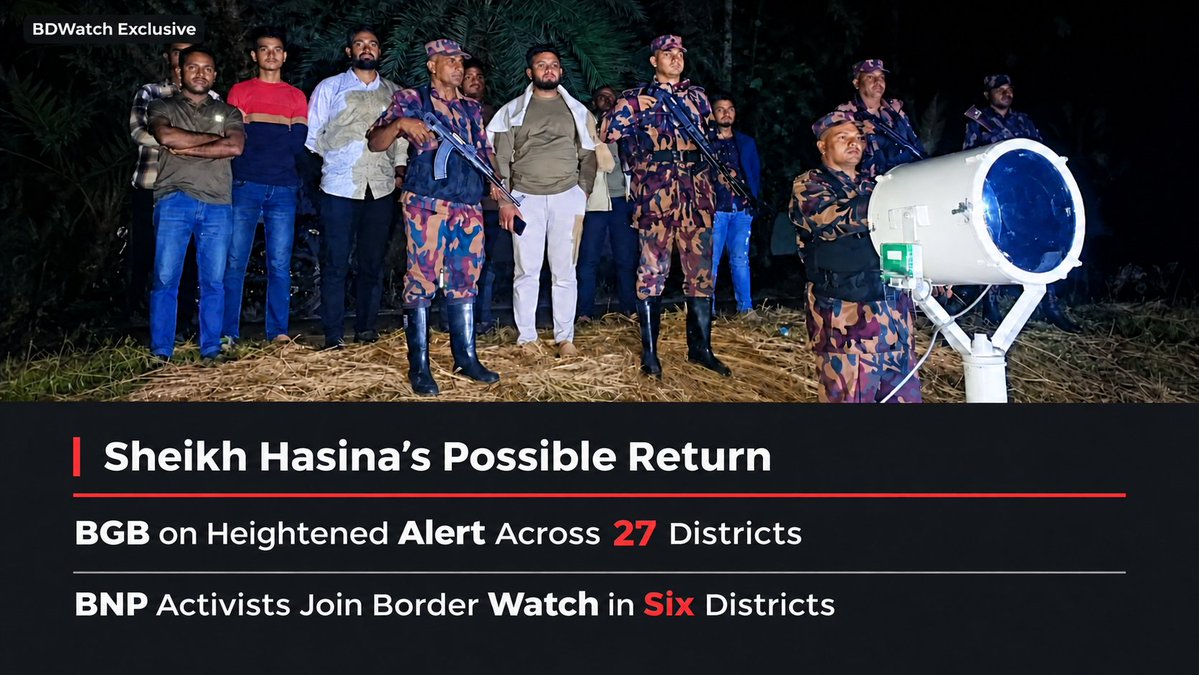
#BDWire Exclusive | Heightened Watch Across 27 Bangladesh-India Border Districts as Sheikh Hasina Signals Return.
#BNP activists join the watch in at least six districts.
In public, the BNP government ministers and senior party leaders have consistently played down the prospect of #SheikhHasina’s return.
Along the border with #India, where Hasina and other senior #AwamiLeague leaders are in exile, the government appears to be taking no chances however.
Hasina has repeatedly said she intends to return to #Bangladesh, with 16 December 2026 as her preferred date.
Recent reports of senior Awami League leaders visiting border outposts in India have also been circulating in the news media and on social media, further fuelling speculation.
A BDWire review of local and national media reports published from 1 to 27 November 2026 found that the paramilitary Border Guard Bangladesh (BGB), BNP activists or both had stepped up patrols, increased surveillance, issued alerts or organised local watches in at least 27 districts along the border with India.
Reports from some districts explicitly linked the heightened watch to Hasina’s stated intention to return or to reported movements of Awami League leaders in India.
In recent days, top officials of local BGB units have also spoken publicly of increased vigilance over possible crossings by “members of any banned organisation”, an apparent reference to the Awami League, whose activities remain suspended in Bangladesh.
Elsewhere, BGB commanders cited less specific justifications, such as security for "December", efforts to prevent unauthorised crossings, and possible political unrest.
The 27-district total includes both sets of reports.
BNP activists reportedly joined the border watch in at least six districts: Jashore, Jamalpur, Cumilla, Brahmanbaria, Satkhira and Mymensingh.
Reports identified increased BGB vigilance in 21 other districts:
Feni, Chapainawabganj, Rajshahi, Naogaon, Kushtia, Meherpur, Jhenaidah, Chuadanga, Netrokona, Sherpur, Sylhet, Sunamganj, Moulvibazar, Habiganj, Panchagarh, Thakurgaon, Dinajpur, Nilphamari, Lalmonirhat, Kurigram and Joypurhat.
Sources: Daily Star, Dhaka Times 24, Ajker Bangladesh, Ajker Mymensingh, News DBC, Ajker Patrika, Jago News 24, Nobodoy, Bangladesh Today, Prothom Alo.
...
@arschipani @krishnadas56 @aftabahmed00 @PreetaTweets @karishma__m__ @HannahEP @yogital @rheamogul @tom_sasse @christopherkay @Krishn_ @SaeedShah @ByShanLi @sudhiranjansen @tanvirbengal @AlbanAlvarez @suhasinih
#BDWire Snippet.
Speaker of the #Bangladesh National Parliament, Hafiz Uddin Ahmed, has claimed that #India intervened in the 1971 Liberation War to weaken #Pakistan, rather than to help the #Bengali people.
The senior #BNP politician, currently on an official visit to Pakistan, made the remarks while addressing the press in #Islamabad yesterday.
The comments drew some strong reactions in social media with users pointing out the crucial role of the Indian Government in mobilising international support for the cause of Bengali independence as well as the supreme sacrifices made by members of the Indian armed forces.
Official Indian Government figures report 3,843 Indian defence personnel killed and 9,851 wounded in the 1971 war (PIB, India).
#SouthAsia #History #Politics

#BDWire Explainer: The Case for a Fresh Trial for #SheikhHasina (2/2).
Double Jeoprady Not a Issue
The ICT chief prosecutor has argued that Bangladeshi law does not permit Sheikh Hasina to be tried twice on the same charges.
The @UNHumanRights Committee has addressed precisely this question.
In para. 54 of General Comment No. 32, it states that the double-jeopardy provision of the Int'l Covenant on Civil and Political Rights “does not prohibit retrial of a person convicted in absentia who requests it”.
Paragraph 56 also recognises that a higher court may quash a conviction and order a retrial.
Double jeopardy protects an accused from repeated prosecution by the state. It leaves room for the accused herself to seek relief from a conviction reached in her absence.
There is a directly relevant precedent. Article 22(3) of the Statute of the Special Tribunal for Lebanon gave a person convicted in absentia, who had not designated counsel of their own choosing, the right to be retried in their presence unless they accepted the judgment.
Bangladesh could adopt a comparable safeguard in its own law.
What can Bangladesh Do?
Section 21(3) of the Int'l Crimes (Tribunals) Act sets a 30-day deadline for an appeal and expressly bars an appeal after that period. Hasina filed no appeal within the deadline. As matters stand, no appellate court has heard a defence challenge to her conviction. The state, meanwhile, filed its own appeal seeking to have her life sentence on the first charge increased to death.
Parliament could amend the Act to allow any person sentenced to death in absentia without counsel of their choosing to apply, upon appearing before the court, to have the conviction set aside and the charges reheard.
The provision should cover existing convictions and stay execution while the application is decided. If a fresh trial is granted, a differently constituted bench should hear the case, with adequate preparation time, separate defence counsel and a full opportunity to call and question witnesses.
Why It Matters?
The families who lost loved ones deserve findings they can rely on about who was responsible for each killing.
Sheikh Hasina should have the opportunity to answer those allegations in a process which complies with int'l fair trial standards.
Bangladesh can honour both by allowing a fresh trial.
Sources:
https://t.co/XqfvYRwkqj
https://t.co/5gLbWuSIv7
https://t.co/sXiKF2gqCZ
https://t.co/iuH2YjR0WE
https://t.co/Uw9gC4219M
https://t.co/bXVBm7szBe
https://t.co/t97wFWU5CR
...

#BDWire Explainer: The Case for a Fresh Trial for #SheikhHasina (1/2).
On 17 Nov 2025, #Bangladesh’s International Crimes Tribunal (ICT) convicted former Prime Minister Sheikh Hasina of crimes against humanity over the violent events of July–August 2024 and sentenced her to death in absentia.
Two considerations are of paramount importance here:
First, the victims and their families are entitled to justice; Second, Hasina and other accused are entitled to a trial that complies with int'l fair trial standards.
Given the serious legal and procedural deficiencies in the ICT proceedings, a fresh trial would better serve the interests of both the victims and the accused.
Here are six reasons why:
1. Denial of Counsel of Choice
The ICT appointed a single lawyer to defend both Hasina and her former home minister, Asaduzzaman Khan Kamal.
Neither defendant chose him. Neither gave him instructions. Yet their interests could plainly diverge. On the central question of who ordered the use of force, a defence available to one could implicate the other.
Without instructions from either client, how could the same lawyer adequately investigate and advance each defendant’s case?
2. Inadequate Preparation Time
The ICT-appointed counsel reportedly received the prosecution evidence roughly five weeks before the evidentiary hearings began.
This was manifestly inadequate for a case of such scale, gravity and complexity, particularly one in which the defendants faced the death penalty.
3. Inadequate Defence and Limits of Cross-Examination
The prosecution called 54 witnesses. The defence called none. While defence counsel cross-examined prosecution witnesses, the ICT accepted the prosecution’s argument that counsel could not confront witnesses with discrepancies between their courtroom testimony and their earlier statements to investigators.
This is particularly significant. If a witness changes their account of who gave an order, when it was given or what it meant, the defence must be able to put those contradictory accounts to the witness and seek an explanation.
4. Undue Reliance on Approver Evidence
Consider the evidence of former police chief Abdullah Al-Mamun. A co-accused who became a prosecution witness, Al-Mamun received five years’ imprisonment, while Hasina and Kamal received death sentences.
A fresh trial would allow separately instructed defence lawyers to examine what Al-Mamun understood he stood to gain from cooperating with the prosecution, how his account developed, and which aspects of his testimony were independently corroborated.
These questions bear directly on the reliability of his evidence and the weight a court should attach to it.
5. Reliance on Unchallenged Telephone Recordings
The ICT relied on Hasina’s telephone conversation with the Dhaka University vice-chancellor on 14 July 2024 to conclude that she had already ordered the killing of protesters.
After examining the judgment, journalist Bergman identified a discrepancy within the court’s own text. The same Bengali phrase appeared in the translated transcript as “I have told you” and in the tribunal’s findings as “I have already ordered”. He found no explanation for this significant difference.
Telephone recordings formed a crucial part of the prosecution’s evidence on both charges. Yet defence counsel did not challenge their authenticity.
A fresh trial would allow the defence to engage independent experts to examine the authenticity, integrity, translation and interpretation of these recordings.
6. Concerns Regarding Judicial Independence and Competence
At least one of the judges who presided was, until relatively recently, an active member of a #BNP-backed lawyers’ organisation.
Questions also remain regarding the judges’ experience in adjudicating complex cases involving int'l criminal law.
A fresh trial could be conducted before a reconstituted ICT comprising judges whose independence, impartiality and expertise inspire confidence.
...

#BDWire Explainer | The Missing Context in Recent Int'l #Media Coverage of #Bangladesh Politics.
Recent protests involving the #AwamiLeague (AL) and its affiliated organisations have included road blockades, arson attacks and clashes with police, raising fresh concerns about peace and stability in Bangladesh.
International media coverage has largely framed the unrest around exiled leader #SheikhHasina’s announcement that she plans to return to Bangladesh in December.
Even without that announcement, an escalation was foreseeable, one might even say inevitable. To understand why, we need to examine what has happened to millions of AL members and supporters since August 2024.
The closure of democratic and political space
Since August 2024, one of Bangladesh’s largest political parties has lost virtually every avenue for open political activity.
The #Yunus-led interim Govt banned the Awami League’s activities by executive order under the Anti-Terrorism Act. The BNP Govt led by PM #TariqueRahman subsequently formalised the restrictions through legislation.
Amendments to the Act have also criminalised expressions of support for the party, including posts on social media.
Mass arrests, arbitrary detention and political persecution
Between August 2024 and October 2026, at least 100,000 AL members and supporters were arrested. That estimate covers only arrests reported in the media, so the actual figure is likely to be considerably higher.
Those arrested include around 140 former MPs and ministers, hundreds of elected local government representatives and hundreds of national and district-level party leaders.
The arrests have extended to lawyers, judges, academics, journalists, former civil servants and artists associated with the party or perceived to be sympathetic to it.
Many who have escaped arrest have faced professional blacklisting, social exclusion and other forms of discrimination.
@hrw has documented cases in which students perceived to support the AL were expelled, had their academic qualifications revoked or were prevented from attending classes or sitting examinations.
Thousands of detainees have spent more than two years in prison without charges, and courts have routinely denied bail.
At least 52 AL leaders, activists and supporters have died in prison custody over the past 27 months. In 29 of those cases, families alleged torture in custody, denial or delay of necessary medical treatment, or both.
AL members and supporters continue to face arrest almost daily under the Anti-Terrorism Act for organising processions, holding meetings, chanting slogans and expressing political opinions. Scores have been arrested at funerals alone.
The normalisation of violence and collective punishment
Since August 2024, violence against AL members and supporters by both state and non-state actors has become increasingly commonplace. Activists and supporters have faced mob attacks, targeted killings, intimidation and harassment. Around 400 are reported to have been killed over the past 27 months.
The violence has also affected families and communities. Attackers have vandalised homes and businesses, destroyed or occupied property and deprived families of their livelihoods.
For more than two years, AL members and supporters sought to express their views peacefully. But even attending a meeting or joining a procession could expose them to violence, intimidation or imprisonment.
It was in November that some of the protests began to turn violent. Hasina’s announcement may help explain the timing. Understanding why the unrest escalated also requires an account of the preceding two years, during which the avenues for peaceful political participation were steadily closed.
...
@arschipani @krishnadas56 @aftabahmed00 @reutersruma @SheikhSaaliq @PreetaTweets @karishma__m__ @HannahEP @yogital @soutikBBC @rheamogul @tom_sasse @christopherkay @Krishn_ @SaeedShah @ByShanLi @sudhiranjansen @tanvirbengal @diaahadid @AlbanAlvarez


Last Seen Hashtags on Sotwe
Trends for you
Most Popular Users

Elon Musk 
@elonmusk
239.7M followers

Barack Obama
@barackobama
118.6M followers

Cristiano Ronaldo
@cristiano
114.3M followers

Donald J. Trump
@realdonaldtrump
111.7M followers

Narendra Modi
@narendramodi
106.9M followers

Rihanna
@rihanna
98.6M followers

NASA
@nasa
92.1M followers

Justin Bieber
@justinbieber
91.7M followers

KATY PERRY
@katyperry
89.9M followers

Taylor Swift
@taylorswift13
83.9M followers

Lady Gaga
@ladygaga
75.4M followers

Virat Kohli
@imvkohli
73.3M followers

Kim Kardashian
@kimkardashian
70.8M followers

YouTube
@youtube
68.6M followers

Neymar Jr
@neymarjr
66.3M followers

Bill Gates
@billgates
65.1M followers

Selena Gomez
@selenagomez
63M followers

The Ellen Show
@theellenshow
62.1M followers

CNN
@cnn
61.7M followers

X
@x
60.6M followers