From Vandalism to Arson: The Scale of Attacks on Bangladesh’s Minorities
Between August 5 and August 20, 2024, at least 1,068 homes and businesses belonging to minority communities were reportedly attacked, vandalized, looted, or set on fire across Bangladesh.
According to reports from the Bangladesh Hindu Buddhist Christian Unity Council, Hindu, Buddhist, and Christian communities faced widespread violence in the aftermath of the political transition. More than 150 Hindu families were reportedly affected, with Khulna and Rangpur among the hardest-hit regions.
These figures serve as a reminder that the protection of religious minorities and their fundamental rights remains a critical challenge. Every citizen, regardless of faith, deserves security, dignity, and equal protection under the law.
#Bangladesh #MinorityRights #HumanRights #ReligiousFreedom #StopViolence #Justice #SouthAsia #HumanDignity #ProtectMinorities #RuleOfLaw
Bangladesh’s centuries-old Sufi heritage is facing a troubling rise in attacks.
Shrines that have long stood as symbols of spirituality, tolerance, and cultural coexistence are increasingly becoming targets of vandalism and violence. Reports indicate that dozens of shrines have been attacked in recent months, while devotees and spiritual leaders have also faced assaults.
Protecting religious and cultural heritage is not just about preserving history. It is about safeguarding the values of pluralism, tolerance, and peaceful coexistence.
#Bangladesh #SufiHeritage #ReligiousFreedom #CulturalHeritage
Why Are the 1971 Narratives Changing in Bangladesh?
The legacy of Bangladesh’s 1971 Liberation War has become the center of an increasingly heated political debate.
Critics argue that anti-liberation forces are attempting to reshape the historical narrative by downplaying the role of collaborators during the war, revisiting the legacy of Jamaat-e-Islami, and reframing key aspects of Bangladesh’s struggle for independence.
They also warn that growing engagement with Pakistan, coupled with efforts to diminish the significance of India’s contribution to Bangladesh’s liberation, risks undermining the historical foundations of the nation.
Supporters of these concerns believe that the battle over history is not just about the past—it is about the future direction of Bangladesh and its place in South Asia.
As competing narratives emerge, one question remains: Who gets to define the memory of 1971?
#Bangladesh #LiberationWar #History #SouthAsia #Politics #RegionalSecurity
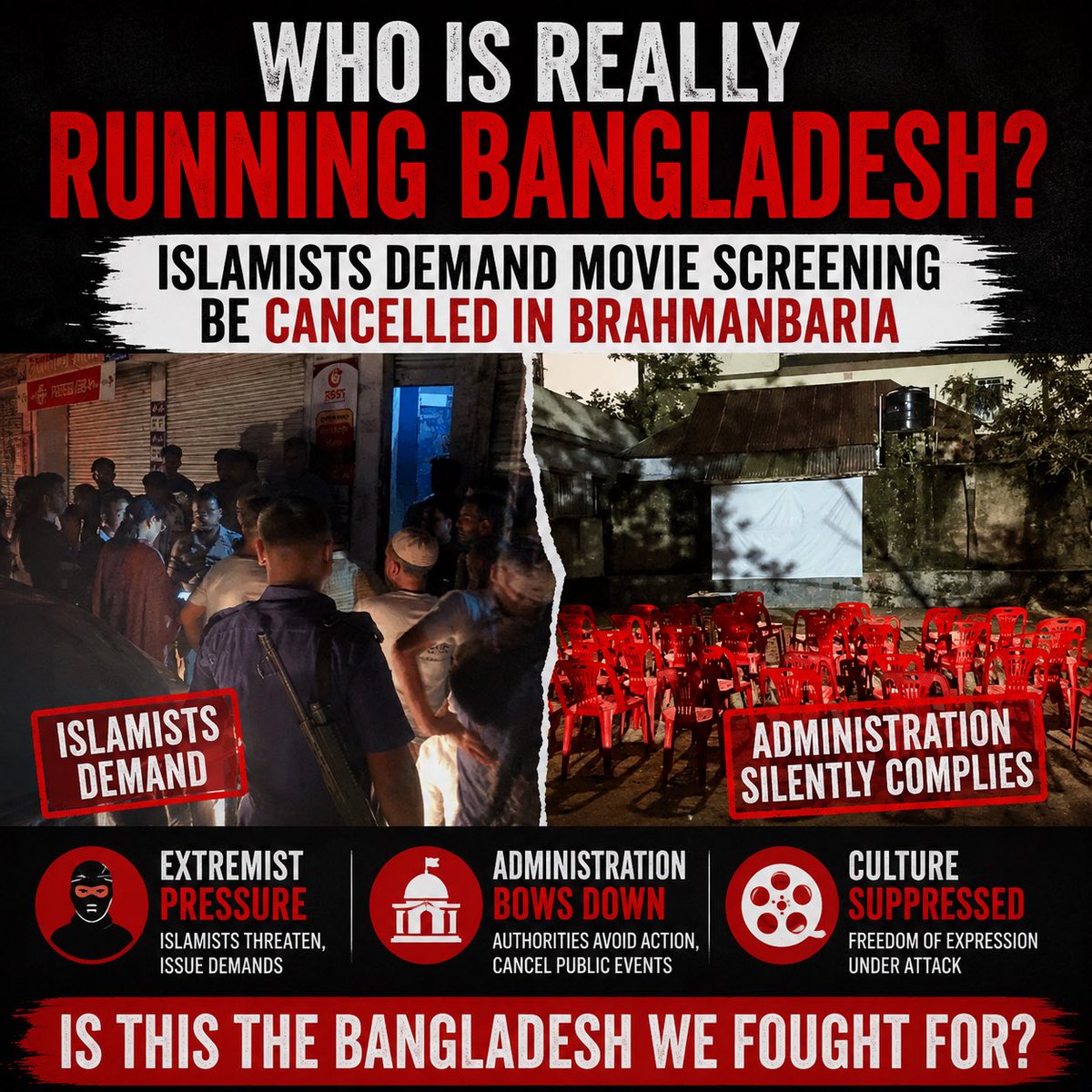
The screening of a popular new #Bangla movie was cancelled in #Brahmanbaria following threats from #Islamists, raising a critical question: who is really governing #Bangladesh?
Under the #Yunus-led Interim Govt, Islamists in Bangladesh gained unprecedented influence and authority. During that period, #arts and #culture came under sustained attack. Concerts, film premieres, folk festivals, spring celebrations, and numerous other cultural events were obstructed, disrupted, attacked, or cancelled at the whims of Islamist groups.
We extensively reported on this troubling trend at the time.
The dangerous anti-arts climate that emerged under the Interim Govt now appears to be making a comeback under PM #TariqueRahman's BNP Govt. A scheduled screening of the popular new Bangla film “Bonolota Express” in Brahmanbaria has been cancelled following the withdrawal of venue permission and what organisers described as a “lack of administrative support.”
The controversy began when members of the Qawmi Chhatra Oikya Parishad, an organisation of Islamic madrasa students, launched a social media campaign demanding that the screening be stopped.
Rather than defending the organisers' right to hold a lawful cultural event, the administration withdrew its permission for the screening. This is a phenomenon that became all too familiar during the Yunus era.
News: https://t.co/MTzpDoxMaK
The question that therefore needs to be asked is: who is really governing Bangladesh? If organised pressure from Islamist groups is sufficient to halt lawful cultural events, what does that say about the authority of the state?
….
#BangladeshCrisis #IslamistResurgence #Arts #Culture @UNESCO@State_SCA@kajakallas@FCDOGovUK@Chellaney@paulocasaca1@CJBdingo25@MujMash@HannahEP@CordeliaSkyNews@FOREF_EU@NazilaGhanea
Bangladesh Sees Rise in Mob Violence and Unidentified Deaths, Rights Group Says
Report documents 69 mob attacks and 53 unidentified bodies recovered in May
In what many Bangladeshis describe as a growing climate of insecurity, concerns are mounting over mob violence and the apparent erosion of public trust in the justice system.
According to a recent report by the Manabadhikar Shongskriti Foundation (MSF), 69 incidents of mob violence were recorded in May alone, leaving 32 people dead and dozens injured. The report also documented the recovery of 53 unidentified bodies from rivers, railway tracks, roadsides and fields across the country.
Questions raised over law and order
Critics argue that these figures raise questions about the state of law and order in Bangladesh. Some have drawn comparisons with earlier periods of political instability, asking whether the country is witnessing a return to patterns of violence seen in previous decades.
Following the controversial 12 February election, which was boycotted by several major political parties, the BNP and Jamaat-e-Islami emerged as key forces in government. Opponents of the administration have questioned the legitimacy of the process and accuse the authorities of failing to address growing insecurity.
Growing reliance on vigilante justice
The MSF report warned that members of law enforcement agencies themselves have become targets of mob attacks, describing the trend as evidence of weakening state authority.
The organisation said an increasing number of people appear to be taking the law into their own hands rather than seeking legal remedies through the courts. Human rights advocates argue that this reflects declining confidence in formal justice mechanisms and highlights broader concerns about accountability and the rule of law.
Discovery of unidentified bodies fuels concern
The recovery of 53 unidentified bodies during a single month has further alarmed rights groups and civil society observers. Bodies were reportedly found in rivers, along railway lines and in open fields across different parts of the country.
Human rights organisations say the trend underscores the need for more effective criminal investigations and greater transparency regarding unexplained deaths.
Echoes of past instability
For some observers, the recent developments evoke memories of earlier periods marked by political violence and attacks on vulnerable communities. While the forms of violence may have evolved, critics contend that longstanding concerns about public security, governance and the protection of citizens remain unresolved.
The government has not accepted such comparisons, but the debate over security, justice and accountability is likely to remain a prominent issue in Bangladesh’s political landscape.
#Bangladesh #MobViolence
Following the pattern of tightly controlled #elections for the national #parliament and various professional bodies, #Bangladesh now appears to be preparing for yet another restricted democratic exercise.
This time, attention has turned to local government elections, where new regulations are expected to effectively exclude candidates associated with the #AwamiLeague.
The Election Commission (EC) has decided to amend the code of conduct and eligibility requirements for local government election candidates. Under the proposed changes, all candidates will be required to submit a declaration stating that they are not, and have never been, associated with any organisation that has been banned or whose activities have been suspended.
While the wording of the amendment appears neutral on the surface, its practical implications are difficult to ignore. The move is widely seen as part of a broader effort to prevent individuals associated with the Awami League from contesting elections.
The party's activities have remained suspended since May 2025 under the Anti-Terrorism Act, making the proposed declaration a potential mechanism for disqualifying a large section of political actors from participating in the electoral process.
According to reports, the revised rules are expected to be introduced ahead of the upcoming Union Council elections and subsequently applied to elections for city corporations, municipal councils, upazila councils, and district councils across the country.
The development is particularly significant because local government elections in Bangladesh are officially non-party contests, where candidates are expected to run as independents rather than under party banners.
Political analysts argue that, despite the suspension of the Awami League's activities, individuals associated with the party could still have participated as independent candidates. The proposed amendments appear designed to close that avenue, ensuring that such candidates are unable to contest even in a formally non-partisan electoral framework.
News: https://t.co/MMFbrBGoTA
This development follows an increasingly visible pattern of what critics describe as "controlled" electoral contests with virtually pre-determined outcomes. During the February 2026 parliamentary elections, political competition was effectively confined to a limited spectrum of right-wing parties, with large sections of the political landscape absent from the process.
Similar concerns were raised during the recent bar association elections held across the country, where pro-Awami League candidates were reportedly sidelined and prevented from competing on an equal footing apparently for giving the electoral edge to parties like the #BNP, #JamaatEIslami, and the #NCP.
Taken together, these developments raise serious questions about political pluralism and democratic participation in Bangladesh. A functioning democracy requires meaningful competition, diverse political representation, and the ability of citizens to choose from across the political spectrum.
When an entire political constituency is systematically excluded from the electoral process, the legitimacy and representativeness of elections inevitably come under scrutiny.
#Democracy cannot be fully established or sustained when one side of the political landscape is effectively marginalised through administrative or legal mechanisms.
Elections conducted under such conditions risk failing to reflect the true will of the people and may further deepen political polarisation rather than contribute to democratic consolidation.
….
#BangladeshCrisis #DemocracyUnderThreat @amnesty@hrw@Int_IDEA@IRIglobal@WFD_Democracy@NDI@USAID@FCDOHumanRights@kajakallas@eu_eeas@State_SCA@NEDemocracy@freedomhouse@ChathamHouse@cnni@anticorruption@MichaelKugelman@S_Asian_Rights@fidh_en@CIVICUSalliance@forum_asia@OsloFF@CFR_org
A Film Cleared by the Censors Can’t Be Screened Because “There’s Controversy”?
Seven police vehicles were reportedly dispatched to shut down a film screening in a village field. Yet the Superintendent of Police did not provide a detailed explanation, simply describing the film as “obscene.” If a movie has already received clearance from the government’s censorship board, on what basis can local police authorities declare it obscene?
Critics argue that such actions reflect the political environment that emerged after the February 12 election. They contend that major political parties did not participate, voter turnout was low, yet power was consolidated nonetheless. In their view, this environment has emboldened familiar political actors to reassert themselves in public life.
They point to the BNP, a party whose opponents often criticize its historical record and origins, accusing it of presenting itself as a guardian of public morality. They also criticize Jamaat-e-Islami, alleging that the party has long used religion as a political instrument, and note that some of its supporters have called on social media for the film to be banned.
According to these critics, a segment of society is increasingly attempting to determine what people can watch, read, and think. They argue that while films are being denounced as unacceptable, concerns about electoral integrity receive far less attention.
Some observers have gone so far as to suggest that Bangladesh now appears divided into different ideological spaces—one resembling Bangladesh as envisioned by its founders, another reflecting influences associated with Pakistan, and yet another evoking comparisons to Afghanistan.
#Bangladesh #BangladeshCrisis
Attacks on Sufis and Their Shrines are Growing in Bangladesh
The Jamaat-e-Islami and affiliated groups are attacking Bangladesh’s long tradition of cultural and social pluralism.
https://t.co/47fC9i9zru
#Bangladesh#BangladeshCrisis
🚨 Rising Violence Against Minorities in Bangladesh
———
A new HRCBM report documents 505 incidents of violence against minority communities across 62 districts in just four months.
The allegations include:
▪️ Murders & abductions
▪️ Attacks on temples
▪️ Land grabbing & intimidation
▪️ Arson & looting
▪️ Rape and violence against women & girls
Women, children, and Indigenous communities remain among the most vulnerable.
The report warns that weak investigations, lack of accountability, and a culture of impunity are allowing these attacks to continue.
Religious freedom and equal protection must apply to every citizen.
Silence cannot be the answer!
#Bangladesh #BangladeshCrisis #SaveBangladeshiHindus #SaveBangladeshiMinorities
Was a “Third Force” involved in the Dhaka protests?
New controversy over OHCHR report, alleged Rohingya militants, KNF links, sniper attacks, and undisclosed forensic analysis
- Salahuddin Ahmed | 29 May 2026
Why did the OHCHR report overlook police killings, prison attacks, and organized assaults on state security infrastructure? The OHCHR fact-finding report on the political violence and state crisis in Bangladesh during July–August 2024 has sparked intense nationwide debate since its release. Questions are now being raised about the death toll, the context of use of force, alleged police killings, militant involvement, and the neutrality of the international investigation.
While the OHCHR report mentions approximately 1,400 deaths, the interim government’s official gazette lists around 834 fatalities. Meanwhile, different political and independent sources provide varying figures. Who supplied the figure of 1,400 to the United Nations? If it was accepted through verification, why does the government’s official gazette show around 834 deaths?
In international human rights investigations, the principles of “Verification, Corroboration, and Chain of Evidence” are crucial. According to international law, no death toll should be published without independent forensic analysis, eyewitness testimony, hospital records, postmortems, digital evidence, and state documentation.
However, when significant discrepancies arise between government data, political claims, and international reports, questions about neutrality and intent naturally emerge. Full forensic and ballistic analyses of the deceased have not been made public, further fueling controversy.
Police killings and attacks on state infrastructure: why are they underemphasized in UN reporting?
During the protests, reports emerged of police officers being killed in various parts of the country. Social media and local sources even alleged brutal killings of police personnel, including bodies being displayed on bridges. At the same time, violent attacks targeted state installations, television buildings, prisons, and critical security infrastructure. From an international legal perspective, organized violence against state officials, targeted attacks, and armed assaults also constitute serious crimes. Legal experts classify such incidents under “Targeted Violence against State Officials,” “Political Terror,” and “Crimes against Public Order.” A key principle in international human rights law is the “Principle of Equality of Victims,” meaning that the life of a civilian is as valuable as that of a police officer performing official duties. If an investigation highlights only one side of casualties while ignoring killed security personnel, it may be considered “Selective Human Rights Documentation.”
The question remains: why were these incidents not given equal weight in the UN report?
State responsibility vs. police right to self-defense under international law
The OHCHR report includes serious allegations such as “extrajudicial killings” and “mass shootings of protesters.” At the same time, it acknowledges deaths of police officers. Under international law, two parallel principles apply. First, “State Responsibility”: the state must protect lives and prevent unlawful killings, excessive force, or extrajudicial use of force by law enforcement agencies. According to the International Covenant on Civil and Political Rights (ICCPR) and the UN Basic Principles on the Use of Force and Firearms, the use of force must be necessary, proportionate, and lawful. Second, international law also recognizes that police and law enforcement officers have the right to use defensive force when facing armed attacks, lethal threats, or organized violence. Lethal force is only lawful when it is “strictly unavoidable to protect life.”Thus, state responsibility and the right of self-defense are not mutually exclusive; they operate simultaneously.
Why were police killings underreported in international discourse? Who used sniper weapons? Questions over weapons origin
Several local media outlets reported sniper-style attacks during which many students were allegedly shot in the head and eyes. This raises questions about what type of weapons were used and where they came from, as such weapons are not typically part of standard police arsenals. This has led to further questions regarding weapon sourcing and operational control.
Withholding forensic investigation and international accountability
The deaths of students during the July–August 2024 violence, alleged sniper attacks, ballistic analyses, and state responses have raised a central question in international discourse: If the purpose was truly impartial justice and human rights protection, why have full forensic and ballistic reports not been released to the public?
Under international investigative standards, postmortems (autopsies), ballistic analysis, sniper trajectory mapping, weapon origin tracing, and chain of custody documentation must be transparently maintained and published in cases of mass political violence. It has been alleged that the then Yunus-led interim administration obstructed full forensic investigation of deceased students. More significantly, forensic experts and FBI-linked personnel who arrived from the United States reportedly collected samples and ballistic data, yet their findings have not been made public. This raises key international legal questions: Where is transparency?
If the investigation was impartial, why are forensic findings being withheld? Can victims’ right to truth be considered violated? Who fired the shots, what weapons were used, from which direction, and under whose command structure was force applied? Does the non-disclosure of ballistic evidence indicate political intent? When narratives disproportionately assign blame to one political side while forensic evidence remains undisclosed, questions arise about whether the investigation was impartial or whether evidence was selectively used to construct a predetermined narrative.
Was the international investigation comprehensive?
A credible international investigation must examine protesters, police, state forces, armed actors, extremist infiltration, and third-party violence equally. However, if police killings, armed assaults, militant involvement, or attacks on law enforcement infrastructure are not adequately assessed, the neutrality of the investigation is questioned.
In democratic systems, allegations may be made against governments or security forces, but international law requires that accusations be evidence-based, not politically predetermined. Without “Chain of Custody,” “Forensic Integrity,” and “Independent Verification,” major human rights claims cannot be treated as conclusive truth.
Allegations of militant involvement and “Non-State Armed Actors”
During the protests, evidence allegedly emerged of involvement by third parties, armed groups, or extremist elements. Reports referenced individuals linked to Rohingya armed networks and previously arrested militant actors found with heavy weapons during earlier periods. One of the central unresolved questions is: If the movement was centered in Dhaka, why did armed networks from border regions and hill areas reportedly move toward the capital during the unrest? Who facilitated their movement, shelter, or logistics?
Bangladesh’s security context has long included concerns over border areas, Rohingya camps, arms trafficking, and insurgent networks. Were these potential links adequately investigated during the unrest?
International media outlets such as Reuters have previously reported allegations of recruitment, cross-border movement, and militant mobilization in Rohingya camps, including concerns involving ARSA and RSO-linked networks, arms circulation, and regional instability risks. Similarly, concerns have been raised about KNF-related armed activity and training in the Chittagong Hill Tracts. KNF (Kuki National Front) is described as a Kuki armed group associated with separatist demands in India’s northeast. The 2023 Manipur ethnic conflict between Meitei and Kuki-Zo communities further intensified regional tensions.
It is also noted that Bangladesh’s KNF (Kuki-Chin National Front) and India’s KNF are distinct in context, though they share ethnic roots and may have strategic or logistical overlaps due to cross-border proximity.
Was there a “third force” in the Dhaka movement?
Who financed, coordinated, and transported organized violence? Did border and hill-based armed actors exploit the unrest in the capital? Was there involvement of foreign intelligence, regional proxy networks, or extremist groups? These questions remain unproven. Therefore, the responsible position is to treat them as claims requiring independent investigation rather than established facts. From an international legal standpoint, a full investigation must examine not only who fired shots, but also who escalated violence, who facilitated armed infiltration, who exploited state instability, and who attempted to use a civilian movement to advance alternative agendas.
The 2024 Bangladesh crisis was not only a political movement; it was a multi-dimensional intersection of security, intelligence, border dynamics, and geopolitics. Under international law, violence by “Non-State Armed Actors” is also a key subject of investigation. If allegations of militant or armed involvement arise within a protest movement, they must be assessed with equal seriousness, alongside allegations against state forces.
Controversy over video evidence and investigative neutrality
Questions have also been raised about OHCHR video materials and visual documentation. Critics argue that full context or preceding events were not always shown. Additionally, allegations of post-government-change violence, revenge attacks, killings of police personnel, and political reprisals did not receive equal international attention.
A fundamental principle of international law states:
“Justice must not only be done, but must also be seen to be done.” Investigations must equally examine state forces, protesters, political actors, international agencies, potential third parties, and armed groups. In international law, investigations are not merely about counting casualties; they require a full contextual legal assessment, including origin of weapons, planning of attacks, organized violence, and potential international influence.
#bangladesh #BangladeshCrisis
Questions are growing over whether Bangladesh’s interim leadership delivered reform—or deepened instability, polarization, and insecurity. As democratic institutions weaken and extremist forces gain visibility, the international human rights community must closely monitor developments in Bangladesh before the crisis escalates further.
Read More: https://t.co/MXBy47S91I
#Bangladesh #HumanRights #Democracy #RuleOfLaw
#BNP Govt set to significantly expand its capabilities to block and filter online content, including material posted on #socialmedia platforms and websites deemed to constitute “anti-government propaganda”.
The decision was taken at a recent meeting of the Cabinet Committee on Government Purchase, which approved a proposal titled “Expansion of Content Blocking and Filtering System (Phase-1)” for the National Telecommunications Monitoring Centre (NTMC).
The project is set to be implemented through a contract awarded to supplier Global Brand, involving the procurement of equipment and services from various int’l tech brands, at a total cost of Tk 949.05 million (approximately US$7.7 million).
However, the official meeting documents did not specify the precise products, technologies, or #surveillance systems that would be acquired under the agreement.
News:
https://t.co/VEzVLuwX9D
The move comes amid renewed scrutiny of the #NTMC’s surveillance activities, particularly longstanding allegations regarding the monitoring of citizens’ private communications under previous governments.
The expansion of the agency’s technical capabilities also coincides with a growing number of arrests linked to online expression. Over the past three months, multiple individuals have reportedly been arrested for social media posts or online content critical of the government, ruling party figures, or senior state officials, including the Prime Minister, Home Minister, Chief Whip, and other politicians.
The combination of enhanced surveillance and content-filtering capabilities, together with an increasingly aggressive willingness to prosecute individuals over allegedly “anti-government” online content, has raised serious concerns among #humanrights activists and digital rights advocates.
Critics warn that such measures risk enabling broader censorship, suppressing dissent, and undermining fundamental rights to #privacy and freedom of expression. Concerns have also been raised about the potential lack of transparency, judicial oversight, and accountability surrounding the deployment of these expanded surveillance and filtering mechanisms.
Taken together, these developments have intensified fears that #Bangladesh may be moving toward a significantly more restrictive and heavily monitored digital environment, where criticism of the government or ruling party could increasingly become subject to surveillance, censorship, and/or criminal prosecution.
…
#BangladeshCrisis #RIghtToPrivacy #FreedomOfExpression @amnestysasia@hrw@ESandersFCDO@BonaveroIHR@StateDRL@EURightsAgency@UNHumanRights@HRF@volker_turk@article19org@techglobalinst@Irenekhan@accessnow@AUDRights@EFF@edri@privacyint@EPICprivacy@calyxinstitute@AJListeningPost@orfonline
The weaponisation of the criminal justice system to target political rivals and high-profile detainees under the #BNP Govt has now reached such an alarming stage that even High Court rulings appear to be openly disregarded.
The use of the criminal justice system to arbitrarily detain political leaders and other prominent individuals has escalated to the point where both the police and lower courts seem increasingly unwilling, or unable, to uphold even basic legal safeguards, even when directed to do so by the superior courts.
Former Chief Justice ABM Khairul Haque, who has now reportedly been detained without formal charges for more than 300 days, has once again been “shown arrested” despite a clear ruling from the High Court to the contrary.
The High Court had specifically directed authorities not to show the 81-year-old former Chief Justice arrested unless there was a specific case against him. Nevertheless, a Dhaka court subsequently permitted police to show him arrested in yet another murder case connected to the July 2024 protests where he wasn’t named.
Despite the High Court’s order, Dhaka Metropolitan Magistrate Sarah Farzana Haque on 23 May allowed police to show Khairul Haque arrested following an application submitted by investigation officer Md Ibrahim Khalil of Jatrabari Police Station.
Report:
https://t.co/3cpcwEpakM
This deeply troubling development has once again highlighted the extent to which the criminal justice system has been weaponised to indefinitely detain political opponents and high-profile individuals through questionable and often politically sensitive cases linked to the July 2024 protests.
There are growing concerns that both the police and lower judiciary, including magistrates’ courts as well as district and sessions courts, are failing to uphold fundamental legal principles in cases involving politically sensitive detainees, due to the presumed political directives under which they are operating.
This appears to persist even when superior courts, including the High Court Division and the Appellate Division of the Supreme Court, issue explicit directions intended to safeguard due process and personal liberty.
Against this backdrop, it is perhaps unsurprising that the BNP Govt led by Prime Minister #TariqueRahman appears reluctant to meaningfully separate the #judiciary from the executive branch.
This concern has been further reinforced by recent efforts to abolish the independent Supreme Court Secretariat, a move widely viewed by the stakeholders as undermining judicial independence and consolidating greater executive influence over the administration of justice.
…
#BangladeshCrisis @amnestysasia@AgnesCallamard@taqbirhuda@meeganguly@PearsonElaine@StateDRL@justiceinfonet@job71org@icsforum@TheDavidBergman@IBAHRI@S_Asian_Rights@ESandersFCDO@DoughtyStIntl@kingsleynapley@CIVICUSalliance@BonaveroIHR@hrw@UN_HRC@Ginitastar@forum_asia@SRjudgeslawyers@UN_SPExperts@volker_turk@forum_asia@FortifyRights
Bangladesh vs Pakistan: Two Different Economic Journeys
Bangladesh and Pakistan started their economic journeys from very different realities — and their paths evolved differently over time.
Bangladesh rebuilt itself from the devastation of 1971 through exports, garments, remittances and human-resource-driven growth. Despite challenges like inflation and political instability, the country achieved strong progress in poverty reduction and economic expansion.
Pakistan inherited a larger industrial base but faced repeated setbacks from political instability, debt dependence and security crises, which weakened long-term economic stability.
Today, the contrast is clear:
Bangladesh moved toward export-driven growth.
Pakistan continues to struggle with structural and debt-related pressures.
#Bangladesh ✅
#Pakistan ❌
Bangladesh was founded to defeat extremism — not surrender to it.
Today, as Islamist street power resurges and militant-linked networks regain influence, the consequences are no longer confined within Bangladesh’s borders. A nation once built on secularism and liberation now risks becoming a breeding ground for radicalization, intimidation, and transnational instability.
When extremists are normalized, democracy weakens, minorities suffer, women lose freedoms, and violence finds legitimacy. The world cannot afford to ignore the warning signs emerging from Bangladesh.
Silence today will become a far greater crisis tomorrow.
The Australia Today article: https://t.co/s7VgP88oRF
#Bangladesh #Extremism #HumanRights #SouthAsia #Democracy #CounterTerrorism #ReligiousExtremism #GlobalSecurity
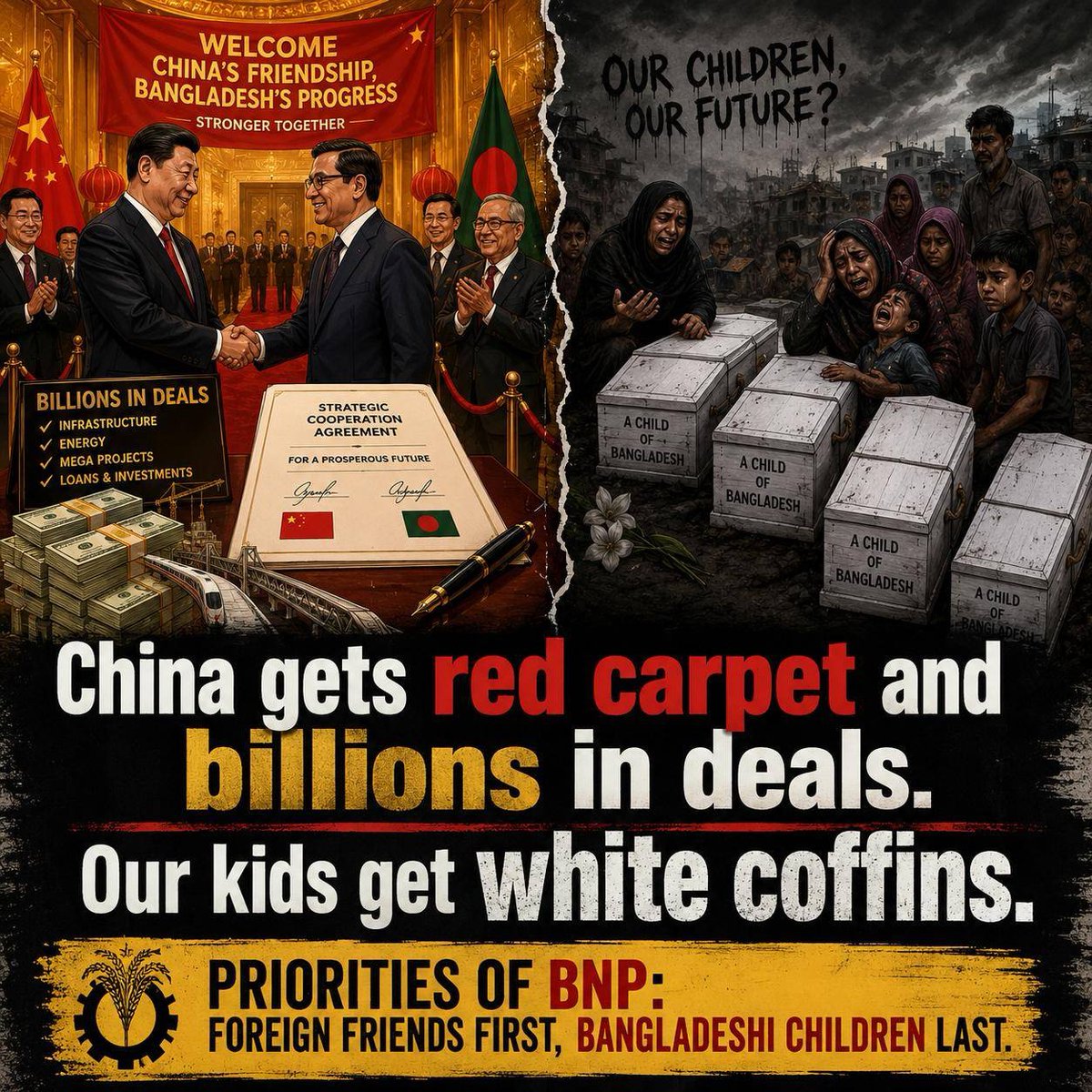
China gets red carpet and billions in deals. Our kids get white coffins.
Priorities of BNP: Foreign friends first, Bangladeshi children last.
#Bangladesh#China#BNP
Strangers in Pakistan get official government sympathy.
Our own innocent children get early graves and government silence.
This level of neglect is unforgivable.
#Bangladesh#BNP#Pakistan#China
They found time to condemn the Pakistan train incident.
But have no time to address the measles deaths happening across Bangladesh.
Foreign statements over local lives.
#Bangladesh#China#BNP#Pakistan
From Political Crisis to Security Concern
Political instability in Bangladesh is creating new fears about extremist expansion.
📈 Analysts warn of:
• Increased street mobilization by hardline groups
• Growing radical narratives online
• Pressure on democratic institutions
• Rising insecurity for minorities and women
The future of Bangladesh will shape the stability of the entire region.
Read ➡️ https://t.co/rhXx2CiFia
#Bangladesh #Democracy #HumanRights #SouthAsia #GlobalSecurity
📍 Why the World Is Watching Bangladesh
Bangladesh sits at a critical geopolitical crossroads:
🌏 Bordering India
✈️ Connected through global migrant networks
📱 Facing rapid online radicalization trends
Reports suggest extremist organizations are trying to rebuild influence through campuses, mosques, and social media.
The fear? Bangladesh becoming a regional hub for militant recruitment once again.
Read ➡️ https://t.co/rhXx2Ci7sC
#BangladeshCrisis #RegionalSecurity #CounterExtremism #SouthAsia