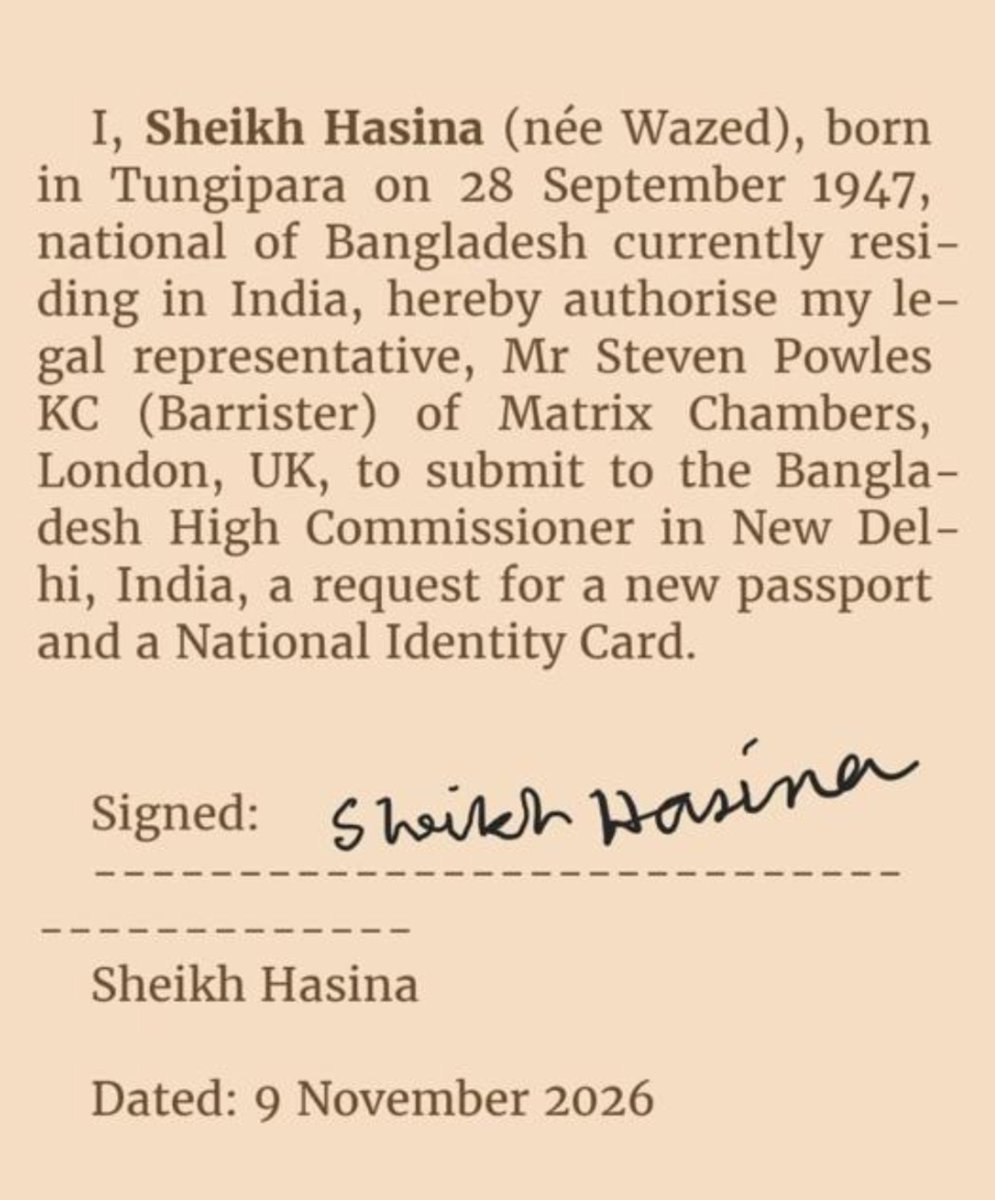
Breaking: #SheikhHasina Renews Request for Identity Documents to Return to #Bangladesh; Sends Authorisation Letter for Lawyer.
Steven Powles KC, the British lawyer acting for former Bangladeshi Prime Minister Sheikh Hasina, has written again to the Bangladesh High Commission in #NewDelhi, asking the mission to begin the process of issuing the identity documents she needs to return home.
This time, Powles enclosed a formal authorisation signed by Hasina. He also asked for an update on his earlier request, which the mission has yet to answer.
Source: @sidhant
Will the Bangladeshi authorities respond? Since the first letter became public, senior #BNP government officials have insisted that Hasina can return only through #extradition under Bangladesh’s treaty with #India. That process could take considerable time, and its outcome is far from certain.
Sheikh Hasina says she is ready to return voluntarily as soon as December.
As recently as a few weeks ago, the BNP and its political allies in the opposition, the #NCP and #JamaatEIslami, were repeatedly calling for Hasina to be brought back and executed.
Now that she is seeking to return of her own accord, why is the BNP government and its allies so adamant to stop, at the very least, delay it?
If the mobilisation of her supporters in recent days over her possible return is any indication, the answer to that question is clear.
...
#BangladeshUnrest #SouthAsia
Four news clips from the past 24 hours show what #AwamiLeague supporters in #Bangladesh, and even those merely suspected of supporting the party, face every day.
Video 1
The footage shows Rabiul Islam Nayon, Prime Minister Tarique Rahman’s “mob enforcer-in-chief”, and his associates stopping people at an informal checkpoint in the capital and searching their phones.
The slightest suspicion of support for the Awami League can lead to public humiliation or assault. Those stopped and "identified" are then handed over to police, implicated in a fabricated criminal case or pressed under the Anti Terrorism Act, and left to languish in jail.
Video 2
In Cumilla last night, police arrested 61 people from their homes during a "block raid" to detain known AL supporters after midnight.
For those known to support the Awami League, their political affiliation alone is enough to land them in jail. Even relatives of people affiliated with the party face the same risk.
Once in custody, detainees are then falsely implicated in criminal cases or pressed under the Anti Terrorism Act.
Video 3
The footage shows actress Jyotika Jyoti being brought before a court. Jyoti has publicly expressed support for the Awami League on social media. And that's her only "crime".
She was picked up from her home late last night. Today, police told the magistrate that she was an "unnamed" accused in a case relating to violence in July 2024. The magistrate accepted the police account without scrutiny and sent her to jail.
This has become standard practice in Bangladesh for judges in cases involving anyone directly or indirectly affiliated with the Awami League.
Video 4
When those being sought by the police or ruling #BNP activists cannot be found, their homes or businesses can come under attack.
The footage shows the residence of former State Minister for Foreign Affairs @MdShahriarAlam being set on fire in Bagha, Rajshahi.
His is one of at least 23 homes linked to Awami League leaders and supporters targeted in the past 72 hours.
Everyday Reality for Millions
Taken together, these clips show why the fear extends well beyond those arrested.
A phone search by ruling-party activists can end in police custody.
A midnight raid can reach an entire family.
Once someone is brought before a magistrate, courts simply accept the police account without even a shred of evidence connecting them to the alleged offence.
For those facing fabricated charges, that failure can mean months, even years, behind bars.
Even those who escape detention have reason to fear for their homes, livelihoods and family members.
These conditions have persisted under successive governments, first under the interim government led by Muhammad #Yunus and now under the BNP government led by #TariqueRahman.
Thus, any discussion of the recent protests by the Awami League supporters, including those that have turned violent, must take account of this daily reality for millions of people in Bangladesh.
...
Videos: DBC News, Channel 24, Jamuna TV.
...
@State_SCA@eu_eeas@StateDRL@Shabia_M@FCDOGovUK@hrw@ESandersFCDO@MEAIndia@GERonSouthAsia@suhasinih
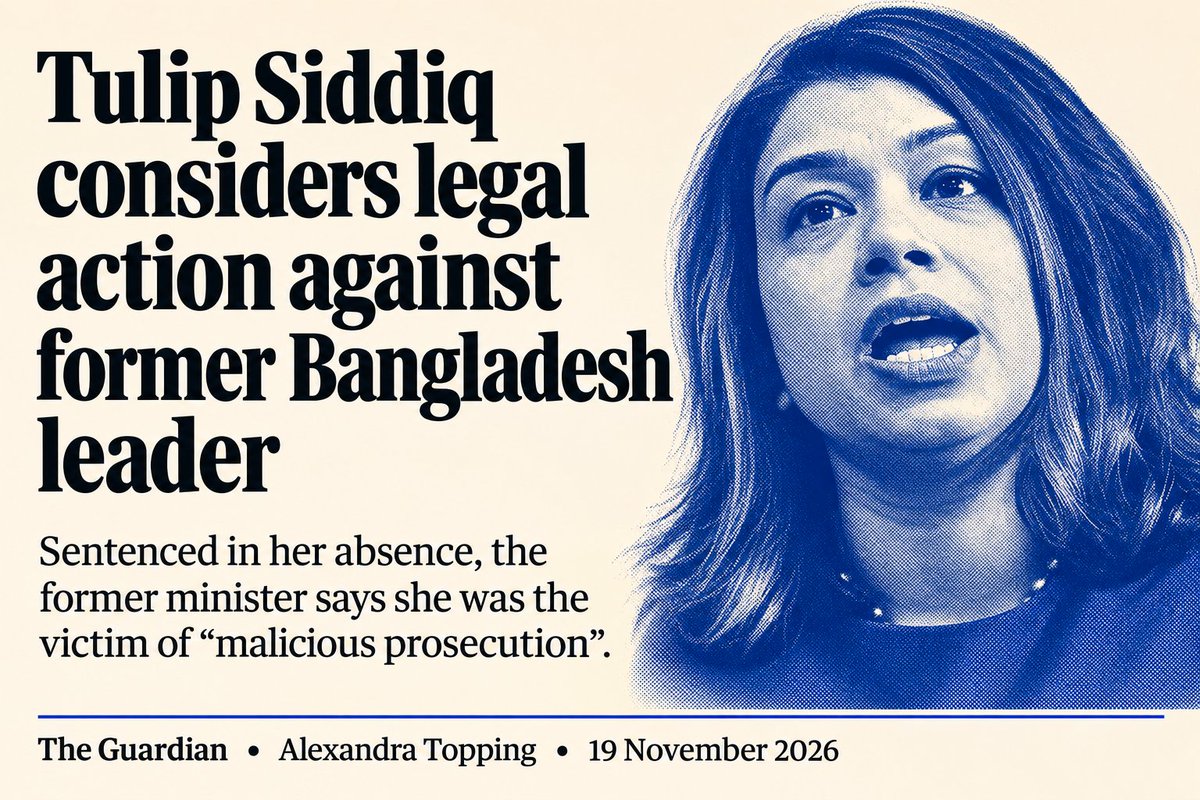
UK MP @TulipSiddiq says she is considering legal action against former #Bangladesh interim leader Muhammad #Yunus for ‘malicious prosecution’, @guardian reports.
The former UK minister Tulip Siddiq MP has said she is considering taking legal action against the former interim leader of Bangladesh over corruption allegations made by his administration led her to resign from the UK government last year.
The MP was accused of benefiting from the former regime by the authorities in the Bangladeshi capital, Dhaka.
Siddiq was sentenced to two years in prison in Bangladesh in Dec las year after being put on trial in her absence, alongside 16 other people, over corruption allegations.
She was found guilty of influencing her aunt to secure a plot of land for her family in the outskirts of Dhaka. Siddiq, who is based in London and strongly denied the charges, is unlikely to ever serve the sentence.
In an interview with the Guardian in summer 2025, Siddiq called the charges against her “completely absurd”, saying she was “collateral damage” in a longstanding feud between her aunt and Bangladesh’s former interim leader Muhammad Yunus.
Speaking to Politics Unleashed, Siddiq said she had been the victim of a “malicious prosecution”. She added that she was speaking with a reputable lawyer who had told her she had a case to sue Yunus, the Nobel peace prize-winning economist who led the interim government in Bangladesh from 2024 to 2026.
“It was essentially malicious prosecution,” she said, adding that she was exploring options with lawyers and “considering” legal action.
Yunus, approached by Guardian for a response through two close associates, declined to comment.
Siddiq said she had repeatedly tried to get details about what she was accused of, but the Bangladesh government had not replied to letters from her lawyers.
She detailed sending a handwritten letter to Yunus, who was staying at the Dorchester in London. “He refused to meet with me. I tried repeatedly to see him face to face,” she said, insisting she had not been stressed by the accusations and subsequent trial because she knew she was innocent. “I was more baffled by the whole thing than anything else,” she said.
Speaking about the impact of the trial, she compared the experience to being in a “Kafkaesque nightmare”, adding: “I had no idea what I was being convicted for. The only way I found out I had been convicted is when I woke up in the morning and saw an alert from Sky News.”
Siddiq also revealed she had received support from the former prime minister Keir Starmer during the controversy. She said he sent her a message when he was in the US with Donald Trump after she had received a security threat. “It kind of matched with the timing of when he was just about to see Trump,” she said
Report:
https://t.co/LaoP5KpMgk
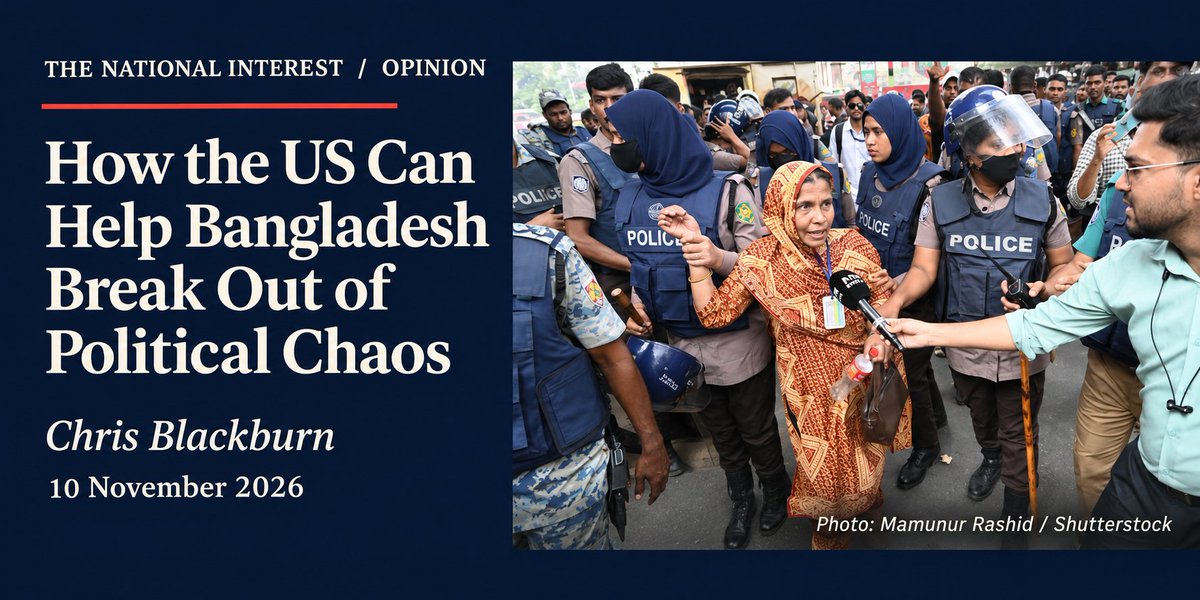
How the US Can Help #Bangladesh Break Out of Political Chaos: Chris Blackburn writes for the National Interest.
British parliamentarians have called for help in breaking Bangladesh’s cycle of political revenge.
Washington should bring some American diplomatic muscle to the effort.
"Bangladesh’s political class has become remarkably good at demanding democracy from its opponents and remarkably bad at practicing it once power changes hands. Every camp has its martyrs, its grievances, and its explanation for why somebody else must behave first. Meanwhile, ordinary Bangladeshis are expected to endure the consequences. So, a plague on all their houses.
That is the starting point for a serious discussion of reconciliation. Without an honest accounting of the rival camps’ conduct, reconciliation becomes another respectable word attached to the same rotten habits.
Americans should recognize the danger of investing their hopes in whichever politician has most recently acquired the language of reform."
Read more:
https://t.co/FOqcNHZVxp
...
@StateDept@State_SCA@marcorubio@usembassydhaka@USAmbBangladesh@SFRCdems@SenateForeign@SenatorRisch@SenatorShaheen@houseforeign@HouseForeignGOP@SergioGor@RepBrianMast@StateDRL@RepGregoryMeeks@CJBdingo25
Economist @binayak_sen argues that #Bangladesh cannot resolve its economic challenges without moving beyond the “zero-sum game” that defines its politics.
He calls for a more inclusive approach grounded in dialogue and mutual recognition, with each side acknowledging the legitimacy of the “Other”.
Reflecting on a recent article by @TheEconomist on Bangladesh, Sen writes:
"The binding constraint, or key factor, underlying the present economic problem, in my view, lies in the country’s highly polarized politics, as if bent on mutual annihilation. Without addressing this, the country cannot restore organic stability, durable order, or credible investor confidence.
Confidence cannot be encouraged through authoritarian dictates, but only through a soft, inclusive approach based on mutual dialogue and recognition of the Other.
One needs to rethink the existing political premises underlying the bitter party politics. One must make some political compromises to prevent further economic collapse and social polarization.
Maybe all the main political stakeholders in Bangladesh will envision the country's political future and move beyond their narrow party-ideological perspectives (an exercise conducted behind Rawls's “veil of ignorance”).
After all, these parties have come to stay and will remain for the foreseeable future. They must now accept each other as “the face of the Other” as required by Levinasian ethics. The face says, “thou shalt not kill.” National reconciliation is an absolute necessity.
This doesn't mean everyone who committed crimes in the distant or recent past should be unconditionally admitted into political life (for crimes proven beyond a reasonable doubt in a fair, transparent court through due diligence).
The government in power must show signs of such rethinking and take the first steps. It bears the primary responsibility for the country’s economic outcomes."
...
#BangladeshUnrest #Protests #Inclusion #Democracy @hrw@State_SCA@GERonSouthAsia@MEAIndia@Chellaney@eu_eeas@Ed_Miliband@Shabia_M
#Bangladesh Unrest | #BNP Govt Orders Pvt. Schools, Colleges and Universities to Hold In-Person Classes Despite Potential for Violence.
Several parents and students have informed us that their institutions had initially announced that classes would move online today amid concerns about possible violence and clashes during the #AwamiLeague’s lockdown programme.
This morning, the same institutions withdrew their earlier notices and informed students that classes would be held in person.
Educators confirmed to us that the reversal followed a direct directive from the BNP government requiring private educational institutions to remain open and hold classes in person despite the safety concerns.
The BNP Government’s primary aim seems to be to give the impression that daily life is continuing as usual in Bangladesh despite the political and economic unrest.
....
#Bangladesh Unrest:
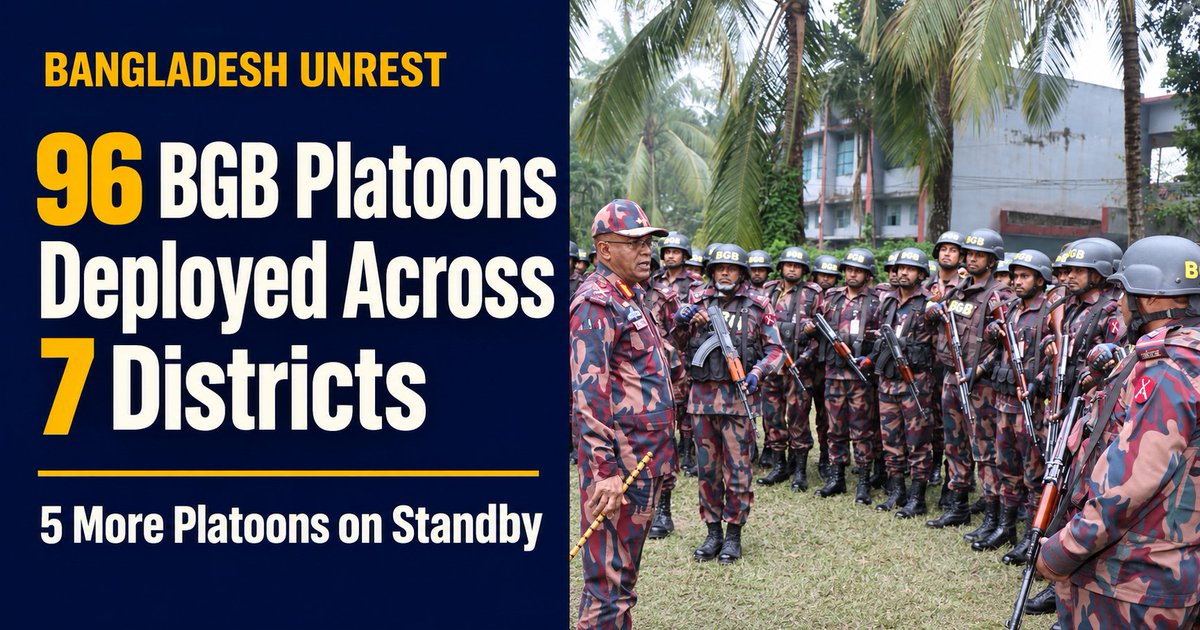
The BNP Government has deployed 96 platoons of the paramilitary Border Guard Bangladesh (BGB) across seven districts as garment workers’ wage protests enter their 20th day and the #AwamiLeague steps up its political programmes.
A total of 96 BGB platoons have been deployed in Dhaka, Gazipur, Chattogram, Narayanganj, Faridpur, Gopalganj, and Mymensingh districts to "control the overall state of law and order in the country", according to a media statement by the BGB.
Five more platoons have been kept on standby.
The scale of the paramilitary BGB deployment suggests the BNP Govt is dissatisfied with how regular law enforcement agencies like police have handled the unrest over the past two weeks.
Garment workers’ protests show no sign of easing, while the Awami League’s political programmes are intensifying and spreading beyond Gopalganj.
However, what can deploying more security forces achieve if workers’ wage demands remain unresolved and the political grievances driving the Awami League’s agitation go unaddressed?
Security approaches will never work on issues fuelled by political and economic grievances.
...
#BangladeshUnrest #SouthAsia
What happened during the eighteen months of the interim administration that Bangladesh, which had continued to make steady development progress despite some setbacks, is now being described as no longer a development miracle?
For those who remain sceptical, I would suggest revisiting the IMF's June 2024 report. It provides an important picture of Bangladesh's economic position before the political transition.
The task, then, is to examine what changed, why it changed, and what role the interim administration's policies and decisions played in that trajectory.
@TheEconomist's account appears to give the interim government relatively little scrutiny. Bangladesh's bad loan crisis is decades in the making, with corruption and political patronage across successive governments playing a significant role in its development. That historical context, however, should not obscure the need to examine what happened under the interim government. We should also look closely at its policy decisions, institutional interventions, and their economic consequences. Here are some of the key developments during its tenure:
1/ @TheEconomist credits Bangladesh’s interim government with adopting the 90-day bad-loan rule. That was an IMF condition, and the phase-in began in April 2024 under the Awami League. The interim completed it; it didn’t originate it. https://t.co/m29cfrYkUS https://t.co/UiBt6YN1a2
2/ The Economist calls the 2019 rule (2% down, a decade to repay) the old regime’s way of hiding bad loans. In Sept 2025 the interim brought back essentially the same terms: 2% down, up to 10 years. https://t.co/edGbHfcMdh
3/ Before that, some 250 companies, including some of the biggest defaulters, were allowed to put down as little as 1% and take up to 15 years to repay. https://t.co/WL8SqvzcTf
4/ Result: banks rescheduled Tk1.7trn ($14bn) of loans in 2025, 9.4% of all lending, and doubled 2024. That’s Bangladesh Bank’s own Financial Stability Report. https://t.co/ExJ2ni8Id4
5/ Aug 2024: The new governor pledged no money printing for weak banks. Nov 2024: Tk22,500 cr printed for six banks. https://t.co/PuliRt6QpG https://t.co/hmsGBAuAYT
6/ By June 2025, Tk52,500 cr had gone to 12 banks, Tk33,000 cr of it as new loans. The collateral and repayment terms were never officially published. The $6.2bn total The Economist cites that it was reached by June 2026. https://t.co/fSPp3CAzI2 https://t.co/821shz3eYq
7/ In Jan 2026 the interim told 7.5m depositors of five failed Islamic banks they’d get no profit for 2024–25, with withdrawals capped. It reversed course only after protests, and only for individuals. https://t.co/lQxXGGjKke https://t.co/8MKChVEy4S
4/ The result is in Bangladesh Bank’s own Financial Stability Report: Tk1.7trn ($14bn) of loans rescheduled in 2025, 9.4% of all lending, and double the year before. The Economist faults the new government for rescheduling; the interim did far more. https://t.co/ExJ2ni8Id4
5/ The same pattern holds for money. In Aug 2024 the new governor pledged no printing for weak banks. Three months later, Tk22,500cr was printed for six of them. https://t.co/PuliRt6QpG https://t.co/hmsGBAuAYT
6/ By June 2025, Tk52,500 cr had gone to 12 banks, Tk33,000 cr of it as new loans. Collateral and repayment terms were never officially published. The article cites a $6.2bn total without saying when it was lent. https://t.co/yB2SiMLZ5J
7/ Accountability. The closing section is all about the BNP: “dragging its feet." BNP-linked oligarchs are waiting “for their turn to loot." The interim’s eighteen months of rule by ordinance, its bank takeovers, and its merger decisions are not assessed at all.
A technocrat government's action is not above scrutiny—linking the banking sector's crisis to a political government's alleged corruption is a siloed approach—that opacity alone cannot solve the problem.
Read this: Unfortunately, the article by @TheEconomist does not pinpoint the crux of the crisis that marks the “now-time”. https://t.co/wdVkKTAQn9
The main problem the article highlights misses the urgency of the moment. It is not access to credit (a result of high debt defaults, which look even higher now that statistics are more transparent). The fiscal constraint (a low tax-to-GDP ratio and high government borrowing to finance public expenditures) also complicates the situation, as it clearly constrains public service delivery. However, high banking debt and low fiscal capacity cannot be addressed overnight and may be a medium-term reform challenge.
Inflation is rising, admittedly, not because of the food sector's poor performance (agriculture is performing well despite challenges). Inflation is now higher mainly due to higher energy prices from external shocks (which even influenced the US mid-term electoral results) and other well-known externally driven factors that reduce Bangladesh’s maneuverability in sourcing energy from alternative sources. The inflationary situation can improve overnight once the root cause is over, which is beyond Bangladesh’s control. Arguably, inflation is not the main cause of the current maladies.
The binding constraint, or key factor, underlying the present economic problem, in my view, lies in the country’s highly polarized politics, as if bent on mutual annihilation. Without addressing this, the country cannot restore organic stability, durable order, or credible investor confidence.
Confidence cannot be encouraged through authoritarian dictates, but only through a soft, inclusive approach based on mutual dialogue and recognition of the Other.
One needs to rethink the existing political premises underlying the bitter party politics. One must make some political compromises to prevent further economic collapse and social polarization.
Maybe all the main political stakeholders in Bangladesh will envision the country's political future and move beyond their narrow party-ideological perspectives (an exercise conducted behind Rawls's “veil of ignorance”). After all, these parties have come to stay and will remain for the foreseeable future. They must now accept each other as “the face of the Other” as required by Levinasian ethics. The face says, “thou shalt not kill.” National reconciliation is an absolute necessity.
This doesn't mean everyone who committed crimes in the distant or recent past should be unconditionally admitted into political life (for crimes proven beyond a reasonable doubt in a fair, transparent court through due diligence).
The government in power must show signs of such rethinking and take the first steps. It bears the primary responsibility for the country’s economic outcomes.
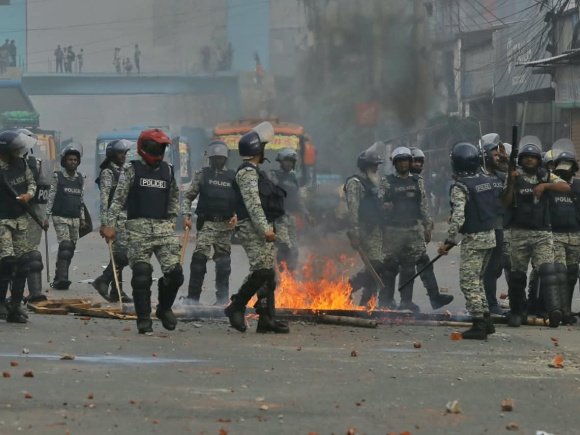
From @ReutersAsia: #Bangladesh stepped up security and deployed hundreds of paramilitary troops nationwide on Wednesday as the planned return of former Prime Minister #SheikhHasina has sparked clashes, bomb blasts and arson attacks blamed on supporters of her banned party.
Hasina, who has lived in exile in neighbouring India since she fled Dhaka following violent protests demanding her resignation in August 2024, has requested a new passport and identity card, saying she plans to return in December.
But the government has so far rejected her request, leading to members and supporters of her Awami League party taking to the streets in protest.
Last week, the party announced a week-long programme of protests and rallies to mobilise support for Hasina's return, culminating in a nationwide lockdown on November 19.
Police have recorded dozens of crude bomb blasts and incidents of vehicles being torched in at least 28 districts over the last 10 days, with several police personnel and civilians injured, local media has reported.
@Reuters Report:
https://t.co/IZMCiTpx5p
...
#Politics #SouthAsia #India
#Bangladesh's first #nuclear power plant reached a major milestone yesterday when the first unit at #Rooppur began supplying 350 MW of #electricity to the national grid.
Bangladesh became the 33rd country in the world to generate nuclear power.
Bangladeshis took to social media to celebrate a moment of national pride.
In a development likely to annoy and embarrass the #BNP Govt, many social media users thanked former Prime Minister Sheikh Hasina by name.
Much of the mainstream media covered the grid connection without mentioning her role in making it possible.
It was under Hasina’s leadership that the #AwamiLeague Govt negotiated the agreement for the 2,400 MW nuclear project with #Russia, secured financing, arranged the supply of materials and oversaw construction of the plant, including its 1,200 MW first unit.
When Hasina set out to build a nuclear power plant, many doubted Bangladesh could see the project through. Some of those sceptics were experts.
The Rooppur plant has begun supplying electricity to the national grid at a time when Bangladesh faces a severe #energy crisis, with frequent power cuts disrupting businesses and daily life in homes across the country.
Yesterday, as electricity from the Rooppur Project reached the national grid for the first time, many Bangladeshis made clear whom they credited.
...
#Bangladesh #EnergyCrisis #NuclearPower #RooppurNPP
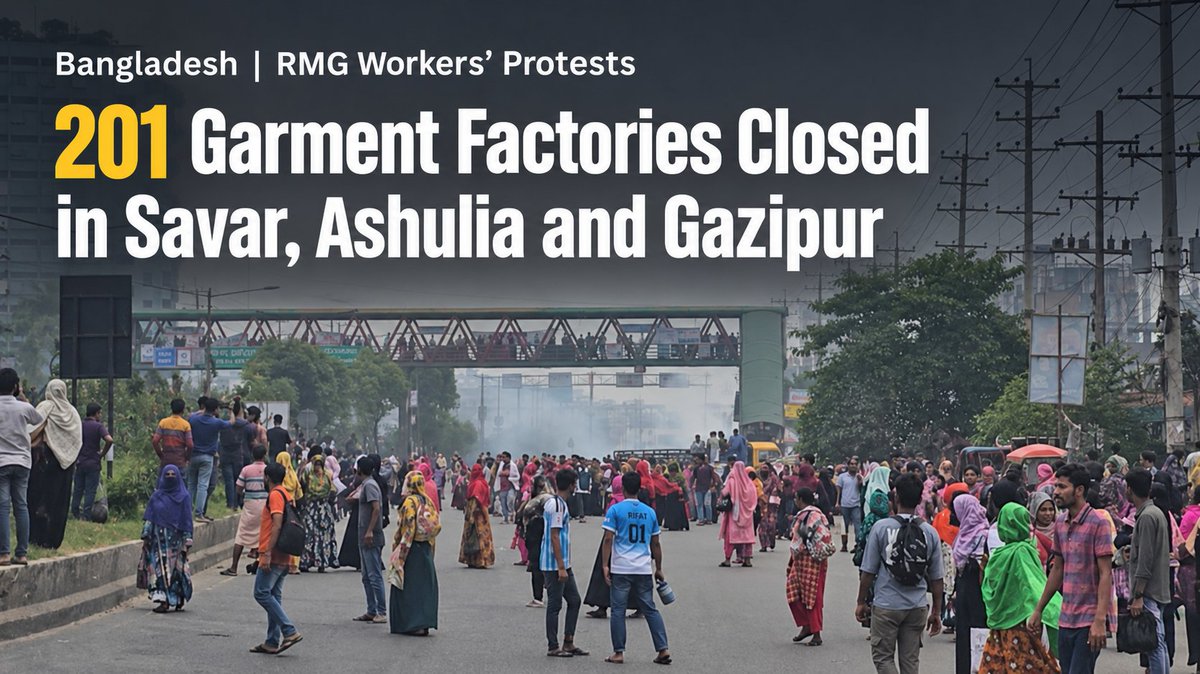
#Bangladesh Garment #Workers' #Protests for Fair Wages Intensify.
Garment workers staged fresh protests in Gazipur, Savar, Ashulia and Mirpur today, blocking roads and prompting police to use sound grenades and tear gas to disperse them amid ongoing labour unrest over wage-related demands.
Police fired tear gas shells and sound grenades in Savar to disperse protesters. In Gazipur, police also fired sound grenades as workers blocked roads.
...
Images (c) @dailystarnews.
Full report:
https://t.co/syp11P4nrz
@amnestys@hrw@IHRF_English
A new whitepaper, "Counting the Economic Cost: A Whitepaper on Bangladesh under the Yunus-led Interim Regime" (authors: Dr Mamunur Rashid, Dr Sangita Gazi, Prof Bidit L. Dey & Dr Tashfeen Hussain), estimates that 18 months of the unelected interim administration (Aug 2024–Feb 2026) cost Bangladesh USD 80–112 billion - roughly $470–660 per citizen, or 17–24% of a year’s national output.
The report contrasts this with the pre-August 2024 record: poverty fell from 44% to 13%, average ~6% growth over decades, the world’s second-largest RMG industry, near-universal electrification, and strong health gains (the “Bangladesh paradox”). It attributes the reversal not to external shocks alone but to rapid “institutional capture”: neutral institutions (central bank, courts, regulators, revenue machinery) were subordinated to a small “Kitchen Cabinet” circle. Governance shifted to ordinances (100+), elected local bodies were largely dismantled, and judicial/financial oversight was neutralised. Losses are counted bottom-up from official data, Bangladesh Bank figures, IMF/WB documents and news records; the authors stress conservative methodology and note the true cost is higher.
Main loss categories (USD billion):
- Banking & finance: 31.9–42.1 (largest share; NPLs nearly tripled from 12.6% to a 35.7% peak - highest in Asia; stock ~USD 54 bn)
- Economic mismanagement: 27.7–37.9 (GDP growth fell to 3.49% in FY2025, weakest in 20 years; opportunity loss ~USD 17–22 bn; ADP execution collapsed from 81–95% to 11.5%, lowest on record)
- Private investment & business infrastructure: 11.6–18.5 (FDI collapsed to USD 1.27 bn / 0.28% of GDP; credit growth hit 15-year lows; port, energy and logistics disruptions)
- Institutional capture + other social/reputational/crony losses: ~8–14 bn
Human and social costs (partly quantified): first labour-force contraction since 2010 (−1.74 million workers, of which ~1.6 million women); hundreds of RMG factory closures and >100k direct job losses; vaccine stock depletion and health setbacks; elevated mob violence and attacks on minority commercial properties; rising bribery and capital flight indicators.
The paper also flags forward liabilities of USD 16–30 billion (including a late US energy purchase commitment) and unquantified items (schooling, brain drain). It does not adjudicate the July 2024 events themselves and frames the 18 months as a documented case of institutional capture transmitting into measurable macroeconomic damage.
Full report: https://t.co/ro2CjimhMs
“Full Stalin” Mode: Politicisation of #Bangladesh’s Law Enforcement Reaches Unprecedented Levels Under #BNP.
According to a report by the Daily Times of Bangladesh (ToB), approximately 22,000 police personnel recruited during the #AwamiLeague’s 15 years in power have been placed under special surveillance, while internal investigations are under way against several thousand officers and other personnel suspected of secretly maintaining contact with leaders and activists of the ousted party.
Citing multiple sources at Police Headquarters, the report reveals that intelligence is being gathered on approximately 17,000 constables and 4,000 Sub-Inspectors (SIs). The remainder comprise personnel who were promoted to the ranks of Assistant Sub-Inspector (ASI) and Assistant Superintendent of Police (ASP).
It should be noted that, in the last 27 months, 174 police officers have already been sent into compulsory or forced retirement, while at least 100 more officers of various ranks have reportedly been placed on special duty, for political considerations.
Senior police officials have also been subjected to frequent transfers since the BNP Government assumed power eight months ago. Most recently, Jahangir Alam, Superintendent of Police of the Chattogram Range Reserve Force, was arrested and jailed in a sedition case over allegations of maintaining secret contacts with the Awami League.
News:
https://t.co/FpmcGPi6br
What is behind this extraordinary campaign of surveillance, investigation, and removal within Bangladesh's police force?
The emerging pattern suggests something far more troubling than routine administrative oversight or efforts to improve professional accountability. It increasingly resembles a sweeping test of political allegiance, in which officers are judged not by their professional competence, integrity, or adherence to the law, but by their perceived loyalty to the ruling party.
The apparent objective is to transform the police into an extension of the ruling BNP's political machinery, rather than an independent law enforcement institution accountable to the Constitution and the people of Bangladesh.
Under such a system, merely having been recruited or promoted during the previous government becomes grounds for suspicion. Even more disturbingly, maintaining personal or professional contact with individuals associated with the Awami League appears sufficient to trigger intelligence surveillance, internal investigations, and potentially punitive administrative measures.
Since when did recruitment under a particular government, or suspected political sympathies, become evidence of professional misconduct?
Over the past eight months, we have documented numerous instances of police officers arbitrarily arresting individuals on the basis of their political affiliations, producing detainees before courts in cases where little or no credible evidence has been presented, and regularly facilitating or cooperating with ruling-party activists engaged in intimidation and #mob violence.
The treatment of Awami League leaders, activists, supporters, and even their family members has been particularly alarming. Political affiliation is increasingly being treated as a substitute for evidence of criminal wrongdoing.
Against this backdrop, the reported surveillance of 22,000 police personnel raises a deeply disturbing possibility: officers who refuse to participate in politically motivated arrests, harassment, or excessive use of force against the BNP Govt’s political opponents may themselves risk being labelled Awami League sympathisers.
What we are witnessing under PM #TariqueRahman's Govt increasingly resembles an Stalinist ideological purge of the law enforcement establishment, accompanied by an expectation of unquestioning political obedience.
For a government that claims to have “restored” democratic governance, the contradiction could hardly be more glaring.
…
Karnaphuli Garden City in Kakrail, #Dhaka once a bustling mall, has been shut since October 1, with only 17 of its 198 shops still open and monthly expenses of Tk 15 lakh against income of Tk 1.5 lakh, according to @DhakaTribune.
The @dailystarnews found at least 10 other older complexes in Dhaka facing the prospect of closure, though owners also blame mismanagement and online shopping, so the mall alone does not prove a recession.
The wider retail picture is harder to explain away: fashion retailers told the Daily Star that sales are at least 20% lower than last year despite discounts of up to 50%, and shorter shopping hours to save electricity have cut some sales by as much as 30%.
The reason is in the household budget. #Inflation was 8.27% in October but non food inflation rose to 9.89%, while wage growth slowed to 7.63%, so pay has trailed prices for more than four years.
A #Bangaldesh Bureau of Statistics (BBS) survey found 47.42% of households borrowing to meet basic living costs, and the @WorldBankGroup estimates the poverty rate at 22.5%, although that figure comes from modelling.
When people borrow to eat, they stop buying shirts, sofas and cars, which is why car registrations are on course to fall about 13% this year and motorcycle sales are slipping too.
#Businesses are behaving the same way. Private sector credit growth has stayed below 5% for seven straight months and was 4.14% in the latest reading, and capital machinery imports fell from $750.7 million to $506.9 million in July and August, a sign that firms are not expanding.
Net foreign direct #investment fell 28% in the first half of 2026, and at 27 listed banks, net interest income turned negative at Tk 5,624 crore in January to September, because banks would rather hold government securities than lend.
Even the encouraging news, October's PMI of 51.8, which ended two months of contraction, came with weak new orders in manufacturing, construction and services.
The state has little room to rescue anyone. The National Board of Revenue (NBR) is more than Tk 50,000 crore short of its four month target, the FY27 target is 45% above last year's collection, and the @IMFNews has cut its growth forecast to 3.2%, the lowest in 38 years.
The US dollar has crossed Tk 125 as fuel imports cost around $148 a barrel against under $90 before the war, foreign debt service of $1.35 billion in the first quarter was more than double the aid received, and the finance ministry has now frozen new vehicle purchases and new government buildings.
So is it a recession? By the textbook definition, no: GDP grew 3.68% in FY26 and the #economy is still expanding on paper.
But growth this slow, with prices outrunning pay, empty shops and banks that will not lend, feels like a recession to many families and businesses, and the label matters less than the direction.
The numbers to watch are credit growth, machinery imports, the taka and the next GDP reading, and the question for policymakers is whether they can restore confidence before a slowdown hardens into something worse.
Source:
https://t.co/YwOUKdCqKV
...
#BangladeshEconomy #Recession
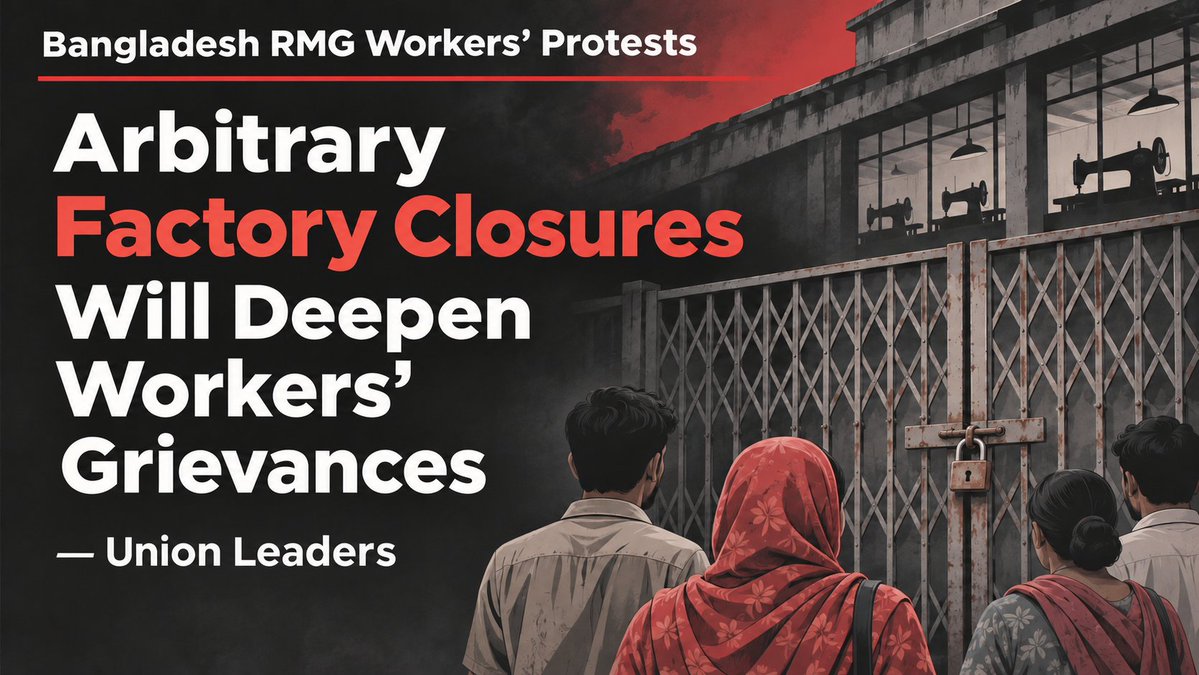
Garment factory owners have threatened to shut unrest-hit units indefinitely from tomorrow (15 November) under the Labour Act if workers do not return to work.
Union leaders, however, warn that such a knee-jerk response will only prolong the crisis, hurting owners and workers alike.
Speaking at a press conference today (14 November), Bangladesh Garment Manufacturers and Exporters Association (BGMEA) President Mahmud Hasan Khan said production had been halted at 147 factories due to “unrest”.
He said the owners would invoke Section 13(1) of the Labour Act to close factories on a “no work, no pay” basis.
Trade union leaders warned that such closures would only deepen workers’ grievances. Workers are demanding not only fairer wages and better working conditions, but also an end to the practice of shutting factories whenever they demand change and respect.
They argued that threatening closures while the wage board is still considering workers’ proposals signals a lack of good faith and raises doubts about the owners’ willingness to adjust wages to reflect workers’ economic circumstances.
News:
https://t.co/lzwOWmAsGS
...
@davemorrissey64@JamesPurefoy@ituc@ILOAsiaPacific@ilo@uniglobalunion@global_labor@TUCGlobal@BizHumanRights@IndustriALL_GU@amnestysasia@ApsanaBegumMP@meeganguly
#Bangladesh: Businesses are facing mounting pressure amid sluggish investment, high interest rates, rising production costs and political and economic uncertainty.
The National Board of Revenue’s (NBR) move to seek bank account details of more than 200 individuals and companies, and freeze accounts of around 100 people over alleged involvement in fuelling unrest in the garment sector, has added to entrepreneurs’ concerns, @DhakaTribune reports.
Business leaders warn that indiscriminate account freezes based on political affiliations or past business ties could harm innocent entrepreneurs. They argue that action should be taken only after investigations establish specific evidence of involvement in labour unrest.
On November 4, the NBR’s Income Tax Intelligence and Investigation Unit and Central Intelligence Cell sent letters to banks seeking information on the accounts of more than 200 individuals and entities. Banks were also instructed to freeze the accounts of around 100 individuals.
NBR officials said the measures were taken based on “intelligence agency” information. The list reportedly includes former #AwamiLeague lawmakers and politically affiliated individuals, as well as businesspeople without known political connections. Several major export-oriented groups have also come under scrutiny.
The Bangladesh Garment Manufacturers and Exporters Association (BGMEA) has raised concerns with the government, seeking to prevent further complications for the industry.
BGMEA President Mahmud Hasan Khan Babu said the association had urged the government not to freeze the accounts of factory owners or companies without specific evidence that they had instigated or financed labour unrest.
Read More: https://t.co/CYZwQs0kCI
…
"There is, I think, no precedent for a government telling one of its own citizens, convicted in absentia and the subject of its own extradition request, that she may not come home voluntarily to submit to its courts, but must instead be extradited. Yet this is the BNP Govt's position, so desperate it is to keep Sheikh Hasina out of the country"
@TheDavidBergman on the #BNP Government's refusal to facilitate #SheikhHasina's voluntary return to #Bangladesh and insistence on an uncertain and time-consuming #extradition process.
So, why doesn’t the BNP want Sheikh Hasina back in Bangladesh?
See:
https://t.co/zEntT2bFl2
...
#SouthAsia #Politics #Diplomacy