#Bangladesh | Crackdown
Even the Family of a Deceased MP Is Not Spared from the Ongoing Crackdown.
The Detective Branch (DB) of Dhaka Metropolitan Police (DMP) detained Muntarin Ferdous Dorin, daughter of former lawmaker Anwarul Azim Anar, from her residence in Lalmatia last night.
Her father, Anwarul Azim Anar, a former Awami League MP, was murdered in India in May 2024.
According to Molla Mohammad Shaheen, deputy commissioner of the DB’s Wari Division, legal proceedings against 24-year-old Dorin are underway.
No specific criminal allegation against Dorin has been publicly disclosed, nor has any political affiliation been established.
Her apparent offence is simply that her deceased father was associated with the Awami League.
This is how wide a net the BNP government's political crackdown, intensified at the beginning of this month, is now casting.
....
@amnestysasia@ESandersFCDO@PearsonElaine@StateDRL@hrw@UNHumanRights@Ginitastar@SRjudgeslawyers@volker_turk@meeganguly@S_Asian_Rights@Kennedy_HRC@IHRF_English
#BangladeshUnrest | Crackdown
Since November 1, at least 3,320 leaders, activists and supporters of the #AwamiLeague and its affiliate organisations have been arrested across #Bangladesh as part of the #BNP government's declared crackdown on the political opposition.
Previously, we reported at least 3,036 arrests between November 1 and 22, 2026. In the subsequent four days, at least 239 more individuals have been detained.
The arrests were carried out in Dhaka Metropolitan Area (142), Jashore (46), Cumilla (31), Chattogram (9), Sylhet (4), Satkhira (4), Khulna (4), Rajshahi (4), Bogura (3), Gazipur (3), and Patuakhali (3).
The highest number of arrests over the past four days was recorded in the Dhaka Metropolitan area with at least 142, followed by Jashore with at least 86.
Some reports concerned arrests in connection with processions, while others involved police raids and arrests of named and unnamed individuals in cases arising from the July–August 2024 violence or filed under the Anti-Terrorism Act.
What the Figure Represents
The figure of 3,320 represents a conservative, media-based minimum rather than a comprehensive national tally. Not all arrests receive media coverage, particularly in rural and remote areas.
Additionally, the figure excludes those who are arrested without assigning any cause whatsover, such as family members of Awami League-affiliated individuals.
The actual figure is, therefore, likely to be higher.
Strategy of Detaining Opposition
Previously, we highlighted reports of approximately 100,000 arrests of Awami League-associated individuals between August 2024 and October 2026.
The latest wave of over 133+ arrests on average per day in November coincides with discussions surrounding former Prime Minister #SheikhHasina’s announced return in December 2026.
This suggests that silencing the political opposition through mass incarceration remains the dominant strategy of the BNP government led by Prime Minister #TariqueRahman.
...
#BangladeshCrisis @amnestysasia@hrw@PearsonElaine@amnesty@meeganguly@ESandersFCDO@StateDRL@UNHumanRights@OHCHRAsia@SRjudgeslawyers@volker_turk@Shabia_M@IBAHRI@BonaveroIHR@Kennedy_HRC@CIVICUSalliance@IHRF_English
#BangladeshUnrest: Is the #BNP Government Treating #Gopalganj as Enemy Territory?
The BNP Government has taken a series of extraordinary security, administrative and financial measures concerning Gopalganj since the recent political unrest began.
These measures raise serious concerns under both Bangladesh’s Constitution and international human rights law.
As of 26 November, the reported measures include the massive deployment of security forces, intensified surveillance, freezing of bank accounts, suspension of in-person education at Gopalganj Science and Technology University, and intelligence surveillance of government officials.
However, the most concerning measures are the following:
1. Suspension of all railway services to and from the district, with no immediate plans to resume operations.
2. Suspension of government funding, including financial allocations to local government institutions.
3. Continued closure of two police stations in Tungipara and Muksudpur, with no immediate plans for reopening. This has severely restricted residents' access to local law enforcement services in these two upazilas.
4. Limiting mobile-wallet services like BKash across the district.
The Human Rights Implications
All four measures above are akin to collective punishment.
They affect the general population of Gopalganj, irrespective of their individual involvement in violence or unrest.
Gopalganj's historical association with the #AwamiLeague cannot justify discriminatory treatment of its residents (Article 26, ICCPR; Article 27, Bangladesh Constitution).
The prolonged suspension of all railway services disproportionately affects ordinary people, particularly low-income commuters, students, patients and workers.
The continued suspension appears neither lawful, necessary nor proportionate (Article 12, ICCPR; Article 36, Bangladesh Constitution).
Withholding financial allocations to local government institutions could adversely affect infrastructure, sanitation, healthcare and other essential public services.
This raises serious concerns regarding Bangladesh’s obligations under the International Covenant on Economic, Social and Cultural Rights (ICESCR).
The prolonged closure of two police stations risks depriving residents of effective access to law enforcement and legal remedies. The state has a positive obligation to protect all citizens, irrespective of their political affiliations.
The suspension or limiting of mobile wallet services affects hundreds of thousands of people across the district, including students, small traders, healthcare institutions, businesses, other services etc.
The fundamental question is whether the government is seeking to restore law and order in Gopalganj or punish its population for its perceived political loyalties.
The people of Gopalganj are citizens of Bangladesh, entitled to the same constitutional protections, public services and fundamental freedoms as the residents of every other district.
They cannot be treated as inhabitants of enemy territory.
...
#BangladeshCrisis @amnestysasia@hrw@PearsonElaine@amnesty@meeganguly@ESandersFCDO@StateDRL@UNHumanRights@OHCHRAsia@SRjudgeslawyers@volker_turk@Shabia_M@IBAHRI@BonaveroIHR@Kennedy_HRC@CIVICUSalliance@IHRF_English
A few days, the The New York Times published an article titled “Deadly Protests Erupt in Bangladesh Over Exiled Former Leader: What to Know”, in which the journalists, in their own voices, attributed that the violence “is being carried out by the members of the Awami League” and characterized the attack as a “small-scale insurgency”.
In ordinary usage, the term implies an armed rebellion against the state. The article describes that the Awami League, which is currently banned from participating in political activities, marched with sticks and oars and called for a shutdown, some of which turned violent as two political parties clashed. Calling this an “insurgency” adopts the government’s framing at a time when the party’s supporters have been the target of mass arrests for more than two years.
With these government’s actions against Gopalganj, the use of the word “insurgency” seems deliberate and less of journalism and more of politics.
Here is official Indian Hatred from the Speaker of the Parliament of Bangladesh Mr. Hafizur.
Just so you all know - there is NO differemce between BNP and Jamaat when it comes to what they think of Bangladesh, its birth-pangs, and its legacy.
They will twist, rewrite, retell, lie, and ultimately make fun of all the sacrifices made to establish sovereign Bangladesh and to repackage it all in a Pakiatani narrative.
It seems, with the current government, the historical revisionism has come a full-circle. They are sad that Pakiatan broke and Bangladesh was born and that the breakup was only exacerbated by India.
Is this audacity or just plain treason!?
#BDWire Explainer: The Case for a Fresh Trial for #SheikhHasina (2/2).
Double Jeoprady Not a Issue
The ICT chief prosecutor has argued that Bangladeshi law does not permit Sheikh Hasina to be tried twice on the same charges.
The @UNHumanRights Committee has addressed precisely this question.
In para. 54 of General Comment No. 32, it states that the double-jeopardy provision of the Int'l Covenant on Civil and Political Rights “does not prohibit retrial of a person convicted in absentia who requests it”.
Paragraph 56 also recognises that a higher court may quash a conviction and order a retrial.
Double jeopardy protects an accused from repeated prosecution by the state. It leaves room for the accused herself to seek relief from a conviction reached in her absence.
There is a directly relevant precedent. Article 22(3) of the Statute of the Special Tribunal for Lebanon gave a person convicted in absentia, who had not designated counsel of their own choosing, the right to be retried in their presence unless they accepted the judgment.
Bangladesh could adopt a comparable safeguard in its own law.
What can Bangladesh Do?
Section 21(3) of the Int'l Crimes (Tribunals) Act sets a 30-day deadline for an appeal and expressly bars an appeal after that period. Hasina filed no appeal within the deadline. As matters stand, no appellate court has heard a defence challenge to her conviction. The state, meanwhile, filed its own appeal seeking to have her life sentence on the first charge increased to death.
Parliament could amend the Act to allow any person sentenced to death in absentia without counsel of their choosing to apply, upon appearing before the court, to have the conviction set aside and the charges reheard.
The provision should cover existing convictions and stay execution while the application is decided. If a fresh trial is granted, a differently constituted bench should hear the case, with adequate preparation time, separate defence counsel and a full opportunity to call and question witnesses.
Why It Matters?
The families who lost loved ones deserve findings they can rely on about who was responsible for each killing.
Sheikh Hasina should have the opportunity to answer those allegations in a process which complies with int'l fair trial standards.
Bangladesh can honour both by allowing a fresh trial.
Sources:
https://t.co/XqfvYRwkqj
https://t.co/5gLbWuSIv7
https://t.co/sXiKF2gqCZ
https://t.co/iuH2YjR0WE
https://t.co/Uw9gC4219M
https://t.co/bXVBm7szBe
https://t.co/t97wFWU5CR
...
#BDWire Explainer: The Case for a Fresh Trial for #SheikhHasina (1/2).
On 17 Nov 2025, #Bangladesh’s International Crimes Tribunal (ICT) convicted former Prime Minister Sheikh Hasina of crimes against humanity over the violent events of July–August 2024 and sentenced her to death in absentia.
Two considerations are of paramount importance here:
First, the victims and their families are entitled to justice; Second, Hasina and other accused are entitled to a trial that complies with int'l fair trial standards.
Given the serious legal and procedural deficiencies in the ICT proceedings, a fresh trial would better serve the interests of both the victims and the accused.
Here are six reasons why:
1. Denial of Counsel of Choice
The ICT appointed a single lawyer to defend both Hasina and her former home minister, Asaduzzaman Khan Kamal.
Neither defendant chose him. Neither gave him instructions. Yet their interests could plainly diverge. On the central question of who ordered the use of force, a defence available to one could implicate the other.
Without instructions from either client, how could the same lawyer adequately investigate and advance each defendant’s case?
2. Inadequate Preparation Time
The ICT-appointed counsel reportedly received the prosecution evidence roughly five weeks before the evidentiary hearings began.
This was manifestly inadequate for a case of such scale, gravity and complexity, particularly one in which the defendants faced the death penalty.
3. Inadequate Defence and Limits of Cross-Examination
The prosecution called 54 witnesses. The defence called none. While defence counsel cross-examined prosecution witnesses, the ICT accepted the prosecution’s argument that counsel could not confront witnesses with discrepancies between their courtroom testimony and their earlier statements to investigators.
This is particularly significant. If a witness changes their account of who gave an order, when it was given or what it meant, the defence must be able to put those contradictory accounts to the witness and seek an explanation.
4. Undue Reliance on Approver Evidence
Consider the evidence of former police chief Abdullah Al-Mamun. A co-accused who became a prosecution witness, Al-Mamun received five years’ imprisonment, while Hasina and Kamal received death sentences.
A fresh trial would allow separately instructed defence lawyers to examine what Al-Mamun understood he stood to gain from cooperating with the prosecution, how his account developed, and which aspects of his testimony were independently corroborated.
These questions bear directly on the reliability of his evidence and the weight a court should attach to it.
5. Reliance on Unchallenged Telephone Recordings
The ICT relied on Hasina’s telephone conversation with the Dhaka University vice-chancellor on 14 July 2024 to conclude that she had already ordered the killing of protesters.
After examining the judgment, journalist Bergman identified a discrepancy within the court’s own text. The same Bengali phrase appeared in the translated transcript as “I have told you” and in the tribunal’s findings as “I have already ordered”. He found no explanation for this significant difference.
Telephone recordings formed a crucial part of the prosecution’s evidence on both charges. Yet defence counsel did not challenge their authenticity.
A fresh trial would allow the defence to engage independent experts to examine the authenticity, integrity, translation and interpretation of these recordings.
6. Concerns Regarding Judicial Independence and Competence
At least one of the judges who presided was, until relatively recently, an active member of a #BNP-backed lawyers’ organisation.
Questions also remain regarding the judges’ experience in adjudicating complex cases involving int'l criminal law.
A fresh trial could be conducted before a reconstituted ICT comprising judges whose independence, impartiality and expertise inspire confidence.
...
#Bangladesh Garment Workers' Protests: Workers Reject New Minimum Wage Proposed by Board; Daylong Unrest Forces 143 Factories to Close Across Three Districts.
The Wage Board announced a new monthly minimum wage of Tk 17,000 (up from the current Tk 12,500) late last night. While the proposal was approved with the consent of some labour representatives, ordinary RMG workers appear to have overwhelmingly rejected it.
The entire day was marked by protests, road blockades, clashes, chases, beatings, and repeated firing of tear gas shells and sound grenades by law enforcement and security forces.
The unrest spread across three major RMG industrial hubs: Gazipur, Savar-Ashulia and Narayanganj.
Scores of protesters were injured amid clashes and indiscriminate beatings by police and ruling #BNP activists. Several law enforcement personnel were also injured.
The workers made it clear that they remain committed to their demand for a monthly minimum wage of Tk 30,000 and that the proposed Tk 17,000 is unacceptable.
The daylong unrest forced at least 143 factories to suspend operations across Gazipur, Savar-Ashulia and Narayanganj.
...
@hrw@ActionAid@Oxfam@ilo@amnestysasia@BonaveroIHR@GRC_HumanRights@UN_HRC@davemorrissey64@JamesPurefoy@ESandersFCDO@PearsonElaine@AgnesCallamard@StateDRL@ituc@ILOAsiaPacific@HRF@S_Asian_Rights@uniglobalunion@global_labor@TUCGlobal@IndustriALL_GU@IHRF_English@ApsanaBegumMP@amnesty
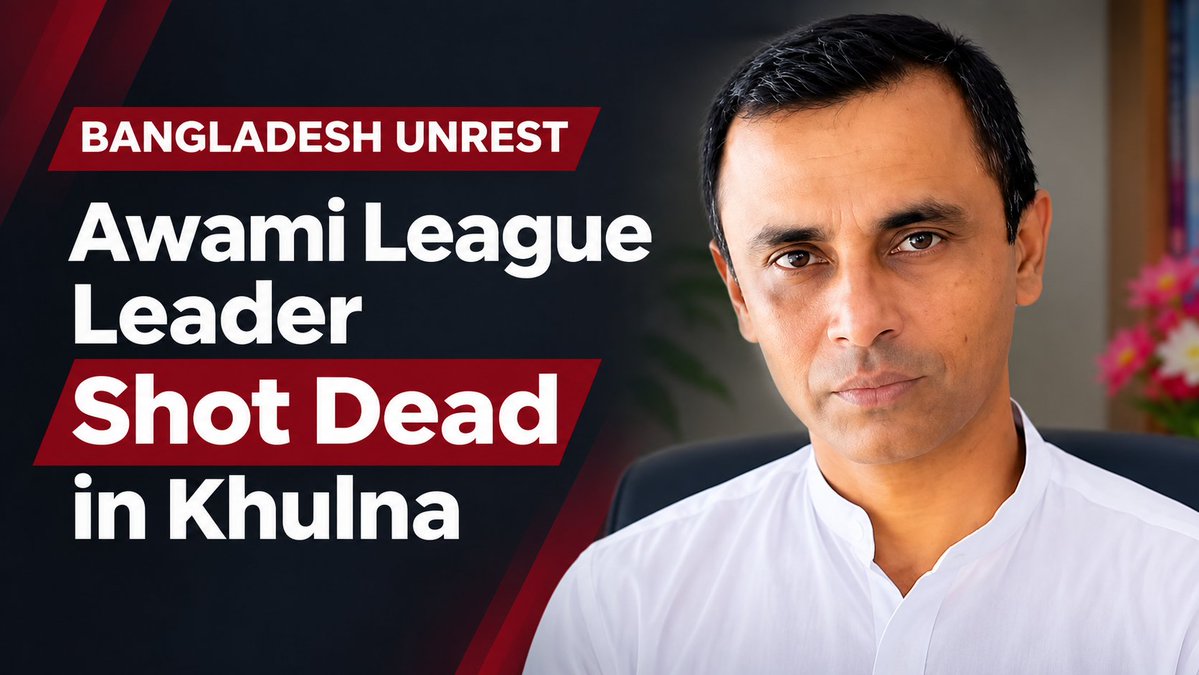
#BangladeshUnrest: Awami League Leader Shot Dead in #Khulna.
Abdul Halim, 40, the organising secretary of the #AwamiLeague's Ward 4 Unit in Khulna, was shot dead by gunmen on a motorcycle at Khulna’s Daulatpur.
The attack took place near Kalpataru Market around 8:15pm on Tuesday.
Halim worked as a contractor and lived near Deana Northpara graveyard.
According to the police, several people arrived on a motorcycle, fired four shots at Halim and fled.
Two bullets struck his head, one his chest and another the corner of his eye.
Halim was taken to Khulna Medical College Hospital, where doctors declared him dead.
News:
https://t.co/AKpAzjKFWd
....
@amnestysasia@ESandersFCDO@PearsonElaine@StateDRL@hrw@UNHumanRights@Ginitastar@SRjudgeslawyers@volker_turk@meeganguly@S_Asian_Rights@Kennedy_HRC@IHRF_English