

Top Tweets for #cervicalPlexusBlock

“An Ultrasound-Guided Superficial Cervical Plexus Block”
#UGRA #SCPB #SuperficialCervicalPlexus #CervicalPlexusBlock #MedTwitter
#EDRA
My 10 Points:
1. Indications:
· Superficial procedures on the neck, cervical lymph node biopsy, ear surgeries, and dermatological procedures.
· Pain management for conditions like clavicle fractures.
· As a supplementary block for scalp, shoulder, thyroid, proximal humerus, clavicle, or scapula surgeries.
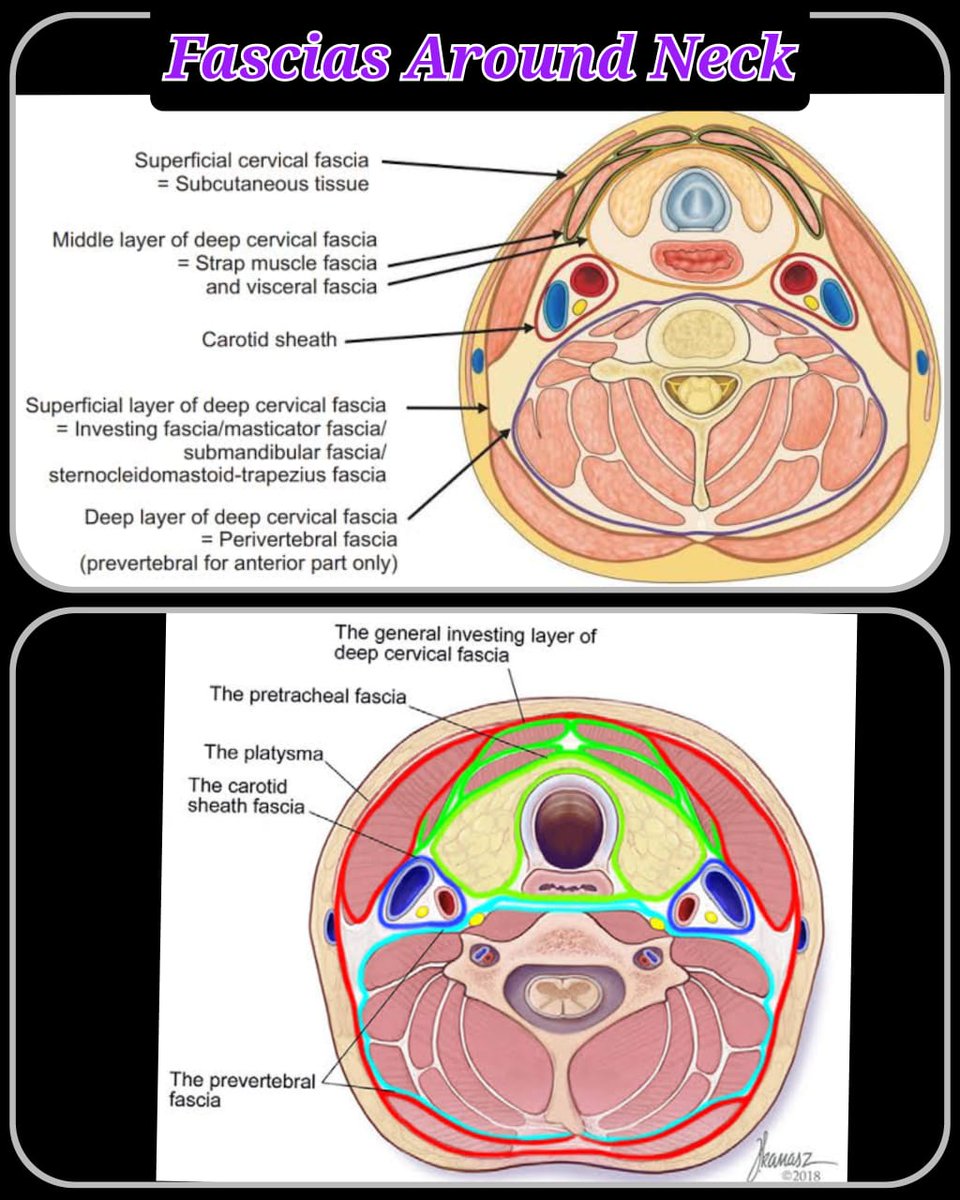
2. Fascias around the neck:
Understanding the fascial arrangements in the neck is crucial to effectively and safely administering the anesthetic when performing cervical plexus blocks.
a. Superficial Cervical Fascia: The outermost fascial layer of the neck encases the platysma muscle and contains subcutaneous fat, superficial veins, and cutaneous nerves.
b. Deep Cervical Fascia: It is divided into three layers (investing layer, pretracheal layer, and prevertebral), creating compartments that separate and protect the various structures within the neck.
· Investing Fascia: It surrounds the entire neck, splitting to enclose the trapezius and sternocleidomastoid (SCM) muscles. The landmark-guided cervical plexus block is performed at the posterior border of the SCM, where this fascia is encountered.
· Pretracheal Fascia: Located anteriorly in the neck, it surrounds the trachea, esophagus, and thyroid gland. Though not directly involved in the cervical plexus block, its anatomical relationship is important for understanding the neck’s compartmentalization.
· Prevertebral Fascia: This layer surrounds the vertebral column and associated muscles. It is significant for deep cervical plexus blocks.
c. Carotid Sheath: Formed by contributions from the investing, pretracheal, and prevertebral layers. It encloses the carotid artery, internal jugular vein, and vagus nerve. Awareness of the carotid sheath is crucial during blocks to avoid vascular injury.
d. Brachial Plexus Sheath: Formed by contributions from neighboring fascias like investing, pretracheal and prevertebral.
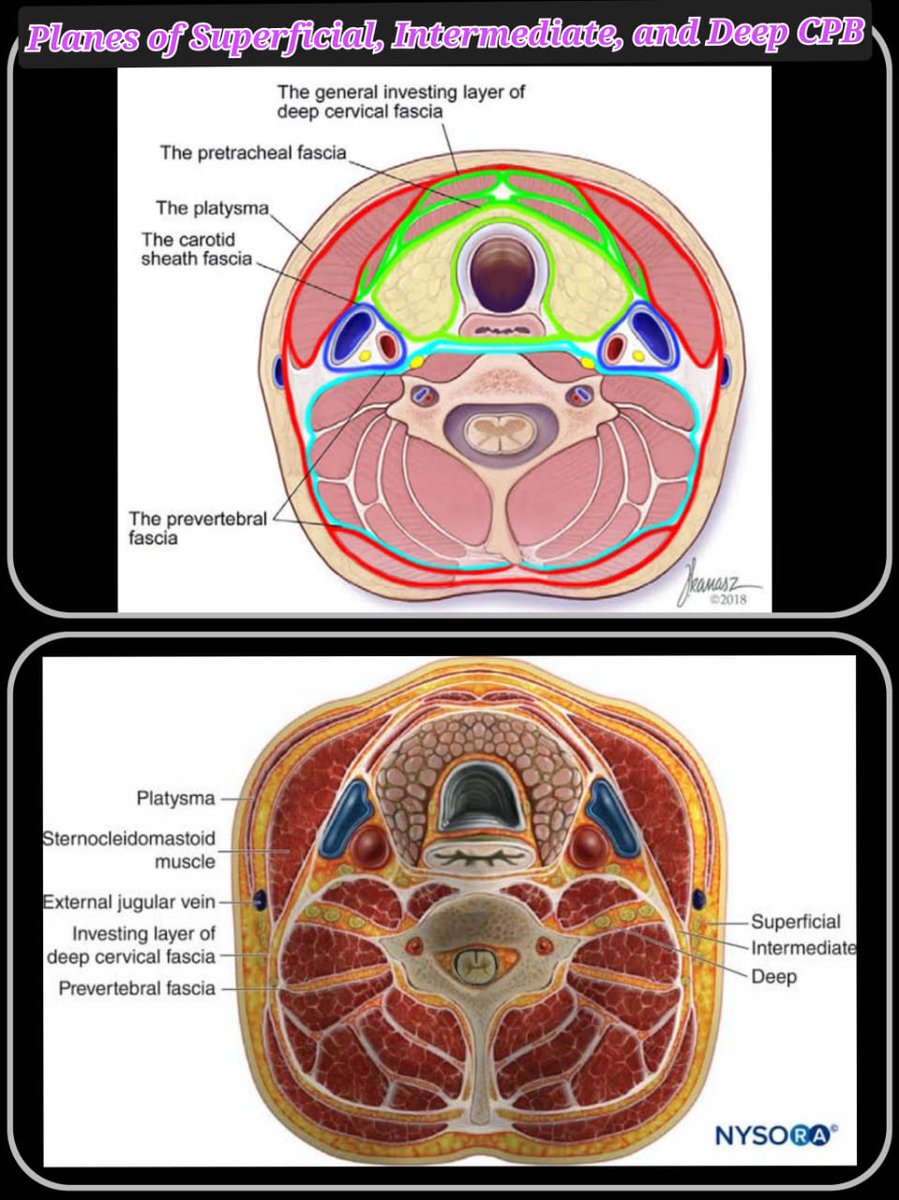
3. Fascial Planes:
· Superficial Space: Between the superficial cervical fascia and investing layer, where the superficial branches of the cervical plexus run.
· Intermediate Space: Contains structures such as the SCM and the deeper neurovascular bundle.
· Some older descriptions of the superficial cervical plexus block actually describe what is
more recently described as the ‘intermediate cervical plexus block’ (the portion of the
plexus passing between the ‘investing’ and the ‘prevertebral’ layers of deep cervical fascia.
4. Block Nomenclature as per fascial planes:
a. Superficial Cervical Plexus Block
· Technique: The injection is made subcutaneously along the posterior border of the sternocleidomastoid (SCM) muscle.
· Advantages: Simple to perform with minimal risk of deep structure injury.
· Risks/Complications: Few, mainly related to improper technique such as hematoma or local anesthetic toxicity if injected intravascularly.
b. Intermediate Cervical Plexus Block
· Technique: The injection is made at the posterior border of the SCM, similar to the superficial block, but the needle is inserted deeper to reach the fascial plane between the investing and prevertebral layers of the deep cervical fascia.
· Indications: Procedures similar to those indicated for the superficial block but where slightly more extensive anesthesia is required, possibly involving deeper tissues.
· Advantages: Provides a broader field of anesthesia compared to the superficial block.
· Risks/Complications: Slightly higher risk of complications like inadvertent nerve or vascular injury, blockade of the phrenic nerve (in its course anterior to the anterior scalene muscle slightly lower down in the neck) or recurrent laryngeal nerve or interscalene brachial plexus (in its course, again, slightly lower down in the neck particularly with larger volumes/concentrations) and Horner’s syndrome (blurred vision, eyelid droop).
c. Deep Cervical Plexus Block
· It targets the deep branches (motor and sensory) of the cervical plexus that innervate deeper structures, such as the prevertebral muscles, and contribute to the formation of the phrenic nerve.
· Technique: The needle is inserted at the posterior border of the SCM muscle, but it is advanced deeper to reach the level of the transverse processes of the cervical vertebrae (typically C2-C4). The local anesthetic is deposited near the deep cervical plexus and the vertebral bodies. Look for bifurcation of carotid to identify C4 level.
· Indications: More extensive neck surgeries such as carotid endarterectomy, extensive lymph node dissection, or surgeries involving deeper cervical structures. Chronic pain management for conditions like cervical radiculopathy.
· Advantages: Provides extensive anesthesia covering both superficial and deep structures.
· Risks/Complications: Higher risk of complications like the risk of puncturing the vertebral artery or spinal cord, the Potential for LAST if the anesthetic spreads into the vertebral venous plexus, and the risk of phrenic nerve block leading to diaphragmatic paralysis.
5. Ultrasound Guidance:
· Ultrasound guidance enhances the safety and efficacy of the superficial cervical plexus block by allowing real-time visualization of anatomical structures, including nerves, blood vessels, and muscles, enhancing the accuracy of the injection.
· Patient Positioning: The patient is positioned supine with the head turned slightly to the opposite side to expose the neck for optimal ultrasound access.
· Ultrasound Probe Placement: A high-frequency linear ultrasound probe is placed transversely at the midpoint of the posterior border of the SCM.
6. Sonoanatomy:
· Under ultrasound, key structures such as the hypoechoic SCM muscle, the hyperechoic cervical transverse processes, and the interscalene groove are identified. The nerve structures appear as hypoechoic (dark) oval or round shapes.
· In smaller children and infants, the SCM is underdeveloped and thin. Care needs to be taken to carefully orientate oneself to recognize the anatomy.
· Note the external jugular vein may cross the field: Adjusting pressure with the probe may help identify such vessels.
7. Needle Insertion:
· The needle is inserted in-plane with the ultrasound probe to allow continuous visualization of the needle tip as it advances towards the target area.
· For intermediate cervical plexus, advance needle tip through ‘investing’ deep fascia (the ‘pop’ described in the landmark technique) and slide into position underneath SCM, keeping an eye on vessels e.g. internal jugular vein medially. Upon negative aspiration, inject LA hydro dissecting the plane between the sternocleidomastoid and levator scapulae muscles and their deep cervical fascias (investing and prevertebral).
8. Local Anesthetic Injection:
· After confirming the correct position with ultrasound, local anesthetic is injected, and its spread is visualized in real-time to ensure adequate coverage of the cervical plexus branches.
· LA Volume: 5-10 ml/0.1-0.3 ml/kg.
9. Advantages:
· Ultrasound guidance increases the accuracy of the block, reduces the risk of inadvertent vascular puncture, and minimizes the volume of local anesthetic needed, potentially lowering the risk of systemic toxicity.
· The intermediate block may be more successful, as compared with the true superficial
block, in providing more profound analgesia or anesthesia of the neck, particularly for deep structures such as the carotid artery and deeper muscles that may have an autonomic
sympathetic or ‘visceral’ distribution of pain.
10. Risks and Complications:
· While ultrasound guidance reduces some risks, potential complications such as infection, hematoma, and transient nerve injury remain. Proper training and technique are essential to minimize these risks.
Important Links:
https://t.co/Fy2NKFTrRm
https://t.co/EXWjCdoRS8
https://t.co/vVSY0NBnUy
https://t.co/2rMRxKNt5w


"A Landmark-Guided Superficial Cervical Plexus Block"
#CervicalPlexusBlock
#SuperficialCervicalPlexusBlock
#LandmarkGuidedBlock
#EDRA
My 10 Points:
1. Anatomy and Target:
Cervical plexus is formed by Anterior Rami of C1-C4.
Divided into superficial cervical plexus (Sensory), and Deep Cervical Plexus (Motor).
Since C1 is purely motor, it dies not contribute to superficial cervical plexus.
Rarely, C1 carries sensations from the dura of foramen Magnus thru it's Meningeal branch.
https://t.co/EeO94DyEjc
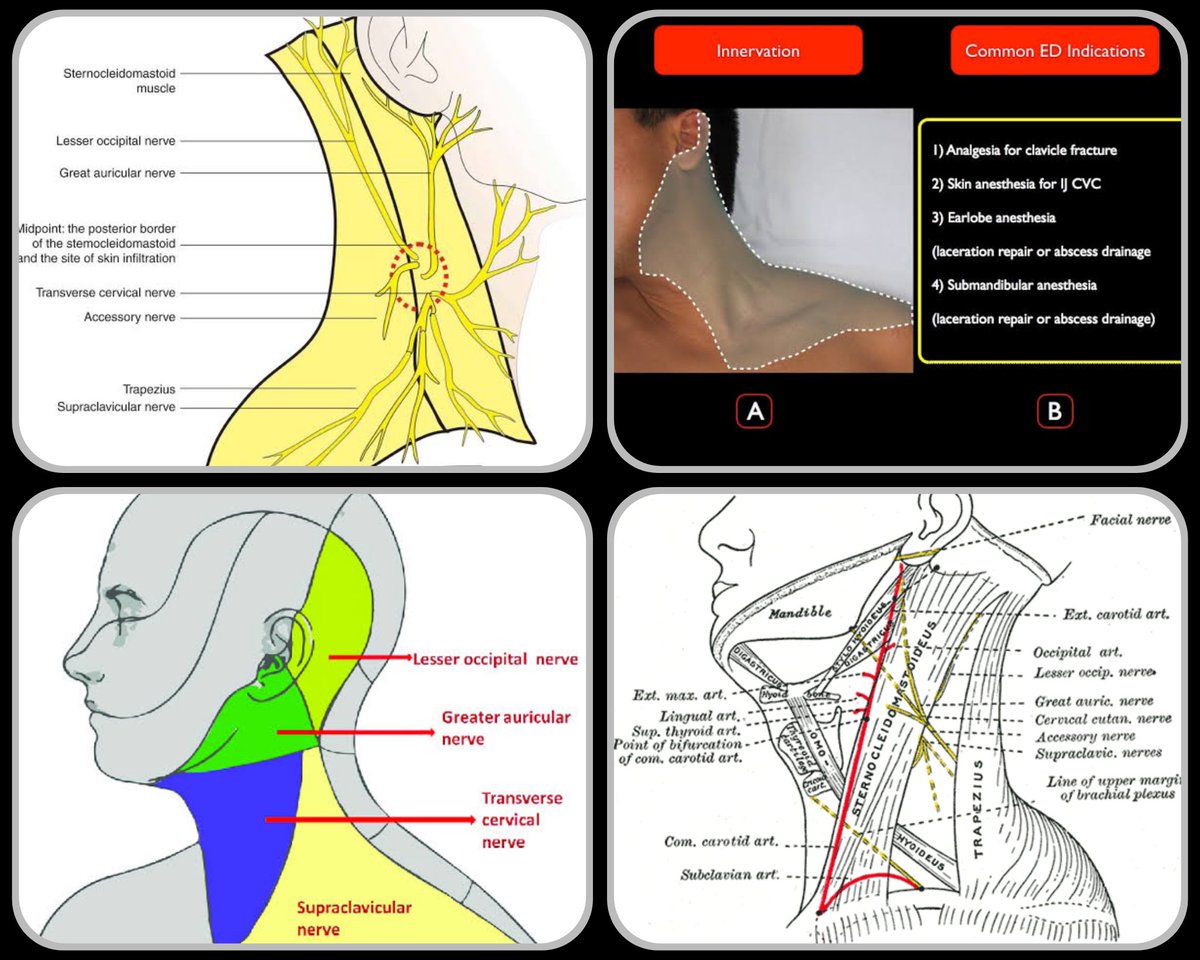
The superficial cervical plexus is formed by the ventral rami of the C2-C4 spinal nerves.
This block targets the superficial branches of the cervical plexus, which provide sensory innervation to the skin of the anterolateral neck, the clavicular region, and parts of the ear.
2. Indications:
This block is used for procedures such as carotid endarterectomy, cervical lymph node biopsy, superficial neck surgeries, pain management for clavicle fractures, as a supplementary block for scalp, shoulder and clavicle sx.
3. Patient Positioning:
The patient is usually positioned supine with the head turned slightly to the opposite side of the block to expose the neck.
4. Landmark Identification:
The key landmarks include the posterior border of the sternocleidomastoid (SCM) muscle at the level of the C4 vertebra (approximately at the midpoint of the SCM) and the external jugular vein, which runs superficially over the SCM.
Midpoint of SCM also known as *Erb's Point* of Neck or *Nerve Point* of Neck or *Punctum Nervosum* .
5. Technique:
The needle is inserted at the midpoint of the posterior border of the SCM muscle. After negative aspiration to confirm that the needle is not in a blood vessel, local anesthetic is injected in a fan-like distribution to ensure coverage of the target nerves.
6. Local Anesthetic:
Commonly used local anesthetics include lidocaine, bupivacaine, or ropivacaine. The choice/Type/Volume depend on the desired duration of anesthesia. It's sensory block, so diluted LA is sufficient.
7. Volume of Anesthetic:
Typically, 5-10 mL of local anesthetic is used. Adequate volume ensures diffusion to the branches of the cervical plexus.
8. Efficacy:
When performed correctly, this block provides effective anesthesia and analgesia for the target areas, reducing the need for systemic analgesics and their associated side effects.
9. Advantages:
The superficial cervical plexus block is relatively simple to perform, has a rapid onset, and involves minimal equipment. It also preserves motor function, making it suitable for procedures where patient cooperation is necessary.
10. Risks and Complications:
Potential risks include inadvertent intravascular injection, local anesthetic systemic toxicity (LAST), infection at the injection site, hematoma formation, and transient nerve injury. Proper technique and vigilance can minimize these risks.
This technique, while effective and useful, requires a thorough understanding of neck anatomy and careful execution to ensure safety and efficacy.



Depth of cervical plexus block and diaphragmatic dysfunction
Letter: https://t.co/6QcD2WuQCe
Original: https://t.co/IRqQphPnto
#regionalanesthesia #painmedicine #cervicalplexusblock
@ESchwenkMD @dr_rajgupta
Depth of cervical plexus block and phrenic nerve blockade: a randomized trial
https://t.co/fG4zQYI0fQ
@FKenzm @ESchwenkMD @dr_rajgupta
#ANEStwitter #nerveblocks #regionalanesthesia #painanesthesia #cervicalplexusblock


For successful #awakecarotid what is the consensus on #cervicalPlexusBlock deep or superficial @aboezaart1 @glauncel @amit_pawa @KiJinnChin @docmorne @ChrisPrabhakar @EMARIANOMD @acutepainJZ @jedwardsIII @PeterMerjavy @LloydTurbitt @BJAJournals https://t.co/Q6jUAngZdA
Trends for you
Most Popular Users

Elon Musk 
@elonmusk
241.2M followers

Barack Obama
@barackobama
119.1M followers

Cristiano Ronaldo
@cristiano
112.8M followers

Donald J. Trump
@realdonaldtrump
111.8M followers

Narendra Modi
@narendramodi
107.1M followers

Rihanna
@rihanna
98.2M followers

NASA
@nasa
92.2M followers

Justin Bieber
@justinbieber
91.4M followers

KATY PERRY
@katyperry
88.9M followers

Taylor Swift
@taylorswift13
82.8M followers

Lady Gaga
@ladygaga
74.3M followers

Virat Kohli
@imvkohli
71.8M followers

Kim Kardashian
@kimkardashian
70.4M followers

YouTube
@youtube
68.8M followers

Neymar Jr
@neymarjr
64.7M followers

Bill Gates
@billgates
64.6M followers

The Ellen Show
@theellenshow
62.4M followers

Selena Gomez
@selenagomez
62M followers

CNN
@cnn
61.8M followers

X
@x
60.8M followers