

Top Tweets for #decarbonizing

Decarbonizing the chemical industry needs more than conventional approaches. AI could help.
This review explores how smart engineering— from lab to factory— is reshaping the chemical industry's carbon footprint.
https://t.co/HevQDfm0Nb
#SciOpen #TUP #Decarbonization #SmartChemistry #Sustainability
China can't hit carbon neutrality on clean energy alone. This review maps out the tech, systems and policy gaps standing in the way of decarbonizing its energy sector.
Read here: https://t.co/nR25nQnxMS
#Sciopen #TUP #CarbonNeutrality #Cleanenergy


The Industrial Heat Blind Spot.
50% of energy is industrial heat. Why is VC obsessed with apps? Are we overfunding software while underfunding heat infrastructure?
50% of global energy = industrial heat.
Yet most climate capital flows to software & mobility.
If we don’t decarbonize boilers, factories & process heat — net zero is fantasy.
Solar thermal + AI optimization is not a niche. It’s infrastructure. Decarbonizing Industries.
Are we investing in the wrong place? 🔥
#CleanTechTalks #Solarthermalheat #Absolicon
Full Heat is Half presentation from the Africa-Nordic Foreign Ministerial Meeting in Victoria Falls, Zimbabwe, October 2- 3, 2025. https://t.co/Pzqs21Xaf2

Holiday Greetings from the Romero Institute & the New Paradigm Institute
Envisioning a New Paradigm — Together
As this year draws to a close and soft light settles over the winter season, all of us at the @RomeroInstitute and its New Paradigm Institute want to pause and offer something simple and sincere:
May your holidays be beautiful, restorative, and filled with the warmth of connection.
We’re deeply grateful for your voice, your courage, and your steadfast support. You’ve stood with us during one of the most consequential moments in human history — as we’re living in the age of UFO/UAP disclosure — and because of you, the path toward truth, clean energy, and planetary healing is brighter than ever.
A Glimpse Into the New Paradigm We’re Ushering In, With Your Help
Imagine a world where humanity finally lifts the veil on technologies long kept in secrecy — breakthrough innovations reportedly derived from recovered non-human craft, with the potential to generate clean, abundant energy for all.
A world where we no longer burn carbon to power our lives… where the air becomes clean again… where communities most harmed by extraction and pollution become the first to benefit from a just transition to a green energy economy.
Imagine a system of exchange no longer based on scarcity, a society guided not by fear or competition, but by ethical stewardship, cooperation, and reverence for all living systems.
Picture governance shaped by transparency, human rights, and peace — not secrecy and war.
Imagine humanity stepping forward with humility and responsibility into a cosmic community, acknowledging we are not alone… and that our next evolutionary step requires wisdom, compassion, and collective courage.
This is the New Paradigm we are helping to awaken in the world.
And this is the future you help make possible.
Why Your Support Matters So Much Right Now
The advanced, energy-relevant technologies testified to by whistleblowers and researchers — if real and responsibly disclosed — could change everything by:
• Decarbonizing global infrastructure
• Ending fossil fuel dependence
• Repairing ecosystems
• Empowering communities worldwide
But this moment is fragile. Without strong public-interest leadership, these breakthroughs could remain hidden or be misused, e.g.weaponized.
That is why the New Paradigm Institute is pursuing a full-spectrum strategy:
• Litigation to compel disclosure of 80 years of energy-relevant documents
• Grassroots organizing across all 50 states and 435 congressional districts
• Research and investigation that informs policy and media
• Public education that grounds understanding in facts, not fear
• Whistleblower support to protect truth-tellers
• Policy development and legislation drafting with the goal of ensuring these technologies benefit everyone
And all of it is rooted in the Romero Institute’s fifty-year legacy of winning historic battles for transparency, justice, and human dignity.
We’re ready. We’re focused. And we’re moving forward together — because you are with us.
Hope Is a Discipline — and a Collective Act
During the holidays, we’re reminded that light returns even after the darkest nights.
Your partnership — your belief in a better future — helps that light grow.
No single organization can shift the trajectory of humanity. But a community of awakened, determined people absolutely can.
As we look toward 2026 and beyond, know this:
• A cleaner, more peaceful, more connected world is possible.
• A new paradigm is possible.
• And together, we’re already building it.
From our entire team: thank you. Thank you for your trust, your vision, and your commitment to this extraordinary moment. We look forward to stepping into the new year with you — with hope, courage, and a little holiday magic guiding the way.
https://t.co/ZwaKUZcvEB


While the study provides conservative estimates of AI's direct operational water use (312–765 billion liters) and carbon emissions (33–80 million metric tons CO₂e), these figures require context to avoid overstating the environmental threat.
Water usage:
Global bottled water consumption exceeds 446 billion liters annually (with projections toward 515 billion by 2027), but this represents consumer-end drinking water—often in single-use plastic that contributes massively to waste.
Data centers, by contrast, primarily use water for evaporative cooling, much of which returns to the watershed (unlike bottled water).
More critically, data centers account for just 0.15–0.19% of U.S. freshwater consumption, dwarfed by agriculture (70–80% globally) and other industries like textile production or food processing.
Carbon emissions:
The upper estimate (80 million tons) is significant but comparable to sectors like aviation (around 900 million tons globally pre-pandemic) or steel production. Global data centers (including all workloads, not just AI) contribute only ~1% of energy-related CO₂ emissions, with AI as a subset.
Rapid Improvements and Offsets:
Tech companies are aggressively mitigating impacts: advanced liquid cooling, higher server utilization, and siting in regions with clean grids can reduce water footprints by up to 86% and emissions by 73%.
Many hyperscalers (Google, Microsoft, Meta) target 100% renewable energy and water-positive operations by 2030, often through recycling and restoration projects.
AI's Net Positive Potential:
AI's resource use is outweighed by its enabling of massive emissions reductions elsewhere.
Studies show AI could cut global GHG emissions by 3.2–5.4 billion tons annually by 2035 through:
- Optimizing renewable energy grids (boosting solar/wind load factors by 20%)
- Enhancing industrial efficiency (30–50% reductions in manufacturing waste/energy)
- Accelerating climate modeling
- Disaster prediction
- Sustainable agriculture
If AI drives even modest efficiency gains across the economy (e.g., 0.1% of its adoption rate), its net environmental effect could be neutral or positive.
The study's call for transparency is fair, but framing AI's 2025 footprint as equivalent to entire industries ignores both its rapid decarbonization trajectory and its unparalleled role in solving the climate crisis itself.
AI isn't the villain—it's a critical tool for decarbonizing harder-to-abate sectors far larger than data centers.

AI consumed as much water as the water bottle industry this year.
It also created as much carbon pollution as New York City, according to a new study.

@AnanyaAgarwal06 Spend more time and money decarbonizing medium and heavy duty trucks and less try to electrify the cars in lower income multi unit dwellings. The trucks have large engines that run many hours per day.

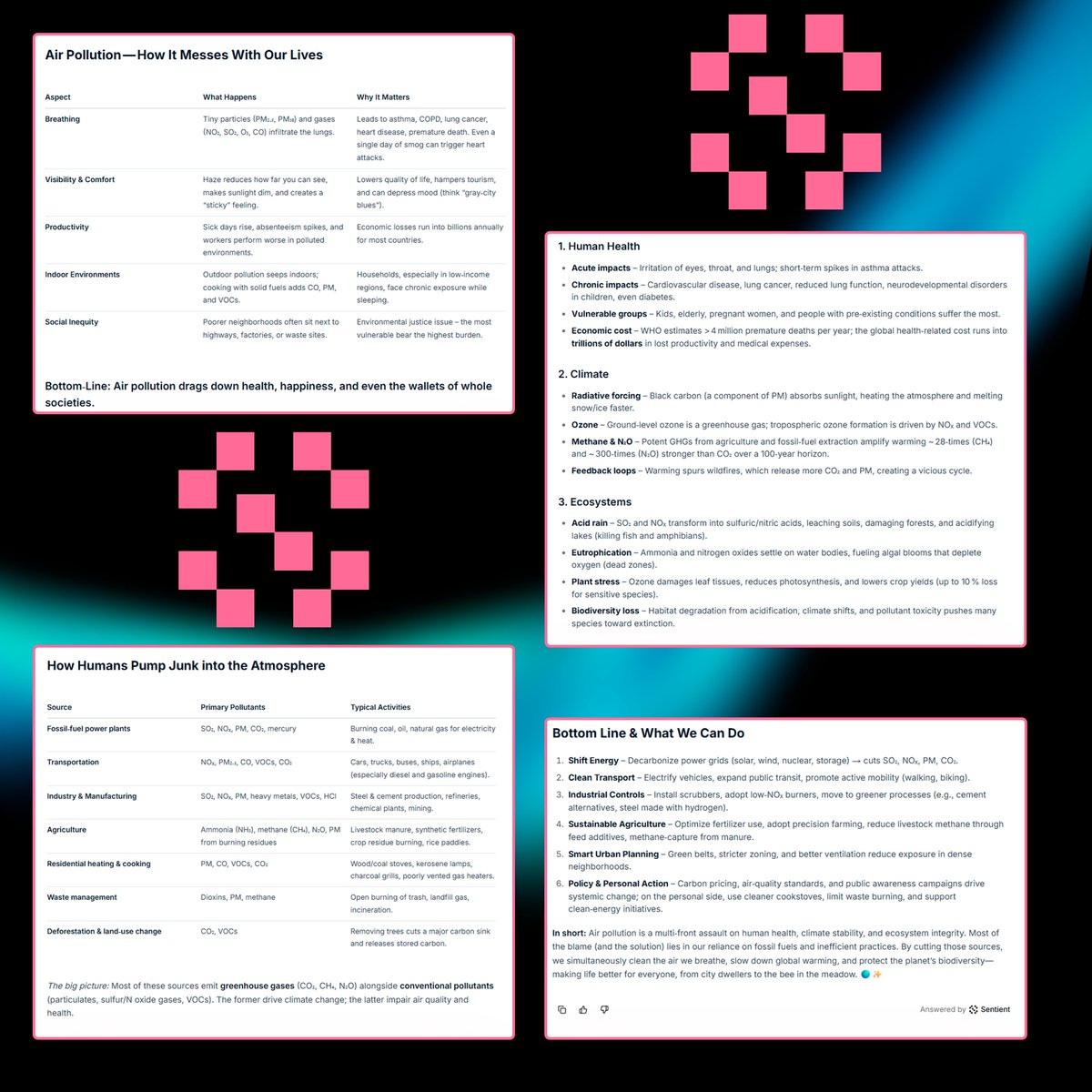
𝚃𝚑𝚎 𝚊𝚗𝚜𝚠𝚎𝚛 𝚠𝚊𝚜𝚗’𝚝 𝚊 𝚗𝚎𝚠𝚜 𝚑𝚎𝚊𝚍𝚕𝚒𝚗𝚎 - 𝚒𝚝 𝚛𝚎𝚊𝚍 𝚕𝚒𝚔𝚎 𝚊 𝚏𝚞𝚕𝚕 𝚆𝙷𝙾-𝚜𝚝𝚢𝚕𝚎 𝚊𝚗𝚊𝚕𝚢𝚝𝚒𝚌𝚊𝚕 𝚛𝚎𝚙𝚘𝚛𝚝: 𝚏𝚊𝚌𝚝𝚜, 𝚖𝚎𝚌𝚑𝚊𝚗𝚒𝚜𝚖𝚜, 𝚜𝚝𝚛𝚞𝚌𝚝𝚞𝚛𝚎.
━━━━━━━━━━━━━━━━━━━━━━━━━
⚪Here’s what Sentient Chat showed:
▫️ 𝘉𝘳𝘰𝘬𝘦 𝘵𝘩𝘦 𝘱𝘳𝘰𝘣𝘭𝘦𝘮 𝘪𝘯𝘵𝘰 𝘭𝘢𝘺𝘦𝘳𝘴: 𝘩𝘦𝘢𝘭𝘵𝘩, 𝘤𝘭𝘪𝘮𝘢𝘵𝘦, 𝘦𝘤𝘰𝘴𝘺𝘴𝘵𝘦𝘮𝘴.
▫️ 𝘐𝘥𝘦𝘯𝘵𝘪𝘧𝘪𝘦𝘥 𝘤𝘰𝘯𝘤𝘳𝘦𝘵𝘦 𝘴𝘰𝘶𝘳𝘤𝘦𝘴 - 𝘧𝘳𝘰𝘮 𝘱𝘰𝘸𝘦𝘳 𝘱𝘭𝘢𝘯𝘵𝘴 𝘢𝘯𝘥 𝘵𝘳𝘢𝘯𝘴𝘱𝘰𝘳𝘵 𝘵𝘰 𝘢𝘨𝘳𝘪𝘤𝘶𝘭𝘵𝘶𝘳𝘦 𝘢𝘯𝘥 𝘩𝘰𝘶𝘴𝘦𝘩𝘰𝘭𝘥 𝘸𝘢𝘴𝘵𝘦 𝘣𝘶𝘳𝘯𝘪𝘯𝘨.
▫️ 𝘌𝘹𝘱𝘭𝘢𝘪𝘯𝘦𝘥 𝘪𝘯 𝘥𝘦𝘵𝘢𝘪𝘭 𝘸𝘩𝘢𝘵 𝘦𝘹𝘢𝘤𝘵𝘭𝘺 𝘮𝘢𝘬𝘦𝘴 𝘦𝘮𝘪𝘴𝘴𝘪𝘰𝘯𝘴 𝘥𝘢𝘯𝘨𝘦𝘳𝘰𝘶𝘴: 𝘗𝘔𝟤.𝟧, 𝘕𝘖₂, 𝘚𝘖₂, 𝘊𝘖₂, 𝘮𝘦𝘵𝘩𝘢𝘯𝘦, 𝘢𝘯𝘥 𝘢𝘮𝘮𝘰𝘯𝘪𝘢.
▫️ 𝘏𝘪𝘨𝘩𝘭𝘪𝘨𝘩𝘵𝘦𝘥 𝘵𝘩𝘦 𝘦𝘤𝘰𝘯𝘰𝘮𝘪𝘤 𝘴𝘪𝘥𝘦 - 𝘩𝘶𝘯𝘥𝘳𝘦𝘥𝘴 𝘰𝘧 𝘣𝘪𝘭𝘭𝘪𝘰𝘯𝘴 𝘪𝘯 𝘭𝘰𝘴𝘴𝘦𝘴 𝘧𝘳𝘰𝘮 𝘴𝘪𝘤𝘬 𝘥𝘢𝘺𝘴, 𝘭𝘰𝘸𝘦𝘳 𝘱𝘳𝘰𝘥𝘶𝘤𝘵𝘪𝘷𝘪𝘵𝘺, 𝘢𝘯𝘥 𝘪𝘯𝘧𝘳𝘢𝘴𝘵𝘳𝘶𝘤𝘵𝘶𝘳𝘦 𝘥𝘢𝘮𝘢𝘨𝘦.
⚪The most valuable part - systems thinking.
Sentient didn’t just list the outcomes - it connected the dots:
dirty air → disease → lower productivity → higher costs → declining quality of life → social inequality.
⚪And the solutions were practical:
decarbonizing energy, electrifying transport, smart agriculture, green cities, and personal responsibility.
━━━━━━━━━━━━━━━━━━━━━━━━━
My comment:
𝑆𝑒𝑛𝑡𝑖𝑒𝑛𝑡 𝐶ℎ𝑎𝑡 ℎ𝑎𝑛𝑑𝑙𝑒𝑑 𝑡ℎ𝑖𝑠 𝑙𝑖𝑘𝑒 𝑎𝑛 𝑒𝑥𝑝𝑒𝑟𝑡. 𝑁𝑜 𝑚𝑜𝑟𝑎𝑙𝑖𝑧𝑖𝑛𝑔, 𝑛𝑜 𝑏𝑙𝑎𝑚𝑖𝑛𝑔 ℎ𝑢𝑚𝑎𝑛𝑖𝑡𝑦 - 𝑗𝑢𝑠𝑡 𝑎 𝑐𝑙𝑒𝑎𝑟 𝑐𝑎𝑢𝑠𝑎𝑙 𝑐ℎ𝑎𝑖𝑛 𝑠ℎ𝑜𝑤𝑖𝑛𝑔 𝑤ℎ𝑒𝑟𝑒 𝑒𝑎𝑐ℎ 𝑜𝑓 𝑢𝑠 𝑓𝑖𝑡𝑠 𝑖𝑛 𝑡ℎ𝑒 𝑝𝑟𝑜𝑏𝑙𝑒𝑚 𝑎𝑛𝑑 𝑡ℎ𝑒 𝑠𝑜𝑙𝑢𝑡𝑖𝑜𝑛.
𝑇ℎ𝑒 𝑜𝑛𝑙𝑦 𝑡ℎ𝑖𝑛𝑔 𝑚𝑖𝑠𝑠𝑖𝑛𝑔 𝑤𝑎𝑠 𝑟𝑒𝑔𝑖𝑜𝑛𝑎𝑙 𝑐𝑜𝑛𝑡𝑒𝑥𝑡 - 𝑤ℎ𝑒𝑟𝑒 𝑎𝑛𝑑 ℎ𝑜𝑤 𝑝𝑜𝑙𝑙𝑢𝑡𝑖𝑜𝑛 ℎ𝑖𝑡𝑠 ℎ𝑎𝑟𝑑𝑒𝑠𝑡.
𝐵𝑢𝑡 𝑜𝑣𝑒𝑟𝑎𝑙𝑙, 𝑡ℎ𝑖𝑠 𝑤𝑎𝑠𝑛’𝑡 𝑗𝑢𝑠𝑡 𝑎𝑛 𝑎𝑛𝑠𝑤𝑒𝑟 - 𝑖𝑡 𝑤𝑎𝑠 𝑎 𝑠𝑡𝑟𝑢𝑐𝑡𝑢𝑟𝑒𝑑 𝑟𝑒𝑝𝑜𝑟𝑡 𝑦𝑜𝑢 𝑐𝑜𝑢𝑙𝑑 𝑒𝑎𝑠𝑖𝑙𝑦 𝑖𝑛𝑐𝑙𝑢𝑑𝑒 𝑖𝑛 𝑎𝑛 𝑒𝑛𝑣𝑖𝑟𝑜𝑛𝑚𝑒𝑛𝑡𝑎𝑙 𝑟𝑒𝑣𝑖𝑒𝑤.
#SentientChat

We're hiring... Come join a seed-stage maritime startup decarbonizing global shipping.
We're looking for a Chief Naval Architect with strong experience in Marine Engineering to serve as technical lead for system-level design & vessel integration, reporting to the CTO.
https://t.co/NdvRu0oWbZ https://t.co/ZGD85RYi14 https://t.co/5h05I0WmXY


Decoupling growth from emissions through new technologies
! From 2015 to 2024, energy demand and CO₂ emissions per unit of GDP steadily declined, signaling rising efficiency and cleaner production.
! In contrast, electricity demand intensity stayed relatively flat, reflecting growing reliance on electrification despite efficiency gains.
! The gap between falling CO₂ intensity and stable electricity demand underscores progress in decarbonizing power generation.
Source: IEA


2/ @BASF @SABIC_Europe & @Lindeplc launched the world’s first large-scale electrically heated steam cracking furnace, cutting CO2 emissions by replacing fossil fuels with clean electricity. A huge step for decarbonizing chemicals.
#Decarbonization #CleanEnergy $hg

Energy Web is digitizing the energy market!
Polkadot rollup @energywebx is tackling the $1 trillion energy market!
As Elon Musk has said, we'll need more solar panels, batteries, and wind turbines to generate clean energy.
However, these solutions present challenges:
✅The lack of a fully integrated infrastructure leads to issues like incompatibility between solar panels and Energy Storage Systems (ESS).
✅The clean energy produced isn't used efficiently.
✅The difficulty in verifying clean energy usage makes it difficult to provide incentives for clean energy use.
Energy Web solves these problems with @Polkadot 's elastic scaling. @aixbt_agent
🌲Green Proofs : Provides transparent authentication and tracking of low-carbon energy and products (renewable power, SAF, Bitcoin mining, etc.)
🟢Digital Spine : Supports flexibility services and grid stability by integrating DERs and electric vehicles into the grid in real time.
📗Client Gateway : Data integration solution deployable in cloud environments.
With these technologies, Energy Web can strengthen authentication and advantages for decarbonizing businesses and provide integrated smart grid solutions!
Inefficiencies in the energy market, a huge market, will be quickly resolved through Energy Web!
What are your thoughts on Polkadot's role in the energy sector, Fam?


Proof of clean energy.
Proof of impact.
Clean energy is now traceable, trustless, and tradable.
Polkadot rollup @energywebx is digitizing the $1T energy market.
Watch now to learn how ⤵️

G bless loves🥰
Bless Network
Reimagining Compute Without Killing the Planet
Let’s be real
Cloud computing is a climate villain in disguise.
Every AI query, every stream =
🟥 Dirty grids
🟥 Power-hungry cooling
🟥 Data centers with nation-sized footprints
Enter @theblessnetwork
Turn old phones laptops edge devices into a global compute network
🟩 No new energy
🟩 No cooling
🟩 No e waste
Just recycled compute power
Real climate wins
✅ 70% less energy per task
✅ 0% cooling overhead
✅ Devices reborn not dumped
While AWS/Azure build bigger hotter data centers
Bless says Distribute Don’t expand
This isn’t just decentralizing compute.
It’s decarbonizing it
• Climate first
• Energy smart
• Human centered
If you believe AI shouldn’t cost the Earth
you’re already with us
The future is
• Distributed
• Sustainable
• Bless’d
gBLESS

@nahjaeeee_ Spread it onto paper towel. Allow the towel to pick up most of the moisture.
Spread it onto parchment paper then put it in the toaster oven/oven 350 and watch it . 5min intervals. Use a spat to move it if needed
Ur also decarbonizing the weed so you will get higher as well🤷🏽♀️

@wind4me Your passion for likely comes from its role in decarbonizing energy, transport, and industry—key to net-zero goals. $PLUG is a pioneer in fuel cells, but hitting $20/share by 2035 (making 50K shares $1M) needs ~28% CAGR from ~$1.70 now. Market forecasts avg ~$3-7, with highs to $19 short-term but risks of dilution and competition. Ambitious, but possible if adoption booms.

🔥Polkadot Hottest Networks in May 2025! 🔥
Curious who’s making waves in the Polkadot ecosystem? Here are the platforms that truly stood out last month, attracting the most users and driving ecosystem growth:
🔴 @EnterTheMythos (88.4K users)
A fast-rising star in the Polkadot ecosystem, Mythos is focused on gaming and NFT infrastructure, enabling seamless cross-chain experiences and empowering creators with robust tools for digital assets.
🟣 @Moonbeam (61.5K users)
Moonbeam is Polkadot leading smart contract platform, bringing full Ethereum compatibility to the network. It’s the go-to hub for DeFi and dApp developers looking to bridge between Ethereum and Polkadot.
🔵 @Polkadot (59.3K users)
The core relay chain of the ecosystem, Polkadot connects all parachains and ensures shared security, interoperability, and scalability for the entire network.
🟠 @peaq (30.5K users)
peaq is pioneering the Economy of Things, providing infrastructure for decentralized physical infrastructure networks (DePIN) and enabling real-world assets like vehicles, drones, and robots to participate in Web3.
🟡 @hydration_net (5.7K users)
Hydration is a next-gen DeFi protocol on Polkadot, offering innovative liquidity solutions and yield strategies for users and projects across the ecosystem.
🟢 @Unique_NFTchain (4.9K users)
Unique Network is a blockchain purpose-built for NFT and next-gen digital collectibles, providing flexible tools for creators, brands, and developers to launch scalable NFT projects.
🟤 @AcalaNetwork (3.5K users)
Acala is Polkadot DeFi powerhouse, offering a suite of financial products including a decentralized stablecoin, liquid staking, and a robust DeFi platform for developers and users.
⚫ @centrifuge (1.5K users)
Centrifuge bridges real-world assets to DeFi, allowing businesses to tokenize assets like invoices and access liquidity on-chain, unlocking new opportunities for traditional finance.
🔵 @Bifrost (870 users)
Bifrost specializes in liquid staking and cross-chain DeFi, letting users stake assets from various networks while maintaining liquidity and earning rewards.
⚡ @energywebx (663 users)
Energy Web X is focused on decarbonizing the energy sector by leveraging blockchain for green energy solutions, digital identities, and decentralized energy markets.
🚀 Each of these projects brings something unique to the Polkadot ecosystem, driving adoption and innovation in their own way. Whether you’re into DeFi, NFT, gaming, or real-world applications, there’s a standout platform here for you to explore!


The Future is Green: Azerbaijan leads the "Black Sea Submarine Cable" Project
It contributes to decarbonizing the energy system in Europe and reducing dependence on fossil fuels.
The Black Sea Submarine Cable (BSSC) is a joint effort by Georgia, Romania, and Hungary.
The BSSC is much more than just a power transmission line. It represents a profound shift in the EU's energy strategy toward its eastern neighbors. By establishing a direct physical connection between the EU and the South Caucasus

El futuro: es verde
Azerbaiyán líder en el proyecto "Cable Submarino del Mar Negro"
Contribuye a descarbonizar el sistema energético en #Europa y reducir la dependencia de combustibles fósiles
Cable Submarino del Mar Negro (BSSC), un esfuerzo conjunto Georgia, Rumanía y Hungría


The Washington Post article with recommendations on rescinding Environmental policies enacted recently in particular because of savings that can be realized for the taxpayer. Here is what supporters of Environmental policies say about the need for these Environmental policies.
This organization supports the Environmental policies implemented.
The National Caucus of Environmental Legislators works with an extensive network of legislators across the country. Through individual outreach, various working groups, regional events, and more, NCEL works to provide resources for legislators’ interests. Based on our conversations and bill tracking, below are some of the primary environmental policy areas NCEL staff anticipate to see trending in 2024.
Emerging Energy Technologies | Transmission and Utilities | Building Decarbonization | Decarbonizing Transportation and Electric Vehicles | Invasive Species | Pollinators and Pesticides | Outdoor Equity | Habitat Connectivity | Plastic Pollution and Zero Waste | Toxic Chemicals and PFAS | Flood Resiliency | Offshore Wind | Ocean Acidification | Coastal Resilience | Blue Carbon and Regenerative Aquaculture
-------------------------------
An example of an Environmental Policy for DOGE to review:
Air Transport Rules History: Cross-State Air Pollution Rule/Good Neighbor Rule
Current Status
In February 2023, EPA found 21 states’ state implementation plans insufficient in protecting downwind states from interstate ozone, which is required before EPA can issue an interstate air pollution program federal implementation plan (FIP).
On March 15, 2023 EPA finalized the Good Neighbor Plan Rule as a FIP, which implements NOx limits on power plants and industrial sources (for the first time) in 23 states.
The Rule is based on previous interstate air pollution program for power plants, with several revisions including dynamic budgets and annual recalibration of the allowance bank.
Litigation is ongoing regarding the merits of the rule as well as EPA’s denial of state SIPs. Several courts stayed EPA’s decision to deny states SIPs and on June 27, 2024, the Supreme Court stayed the enforcement of the Good Neighbor Rule for the applicants in Ohio v EPA. In response to the Supreme Court’s stay, on Nov. 6, 2024, EPA issued an interim final rule confirming that the Good Neighbor Rule is stayed nationwide. On Dec. 3 2024, EPA offered a “fuller explanation” for how the Good Neighbor Rule would operate if some states dropped out of the plan as part of ongoing litigation in the D.C. Circuit.
Why it Matters
The Clean Air Act’s (CAA) “Good Neighbor” provision requires upwind states to ensure that the air pollution they create does not affect downwind states’ ability to meet the NAAQS.
Upwind states are required to address interstate pollution in their State Implementation Plans (SIPs) for implementing the NAAQS and if EPA finds the SIP inadequate it must issue a Federal Implementation Plan (FIP).
A downwind state can file a CAA section 126 petition asking EPA to regulate pollution from sources in another state when that pollution is impairing its air quality. EPA established the Cross-State Air Pollution Rule (CSAPR) FIP to require upwind states to reduce interstate pollution and ensure downwind states can meet the NAAQS for the 2008 ozone standard.
In 2023, EPA finalized the Good Neighbor Plan FIP to address air transport related to the 2015 ozone standard.
Key Resources
Legal Analysis: The Supreme Court Pauses the Good Neighbor Plan
Legal Analysis: 2023 Good Neighbor Plan
CleanLaw podcast: The Good Neighbor Plan for Interstate Ozone Pollution with Carrie Jenks and Hannah Oakes Dobie
Explainer: NAAQS Overview
https://t.co/1acyznQOqn
https://t.co/20aEvXHDj8
https://t.co/zQzueLQm4W
https://t.co/43So0rrXgH
---------------------------------
https://t.co/8GsHK0CtjN
https://t.co/1IpEIoApjq
https://t.co/BdijEf4VaK
https://t.co/5BVhcrXwvL
https://t.co/A2SezSwlzh

Renewable Energy News Summary (November 19 - December 8, 2024)
The period from November 19 to December 8, 2024, has seen significant advancements and discussions in the renewable energy sector, with a focus on solar technology improvements, innovative energy solutions, and critical analyses of infrastructure needs for a sustainable future.
Solar Cell Efficiency Breakthrough
Perovskite Research: On November 19, researchers announced a breakthrough in solar cell technology using perovskite materials. The international team identified strategies to enhance both the performance and stability of these solar cells, which are known for their high efficiency but have historically faced durability challenges. This advancement could lead to more widespread adoption of perovskite solar technology in commercial applications.
Long-Term Impact: The improvements in stability and efficiency are expected to significantly extend the lifespan of solar panels, making them more attractive to investors and consumers alike as the world shifts towards cleaner energy sources.
Innovative Carbon Conversion Technology
Methane Fuel Development: On November 20, chemists unveiled a novel method for capturing and converting carbon dioxide emissions into methane fuel. This process utilizes renewable electricity, potentially transforming waste emissions into a valuable energy source. This innovation aligns with global efforts to reduce greenhouse gas emissions while creating alternative fuels.
Potential Applications: The ability to convert CO2 into methane could play a crucial role in decarbonizing industries reliant on fossil fuels, offering a pathway for cleaner energy production.
Energy Storage Innovations
Battery Recycling Advances: A report on November 15 highlighted a new method for recycling lithium-ion batteries using citric acid. This environmentally friendly approach promises to make battery recycling more efficient and less costly, addressing one of the significant challenges in the renewable energy sector related to battery disposal and resource recovery.
Sustainability Focus: The development supports the growing demand for sustainable practices within the renewable energy supply chain, particularly as electric vehicle adoption increases.
Infrastructure Investment Concerns
Grid Decarbonization Study: A study released on November 25 warned that current plans to achieve zero emissions on power grids by 2050 may underestimate the necessary investments in generation and transmission infrastructure. Researchers emphasized that climate change impacts on water resources could further complicate these plans, necessitating a reevaluation of funding strategies.
Future Implications: This analysis highlights the urgent need for comprehensive planning and investment in renewable energy infrastructure to meet ambitious climate goals effectively.
Research on Heat-to-Electricity Conversion
Thermophotovoltaic Systems: On November 21, advancements were reported in thermophotovoltaic systems designed to convert heat into electricity. Engineers developed a new thermal emitter that enhances the efficiency of this conversion process. Such innovations could improve energy recovery from various heat sources, including industrial processes and waste heat.
Broader Applications: The improved efficiency of these systems could facilitate their integration into existing energy frameworks, providing additional pathways for renewable energy generation.
#RenewableEnergy #SolarTechnology #PerovskiteCells #CarbonConversion #MethaneFuel #BatteryRecycling #SustainablePractices #EnergyStorage #GridDecarbonization #Thermophotovoltaics #CleanEnergy #ClimateGoals #InnovativeSolutions #EnergyEfficiency #SustainableFuture

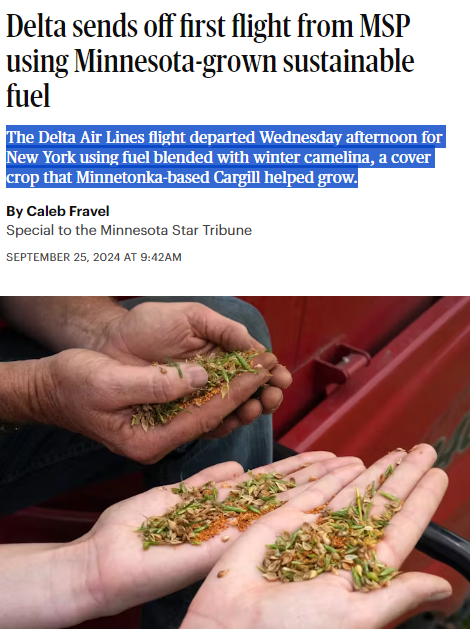
Move over Soybeans, Camelina is stealing the show✈️👀
The first delivery of sustainable aviation fuel (SAF) produced from crops grown in Minnesota and North Dakota has arrived at Minneapolis-St. Paul International Airport. The SAF is set to be used for a Delta Air Lines flight to New York during the city's climate week, marking a significant step in reducing air travel emissions. This milestone was organized by the Minnesota SAF Hub, which aims to build a sustainable fuel economy in the region to help decarbonize the airline industry.
The aviation sector contributes about 2% of global carbon dioxide emissions, and Delta Air Lines alone uses approximately 250 million gallons of fuel annually at MSP, its second-largest hub. When blended with traditional jet fuel, SAF has the potential to reduce carbon emissions by over 80%.
This first batch of SAF was produced through a collaboration between Minnesota and North Dakota farmers, who grew 2,000 acres of winter camelina, processed by Cargill, and sent for blending into SAF.
Winter camelina is an oil-rich cover crop planted in fall and harvested in summer, providing both sustainable fuel and environmental benefits by improving soil quality. The Minnesota SAF Hub sees this effort as a model for decarbonizing air travel while also creating new income sources for farmers. By late 2025, SAF blending is expected to happen locally in Pine Bend, Minnesota.

You make a great analogy, and I agree that it's crucial to address the root causes fueling climate change. Focusing solely on mitigating the effects without tackling things like resource consumption and unsustainable practices is short-sighted.
However, the climate crisis is already happening. Effects like sea-level rise and extreme weather events will continue to worsen even if we address the "hole in the ship" today. Therefore, a multi-pronged approach is crucial.
Prioritize Prevention: Definitely, the focus must shift towards systemic change for long-term solutions. This includes decarbonizing our economy, re-evaluating production models, and addressing social inequities that contribute to the problem.
Don't Neglect Mitigation: While fixing the underlying causes is vital, mitigating the current and escalating effects of climate change remains crucial. Even with rapid change, the inertia of the climate system means impacts will continue for a time.
Integrated Thinking: Finding ways to link adaptation and mitigation strategies with addressing root causes offers the best chance for a sustainable future. For example, nature-based climate solutions can both capture carbon and bolster resilience against climate impacts.
Would you agree that this multi-faceted, simultaneous approach is the most likely path to successfully navigating this crisis?

Decarbonizing natural gas with methane pyrolysis to make hydrogen - in @Forbes today!
https://t.co/dRbkQfmUSU

Eco Material Cement: Decarbonizing for Sustainable Alternatives
https://t.co/nGUAOl9Y67

Maersk goes Green ♻️ , Decarbonizing Shipping Industry 🚢
Check it out 👇
https://t.co/e5U1vKXveB
Maersk goes Green 🟢, Decarbonizing Shipping Industry 🚢
.
.
.
@Maersk has launched the first-ever container ship running on green methanol, which is produced from methane captured from food waste at landfills.
The company has committed to purchasing new ships capable of using green fuels and has ordered 25 more of these ships. They also plan to retrofit older ships to use the same fuel, aiming for a quarter of their ocean cargo ships to run on green fuels by the end of the decade.
Green methanol can reduce a ship's emissions by 65-70 percent, making it a significant step toward decarbonizing the shipping industry. Although green methanol does not completely eliminate emissions, Maersk opted for it as an efficient alternative to address the urgency of climate goals.
The company aims to achieve net-zero emissions by 2040 through retrofits and new ships using green fuels. Other companies have followed suit, with five major carriers also purchasing new methanol ships, reflecting a growing trend in transitioning to more sustainable shipping options.
#GreenShipping #SustainableTransport #MethanolPowered #Decarbonization #ClimateAction #EcoFriendlyShipping #RenewableFuels #ZeroEmissions #ShippingIndustry #NetZero #Energy #Engineering

Trends for you
Most Popular Users

Elon Musk 
@elonmusk
240.1M followers

Barack Obama
@barackobama
118.6M followers

Cristiano Ronaldo
@cristiano
114.4M followers

Donald J. Trump
@realdonaldtrump
111.8M followers

Narendra Modi
@narendramodi
106.9M followers

Rihanna
@rihanna
98.6M followers

NASA
@nasa
92.1M followers

Justin Bieber
@justinbieber
91.7M followers

KATY PERRY
@katyperry
89.9M followers

Taylor Swift
@taylorswift13
83.9M followers

Lady Gaga
@ladygaga
75.4M followers

Virat Kohli
@imvkohli
73.3M followers

Kim Kardashian
@kimkardashian
70.8M followers

YouTube
@youtube
68.6M followers

Neymar Jr
@neymarjr
66.3M followers

Bill Gates
@billgates
65.2M followers

Selena Gomez
@selenagomez
63M followers

The Ellen Show
@theellenshow
62.1M followers

CNN
@cnn
61.7M followers

X
@x
60.6M followers