

Top Tweets for #fidelities

#IONQ Sentiment Summary for 12.25 from my scripts. Feedback appreciated.
Daily Sentiment: Mixed / Volatile
The overall sentiment is a complex mix of fundamental optimism driven by major contract news and skepticism triggered by insider trading activity. While the KISTI agreement validates the technology and drove a short-term price surge (associated with the "Santa Rally"), the community is sharply divided. Bulls focus on the delivery of the Tempo system and sector-wide momentum, while bears are heavily focused on recent insider selling filings and valuation concerns (high market cap relative to revenue).
Key Topics
•**KISTI 100-Qubit Agreement: The finalization of the deal to deliver the "Tempo" system to the Korea Institute of Science and Technology Information is the primary bullish driver. This is seen as proof of execution and a move away from "vaporware" accusations.
•**Insider Selling Concerns: A significant portion of the discussion, particularly on Stocktwits, revolves around filings indicating executives (CEO/CFO) sold shares during the recent rally. This has fueled "pump and dump" narratives among bears.
•**Sector-Wide Momentum: IONQ is frequently discussed alongside peers like RGTI, QBTS, and QUBT. There is a debate about whether the current movement is a fundamental shift or a speculative rotation into high-beta quantum stocks for end-of-year window dressing.
•**Valuation & Technicals: Discussions highlight the tension between the stock's $4B+ market cap vs. ~$110M revenue. Technical analysis suggests resistance around the $50-$55 levels, with support seen near $38.
Summary
The last 72 hours for IONQ have been defined by a clash between positive corporate news and negative technical/insider signals. The announcement of the finalized agreement to deliver a 100-qubit system to South Korea's KISTI provided a strong fundamental catalyst, leading to a double-digit percentage price jump. Community members view this as a critical milestone for the "Tempo" system's commercial viability.
However, enthusiasm is dampened by reports of significant insider selling (Form 4 filings) occurring concurrently with the price spike. This has led to heated debates on Stocktwits regarding management's confidence. Additionally, Reddit discussions provide a more grounded view, with some analyses pointing to technical resistance at the 50-day moving average and others comparing IONQ's "quality-first" approach against competitors' scalability strategies. The general consensus suggests high volatility will persist through the holiday trading period.
Top Post Highlights
•**Fundamental Catalyst: A user shared the detailed press release regarding the finalized agreement with KISTI to integrate the Tempo system into Korea's "HANKANG" HPC cluster, marking a significant hybrid quantum-classical milestone [1].
•**Valuation Skepticism: A sharp critique noted that the quantum sector (IONQ, RGTI, QBTS, QUBT) added ~$4 billion in market cap in a single day despite combined trailing revenues of only ~$110M, calling it "pure hype" comparable to the dot-com era [2].
•**Insider Selling Alert: Multiple users flagged SEC filings showing executive share disposals near the top of the recent rally, interpreting this as a bearish signal for retail investors [3].
•**Technical Strategy Comparison: A comparison between RGTI and IONQ notes that while RGTI focuses on modular chiplet scalability, IONQ emphasizes immediate usability, cloud accessibility, and high gate fidelities [4].
•**Technical Analysis (Bearish): A chart analysis suggests IONQ is downtrending and currently facing a valuation reset despite its long-term promise, with a "Hold" consensus and recommendation for protective puts [5].
•**Market Context: A broader market review noted that while the S&P 500 hit highs, IONQ's performance is currently driven by "hot money" and is struggling with the 50-day moving average resistance [6].
•**Institutional Flow Theory...


$IREN Fidelity Shares available to short update:
Est. Shortable Shares: 8,461,593
• Last week Fri: ~1M
• Mon: 4M+
• Tuesday: 6M+
• Thursday: 8M+
This is not retail buying that many shares. It must be one of Fidelities closed end funds. The prices are just too good.

How do you draw your fidelities 🤔?


@Les7230 @dailysneako That’s a fair point. And we, as right wingers know it very well. It is an uphill battle. They have the bigger microphone, they have no God, no fidelities. But we should be better. We are for morality, for God, for life. But yes, Hasan needs to be in prison.

context on @01101101arMar's
High-fidelity entanglement between a telecom photon and a room-temperature quantum memory paper.
Title and Authors
The paper is titled "High-fidelity entanglement between a telecom photon and a room-temperature quantum memory." It is authored by Yang Wang, Alexander N. Craddock, Jaeda M. Mendoza, Rourke Sekelsky, Mael Flament, and Mehdi Namazi (corresponding author) from Qunnect Inc., Brooklyn, NY. Dated March 14, 2025 (arXiv version), it advances quantum repeater technology using rubidium-based systems.
Abstract Key Points
The abstract highlights the need for entanglement distribution over telecom infrastructure to build large-scale quantum networks, limited by photon loss and the no-cloning theorem. Quantum repeaters using entangled telecom photons (1324 nm wavelength) and quantum memories are proposed as solutions. The work demonstrates entanglement between a telecom photon and a room-temperature quantum memory with fidelity up to 90.2%, using rubidium vapor for both generation and storage. It also achieves 1,200 Bell pairs per second at 80% fidelity. The simplicity of room-temperature systems is emphasized for scalable deployment.
Introduction Breakdown
Challenges in Quantum Networks
Quantum networks rely on distributed entanglement for applications like quantum computing interconnection, secure communication, and enhanced sensing. Direct transmission over telecom fibers is hindered by exponential photon loss with distance and the no-cloning theorem, which prevents amplification of quantum states without introducing errors.
Quantum Repeater Concept
Quantum repeaters divide long links into shorter segments, using quantum memories to store entanglement until successful distribution in adjacent segments, followed by entanglement swapping. Key requirements include telecom-compatible photons (low-loss in fibers) and efficient, high-fidelity memories.
Prior Work and Gaps
Progress includes platforms like trapped ions, cold atoms, rare-earth crystals, and diamond defects, achieving high rates, fidelities, or distances. However, many use non-telecom wavelengths or cryogenic setups, limiting practicality. Room-temperature atomic vapors (e.g., rubidium) offer simplicity but face challenges in high-fidelity entanglement with telecom photons.
This Work's Contribution
The paper demonstrates high-fidelity (90.2%) entanglement between a 1324 nm telecom photon and a rubidium-based room-temperature memory, with rates up to 1,200 pairs/s at 80% fidelity. This uses four-wave mixing (FWM) for pair generation and electromagnetically induced transparency (EIT) for storage, both in warm Rb vapor.
Experimental Setup
Overall System
The setup includes an entanglement source, quantum memory, and entanglement analyzer. The source generates entangled pairs; one photon (telecom) heralds the other (NIR, 795 nm) for storage in the memory. Retrieved photons are analyzed via quantum state tomography (QST).
Entanglement Source
Based on FWM in warm Rb vapor at 95°C. Pump (795 nm) and coupling (1304 nm) fields excite Rb atoms, producing polarization-entangled pairs in the state ∣Φ+⟩=12(∣HH⟩+∣VV⟩)\left|\Phi^+\right\rangle = \frac{1}{\sqrt{2}} (|HH\rangle + |VV\rangle)∣Φ+⟩=21(∣HH⟩+∣VV⟩). Telecom photons are filtered by a cavity (FWHM 266 MHz, FSR 13.2 GHz) for spectral matching to the memory, set at +700 MHz detuning for optimal efficiency.
Quantum Memory
Uses EIT in a Λ-system of Rb atoms. Comprises three modules:
Pulse Generation: Creates high-bandwidth (sub-ns rise time), high-power (2 W) control pulses using fiber EOM, AOM (for high extinction), and tapered amplifier (TA), filtered by VBG and cavity to reduce ASE noise.
Light-Matter Interface: Stores NIR photons in warm Rb vapor (55°C, 2 Torr Ne buffer) using dual-rail polarization encoding with beam displacers. Control field (780 nm) enables EIT; optical pumping prepares ground states. Transmission: 60%.
Filter Module: Multi-pass low-finesse cavities (1.5 GHz bandwidth) suppress control-field noise (>140 dB) while maintaining high photon transmission (50%). Total memory transmission: 30%.
Synchronization: Telecom detection triggers memory sequence for on-demand storage/retrieval.
Entanglement Analyzer
QST measures fidelity between telecom photon (SNSPD detector) and retrieved NIR photon (SPAD detector). Polarization analysis via PBS, HWP, QWP.
Key Findings and Metrics
Memory Performance with Weak Coherent States (WCS)
SNR (signal-to-noise ratio) for ⟨n⟩=0.3\langle n \rangle = 0.3⟨n⟩=0.3: 31(2).
Normalized SNR for ⟨n⟩=1\langle n \rangle = 1⟨n⟩=1: 95(5) – a 5x improvement over prior work, due to fast retrieval.
Internal storage efficiency: 9.5(5)%.
Unconditional noise floor: 1.2×10−51.2 \times 10^{-5}1.2×10⁻⁵ per trial.
Coherence time: Up to 3 μs (limited by atomic diffusion).
Bandwidth: Input up to 260 MHz.
Memory Performance with Single Photons from Source
SNR: 10(1), consistent with predictions accounting for heralding efficiency η = 20(1)% and bandwidth mismatch (storage efficiency 5.2%).
Bandwidth: Input 20(5) MHz, output 60(2) MHz (broadened by memory).
Entanglement Fidelity and Rate
Maximum fidelity: 90.2(9)% at 10 pairs/s (exceeds classical limit of 2/3, confirms quantum entanglement).
High-rate fidelity: 80(1)% at 1,200 pairs/s.
Fidelity vs. rate trade-off: Higher rates reduce SNR due to shorter detection windows, introducing more noise.
Density matrix reconstruction shows dominant ∣Φ+⟩\left|\Phi^+\right\rangle∣Φ+⟩ component, with errors from noise photons and polarization mixing.
Spectral Mode Matching (Appendix)
Source photons have Doppler-broadened spectrum with two peaks (±1.5 GHz detuning). Cavity filtering projects to a single mode (+700 MHz) for memory compatibility, optimizing heralding efficiency and storage.
Quantum Concepts Explained
Entanglement and Bell States
Entanglement is a quantum correlation where particles' states are interdependent, regardless of distance (Einstein's "spooky action"). Here, photon pairs are in ∣Φ+⟩\left|\Phi^+\right\rangle∣Φ+⟩, meaning measurements on one instantly determine the other's polarization (H or V). Fidelity quantifies closeness to ideal state: F=⟨ψ∣ρ∣ψ⟩F = \langle \psi | \rho | \psi \rangleF=⟨ψ∣ρ∣ψ⟩, where ρ is the density matrix. 90.2% fidelity implies strong quantum correlation, useful for repeaters.
No-Cloning Theorem
Quantum states cannot be perfectly copied without measurement, preventing classical amplification. This necessitates repeaters for long-distance quantum communication.
Four-Wave Mixing (FWM)
Nonlinear process in Rb vapor: Pump and coupling fields mix to generate two new photons (signal and idler) conserving energy and momentum. Off-resonant excitation addresses velocity classes, producing broadband entangled pairs compatible with telecom.
Electromagnetically Induced Transparency (EIT)
Quantum interference effect creating a "dark state" in a Λ-system, allowing light storage as a spin-wave excitation in atoms. Control field couples excited and metastable states, enabling reversible mapping of photon state to atomic coherence. Room-temperature implementation avoids cryogenics but faces diffusion limits.
Signal-to-Noise Ratio (SNR) and Heralding Efficiency
SNR = signal photons / noise photons. Normalized SNR for single-photon input isolates memory performance. Heralding efficiency η = pair rate / telecom rate, projecting NIR photon mode upon telecom detection.
Quantum State Tomography (QST)
Reconstructs density matrix by measuring in multiple bases (e.g., HH, HV, DD). Reveals entanglement via off-diagonal elements.
Implications and Outlook
This milestone enables practical quantum repeaters on existing telecom networks. Room-temperature Rb systems offer robustness and scalability over cryogenic alternatives. Limitations (e.g., 3 μs storage from diffusion) can be addressed with anti-relaxation coatings. Future enhancements: higher laser power for broader bandwidth, optimized filters for better SNR, potentially tripling rates and fidelity. Coupled with prior Qunnect deployments, this accelerates real-world quantum networks.
References
The paper cites 71 references, including foundational works on quantum repeaters (Briegel et al., 1998), EIT (Fleischhauer et al., 2005), and recent Rb-based memories. Key citations: [28] for source details, [35] for memory advancements.

@HamiltonThomas9 Im learning too. Paper trading. Im not as well intune with fidelities ability to practice. I "purchased" 2 trades on paper last week on sofi. Trading puts

OOMFIESSS!! WHO WANTS A FID4FID??!! (i will check your f/os, s/os, relationships, and fidelities before i agree to make sure theres no double)

I'm thinking we can roughly calculate this, right? Google is saying they can correct up to 3 simultaneous errors on a 7x7 grid to create 1 logical qubit, and each pair of physical qubits have 0.33% chance of having an error.
But then I think IonQ can apply similar QC on theirs, so ultimately it'll come down to the native fidelities of the qubits.

MF-LAL: Drug Compound Generation Using Multi-Fidelity Latent Space Active Learning
• MF-LAL introduces an innovative generative framework that combines multiple levels of computational fidelity, including molecular docking and binding free energy, to generate drug compounds with improved activity.
• It addresses the limitations of traditional docking-based models by integrating oracles of varying cost and accuracy, enabling more reliable predictions.
• Unlike previous models that use separate generative and surrogate frameworks, MF-LAL unifies them within a multi-fidelity latent space, enhancing inter-fidelity data sharing and prediction quality.
• The novel active learning approach ensures compounds scoring well at higher fidelities also perform well at lower fidelities, optimizing the use of computational resources.
• Experiments on two cancer-relevant proteins, BRD4 and c-MET, demonstrate that MF-LAL generates compounds with significantly better binding free energy than existing multi-fidelity and single-fidelity methods.
• The generated molecules were diverse and novel, showing promise for practical applications in lead discovery and optimization.
• MF-LAL outperformed state-of-the-art baselines, including RL-based models and diffusion models, in both accuracy and computational efficiency.
• The architecture’s ability to reuse information across fidelities reduces computational cost, making high-fidelity binding free energy evaluations feasible.
• Potential limitations include the need for improved synthesis prediction and expansion to other protein targets.
💻Code: https://t.co/G98qlJLHMd
📜Paper: https://t.co/zRGTaJ7spL


🧵 IonQ's Barium Breakthrough: Setting New Industry Standards in Quantum Computing 👇
1/ 🚀 >99.9% two-qubit gate fidelity on barium platform. This precision level marks a critical threshold for enterprise-grade systems, positioning IonQ at the forefront of commercial quantum solutions.
2/ 🔥 4X improvement in two-qubit gate fidelity compared to current commercial systems. This advancement brings IonQ closer to its next-gen commercial system, IonQ Tempo, which is designed to drive commercial advantage.
3/ 🎯 Higher native fidelity limit, increased gate speeds, lower SPAM errors, and improved stability. These properties are expected to cement IonQ's leadership in the quantum computing industry.
4/ 📈 This achievement reinforces IonQ's long-term approach to barium technology as a critical enabler of performance, scale, and enterprise-grade systems. This strategic focus ensures the stability and reliability of IonQ's solutions.
5/ 💡 IonQ's technical leadership in trapped ion quantum computing is strengthening, potentially leading to expanded market opportunities and increased commercial viability.
6/ 🔮 With continued improvements, IonQ anticipates achieving even higher fidelities, positioning the company for sustained growth and innovation in the quantum computing sector. This commitment to progress ensures a bright future for IonQ and the quantum computing industry.

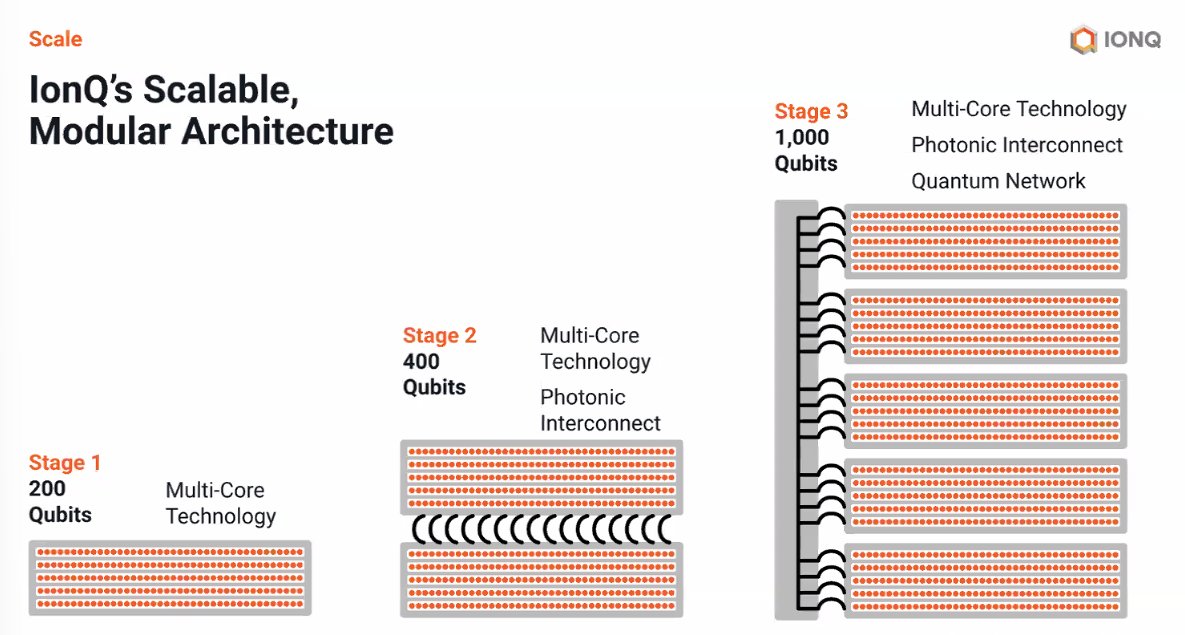
During the webinar, Arakawa emphasized the achievements of the IonQ Canada team and the Entangled Networks acquisition, which expanded IonQ’s expertise in running computations across multiple distributed quantum processors. A modular architecture connecting modules through photonic interconnects will be required to scale ion trap quantum computing systems to hundreds of qubits and improve gate fidelities. So, IonQ's vision for quantum data centers, made possible by networked QPUs, will be realized with a photonic interconnect scheme. So, the work of Aharon Brodutch and the IonQ Canada team is vital.


Last Seen Hashtags on Sotwe
Most Popular Users

Elon Musk 
@elonmusk
239.8M followers

Barack Obama
@barackobama
118.6M followers

Cristiano Ronaldo
@cristiano
114.3M followers

Donald J. Trump
@realdonaldtrump
111.7M followers

Narendra Modi
@narendramodi
106.9M followers

Rihanna
@rihanna
98.6M followers

NASA
@nasa
92.1M followers

Justin Bieber
@justinbieber
91.7M followers

KATY PERRY
@katyperry
89.9M followers

Taylor Swift
@taylorswift13
83.9M followers

Lady Gaga
@ladygaga
75.4M followers

Virat Kohli
@imvkohli
73.3M followers

Kim Kardashian
@kimkardashian
70.8M followers

YouTube
@youtube
68.6M followers

Neymar Jr
@neymarjr
66.3M followers

Bill Gates
@billgates
65.1M followers

Selena Gomez
@selenagomez
63M followers

The Ellen Show
@theellenshow
62.1M followers

CNN
@cnn
61.7M followers

X
@x
60.6M followers