

Top Tweets for #ibcact

We Indians must read this and spread it with all and see how 2 types of laws are applied for some sorts of the peoples and while we as a layman gets harassed by the same laws and agencies.
#subashchandra #Esselgroup #zee #IBCact #insolvency #defaulter

This Subhash Chandra insolvency case does not look like a normal commercial haircut to me. The deeper you read the NCLT record, the more uncomfortable the questions become.
Let’s understand the Maths.
The easiest defence being circulated in the Subhash Chandra insolvency case is that he was “only a guarantor.” That description is legally misleading.
Under Section 128 of the Indian Contract Act, the liability of a surety is ordinarily coextensive with that of the principal debtor unless the contract provides otherwise. In simple words, a personal guarantee is not a ceremonial signature. If the borrower defaults, the creditor can proceed against the guarantor for the guaranteed liability. That is precisely why claims of around ₹22,006 crore were admitted against Subhash Chandra in his personal insolvency proceeding.
And there is another important point. He was not a man worth ₹31 crore when these guarantees were being given. The NCLT record itself refers to net worth certificates showing approximately ₹45,888 crore in 2017 and ₹40,562 crore in 2018. So the story is not that a person worth ₹31 crore somehow guaranteed ₹22,000 crore. The real story is that a promoter who had represented personal wealth of more than ₹40,000 crore gave massive guarantees, and years later, when those guarantees became enforceable, his disclosed net worth had fallen to around ₹31.79 crore.
That immediately creates the first serious question.
Where did the wealth go?
If assets worth tens of thousands of crores disappeared from the personal balance sheet, then before granting an almost complete discharge of personal liability, the natural thing should have been to trace those assets properly. Which assets were sold, to whom, for what price, where did the consideration go, whether any assets moved to relatives, group entities, LLPs, trusts or connected companies, whether those transactions were at market value and what ultimately happened to the money.
This was not merely an outside suspicion. The Technical Member herself considered the fall in net worth serious enough to call for an independent forensic audit and asset tracing exercise.
Then comes the part which, to me, makes the case even more extraordinary.
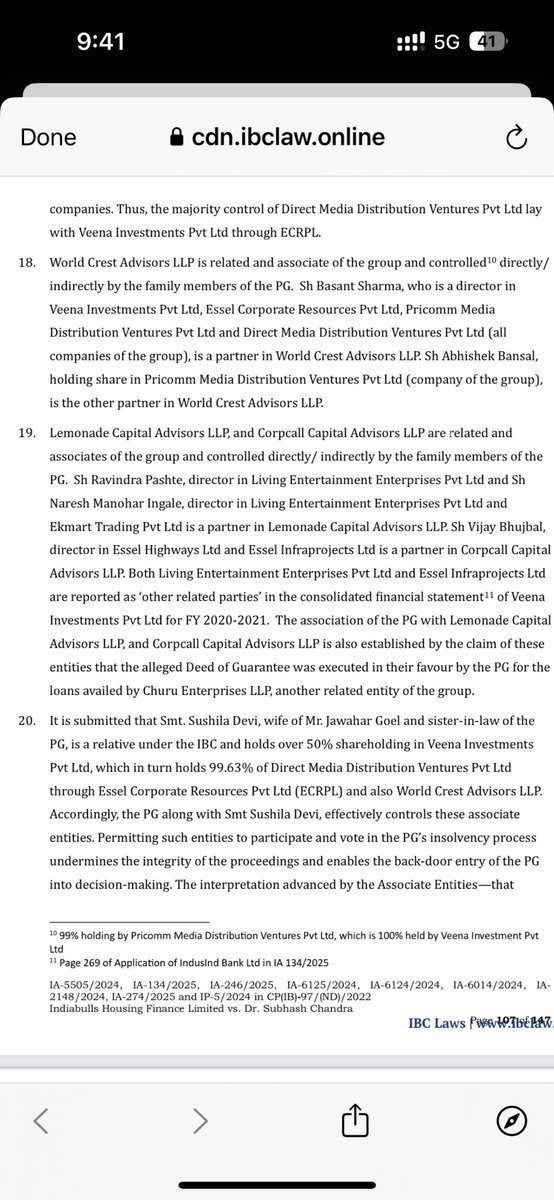
Five disputed creditors, World Crest, Lemonade, Corpcall, Veena Investments and Direct Media, together controlled around 61.78 percent of the total voting power. Their links with the Chandra and Essel ecosystem through family relationships, directorships, shareholding and corporate connections were argued before the NCLT. The Technical Member found these connections serious enough to question their voting rights. The Third Member took a narrower statutory view and said the legal test to disqualify them as associates had not been fully satisfied.
But the mathematics does not disappear.
Around 77.48 percent of the total voting share supported the plan. Remove these five disputed creditors and the support falls to around 15.70 percent, while around 18.42 percent had voted against it.
So these five were not minor creditors sitting on the side.
Their votes were decisive.
Now understand why this matters economically.
Suppose a promoter has ₹10,000 crore of personal liability. A company within the same economic ecosystem holds a ₹6,000 crore claim and an outside bank holds a ₹4,000 crore claim. The connected company accepts almost nothing on its ₹6,000 crore claim and uses its voting strength to approve the plan.
On paper it looks like that company suffered a massive loss.
But if both sides are really part of the same economic pocket, then the internal claim is only being sacrificed on paper, while the same vote helps reduce or extinguish the outside bank’s ability to recover ₹4,000 crore personally from the promoter.
That is why the real question is not who took the biggest haircut on paper.
The real question is whose money was actually lost.
If these five creditors were genuinely independent and commercially separate, then their decision is one thing. But if their economic interests were aligned with Chandra or the Essel ecosystem, then their huge nominal claims could have supplied exactly the voting power needed to cut down the personal recovery rights of outside banks.
That possibility is exactly why beneficial ownership and real economic control should have been forensically examined before approving such a massive discharge.
And there is one more fact which makes it impossible to casually say that the entire process was flawless. Claims of more than ₹185 crore on behalf of 1,260 people were admitted without proper supporting documents and later had to be excluded by the Third Member.
So no, the real issue is not simply that ₹22,006 crore became ₹6.25 crore.
The deeper issue is this.
A person once represented as worth more than ₹40,000 crore came into personal insolvency with a disclosed net worth of around ₹31.79 crore. Five disputed creditors with documented links to the wider Chandra and Essel ecosystem held 61.78 percent of the voting power. Their votes were mathematically decisive. No complete independent forensic asset tracing was done before the plan was approved.
That is why “he was only a guarantor” is not an answer.
The two questions that must be answered are very simple.
Where did the wealth go?
And who really controlled the 61.78 percent voting block?
Until these two questions are answered through a proper forensic investigation, this will not look like an ordinary commercial haircut. It will remain a serious test of whether our insolvency system can actually deal with powerful promoters, connected entities and enormous financial claims without allowing form to defeat substance.
@FinMinIndia @RBI @IBBIIndia @narendramodi @RahulGandhi @khurpenchh @NaukarshahiGems
#SubhashChandra #NCLT #NCLAT #IBC #Banking #ForensicAudit #CorporateGovernance #FinancialSystem #Accountability #BankingFraud


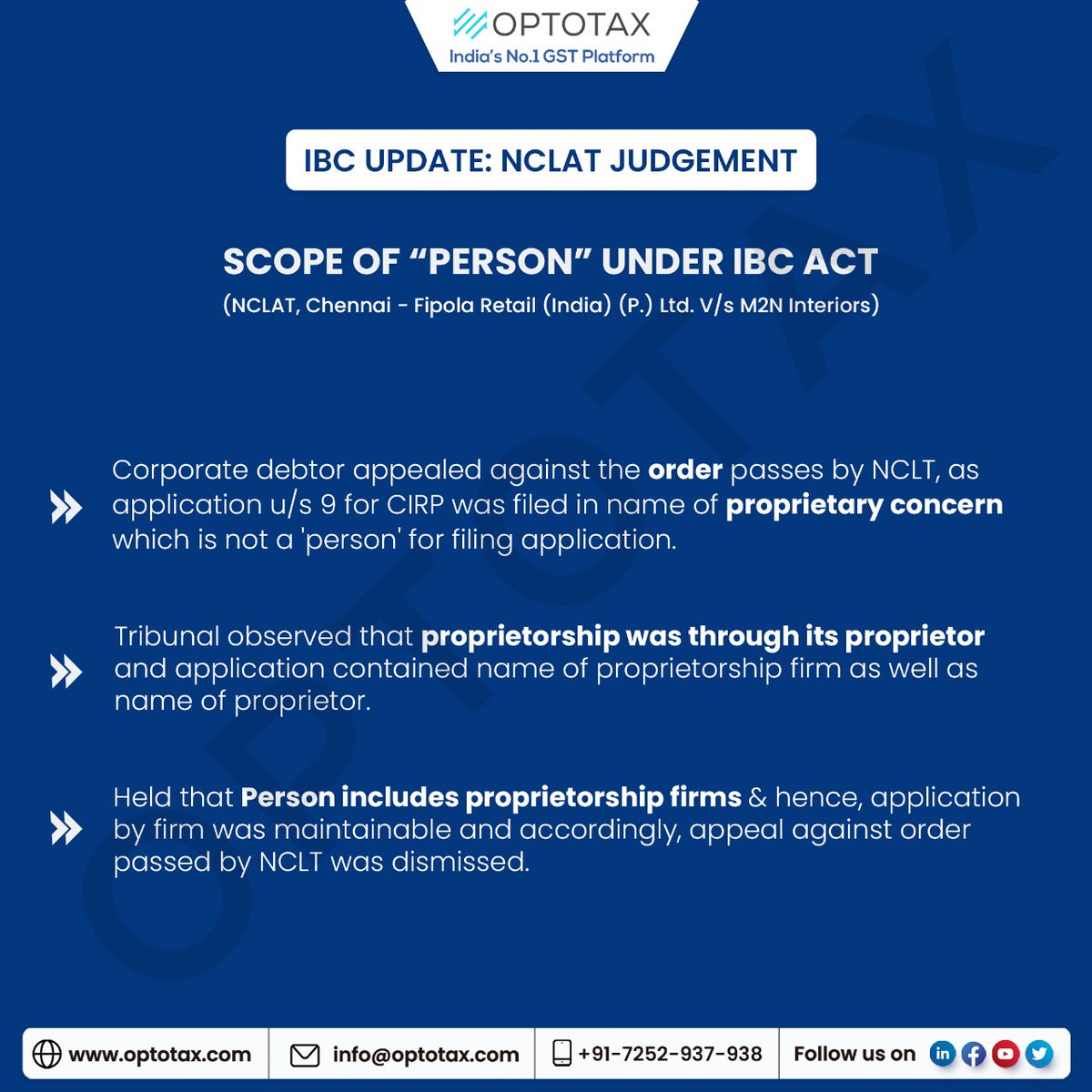
Optotax IBC Updates:
Scope of Person under IBC Act.
(Refer to the below image to know more)
#IBC #ibcupdate #scope #ibcact #proprietorship #firm #optotax

@RealtynInfra @abhaykol @msshankar1961 #Homebuyers & creditors including MSME are once again deprived of their rights under #Ibcact. No need at this juncture for announcement on increasing the threshold of Rs1 lac to Rs1 crores & as well hinting to suspend section 7, 9 &10
@nsitharaman @jayantsinha @rajeev_mp

Checkout the information on revised Insolvency and Bankruptcy Code(IBC Act) by Supreme court to protect the right of Home Buyers.
Avail full information @ https://t.co/aj58cpCIEa
#IBCAct #SupremeCourt #RealEstateUpdates #HomeBuyer


#ArunJaitley asks PM Modi not to include him in the new gov. Thankyou @arunjaitley for serving nation for 5yrs, Personally, I have some different views & stand on your fin policies. But your effects on #GST, #Demonetisation, #IBCAct, #6K4Farmers & EaseBiz are great. Thanks again.
Last Seen Hashtags on Sotwe
Most Popular Users

Elon Musk 
@elonmusk
241.5M followers

Barack Obama
@barackobama
119M followers

Cristiano Ronaldo
@cristiano
113.9M followers

Donald J. Trump
@realdonaldtrump
111.8M followers

Narendra Modi
@narendramodi
107.2M followers

Rihanna
@rihanna
98.6M followers

NASA
@nasa
92.4M followers

Justin Bieber
@justinbieber
91.8M followers

KATY PERRY
@katyperry
89.7M followers

Taylor Swift
@taylorswift13
83.7M followers

Lady Gaga
@ladygaga
75.1M followers

Virat Kohli
@imvkohli
72.9M followers

Kim Kardashian
@kimkardashian
70.8M followers

YouTube
@youtube
68.8M followers

Neymar Jr
@neymarjr
65.9M followers

Bill Gates
@billgates
64.9M followers

Selena Gomez
@selenagomez
62.8M followers

The Ellen Show
@theellenshow
62.3M followers

CNN
@cnn
61.8M followers

X
@x
60.7M followers