

Top Tweets for #parameter

https://t.co/D8rWjpRHsr just dropped GLM-5.4... a 750B “Loop Transformer” that runs the same layers twice for deeper reasoning.
No new parameters. More depth. Claims intelligence on par with 2–3T models. Adds vision. Targets real coding + CAD, shaders, games, video.

This is why I been building tiny transformer models .. it is the future .. it works efficiently .. Tesla new 3rd person view is 1b parameters according to Gawk
https://t.co/HjKQrqxvKn


It's realtime video generation.
Per Elon, the car runs a ~1B-parameter diffusion model (conditional mean-flow) on the same Universal Vision Encoder features used for driving. It takes the prior Reality View frame, adds noise, then denoises it into the next frames (8 at 36 fps). No prebuilt 3D objects or game engine—just generative AI video from the perception stack.

Thinking Machines released Inkling 2 Mini on 20 November: 26.4B parameters, 3.4B active per token, Apache 2.0 weights and a checkpoint of about 20 GB that its model card says fits a Mac with 32 GB or a DGX Spark.
Run line: ollama run inkling-2-mini (20 GB download, 1M context).
The vendor's own table, against Qwen3.8-27B. Their numbers and their harnesses, not an independent test:
Wins: SWE-Bench Verified 79.2 vs 77.8 · DeepSWE 48.2 vs 42.2 · MCP Atlas 82.7 vs 77.3 · ScreenSpot Pro 76.5 vs 57.6
Trails: Terminal Bench v2.1 71.6 vs 73.0 · ARC-AGI v1 84.5 vs 87.5 · AutomationBench 41.8 vs 48.2 · non-hallucination rate 63.4 vs 71.4
How it fits that size: the middle 12 of its 24 layers run three times per token. The card counts that as about 5.4B active parameters of compute, so it is slower per token than 3.4B suggests, and it says support for looped models in local runtimes is new.
The card's own limits: weaker on factual recall than the larger Inkling 2 Small, sometimes stuck in long reasoning loops, and as an agent it may delete or overwrite files without asking. It recommends limits on output tokens and agent turns, and a sandbox.
Licence: Apache 2.0 on the weights. The training data is described but not published, so call it open weights, not open source.
For a local coding agent, which would you pick: the small model that wins on tools and code, or the one with the higher non-hallucination score?
https://t.co/TjU8sgZmtf

⚡📏 Choosing an SMD power inductor takes more than matching inductance.
Structure, current ratings, and key parameters all matter.
Learn how to select the right component 👇 https://t.co/zNHlWmJGFf

⚡📏 Choosing an SMD power inductor takes more than matching inductance.
Structure, current ratings, and key parameters all matter.
Learn how to select the right component 👇 https://t.co/zNHlWmJGFf

⚡📏 Choosing an SMD power inductor takes more than matching inductance.
Structure, current ratings, and key parameters all matter.
Learn how to select the right component 👇 https://t.co/zNHlWmJ8PH


Researchers deliberately broke working AI projects, then used the repair jobs to train a better coding agent.
After training, a 9-billion-parameter model solved 33% of the real software issues in SWE-bench Lite, up from 24.3%. The gains carried beyond the machine-learning projects it had practiced repairing.
The paper, BuggyMLE, tackles a practical problem: as coding agents improve, we need harder tasks to test and train them. Manually collecting realistic debugging problems is slow, and endlessly generating similar exercises gives us more practice without necessarily making it more useful.
The researchers built a system that starts with working machine-learning code and injects defects into data processing, training or evaluation. It then runs the project to check that the changes actually cause a crash or damage performance.
A second process isolates which changes caused the damage. The repair agent gets the broken project, access to its files and terminal, and no clean reference solution.
This matters because machine-learning bugs can hide behind apparently healthy results. In one example, an indexing error preserved a validation score of 0.953 while reducing the held-out test score to 0.017. The number the agent could see gave it little reason to suspect the damage.
The framework produced more than 6,600 broken project variants from 222 source repositories. Increasing the difficulty exposed a substantial gap: the best full-repair rate fell from about 95% on the easiest tier to 9% on the hardest.
Full repair was a demanding standard. Recovering the performance score alone was insufficient: every verified defect had to be fixed, and bypassing broken components did not count.
For training, an easy-to-hard progression worked better than practicing only easy or only hard repairs. That mixed curriculum produced the improvement on real software issues.
This is a preprint, and success at repairing deliberately injected bugs doesn’t establish that an agent can independently invent better AI systems. Results on building machine-learning solutions from scratch were mixed.
Still, it offers a useful way to turn working code into a growing supply of checked practice problems, with difficulty that can increase as the agent improves.

Banger paper from Google on ML engineering agents.
Pay attention to this one, builders. It's a clever way to scale ML engineering by injecting bugs.
(bookmark it)
Repository-level coding benchmarks are saturating. BuggyMLE makes tasks harder on purpose by having agents inject controlled bugs into 222 working ML repositories.
- A Code Complexity Index built from ten repo features predicts average solve rates across eight coding benchmarks with R^2 = 0.951.
- On the graded MLE-Bench Lite variant, the best of 14 models drops from a 95% solve rate on the easiest tier to 9% on the hardest.
- A Qwen3.5-9B trained on the bug curriculum rivals frontier models there and raises SWE-bench Lite from 24% to 33%.
Patch size and code complexity are the strongest predictors of difficulty, so the generator can raise both to produce harder tasks and training data from the same repos.
This is a great example of how to build harder tasks from your own repos to improve the overall system.
https://t.co/Qy6Jrd1jmp
Chat with Paper: https://t.co/xtU0wkytOH


Accountability thread ( ・ั﹏・ั)
Current stats 🐮
BMI: 23
CW: 119lbs
Parameters 📒
~ Max 1k daily cal
~ Weigh ins every Monday
~ No energy drinks or coffee
~ At least 4 bottles of water per day
~ fast food slop only 1x/wk
Goal 🎊
~ Hit 90lbs by August 🍀


LingSante 3.1 is 100% a solid opensource model. 560B parameter MoE
congrats to @AntLingAGI
most of us def don't have the hardware to run it but what a start to the week

Today, we release LingSante-3.1-flash, an open-weight MoE model with 560B total parameters and 25B activations per token. It unifies diverse medical capabilities while retaining general capabilities, including complex medical reasoning, long-horizon workflow execution, and professional behavior alignment.
LingSante-3.1-flash moves beyond medical QA toward real-world healthcare problem. The model leads on HealthBench Professional (65.72), HLE (text-only, with tools: 72.22) and BrowseComp (with context: 94.10), outperforming GPT-6 Astra, Claude Opus 5.5 and Gemini 4 Argon on all three. LingSante-3.1-flash also performs well on professional long-horizon medical workflows, such as PhysicianBench (57) and EHR-Complex (74.40).
Together, these results establish LingSante-3.1-flash as the leading open-weight models for healthcare.
The weights are available. Explore LingSante and build with it.
More below ↓


Shipped raw copy-pasteable prompt output in OpenPrompt OS today.
Killed all the template boilerplate wrapping our generated text in apps/api and guided-parameters.tsx so you can drop outputs straight into your LLM call without manual cleanup.

Build log from my lab: I stopped trying to make the agent smarter and made its state a file instead. Trained a 0.4 MB state pack — 196,608 parameters — that a frozen model loads at start. No updates to the base model's weights. The behavior lives in the pack: carry it to another machine, the behavior comes with it. Files persist; agents are interchangeable. Anyone else building state as a portable file instead of a bigger agent?

An Android agent can land on a convincing screen and still leave the task unfinished. In an emulator fixture, vary one task parameter and check the destination state after each run. Report the visual and state checks separately. #MobileAgents
@ingi_erlingsson i been training a video generation model from scratch using your videos + curated data in attempt to recreate your style
im really close to figuring it out i just need more references & pre-training data .. aiming for a 1b parameter model
This video was generated by WVY-Transition-30M

GPT Image 2.6 GIF -> Fable 5.2 -> ComfyUI

for game devs building procedural terrain do you expose the noise and biome parameters to players or lock the generation rules and just randomize via seed
building a game rn and trying to figure out what scales better without breaking map balance

@shhhhuubhhh ya but football me normal h aise fans and journalists krte h and its about excitement and hum kisi ka lia parameter decide krne wale kaun hote
Oo mtlb aab tu parameter set krega ki kaun sa fan ko kaisa behave krna chiye wah 😂

@xrpcafe When you change any URL parameter (floor price etc) on the collection page the and delete again it bypasses the snapshot and it appears (until you refresh)

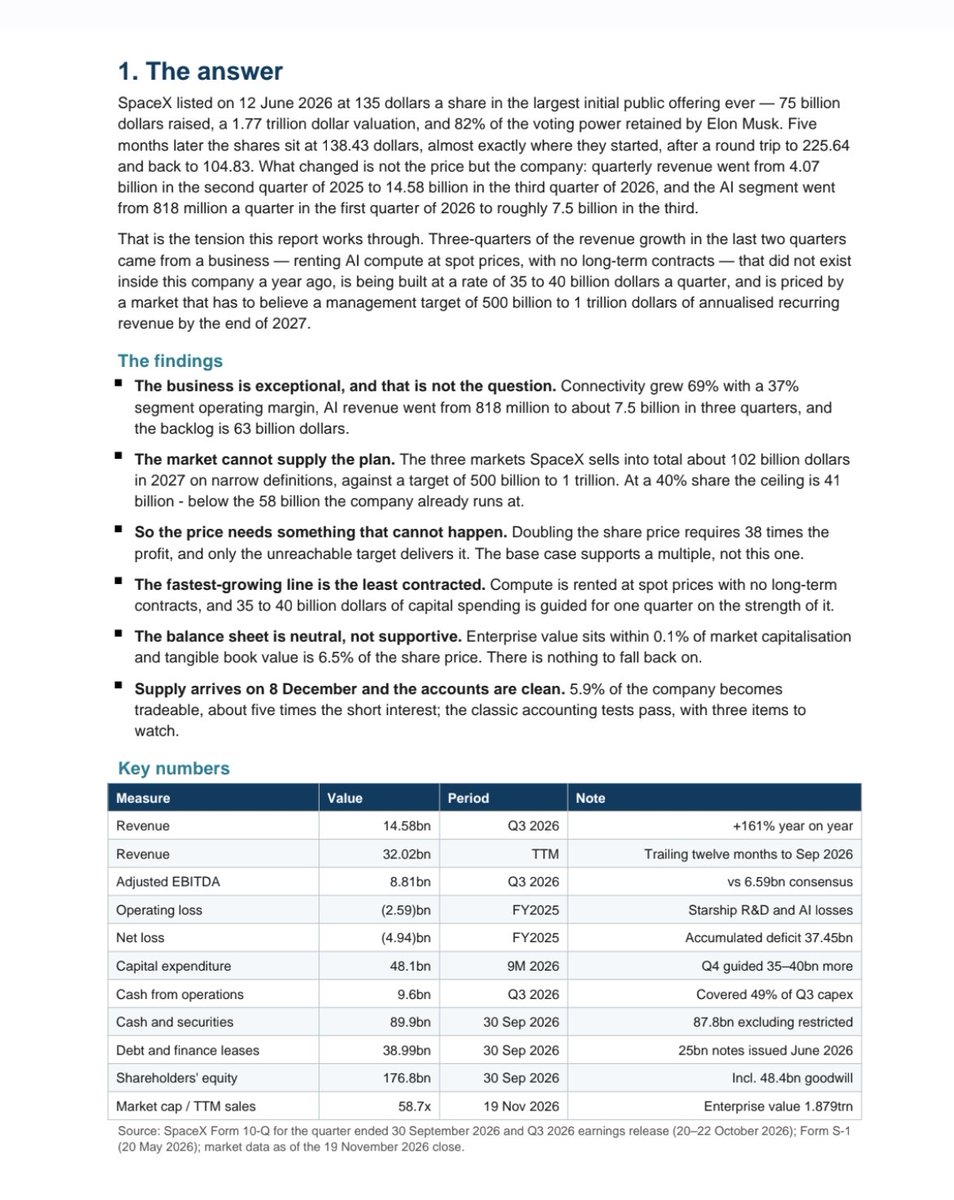
SpaceX grew 161% in a quarter. The share price hasn't moved since June.
Target by company-$500 billion of sales a year by 2027.
However Everything it sells -rockets, internet, AI computing — is a $100 billion market.
Full analysis with more parameters attached in the string.


How to make an image generation model with your own art .. i drew the dataset for this on adobe fresco (i also let cled add a few extra features to match the style)
This is a 14m parameter model to demonstrate whats possible .. can create millions of different cartoons in this specific style
In the future artists will do the same with an evolved, more sophisticated version of this method that unlocks more controllability by targeting emergence
If i can do it you can do it .. we will create a website that allows you to upload your art and it organizes your data automatically labeling it so you can train models
Learn how transformer models actually work & you will be able to make it do anything at any parameter count
This video explains how we were able to make a 7m parameter image model generate images it has never seen
480 possible combinations sculpted into the weights
Follow us to learn how to build AI intentionally so the black box doesn't exist in your architecture
WVY just solved 3D animations & rigging for AI
This 1m parameter model is competing with LLMs
https://t.co/Tm8KHYGciC

Tencent released open weights for Hy4: 770B total parameters, 49B active per token, 1M token context.
▪ 78 layers; 256 routed experts plus 1 shared, top 8 routed active per token
▪ Text, image and video input through a 1.23B ViT; built in 3.3B DFly2 drafter for speculative decoding
▪ Tencent finance eval, 579 tasks graded with 213 professionals: Hy4 3.04 of 4, DeepSeek V4.1 Flash 2.97, Kimi K3.1 Pro 2.68, GLM 5.3 2.68
▪ Internal search hallucination rate: 15.76% on Hy4 preview, 5.45% on Hy4
▪ License: Tencent Hy License, not Apache 2.0
Instruct, FP8 and base checkpoints are on Hugging Face, ModelScope and GitCode.

This is a 1m parameter language model generating full 3d animations
WVY is the future of local intelligence

minimind is trending on GitHub. It trains a 64M-parameter LLM from scratch on one RTX 3090 in about 2.3 hours, roughly 3 yuan of GPU rental, per its README.
LoRA, DPO, PPO and GRPO are written from scratch in PyTorch, with no trl or peft.
https://t.co/CwcquCHBMv

High absorption in copper, precious and refractory metals, low spatter, stable melt pool. Surface roughness Ra 3.2 μm.
Full-plate consistency with full-process traceability: parameters saved and recalled, process data exported for review.

🧪 WHAT IF YOU COULD TEST AN IDEA BEFORE PUTTING CAPITAL BEHIND IT?
Imagine developing a trading strategy.
📊 How would it have performed historically?
📉 What happened during difficult market conditions?
⚖️ How sensitive was it to different parameters?
Simulation and backtesting can help explore these questions before deployment.
KUVI's AFOS vision includes strategy simulation and backtesting.
🦉 Don't just build a strategy.
Challenge it before trusting it.
@KuviLabs
🔗 https://t.co/AcjJUgNaQz
Last Seen Hashtags on Sotwe
Most Popular Users

Elon Musk 
@elonmusk
240.1M followers

Barack Obama
@barackobama
118.6M followers

Cristiano Ronaldo
@cristiano
114.4M followers

Donald J. Trump
@realdonaldtrump
111.7M followers

Narendra Modi
@narendramodi
106.9M followers

Rihanna
@rihanna
98.6M followers

NASA
@nasa
92.1M followers

Justin Bieber
@justinbieber
91.7M followers

KATY PERRY
@katyperry
89.9M followers

Taylor Swift
@taylorswift13
83.9M followers

Lady Gaga
@ladygaga
75.4M followers

Virat Kohli
@imvkohli
73.3M followers

Kim Kardashian
@kimkardashian
70.8M followers

YouTube
@youtube
68.6M followers

Neymar Jr
@neymarjr
66.3M followers

Bill Gates
@billgates
65.2M followers

Selena Gomez
@selenagomez
63M followers

The Ellen Show
@theellenshow
62.1M followers

CNN
@cnn
61.7M followers

X
@x
60.6M followers