

Top Tweets for #preCinema

So popular throughout most of the 19th century were any kind of simple #precinema #opticaltoy for children, that we see an Ombrascope-themed working #chocolatedispenser, made in lithographed sheet metal.
When you deposit your coin, you see a #WhiteShadow image on the front screen while receiving your chocolate. The year is 1880.
Image the François Binétruy Collection.

Jean Caroly (1868-1955), the pen name of Jean-Auguste Faugeras, was the founder and editor of the ‘Illusioniste.’ Caroly was a predominant magician and proponent of White Shadows during his career.
Here is the ‘Illusioniste’ of January 1902 and two of his promotional advertisements.


THE FLOATING WORLD AS A PROTO CINEMATIC SPACE
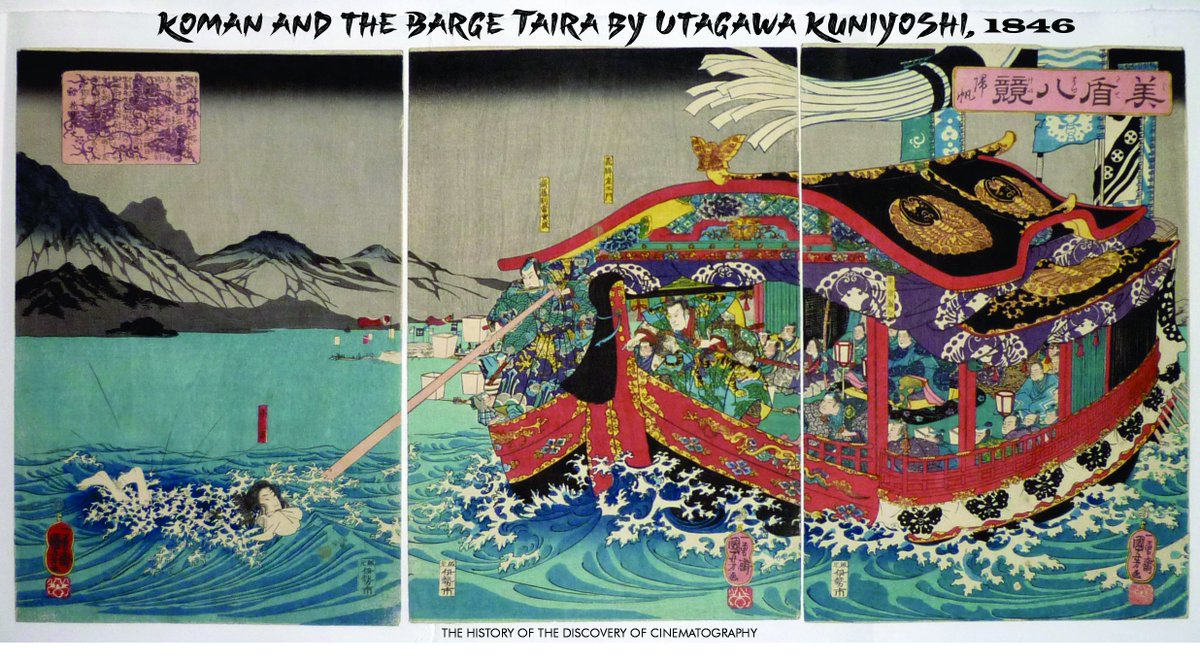
Ukiyo‑e is one of the quiet structural pillars of #precinema, and once you see how it operates, I believe it becomes impossible to unsee its influence — from Magic Lantern shows to early #filmframing to the spatial logic of #anime.
Ukiyo‑e prints often depict scenes as if they were arranged on a shallow stage, with actors, props, and architecture placed in discrete layers. Instead of Western linear perspective, #ukiyo‑e uses stacked planes, diagonals, and abrupt scale shifts — a spatial grammar that anticipates #cinematicmontage more than #Renaissance painting.
Multi‑sheet #Panoramas and narrative print series behave like early #storyboards or proto sequences. Cinema inherits not just the look but the performative vocabulary.
THE JUMP CUT AND SEQUENTIAL FRAMING
Kuniyoshi often used a technique that mimicked a film's storyboard. Or should we say, the other way around.
With regards to action sequences, in his warrior prints, he would often draw a character twice in the same scene—once preparing for a blow and once landing it.
The ‘Triptych Pan’ was used by Kuniyoshi. He would design them so that if you scanned from right to left, the action unfolded in time. This is effectively a #trackingshot or a #pan, where the artist controls the speed at which you digest the narrative.
Here from Utagawa Kuniyoshi is his ‘One Hundred Tales’
storyboard made of three three-sheet sets called ‘triptychs.’

It is with great sadness that I must report that the #Aztecs made no contribution to #precinema.
They were too busy sacrificing their inventors.

There’s limited documentation on a specific Ombrascope device from exactly 1820, but the term aligns with the period’s interest in #Shadowgraphy and optical curiosities, as seen in later references to #Umbromania in the 1880s.
As this image shows, this simple #precinema #opticaltoy offers a shadow of white onto the wall. These very early #Victorianera toys were first seen around 1820.
The Ombrascope had many names;
🎬 Ombrascopes
🎬#WhiteShadows
🎬#Shadowscopes
🎬Umbromania refers to a shadow craze

1820
OMBRASCOPES AND WHITE SHADOWS
The #Ombrascope falls within a multitude of Victorian pre cinema optical toys closely related to #ShadowPuppetry. So much so they could be kissing cousins.
Image the François Binétruy Collection.
In the early 1800s, such devices were typically used in domestic settings or small gatherings to cast silhouettes or shadow figures onto a surface, often using candlelight or early oil lamps. They were part of the broader fascination with optics and visual effects during the #Regencyperiod, aligning with the development of other pre cinematic technologies.
For example, Shadow Plays or ‘ombres chinoises’ (Chinese shadows) were popular in Europe, and an Ombrascope might have been a specific tool or toy marketed for creating very similar effects, possibly involving cutout figures or translucent cards.

This is a three-page fold-out brochure with title page and dedication of Chevallier’s 1810 “Le Conservateur de la Vue.” #historyofoptics #precinema
Chevallier signed the left page. It was dedicated to his patron the #KingofWestphalia.

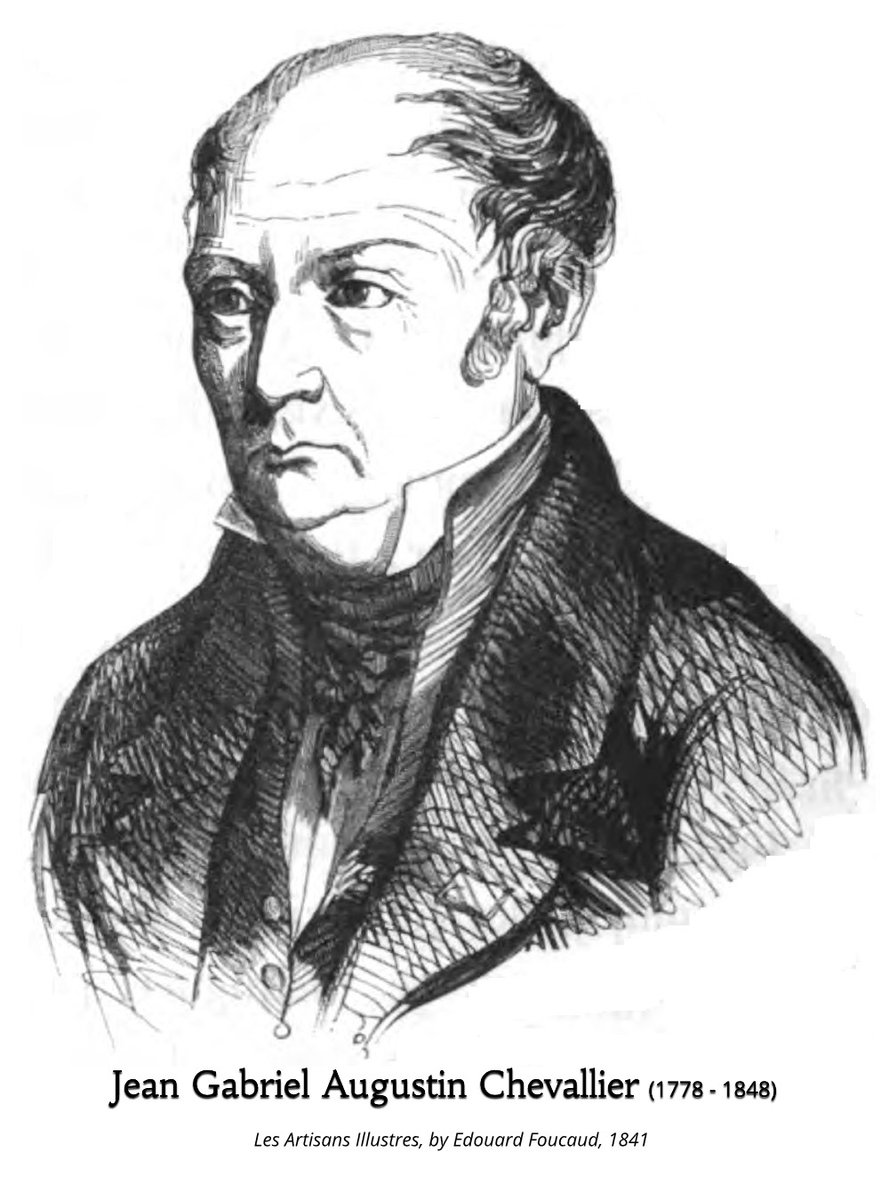
Two optical houses with analogous names; #Chevallier and #Chevalier (one L vs. two), were among the most highly recognised Parisian optical businesses.
Although the two families were unrelated, the parallels in their names recurrently caused confusion, instruments were mistaken for the other.
Here is an 1815 view of Jean-Gabriel Augustin Chevallier’s shop at 1 Place de l’Horloge, Paris. Chevallier’s shop is the tallest building with the spire.
This image is taken from Chevallier’s 1815 edition of ‘Le Conservateur de la Vue.’

5/5
In conclusion, I give you Jacques de Vaucanson’s personal description of his duck in 1738.
Chapter six contains the works of de Vaucanson, as well as #Caneletto, #Cheselden, Holmes and many many more who make their chronological contribution to #precinema here 👉 https://t.co/3UfBy2nV0v -30-

Jacques de Vaucanson made other automata; the Tambourine Player and the most famous being a duck that defecated.
But unlike The Flute Player, the duck was far less popular due to what it did vs. the playing of music.
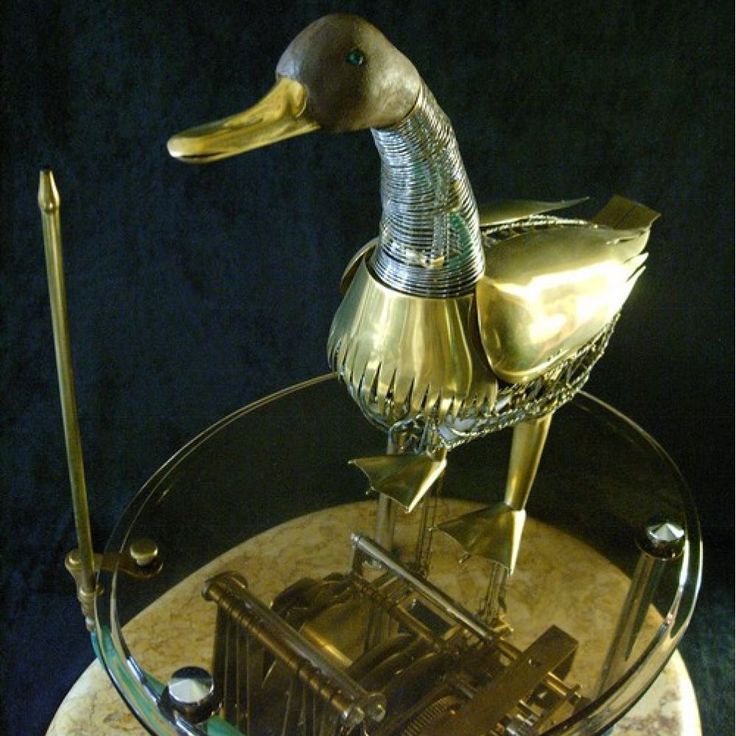
The de Vaucanson duck top images, showing the internal mechanism, from a publication from the mid-1800s.
Bottom right a replica of Jacques de Vaucanson’s digesting duck automaton, from the Museum of Automata, Grenoble, France.
The original apparatus met its demise in a fire in 1879.


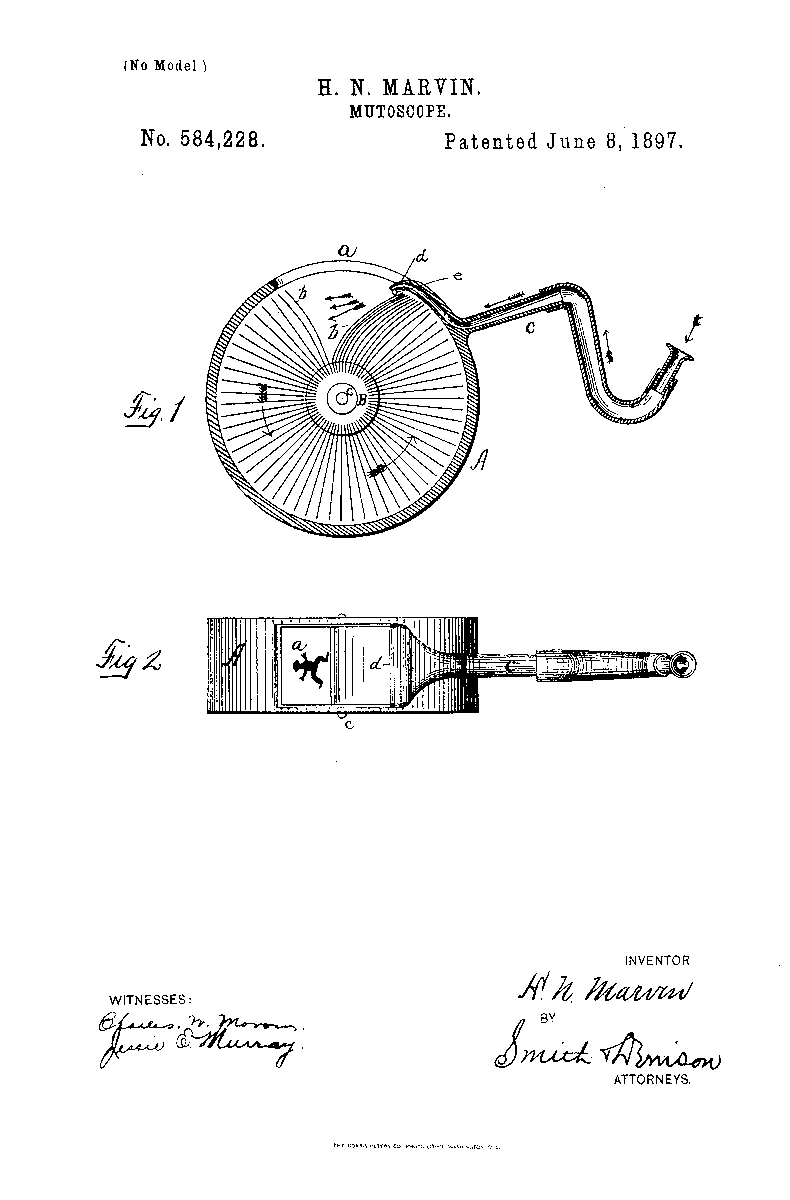
Marvin's US patent № 584228 granted 8 June 1897 was for a cylindrical Toy Mutoscope where the power to turn the images was provided by the viewer's breath. #HarryMarvin #AMBC #historyofmovies #precinema
Marvin was able to tap into the children’s pre cinema market, but it took 21 months for this motion toy to be approved. Rossell 2022, p184.
1897
TOY MUTOSCOPE
HARRY NORTON MARVIN (1862-1940)
Marvin of #AMBC fame created his #ToyMutoscope that operated by the user simply breathing. This was a very simple take-off of his partner Herman Casler’s #Nickelodeon #Mutoscope (which was cranked) where the viewers breath turned images into motion.
Air powered movies.

Below is the Phonoscope showing the door open and the exposed disk. Top right is the disk itself with Demenÿ’s image photographed by the Photophone. #filmhistory #historyoffilm #precinema
Bottom left is the proof sheet and bottom right, Georges Demenÿ.


Left and Top Right
Here from Henry Hopwoods ‘Living Pictures: Their History, Photo-Production and Practical Working’ (Henry Vaux Hopwood, Optician and #Photographic Trades Review, London, 1899), on pp61 & 62 we read about the Phonoscope and Photophone.
Bottom Right
The Demenÿ apparatus and description here, from ‘Magic - Stage Illusions and Scientific Diversions, Including Trick Photography’ by Albert Allis Hopkins, Sampson Low, Marston and Company, London, 1897, on p492.


Here's two Magic Lantern slides called #GirlSkipping and #DogSkipping. The speed at which the lass skips can be varied according to the enthusiasm of the user. Same for the dog. These hand-painted slides were common in #Victorian Magic Lantern shows, a form of #precinema projection entertainment.
The frame in your image (wood and metal mount) is a giveaway — it’s consistent with British or German-made mechanical lantern slides, especially those manufactured by #Ernemann in Germany, or Carpenter & Westley, or Newton & Company in the UK.
They may have also been manufactured by anonymous cottage-industry producers in England, France, and Germany.
The skipping motion is achieved via internal mechanical gears or a sliding lever that animates the limbs or rope in a loop. These were used both for education and entertainment, and animations like skipping, walking, or dancing were very common.
Here is a wonderful Mechanical Magic Lantern slip-slide featuring rich, colourful, hand painted details.
The user pulls a glass slide back and forth to alter the image. Also, a man skipping rope.
While Cellini doesn’t provide a technical blueprint, historians believe his device was an early optical projector, likely using a light source (such as candles or oil lamps), painted glass slides, and a convex lens to project images. #precinema
This setup if accurate, aligns with the principles of the #CameraObscura, known well in Europe since the Middle Ages, and anticipates the #MagicLantern, which became an extremely popular entertainment device in the 1600s.
#ChristiaanHuygens is often credited with refining the Magic Lantern around 1659, but Cellini’s performance suggests Renaissance artists were already exploring optical projections.
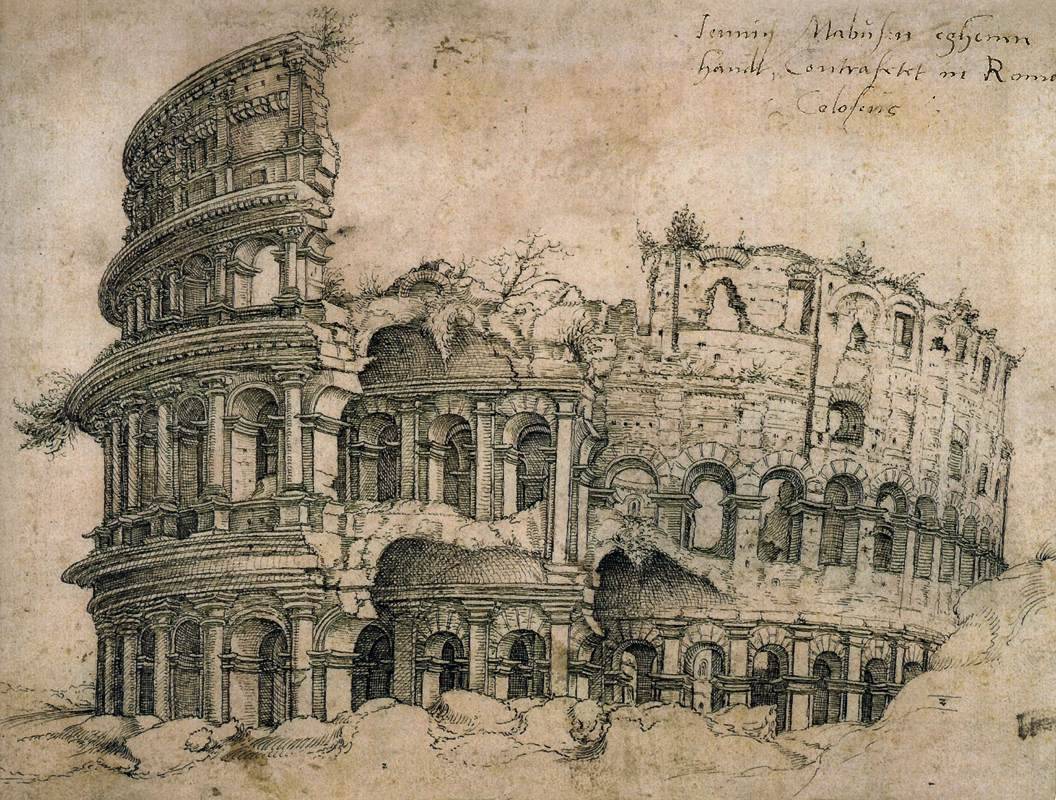
This is a view of how the Colosseum known then as the Amphitheatre looked, by the French-born Dutch artist Jan Gossaert (1478-1532) c. 1509. Imagine seeing a Phantasmagoria show in this venue, at night, in those days.
THE PHANTASMAGORIA BEFORE THE PHANTASMAGORIA
The Colosseum, already a ruin by the 16th century, was an evocative setting. Its vast, open structure would have provided a dramatic backdrop for projections, with flickering light casting images on walls or screens.
Cellini’s account emphasizes the emotional impact on the audience, who were reportedly awestruck, highlighting the event’s blend of art, technology, and spectacle. Below, a scene taken from the Berlioz's opera Benvenuto Cellini depicting the #Roscoe report on the #Phantasmagoria-type dressed stage at the Coliseum (or #Amphitheatre), Rome in 1540.

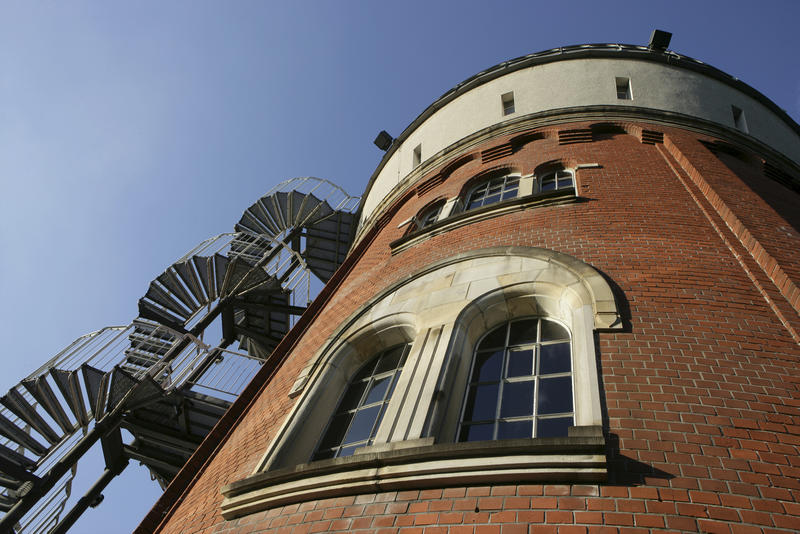
The Mülheim Museum contains pre cinema objects from the period 1750 onwards. This includes #LaternaMagicas, and vues d’optiques with over 1,100 exhibits on #precinema.


The former Broicher Water Tower is in fact a neo-#Romanesque brick building from 1904, in the MüGa Park @Ruhr_Tourismus. The Mülheim Camera Obscura, also houses the #MülheimMuseum on the history of film and photography.


The Great Art Of Light And Shadow: Archaeology of the Cinema ON SALE NOW! https://t.co/5Gr9ypa4OT
#precinema #opticalmedia #opticalillusion #cameraobscura

The Galantee showmen gave way to the Professors, showmen who had access to more elaborate equipment and wonderful, but expensive, animated slides.
Robertson was a Professor of the Magic Lantern show and perfected the #Phantasmagoria. #precinema


The Galantee showmen or Savoyards put on lantern shows that became known as Galantee So which translates to “a fine show.”
The visual themes would relate to Biblical, moral, and current events, and the showman would create stories for the children watching.


Discover stunning new #3D collections on @Europeanaeu! 🌟
From #PreCinema artifacts in Girona to ancient treasures from Bibracte, explore our shared #CulturalHeritage in 3D with the @eureka_3d project.
Read more⤵️
https://t.co/4SwOhLTVZ2
@arxiu_gi @BibracteBeuvray

https://t.co/V0iegkj143
A beautiful collection of #precinema heritage from @Girona_Cat and @museucinema has just been published in @Europeanaeu in the context of the @eureka_3d project! Enjoy!
@EU_HaDEA @DigitalEU @digitalMculture @UNESCO_DCH_ERA @EGI_eInfra @BibracteBeuvray
The Pleorama is one of the earliest examples we have, of a #precinema illusion that would later realize its ideal form, with the advancement of #Cinematography. -30-

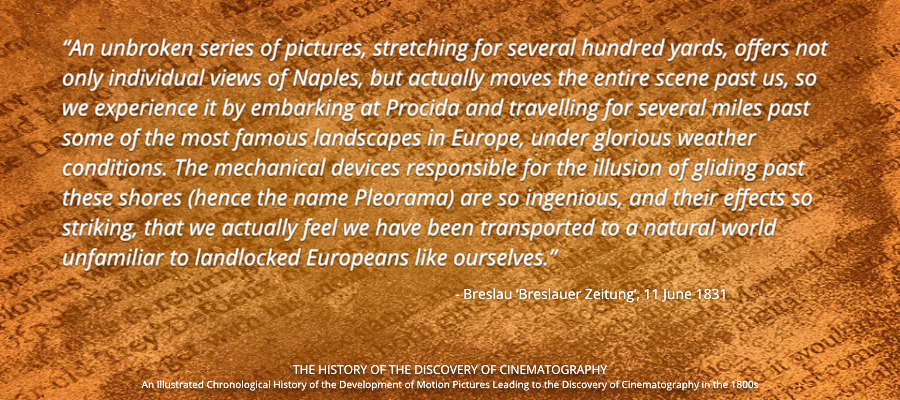
Patented in 1787, the Panorama was a spectacular visual entertainment event like going to the movies.
The Panorama was motion entertainment at its #precinema best, and flourished throughout the 19th century, mostly in #Europe and the #UnitedStates.

1787
THE PANORAMA
The portrait painter #RobertBarker coined the word "panorama," from the Greek word ‘pan’ meaning ‘all’ and ‘horama’ meaning ‘view’ describing paintings of #Edinburgh, shown on a cylindrical surface, which he soon was exhibiting in #London as the #Panorama.

14/14
The Shadow Theatre was the Cabaret's most notable #attraction, lasting a decade until its closure in 1897.
However, it never lasted as long as Séraphin's Ombres Chinoises.
From The Museum of #Precinema in #Padua (Founded by Laura Minici Zotti), a unique donation; -30-

Rivière designed a clever system of zinc silhouette cutouts organised in a wooden framework behind the screen by the time it premiered in 1887.
The light source was mostly an oxyhydrogen flame located in the very back of the structure although an open flame was sometimes used.


Nuovo articolo! Uno strumento ottico dell'Ottocento e un divertente esercizio di #prospettiva. #didattica #arte #scuola #precinema
https://t.co/mWWLuCOvft

Últimos ejemplares disponibles en https://t.co/M5CX0Xx9uY
#libros #librosrecomendados #librosdecine #librosdemagia #magianegra #magiablanca #precinema #ilusion #ilusión #peliculasrecomendadas #cinemagia #magiadelcine #elilusionista #regalo #regalosoriginales #buencine


Last Seen Hashtags on Sotwe
momson(***)***+filter:native_video
Seen from Ukraine
monkeyapp #ometv
Seen from United States
รับงานบางบ่อ
Seen from Thailand
ass #pmv
Seen from United States
beurette hijab
Seen from Pakistan
incestoconmamá
Seen from Mexico
momson((())) filter:videos
Seen from Turkey
نيج_عراقية
扩张
อยุธยารับงาน
Seen from Thailand
Most Popular Users

Elon Musk 
@elonmusk
241M followers

Barack Obama
@barackobama
119.2M followers

Cristiano Ronaldo
@cristiano
111.8M followers

Donald J. Trump
@realdonaldtrump
111.8M followers

Narendra Modi
@narendramodi
107M followers

Rihanna
@rihanna
98M followers

NASA
@nasa
92.2M followers

Justin Bieber
@justinbieber
91.2M followers

KATY PERRY
@katyperry
88.3M followers

Taylor Swift
@taylorswift13
82.2M followers

Lady Gaga
@ladygaga
73.7M followers

Virat Kohli
@imvkohli
70.9M followers

Kim Kardashian
@kimkardashian
70.1M followers

YouTube
@youtube
68.7M followers

Bill Gates
@billgates
64.3M followers

Neymar Jr
@neymarjr
63.8M followers

The Ellen Show
@theellenshow
62.4M followers

CNN
@cnn
61.8M followers

Selena Gomez
@selenagomez
61.4M followers

X
@x
60.8M followers