

Top Tweets for #proteinfunctionprediction

Molecular-level protein semantic learning via structure-aware coarse-grained language modeling
1. This study introduces a novel structure-aware coarse-grained protein language that redefines protein representation by integrating secondary structure segmentation with vector quantization techniques. The framework partitions proteins into biologically meaningful structural fragments, significantly reducing sequence length while preserving functional semantics.
2. The proposed SCG (Structure-Aware Coarse-Grained) language outperforms traditional amino acid sequences and state-of-the-art protein languages in capturing molecular-level semantics, especially for long proteins. This is achieved by constructing a compact vocabulary of local structural patterns derived from secondary structures.
3. The SCG framework mitigates semantic truncation in large proteins during language model processing. Empirical evaluations show that SCG representations experience minimal truncation effects compared to fine-grained languages, preserving structural and functional context in downstream tasks.
4. The study explores different segmentation strategies and confirms that secondary structure-based segmentation is essential for preserving biologically relevant features. Alternative segmentation schemes like uniform random and dynamic random fragment segmentation lead to significant performance degradation.
5. The SCG method employs a multi-head attention encoder in VQ-VAE to improve codebook utilization and vocabulary construction. This design enhances stability and efficiency in vector quantization, outperforming traditional clustering methods like k-means.
6. The SCG language demonstrates stable performance across various downstream tasks, including function prediction, enzyme classification, and interaction identification. It shows consistent advantages when applied to both lightweight and deep language models.
7. The study highlights the potential of combining SCG representations with existing protein modeling approaches to further improve modeling efficiency and scalability. Future work may explore extending this coarse-grained paradigm to graph neural networks for scalable, structure-aware protein modeling.
8. The authors have made the data and source code available on GitHub and Zenodo, facilitating reproducibility and further research in the field.
💻Code: github.com/bug-0x3f/coarse-g…
📜Paper: doi.org/10.1093/bioinformati…
#ProteinLanguageModeling #CoarseGrainedRepresentation #StructuralBioinformatics #Bioinformatics #ProteinFunctionPrediction

SuperEdgeGO: Edge-supervised graph representation learning for enhanced protein function prediction @PLOSCompBiol
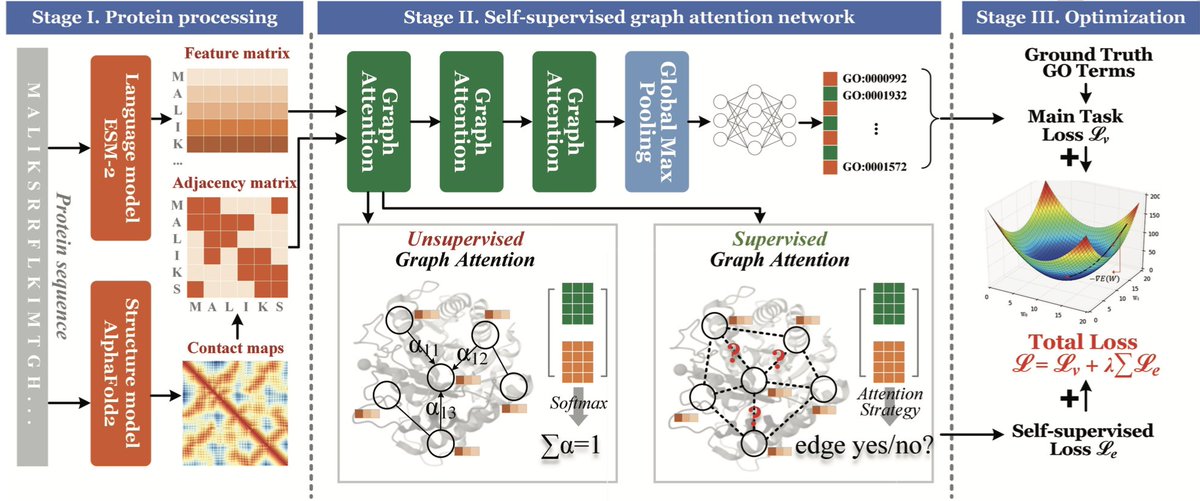
1. A new computational method called SuperEdgeGO has been proposed to predict protein functions more accurately. This method leverages edge-supervised graph representation learning to enhance the prediction of protein functions, addressing the limitation of previous methods that underutilized edge information in protein graphs.
2. SuperEdgeGO introduces a supervised attention mechanism to explicitly encode residue contacts into protein representations. Unlike traditional graph convolution methods that use edge information in an unsupervised manner, this approach directly supervises the edges, leading to more effective capture of structural features.
3. The study demonstrates that SuperEdgeGO achieves state-of-the-art performance across all three categories of protein functions (molecular function, biological process, and cellular component). The ablation analysis further validates the effectiveness of the edge supervision strategy.
4. SuperEdgeGO uses AlphaFold2-predicted protein structures to construct protein graphs, which are then processed through a novel attention mechanism. This method not only improves the accuracy of function prediction but also highlights the importance of edge information in protein structure modeling.
5. The model's performance is evaluated on a benchmark dataset containing over 20,000 human proteins. SuperEdgeGO outperforms existing state-of-the-art methods, particularly in the molecular function category, where it achieves a significant improvement in Fmax.
6. The authors also conducted cross-species experiments on datasets from different organisms, including S. cerevisiae, E. coli, fruit fly, and rat. The results show that SuperEdgeGO can generalize well across species, further proving its effectiveness.
7. The edge supervision strategy in SuperEdgeGO has the potential to be applied to other biological tasks that rely on structural insights, such as drug-target affinity prediction and protein-protein interaction analysis.
💻Code: github.com/Lyt0715/SuperEdge…
📜Paper: journals.plos.org/ploscompbi…
#ProteinFunctionPrediction #GraphRepresentationLearning #ComputationalBiology #SuperEdgeGO #EdgeSupervision #AlphaFold2
Opus-go: Unlocking Residue-Level Insights from Sequence-Level Annotations Using Biological Language Models
1. OPUS-GO is a novel method that enhances protein function prediction by providing both sequence-level accuracy and residue-level interpretability. This approach is particularly innovative as it bridges the gap between high-level classification and detailed residue analysis, offering deeper biological insights.
2. The core of OPUS-GO lies in its modified Multiple Instance Learning (MIL) strategy. By treating protein sequences as bags and residues as instances, it effectively identifies critical residues associated with functional labels. This dual-level approach outperforms traditional methods in both sequence and residue classification tasks.
3. OPUS-GO leverages biological language models (BLMs) like ESM-2 to extract features, ensuring that the method is broadly applicable and can be integrated into various existing frameworks. Its ability to pinpoint critical residues without requiring structural information makes it a powerful tool for functional annotation.
4. In experiments across multiple benchmarks, OPUS-GO consistently demonstrates superior performance. For example, it achieves higher AUPR and Fmax scores in Gene Ontology (GO) term prediction tasks compared to baseline methods. This highlights its robustness and accuracy in identifying functional residues.
5. The method also shows promise in enzyme function prediction, identifying consistent patterns within enzyme categories. While it may not always pinpoint specific active sites, its ability to detect key residues related to functional labels makes it a valuable asset for protein design and engineering.
6. The code and pre-trained models for OPUS-GO are publicly available, allowing researchers to easily implement and build upon this work. This accessibility is crucial for advancing the field and encouraging further research into protein function prediction and design.
💻Code: github.com/thuxugang/opus_go
📜Paper: openreview.net/forum?id=iYXa…
#ProteinFunctionPrediction #Bioinformatics #MachineLearning #ComputationalBiology

A Multimodal Model for Protein Function Prediction (MMPFP) @SciReports
1. MMPFP is a novel multimodal model for protein function prediction that integrates both protein sequence and structure information using Graph Convolutional Networks (GCN), Convolutional Neural Networks (CNN), and Transformer models. This approach addresses the limitations of single-modality models that often overlook structural properties critical for accurate predictions.
2. The model processes inputs through three main modules: the protein sequence encoding module, the multilayer GCN protein representation module, and the protein CNN module. By combining these modules, MMPFP constructs a comprehensive framework for learning complex protein functions.
3. MMPFP achieves state-of-the-art performance in predicting Molecular Function (MF), Biological Process (BP), and Cellular Component (CC) with AUPR scores of 0.721, 0.401, and 0.495, respectively. Fmax scores of 0.769, 0.632, and 0.695, and Smin scores of 0.320, 0.480, and 0.448 demonstrate significant improvements over baseline models.
4. Ablation studies confirm that the Transformer module within the GCN branch is essential for capturing complex relationships within protein graphs, providing a substantial performance boost over LSTM-based methods.
5. The combination of CNN, GCN, and Transformer modules allows the model to effectively integrate spatial structural features and sequence information, enhancing the overall prediction accuracy and robustness.
6. Comparative analysis against various baseline models, including TAWFN, DeepGO, DeepFRI, and others, shows that MMPFP consistently outperforms these methods by 3-5% in Fmax, AUPR, and Smin metrics.
7. The model’s multimodal architecture allows for a more comprehensive understanding of protein function, making it a promising tool for tasks like protein structure prediction, multitask learning, and integrating additional modalities such as protein-protein interaction networks.
8. Future work aims to expand MMPFP’s capabilities by incorporating new learnable features and advanced deep learning models to further improve prediction accuracy and broaden its applicability.
📜Paper: nature.com/articles/s41598-0…
#ProteinFunctionPrediction #MultimodalLearning #GCN #CNN #Transformer #DeepLearning #Bioinformatics #ProteinStructure

Automatically Defining Protein Words for Diverse Functional Predictions Based on Attention Analysis of a Protein Language Model
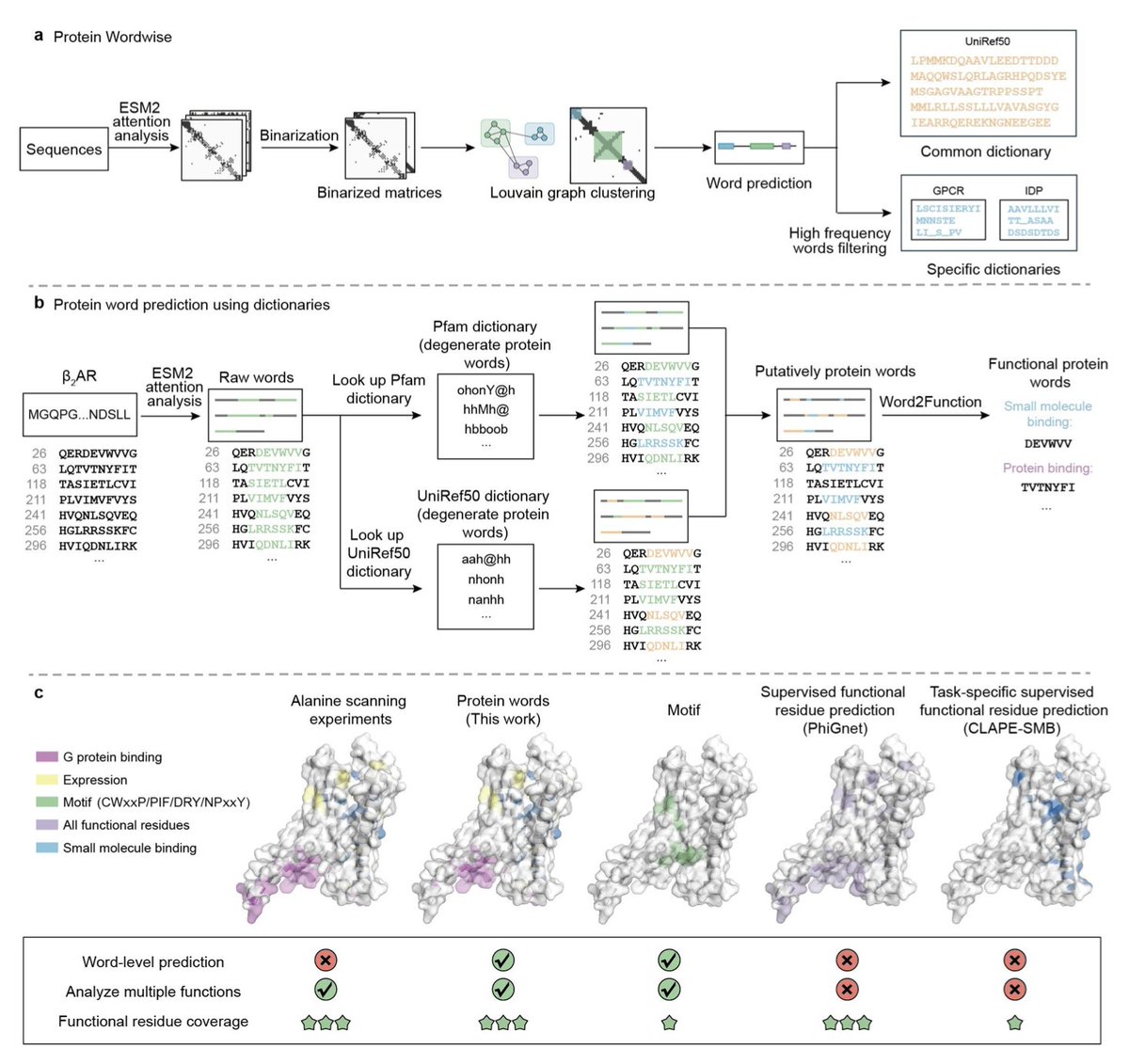
1/ This study introduces "protein words" as a novel concept for studying protein functions, leveraging attention matrices from protein language models (PLMs). Unlike traditional motifs or domains, protein words provide a flexible, annotation-agnostic approach for functional predictions.
2/ The researchers developed "Protein Wordwise," an unsupervised tool that identifies protein words using a community detection algorithm on attention matrices from the ESM2 PLM. This approach systematically parses protein sequences into sets of residues (protein words) with functional relevance.
3/ To enable function prediction, they created "Word2Function," a supervised model mapping protein words to Gene Ontology (GO) terms using feature importance analysis. This model achieves residue-level functional annotations with high accuracy.
4/ The toolkit outperforms traditional motif-based methods like PROSITE in functional predictions across diverse datasets, including tasks such as DNA-binding, small-molecule interactions, and catalysis, demonstrating broad applicability.
5/ A curated dataset, "PWNet," was assembled to benchmark protein word prediction for 10 diverse functional tasks. Protein Wordwise achieved a functional residue coverage of up to 90%, significantly surpassing traditional methods.
6/ This framework also demonstrated success in identifying functional residues within "domains of unknown function" (DUFs) and provided insights into previously uncharacterized proteins, showcasing its potential for de novo protein design and understanding protein dynamics.
7/ The authors highlight the adaptability of protein words for various applications, including coarse-grained modeling of protein motion and protein-small molecule interactions, providing a middle ground between atomic-level and domain-level analyses.
📜Paper: biorxiv.org/content/10.1101/…
#ProteinWords #PLM #Bioinformatics #ProteinFunctionPrediction #ProteinEngineering
ProtBoost: protein function prediction with Py-Boost and Graph Neural Networks - CAFA5 top2 solution
1. ProtBoost emerged as the 2nd best solution in the CAFA5 competition, leveraging Py-Boost, a novel gradient boosting algorithm optimized for multi-target tasks, and Graph Neural Networks (GCNs) to achieve a score of 0.58240, outperforming over 1,600 teams.
2. Introduced Py-Boost, the first gradient boosting method capable of efficiently predicting thousands of targets simultaneously, with computational speedups of over 50x compared to alternatives like XGBoost and CatBoost.
3. Employed cutting-edge protein language models (Prot-T5, ESM2) to generate embeddings that effectively capture protein sequence properties, achieving superior functional similarity predictions compared to traditional alignment methods.
4. Developed Conditional Probability Modeling (CondProbMod), a novel approach to account for hierarchical relationships in Gene Ontology, significantly enhancing prediction accuracy by incorporating ontology structure directly into model training and ensembling.
5. Utilized a GCN-based stacking strategy to integrate multiple models and external annotations, such as QuickGO and UniProtKB, achieving a substantial performance boost from 0.59 to 0.62 in ablation studies.
6. Demonstrated superior scalability and flexibility of ProtBoost, enabling prediction of up to 13,000 Gene Ontology terms, with models trained on diverse datasets of 142,246 proteins spanning eukaryotes, prokaryotes, and viruses.
7. Highlighted the efficacy of machine learning in protein function prediction tasks, addressing challenges of large-scale multi-target modeling and paving the way for advancements in bioinformatics through collaborative competition frameworks.
💻Code: github.com/btbpanda/CAFA5-pr…
📜Paper: arxiv.org/abs/2412.04529
#Bioinformatics #ProteinFunctionPrediction #GradientBoosting #GraphNeuralNetworks #CAFA5 #MachineLearning

ProtFAD: Introducing function-aware domains as implicit modality towards protein function prediction
• ProtFAD pioneers a multi-modal protein representation framework by introducing function-aware domain (FAD) embeddings. These embeddings act as an implicit modality bridging protein sequences and structures with their biological functions, leveraging domain-function priors for enhanced accuracy.
• A key innovation is the domain-joint contrastive learning strategy, which aligns multi-modal representations (sequence, structure, and domains) while distinguishing different protein functions. This approach uses a novel triplet InfoNCE loss to enhance representation consistency and minimize noise.
• ProtFAD achieves state-of-the-art performance across benchmarks, including enzyme reaction classification and Gene Ontology (GO) term prediction. Results show a significant increase in prediction metrics: 0.518 for Biological Process, 0.701 for Molecular Function, and 0.551 for Cellular Component ontologies.
• Domain attention modules are integrated to extract functional representations of joint domains, further improving prediction robustness by incorporating positional encoding tailored for protein domains.
• Ablation studies highlight the importance of FAD embeddings, domain pretraining, and the contrastive learning strategy, with ProtFAD significantly outperforming degenerate models lacking these components.
• Limitations include challenges in applying domain-based predictions to granular tasks like binding site identification and risks of overfitting in data-scarce scenarios, despite function-prior pretraining.
💻Code: github.com/grizzledtroubadou…
📜Paper: arxiv.org/abs/2405.15158
#ProteinFunctionPrediction #Bioinformatics #MultiModalAI #ContrastiveLearning #ProteinDomains

Last Seen Hashtags on Sotwe
سِِكُسْ_كتَاب
Seen from Sweden
Minichamps
Seen from United States
interfaithxxx
Seen from India
sph
Seen from Singapore
anxiouspandaaaa
Seen from Netherlands
femboy
Seen from United States
incesto
Seen from Mexico
mgai()*****************************(************)*********
Seen from France
snapchat
Seen from United Kingdom
cnc
Seen from United States
Most Popular Users

Elon Musk 
@elonmusk
240.2M followers

Barack Obama
@barackobama
118.6M followers

Cristiano Ronaldo
@cristiano
114.4M followers

Donald J. Trump
@realdonaldtrump
111.8M followers

Narendra Modi
@narendramodi
106.9M followers

Rihanna
@rihanna
98.6M followers

NASA
@nasa
92.2M followers

Justin Bieber
@justinbieber
91.7M followers

KATY PERRY
@katyperry
89.9M followers

Taylor Swift
@taylorswift13
83.9M followers

Lady Gaga
@ladygaga
75.4M followers

Virat Kohli
@imvkohli
73.3M followers

Kim Kardashian
@kimkardashian
70.8M followers

YouTube
@youtube
68.6M followers

Neymar Jr
@neymarjr
66.3M followers

Bill Gates
@billgates
65.2M followers

Selena Gomez
@selenagomez
63M followers

The Ellen Show
@theellenshow
62.1M followers

CNN
@cnn
61.7M followers

X
@x
60.6M followers