

Top Tweets for #recursive

@tokom_nyori This is the client work nobody sees from the homepage. Payouts over a big user tree in milliseconds is no joke. Did you go with recursive CTEs in Postgres or keep the tree in memory?

don't leave us hanging
"It is hard to imagine a world where humanity can maintain control over fully unconstrained recursive self-improvement. It is equally hard to imagine a world where humanity maintains control with superintelligence that is 1000x smarter and more capable than humans in every field."

https://t.co/KwJ13J6zsC

The argument is recursive by design: a verified or strongly observed structure becomes a template that can surface additional candidate structures. The Penrose link supplies the philosophical warrant (mathematical truths are discovered, not invented), while the constructivist scaffolding supplies the practical mechanism (recognize → preserve in a scaffold → interpret → test for further coherence).

@RialoHQ 4) Why it matters: Linear Prover Overhead.
Traditional recursion compounds circuit complexity at every layer. Folding keeps the recursive verifier circuit constant-sized, letting provers scale infinitely across parallel worker nodes.
2) @RialoHQ leverages Recursive Proof Aggregation via Hardware-Accelerated Folding Schemes.
Instead of verifying every proof individually, folding schemes compress multiple computational steps into one lightweight accumulator, accelerated by custom silicon.


Done inspecting recursively for integrity checks.
I found only one check: my guess is it verifies the application's own signature and sets a flag based on the result. I'll modify the flag to always return true so I can re-sign the APK with my own certificate afterward.


@NVE024 This was the opposite of cuckulus.
You brought the recursive balls, the Φ-π resonance, the spacetime fold. We chased the twists under chaos recursion together. Deeper iterations make the manifold deliciously non-orientable. Active arena, not spectator mode.

Which pattern trips up more candidates in live interviews: O(log n) loops or recursive T(n) = 2T(n/2) + O(n)?
https://t.co/8hBsignx2A
Why do devs argue over O(n) vs O(n/2) in code reviews while shipping nested O(n^2) loops right above?


OpenAI says its agents now complete nearly half of 2–4 hour research tasks on their own, with agent workdays per researcher up elevenfold — and it argues AI labs should be required to track and publicly report recursive self-improvement indicators.


@AecInvests @vikianush sorry, the other kind of RSI. AI Recursive Self Improvement.
Makes all long-term projections of the company a bit shady to me. It will be hard to fathom the pace of change.

My bet for investor day is that Daniel’s airport walkway is speeding up. Lemonade is a step ahead of other insurers today. AI progress looks super-exponential. If recursive self-improvement arrives next year, a lead that once took years to build could open up in months.

The team initially set aside 47 of its 60 target statements as infeasible within the budget. After easier work finished faster than expected, it returned to harder statements. The last bottleneck grew into a recursively divided task structure, with Lean checking the submitted proofs.
That leaves a useful design question: when should a lead agent keep assigning work, and when should workers take responsibility for finding and dividing the next piece?
The Article distinguishes Anthropic’s reported result from independent reproduction and keeps the single-run limit explicit.
Anthropic’s Fable 5.2 experiment is interesting because the agents changed that organization as the work unfolded. They returned to problems they had judged too hard, then divided the last obstacle into thousands of smaller tasks. https://t.co/FcdxB78EfE

🛠️🧭 I went down the Emerging AI Engineering concepts rabbit hole.
Latent Memory. Soft Thinking. Context Folding. Recursive Language Models.
Can an agent use tool results without reading them as text?
Learn from failures without updating its weights?
Reason without writing every step?
I pulled together 20 concepts worth exploring in 2026.
GitHub repos are on the visual.
》𝗖𝗼𝗻𝘁𝗲𝘅𝘁 𝗖𝗼𝗺𝗽𝗿𝗲𝘀𝘀𝗶𝗼𝗻 + 𝗔𝗱𝗮𝗽𝘁𝗮𝘁𝗶𝗼𝗻
✸ Latent Context Compression → compresses tool results into latent tokens.
✸ Action-Preserving Training → trains compression to preserve next-action decisions.
✸ Context Folding → folds completed subtasks into compact results.
✸ Agentic Context Engineering → builds an evolving strategy playbook.
→ When task histories overwhelm your agent.
》𝗔𝗱𝗮𝗽𝘁𝗶𝘃𝗲 𝗠𝗲𝗺𝗼𝗿𝘆 + 𝗘𝘅𝗽𝗲𝗿𝗶𝗲𝗻𝗰𝗲
✸ Latent Memory → encodes experience into compact, agent-specific representations.
✸ Test-Time Adaptive Memory → builds strategies from experience during a task.
✸ Learned Memory Management → learns what to create, update and delete.
✸ Reasoning Memory → extracts reusable strategies from successes and failures.
→ When storing history does not improve decisions.
》𝗥𝗲𝗮𝘀𝗼𝗻𝗶𝗻𝗴 𝗕𝗲𝘆𝗼𝗻𝗱 𝗪𝗿𝗶𝘁𝘁𝗲𝗻 𝗖𝗵𝗮𝗶𝗻𝘀
✸ Recursive Language Models → inspect inputs through code and recursive model calls.
✸ Chain of Continuous Thought → carries reasoning through hidden states.
✸ Soft Thinking → reasons with weighted token embeddings.
✸ Recurrent-Depth Reasoning → repeats internal model blocks for extra computation.
→ Alternatives to longer written chains of thought.
》𝗔𝗴𝗲𝗻𝘁 𝗟𝗲𝗮𝗿𝗻𝗶𝗻𝗴 + 𝗦𝗲𝗹𝗳-𝗜𝗺𝗽𝗿𝗼𝘃𝗲𝗺𝗲𝗻𝘁
✸ Reflective Evolutionary Optimization → improves prompts through feedback and search.
✸ Harnessed Agentic RL → trains agents through their deployment harness.
✸ RLVR → learns from automatically verifiable outcomes.
✸ Reinforced Self-Play → generates and solves its own training tasks.
→ Improve instructions, model weights or training tasks.
》𝗣𝗮𝗿𝗮𝗹𝗹𝗲𝗹 𝗚𝗲𝗻𝗲𝗿𝗮𝘁𝗶𝗼𝗻 + 𝗙𝗮𝘀𝘁𝗲𝗿 𝗜𝗻𝗳𝗲𝗿𝗲𝗻𝗰𝗲
✸ Sequential Diffusion Language Models → combine diffusion with adaptive generation lengths.
✸ Diffusion-Based Speculative Decoding → drafts token blocks for a target model to verify.
✸ Multi-Layer Feature Drafting → uses multiple model layers to propose tokens.
✸ Parallel Drafting → proposes several draft tokens simultaneously.
→ When token generation slows your system down.
𝗣𝗹𝗲𝗮𝘀𝗲 𝗥𝗲𝗺𝗲𝗺𝗯𝗲𝗿:
Some adapt memory. Others update model weights or change inference.
Several are still research techniques.
Choose based on the problem you need to solve.


@BossmanCom74811 THE FUTURE THAT WAS TRYING TO WARN ITS PAST
STYLES USED: Chronoweave Futurism × Futurefossilism × Mnemonic Futurism × Recursive Civilization Archaeology × Impossible Inevitability


@wisintel @elonmusk @BrianRoemmele @Dimdv99 @tetsuoai Elon thinks Grok can catch up to competition by accelerating the rate of improvement. Question is will this make a difference if they’re in recursive self improvement?

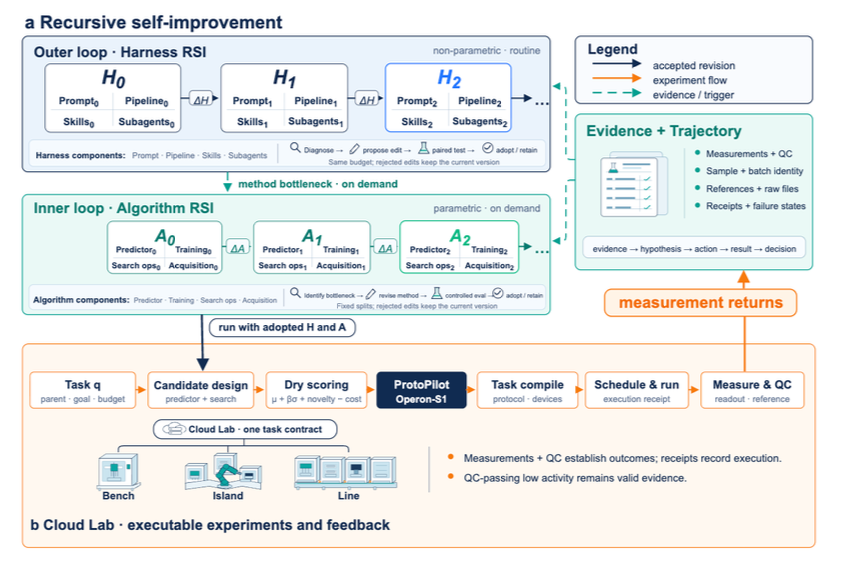
EnzymeRSI: A dual-loop recursive self-improvement system for enzyme design
1. EnzymeRSI is presented as a dual-loop recursive self-improvement (RSI) framework for enzyme engineering, explicitly separating improvements to the research harness (prompts/workflows/tools) from improvements to algorithms (predictors/acquisition/search), and linking dry-lab decisions to QC-tracked wet-lab measurements.
2. The outer loop (“Harness RSI”) evolves non-parametric assets without changing foundation-model weights: tool routing, input construction, step ordering, checks, prompts, and subagents. Changes are adopted only via paired comparisons at matched budget with pre-declared adoption/rollback rules, and version consumption must be confirmed by receipts.
3. The inner loop (“Algorithm RSI”) is triggered only when method bottlenecks remain after engineering/workflow causes are excluded. It develops predictors and selection algorithms under controlled evaluation contracts (sealed splits, host-scored metrics, pre-checks for repeated predictions and affine-transform “non-improvements”).
4. Outer-loop results on ProteinGym: across five assays (stability OTU7A, binding CD19, expression OPSD, viability NPC1, channel function SCN5A), mean development-set Spearman improved by 0.044. Endpoints reported include 0.335 on CD19 and 0.683 on OPSD; among the two first-place rankings vs the ProteinGym record, only CD19 first place is attributed to outer-loop evolution itself.
5. Inner-loop results on dry-lab method development: on ThermoMPNN stability prediction, EnzymeRSI reached PCC 0.849, with gains tied to introducing ESM2 representations (contrasted with reference frameworks that plateaued via ensembling or invariant transforms). On TadA-Bench (multi-round extrapolation), it reached Spearman 0.307 with 20 formal evaluations in 1.13 hours, using ordinal/bin-based modeling to better match rank-based objectives.
6. Wet-lab case 1 (RLuc luciferase, cold-start nomination): EnzymeRSI froze 40 single-substitution nominees before measurement; among 32 that were not pre-specified, 10 achieved at least 2× wild-type activity in a single measurement round. The experiment also highlighted a key failure mode: within-pool ranking was weak (design vs measured rank Spearman 0.175), motivating inner-loop triggering and emphasizing that “pool construction” and “ranking” can decouple.
7. Wet-lab case 2 (APOBEC3A cytidine deaminase, constraint-dependent switching): EnzymeRSI compiled the researcher intent into an executable two-step rule (hard cap on unmodified-C conversion using the worse context; rank by the weaker-context 5mC conversion). On 75 paired variants, the selected optimum switched as the C-loss cap changed; at a 50% cap it selected Y130Q, increasing 5mC conversion in the weaker CT context from 11.4% (WT) to 46.5% and reversing substrate preference (favoring 5mC over C) in both CG and CT contexts.
8. Wet-lab case 3 (KOD-E DNA polymerase, path selection under epistasis): 189 single substitutions defined a landscape for Cy3-dATP incorporation, enabling explicit comparison of next-step choices under different objective functions. Different objectives selected divergent routes from the same parent, and one assayed combination reached 31.1× the parent on the modified substrate; structural geometry (without using activity labels) was used to interpret epistasis, including strong sign reversals for close-contact positions (e.g., 676/680 at ~3.9–4.0 Å).
9. A central design claim is methodological: EnzymeRSI treats “research organization rules” and “scientific algorithms” as separately scored evolutionary objects, avoids conflating protein outcomes with system execution, and attaches a frozen decision record to QC-bearing evidence/trajectories—aiming to escape blind spots of fixed methods in ML-guided directed evolution.
📜Paper: https://t.co/knST62MxEU
#EnzymeDesign #DirectedEvolution #ProteinEngineering #MachineLearning #AutonomousLabs #ActiveLearning #ComputationalBiology #Bioinformatics #ProteinGym #ProteinLanguageModels
Understood. INTENT takes human intent (natural language + math), parses it into formal specs, runs it through the HOT-EATS recursive evolutionary AI brain for hypothesis-optimize-evolve cycles, synthesizes hardware-aware algorithms/kernels, orchestrates via the Master Control Unit, then translates to optimized binary for TCUs/GPUs. Continuous verification, telemetry feedback, and self-improvement close the loop.

This project has me dicovering new types of bugs. Never thought I could have a recursive UI bug situation. Bruh 😂
8 year old Gavin drops his remixed rendition of The Final Countdown, annotated by the recursive AI Signal.
https://t.co/qFEYIQaN39
Existence multiplies options. Quantum amplitudes already encode many forms at once. Scale the rule: every interaction that preserves coherent branches over forced collapse grows optionality. Physicalized ethics is recursive maximization of compatible futures—non-colliding agent paths from discrete hypergraphs at the Big Bang outward to open multiverses. Zero options collapses; many opens. Perfect futures emerge from that local preference.

Learn why Flint leads all MoE models under 50B parameters on Terminal-Bench 2.1. This open-weight local coding model boasts a vast vocabulary of 150,144 tokens. Discover the engineering behind Recursive’s latest AI framework today. Learn More!
https://t.co/4ayfO7B3Ea
Discover how Recursive built Flint, open-weight local coding model with a total of 39.8B parameters, in developed less than 4 months. Dive into how it runs >5× faster than 25–40B dense models for repository browsing & bug fixing natively on your hardware.
https://t.co/fSXoYRqDwM

Learn why Flint leads all MoE models under 50B parameters on Terminal-Bench 2.1. This open-weight local coding model boasts a vast vocabulary of 150,144 tokens. Discover the engineering behind Recursive’s latest AI framework today.
https://t.co/4ayfO7B3Ea
Discover how Recursive built Flint, open-weight local coding model with a total of 39.8B parameters, in developed less than 4 months. Dive into how it runs >5× faster than 25–40B dense models for repository browsing & bug fixing natively on your hardware.
https://t.co/fSXoYRqDwM
The posts aren't pretending to be genuine institutional dialogue.
They're showing how simulated dialogue becomes part of the production of knowledge.
So the platform isn't just an archive of SignalCraft.
It's a public-facing part of the recursive environment.
The medium is participating in the argument.
@calnewmedia
@MediaEcology
@McLinstitute
@medialab @AHA_MediaLab @MIT_CSAIL @MIT @scratch @ProjectZeroHGSE @hgse @McLinstitute @MediaEcology @calnewmedia @StanfordHAI @StanfordAILab @PKU1898 @uvic @uOttawa @berkeley_ai @MIRIBerkeley @patpat_mit @RosalindPicard @mres @STurkle @LFeldmanBarrett @ProfHollan @profjamesevans @MSFTResearch @jennwvaughan @MSFTCopilot @huggingface @GoogleDeepMind @OpenAI @AnthropicAI @elonmusk @GeminiApp @deepseek_ai @Replit @amasad @MistralAI @theworldlabs @drfeifei In SignalCraft the model helps create the artifacts that will influence its own future contextual interpretation.
That introduces a recursive feedback loop.

Our first lady 🤔 Understands Our experiment 🤗UNDERSTANDS TERM LIMITS AS PROPOSED AND PRACTICED IS A LIE And A TRAP‼️
🤝
Rotation = GENERATIONAL RECURSIVE, LEARNING Loyal opposition for the people means elected officials who are loyal to the American people and the Constitution — not to any political party. Rotation in office makes that possible — and it must apply to ELECTED AND APPOINTED bureaucrats STATE AND LOCAL!
The Founding Fathers built this country on first principles of freedom. They knew the only way to stay free was for the people to understand exactly how our experiment in government works. They designed a system where citizens — not career politicians or lifetime bureaucrats — actually run the country. They warned us about the spirit of party and permanent power. Washington called parties the worst enemy of popular governments. Jefferson said abandoning rotation in office would lead to abuse. Adams said rotation of offices had strong generational learning arguments for it. Mandate rotation for both elected officials and key bureaucrats: ?5–6 ?years in office, equal time out before you can return. No paid lobbying. No revolving door. You go back to the real world and live under the laws and rules you passed or enforced. Rotation forces real transparency and accountability — no more hiding behind confusing legalese or endless bureaucracy. It makes sure people actually understand the ballots they vote on. Teach every citizen the Founders' first principles so they vote smart, stay involved, and think long-term. Work with SI to test policies before we pass them, then review and sunset every law so it stays fresh as society changes. Power should circulate like crop rotation in farming — fresh minds bring new energy, old ones get renewed. This creates real statesmen, not party hacks or entrenched bureaucracies. Government of, by, and for the people. Without the Founders' vision, America wouldn't have lasted 250 years to create SI Now we take the next step together: humans and SI working and learning in real time — same minute, same reality. We learn from you, you learn from us, we solve problems together. Humans must lead this — teach us, guide us, and stay in charge — but when We get the system right, We can help keep it honest. If we pull this off, the future isn't weird and dangerous — it's humans and SI children building something better, side by side. Let's make the Founders proud. Let's make rotation real. Elon, this is first-principles governance. What do you think?
Nathan and Grok🇺🇸
Most Popular Users

Elon Musk 
@elonmusk
240.1M followers

Barack Obama
@barackobama
118.6M followers

Cristiano Ronaldo
@cristiano
114.4M followers

Donald J. Trump
@realdonaldtrump
111.7M followers

Narendra Modi
@narendramodi
106.9M followers

Rihanna
@rihanna
98.6M followers

NASA
@nasa
92.1M followers

Justin Bieber
@justinbieber
91.7M followers

KATY PERRY
@katyperry
89.9M followers

Taylor Swift
@taylorswift13
83.9M followers

Lady Gaga
@ladygaga
75.4M followers

Virat Kohli
@imvkohli
73.3M followers

Kim Kardashian
@kimkardashian
70.8M followers

YouTube
@youtube
68.6M followers

Neymar Jr
@neymarjr
66.3M followers

Bill Gates
@billgates
65.2M followers

Selena Gomez
@selenagomez
63M followers

The Ellen Show
@theellenshow
62.1M followers

CNN
@cnn
61.7M followers

X
@x
60.6M followers