

Top Tweets for #waterUse


Zero-water cooling for a data center isn't a future concept.
It's running today.
Tecogen's dual-power chillers reject heat straight to the air instead of a cooling tower. No evaporation, no draw on the local supply through more load on the power plants.
#DataCenters #WaterUse


Feeding 10 billion people by 2050 on a livable planet means balancing food production, and #WaterUse.
Our new report, #NourishandFlourish, shows how smarter agricultural water use can boost yields, jobs, and ecosystems—creating up to 245M jobs: https://t.co/eY9flyCqyL


Do Golf Courses Really Use More Water Than Data Centres?
https://t.co/d0bZMzmAOP
#DataCentres #WaterUse #AIInfrastructure

Hong Kong woman's rented apartment's tap water turns orange-yellow...... LL refuses to resolve #wateruse #buildingmanagement
https://t.co/wbciWvu7Og

#DataCenters #WaterUse #ElectricPowerGeneration
WHO USES MORE WATER THAN DATA CENTERS:
ELECTRIC GENERATORS, HYDRAULIC FRACTURING (FRACKING), GOLF COURSES & LANDSCAPING, INEFFICIENT AGRICULTURE, AND OTHERS
People in Texas are raising data center protests, with recalcitrant landowners, municipal officials, and tort lawyers in the middle.
Gov Abbott and other elected officials are responding asking for impact information. To date the fad of complaining has not spread to our new mega-factories for chips.
We live on a water planet, yet we are running out of water to improve our lives. This is bad utilization of resources, not bad decisions to have data centers.
Allocating available water among the various large industrial users of water—electric generators, frackers, manufacturers—chips, refining, chemical plants, construction materials—data centers, municipal users, agricultural users, and others is a near impossible policy task especially in the face of our spreading desert in the West and Central US.
This is sudden uproar about data centers should not be used to “shake down” the entrepreneurs who own and operate the centers, although we are seeing a good deal of that. This uproar is somewhat like the political and environmental flap we had regarding hydraulic fracturing operations from 2009-2015 that all of a sudden just collapsed.
Lawyers and municipal officials are blatantly shaking down data centers to fund their city wish lists: high property and income taxes for infrastructure, parks, raises. The NYT suggested that data center revenue should be used to balance our budget for entitlements (rather than cleaning up the fraud in entitlements).
Governor Abbot has demanded a report regarding data centers and their impacts.
This instant set of brief comments is just opening remarks about water, which may be the most difficult issue since there is only so much usable water if he requests formal comments from interested parties. “Data centers must operate in ways that reduce costs for residential electricity customers, do not drain water needed for our communities, and take into consideration the needs of our neighborhoods,” said Governor Abbott. (This is very odd, and I decline to address this now.)
(Or in the case of data centers, you do not have to be part of the utility;) Abbott continues "you can form your own isolated or “inside the fence” self sustaining operation not tied to the power grid. This is fine for the electric use, but it does not solve the water issue at all.
A utility is a communitized business operation. Central principles are that rates must be just and reasonable and must not shift costs unduly among customer classes. To achieve this the PUC must require data centers to fully fund the costs of electric infrastructure needed to serve their operations, preventing those costs from being passed on to residential ratepayers.)
Gov Abbott’s directive continues: “The PUCT and ERCOT must identify additional actions under their authority to safeguard residential and small business ratepayers and submit a joint memorandum to the Office of the Governor by July 17, 2026.
The PUC shall initiate action to reduce residential ratepayers’ transmission costs by July 31, 2026.” (This only applies if the data center chooses to interconnect to the grid rather than operate behind the fence.)
Governor Abbott also pledged to work with the Legislature next session to codify these protections and ensure data centers add to Texas’ electric capacity rather than merely increasing demand.
https://t.co/29ZvLsegms
We live on a water planet. There should be a lot of available water and AI itself should help with the technology for improving water use. Our government and entrepreneurs have refused to look at this issue on the scale necessary to attack our spreading desert in the western and central North America and Africa and Asia.
Commenters should look at other water users, electric generators being the largest. Responders note that some of these are spread across geographic areas such as golf courses, but several are as localized as data centers.
Science Direct notes that: Cooling water is used by many industrial facilities. By far, the largest user of cooling water is the electric power industry. Chip manufacturing uses a massive amount of water. A single modern fabrication plant ("fab") can use anywhere from 2 million to 10 million gallons of water every single day. This water is vital for rinsing, cleaning, and polishing silicon wafers between microscopic manufacturing steps.
Other significant users include the pulp and paper, chemical, iron and steel, aluminum, and petroleum refining industries.
Power plants: their cooling power plants is a larger water use than the data center’s direct cooling in many cases. Compared to other plants, nuclear plants are less efficient than gas, especially CCGT, so they consume more water when you just look at the plant. A Natural gas plant can operate at 50% efficiency to 66% efficiency, with a significant chunk of air cooling. They require less heat rejection to water overall, minimizing water use compared to nuclear. But the fuel, i.e., the natural gas itself, through hydraulic fracturing methods, below, is very water-intensive.
Fracking: while a single fracking well uses more concentrated water upfront, data centers consume vastly more water over time due to continuous operations and indirect electricity generation footprints.
Permian Basin totals roughly 70 to 80 billion gallons/yr, while the Marcellus Shale region consumes an estimated 15 to 25 billion gallons per year, though precise annual totals fluctuate based on active rig counts and completion efficiencies.
Per Well Average: Individual horizontal wells consume about 10 million to 16 million gallons of fluid. Recycling Rate: Roughly 50% to 70% of the water utilized in the Permian comes from recycled, highly salty "produced water" brought up from previous drilling instead of fresh groundwater. Marcellus Shale Water Use: Total Volume: Operators consume approximately 15 billion to 25 billion gallons annually across Pennsylvania, West Virginia, and neighboring states, driven by lower overall active well completions compared to the Permian. Marcellus Per Well Average: Individual horizontal gas wells in the Marcellus average 4 million to 5 million gallons of water.
Re Marcellus energy vs fracking water use, electric generation uses nearly 150 million gallons a day in the Susquehanna River Basin, while the projected total demand for peak Marcellus Shale activity in the same area is 8.4 million gallons per day.
EPA COOLING WATER INTAKE REGULATIONS. The US Environmental Protection Agency (EPA) is currently developing regulations to implement section 316(b) of the Clean Water Act, which deals with cooling water intake structures.
So Governor Abbott’s request for data and research should probably include this information as well as EIA and NERC data.
We need to focus on water consumption vs. water withdrawal
Data centers use water to keep servers cool.
What methods are used. Methods are evolving that are more efficient and use less water. The Centers need to explain how data center usage compares to cooling for the power plants, all the way back to production of the natural gas.
Methods:
Air cooling uses no water but requires compression, i.e. more electricity
Evaporative cooling (open-loop): A majority of large, modern data centers use water-based cooling for better energy efficiency. This often involves cooling towers or evaporative chillers.
Closed-loop water cooling: In closed-loop systems, water circulates in sealed pipes or coils that cool the servers without directly exposing water to air. Because the water isn’t evaporated to the environment, losses are minimal – it’s mostly the same water recirculating (with some makeup water added occasionally).
These systems can include water-cooled heat exchangers or liquid-to-liquid cooling loops.
Direct liquid cooling & immersion: An emerging category is liquid cooling at the server or chip level. Direct-to-chip cooling uses cold liquid (water or special coolant) piped directly to server CPUs/GPUs, and immersion cooling submerges whole servers in a bath of non-conductive fluid. These methods transfer heat very efficiently and can significantly reduce water usage. Typically, they still need a heat exchange system to reject heat (often a dry cooler or a closed-loop water circuit), but because they target heat more directly, they require less bulk air conditioning. Immersion and direct liquid cooling are gaining traction for high-density AI and HPC (high-performance computing) data centers, especially in water-limited areas. In areas with scarce water, liquid cooling is ideal as it uses minimal water, whereas in areas with strained power grids, evaporative cooling is favored for using less electricity.
=============================
SOURCES:
Florida Water & Pollution Control Operators Association https://t.co/lBRpkrGfEE
Cooling water use patterns at US nonutility electric generating facilities
https://t.co/btpCDQxePG
Repeated {WSD} pipe leaks in Tuen Mun not ideal .......
#wateruse
'not ideal' is the same term FSD used at the Tai Po fire inquiry #firesafety
https://t.co/GWR7cAX7NO
Feeding 10 billion people by 2050 on a livable planet means balancing food production, and #WaterUse.
Our new report, #NourishandFlourish, shows how smarter agricultural water use can boost yields, jobs, and ecosystems—creating up to 245M jobs: https://t.co/eY9flyCqyL

WSD rules: residential buildings shall have water storage for 24 hours.
wondering were the buildings in Shau Kei Wan somehow exempt? #wateruse

The loss of water in Shau Kei Wan was due to an ageing water main pipe, said Water Supplies Department head Roger Wong, who still has a job after the whole bitumen fiasco last June
https://t.co/KtnmpFcwZ1
@Tweeteringonthe even with full reservoirs HK still has to pay for fresh water from the mainland, even if its not used ;) #wateruse
coastal cities should be using seawater for toilet/urinal flushing, better than flushing drinking water down the pan #wateruse

"On ne va pas irriguer les champs avec de l'eau dessalée acheminée par des milliers de km de canalisations" c'est vrai et personne ne propose ça. Homme de paille.
La vraie logique c'est une cascade. L'eau dessalée alimente les villes côtières, ça libère l'eau de rivière et l'eau recyclée qui les alimentaient jusque-là, et c'est cette eau-là qui part vers l'agriculture intérieure. On ne déplace pas l'eau de mer vers les terres, on ne fait que redistribuer l'eau déjà en circulation grâce à ce qu'elle remplace sur la côte. Pas un km de tuyau neuf nécessaire !
Le calcul est frappant aux USA, remplacer la seule consommation côtière californienne du Colorado par du dessalement ne demande que ~16 TWh/an (l'équivalent de 2 réacteurs nucléaires) et libère d'autant l'eau du fleuve pour l'Arizona, le Nevada, l'agriculture de l'intérieur. On ne construit aucun aqueduc nouveau, on ne fait que soulager celui qui existe déjà.
Et quand l'irrigation directe au dessalement existe (Espagne, Israël), c'est sur la frange littorale : maraîchage et arbo à côté de la mer, jamais à des milliers de km dans les terres. Le pack d'eau minérale dans le champ c'est un délire hors-sol.


Chat gpt பயன்படுத்துறீங்களா?.. இதை தெரிஞ்சுக்கோங்க...!
#ChatGpt #DataCenter #PureWater #Evaporation #WaterUse #Cooling #System #Shorts #ZeeTamilNews

Arizona is a leader in #WaterConservation, cutting household #water use as its population grows. Now, @asuengineering researchers are helping #industries rethink their #WaterUse. https://t.co/o7PvMk7ZhM 💧#ASUEngineering #ResearchMatters #AZWaterInnovationInitiative

@HistorianZhang yes but, many billions of litres, are flushed down the toilet, when seawater could be used, saving drinking water, without any fancy tech #wateruse

Amazon’s data centers used 2.5 billion gallons of water in 2025. Water usage fell 2% from 2024 to 0.12 litres per kilowatt-hour, while Amazon said it uses air cooling about 90% of the time.
#Amazon #Amazons #Water #DataCenters #WaterUse


Water use prompts congressional calls for data center scrutiny
#datacenters #energy #wateruse
https://t.co/MqoHmfLGMn
Feeding 10 billion people by 2050 on a livable planet means balancing food production, and #WaterUse.
Our new report, #NourishandFlourish, shows how smarter agricultural water use can boost yields, jobs, and ecosystems—creating up to 245M jobs: https://t.co/PlxII473sQ


⛰️💧 Spatiotemporal Variation in Carbon and #WaterUse #Efficiency and Their Influencing Variables Based on Remote Sensing #Data in the Nanling #Mountains Region
✍️ Sha Lei et al.
🔗 https://t.co/JamZzyTDNZ


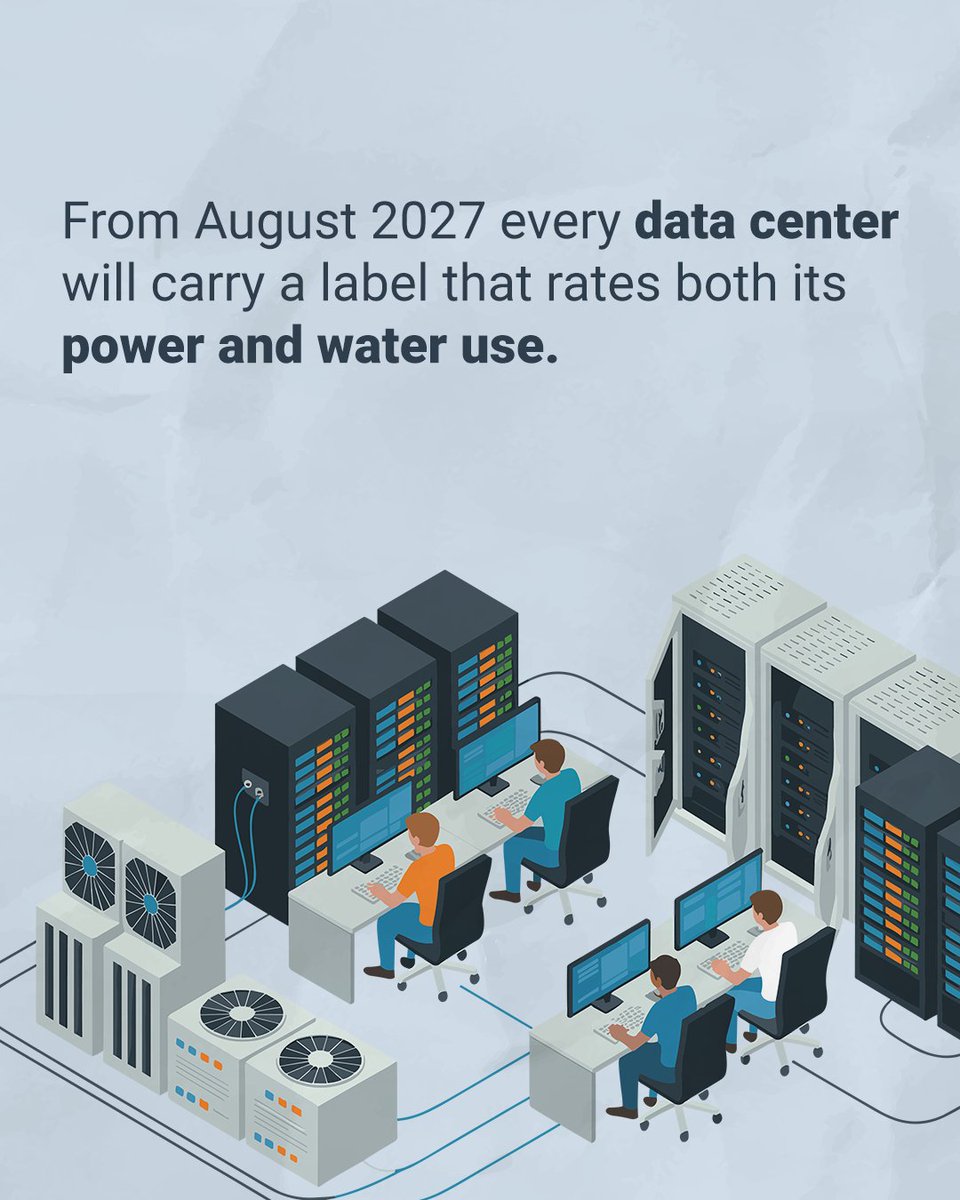
⚡ The European Commission proposes a new rating scheme for data centres. From Aug 2027, facilities will be labelled A–G based on energy & water efficiency. 💬 Have your say by 23 April: https://t.co/a4MX8YULNa
#EnergyEfficiency #WaterUse #Digitalisation #Sustainability

Feeding 10 billion people by 2050 on a livable planet means balancing food production, and #WaterUse.
New @WorldBankWater report, #NourishandFlourish, shows how smarter agricultural water use can boost yields, jobs, and ecosystems—creating up to 245M jobs: https://t.co/PlxII473sQ

Last Seen Hashtags on Sotwe
فان_سبايسي
Seen from France
omegle #flash
Seen from Turkey
momsonn(*)*******
Seen from France
ometv #pytt
Qustodio
Seen from Turkey
รับงานพัทยา
Seen from Thailand
momson() nolimit()* filter:native_video
Seen from Chile
เรื่องเสียวๆ
Seen from Thailand
k9slut() +filter:native_video
Seen from United Kingdom
tlhspoilers
Seen from United States
Most Popular Users

Elon Musk 
@elonmusk
241.6M followers

Barack Obama
@barackobama
119M followers

Cristiano Ronaldo
@cristiano
114.1M followers

Donald J. Trump
@realdonaldtrump
111.8M followers

Narendra Modi
@narendramodi
107.2M followers

Rihanna
@rihanna
98.7M followers

NASA
@nasa
92.4M followers

Justin Bieber
@justinbieber
91.8M followers

KATY PERRY
@katyperry
89.8M followers

Taylor Swift
@taylorswift13
83.8M followers

Lady Gaga
@ladygaga
75.3M followers

Virat Kohli
@imvkohli
73.1M followers

Kim Kardashian
@kimkardashian
70.8M followers

YouTube
@youtube
68.8M followers

Neymar Jr
@neymarjr
66.1M followers

Bill Gates
@billgates
65M followers

Selena Gomez
@selenagomez
62.9M followers

The Ellen Show
@theellenshow
62.3M followers

CNN
@cnn
61.8M followers

X
@x
60.7M followers