I've been talking to a bunch of PhD students and researchers recently, and I've qualitatively noticed two growing (but concerning) trends with AI:
1. Researchers seem to be reading less. Some even reported that they read <10 papers a year now with AI because they can simply either 1) retrieve or 2) summarize papers. BUT deep reading is how we engage with underlying intellectual arguments, develop research taste, spot methodological flaws, and form original ideas. It's arguably the most fun part of a PhD imo
2. Researchers seem to be vibe-coding and paper-maxxing. AI dramatically cheapens execution, such as implementing experiments, running analyses, and producing manuscripts. Some even "let [Claude Code] rip" without checking the code or validating the results somehow. BUT it also incentivizes quantity over depth, rigor, and meaningful contributions.
Overall, the cost of producing research is falling much faster than the cost of developing genuine intellectual understanding. Rather than simply producing more papers, I think we should engage deeply with the literature, ask questions that truly matter, and produce work that meaningfully advances our collective understanding.
كل مدربين ألمانيا اخر 10 سنوات (بإستثناء فليك) وظيفتهم الوحيدة هي الترقيع ومراضاة اللاعبين الأساسيين شلون ما جان
كلوب الوحيد الي تجرأ وطرد البقرات المقدسة من التشكيلة الأساسية والإحتياط بعد
كلوب الوحيد الي انطى فرص حقيقية للاعبين مبدعين ومواهب شابة موهوبة نفس غرودا، ترو، شيرنات وغيرهم
كلوب الوحيد الي بنى مشروع منتخب حقيقي يقدر ينافس على الألقاب بالمستقبل القريب، عكس المدربين السابقين الي وظيفتهم هي الترقيع لا أكثر
كلوب لعب نص البطولة بالإحتياط رغم هذا حسم التأهل بخماسية نظيفة (حتى الأن) ضد هولندا ودعس وسكت كل المشككين
In Klopp we trust 💛❤️🖤
I started my PhD around the same time as Emmy (2021), and very much agree with Emmy's take here.
I told myself at the time when I started my PhD that I'd write something akin to "The PhD Grind"––a book I was really inspired by––but as I was trying to pen down my thoughts/advice for incoming PhD students last month, I felt that I really don't know what to say.
One thing imo you should take away here is that: you should downweight the advice from whoever tells you *confidently* you should or should not do PhD based on their experiences––without expressing any thoughtful musing about what it means to be a researcher in academia in both next year and 5 years ahead.
I remember around late 2023 (right before I started my first AI safety paper), I had a discussion with my PhD roommates that I'm afraid AI is going to eat researcher jobs like mine.
I would like to believe that I have been doing good research, but man at that time, I already found a lot of my own experimental workflows are mid-to-low-intellectual tasks (the "mechanics" Emmy talked about).
Most of my value was on deciding what ideas and directions to best spend my limited time/energy/compute on, and continuously verifying that my findings and conclusions are indeed robust and can hopefully stand the test of time.
In a future world of expanding compute and where LLM can "jump" because of interconnected knowledge, researchers would really have to think twice about our own roles.
Most people will never spend 2 hours learning how AI actually works.
But Andrej Karpathy just made those 2 hours worth your time.
After years of building AI at OpenAI and Tesla, he packed his practical knowledge into a free lecture on how modern AI systems are built.
No $15K bootcamp.
No complicated curriculum.
Just 2 hours of concentrated knowledge from someone who has been deep in the field.
You might not have 2 hours today.
That’s fine.
Save this post now.
Come back when you have the time, watch the lecture, and start building your first AI loop.
Patrick is the best! Such a delight to walk through the full stack of AI infra, and how we need to reinvent it for abundant intelligence. much to build @sailresearchco, join us!
INSTEAD OF WATCHING NETFLIX TONIGHT.
Spend 1 hour with this.
Claude AI FULL COURSE that teaches you how to BUILD and AUTOMATE anything.
The people who watch this tonight will wake up tomorrow with a new skill.
Watch it and Bookmark it now.
The man who BUILT Claude Code just sat down and showed how he actually uses it.
Not a tutorial creator.
Not a vibe coder with 3 months of experience.
The CREATOR.
30 minutes of watching him work will restructure how your brain thinks about building with AI.
Most people are using Claude Code like a smarter autocomplete.
He uses it like a second engineering team.
The gap between those two mental models is the gap between shipping toys and shipping products people pay for.
Bookmark this.
Watch it twice.
The second watch hits different once you understand what he is actually doing.
Follow @cyrilXBT for more Claude Code breakdowns the moment they drop.
Some dumb researchers still read papers one by one.
Stanford PhD students just use Claude.
Here are 9 prompts that turn 40+ papers into structured literature reviews, knowledge maps, and research gaps in minutes:
I accidentally discovered how to compress a semester of learning into 48 hours.
A grad student at MIT showed me his NotebookLM setup. I thought he was just organized. Then I watched him pass a qualifying exam on a subject he'd never studied before.
Here's exactly what he did:
First: he didn't upload a textbook.
He uploaded 6 textbooks, 15 research papers, and every lecture transcript he could find on the subject.
Then he asked NotebookLM one question:
"What are the 5 core mental models that every expert in this field shares?"
Not "summarize this." Not "explain this topic."
Mental models. The stuff that takes professors years to develop.
But the next part is what broke my brain.
He followed up with:
"Now show me the 3 places where experts in this field fundamentally disagree, and what each side's strongest argument is."
In 20 minutes he had a map of the entire intellectual landscape of the field:
the debates, the consensus, the open questions.
Most students spend a full semester just figuring out what those debates even are.
Then he did something I've never seen before.
He asked:
"Generate 10 questions that would expose whether someone deeply understands this subject versus someone who just memorized facts."
He spent the next 6 hours answering those questions using the source material. Every wrong answer triggered a follow-up:
"Explain why this is wrong and what I'm missing."
By hour 48, he could hold a conversation with his thesis advisor without getting destroyed.
The tool didn't change. The questions did.
Most people treat NotebookLM like a fancy highlighter.
These students are using it like a private tutor who has read everything ever written on the subject.
The difference between a semester and 48 hours isn't the amount of content.
It's knowing which questions to ask.
AI / ML Engineer in 2026, please learn:
One ML stack deeply:- PyTorch or JAX, not just .fit(), but GPU memory, kernels, mixed precision, profiling, and why your model OOMs at 3am.
Data:- Where it comes from, how it lies, how it drifts, how labels break, how leakage sneaks in, and why 80% of model failures are upstream.
Statistics:- Bias vs variance, confidence intervals, calibration, distribution shift, and why “95% accuracy” is often meaningless.
Loss functions:- What you are actually optimizing, how it shapes behavior, and how bad losses silently create bad products.
Evaluation:- Real-world metrics, not Kaggle ones. Offline vs online. Regression tests for models. When numbers lie.
Training:- Distributed GPUs, gradient accumulation, checkpointing, reproducibility, and how to not lose a 3-day run to one crash.
LLMs: Tokenization, attention, context limits, KV cache, LoRA vs fine-tuning vs RAG, and where hallucinations are born.
Inference:- Batching, quantization, vLLM, streaming, cold starts, GPU vs. CPU, and why serving is harder than training.
Retrieval:- Embeddings, chunking, hybrid search, reranking, grounding, and why most RAG systems fail quietly.
Pipelines:- Feature stores, offline vs. online data, backfills, late events, schema evolution, and broken joins.
Monitoring:- Drift, outliers, token spend, latency, hallucination rate, and silent quality decay.
Optimization:- Distillation, pruning, caching, prompt compression, and how to make models affordable.
Agents:- Tool calling, memory, retries, failure modes, and why autonomous systems are chaos engines.
Security:- Prompt injection, data exfiltration, training data leaks, and tool misuse.
Deployment:- Model versioning, shadow runs, canaries, rollbacks, and killing bad models fast.
Distributed systems:- Queues, retries, idempotency, backpressure, and partial failures. ML is just distributed systems with gradients.
Documentation:- Model cards, data contracts, eval reports, and written tradeoffs.
Pick one stack. Build real systems. Break them. Fix them.
If I missed something, Add in the comment section.
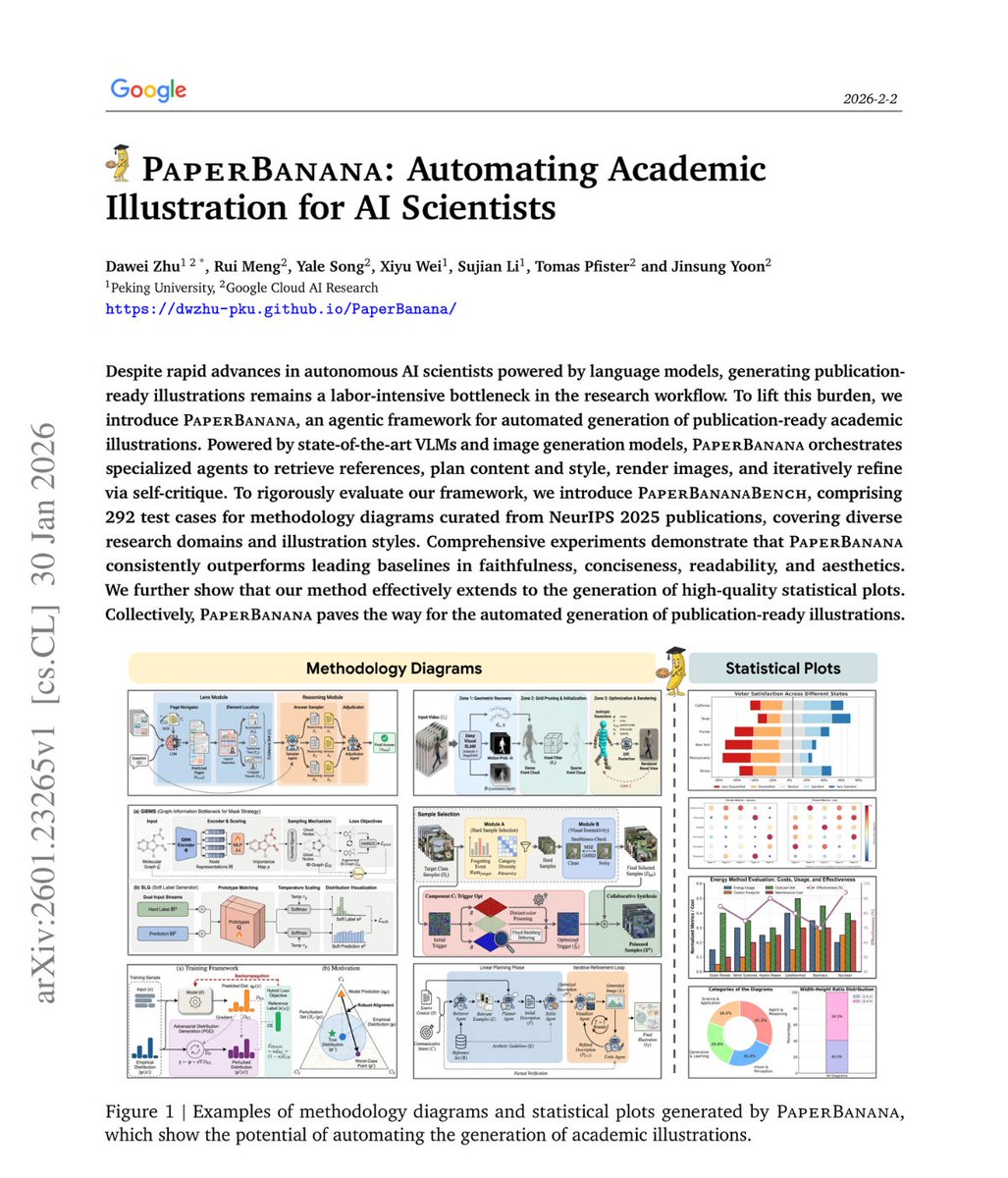
🚨BREAKING: Google just dropped another hit!
It's called PaperBanana and it generates publication-ready academic illustrations from just your methodology text.
No Figma. No manual design. No illustration skills needed.
Here's how it works:
A team of AI agents runs behind the scenes
→ One finds good diagram examples
→ One plans the structure
→ One styles the layout
→ One generates the image
→ One critiques and improves it
Here's the wildest part:
Random reference examples work nearly as well as perfectly matched ones. What matters is showing the model what good diagrams look like, not finding the topically perfect reference.
In blind evaluations, humans preferred PaperBanana outputs 75% of the time.
This is the recursion we've been waiting for AI systems that can fully document themselves visually.
Waitlist’s open, Link in the first comment.